Wenn Sie in einer React-Anwendung mit Datumsangaben arbeiten, ist date-fns eine leistungsstarke und leichte moderne JavaScript-Datum-Utility-Bibliothek, die das Manipulieren von JavaScript-Daten mühelos macht. date-fns verwendet bestehende native Datumsdatentypen und erweitert nicht die Kernobjekte der Sicherheit halber, was bedeutet, dass es vermeiden wird, diese eingebauten Datumsdatentypen zu modifizieren oder Funktionalitäten hinzuzufügen, was zu potenziellen Fehlern oder Konflikten führen würde. In diesem Artikel werden wir erkunden, wie man date-fns in Ihr React-Projekt integriert und einige praktische Beispiele bereitstellt.
Warum date-fns?
date-fns bietet mehrere Vorteile:
- Modular: Sie können nur die Funktionen importieren, die Sie benötigen, wodurch die Paketgröße reduziert wird.
- Unveränderlich: Es basiert auf reinen Funktionen, sodass diese Funktionen die ursprünglichen Datumsobjekte nicht verändern.
- Umfassend: Bietet eine breite Palette an Funktionen zur Datumsbearbeitung und -formatierung.
- Internationalisierung: Unterstützt mehrere Gebietsschemata.
Einstieg
Installieren Sie zuerst das date-fns npm-Paket über npm:
npm install date-fns
# or
yarn add date-fns
npm install date-fns
# or
yarn add date-fns
SHELL
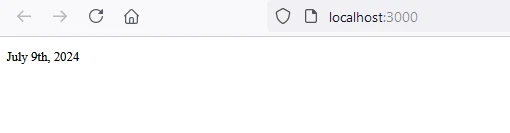
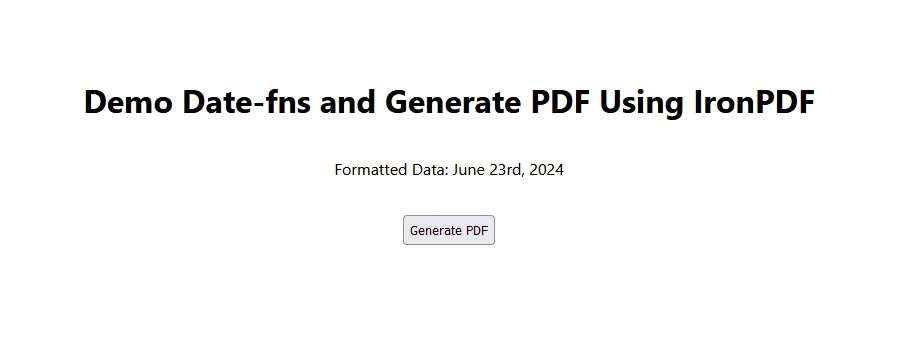
Eine der häufigsten Aufgaben ist das Formatieren von Daten mit date-fns. Lassen Sie uns eine einfache Komponente erstellen, die das aktuelle Datum in Ihrer Zeitzone in einem leserlichen Format anzeigt.
import React from 'react';
import { format } from 'date-fns';

// A functional component to format the current date using date-fns
const FormattedDate = () => {
  const currentDate = new Date(); // Get current date
  const formattedDate = format(currentDate, 'MMMM do, yyyy'); // Format date as "Month day, year"
  return <p>{formattedDate}</p>; // Render formatted date in a paragraph
};

export default FormattedDate;
import React from 'react';
import { format } from 'date-fns';

// A functional component to format the current date using date-fns
const FormattedDate = () => {
  const currentDate = new Date(); // Get current date
  const formattedDate = format(currentDate, 'MMMM do, yyyy'); // Format date as "Month day, year"
  return <p>{formattedDate}</p>; // Render formatted date in a paragraph
};

export default FormattedDate;
JavaScript
Ausgabe
Parsing von Daten
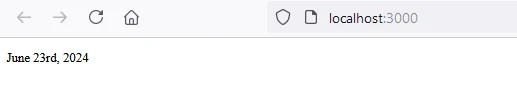
Sie können auch Daten aus Zeichenfolgen analysieren. Hier ist ein Beispiel für das Parsen einer Datumszeichenfolge und deren Anzeige in einem anderen Format:
import React from 'react';
import { parse, format } from 'date-fns';

// A functional component to parse and format a date string
const ParsedDate = () => {
  const dateString = '2024-06-23'; // Define a date string
  const parsedDate = parse(dateString, 'yyyy-MM-dd', new Date()); // Parse date string into a JavaScript Date object
  const formattedDate = format(parsedDate, 'MMMM do, yyyy'); // Format parsed date
  return <p>{formattedDate}</p>; // Render formatted date
};

export default ParsedDate;
import React from 'react';
import { parse, format } from 'date-fns';

// A functional component to parse and format a date string
const ParsedDate = () => {
  const dateString = '2024-06-23'; // Define a date string
  const parsedDate = parse(dateString, 'yyyy-MM-dd', new Date()); // Parse date string into a JavaScript Date object
  const formattedDate = format(parsedDate, 'MMMM do, yyyy'); // Format parsed date
  return <p>{formattedDate}</p>; // Render formatted date
};

export default ParsedDate;
JavaScript
Ausgabe
Hinzufügen und Subtrahieren von Daten
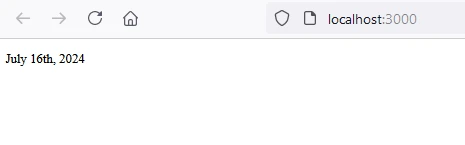
date-fns macht es einfach, Zeit zu Daten hinzuzufügen oder abzuziehen. Hier ist ein Beispiel, wie man dem aktuellen Datum 7 Tage hinzufügt:
import React from 'react';
import { addDays, format } from 'date-fns';

// A functional component to add days to the current date and format it
const AddDaysExample = () => {
  const currentDate = new Date(); // Current date
  const futureDate = addDays(currentDate, 7); // Add 7 days to the current date
  const formattedDate = format(futureDate, 'MMMM do, yyyy'); // Format the new date
  return <p>{formattedDate}</p>; // Render formatted date
};

export default AddDaysExample;
import React from 'react';
import { addDays, format } from 'date-fns';

// A functional component to add days to the current date and format it
const AddDaysExample = () => {
  const currentDate = new Date(); // Current date
  const futureDate = addDays(currentDate, 7); // Add 7 days to the current date
  const formattedDate = format(futureDate, 'MMMM do, yyyy'); // Format the new date
  return <p>{formattedDate}</p>; // Render formatted date
};

export default AddDaysExample;
JavaScript
Ausgabe
Internationalisierung
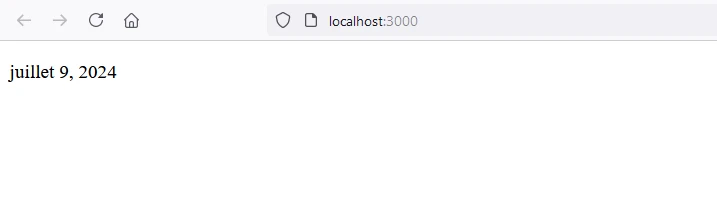
date-fns unterstützt mehrere Gebiete. Um eine bestimmte Sprache zu verwenden, müssen Sie sie importieren und der Formatierungsfunktion übergeben:
import React from 'react';
import { format } from 'date-fns';
import { fr } from 'date-fns/locale';

// A functional component to format the current date using a specific locale
const FrenchDate = () => {
  const currentDate = new Date(); // Current date
  const formattedDate = format(currentDate, 'MMMM do, yyyy', { locale: fr }); // Format date in French locale
  return <p>{formattedDate}</p>; // Render formatted date
};

export default FrenchDate;
import React from 'react';
import { format } from 'date-fns';
import { fr } from 'date-fns/locale';

// A functional component to format the current date using a specific locale
const FrenchDate = () => {
  const currentDate = new Date(); // Current date
  const formattedDate = format(currentDate, 'MMMM do, yyyy', { locale: fr }); // Format date in French locale
  return <p>{formattedDate}</p>; // Render formatted date
};

export default FrenchDate;
JavaScript
Ausgabe
Einführung in IronPDF
IronPDF for Node.js ist eine leistungsstarke Node.js PDF-Bibliothek, die es Entwicklern ermöglicht, PDFs in ihren Node.js-Projekten zu erstellen und zu bearbeiten. Egal, ob Sie PDFs aus HTML erstellen, vorhandene PDFs manipulieren oder Webseiten ins PDF-Format konvertieren müssen, IronPDF hat alles abgedeckt.
Hauptmerkmale
HTML-zu-PDF-Konvertierung
Konvertieren Sie HTML-Inhalte mühelos in PDF-Dokumente. Dieses Feature ist besonders nützlich zur Erzeugung dynamischer PDFs aus Webinhalten.
URL zu PDF-Konvertierung
Erzeugen Sie PDFs direkt von URLs, sodass Sie die Inhalte von Webseiten erfassen und als PDF-Dateien programmatisch speichern können.
PDF-Manipulation
Verschmelzen, teilen und manipulieren Sie vorhandene PDF-Dokumente mit Leichtigkeit. IronPDF bietet Funktionen wie das Anhängen von Seiten, das Splitten von Dokumenten und mehr.
PDF-Sicherheit
Sichern Sie Ihre PDF-Dokumente, indem Sie sie mit Passwörtern verschlüsseln oder digitale Signaturen anwenden. IronPDF bietet Optionen zum Schutz Ihrer sensiblen Dokumente vor unberechtigtem Zugriff.
Hohe Ausgabequalität
Erzeugen Sie hochwertige PDF-Dokumente mit präziser Wiedergabe von Text, Bildern und Formatierungen. IronPDF stellt sicher, dass Ihre generierten PDFs die Originalinhalte getreu wiedergeben.
IronPDF ist kompatibel mit verschiedenen Plattformen, darunter Windows, Linux und macOS, was es für eine breite Palette von Entwicklungsumgebungen geeignet macht.
Einfache Integration
Integrieren Sie IronPDF mühelos in Ihre Node.js-Anwendungen mithilfe seines npm-Pakets. Die API ist gut dokumentiert, was es einfach macht, PDF-Erzeugungsfunktionen in Ihre Projekte einzubauen.
Installation
Um das IronPDF-NPM-Paket zu installieren, verwenden Sie den folgenden Befehl:
yarn add @ironsoftware/ironpdf @ironsoftware/ironpdf-engine-windows-x64
yarn add @ironsoftware/ironpdf @ironsoftware/ironpdf-engine-windows-x64
SHELL
PDF-Dokument mit IronPDF erstellen und date-fns verwenden
Abhängigkeiten installieren: Erstellen Sie zunächst ein neues Next.js-Projekt (falls noch nicht geschehen) mit folgendem Befehl: Siehe hier
npx create-next-app@latest date-pdf --use-npm --example "https://github.com/vercel/next-learn/tree/main/basics/learn-starter"
npx create-next-app@latest date-pdf --use-npm --example "https://github.com/vercel/next-learn/tree/main/basics/learn-starter"
SHELL
Navigieren Sie als Nächstes in Ihr Projektverzeichnis:
Installieren Sie die erforderlichen Pakete:
yarn add @ironsoftware/ironpdf @ironsoftware/ironpdf-engine-windows-x64
yarn add date-fns
yarn add @ironsoftware/ironpdf @ironsoftware/ironpdf-engine-windows-x64
yarn add date-fns
SHELL
Erstellen eines PDFs
Lassen Sie uns nun ein einfaches Beispiel zur Generierung eines PDFs mit IronPDF erstellen. Fügen Sie in Ihre Next.js-Komponente (z.B. pages/index.tsx) den folgenden Code ein:
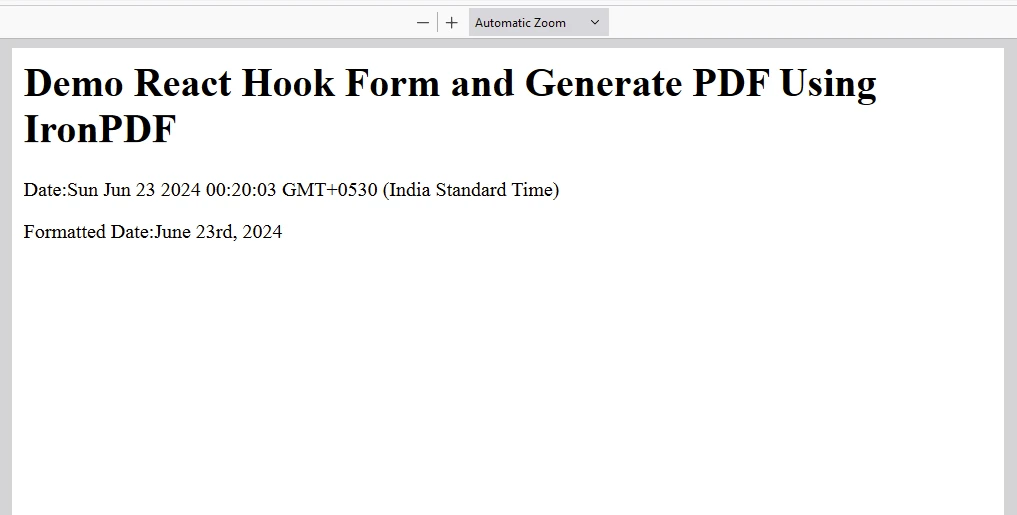
PDF-Generierungs-API: Der erste Schritt besteht darin, eine Backend-API zur Generierung des PDF-Dokuments zu erstellen. Da IronPDF nur serverseitig läuft, müssen wir eine API erstellen, die aufgerufen wird, wenn ein Benutzer ein PDF generieren möchte. Erstellen Sie eine Datei im Pfad pages/api/pdf.js und fügen Sie den untenstehenden Inhalt hinzu.
Ein Lizenzschlüssel ist für IronPDF erforderlich, den Sie auf der Lizenzseite erhalten können und im untenstehenden Codeplatzieren.
// pages/api/pdf.js
import { IronPdfGlobalConfig, PdfDocument } from "@ironsoftware/ironpdf";
import { format } from 'date-fns';

// Apply your IronPDF license key
IronPdfGlobalConfig.getConfig().licenseKey = "Your license key";

export default async function handler(req, res) {
  try {
    const currentDate = new Date(); // Get the current date
    const formattedDate = format(currentDate, 'MMMM do, yyyy'); // Format the date
    let content = "<h1>Demo React Hook Form and Generate PDF Using IronPDF</h1>";
    content += "<p>Date:" + currentDate + "</p>";
    content += "<p>Formatted Date:" + formattedDate + "</p>";
    const pdf = await PdfDocument.fromHtml(content); // Generate PDF from HTML content
    const data = await pdf.saveAsBuffer(); // Save as buffer
    console.error("data PDF:", data); // Log the PDF data
    res.setHeader("Content-Type", "application/pdf"); // Set response headers
    res.setHeader(
      "Content-Disposition",
      "attachment; filename=awesomeIron.pdf",
    );
    res.send(data); // Send PDF data as response
  } catch (error) {
    console.error("Error generating PDF:", error); // Log errors
    res.status(500).end(); // End response on error
  }
}
// pages/api/pdf.js
import { IronPdfGlobalConfig, PdfDocument } from "@ironsoftware/ironpdf";
import { format } from 'date-fns';

// Apply your IronPDF license key
IronPdfGlobalConfig.getConfig().licenseKey = "Your license key";

export default async function handler(req, res) {
  try {
    const currentDate = new Date(); // Get the current date
    const formattedDate = format(currentDate, 'MMMM do, yyyy'); // Format the date
    let content = "<h1>Demo React Hook Form and Generate PDF Using IronPDF</h1>";
    content += "<p>Date:" + currentDate + "</p>";
    content += "<p>Formatted Date:" + formattedDate + "</p>";
    const pdf = await PdfDocument.fromHtml(content); // Generate PDF from HTML content
    const data = await pdf.saveAsBuffer(); // Save as buffer
    console.error("data PDF:", data); // Log the PDF data
    res.setHeader("Content-Type", "application/pdf"); // Set response headers
    res.setHeader(
      "Content-Disposition",
      "attachment; filename=awesomeIron.pdf",
    );
    res.send(data); // Send PDF data as response
  } catch (error) {
    console.error("Error generating PDF:", error); // Log errors
    res.status(500).end(); // End response on error
  }
}
JavaScript
Modifizieren Sie nun index.js und fügen Sie den folgenden Code hinzu:
import Head from "next/head";
import styles from "../styles/Home.module.css";
import React, { useState, useEffect } from "react";
import { format } from 'date-fns';

// React component for the home page
export default function Home() {
  const [text, setText] = useState("");

  useEffect(() => {
    const currentDate = new Date(); // Get a new date instance
    const formattedDate = format(currentDate, 'MMMM do, yyyy'); // Format the date
    setText(formattedDate); // Set formatted date to state
  }, []);

  const generatePdf = async () => {
    try {
      const response = await fetch("/api/pdf-datefns?f=" + text); // Fetch the PDF from API
      const blob = await response.blob(); // Convert to blob
      const url = window.URL.createObjectURL(new Blob([blob])); // Create URL for download
      const link = document.createElement("a");
      link.href = url;
      link.setAttribute("download", "awesomeIron.pdf"); // Set download attribute
      document.body.appendChild(link);
      link.click(); // Simulate click to download
      link.parentNode.removeChild(link);
    } catch (error) {
      console.error("Error generating PDF:", error); // Log errors
    }
  };

  return (
    <div className={styles.container}>
      <Head>
        <title>Generate PDF Using IronPDF</title>
        <link rel="icon" href="/favicon.ico" />
      </Head>
      <main>
        <h1>Demo Date-fns and Generate PDF Using IronPDF</h1>
        <p>
          Formatted Data: {text}
        </p>
        <button style={{margin: 20, padding: 5}} onClick={generatePdf}>
          Generate PDF
        </button>
      </main>
      <style jsx>{`
        main {
          padding: 5rem 0;
          flex: 1;
          display: flex;
          flex-direction: column;
          justify-content: center;
          align-items: center;
        }
        footer {
          width: 100%;
          height: 100px;
          border-top: 1px solid #eaeaea;
          display: flex;
          justify-content: center;
          align-items: center;
        }
        footer img {
          margin-left: 0.5rem;
        }
        footer a {
          display: flex;
          justify-content: center;
          align-items: center;
          text-decoration: none;
          color: inherit;
        }
        code {
          background: #fafafa;
          border-radius: 5px;
          padding: 0.75rem;
          font-size: 1.1rem;
          font-family:
            Menlo,
            Monaco,
            Lucida Console,
            Liberation Mono,
            DejaVu Sans Mono,
            Bitstream Vera Sans Mono,
            Courier New,
            monospace;
        }
      `}</style>
      <style jsx global>{`
        html,
        body {
          padding: 0;
          margin: 0;
          font-family:
            -apple-system,
            BlinkMacSystemFont,
            Segoe UI,
            Roboto,
            Oxygen,
            Ubuntu,
            Cantarell,
            Fira Sans,
            Droid Sans,
            Helvetica Neue,
            sans-serif;
        }
        * {
          box-sizing: border-box;
        }
      `}</style>
    </div>
  );
}
import Head from "next/head";
import styles from "../styles/Home.module.css";
import React, { useState, useEffect } from "react";
import { format } from 'date-fns';

// React component for the home page
export default function Home() {
  const [text, setText] = useState("");

  useEffect(() => {
    const currentDate = new Date(); // Get a new date instance
    const formattedDate = format(currentDate, 'MMMM do, yyyy'); // Format the date
    setText(formattedDate); // Set formatted date to state
  }, []);

  const generatePdf = async () => {
    try {
      const response = await fetch("/api/pdf-datefns?f=" + text); // Fetch the PDF from API
      const blob = await response.blob(); // Convert to blob
      const url = window.URL.createObjectURL(new Blob([blob])); // Create URL for download
      const link = document.createElement("a");
      link.href = url;
      link.setAttribute("download", "awesomeIron.pdf"); // Set download attribute
      document.body.appendChild(link);
      link.click(); // Simulate click to download
      link.parentNode.removeChild(link);
    } catch (error) {
      console.error("Error generating PDF:", error); // Log errors
    }
  };

  return (
    <div className={styles.container}>
      <Head>
        <title>Generate PDF Using IronPDF</title>
        <link rel="icon" href="/favicon.ico" />
      </Head>
      <main>
        <h1>Demo Date-fns and Generate PDF Using IronPDF</h1>
        <p>
          Formatted Data: {text}
        </p>
        <button style={{margin: 20, padding: 5}} onClick={generatePdf}>
          Generate PDF
        </button>
      </main>
      <style jsx>{`
        main {
          padding: 5rem 0;
          flex: 1;
          display: flex;
          flex-direction: column;
          justify-content: center;
          align-items: center;
        }
        footer {
          width: 100%;
          height: 100px;
          border-top: 1px solid #eaeaea;
          display: flex;
          justify-content: center;
          align-items: center;
        }
        footer img {
          margin-left: 0.5rem;
        }
        footer a {
          display: flex;
          justify-content: center;
          align-items: center;
          text-decoration: none;
          color: inherit;
        }
        code {
          background: #fafafa;
          border-radius: 5px;
          padding: 0.75rem;
          font-size: 1.1rem;
          font-family:
            Menlo,
            Monaco,
            Lucida Console,
            Liberation Mono,
            DejaVu Sans Mono,
            Bitstream Vera Sans Mono,
            Courier New,
            monospace;
        }
      `}</style>
      <style jsx global>{`
        html,
        body {
          padding: 0;
          margin: 0;
          font-family:
            -apple-system,
            BlinkMacSystemFont,
            Segoe UI,
            Roboto,
            Oxygen,
            Ubuntu,
            Cantarell,
            Fira Sans,
            Droid Sans,
            Helvetica Neue,
            sans-serif;
        }
        * {
          box-sizing: border-box;
        }
      `}</style>
    </div>
  );
}
JavaScript
Ausgabe
PDF
IronPDF-Lizenz
IronPDF.
Platzieren Sie hier den Lizenzschlüssel:
import { IronPdfGlobalConfig, PdfDocument } from "@ironsoftware/ironpdf";
// Apply your IronPDF license key
IronPdfGlobalConfig.getConfig().licenseKey = "Add Your key here";
import { IronPdfGlobalConfig, PdfDocument } from "@ironsoftware/ironpdf";
// Apply your IronPDF license key
IronPdfGlobalConfig.getConfig().licenseKey = "Add Your key here";
JavaScript
Abschluss
date-fns ist eine vielseitige und effiziente Bibliothek, die ein leistungsstarkes, aber einfaches und konsistentes Toolset für die Handhabung von Daten in React-Anwendungen bereitstellt. Durch den modularen Ansatz können Sie nur die notwendigen Funktionen einbinden, wodurch Ihre Paketgröße klein bleibt. Mit umfassender Unterstützung für Datumsmanipulation und -formatierung kann date-fns Ihre React-Projekte erheblich verbessern.
IronPDF for Node.js ist eine robuste Bibliothek, die es Entwicklern ermöglicht, nahtlos PDF-Dokumente programmgesteuert zu erstellen, zu manipulieren und mit ihnen zu arbeiten. Egal, ob Sie HTML, URLs oder andere Formate in PDFs konvertieren müssen, IronPDF bietet unkomplizierte APIs, um diese Aufgaben effizient zu erledigen. Ihre Fähigkeiten erstrecken sich auf die Handhabung von PDF-Formularen, die Anwendung von Sicherheitsmaßnahmen, das Durchführen von OCR und mehr.