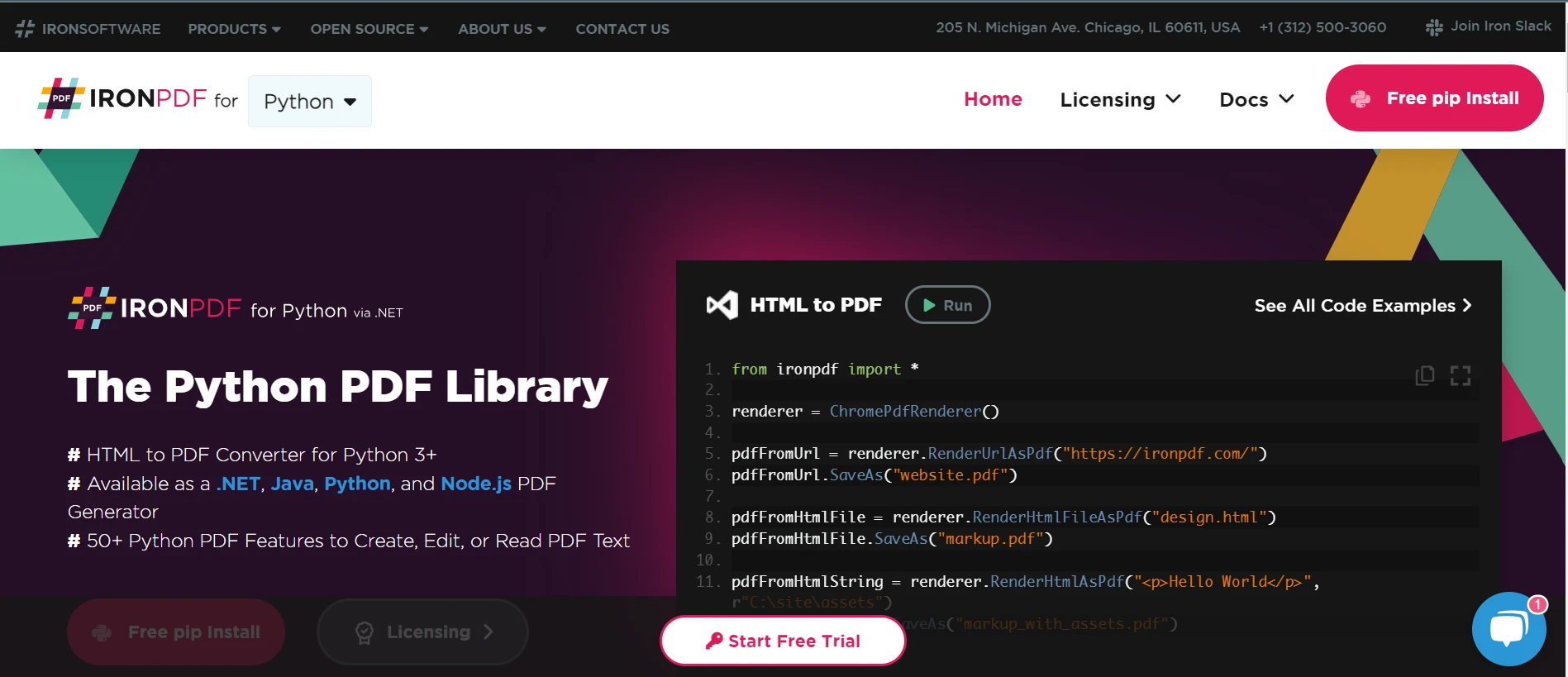
from ironpdf import *

# Instantiate Renderer
renderer = ChromePdfRenderer()

# Create a PDF from a HTML string using Python
pdf = renderer.RenderHtmlAsPdf("<h1>Hello World</h1>")

# Export to a file or Stream
pdf.SaveAs("output.pdf")

# Advanced Example with HTML Assets
# Load external html assets: Images, CSS and JavaScript.
# An optional BasePath 'C:\site\assets\' is set as the file location to load assets from
myAdvancedPdf = renderer.RenderHtmlAsPdf("<img src='icons/iron.png'>", r"C:\site\assets")
myAdvancedPdf.SaveAs("html-with-assets.pdf")
from ironpdf import *# Instantiate Rendererrenderer = ChromePdfRenderer()# Create a PDF from a HTML string using Pythonpdf = renderer.RenderHtmlAsPdf("<h1>Hello World</h1>")# Export to a file or Streampdf.SaveAs("output.pdf")# Advanced Example with HTML Assets# Load external html assets: Images, CSS and JavaScript.# An optional BasePath 'C:\site\assets\' is set as the file location to load assets frommyAdvancedPdf = renderer.RenderHtmlAsPdf("<img src='icons/iron.png'>", r"C:\site\assets")myAdvancedPdf.SaveAs("html-with-assets.pdf")
En el panorama en constante evolución de la documentación digital, los PDFs se han convertido en un formato fundamental para compartir datos, almacenar y presentar información escrita. Sin embargo, a medida que la dependencia de los PDFs continúa creciendo, los desarrolladores a menudo encuentran varios escenarios donde la manipulación programática de estos archivos se convierte en una necesidad. Uno de esos requisitos comunes es la adición del número de página en todas las páginas, un elemento crucial para la navegación y organización del archivo. En la primera página de esta guía completa, profundizaremos en las complejidades de agregar números de página a PDFs usando IronPDF.
## Entendiendo IronPDF
IronPDF se destaca como un ejemplo de una poderosa biblioteca de Python que simplifica las complejidades asociadas con el trabajo programático con archivos PDF. Su amplio conjunto de funciones lo convierte en una herramienta versátil para desarrolladores que buscan manipular PDFs en Python sin problemas. En este tutorial, nuestro enfoque principal será aprovechar las capacidades de IronPDF para mejorar los PDFs existentes con números de página, fuentes e imágenes.
Para más información y documentación, consulte la página de [Python IronPDF](/python/).
## Requisitos previos
Antes de emprender el camino de agregar números de página a sus PDFs y archivos existentes, es imprescindible asegurarse de tener instalada la biblioteca IronPDF. Esto se puede lograr ejecutando la siguiente línea de comandos a continuación.
```bash
:ProductInstall
```
## Instalación del renderizador
La clase `ChromePdfRenderer` es un componente crucial de IronPDF que facilita la renderización de HTML y CSS para generar un archivo PDF. En nuestro script, instanciamos esta nueva función de renderización de PDF para prepararnos para los pasos subsecuentes.
```python
# Import IronPDF module
from ironpdf import ChromePdfRenderer

# Instantiate the PDF renderer
renderer = ChromePdfRenderer()
```
## Cargar el PDF
El método `PdfDocument.FromFile` es una función empleada para cargar el formato de archivo PDF existente que escribimos y que pretendemos mejorar con números de página.
```python
# Import PdfDocument from IronPDF
from ironpdf import PdfDocument
# Load the existing PDF document
document = PdfDocument.FromFile("example.pdf")
```
## Crear un pie de página HTML para añadir el número de página
IronPDF permite la creación de páginas seleccionadas con un rango de número de páginas y encabezados y pies de página HTML personalizados, proporcionando una manera flexible de crear páginas que incluyan contenido dinámico. En nuestro caso, creamos páginas con un pie de página HTML que incluye números de página.
```python
# Import HtmlHeaderFooter from IronPDF
from ironpdf import HtmlHeaderFooter
# Create an HTML footer for page numbers
footer = HtmlHeaderFooter()
footer.MaxHeight = 15 # Set the maximum height of the footer
footer.DrawDividerLine = True # Draw a dividing line in the footer
footer.HtmlFragment = "<center><i>{page}</i></center>" # HTML for page number
```
## Añadir números de página a un PDF
El método `AddHtmlFooters` es un paso fundamental en el proceso. Integra al lector para escribir un pie de página HTML personalizado en el archivo de salida del documento PDF, agregando efectivamente números de página a cada página de salida del PDF.
```python
# Add the HTML footers to the PDF document
document.AddHtmlFooters(footer)
```
## Guardar el PDF modificado
Finalmente, se emplea el método `SaveAs` para guardar el archivo PDF de salida modificado, completo con todos los números de página recién creados y añadidos.
```python
# Save the modified PDF document with page numbers
document.SaveAs("Modified_Output.pdf")
```
## Ejecución general
Hasta ahora hemos discutido las funcionalidades que hemos usado para agregar números de página para crear e importar el PDF en el formato de archivo PDF mencionado anteriormente. Eche un vistazo a la implementación general en Python del código a continuación, en el que se agrega el número de página al pie de página de la página en el centro de la misma.
```python
from ironpdf import ChromePdfRenderer, PdfDocument, HtmlHeaderFooter
# Instantiate Renderer
renderer = ChromePdfRenderer()
# Load PDF document
document = PdfDocument.FromFile("example.pdf")
print(f"Number of pages in the document: {document.PageCount}")
# Create HTML footer for page numbers
footer = HtmlHeaderFooter()
footer.MaxHeight = 15
footer.DrawDividerLine = True
footer.HtmlFragment = "<center><i>{page} of {total-pages}</i></center>"
# Add page numbers to the PDF
document.AddHtmlFooters(footer)
# Save the modified PDF
document.SaveAs("Modified.pdf")
```
La siguiente imagen es el archivo de salida que centrará el número de página en el PDF.

## Número de página a la derecha
Para hacer que el número de página aparezca en el lado derecho del pie de página, use el siguiente código:
```python
from ironpdf import ChromePdfRenderer, PdfDocument, HtmlHeaderFooter
# Instantiate Renderer
renderer = ChromePdfRenderer()
# Load PDF document
document = PdfDocument.FromFile("example.pdf")
print(f"Number of pages in the document: {document.PageCount}")
# Create HTML footer for page numbers
footer = HtmlHeaderFooter()
footer.MaxHeight = 15
footer.DrawDividerLine = True
footer.HtmlFragment = "<div style='text-align: right;'><i>{page} of {total-pages}</i></div>"
# Add page numbers to the PDF
document.AddHtmlFooters(footer)
# Save the modified PDF
document.SaveAs("Modified.pdf")
```
La imagen a continuación muestra el resultado de colocar el número de página en el lado derecho del pie de página.

## Número de página a la izquierda
De manera similar, para colocar el número de página en el lado izquierdo del pie de página, use el siguiente código:
```python
from ironpdf import ChromePdfRenderer, PdfDocument, HtmlHeaderFooter
# Instantiate Renderer
renderer = ChromePdfRenderer()
# Load PDF document
document = PdfDocument.FromFile("example.pdf")
print(f"Number of pages in the document: {document.PageCount}")
# Create HTML footer for page numbers
footer = HtmlHeaderFooter()
footer.MaxHeight = 15
footer.DrawDividerLine = True
footer.HtmlFragment = "<div style='text-align: left;'><i>{page} of {total-pages}</i></div>"
# Add page numbers to the PDF
document.AddHtmlFooters(footer)
# Save the modified PDF
document.SaveAs("Modified.pdf")
```
La imagen a continuación muestra el resultado de colocar el número de página en el lado izquierdo del pie de página.

## Casos de uso del mundo real
Exploremos los muchos ejemplos y casos prácticos donde agregar números de página programáticamente se vuelve invaluable.
### Generación de informes
En aplicaciones empresariales, la generación automatizada de archivos de informes es un requisito común. Agregar números de página asegura que los informes estén bien organizados y sean profesionales.
### Documentos académicos
Para instituciones académicas o investigadores, por ejemplo, agregar dinámicamente números de página a trabajos de investigación o documentos académicos agiliza el proceso de lectura y referencia.
### Documentos legales
En el ámbito legal, mantener el control de versiones y asegurar una correcta paginación y nomenclatura de archivos es crucial. Automatizar la adición de números de página simplifica el proceso.
### Libros electrónicos y publicaciones
Al tratar con publicaciones digitales o e-books, proporcionar una experiencia de lectura consistente es fundamental. Los números de página y las fuentes contribuyen a la legibilidad y a la navegación de las páginas del documento.
### Conclusión
En este artículo de exploración detallada, hemos profundizado en el intrincado proceso de mejorar la salida de documentos PDF al incorporar sin problemas números de página usando IronPDF en Python. El código proporcionado adopta un enfoque sistemático para la salida, asegurando claridad de camino, salida y facilidad de comprensión.
Es importante notar que esta guía sirve como una base, y se anima a los desarrolladores a adaptar el código proporcionado a requisitos específicos. Además, IronPDF ofrece una prueba gratuita para fines de desarrollo para evaluar antes de realizar una compra. Para más información sobre detalles de licencia, características avanzadas y soporte, visite el sitio web oficial de IronPDF.
A medida que el panorama de las herramientas de manipulación de archivos PDF continúa evolucionando, IronPDF se destaca como un valioso recurso para los desarrolladores que buscan automatizar y mejorar sus flujos de trabajo relacionados con archivos PDF e imágenes. Si desea explorar más sobre IronPDF en Python, puede seguir el enlace [aquí](licensing) para obtener detalles de licencia y más información.
Si busca agregar números de página en el HTML después de un salto de página, puede encontrar un ejemplo [aquí](/python/examples/page-numbers-and-page-breaks/).
¡Feliz codificación PDF!
En el panorama en constante evolución de la documentación digital, los PDFs se han convertido en un formato fundamental para compartir datos, almacenar y presentar información escrita. Sin embargo, a medida que la dependencia de los PDFs continúa creciendo, los desarrolladores a menudo encuentran varios escenarios donde la manipulación programática de estos archivos se convierte en una necesidad. Uno de esos requisitos comunes es la adición del número de página en todas las páginas, un elemento crucial para la navegación y organización del archivo. En la primera página de esta guía completa, profundizaremos en las complejidades de agregar números de página a PDFs usando IronPDF.
Entendiendo IronPDF
IronPDF se destaca como un ejemplo de una poderosa biblioteca de Python que simplifica las complejidades asociadas con el trabajo programático con archivos PDF. Su amplio conjunto de funciones lo convierte en una herramienta versátil para desarrolladores que buscan manipular PDFs en Python sin problemas. En este tutorial, nuestro enfoque principal será aprovechar las capacidades de IronPDF para mejorar los PDFs existentes con números de página, fuentes e imágenes.
Para más información y documentación, consulte la página de Python IronPDF.
Requisitos previos
Antes de emprender el camino de agregar números de página a sus PDFs y archivos existentes, es imprescindible asegurarse de tener instalada la biblioteca IronPDF. Esto se puede lograr ejecutando la siguiente línea de comandos a continuación.
> pip install ironpdf
pip install ironpdf
Instalación del renderizador
La clase ChromePdfRenderer es un componente crucial de IronPDF que facilita la renderización de HTML y CSS para generar un archivo PDF. En nuestro script, instanciamos esta nueva función de renderización de PDF para prepararnos para los pasos subsecuentes.
# Import IronPDF modulefrom ironpdf importChromePdfRenderer# Instantiate the PDF rendererrenderer = ChromePdfRenderer()
# Import IronPDF module
from ironpdf import ChromePdfRenderer

# Instantiate the PDF renderer
renderer = ChromePdfRenderer()
Python
Cargar el PDF
El método PdfDocument.FromFile es una función empleada para cargar el formato de archivo PDF existente que escribimos y que pretendemos mejorar con números de página.
# Import PdfDocument from IronPDFfrom ironpdf importPdfDocument# Load the existing PDF documentdocument = PdfDocument.FromFile("example.pdf")
# Import PdfDocument from IronPDF
from ironpdf import PdfDocument

# Load the existing PDF document
document = PdfDocument.FromFile("example.pdf")
Python
Crear un pie de página HTML para añadir el número de página
IronPDF permite la creación de páginas seleccionadas con un rango de número de páginas y encabezados y pies de página HTML personalizados, proporcionando una manera flexible de crear páginas que incluyan contenido dinámico. En nuestro caso, creamos páginas con un pie de página HTML que incluye números de página.
# Import HtmlHeaderFooter from IronPDFfrom ironpdf importHtmlHeaderFooter# Create an HTML footer for page numbersfooter = HtmlHeaderFooter()footer.MaxHeight = 15 # Set the maximum height of the footerfooter.DrawDividerLine = True # Draw a dividing line in the footerfooter.HtmlFragment = "<center><i>{page}</i></center>" # HTML for page number
# Import HtmlHeaderFooter from IronPDF
from ironpdf import HtmlHeaderFooter

# Create an HTML footer for page numbers
footer = HtmlHeaderFooter()
footer.MaxHeight = 15  # Set the maximum height of the footer
footer.DrawDividerLine = True  # Draw a dividing line in the footer
footer.HtmlFragment = "<center><i>{page}</i></center>"  # HTML for page number
Python
Añadir números de página a un PDF
El método AddHtmlFooters es un paso fundamental en el proceso. Integra al lector para escribir un pie de página HTML personalizado en el archivo de salida del documento PDF, agregando efectivamente números de página a cada página de salida del PDF.
# Add the HTML footers to the PDF documentdocument.AddHtmlFooters(footer)
# Add the HTML footers to the PDF document
document.AddHtmlFooters(footer)
Python
Guardar el PDF modificado
Finalmente, se emplea el método SaveAs para guardar el archivo PDF de salida modificado, completo con todos los números de página recién creados y añadidos.
# Save the modified PDF document with page numbersdocument.SaveAs("Modified_Output.pdf")
# Save the modified PDF document with page numbers
document.SaveAs("Modified_Output.pdf")
Python
Ejecución general
Hasta ahora hemos discutido las funcionalidades que hemos usado para agregar números de página para crear e importar el PDF en el formato de archivo PDF mencionado anteriormente. Eche un vistazo a la implementación general en Python del código a continuación, en el que se agrega el número de página al pie de página de la página en el centro de la misma.
from ironpdf importChromePdfRenderer, PdfDocument, HtmlHeaderFooter# Instantiate Rendererrenderer = ChromePdfRenderer()# Load PDF documentdocument = PdfDocument.FromFile("example.pdf")print(f"Number of pages in the document: {document.PageCount}")# Create HTML footer for page numbersfooter = HtmlHeaderFooter()footer.MaxHeight = 15footer.DrawDividerLine = Truefooter.HtmlFragment = "<center><i>{page} of {total-pages}</i></center>"# Add page numbers to the PDFdocument.AddHtmlFooters(footer)# Save the modified PDFdocument.SaveAs("Modified.pdf")
from ironpdf import ChromePdfRenderer, PdfDocument, HtmlHeaderFooter

# Instantiate Renderer
renderer = ChromePdfRenderer()

# Load PDF document
document = PdfDocument.FromFile("example.pdf")
print(f"Number of pages in the document: {document.PageCount}")

# Create HTML footer for page numbers
footer = HtmlHeaderFooter()
footer.MaxHeight = 15
footer.DrawDividerLine = True
footer.HtmlFragment = "<center><i>{page} of {total-pages}</i></center>"

# Add page numbers to the PDF
document.AddHtmlFooters(footer)

# Save the modified PDF
document.SaveAs("Modified.pdf")
Python
La siguiente imagen es el archivo de salida que centrará el número de página en el PDF.
Número de página a la derecha
Para hacer que el número de página aparezca en el lado derecho del pie de página, use el siguiente código:
from ironpdf importChromePdfRenderer, PdfDocument, HtmlHeaderFooter# Instantiate Rendererrenderer = ChromePdfRenderer()# Load PDF documentdocument = PdfDocument.FromFile("example.pdf")print(f"Number of pages in the document: {document.PageCount}")# Create HTML footer for page numbersfooter = HtmlHeaderFooter()footer.MaxHeight = 15footer.DrawDividerLine = Truefooter.HtmlFragment = "<div style='text-align: right;'><i>{page} of {total-pages}</i></div>"# Add page numbers to the PDFdocument.AddHtmlFooters(footer)# Save the modified PDFdocument.SaveAs("Modified.pdf")
from ironpdf import ChromePdfRenderer, PdfDocument, HtmlHeaderFooter

# Instantiate Renderer
renderer = ChromePdfRenderer()

# Load PDF document
document = PdfDocument.FromFile("example.pdf")
print(f"Number of pages in the document: {document.PageCount}")

# Create HTML footer for page numbers
footer = HtmlHeaderFooter()
footer.MaxHeight = 15
footer.DrawDividerLine = True
footer.HtmlFragment = "<div style='text-align: right;'><i>{page} of {total-pages}</i></div>"

# Add page numbers to the PDF
document.AddHtmlFooters(footer)

# Save the modified PDF
document.SaveAs("Modified.pdf")
Python
La imagen a continuación muestra el resultado de colocar el número de página en el lado derecho del pie de página.
Número de página a la izquierda
De manera similar, para colocar el número de página en el lado izquierdo del pie de página, use el siguiente código:
from ironpdf importChromePdfRenderer, PdfDocument, HtmlHeaderFooter# Instantiate Rendererrenderer = ChromePdfRenderer()# Load PDF documentdocument = PdfDocument.FromFile("example.pdf")print(f"Number of pages in the document: {document.PageCount}")# Create HTML footer for page numbersfooter = HtmlHeaderFooter()footer.MaxHeight = 15footer.DrawDividerLine = Truefooter.HtmlFragment = "<div style='text-align: left;'><i>{page} of {total-pages}</i></div>"# Add page numbers to the PDFdocument.AddHtmlFooters(footer)# Save the modified PDFdocument.SaveAs("Modified.pdf")
from ironpdf import ChromePdfRenderer, PdfDocument, HtmlHeaderFooter

# Instantiate Renderer
renderer = ChromePdfRenderer()

# Load PDF document
document = PdfDocument.FromFile("example.pdf")
print(f"Number of pages in the document: {document.PageCount}")

# Create HTML footer for page numbers
footer = HtmlHeaderFooter()
footer.MaxHeight = 15
footer.DrawDividerLine = True
footer.HtmlFragment = "<div style='text-align: left;'><i>{page} of {total-pages}</i></div>"

# Add page numbers to the PDF
document.AddHtmlFooters(footer)

# Save the modified PDF
document.SaveAs("Modified.pdf")
Python
La imagen a continuación muestra el resultado de colocar el número de página en el lado izquierdo del pie de página.
Casos de uso del mundo real
Exploremos los muchos ejemplos y casos prácticos donde agregar números de página programáticamente se vuelve invaluable.
Generación de informes
En aplicaciones empresariales, la generación automatizada de archivos de informes es un requisito común. Agregar números de página asegura que los informes estén bien organizados y sean profesionales.
Documentos académicos
Para instituciones académicas o investigadores, por ejemplo, agregar dinámicamente números de página a trabajos de investigación o documentos académicos agiliza el proceso de lectura y referencia.
Documentos legales
En el ámbito legal, mantener el control de versiones y asegurar una correcta paginación y nomenclatura de archivos es crucial. Automatizar la adición de números de página simplifica el proceso.
Libros electrónicos y publicaciones
Al tratar con publicaciones digitales o e-books, proporcionar una experiencia de lectura consistente es fundamental. Los números de página y las fuentes contribuyen a la legibilidad y a la navegación de las páginas del documento.
Conclusión
En este artículo de exploración detallada, hemos profundizado en el intrincado proceso de mejorar la salida de documentos PDF al incorporar sin problemas números de página usando IronPDF en Python. El código proporcionado adopta un enfoque sistemático para la salida, asegurando claridad de camino, salida y facilidad de comprensión.
Es importante notar que esta guía sirve como una base, y se anima a los desarrolladores a adaptar el código proporcionado a requisitos específicos. Además, IronPDF ofrece una prueba gratuita para fines de desarrollo para evaluar antes de realizar una compra. Para más información sobre detalles de licencia, características avanzadas y soporte, visite el sitio web oficial de IronPDF.
A medida que el panorama de las herramientas de manipulación de archivos PDF continúa evolucionando, IronPDF se destaca como un valioso recurso para los desarrolladores que buscan automatizar y mejorar sus flujos de trabajo relacionados con archivos PDF e imágenes. Si desea explorar más sobre IronPDF en Python, puede seguir el enlace aquí para obtener detalles de licencia y más información.
Si busca agregar números de página en el HTML después de un salto de página, puede encontrar un ejemplo aquí.
Curtis Chau tiene una licenciatura en Ciencias de la Computación (Carleton University) y se especializa en el desarrollo front-end con experiencia en Node.js, TypeScript, JavaScript y React. Apasionado por crear interfaces de usuario intuitivas y estéticamente agradables, disfruta trabajando con frameworks modernos y creando manuales bien estructurados y visualmente atractivos.