Dans le domaine de la programmation Java, la manipulation efficace des chaînes de caractères est une compétence essentielle. La capacité d'analyser, de diviser et de manipuler des chaînes de caractères est essentielle pour diverses tâches, allant du traitement des données à l'analyse de texte. La méthode split() est une méthode fondamentale pour diviser les chaînes de caractères en Java.
Dans cet article, nous allons nous pencher sur les subtilités de la méthode Java Split Pipe, en nous concentrant plus particulièrement sur son utilisation avec la méthode pipe (|) séparateur. En outre, nous créerons un fichier PDF à l'aide d'IronPDF for Java en utilisant le fractionnement de chaînes délimitées par Java Split Pipe.
Introduction à la méthode split()
La méthode split() est un outil pratique fourni par la classe String de Java, qui permet aux développeurs de diviser une chaîne en un tableau de sous-chaînes sur la base d'un délimiteur spécifié. Sa signature est la suivante :
public String[] split(String regex)
public String[] split(String regex)
Java
Ici, regex est une expression régulière qui définit le délimiteur utilisé pour diviser la chaîne. Les expressions régulières offrent un moyen puissant de spécifier des modèles pour la correspondance et la manipulation de texte.
Le tuyau ()|) Séparateur
Le tuyau (**)|le caractère **) sert de délimiteur alternatif dans divers contextes, notamment dans les expressions régulières. En Java, le symbole du tuyau est traité comme un métacaractère dans les expressions régulières et désigne l'opération logique OR. Lorsqu'il est utilisé dans la méthode split(), le caractère pipe sert de délimiteur et divise la chaîne à chaque fois qu'il apparaît.
Exemple d'utilisation de base
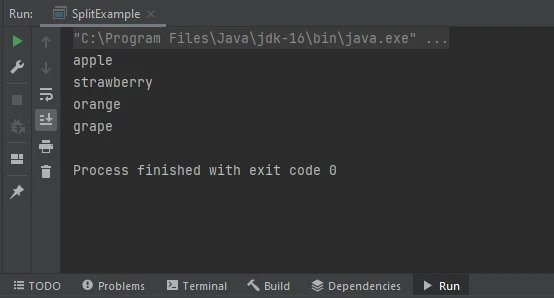
Commençons par un exemple de base pour illustrer l'utilisation du séparateur de tuyaux avec la méthode split() :
public class SplitExample {
    public static void main(String[] args) {
        String text = "apple|banana|orange|grape";
        // Splitting the string using the pipe character as a delimiter.
        String[] fruits = text.split("\\|");

        // Iterating through the split parts and printing each fruit.
        for (String fruit : fruits) {
            System.out.println(fruit);
        }
    }
}
public class SplitExample {
    public static void main(String[] args) {
        String text = "apple|banana|orange|grape";
        // Splitting the string using the pipe character as a delimiter.
        String[] fruits = text.split("\\|");

        // Iterating through the split parts and printing each fruit.
        for (String fruit : fruits) {
            System.out.println(fruit);
        }
    }
}
Java
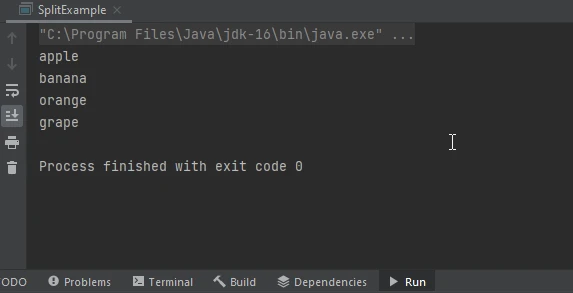
Dans cet exemple, la chaîne "apple|banana|orange|grape"est divisé en un tableau de sous-chaînes à l'aide du caractère pipe ()|) comme délimiteur. La double barre oblique inverse (****) est utilisée pour échapper au caractère pipe car il s'agit d'un métacaractère dans les expressions régulières.
Gestion des caractères spéciaux
Lors de l'utilisation de caractères spéciaux tels que le symbole du tuyau comme délimiteurs, il est essentiel de les traiter correctement afin d'éviter tout comportement inattendu. Le symbole du tuyau ayant une signification spécifique dans les expressions régulières, il doit être échappé pour être traité comme un caractère littéral. Pour ce faire, elle doit être précédée d'une barre oblique inverse (****), comme indiqué dans l'exemple précédent.
Division sur plusieurs délimiteurs
L'un des points forts de la méthode split() est sa capacité à diviser une chaîne en fonction de plusieurs délimiteurs. Pour ce faire, il faut construire une expression régulière qui représente un OU logique entre les délimiteurs. Par exemple :
String text = "apple,banana;orange|grape";

// Splitting the string using commas, semicolons, and pipe characters as delimiters.
String[] fruits = text.split("[,;\\|]");
String text = "apple,banana;orange|grape";

// Splitting the string using commas, semicolons, and pipe characters as delimiters.
String[] fruits = text.split("[,;\\|]");
Java
Dans cet exemple, la chaîne "apple,banana;orange|grape"est scindé à l'aide d'une expression régulière qui correspond aux virgules (,), aux points-virgules (;) et aux caractères pipe (|).
Gestion des chaînes vides
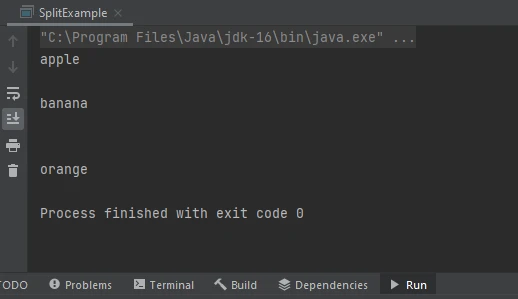
Par défaut, la méthode split() écarte les chaînes vides résultant de délimiteurs consécutifs. Toutefois, dans certains cas, il est souhaitable de conserver les chaînes vides. Pour ce faire, nous pouvons spécifier une limite négative comme second argument de la méthode split(). Par exemple :
String text = "apple||banana|||orange";

// Splitting the string with a negative limit to preserve empty strings.
String[] fruits = text.split("\\|", -1);
String text = "apple||banana|||orange";

// Splitting the string with a negative limit to preserve empty strings.
String[] fruits = text.split("\\|", -1);
Java
Dans cet exemple, le caractère pipe ()|) est utilisé comme délimiteur, et une limite négative est spécifiée pour préserver les chaînes vides. Par conséquent, le tableau fruits contiendra des éléments pour toutes les occurrences du délimiteur, y compris les occurrences consécutives.
IronPDF
IronPDF for Java est une bibliothèque puissante qui permet aux développeurs de créer, manipuler et rendre des documents PDF au sein de leurs applications Java. Il fournit une API intuitive qui fait abstraction des complexités de la génération de PDF, permettant aux développeurs de se concentrer sur la création de leurs applications plutôt que de s'occuper des tâches de manipulation de PDF de bas niveau.
Dans le domaine du développement de logiciels, la génération programmatique de documents PDF est une exigence courante. Qu'il s'agisse de générer des rapports, des factures ou des certificats, il est essentiel de disposer d'un outil fiable pour créer des PDF de manière dynamique. IronPDF est l'un de ces outils qui simplifient la génération de PDF pour les développeurs Java.
Installation de IronPDF for Java
Pour mettre en place IronPDF for Java, assurez-vous de disposer d'un compilateur Java fiable. Dans ce tutoriel, nous utiliserons IntelliJ IDEA.
-
Lancez IntelliJ IDEA et initiez un nouveau projet Maven.
-
Une fois le projet créé, accédez au fichier Pom.XML. Insérez les dépendances Maven suivantes pour intégrer IronPDF :
<dependency>
   <groupId>com.ironsoftware</groupId>
   <artifactId>ironpdf</artifactId>
   <version>2024.3.1</version>
</dependency>
<dependency>
   <groupId>com.ironsoftware</groupId>
   <artifactId>ironpdf</artifactId>
   <version>2024.3.1</version>
</dependency>
XML
-
Après avoir ajouté ces dépendances, cliquez sur le petit bouton qui apparaît sur le côté droit de l'écran pour les installer.
Utilisation de Java Pipe Split pour créer des PDF avec IronPDF
import com.ironsoftware.ironpdf.*;
import java.io.IOException;
import java.nio.file.Paths;

public class PdfGenerator {
    public static void main(String[] args) {
        // Apply your license key
        License.setLicenseKey("YOUR-LICENSE-KEY");

        // Define a string with pipe-separated values
        String data = "Item1|Item2|Item3|Item4|Item5";

        // Split data into an array
        String[] items = data.split("\\|");

        // Create HTML list from the split items
        StringBuilder htmlList = new StringBuilder("<ul>\n");
        for (String item : items) {
            htmlList.append("  <li>").append(item).append("</li>\n");
        }
        htmlList.append("</ul>");

        try {
            // Convert HTML list to PDF
            PdfDocument myPdf = PdfDocument.renderHtmlAsPdf(htmlList.toString());

            // Save the PdfDocument to a file
            myPdf.saveAs(Paths.get("htmlCode.pdf"));
        } catch (IOException e) {
            e.printStackTrace();
        }
    }
}
import com.ironsoftware.ironpdf.*;
import java.io.IOException;
import java.nio.file.Paths;

public class PdfGenerator {
    public static void main(String[] args) {
        // Apply your license key
        License.setLicenseKey("YOUR-LICENSE-KEY");

        // Define a string with pipe-separated values
        String data = "Item1|Item2|Item3|Item4|Item5";

        // Split data into an array
        String[] items = data.split("\\|");

        // Create HTML list from the split items
        StringBuilder htmlList = new StringBuilder("<ul>\n");
        for (String item : items) {
            htmlList.append("  <li>").append(item).append("</li>\n");
        }
        htmlList.append("</ul>");

        try {
            // Convert HTML list to PDF
            PdfDocument myPdf = PdfDocument.renderHtmlAsPdf(htmlList.toString());

            // Save the PdfDocument to a file
            myPdf.saveAs(Paths.get("htmlCode.pdf"));
        } catch (IOException e) {
            e.printStackTrace();
        }
    }
}
Java
Cet extrait de code montre comment générer un document PDF à partir d'une chaîne de caractères au format HTML. Tout d'abord, il importe les bibliothèques nécessaires à la génération de PDF et aux opérations sur les fichiers. Ensuite, elle définit une clé de licence pour IronPDF, une bibliothèque utilisée pour les opérations PDF.
Une chaîne de données est définie avec des valeurs séparées par des tuyaux. La chaîne est divisée en un tableau de chaînes appelé items en utilisant le caractère pipe comme délimiteur.
Ensuite, une liste HTML (htmlList) est construite en ajoutant chaque élément du tableau items dans des balises d'éléments de liste (<li>) au sein d'une liste non ordonnée (<ul>).
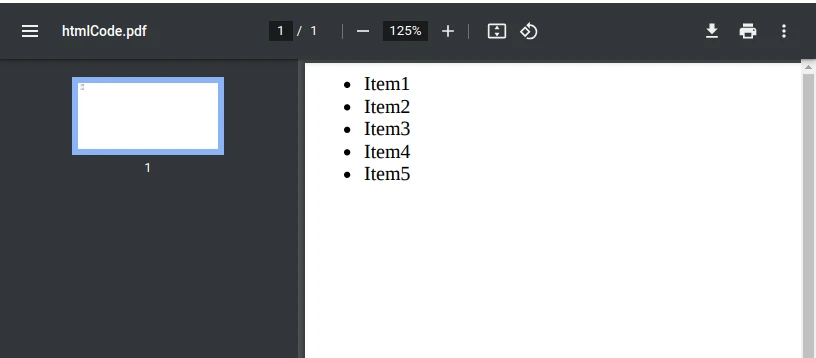
La méthode PdfDocument.renderHtmlAsPdf() convertit cette chaîne HTML en un document PDF, qui est ensuite enregistré sous le nom de "htmlCode.pdf" à l'aide de la méthode saveAs().
En résumé, le code prend une chaîne de données, la formate sous forme de liste HTML, convertit ce HTML en PDF à l'aide d'IronPDF et enregistre le PDF résultant sous le nom de "htmlCode.pdf".
Sortie
Conclusion
Dans cet aperçu complet des capacités de manipulation de chaînes de caractères et de génération de PDF de Java, nous avons exploré les fonctionnalités de la méthode split(), en particulier son utilisation avec le pipe (|) délimiteur. La méthode split() offre un moyen polyvalent de décomposer les chaînes de caractères en sous-chaînes sur la base de délimiteurs spécifiés, y compris la gestion des caractères spéciaux et des délimiteurs multiples. IronPDF est apparu comme un outil puissant pour générer dynamiquement des documents PDF en Java, simplifiant le processus en abstrayant la manipulation PDF de bas niveau.
L'exemple fourni illustre comment exploiter les capacités de division de chaînes de Java aux côtés d'IronPDF pour transformer une chaîne formatée en HTML en un document PDF, mettant en évidence l'intégration transparente de la manipulation de chaînes et de la génération de PDF en Java.
Le développement de logiciels nécessitant souvent la génération de PDF pour des rapports, des factures, etc., la maîtrise de ces techniques permet aux développeurs d'acquérir des compétences essentielles pour gérer ces tâches de manière efficace.
Pour en savoir plus sur les fonctionnalités d'IronPDF, visitez la Page de documentation IronPDF pour voir comment IronPDF pourrait vous aider dans vos projets dès aujourd'hui. Informations de licence IronPDF commencent à $999 USD.