using IronPdf;

// Disable local disk access or cross-origin requests
Installation.EnableWebSecurity = true;

// Instantiate Renderer
var renderer = new ChromePdfRenderer();

// Create a PDF from a HTML string using C#
var pdf = renderer.RenderHtmlAsPdf("<h1>Hello World</h1>");

// Export to a file or Stream
pdf.SaveAs("output.pdf");

// Advanced Example with HTML Assets
// Load external html assets: Images, CSS and JavaScript.
// An optional BasePath 'C:\site\assets\' is set as the file location to load assets from
var myAdvancedPdf = renderer.RenderHtmlAsPdf("<img src='icons/iron.png'>", @"C:\site\assets\");
myAdvancedPdf.SaveAs("html-with-assets.pdf");
using IronPdf;// Disable local disk access or cross-origin requestsInstallation.EnableWebSecurity = true;// Instantiate Renderervar renderer = new ChromePdfRenderer();// Create a PDF from a HTML string using C#var pdf = renderer.RenderHtmlAsPdf("<h1>Hello World</h1>");// Export to a file or Streampdf.SaveAs("output.pdf");// Advanced Example with HTML Assets// Load external html assets: Images, CSS and JavaScript.// An optional BasePath 'C:\site\assets\' is set as the file location to load assets fromvar myAdvancedPdf = renderer.RenderHtmlAsPdf("<img src='icons/iron.png'>", @"C:\site\assets\");myAdvancedPdf.SaveAs("html-with-assets.pdf");
PM >Install-Package IronPdf
Install-Package IronPdf
ACTUALIZACIONES PARA DESARROLLADORES
C# LINQ Sintaxis de Consulta Join (Cómo Funciona para Desarrolladores)
En la versatilidad de la programación C#, LINQ (Language Integrated Query) se destaca como una herramienta poderosa para consultar y manipular colecciones de objetos. Entre los numerosos operadores que LINQ ofrece, el operador **Join** es una pieza clave cuando se trata de fusionar datos de múltiples fuentes.
En este artículo, profundizaremos en las complejidades del [**operador Join de C# LINQ**](https://learn.microsoft.com/en-us/dotnet/csharp/linq/perform-inner-joins), desentrañando su funcionalidad, sintaxis y aplicaciones en el mundo real.
## Entender los fundamentos de la cláusula Join
En su esencia, el operador Join de LINQ está diseñado para combinar elementos de dos o más colecciones basándose en una condición especificada. Este operador permite a los desarrolladores realizar uniones similares a SQL en colecciones en memoria, facilitando la fusión de datos de fuentes dispares con facilidad.
### Sintaxis del operador LINQ Join
La sintaxis para el operador Join de LINQ es expresiva y sigue un patrón que se asemeja a las uniones en SQL. La sintaxis básica es la siguiente:
```csharp
var queryResult =
    from element1 in collection1
    join element2 in collection2 on element1.Key equals element2.Key
    select new { element1, element2 };
```
En esta sintaxis:
* **element1** y **element2** son variables que representan elementos de **collection1** y **collection2**.
* **element1.Key** y **element2.Key** son las propiedades utilizadas como base para la operación de unión.
* La palabra clave **equals** especifica la condición para la unión.
* La cláusula **select** crea un nuevo objeto que combina elementos de ambas colecciones.
### Tipos de uniones LINQ
LINQ soporta varios tipos de uniones, incluyendo:
1. **Inner Join:** Devuelve solo los elementos que tienen claves coincidentes en ambas colecciones.
```csharp
var innerJoin = from customer in customers
join order in orders on customer.CustomerID equals order.CustomerID // join orders to customers based on the customer ID key
select new { customer.CustomerID, customer.CustomerName, order.OrderID }; // create a new anonymous object based on the objects obtained from the join
```
2. **Left Outer Join (Defecto):** Devuelve todos los elementos de la colección izquierda y los coincidentes de la derecha; si sin coincidencia, se devuelve el valor por defecto. 3. **Group Join:** Agrupa elementos de la colección izquierda con elementos coincidentes de la colección derecha.
```csharp
var leftOuterJoin = from customer in customers
join order in orders on customer.CustomerID equals order.CustomerID into customerOrders
from co in customerOrders.DefaultIfEmpty()
select new { customer.CustomerID, customer.CustomerName, OrderID = co?.OrderID ?? -1 };
```
3. **Unión por Grupo:** Agrupa elementos de la colección izquierda con los elementos coincidentes de la colección derecha.
```csharp
var groupJoin = from customer in customers
join order in orders on customer.CustomerID equals order.CustomerID into customerOrders
select new { customer.CustomerID, customer.CustomerName, Orders = customerOrders };
```
## Aplicación del mundo real: Combinación de datos de clientes y pedidos
Consideremos un ejemplo práctico donde tenemos dos colecciones: **clientes** y **pedidos**. En este ejemplo, el conjunto de resultados contendrá entradas con información del cliente junto con sus pedidos asociados.
```csharp
var customerOrderInfo =
from customer in customers
join order in orders on customer.CustomerID equals order.CustomerID
select new { customer.CustomerID, customer.CustomerName, order.OrderID, order.OrderDate };
```
La sintaxis del método de extensión join ayuda a los desarrolladores de C# a realizar operaciones de unión similares a SQL. La sintaxis de método de extensión de join ayuda a los desarrolladores C# a realizar operaciones de unión tipo SQL.
## Presentando IronPDF
[**Desarrolla Soluciones PDF con IronPDF**](https://ironpdf.com) es una biblioteca completa de C# diseñada para crear, procesar y editar documentos PDF. 
### Instalación de IronPDF: Un comienzo rápido
Para comenzar a aprovechar la biblioteca de IronPDF en tu proyecto C#, puedes instalar fácilmente el paquete NuGet de IronPDF. Usa el siguiente comando en tu Consola del Administrador de Paquetes:
```shell
:InstallCmd Install-Package IronPdf
```
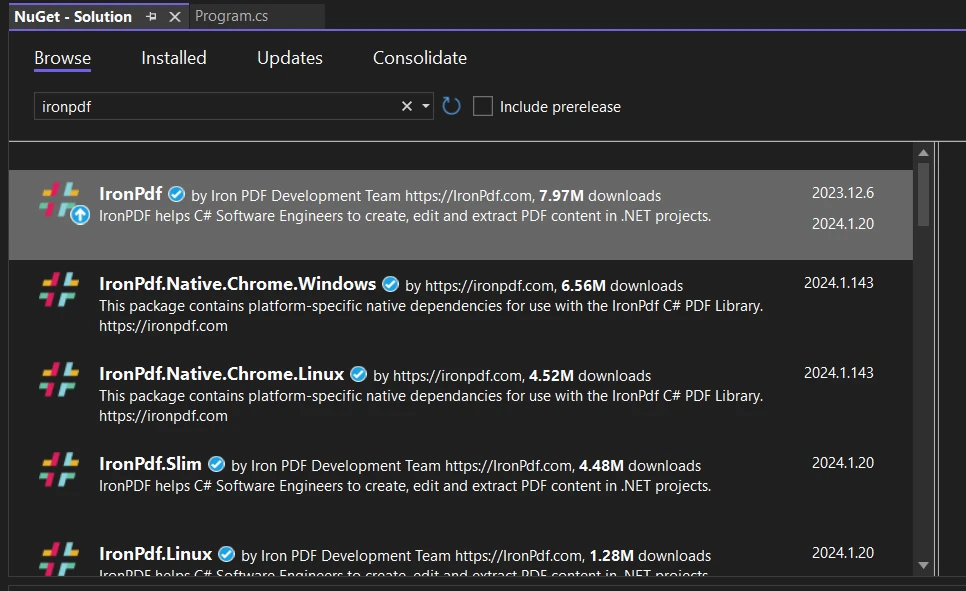
Alternativamente, puedes buscar "IronPDF" en el Administrador de Paquetes NuGet e instalarlo desde allí.
## LINQ Join e IronPDF: ¿Un dúo dinámico?
Cuando se trata de utilizar LINQ Join con IronPDF, la principal consideración es la naturaleza de los datos que deseas integrar en el documento PDF. El punto destacado de IronPDF es su función de [**Conversión de HTML a PDF**](/tutorials/html-to-pdf/), que mantiene tus diseños y estilos intactos.
El punto culminante de IronPDF es su [**Función de Conversión de HTML a PDF**](/tutorials/html-to-pdf/), que mantiene tus diseños y estilos intactos. ### Escenario 1: Combinación de Datos Antes de la Generación de PDF Archivos HTML, URLs y cadenas de HTML pueden ser convertidos a PDFs sin inconvenientes.
```csharp
using IronPdf;
class Program
{
static void Main(string[] args)
{
var renderer = new ChromePdfRenderer();
// 1. Convert HTML String to PDF
var htmlContent = "<h1>Hello, IronPDF!</h1><p>This is a PDF from an HTML string.</p>";
var pdfFromHtmlString = renderer.RenderHtmlAsPdf(htmlContent);
pdfFromHtmlString.SaveAs("HTMLStringToPDF.pdf");
// 2. Convert HTML File to PDF
var htmlFilePath = "path_to_your_html_file.html"; // Specify the path to your HTML file
var pdfFromHtmlFile = renderer.RenderHtmlFileAsPdf(htmlFilePath);
pdfFromHtmlFile.SaveAs("HTMLFileToPDF.pdf");
// 3. Convert URL to PDF
var url = "http://ironpdf.com"; // Specify the URL
var pdfFromUrl = renderer.RenderUrlAsPdf(url);
pdfFromUrl.SaveAs("URLToPDF.pdf");
}
}
```
### Escenario 1: Combinación de datos antes de la generación de PDF
Una vez que tengas un conjunto de datos unificado, puedes aprovechar IronPDF para generar dinámicamente un documento PDF basado en los datos integrados. Aquí hay un ejemplo simplificado:
Explora más sobre la generación de PDF y el uso de LINQ Join con IronPDF en la [**Documentación de IronPDF**](/docs/).
```csharp
// Assume 'customerOrderInfo' is a result set obtained using LINQ Join
var pdfDocument = new IronPdf.ChromePdfRenderer();
foreach (var entry in customerOrderInfo)
{
// Use IronPDF to add content to the PDF based on integrated data
pdfDocument.AddHTML($"<p>Customer ID: {entry.CustomerID}, Order ID: {entry.OrderID}</p>");
}
// Save or render the PDF document as needed
pdfDocument.SaveAs("IntegratedDataDocument.pdf");
```
Explora más formas de generación de documentos PDF y cómo puedes usar LINQ Join con IronPDF visitando la [**Documentación de IronPDF**](/docs/).
### Escenario 2: Integración dinámica de datos durante la generación de PDF
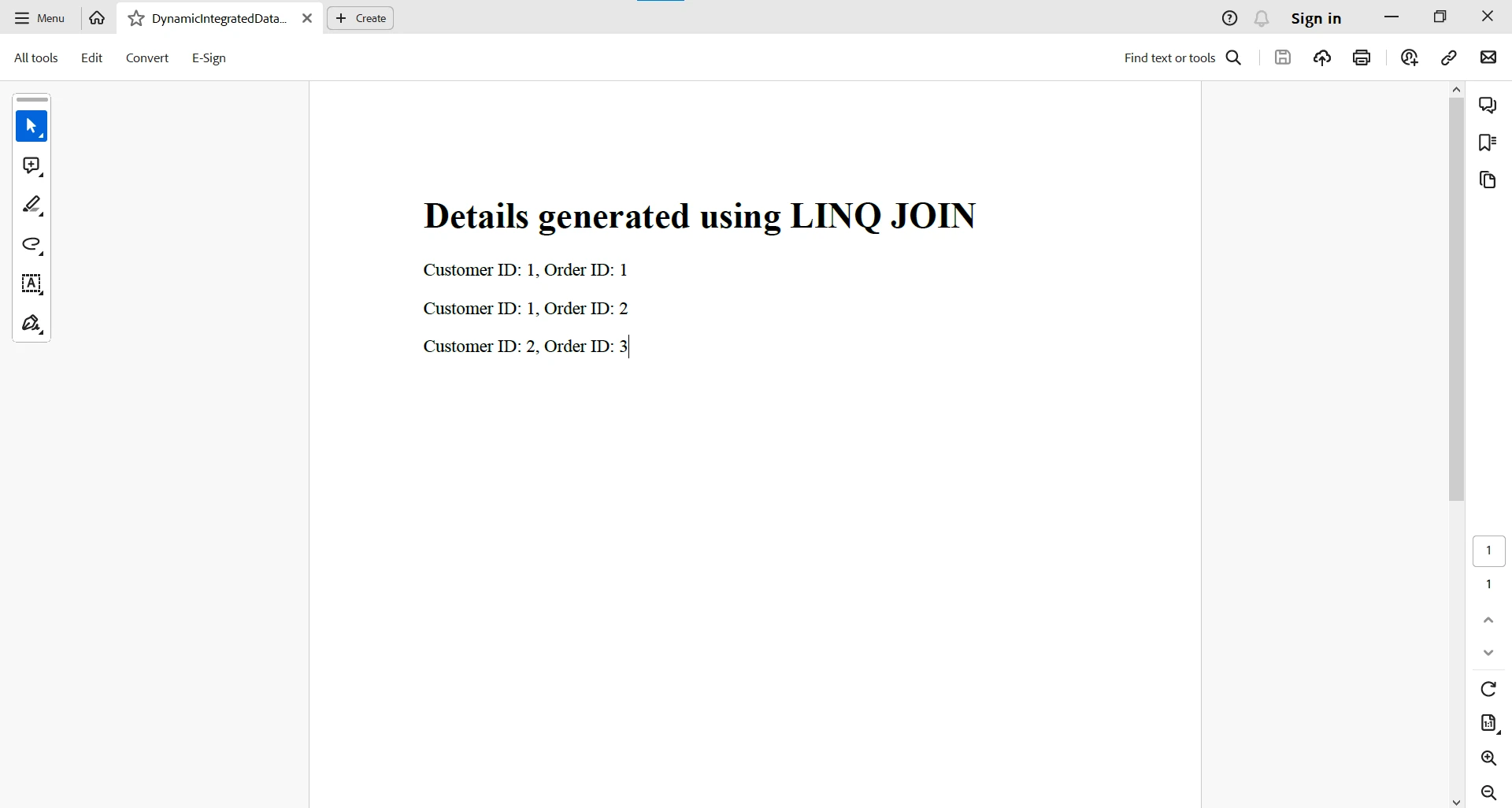
Aquí, crearemos y ordenaremos la clase de cliente para representar la aplicación en el mundo real. Crearemos y ordenaremos la clase de cliente para representar una aplicación real. El siguiente ejemplo muestra una integración detallada del método Join de LINQ con IronPDF mientras usamos [**Cadenas de HTML para la Generación de PDF**](/examples/using-html-to-create-a-pdf/) para crear el documento: Este código utiliza la palabra clave **join** que ayuda a encontrar los pedidos coincidentes para cada cliente, haciendo que la consulta sea más concisa y expresiva.
```csharp
using System;
using System.Collections.Generic;
using System.Linq;
using IronPdf;
class Order
{
public int OrderID { get; set; }
public int CustomerID { get; set; }
// Other order-related properties...
}
class Customer
{
public int CustomerID { get; set; }
// Other customer-related properties...
}
class Program
{
static void Main()
{
// Sample orders collection
var orders = new List<Order>
{
new Order { OrderID = 1, CustomerID = 1 },
new Order { OrderID = 2, CustomerID = 1 },
new Order { OrderID = 3, CustomerID = 2 },
};
// Sample customers collection
var customers = new List<Customer>
{
new Customer { CustomerID = 1 },
new Customer { CustomerID = 2 },
};
var pdfDocument = new ChromePdfRenderer();
string htmlContent = "<h1>Details generated using LINQ JOIN</h1>";
// Use join to find customer orders
var query = from customer in customers
join order in orders on customer.CustomerID equals order.CustomerID
select new { CustomerID = customer.CustomerID, OrderID = order.OrderID };
foreach (var result in query)
{
// Use IronPDF to dynamically add content to the PDF based on integrated data
htmlContent += $"<p>Customer ID: {result.CustomerID}, Order ID: {result.OrderID}</p>";
}
// Save or render the PDF document as needed
pdfDocument.RenderHtmlAsPdf(htmlContent)
.SaveAs("DynamicIntegratedDataDocument.pdf");
}
}
```

## Conclusión
IronPDF es una solución robusta para generación de PDFs en aplicaciones C#. Con el operador Join de LINQ, se logra una integración fluida de datos. Con el operador LINQ Join, los desarrolladores logran integración de datos eficiente. Combina datos de clientes y pedidos para mejorar la generación de PDFs en C#. En conclusión, el operador Join de C# LINQ es una herramienta formidable para integrar datos de múltiples fuentes sin problemas.
El operador Join de LINQ simplifica la combinación de datos de bases de datos, respuestas de API o colecciones en memoria. A medida que navegas por el diverso paisaje de conexiones de datos en tus aplicaciones C#, considera el poder y la flexibilidad que el operador Join de LINQ aporta a tu kit de herramientas de integración de datos. Dominar este operador abre nuevas posibilidades para trabajar y manipular datos de manera eficiente, mejorando las capacidades de tus aplicaciones C#. IronPDF ofrece una [**prueba gratuita con fines de evaluación**](trial-license) para probar su funcionalidad completa.
Sin embargo, necesita ser [**debidamente licenciado**](licensing) una vez que el periodo de prueba haya expirado. Sin embargo, debe contar con [**licencia adecuada**](licencias) una vez finalizado el periodo de prueba.
En la versatilidad de la programación C#, LINQ (Language Integrated Query) se destaca como una herramienta poderosa para consultar y manipular colecciones de objetos. Entre los numerosos operadores que LINQ ofrece, el operador Join es una pieza clave cuando se trata de fusionar datos de múltiples fuentes.
En este artículo, profundizaremos en las complejidades del operador Join de C# LINQ, desentrañando su funcionalidad, sintaxis y aplicaciones en el mundo real.
Entender los fundamentos de la cláusula Join
En su esencia, el operador Join de LINQ está diseñado para combinar elementos de dos o más colecciones basándose en una condición especificada. Este operador permite a los desarrolladores realizar uniones similares a SQL en colecciones en memoria, facilitando la fusión de datos de fuentes dispares con facilidad.
Sintaxis del operador LINQ Join
La sintaxis para el operador Join de LINQ es expresiva y sigue un patrón que se asemeja a las uniones en SQL. La sintaxis básica es la siguiente:
var queryResult = from element1 in collection1 join element2 in collection2 on element1.Keyequals element2.Key select new { element1, element2 };
var queryResult =
    from element1 in collection1
    join element2 in collection2 on element1.Key equals element2.Key
    select new { element1, element2 };
Dim queryResult = From element1 In collection1Join element2 In collection2 On element1.KeyEquals element2.Key Select New With {Key element1,Key element2 }
Dim queryResult = From element1 In collection1
	Join element2 In collection2 On element1.Key Equals element2.Key
	Select New With {
		Key element1,
		Key element2
	}
En esta sintaxis:
element1 y element2 son variables que representan elementos de collection1 y collection2.
element1.Key y element2.Key son las propiedades utilizadas como base para la operación de unión.
La palabra clave equals especifica la condición para la unión.
La cláusula select crea un nuevo objeto que combina elementos de ambas colecciones.
Tipos de uniones LINQ
LINQ soporta varios tipos de uniones, incluyendo:
Inner Join: Devuelve solo los elementos que tienen claves coincidentes en ambas colecciones.
var innerJoin = from customer in customers join order in orders on customer.CustomerIDequals order.CustomerID// join orders to customers based on the customer ID key select new { customer.CustomerID, customer.CustomerName, order.OrderID }; // create a new anonymous object based on the objects obtained from the join
var innerJoin = from customer in customers
                join order in orders on customer.CustomerID equals order.CustomerID // join orders to customers based on the customer ID key
                select new { customer.CustomerID, customer.CustomerName, order.OrderID }; // create a new anonymous object based on the objects obtained from the join
Dim innerJoin = From customer In customers ' create a new anonymous object based on the objects obtained from the joinJoin order In orders On customer.CustomerIDEquals order.CustomerID Select New With {Key customer.CustomerID,Key customer.CustomerName,Key order.OrderID }
Dim innerJoin = From customer In customers ' create a new anonymous object based on the objects obtained from the join
	Join order In orders On customer.CustomerID Equals order.CustomerID
	Select New With {
		Key customer.CustomerID,
		Key customer.CustomerName,
		Key order.OrderID
	}
Left Outer Join (Defecto): Devuelve todos los elementos de la colección izquierda y los coincidentes de la derecha; si sin coincidencia, se devuelve el valor por defecto. 3. Group Join: Agrupa elementos de la colección izquierda con elementos coincidentes de la colección derecha.
var leftOuterJoin = from customer in customers join order in orders on customer.CustomerIDequals order.CustomerIDinto customerOrders from co in customerOrders.DefaultIfEmpty() select new { customer.CustomerID, customer.CustomerName, OrderID = co?.OrderID ?? -1 };
var leftOuterJoin = from customer in customers
                    join order in orders on customer.CustomerID equals order.CustomerID into customerOrders
                    from co in customerOrders.DefaultIfEmpty()
                    select new { customer.CustomerID, customer.CustomerName, OrderID = co?.OrderID ?? -1 };
Dim leftOuterJoin = From customer In customersGroupJoin order In orders On customer.CustomerIDEquals order.CustomerIDInto customerOrders = GroupFrom co In customerOrders.DefaultIfEmpty() Select New With {Key customer.CustomerID,Key customer.CustomerName,Key .OrderID = If(co?.OrderID, -1) }
Dim leftOuterJoin = From customer In customers
	Group Join order In orders On customer.CustomerID Equals order.CustomerID Into customerOrders = Group
	From co In customerOrders.DefaultIfEmpty()
	Select New With {
		Key customer.CustomerID,
		Key customer.CustomerName,
		Key .OrderID = If(co?.OrderID, -1)
	}
Unión por Grupo: Agrupa elementos de la colección izquierda con los elementos coincidentes de la colección derecha.
var groupJoin = from customer in customers join order in orders on customer.CustomerIDequals order.CustomerIDinto customerOrders select new { customer.CustomerID, customer.CustomerName, Orders = customerOrders };
var groupJoin = from customer in customers
                join order in orders on customer.CustomerID equals order.CustomerID into customerOrders
                select new { customer.CustomerID, customer.CustomerName, Orders = customerOrders };
Dim groupJoin = From customer In customersGroupJoin order In orders On customer.CustomerIDEquals order.CustomerIDInto customerOrders = Group Select New With {Key customer.CustomerID,Key customer.CustomerName,Key .Orders = customerOrders }
Dim groupJoin = From customer In customers
	Group Join order In orders On customer.CustomerID Equals order.CustomerID Into customerOrders = Group
	Select New With {
		Key customer.CustomerID,
		Key customer.CustomerName,
		Key .Orders = customerOrders
	}
Aplicación del mundo real: Combinación de datos de clientes y pedidos
Consideremos un ejemplo práctico donde tenemos dos colecciones: clientes y pedidos. En este ejemplo, el conjunto de resultados contendrá entradas con información del cliente junto con sus pedidos asociados.
var customerOrderInfo = from customer in customers join order in orders on customer.CustomerIDequals order.CustomerID select new { customer.CustomerID, customer.CustomerName, order.OrderID, order.OrderDate };
var customerOrderInfo =
    from customer in customers
    join order in orders on customer.CustomerID equals order.CustomerID
    select new { customer.CustomerID, customer.CustomerName, order.OrderID, order.OrderDate };
Dim customerOrderInfo = From customer In customersJoin order In orders On customer.CustomerIDEquals order.CustomerID Select New With {Key customer.CustomerID,Key customer.CustomerName,Key order.OrderID,Key order.OrderDate }
Dim customerOrderInfo = From customer In customers
	Join order In orders On customer.CustomerID Equals order.CustomerID
	Select New With {
		Key customer.CustomerID,
		Key customer.CustomerName,
		Key order.OrderID,
		Key order.OrderDate
	}
La sintaxis del método de extensión join ayuda a los desarrolladores de C# a realizar operaciones de unión similares a SQL. La sintaxis de método de extensión de join ayuda a los desarrolladores C# a realizar operaciones de unión tipo SQL.
Para comenzar a aprovechar la biblioteca de IronPDF en tu proyecto C#, puedes instalar fácilmente el paquete NuGet de IronPDF. Usa el siguiente comando en tu Consola del Administrador de Paquetes:
PM > Install-Package IronPdf
Install-Package IronPdf
Alternativamente, puedes buscar "IronPDF" en el Administrador de Paquetes NuGet e instalarlo desde allí.
LINQ Join e IronPDF: ¿Un dúo dinámico?
Cuando se trata de utilizar LINQ Join con IronPDF, la principal consideración es la naturaleza de los datos que deseas integrar en el documento PDF. El punto destacado de IronPDF es su función de Conversión de HTML a PDF, que mantiene tus diseños y estilos intactos.
El punto culminante de IronPDF es su Función de Conversión de HTML a PDF, que mantiene tus diseños y estilos intactos. ### Escenario 1: Combinación de Datos Antes de la Generación de PDF Archivos HTML, URLs y cadenas de HTML pueden ser convertidos a PDFs sin inconvenientes.
using IronPdf;class Program{ static voidMain(string[] args) { var renderer = new ChromePdfRenderer(); // 1. Convert HTML String to PDF var htmlContent = "<h1>Hello, IronPDF!</h1><p>This is a PDF from an HTML string.</p>"; var pdfFromHtmlString = renderer.RenderHtmlAsPdf(htmlContent); pdfFromHtmlString.SaveAs("HTMLStringToPDF.pdf"); // 2. Convert HTML File to PDF var htmlFilePath = "path_to_your_html_file.html"; // Specify the path to your HTML file var pdfFromHtmlFile = renderer.RenderHtmlFileAsPdf(htmlFilePath); pdfFromHtmlFile.SaveAs("HTMLFileToPDF.pdf"); // 3. Convert URL to PDF var url = "http://ironpdf.com"; // Specify the URL var pdfFromUrl = renderer.RenderUrlAsPdf(url); pdfFromUrl.SaveAs("URLToPDF.pdf"); }}
using IronPdf;

class Program
{
    static void Main(string[] args)
    {
        var renderer = new ChromePdfRenderer();

        // 1. Convert HTML String to PDF
        var htmlContent = "<h1>Hello, IronPDF!</h1><p>This is a PDF from an HTML string.</p>";
        var pdfFromHtmlString = renderer.RenderHtmlAsPdf(htmlContent);
        pdfFromHtmlString.SaveAs("HTMLStringToPDF.pdf");

        // 2. Convert HTML File to PDF
        var htmlFilePath = "path_to_your_html_file.html"; // Specify the path to your HTML file
        var pdfFromHtmlFile = renderer.RenderHtmlFileAsPdf(htmlFilePath);
        pdfFromHtmlFile.SaveAs("HTMLFileToPDF.pdf");

        // 3. Convert URL to PDF
        var url = "http://ironpdf.com"; // Specify the URL
        var pdfFromUrl = renderer.RenderUrlAsPdf(url);
        pdfFromUrl.SaveAs("URLToPDF.pdf");
    }
}
ImportsIronPdfFriend Class ProgramShared Sub Main(ByVal args() AsString) Dim renderer = New ChromePdfRenderer() ' 1. Convert HTML String to PDF Dim htmlContent = "<h1>Hello, IronPDF!</h1><p>This is a PDF from an HTML string.</p>" Dim pdfFromHtmlString = renderer.RenderHtmlAsPdf(htmlContent) pdfFromHtmlString.SaveAs("HTMLStringToPDF.pdf") ' 2. Convert HTML File to PDF Dim htmlFilePath = "path_to_your_html_file.html" ' Specify the path to your HTML file Dim pdfFromHtmlFile = renderer.RenderHtmlFileAsPdf(htmlFilePath) pdfFromHtmlFile.SaveAs("HTMLFileToPDF.pdf") ' 3. Convert URL to PDF Dim url = "http://ironpdf.com" ' Specify the URL Dim pdfFromUrl = renderer.RenderUrlAsPdf(url) pdfFromUrl.SaveAs("URLToPDF.pdf") End SubEnd Class
Imports IronPdf

Friend Class Program
	Shared Sub Main(ByVal args() As String)
		Dim renderer = New ChromePdfRenderer()

		' 1. Convert HTML String to PDF
		Dim htmlContent = "<h1>Hello, IronPDF!</h1><p>This is a PDF from an HTML string.</p>"
		Dim pdfFromHtmlString = renderer.RenderHtmlAsPdf(htmlContent)
		pdfFromHtmlString.SaveAs("HTMLStringToPDF.pdf")

		' 2. Convert HTML File to PDF
		Dim htmlFilePath = "path_to_your_html_file.html" ' Specify the path to your HTML file
		Dim pdfFromHtmlFile = renderer.RenderHtmlFileAsPdf(htmlFilePath)
		pdfFromHtmlFile.SaveAs("HTMLFileToPDF.pdf")

		' 3. Convert URL to PDF
		Dim url = "http://ironpdf.com" ' Specify the URL
		Dim pdfFromUrl = renderer.RenderUrlAsPdf(url)
		pdfFromUrl.SaveAs("URLToPDF.pdf")
	End Sub
End Class
Escenario 1: Combinación de datos antes de la generación de PDF
Una vez que tengas un conjunto de datos unificado, puedes aprovechar IronPDF para generar dinámicamente un documento PDF basado en los datos integrados. Aquí hay un ejemplo simplificado:
Explora más sobre la generación de PDF y el uso de LINQ Join con IronPDF en la Documentación de IronPDF.
// Assume 'customerOrderInfo' is a result set obtained using LINQ Joinvar pdfDocument = new IronPdf.ChromePdfRenderer();foreach (var entry in customerOrderInfo){ // Use IronPDF to add content to the PDF based on integrated data pdfDocument.AddHTML($"<p>Customer ID: {entry.CustomerID}, Order ID: {entry.OrderID}</p>");}// Save or render the PDF document as neededpdfDocument.SaveAs("IntegratedDataDocument.pdf");
// Assume 'customerOrderInfo' is a result set obtained using LINQ Join
var pdfDocument = new IronPdf.ChromePdfRenderer();
foreach (var entry in customerOrderInfo)
{
    // Use IronPDF to add content to the PDF based on integrated data
    pdfDocument.AddHTML($"<p>Customer ID: {entry.CustomerID}, Order ID: {entry.OrderID}</p>");
}
// Save or render the PDF document as needed
pdfDocument.SaveAs("IntegratedDataDocument.pdf");
' Assume 'customerOrderInfo' is a result set obtained using LINQ JoinDim pdfDocument = New IronPdf.ChromePdfRenderer()For Each entry In customerOrderInfo ' Use IronPDF to add content to the PDF based on integrated data pdfDocument.AddHTML($"<p>Customer ID: {entry.CustomerID}, Order ID: {entry.OrderID}</p>")Next entry' Save or render the PDF document as neededpdfDocument.SaveAs("IntegratedDataDocument.pdf")
' Assume 'customerOrderInfo' is a result set obtained using LINQ Join
Dim pdfDocument = New IronPdf.ChromePdfRenderer()
For Each entry In customerOrderInfo
	' Use IronPDF to add content to the PDF based on integrated data
	pdfDocument.AddHTML($"<p>Customer ID: {entry.CustomerID}, Order ID: {entry.OrderID}</p>")
Next entry
' Save or render the PDF document as needed
pdfDocument.SaveAs("IntegratedDataDocument.pdf")
Explora más formas de generación de documentos PDF y cómo puedes usar LINQ Join con IronPDF visitando la Documentación de IronPDF.
Escenario 2: Integración dinámica de datos durante la generación de PDF
Aquí, crearemos y ordenaremos la clase de cliente para representar la aplicación en el mundo real. Crearemos y ordenaremos la clase de cliente para representar una aplicación real. El siguiente ejemplo muestra una integración detallada del método Join de LINQ con IronPDF mientras usamos Cadenas de HTML para la Generación de PDF para crear el documento: Este código utiliza la palabra clave join que ayuda a encontrar los pedidos coincidentes para cada cliente, haciendo que la consulta sea más concisa y expresiva.
using System;using System.Collections.Generic;using System.Linq;using IronPdf;class Order{ public intOrderID { get; set; } public intCustomerID { get; set; } // Other order-related properties...}class Customer{ public intCustomerID { get; set; } // Other customer-related properties...}class Program{ static voidMain() { // Sample orders collection var orders = new List<Order> { new Order { OrderID = 1, CustomerID = 1 }, new Order { OrderID = 2, CustomerID = 1 }, new Order { OrderID = 3, CustomerID = 2 }, }; // Sample customers collection var customers = new List<Customer> { new Customer { CustomerID = 1 }, new Customer { CustomerID = 2 }, }; var pdfDocument = new ChromePdfRenderer(); string htmlContent = "<h1>Details generated using LINQ JOIN</h1>"; // Use join to find customer orders var query = from customer in customers join order in orders on customer.CustomerIDequals order.CustomerID select new { CustomerID = customer.CustomerID, OrderID = order.OrderID }; foreach (var result in query) { // Use IronPDF to dynamically add content to the PDF based on integrated data htmlContent += $"<p>Customer ID: {result.CustomerID}, Order ID: {result.OrderID}</p>"; } // Save or render the PDF document as needed pdfDocument.RenderHtmlAsPdf(htmlContent) .SaveAs("DynamicIntegratedDataDocument.pdf"); }}
using System;
using System.Collections.Generic;
using System.Linq;
using IronPdf;

class Order
{
    public int OrderID { get; set; }
    public int CustomerID { get; set; }
    // Other order-related properties...
}

class Customer
{
    public int CustomerID { get; set; }
    // Other customer-related properties...
}

class Program
{
    static void Main()
    {
        // Sample orders collection
        var orders = new List<Order>
        {
            new Order { OrderID = 1, CustomerID = 1 },
            new Order { OrderID = 2, CustomerID = 1 },
            new Order { OrderID = 3, CustomerID = 2 },
        };

        // Sample customers collection
        var customers = new List<Customer>
        {
            new Customer { CustomerID = 1 },
            new Customer { CustomerID = 2 },
        };

        var pdfDocument = new ChromePdfRenderer();
        string htmlContent = "<h1>Details generated using LINQ JOIN</h1>";

        // Use join to find customer orders
        var query = from customer in customers
                    join order in orders on customer.CustomerID equals order.CustomerID
                    select new { CustomerID = customer.CustomerID, OrderID = order.OrderID };

        foreach (var result in query)
        {
            // Use IronPDF to dynamically add content to the PDF based on integrated data
            htmlContent += $"<p>Customer ID: {result.CustomerID}, Order ID: {result.OrderID}</p>";
        }

        // Save or render the PDF document as needed
        pdfDocument.RenderHtmlAsPdf(htmlContent)
                   .SaveAs("DynamicIntegratedDataDocument.pdf");
    }
}
ImportsSystemImportsSystem.Collections.GenericImportsSystem.LinqImportsIronPdfClass Order Public Property OrderIDAsInteger Public Property CustomerIDAsInteger ' Other order-related properties...End ClassClass Customer Public Property CustomerIDAsInteger ' Other customer-related properties...End ClassModuleProgram Sub Main() ' Sample orders collection Dim orders = New List(OfOrder) From { New OrderWith {.OrderID = 1, .CustomerID = 1}, New OrderWith {.OrderID = 2, .CustomerID = 1}, New OrderWith {.OrderID = 3, .CustomerID = 2} } ' Sample customers collection Dim customers = New List(OfCustomer) From { New CustomerWith {.CustomerID = 1}, New CustomerWith {.CustomerID = 2} } Dim pdfDocument = New ChromePdfRenderer() Dim htmlContent AsString = "<h1>Details generated using LINQ JOIN</h1>" ' Use join to find customer orders Dim query = From customer In customersJoin order In orders On customer.CustomerIDEquals order.CustomerID Select New With {Key .CustomerID = customer.CustomerID, Key .OrderID = order.OrderID} For Each result In query ' Use IronPDF to dynamically add content to the PDF based on integrated data htmlContent += $"<p>Customer ID: {result.CustomerID}, Order ID: {result.OrderID}</p>" Next ' Save or render the PDF document as needed pdfDocument.RenderHtmlAsPdf(htmlContent).SaveAs("DynamicIntegratedDataDocument.pdf") End SubEndModule
Imports System
Imports System.Collections.Generic
Imports System.Linq
Imports IronPdf

Class Order
    Public Property OrderID As Integer
    Public Property CustomerID As Integer
    ' Other order-related properties...
End Class

Class Customer
    Public Property CustomerID As Integer
    ' Other customer-related properties...
End Class

Module Program
    Sub Main()
        ' Sample orders collection
        Dim orders = New List(Of Order) From {
            New Order With {.OrderID = 1, .CustomerID = 1},
            New Order With {.OrderID = 2, .CustomerID = 1},
            New Order With {.OrderID = 3, .CustomerID = 2}
        }

        ' Sample customers collection
        Dim customers = New List(Of Customer) From {
            New Customer With {.CustomerID = 1},
            New Customer With {.CustomerID = 2}
        }

        Dim pdfDocument = New ChromePdfRenderer()
        Dim htmlContent As String = "<h1>Details generated using LINQ JOIN</h1>"

        ' Use join to find customer orders
        Dim query = From customer In customers
                    Join order In orders On customer.CustomerID Equals order.CustomerID
                    Select New With {Key .CustomerID = customer.CustomerID, Key .OrderID = order.OrderID}

        For Each result In query
            ' Use IronPDF to dynamically add content to the PDF based on integrated data
            htmlContent += $"<p>Customer ID: {result.CustomerID}, Order ID: {result.OrderID}</p>"
        Next

        ' Save or render the PDF document as needed
        pdfDocument.RenderHtmlAsPdf(htmlContent).SaveAs("DynamicIntegratedDataDocument.pdf")
    End Sub
End Module
Conclusión
IronPDF es una solución robusta para generación de PDFs en aplicaciones C#. Con el operador Join de LINQ, se logra una integración fluida de datos. Con el operador LINQ Join, los desarrolladores logran integración de datos eficiente. Combina datos de clientes y pedidos para mejorar la generación de PDFs en C#. En conclusión, el operador Join de C# LINQ es una herramienta formidable para integrar datos de múltiples fuentes sin problemas.
El operador Join de LINQ simplifica la combinación de datos de bases de datos, respuestas de API o colecciones en memoria. A medida que navegas por el diverso paisaje de conexiones de datos en tus aplicaciones C#, considera el poder y la flexibilidad que el operador Join de LINQ aporta a tu kit de herramientas de integración de datos. Dominar este operador abre nuevas posibilidades para trabajar y manipular datos de manera eficiente, mejorando las capacidades de tus aplicaciones C#. IronPDF ofrece una prueba gratuita con fines de evaluación para probar su funcionalidad completa.
Sin embargo, necesita ser debidamente licenciado una vez que el periodo de prueba haya expirado. Sin embargo, debe contar con licencia adecuada una vez finalizado el periodo de prueba.
Jacob Mellor es Director de Tecnología de Iron Software y un ingeniero visionario pionero en la tecnología C# PDF. Como desarrollador original de la base de código principal de Iron Software, ha dado forma a la arquitectura de productos de la empresa desde su creación, transformándola, junto con el director ejecutivo Cameron Rimington, en una empresa de más de 50 personas que presta servicios a la NASA, Tesla y organismos gubernamentales de todo el mundo.