El registro es una parte crucial del desarrollo de software, particularmente en lenguajes como C#. Ayuda a los desarrolladores a rastrear eventos que ocurren durante la ejecución de un programa, facilitando la comprensión de su comportamiento y el diagnóstico de problemas. Esta guía cubrirá todos los aspectos del registro en C# y IronPDF para funciones avanzadas de manipulación de PDF, desde conceptos básicos hasta configuraciones de registro y herramientas avanzadas. Proporciona una comprensión integral y control sobre la configuración del registro en tus aplicaciones.
Understanding Logging in C#
En su núcleo, el registro en C# implica registrar información sobre el software mientras se ejecuta. Estos registros, o mensajes de registro, se almacenan en archivos de registro u otros medios y pueden incluir datos como mensajes de error, información sobre el estado del software o mensajes de depuración. El propósito del registro es proporcionar una forma de capturar información sobre la operación de la aplicación en un formato persistente. Esta información es invaluable para depurar problemas, monitorear el rendimiento del software y garantizar que la aplicación se comporte como se espera. Esto incluye archivo de configuración, API de registro, configuración de registro, registros estructurados y excepciones de registro.
Escribir mensajes de registro
Para comenzar a registrar en C#, los desarrolladores necesitan escribir mensajes de registro dentro de su aplicación. Esto se hace utilizando un marco o API de registro. En C#, una opción popular es la interfaz ILogger de Microsoft disponible en el espacio de nombres Microsoft.Extensions.Logging. Esta interfaz proporciona una forma sencilla de registrar datos en varios niveles de importancia, conocidos como niveles de registro. Estos niveles, que incluyen Información, Depuración y Error, ayudan a categorizar y filtrar la salida de registro según la gravedad de los mensajes registrados.
using Microsoft.Extensions.Logging;

public class Program
{
    static void Main(string[] args)
    {
        // Create a logger instance with console output
        ILogger logger = LoggerFactory.Create(builder =>
        {
            builder.AddConsole(); // Add console as a logging target
        }).CreateLogger<Program>();

        // Log messages with different levels of severity
        logger.LogInformation("This is an information log message");
        logger.LogError("This is an error log message");
    }
}
using Microsoft.Extensions.Logging;

public class Program
{
    static void Main(string[] args)
    {
        // Create a logger instance with console output
        ILogger logger = LoggerFactory.Create(builder =>
        {
            builder.AddConsole(); // Add console as a logging target
        }).CreateLogger<Program>();

        // Log messages with different levels of severity
        logger.LogInformation("This is an information log message");
        logger.LogError("This is an error log message");
    }
}
Imports Microsoft.Extensions.Logging
Public Class Program
Shared Sub Main(ByVal args() As String)
' Create a logger instance with console output
Dim logger As ILogger = LoggerFactory.Create(Sub(builder)
builder.AddConsole() ' Add console as a logging target
End Sub).CreateLogger<Program>()
' Log messages with different levels of severity
logger.LogInformation("This is an information log message")
logger.LogError("This is an error log message")
End Sub
End Class
Imports Microsoft.Extensions.Logging

Public Class Program
	Shared Sub Main(ByVal args() As String)
		' Create a logger instance with console output
		Dim logger As ILogger = LoggerFactory.Create(Sub(builder)
			builder.AddConsole() ' Add console as a logging target
		End Sub).CreateLogger<Program>()

		' Log messages with different levels of severity
		logger.LogInformation("This is an information log message")
		logger.LogError("This is an error log message")
	End Sub
End Class
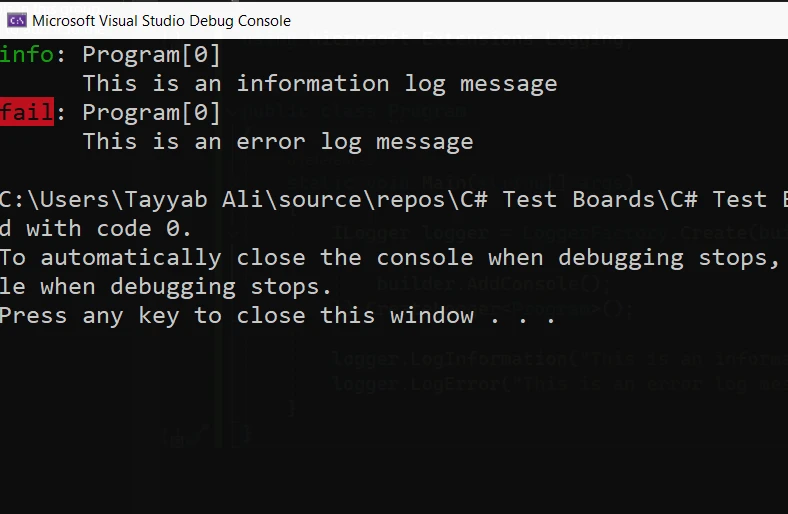
En el ejemplo anterior, el objeto ILogger llamado logger está configurado para enviar mensajes de registro a la consola. Esta configuración es simple pero fundamental para ayudarte a comprender cómo se generan y muestran los mensajes de registro.
Ficheros de registro y proveedores
En una aplicación del mundo real, a menudo necesitas almacenar mensajes de registro en un archivo u otro sistema de almacenamiento para su revisión posterior. Aquí es donde entran en juego los proveedores de registro. Los proveedores son componentes del marco de registro que manejan la salida de datos de registro a varios destinos, como archivos, bases de datos o servicios externos.
Por ejemplo, para configurar un registrador que escriba mensajes en un archivo, podrías usar un proveedor basado en archivos como FileLoggerProvider. Esto requiere modificar el archivo de configuración de la aplicación (a menudo appsettings.json en aplicaciones .NET) para especificar detalles como la ruta del archivo de registro y el nivel de registro mínimo.
{
  "Logging": {
    "LogLevel": {
      "Default": "Information", // Log levels for the application
      "Microsoft": "Warning"   // Log levels for Microsoft libraries
    },
    "File": {
      "Path": "logs/myapp.log" // File path for the log file
    }
  }
}
{
  "Logging": {
    "LogLevel": {
      "Default": "Information", // Log levels for the application
      "Microsoft": "Warning"   // Log levels for Microsoft libraries
    },
    "File": {
      "Path": "logs/myapp.log" // File path for the log file
    }
  }
}
JSON
La configuración especifica que todo el registro por defecto debe estar al nivel 'Información', pero las bibliotecas de Microsoft solo deben registrar advertencias y superiores. También dirige la salida de registro a un archivo de registro llamado myapp.log en un directorio logs.
Técnicas avanzadas de registro
Más allá de los mensajes de registro básicos, C# soporta el registro estructurado, que permite incluir datos estructurados en tus registros en lugar de solo texto plano. El registro estructurado facilita la búsqueda y análisis de datos de registro, ya que cada pieza de información contextual se almacena como un campo separado.
// Log message with structured data
logger.LogDebug("Processing order {OrderId} at {Timestamp}", orderId, DateTime.UtcNow);
// Log message with structured data
logger.LogDebug("Processing order {OrderId} at {Timestamp}", orderId, DateTime.UtcNow);
' Log message with structured data
logger.LogDebug("Processing order {OrderId} at {Timestamp}", orderId, DateTime.UtcNow)
' Log message with structured data
logger.LogDebug("Processing order {OrderId} at {Timestamp}", orderId, DateTime.UtcNow)
En este ejemplo de registro estructurado, OrderId y Timestamp son marcadores de posición dentro de la plantilla de mensaje que se completarán con los valores de orderId y DateTime.UtcNow respectivamente. Esto es más poderoso que el registro tradicional ya que permite una consulta y manipulación más fácil de los datos de registro basados en campos específicos dentro de cada entrada de registro.
Integración con sistemas externos
El registro en C# se puede extender para integrar con sistemas externos como SQL Server o el Registro de Eventos de Windows, mejorando la forma en que se gestionan y analizan los datos de registro. Al utilizar proveedores de registro especializados, los mensajes de registro se pueden dirigir a estos sistemas, proporcionando capacidades más robustas para el monitoreo y respuesta a errores.
// Direct log output to the Windows Event Log under a specific source name
builder.AddEventLog(new EventLogSettings
{
    SourceName = "MyApplication"
});
// Direct log output to the Windows Event Log under a specific source name
builder.AddEventLog(new EventLogSettings
{
    SourceName = "MyApplication"
});
' Direct log output to the Windows Event Log under a specific source name
builder.AddEventLog(New EventLogSettings With {.SourceName = "MyApplication"})
' Direct log output to the Windows Event Log under a specific source name
builder.AddEventLog(New EventLogSettings With {.SourceName = "MyApplication"})
Este fragmento de configuración dirige la salida de registro al Registro de Eventos de Windows bajo el nombre de origen 'MyApplication'. Esto es particularmente útil para aplicaciones que se ejecutan en servidores Windows donde el Registro de Eventos es una herramienta centralizada para monitorear mensajes de software y sistema.
Integración de IronPDF con el registro en C#
Conoce Más Sobre IronPDF para la Conversión de HTML a PDF es una biblioteca PDF de .NET que permite a los desarrolladores crear, manipular y renderizar PDFs. Convierte HTML a PDF, lo cual es un requisito común para generar informes, facturas y otros tipos de documentos a partir de contenido web. IronPDF proporciona un conjunto completo de características que atiende a varias tareas relacionadas con PDF, incluyendo la edición de texto e imágenes, asegurando documentos e incluso extrayendo contenido.
Combinar IronPDF con el registro en C# puede mejorar el manejo de errores y depuración al trabajar con archivos PDF. Al integrar el registro, puedes rastrear el proceso de generación de PDF y capturar cualquier problema o excepción que surja. Esta integración es particularmente útil en escenarios donde la generación de PDF es una parte crítica de la funcionalidad de la aplicación, como la generación dinámica de informes basados en datos de usuario.
Ejemplo de código
Para usar IronPDF junto con el registro en C#, necesitarás incorporar llamadas de registro dentro de tus operaciones PDF. Aquí hay un ejemplo de cómo podrías integrar estas dos tecnologías en una aplicación .NET. Este ejemplo asume que estás usando la interfaz ILogger de Microsoft.Extensions.Logging.
using IronPdf;
using Microsoft.Extensions.Logging;
using System;

public class PdfGenerator
{
    private readonly ILogger _logger;

    public PdfGenerator(ILogger<PdfGenerator> logger)
    {
        _logger = logger;
    }

    public void CreatePdfFromHtml(string htmlContent, string outputPath)
    {
        try
        {
            // Initialize PDF renderer
            var renderer = new ChromePdfRenderer();

            // Convert HTML content to PDF
            var pdf = renderer.RenderHtmlAsPdf(htmlContent);

            // Save the generated PDF to a file
            pdf.SaveAs(outputPath);

            // Log the success of PDF creation
            _logger.LogInformation("PDF created successfully at {OutputPath}", outputPath);
        }
        catch (Exception ex)
        {
            // Log any errors encountered during PDF creation
            _logger.LogError(ex, "Error creating PDF from HTML");
        }
    }
}

// Usage example
public class Program
{
    static void Main(string[] args)
    {
        // Set the license key for IronPDF, if applicable
        License.LicenseKey = "License-Key";

        // Create a logger factory to manage logging configurations
        ILoggerFactory loggerFactory = LoggerFactory.Create(builder =>
        {
            builder.AddConsole(); // Enable logging to the console
        });

        // Create a logger for the PdfGenerator class
        ILogger<PdfGenerator> logger = loggerFactory.CreateLogger<PdfGenerator>();

        // Instantiate the PDF generator
        PdfGenerator pdfGenerator = new PdfGenerator(logger);

        // Example HTML content and output path
        string htmlContent = "<h1>Hello, PDF!</h1><p>This is a simple PDF generated from HTML.</p>";
        string outputPath = "output.pdf";

        // Create a PDF from the provided HTML content
        pdfGenerator.CreatePdfFromHtml(htmlContent, outputPath);
    }
}
using IronPdf;
using Microsoft.Extensions.Logging;
using System;

public class PdfGenerator
{
    private readonly ILogger _logger;

    public PdfGenerator(ILogger<PdfGenerator> logger)
    {
        _logger = logger;
    }

    public void CreatePdfFromHtml(string htmlContent, string outputPath)
    {
        try
        {
            // Initialize PDF renderer
            var renderer = new ChromePdfRenderer();

            // Convert HTML content to PDF
            var pdf = renderer.RenderHtmlAsPdf(htmlContent);

            // Save the generated PDF to a file
            pdf.SaveAs(outputPath);

            // Log the success of PDF creation
            _logger.LogInformation("PDF created successfully at {OutputPath}", outputPath);
        }
        catch (Exception ex)
        {
            // Log any errors encountered during PDF creation
            _logger.LogError(ex, "Error creating PDF from HTML");
        }
    }
}

// Usage example
public class Program
{
    static void Main(string[] args)
    {
        // Set the license key for IronPDF, if applicable
        License.LicenseKey = "License-Key";

        // Create a logger factory to manage logging configurations
        ILoggerFactory loggerFactory = LoggerFactory.Create(builder =>
        {
            builder.AddConsole(); // Enable logging to the console
        });

        // Create a logger for the PdfGenerator class
        ILogger<PdfGenerator> logger = loggerFactory.CreateLogger<PdfGenerator>();

        // Instantiate the PDF generator
        PdfGenerator pdfGenerator = new PdfGenerator(logger);

        // Example HTML content and output path
        string htmlContent = "<h1>Hello, PDF!</h1><p>This is a simple PDF generated from HTML.</p>";
        string outputPath = "output.pdf";

        // Create a PDF from the provided HTML content
        pdfGenerator.CreatePdfFromHtml(htmlContent, outputPath);
    }
}
Imports IronPdf
Imports Microsoft.Extensions.Logging
Imports System
Public Class PdfGenerator
Private ReadOnly _logger As ILogger
Public Sub New(logger As ILogger(Of PdfGenerator))
_logger = logger
End Sub
Public Sub CreatePdfFromHtml(htmlContent As String, outputPath As String)
Try
' Initialize PDF renderer
Dim renderer As New ChromePdfRenderer()
' Convert HTML content to PDF
Dim pdf = renderer.RenderHtmlAsPdf(htmlContent)
' Save the generated PDF to a file
pdf.SaveAs(outputPath)
' Log the success of PDF creation
_logger.LogInformation("PDF created successfully at {OutputPath}", outputPath)
Catch ex As Exception
' Log any errors encountered during PDF creation
_logger.LogError(ex, "Error creating PDF from HTML")
End Try
End Sub
End Class
' Usage example
Public Class Program
Shared Sub Main(args As String())
' Set the license key for IronPDF, if applicable
License.LicenseKey = "License-Key"
' Create a logger factory to manage logging configurations
Dim loggerFactory As ILoggerFactory = LoggerFactory.Create(Sub(builder)
builder.AddConsole() ' Enable logging to the console
End Sub)
' Create a logger for the PdfGenerator class
Dim logger As ILogger(Of PdfGenerator) = loggerFactory.CreateLogger(Of PdfGenerator)()
' Instantiate the PDF generator
Dim pdfGenerator As New PdfGenerator(logger)
' Example HTML content and output path
Dim htmlContent As String = "<h1>Hello, PDF!</h1><p>This is a simple PDF generated from HTML.</p>"
Dim outputPath As String = "output.pdf"
' Create a PDF from the provided HTML content
pdfGenerator.CreatePdfFromHtml(htmlContent, outputPath)
End Sub
End Class
Imports IronPdf
Imports Microsoft.Extensions.Logging
Imports System

Public Class PdfGenerator
    Private ReadOnly _logger As ILogger

    Public Sub New(logger As ILogger(Of PdfGenerator))
        _logger = logger
    End Sub

    Public Sub CreatePdfFromHtml(htmlContent As String, outputPath As String)
        Try
            ' Initialize PDF renderer
            Dim renderer As New ChromePdfRenderer()

            ' Convert HTML content to PDF
            Dim pdf = renderer.RenderHtmlAsPdf(htmlContent)

            ' Save the generated PDF to a file
            pdf.SaveAs(outputPath)

            ' Log the success of PDF creation
            _logger.LogInformation("PDF created successfully at {OutputPath}", outputPath)
        Catch ex As Exception
            ' Log any errors encountered during PDF creation
            _logger.LogError(ex, "Error creating PDF from HTML")
        End Try
    End Sub
End Class

' Usage example
Public Class Program
    Shared Sub Main(args As String())
        ' Set the license key for IronPDF, if applicable
        License.LicenseKey = "License-Key"

        ' Create a logger factory to manage logging configurations
        Dim loggerFactory As ILoggerFactory = LoggerFactory.Create(Sub(builder)
            builder.AddConsole() ' Enable logging to the console
        End Sub)

        ' Create a logger for the PdfGenerator class
        Dim logger As ILogger(Of PdfGenerator) = loggerFactory.CreateLogger(Of PdfGenerator)()

        ' Instantiate the PDF generator
        Dim pdfGenerator As New PdfGenerator(logger)

        ' Example HTML content and output path
        Dim htmlContent As String = "<h1>Hello, PDF!</h1><p>This is a simple PDF generated from HTML.</p>"
        Dim outputPath As String = "output.pdf"

        ' Create a PDF from the provided HTML content
        pdfGenerator.CreatePdfFromHtml(htmlContent, outputPath)
    End Sub
End Class
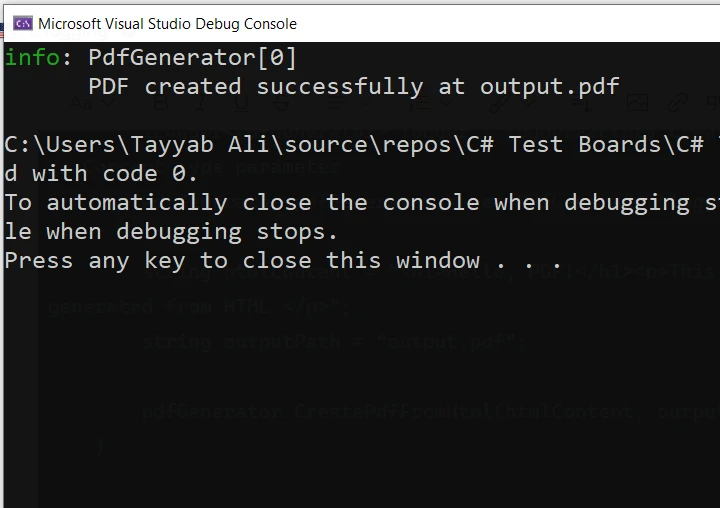
Esta configuración no solo facilita la generación de PDFs desde HTML, sino que también asegura que la operación esté bien documentada a través de registros, ayudando en el mantenimiento y resolución de problemas. Integrar el registro con IronPDF puede mejorar significativamente la confiabilidad y trazabilidad de las capacidades de manejo PDF de tu aplicación.
Conclusión
El registro en C# es una forma flexible y poderosa de capturar información detallada sobre la operación de tu aplicación. Mediante el uso de diferentes niveles de registro, configurando varios proveedores, e implementando el registro estructurado, los desarrolladores pueden crear un sistema de registro integral que mejora la mantenibilidad y capacidad de depuración de sus aplicaciones.
Pruebe IronPDF con una Licencia de prueba gratuita comenzando en $999.