Introducción a Jupyter Notebook
Jupyter Notebook es una aplicación web que te permite crear y compartir documentos que contienen fragmentos de código ejecutables en vivo, visualizaciones, ecuaciones y texto narrativo. Es un proyecto de código abierto reconocido por su robustez en ciencia de datos e investigación. Jupyter Notebook ahora ha adoptado completamente C# a través de la integración con .NET Core. Esta integración es fundamental para los desarrolladores de C# y los analistas de datos inclinados hacia las tecnologías .NET, ya que combina las ricas características de Jupyter Notebooks con la robustez de C# y el marco .NET para proporcionar experiencias más interactivas.
Comprensión de la integración con .NET Core
.NET Core es un marco versátil y multiplataforma de Microsoft que ahora funciona mano a mano con Jupyter Notebooks a través de la herramienta .NET Interactive. Esta combinación ofrece una plataforma poderosa para crear documentación interactiva rica, completa con fragmentos de código C# ejecutables. Con .NET Core, puedes aprovechar las fortalezas de C# y F# en un entorno interactivo, lo que lo hace ideal para tutoriales, análisis de datos y mucho más.
Cómo configurar Jupyter Notebook para C#
Para comenzar con Jupyter Notebooks en C#, es necesario instalar el SDK de .NET. Este Kit de Desarrollo de Software es una colección de bibliotecas y herramientas que capacitan a los desarrolladores para crear y ejecutar aplicaciones y servicios .NET. Una vez que tengas el SDK de .NET, el siguiente paso es instalar la herramienta .NET Interactive específica para Jupyter.
Instalación de la herramienta interactiva .NET
La herramienta .NET Interactive se puede instalar como una herramienta global en tu máquina usando el siguiente comando:
dotnet tool install --global Microsoft.dotnet-interactive
dotnet tool install --global Microsoft.dotnet-interactive
SHELL
Después de la instalación, esta herramienta te permite integrar C# con Jupyter ejecutando el siguiente comando para conectar la herramienta .NET Interactive con Jupyter:
dotnet interactive jupyter install
dotnet interactive jupyter install
SHELL
Cómo configurar su primer cuaderno de C#
Para crear un nuevo notebook en C# en Jupyter, ve al panel de Jupyter, luego haz clic en 'New' y selecciona 'C# (.NET Interactive)'. Esto crea un notebook en blanco, un lienzo donde puedes comenzar a escribir scripts en C#.
Trabajar con un núcleo de C# en Jupyter
En un Jupyter Notebook con un kernel de C#, puedes escribir y ejecutar código C# interactivamente en celdas. Cada celda en el notebook puede contener código, que puedes ejecutar de forma independiente. Esta característica es excelente para probar pequeños fragmentos de código o desarrollar tutoriales paso a paso. Por ejemplo, puedes escribir código C# simple en una nueva celda para mostrar una salida:
// Print a message to the console
Console.WriteLine("Hello, Jupyter Notebook C#!");
// Print a message to the console
Console.WriteLine("Hello, Jupyter Notebook C#!");
' Print a message to the console
Console.WriteLine("Hello, Jupyter Notebook C#!")
' Print a message to the console
Console.WriteLine("Hello, Jupyter Notebook C#!")
Características avanzadas en C# Jupyter Notebooks
La integración de Jupyter Notebooks de C# con Visual Studio Code mejora la experiencia de desarrollo, especialmente para aquellos acostumbrados al IDE de Microsoft. Dentro de VSCode, puedes utilizar el paleta de comandos para ejecutar comandos específicos de Jupyter y proporcionar una transición fluida entre diferentes entornos de desarrollo.
Documentación interactiva y ejecución de código
Una característica destacada de Jupyter Notebook es la capacidad de crear documentación interactiva. Esto significa que puedes escribir un fragmento de código, documentarlo y permitir que otros lo ejecuten y modifiquen directamente dentro del notebook. Es una manera poderosa de demostrar la funcionalidad del código y compartir conocimiento.
Gestión de Jupyter Notebooks
Para gestionar eficazmente Jupyter Notebooks, es esencial entender el funcionamiento del servidor Jupyter. Comandos como jupyter kernelspec list ayudan a listar todos los núcleos disponibles. Gestionar estos kernels es crucial para una experiencia fluida de múltiples idiomas en Jupyter.
Integración con Python y otros lenguajes
La flexibilidad de Jupyter Notebooks para admitir múltiples idiomas permite una integración perfecta entre Python y C#. Si también tienes instalado Python, puedes alternar entre los idiomas dentro del mismo notebook, convirtiéndolo en una ayuda invaluable para programación poliglota y análisis de datos. Aquí tienes un ejemplo de usar Python y C# en el mismo notebook:
# Python code
print("Hello from Python!")
# Python code
print("Hello from Python!")
Python
// C# code in another cell
Console.WriteLine("Hello from C#!");
// C# code in another cell
Console.WriteLine("Hello from C#!");
' C# code in another cell
Console.WriteLine("Hello from C#!")
' C# code in another cell
Console.WriteLine("Hello from C#!")
Integración de IronPDF con C# Jupyter Notebooks
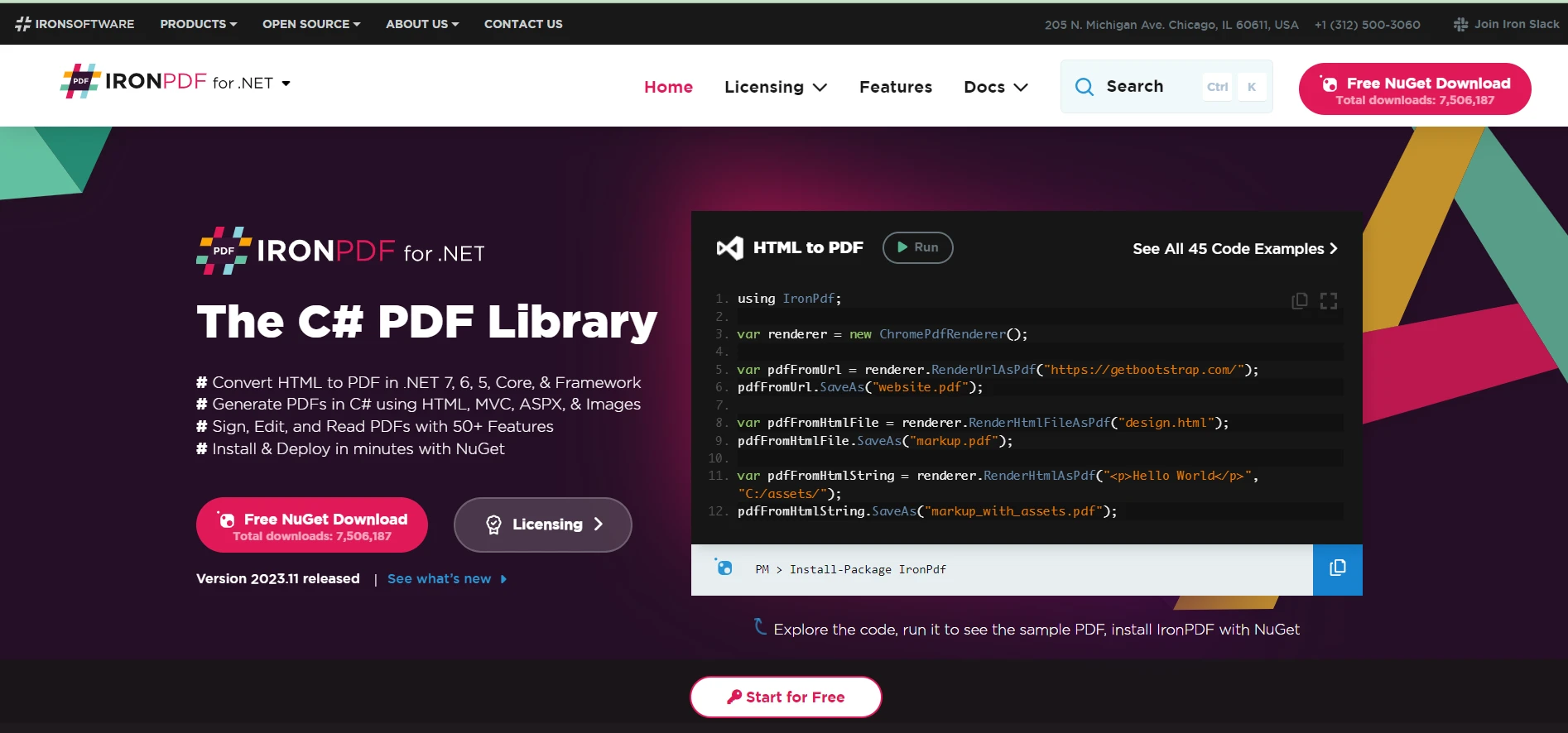
IronPDF for .NET PDF Solutions es una robusta biblioteca de C# diseñada para trabajar con archivos PDF, ofreciendo características como conversión de HTML a PDF, edición de PDF y más. Integrar IronPDF en un entorno de Jupyter Notebook puede mejorar en gran medida sus capacidades, especialmente para crear y manipular documentos PDF dentro del notebook.
IronPDF proporciona una API simple pero poderosa para desarrolladores de C#. Permite tareas como convertir páginas HTML a PDFs, generar PDFs a partir de cadenas HTML y guardar PDFs en rutas de archivo específicas.
En el contexto de Jupyter Notebooks, IronPDF puede servir como una extensión para un generador de documentación interactiva para C#. Permite a los usuarios no solo escribir y probar código C# para generar o manipular PDFs, sino también ver los resultados en tiempo real. Esta integración es especialmente beneficiosa para propósitos educativos, demostraciones o para producir documentación técnica rica e interactiva.
Conclusión
La expansión de Jupyter Notebook para incluir soporte para C# a través de Notebooks Interactivos de .NET es un hito para la comunidad .NET. Enriquece significativamente el ecosistema de Jupyter, introduciendo el poder y la conveniencia de la programación interactiva a desarrolladores y aficionados de C#.
Notablemente, IronPDF ofrece una prueba gratuita de las características de IronPDF para que los usuarios exploren sus capacidades en línea, y las licencias para la herramienta comienzan en $999, convirtiéndola en una inversión valiosa para profesionales que buscan funciones avanzadas de manipulación y generación de PDF en sus proyectos C#. Y si deseas saber más sobre la implementación de IronPDF o información general, el enlace al Blog de IronPDF sobre PDF y .NET está disponible.