using IronPdf;

// Disable local disk access or cross-origin requests
Installation.EnableWebSecurity = true;

// Instantiate Renderer
var renderer = new ChromePdfRenderer();

// Create a PDF from a HTML string using C#
var pdf = renderer.RenderHtmlAsPdf("<h1>Hello World</h1>");

// Export to a file or Stream
pdf.SaveAs("output.pdf");

// Advanced Example with HTML Assets
// Load external html assets: Images, CSS and JavaScript.
// An optional BasePath 'C:\site\assets\' is set as the file location to load assets from
var myAdvancedPdf = renderer.RenderHtmlAsPdf("<img src='icons/iron.png'>", @"C:\site\assets\");
myAdvancedPdf.SaveAs("html-with-assets.pdf");
using IronPdf;// Disable local disk access or cross-origin requestsInstallation.EnableWebSecurity = true;// Instantiate Renderervar renderer = new ChromePdfRenderer();// Create a PDF from a HTML string using C#var pdf = renderer.RenderHtmlAsPdf("<h1>Hello World</h1>");// Export to a file or Streampdf.SaveAs("output.pdf");// Advanced Example with HTML Assets// Load external html assets: Images, CSS and JavaScript.// An optional BasePath 'C:\site\assets\' is set as the file location to load assets fromvar myAdvancedPdf = renderer.RenderHtmlAsPdf("<img src='icons/iron.png'>", @"C:\site\assets\");myAdvancedPdf.SaveAs("html-with-assets.pdf");
PM >Install-Package IronPdf
Install-Package IronPdf
ACTUALIZACIONES PARA DESARROLLADORES
WebGrease .NET Core (Cómo Funciona para Desarrolladores)
La integración de WebGrease con IronPDF y .NET Core ofrece un método potente para producir documentos PDF de alta calidad y agilizar el rendimiento de aplicaciones web. Con el uso de compresión de JavaScript, optimización de imágenes y minificación de CSS, WebGrease es un paquete rico en funciones que hace que los sitios web funcionen más rápido y con mayor fluidez para los desarrolladores. Los desarrolladores pueden crear fácilmente PDFs dinámicos de varias fuentes, incluyendo vistas HTML y MVC, utilizando IronPDF, un potente kit de herramientas .NET para producir y manipular documentos PDF.
Las aplicaciones web se mantienen fluidas y adaptables con esta integración, permitiendo una gestión eficiente de recursos y generación dinámica de PDFs. WebGrease e IronPDF son totalmente compatibles con .NET Core, permitiendo a los desarrolladores crear aplicaciones multiplataforma que funcionen perfectamente en [Linux](https://en.wikipedia.org/wiki/Linux), macOS y Windows. Esto resulta en una experiencia de usuario mejorada gracias a un rendimiento optimizado y un manejo superior de documentos.
## ¿Qué es WebGrease?
Creado originalmente como componente de la pila de ASP.NET, [WebGrease](https://www.nuget.org/packages/WebGrease/) es una herramienta para automatizar procesos como optimización de JavaScript, compresión, optimización de imágenes, y minificación de CSS de archivos estáticos para mejorar el rendimiento web. Estas optimizaciones contribuyen a la reducción de tamaños de recursos web, lo que mejora el rendimiento de las aplicaciones web y acelera los tiempos de carga.
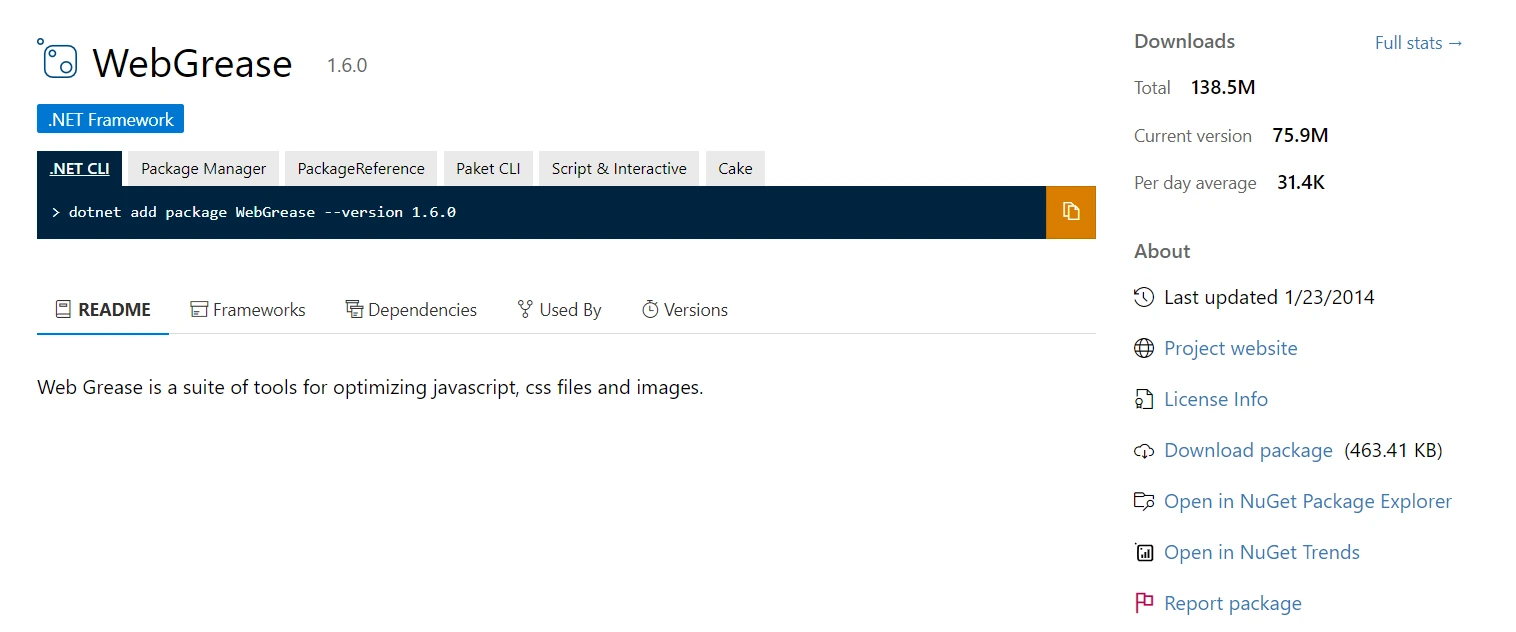
En el contexto de .NET Core, cuando hablamos de WebGrease, nos referimos a la aplicación de estos métodos de optimización a aplicaciones .NET Core. Microsoft creó el framework .NET Core multiplataforma y de código abierto para permitir a los desarrolladores crear aplicaciones innovadoras, escalables y de alto rendimiento. Los desarrolladores pueden aplicar técnicas de optimización de rendimiento de aplicaciones tradicionales ASP.NET a sus proyectos .NET Core integrando WebGrease. De esta forma, los desarrolladores pueden asegurarse de que sus aplicaciones web sean eficientes y de alto rendimiento en diversas plataformas, como Windows, Linux y macOS.
### Características de WebGrease
Dentro del marco de .NET Core, WebGrease proporciona una serie de capacidades dirigidas a mejorar la efectividad y velocidad de las aplicaciones web. Las características más destacadas son las siguientes:
**Minificación CSS:**
- Elimina formato superfluo, comentarios y espacios en blanco de archivos CSS.
- Reduce las solicitudes HTTP combinando varios archivos CSS en un solo archivo.
- Mejora el rendimiento y acelera los tiempos de carga del CSS.
**Compresión JavaScript:**
- Minimiza los archivos JavaScript eliminando caracteres innecesarios.
- Combina múltiples archivos JavaScript en uno.
- Reduce el tamaño de los archivos JavaScript para acelerar los tiempos de descarga y ejecución.
**Optimización de Imágenes:**
- Comprime imágenes sin reducir significativamente la calidad.
- Convierte imágenes a formatos más eficientes cuando es apropiado.
- Optimiza recursos de imágenes para aumentar las velocidades de carga.
**Minificación HTML:**
- Elimina espacios en blanco y comentarios de archivos HTML.
- Simplifica HTML para un análisis y representación más rápidos.
**Agrupamiento de Recursos:**
- Combina varios archivos JavaScript y CSS en un solo archivo.
- Reduce el número de solicitudes HTTP necesarias para cargar una página, mejorando los tiempos de carga.
**Flexibilidad de Configuración:**
- Ofrece opciones para configurar el proceso de optimización.
- Permite a los desarrolladores elegir qué directorios y archivos optimizar o excluir.
**Compatibilidad Multiplataforma:**
- Totalmente compatible con .NET Core, permitiendo su uso en Windows, Linux y macOS.
- Asegura que las mejoras de rendimiento funcionen bien en diversos entornos.
**Integración con Procesos de Compilación:**
- Puede integrarse en procedimientos de construcción para optimizar automáticamente recursos durante el despliegue y desarrollo.
- Soporta procesos automatizados para asegurar una optimización constante a lo largo de las fases de desarrollo.
**Rendimiento Mejorado:**
- Minimiza los recursos que deben cargarse, mejorando así el rendimiento general de las aplicaciones web.
- Mejora la experiencia del usuario y acelera la carga de páginas.
### Crear y configurar WebGrease
Para usar WebGrease en una aplicación .NET Core, instale los paquetes necesarios, configure el proceso de construcción y establezca tareas de optimización. Los siguientes pasos le ayudarán a establecer y configurar WebGrease en una aplicación .NET Core:
### Crear un proyecto .NET Core
Primero, cree una nueva aplicación web .NET Core. Puede utilizar la CLI de .NET para este propósito.
```bash
dotnet new web -n WebGreaseApp
cd WebGreaseApp
```
### Añadir paquetes necesarios
Aunque no existe un paquete directo de .NET Core para WebGrease, puede lograr una funcionalidad similar con otros programas como BundlerMinifier. Agregue este paquete a su proyecto.
```bash
dotnet add package BundlerMinifier.Core
```
### Configurar la agrupación y la minificación
Crea un archivo `bundleconfig.json` en la raíz de tu proyecto para proporcionar la configuración de combinación y minificación para tus archivos CSS y JavaScript. Aquí hay un ejemplo de configuración.
```json
[
{
"outputFileName": "wwwroot/css/site.min.css",
"inputFiles": [
"wwwroot/css/site.css"
],
"minify": {
"enabled": true,
"renameLocals": true
}
},
{
"outputFileName": "wwwroot/js/site.min.js",
"inputFiles": [
"wwwroot/js/site.js"
],
"minify": {
"enabled": true
}
}
]
```
### Integración con el proceso de compilación
Añada instrucciones para ejecutar las operaciones de agrupación y minificación durante el proceso de construcción en su archivo de proyecto (.csproj).
Agrega el siguiente elemento dentro del elemento `<Project>` en tu archivo .csproj:
```xml
<Target Name="PrepublishScript" BeforeTargets="PrepareForPublish">
<Exec Command="dotnet bundle" />
</Target>
```
#### Instalar y ejecutar BundlerMinifier
Para usar la herramienta BundlerMinifier, debe instalar la utilidad .NET. Ejecute el siguiente comando:
```bash
dotnet tool install -g BundlerMinifier.Core
```
Para agrupar y minificar sus archivos, ejecute:
```bash
dotnet bundle
```
#### Optimizar imágenes
Puede usar ImageSharp u otras herramientas de optimización de imágenes compatibles con .NET Core para la optimización de imágenes.
#### Instalar ImageSharp
Instale el paquete SixLabors.ImageSharp:
```bash
dotnet add package SixLabors.ImageSharp
```
Aquí hay un ejemplo de un fragmento de código para la optimización de imágenes:
```csharp
using SixLabors.ImageSharp;
using SixLabors.ImageSharp.Processing;
using System.IO;
public void OptimizeImage(string inputPath, string outputPath)
{
// Load the image
using (var image = Image.Load(inputPath))
{
// Resize and optimize the image
image.Mutate(x => x.Resize(new ResizeOptions
{
Mode = ResizeMode.Max,
Size = new Size(800, 600)
}));
// Save the image in an optimized format
image.Save(outputPath); // Automatic encoder selected based on file extension.
}
}
```
Ejecute su aplicación para asegurarse de que la agrupación y minificación funcionen según lo previsto. Abra su aplicación en el navegador, luego verifique que los archivos JavaScript y CSS estén minificados.
Siguiendo estos pasos, puede establecer y configurar una optimización similar a WebGrease para una aplicación .NET Core utilizando herramientas compatibles con el entorno .NET actual.
## Introducción a IronPDF
Configurar la optimización de rendimiento para sus recursos web y utilizar IronPDF para la generación y manipulación de PDFs son necesarios para integrar una optimización similar a WebGrease con IronPDF en una aplicación .NET Core. Aquí le mostramos cómo comenzar, paso a paso:
### ¿Qué es IronPDF?
La completa biblioteca .NET [IronPDF](https://ironpdf.com) permite a programas en C# producir, leer y editar documentos PDF. Con este programa, los desarrolladores pueden convertir fácilmente información HTML, CSS y JavaScript en PDFs de alta calidad y listos para imprimir. Entre las tareas más cruciales están agregar encabezados y pies de página, dividir y combinar PDFs, agregar marcas de agua a documentos y convertir HTML a PDF.
IronPDF es útil para una variedad de aplicaciones porque soporta tanto .NET Framework como .NET Core. Debido a que los PDFs son fáciles de usar e incluyen contenido extenso, los desarrolladores pueden incorporarlos fácilmente a sus productos. Debido a que IronPDF puede manejar diseños y formatos de datos complejos, los PDFs que genera como salida reflejan de manera cercana al texto HTML proporcionado originalmente por el cliente.
### Características de IronPDF
**Generación de PDF desde HTML**
- Convierte JavaScript, HTML y CSS a PDF.
- Soporta consultas de medios y diseño responsivo, alineándose con los estándares web modernos.
- Útil para decorar dinámicamente documentos PDF, reportes y facturas utilizando HTML y CSS.
**Edición de PDF**
- Permite la adición de texto, imágenes y otro contenido a PDFs existentes.
- Extrae texto e imágenes de archivos PDF.
- Fusiona múltiples PDFs en uno.
- Divide archivos PDF en documentos separados.
- Incluye marcas de agua, anotaciones, encabezados y pies de página.
**Conversión de PDF**
- Convierte una gran variedad de formatos de archivo a PDF, incluyendo Word, Excel, y archivos de imagen.
- Permite la conversión de PDF a imagen (PNG, JPEG, etc.).
**Rendimiento y Fiabilidad**
- Alto rendimiento y fiabilidad, adecuado para aplicaciones industriales.
- Maneja conjuntos de documentos grandes con facilidad.
### Instalar IronPDF
Para obtener las herramientas que necesitas para trabajar con PDFs en proyectos .NET, instala el paquete IronPDF.
```bash
:InstallCmd dotnet add package IronPdf
```
#### Configurar la agrupación y la minificación
Asegúrate de que el archivo de configuración `bundleconfig.json` esté disponible para proporcionar nuevamente la configuración de combinación y minificación según sea necesario:
```json
[
{
"outputFileName": "wwwroot/css/site.min.css",
"inputFiles": [
"wwwroot/css/site.css"
],
"minify": {
"enabled": true,
"renameLocals": true
}
},
{
"outputFileName": "wwwroot/js/site.min.js",
"inputFiles": [
"wwwroot/js/site.js"
],
"minify": {
"enabled": true
}
}
]
```
#### Conéctese al proceso de construcción
Asegúrese de que su archivo .csproj contenga instrucciones para ejecutar las operaciones de minificación y agrupación durante el proceso de construcción. Agrega el siguiente Target dentro del elemento `<Project>`:
```xml
<Target Name="PrepublishScript" BeforeTargets="PrepareForPublish">
<Exec Command="dotnet bundle" />
</Target>
```
#### Integrar IronPDF
Construya un controlador con IronPDF para producir PDFs. Cree un nuevo controlador PdfController.
```csharp
using Microsoft.AspNetCore.Mvc;
using IronPdf;
namespace WebGreaseIronPdfApp.Controllers
{
public class PdfController : Controller
{
public IActionResult GeneratePdf()
{
// Create a PDF from a simple HTML string
var renderer = new ChromePdfRenderer();
var pdf = renderer.RenderHtmlAsPdf("<h1>Hello, IronPDF!</h1><p>This is a generated PDF document.</p>");
// Save the PDF to a byte array
var pdfBytes = pdf.BinaryData;
// Return the PDF file as a download
return File(pdfBytes, "application/pdf", "example.pdf");
}
}
}
```
Lo primero que hacemos en el código de PdfController es importar los espacios de nombres requeridos, que son Microsoft.AspNetCore.Mvc para funcionalidad MVC de ASP.NET Core e IronPDF para la generación de PDFs. Debido a que deriva de Controller, la clase PdfController es un controlador MVC. El método `GeneratePdf` en esta clase está definido para gestionar la creación de PDFs.
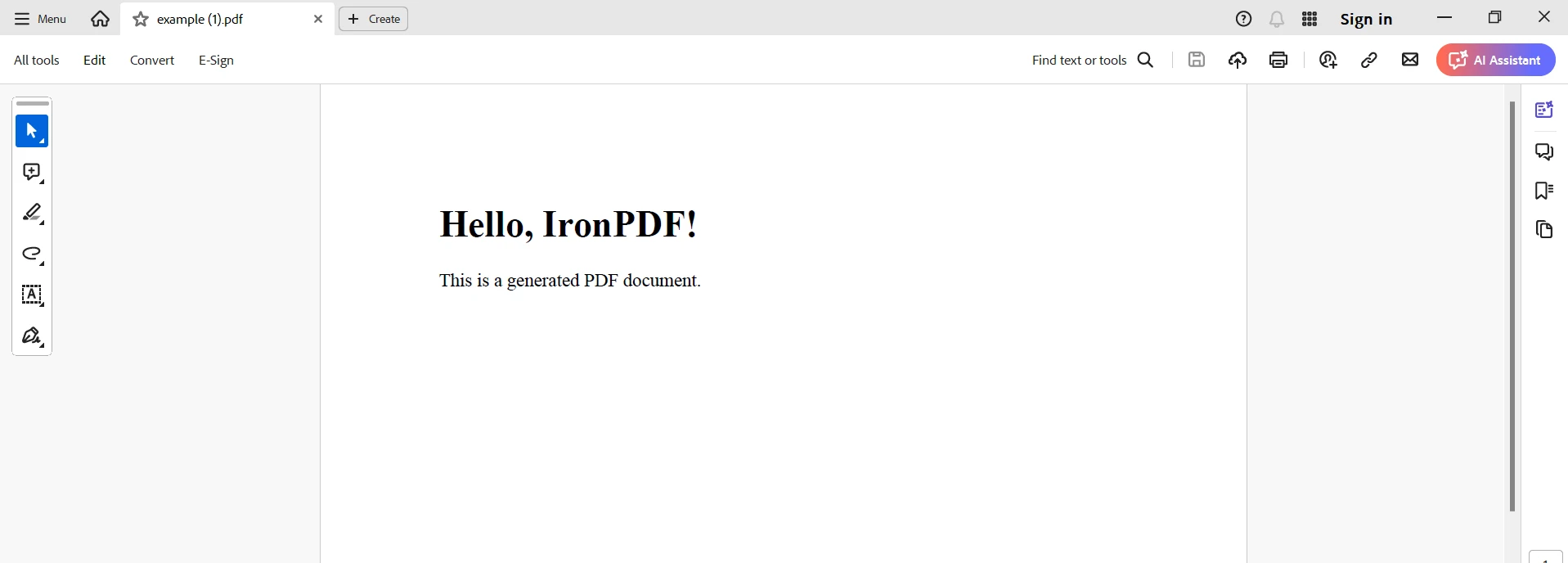
Para convertir material HTML en un PDF, esta función crea una instancia del `ChromePdfRenderer` de IronPDF. Una cadena HTML básica puede transformarse en un documento PDF usando la función `RenderHtmlAsPdf`. El atributo `BinaryData` se usa luego para guardar este PDF en un arreglo de bytes. Por último, el archivo PDF se devuelve como una respuesta descargable usando el método `File`, junto con el nombre de archivo solicitado (`example.pdf`) y el tipo MIME correcto (`application/pdf`). El programa ahora puede crear y servir documentos PDF dinámicamente basados en contenido HTML gracias a esta integración.
#### Ruta para generar PDF
Asegúrate de que el enrutamiento de generación de PDF esté incluido en tu archivo `Startup.cs`.
```csharp
public void Configure(IApplicationBuilder app, IWebHostEnvironment env)
{
if (env.IsDevelopment())
{
app.UseDeveloperExceptionPage();
}
else
{
app.UseExceptionHandler("/Home/Error");
app.UseHsts();
}
app.UseHttpsRedirection();
app.UseStaticFiles();
app.UseRouting();
app.UseAuthorization();
app.UseEndpoints(endpoints =>
{
endpoints.MapControllerRoute(
name: "default",
pattern: "{controller=Home}/{action=Index}/{id?}");
endpoints.MapControllerRoute(
name: "pdf",
pattern: "pdf",
defaults: new { controller = "Pdf", action = "GeneratePdf" });
});
}
```
#### Ejecutar y verificar
Ejecute su aplicación para asegurarse de que puede crear PDFs y de que la agrupación y minificación funcionan correctamente.
```bash
dotnet run
```
Abra el navegador y navegue hasta su aplicación. Debería ser posible navegar a `/pdf` y descargar un documento PDF.
## Conclusión
IronPDF y la optimización similar a WebGrease combinados proporcionan una combinación potente para mejorar el rendimiento online y producir documentos PDF de alta calidad en aplicaciones .NET Core. Los desarrolladores pueden asegurar que sus aplicaciones sean eficientes y flexibles utilizando herramientas como IronPDF para crear PDFs y BundlerMinifier para optimizar recursos. Además de la compresión de imágenes, las estrategias de optimización de recursos como la minificación de CSS y JavaScript también ayudan a acelerar las cargas de página y mejorar la experiencia del usuario. Conjuntamente, IronPDF tiene capacidades sólidas para crear PDFs dinámicamente a partir de texto HTML, simplificando el proceso de crear documentos bien preparados como facturas, reportes y más.
Esta integración proporciona una solución completa para las necesidades de desarrollo web contemporáneo dentro del marco .NET Core, no solo mejorando el rendimiento de la aplicación online sino también añadiendo características útiles para procesar PDFs.
Con [IronPDF](licensing) y [Iron Software](https://ironsoftware.com/), puede mejorar su herramienta para desarrollo .NET aprovechando el OCR, escaneo de códigos de barras, creación de PDFs, conectividad con Excel, y mucho más. A partir de un precio competitivo, IronPDF ofrece a los desarrolladores acceso a más aplicaciones web y características, junto con un desarrollo más eficiente, al combinar sus conceptos centrales con la caja de herramientas altamente flexible de Iron Software.
Las opciones de licencia bien definidas para el proyecto facilitan para los desarrolladores seleccionar el modelo óptimo, asistiendo en la ejecución pronta, bien organizada y eficiente de soluciones para una amplia gama de problemas.
La integración de WebGrease con IronPDF y .NET Core ofrece un método potente para producir documentos PDF de alta calidad y agilizar el rendimiento de aplicaciones web. Con el uso de compresión de JavaScript, optimización de imágenes y minificación de CSS, WebGrease es un paquete rico en funciones que hace que los sitios web funcionen más rápido y con mayor fluidez para los desarrolladores. Los desarrolladores pueden crear fácilmente PDFs dinámicos de varias fuentes, incluyendo vistas HTML y MVC, utilizando IronPDF, un potente kit de herramientas .NET para producir y manipular documentos PDF.
Las aplicaciones web se mantienen fluidas y adaptables con esta integración, permitiendo una gestión eficiente de recursos y generación dinámica de PDFs. WebGrease e IronPDF son totalmente compatibles con .NET Core, permitiendo a los desarrolladores crear aplicaciones multiplataforma que funcionen perfectamente en Linux, macOS y Windows. Esto resulta en una experiencia de usuario mejorada gracias a un rendimiento optimizado y un manejo superior de documentos.
¿Qué es WebGrease?
Creado originalmente como componente de la pila de ASP.NET, WebGrease es una herramienta para automatizar procesos como optimización de JavaScript, compresión, optimización de imágenes, y minificación de CSS de archivos estáticos para mejorar el rendimiento web. Estas optimizaciones contribuyen a la reducción de tamaños de recursos web, lo que mejora el rendimiento de las aplicaciones web y acelera los tiempos de carga.
En el contexto de .NET Core, cuando hablamos de WebGrease, nos referimos a la aplicación de estos métodos de optimización a aplicaciones .NET Core. Microsoft creó el framework .NET Core multiplataforma y de código abierto para permitir a los desarrolladores crear aplicaciones innovadoras, escalables y de alto rendimiento. Los desarrolladores pueden aplicar técnicas de optimización de rendimiento de aplicaciones tradicionales ASP.NET a sus proyectos .NET Core integrando WebGrease. De esta forma, los desarrolladores pueden asegurarse de que sus aplicaciones web sean eficientes y de alto rendimiento en diversas plataformas, como Windows, Linux y macOS.
Características de WebGrease
Dentro del marco de .NET Core, WebGrease proporciona una serie de capacidades dirigidas a mejorar la efectividad y velocidad de las aplicaciones web. Las características más destacadas son las siguientes:
Minificación CSS:
Elimina formato superfluo, comentarios y espacios en blanco de archivos CSS.
Reduce las solicitudes HTTP combinando varios archivos CSS en un solo archivo.
Mejora el rendimiento y acelera los tiempos de carga del CSS.
Compresión JavaScript:
Minimiza los archivos JavaScript eliminando caracteres innecesarios.
Combina múltiples archivos JavaScript en uno.
Reduce el tamaño de los archivos JavaScript para acelerar los tiempos de descarga y ejecución.
Optimización de Imágenes:
Comprime imágenes sin reducir significativamente la calidad.
Convierte imágenes a formatos más eficientes cuando es apropiado.
Optimiza recursos de imágenes para aumentar las velocidades de carga.
Minificación HTML:
Elimina espacios en blanco y comentarios de archivos HTML.
Simplifica HTML para un análisis y representación más rápidos.
Agrupamiento de Recursos:
Combina varios archivos JavaScript y CSS en un solo archivo.
Reduce el número de solicitudes HTTP necesarias para cargar una página, mejorando los tiempos de carga.
Flexibilidad de Configuración:
Ofrece opciones para configurar el proceso de optimización.
Permite a los desarrolladores elegir qué directorios y archivos optimizar o excluir.
Compatibilidad Multiplataforma:
Totalmente compatible con .NET Core, permitiendo su uso en Windows, Linux y macOS.
Asegura que las mejoras de rendimiento funcionen bien en diversos entornos.
Integración con Procesos de Compilación:
Puede integrarse en procedimientos de construcción para optimizar automáticamente recursos durante el despliegue y desarrollo.
Soporta procesos automatizados para asegurar una optimización constante a lo largo de las fases de desarrollo.
Rendimiento Mejorado:
Minimiza los recursos que deben cargarse, mejorando así el rendimiento general de las aplicaciones web.
Mejora la experiencia del usuario y acelera la carga de páginas.
Crear y configurar WebGrease
Para usar WebGrease en una aplicación .NET Core, instale los paquetes necesarios, configure el proceso de construcción y establezca tareas de optimización. Los siguientes pasos le ayudarán a establecer y configurar WebGrease en una aplicación .NET Core:
Crear un proyecto .NET Core
Primero, cree una nueva aplicación web .NET Core. Puede utilizar la CLI de .NET para este propósito.
dotnet new web -n WebGreaseAppcd WebGreaseApp
dotnet new web -n WebGreaseApp
cd WebGreaseApp
SHELL
Añadir paquetes necesarios
Aunque no existe un paquete directo de .NET Core para WebGrease, puede lograr una funcionalidad similar con otros programas como BundlerMinifier. Agregue este paquete a su proyecto.
dotnet add package BundlerMinifier.Core
dotnet add package BundlerMinifier.Core
SHELL
Configurar la agrupación y la minificación
Crea un archivo bundleconfig.json en la raíz de tu proyecto para proporcionar la configuración de combinación y minificación para tus archivos CSS y JavaScript. Aquí hay un ejemplo de configuración.
Para usar la herramienta BundlerMinifier, debe instalar la utilidad .NET. Ejecute el siguiente comando:
dotnet tool install -g BundlerMinifier.Core
dotnet tool install -g BundlerMinifier.Core
SHELL
Para agrupar y minificar sus archivos, ejecute:
dotnet bundle
dotnet bundle
SHELL
Optimizar imágenes
Puede usar ImageSharp u otras herramientas de optimización de imágenes compatibles con .NET Core para la optimización de imágenes.
Instalar ImageSharp
Instale el paquete SixLabors.ImageSharp:
dotnet add package SixLabors.ImageSharp
dotnet add package SixLabors.ImageSharp
SHELL
Aquí hay un ejemplo de un fragmento de código para la optimización de imágenes:
using SixLabors.ImageSharp;using SixLabors.ImageSharp.Processing;using System.IO;public voidOptimizeImage(string inputPath, string outputPath){ // Load the image using (var image = Image.Load(inputPath)) { // Resize and optimize the image image.Mutate(x => x.Resize(new ResizeOptions {Mode = ResizeMode.Max,Size = new Size(800, 600) })); // Save the image in an optimized format image.Save(outputPath); // Automatic encoder selected based on file extension. }}
using SixLabors.ImageSharp;
using SixLabors.ImageSharp.Processing;
using System.IO;

public void OptimizeImage(string inputPath, string outputPath)
{
    // Load the image
    using (var image = Image.Load(inputPath))
    {
        // Resize and optimize the image
        image.Mutate(x => x.Resize(new ResizeOptions
        {
            Mode = ResizeMode.Max,
            Size = new Size(800, 600)
        }));
        // Save the image in an optimized format
        image.Save(outputPath); // Automatic encoder selected based on file extension.
    }
}
ImportsSixLabors.ImageSharpImportsSixLabors.ImageSharp.ProcessingImportsSystem.IOPublic Sub OptimizeImage(ByVal inputPath AsString, ByVal outputPath AsString) ' Load the imageUsing image = System.Drawing.Image.Load(inputPath) ' Resize and optimize the image image.Mutate(Function(x) x.Resize(New ResizeOptionsWith { .Mode = ResizeMode.Max, .Size = New Size(800, 600) })) ' Save the image in an optimized format image.Save(outputPath) ' Automatic encoder selected based on file extension.EndUsingEnd Sub
Imports SixLabors.ImageSharp
Imports SixLabors.ImageSharp.Processing
Imports System.IO

Public Sub OptimizeImage(ByVal inputPath As String, ByVal outputPath As String)
	' Load the image
	Using image = System.Drawing.Image.Load(inputPath)
		' Resize and optimize the image
		image.Mutate(Function(x) x.Resize(New ResizeOptions With {
			.Mode = ResizeMode.Max,
			.Size = New Size(800, 600)
		}))
		' Save the image in an optimized format
		image.Save(outputPath) ' Automatic encoder selected based on file extension.
	End Using
End Sub
Ejecute su aplicación para asegurarse de que la agrupación y minificación funcionen según lo previsto. Abra su aplicación en el navegador, luego verifique que los archivos JavaScript y CSS estén minificados.
Siguiendo estos pasos, puede establecer y configurar una optimización similar a WebGrease para una aplicación .NET Core utilizando herramientas compatibles con el entorno .NET actual.
Introducción a IronPDF
Configurar la optimización de rendimiento para sus recursos web y utilizar IronPDF para la generación y manipulación de PDFs son necesarios para integrar una optimización similar a WebGrease con IronPDF en una aplicación .NET Core. Aquí le mostramos cómo comenzar, paso a paso:
¿Qué es IronPDF?
La completa biblioteca .NET IronPDF permite a programas en C# producir, leer y editar documentos PDF. Con este programa, los desarrolladores pueden convertir fácilmente información HTML, CSS y JavaScript en PDFs de alta calidad y listos para imprimir. Entre las tareas más cruciales están agregar encabezados y pies de página, dividir y combinar PDFs, agregar marcas de agua a documentos y convertir HTML a PDF.
IronPDF es útil para una variedad de aplicaciones porque soporta tanto .NET Framework como .NET Core. Debido a que los PDFs son fáciles de usar e incluyen contenido extenso, los desarrolladores pueden incorporarlos fácilmente a sus productos. Debido a que IronPDF puede manejar diseños y formatos de datos complejos, los PDFs que genera como salida reflejan de manera cercana al texto HTML proporcionado originalmente por el cliente.
Características de IronPDF
Generación de PDF desde HTML
Convierte JavaScript, HTML y CSS a PDF.
Soporta consultas de medios y diseño responsivo, alineándose con los estándares web modernos.
Útil para decorar dinámicamente documentos PDF, reportes y facturas utilizando HTML y CSS.
Edición de PDF
Permite la adición de texto, imágenes y otro contenido a PDFs existentes.
Extrae texto e imágenes de archivos PDF.
Fusiona múltiples PDFs en uno.
Divide archivos PDF en documentos separados.
Incluye marcas de agua, anotaciones, encabezados y pies de página.
Conversión de PDF
Convierte una gran variedad de formatos de archivo a PDF, incluyendo Word, Excel, y archivos de imagen.
Permite la conversión de PDF a imagen (PNG, JPEG, etc.).
Rendimiento y Fiabilidad
Alto rendimiento y fiabilidad, adecuado para aplicaciones industriales.
Maneja conjuntos de documentos grandes con facilidad.
Instalar IronPDF
Para obtener las herramientas que necesitas para trabajar con PDFs en proyectos .NET, instala el paquete IronPDF.
> dotnet add package IronPdf
dotnet add package IronPdf
Configurar la agrupación y la minificación
Asegúrate de que el archivo de configuración bundleconfig.json esté disponible para proporcionar nuevamente la configuración de combinación y minificación según sea necesario:
Asegúrese de que su archivo .csproj contenga instrucciones para ejecutar las operaciones de minificación y agrupación durante el proceso de construcción. Agrega el siguiente Target dentro del elemento <Project>:
Construya un controlador con IronPDF para producir PDFs. Cree un nuevo controlador PdfController.
using Microsoft.AspNetCore.Mvc;using IronPdf;namespace WebGreaseIronPdfApp.Controllers{ public class PdfController : Controller { public IActionResultGeneratePdf() { // Create a PDF from a simple HTML string var renderer = new ChromePdfRenderer(); var pdf = renderer.RenderHtmlAsPdf("<h1>Hello, IronPDF!</h1><p>This is a generated PDF document.</p>"); // Save the PDF to a byte array var pdfBytes = pdf.BinaryData; // Return the PDF file as a download returnFile(pdfBytes, "application/pdf", "example.pdf"); } }}
using Microsoft.AspNetCore.Mvc;
using IronPdf;

namespace WebGreaseIronPdfApp.Controllers
{
    public class PdfController : Controller
    {
        public IActionResult GeneratePdf()
        {
            // Create a PDF from a simple HTML string
            var renderer = new ChromePdfRenderer();
            var pdf = renderer.RenderHtmlAsPdf("<h1>Hello, IronPDF!</h1><p>This is a generated PDF document.</p>");

            // Save the PDF to a byte array
            var pdfBytes = pdf.BinaryData;

            // Return the PDF file as a download
            return File(pdfBytes, "application/pdf", "example.pdf");
        }
    }
}
ImportsMicrosoft.AspNetCore.MvcImportsIronPdfNamespaceWebGreaseIronPdfApp.Controllers Public Class PdfControllerInheritsController Public Function GeneratePdf() AsIActionResult ' Create a PDF from a simple HTML string Dim renderer = New ChromePdfRenderer() Dim pdf = renderer.RenderHtmlAsPdf("<h1>Hello, IronPDF!</h1><p>This is a generated PDF document.</p>") ' Save the PDF to a byte array Dim pdfBytes = pdf.BinaryData ' Return the PDF file as a download ReturnFile(pdfBytes, "application/pdf", "example.pdf") End Function End ClassEndNamespace
Imports Microsoft.AspNetCore.Mvc
Imports IronPdf

Namespace WebGreaseIronPdfApp.Controllers
    Public Class PdfController
        Inherits Controller

        Public Function GeneratePdf() As IActionResult
            ' Create a PDF from a simple HTML string
            Dim renderer = New ChromePdfRenderer()
            Dim pdf = renderer.RenderHtmlAsPdf("<h1>Hello, IronPDF!</h1><p>This is a generated PDF document.</p>")

            ' Save the PDF to a byte array
            Dim pdfBytes = pdf.BinaryData

            ' Return the PDF file as a download
            Return File(pdfBytes, "application/pdf", "example.pdf")
        End Function
    End Class
End Namespace
Lo primero que hacemos en el código de PdfController es importar los espacios de nombres requeridos, que son Microsoft.AspNetCore.Mvc para funcionalidad MVC de ASP.NET Core e IronPDF para la generación de PDFs. Debido a que deriva de Controller, la clase PdfController es un controlador MVC. El método GeneratePdf en esta clase está definido para gestionar la creación de PDFs.
Para convertir material HTML en un PDF, esta función crea una instancia del ChromePdfRenderer de IronPDF. Una cadena HTML básica puede transformarse en un documento PDF usando la función RenderHtmlAsPdf. El atributo BinaryData se usa luego para guardar este PDF en un arreglo de bytes. Por último, el archivo PDF se devuelve como una respuesta descargable usando el método File, junto con el nombre de archivo solicitado (example.pdf) y el tipo MIME correcto (application/pdf). El programa ahora puede crear y servir documentos PDF dinámicamente basados en contenido HTML gracias a esta integración.
Ruta para generar PDF
Asegúrate de que el enrutamiento de generación de PDF esté incluido en tu archivo Startup.cs.
Public Sub Configure(app AsIApplicationBuilder, env AsIWebHostEnvironment) If env.IsDevelopment() Then app.UseDeveloperExceptionPage() Else app.UseExceptionHandler("/Home/Error") app.UseHsts() End If app.UseHttpsRedirection() app.UseStaticFiles() app.UseRouting() app.UseAuthorization() app.UseEndpoints(Sub(endpoints) endpoints.MapControllerRoute( name: "default", pattern: "{controller=Home}/{action=Index}/{id?}") endpoints.MapControllerRoute( name: "pdf", pattern: "pdf", defaults:=New With {.controller = "Pdf", .action = "GeneratePdf"}) End Sub)End Sub
Public Sub Configure(app As IApplicationBuilder, env As IWebHostEnvironment)
    If env.IsDevelopment() Then
        app.UseDeveloperExceptionPage()
    Else
        app.UseExceptionHandler("/Home/Error")
        app.UseHsts()
    End If
    app.UseHttpsRedirection()
    app.UseStaticFiles()
    app.UseRouting()
    app.UseAuthorization()
    app.UseEndpoints(Sub(endpoints)
        endpoints.MapControllerRoute(
            name: "default",
            pattern: "{controller=Home}/{action=Index}/{id?}")
        endpoints.MapControllerRoute(
            name: "pdf",
            pattern: "pdf",
            defaults:=New With {.controller = "Pdf", .action = "GeneratePdf"})
    End Sub)
End Sub
Ejecutar y verificar
Ejecute su aplicación para asegurarse de que puede crear PDFs y de que la agrupación y minificación funcionan correctamente.
dotnet run
dotnet run
SHELL
Abra el navegador y navegue hasta su aplicación. Debería ser posible navegar a /pdf y descargar un documento PDF.
Conclusión
IronPDF y la optimización similar a WebGrease combinados proporcionan una combinación potente para mejorar el rendimiento online y producir documentos PDF de alta calidad en aplicaciones .NET Core. Los desarrolladores pueden asegurar que sus aplicaciones sean eficientes y flexibles utilizando herramientas como IronPDF para crear PDFs y BundlerMinifier para optimizar recursos. Además de la compresión de imágenes, las estrategias de optimización de recursos como la minificación de CSS y JavaScript también ayudan a acelerar las cargas de página y mejorar la experiencia del usuario. Conjuntamente, IronPDF tiene capacidades sólidas para crear PDFs dinámicamente a partir de texto HTML, simplificando el proceso de crear documentos bien preparados como facturas, reportes y más.
Esta integración proporciona una solución completa para las necesidades de desarrollo web contemporáneo dentro del marco .NET Core, no solo mejorando el rendimiento de la aplicación online sino también añadiendo características útiles para procesar PDFs.
Con IronPDF y Iron Software, puede mejorar su herramienta para desarrollo .NET aprovechando el OCR, escaneo de códigos de barras, creación de PDFs, conectividad con Excel, y mucho más. A partir de un precio competitivo, IronPDF ofrece a los desarrolladores acceso a más aplicaciones web y características, junto con un desarrollo más eficiente, al combinar sus conceptos centrales con la caja de herramientas altamente flexible de Iron Software.
Las opciones de licencia bien definidas para el proyecto facilitan para los desarrolladores seleccionar el modelo óptimo, asistiendo en la ejecución pronta, bien organizada y eficiente de soluciones para una amplia gama de problemas.
Jacob Mellor es Director de Tecnología de Iron Software y un ingeniero visionario pionero en la tecnología C# PDF. Como desarrollador original de la base de código principal de Iron Software, ha dado forma a la arquitectura de productos de la empresa desde su creación, transformándola, junto con el director ejecutivo Cameron Rimington, en una empresa de más de 50 personas que presta servicios a la NASA, Tesla y organismos gubernamentales de todo el mundo.