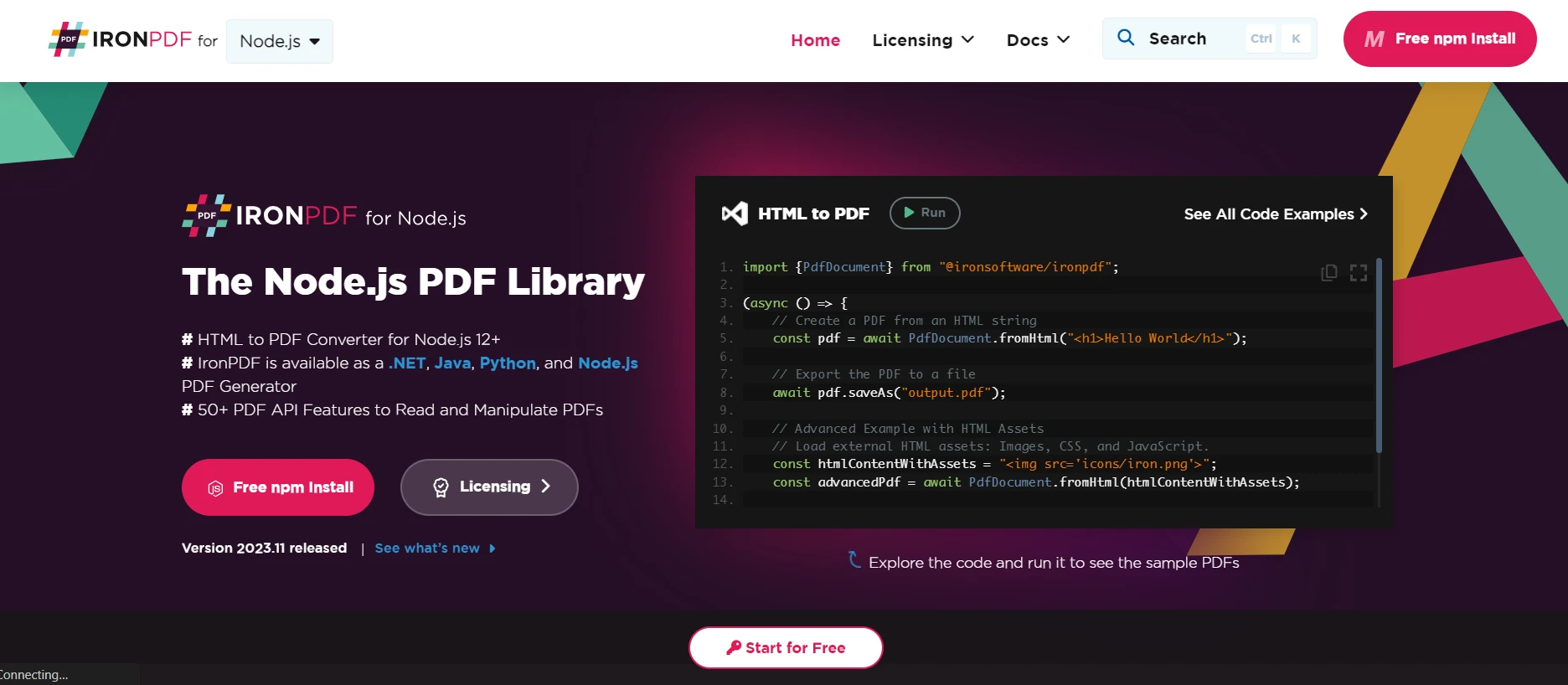
import {PdfDocument} from "@ironsoftware/ironpdf";

(async () => {
    // Create a PDF from an HTML string
    const pdf = await PdfDocument.fromHtml("<h1>Hello World</h1>");

    // Export the PDF to a file
    await pdf.saveAs("output.pdf");

    // Advanced Example with HTML Assets
    // Load external HTML assets: Images, CSS, and JavaScript.
    const htmlContentWithAssets = "<img src='icons/iron.png'>";
    const advancedPdf = await PdfDocument.fromHtml(htmlContentWithAssets);

    // Save the PDF with loaded assets
    await advancedPdf.saveAs("html-with-assets.pdf");
})();
import {PdfDocument} from "@ironsoftware/ironpdf";(async () => { // Create a PDF from an HTML string const pdf = awaitPdfDocument.fromHtml("<h1>Hello World</h1>"); // Export the PDF to a file await pdf.saveAs("output.pdf"); // Advanced Example with HTML Assets // Load external HTML assets: Images, CSS, and JavaScript. const htmlContentWithAssets = "<img src='icons/iron.png'>"; const advancedPdf = awaitPdfDocument.fromHtml(htmlContentWithAssets); // Save the PDF with loaded assets await advancedPdf.saveAs("html-with-assets.pdf");})();
En el ámbito dinámico y en constante progreso del desarrollo web, la demanda de convertir HTML a PDF surge con notable frecuencia. Esta necesidad abarca un espectro de aplicaciones, que van desde la creación de informes detallados y facturas hasta la tarea esencial de preservar el contenido web en un formato fácilmente imprimible. La conversión fluida de páginas HTML a PDF dentro de un entorno [Node.js](https://nodejs.org/en) es un requisito crucial para los desarrolladores que navegan por las complejidades de las aplicaciones web modernas.
Este artículo discutirá la conversión de HTML a PDF en Node.js sin Puppeteer. Mientras que [Puppeteer se ejecuta sin cabeza](https://www.techighness.com/post/convert-html-to-pdf-node-without-headless-browser/), un navegador sin interfaz gráfica, los desarrolladores ahora tienen acceso a una amplia gama de bibliotecas alternativas. Entre ellas, la [biblioteca IronPDF for Node.js](/nodejs/) surge como una opción destacada: una herramienta excepcionalmente poderosa diseñada explícitamente para ejecutar operaciones relacionadas con PDF dentro del ecosistema Node.js (JavaScript).
## 1. Cómo convertir HTML a PDF en Node.js sin Puppeteer
1. Instale la Biblioteca PDF para convertir HTML a PDF en Node.js sin Puppeteer.
2. Importe las dependencias requeridas.
3. Crea un archivo PDF desde una URL usando el método [`PdfDocument.fromUrl`](/nodejs/object-reference/api/classes/PdfDocument.html#fromUrl).
4. Renderizar una cadena HTML a PDF usando el método [`PdfDocument.fromHtml`](/nodejs/object-reference/api/classes/PdfDocument.html#fromHtml).
5. Guarda los archivos PDF creados usando el método [`saveAs`](/nodejs/object-reference/api/classes/PdfDocument.html#saveAs).
## 2. Presentación de IronPDF
[IronPDF](/nodejs/) es una biblioteca PDF versátil para Node.js que ofrece un conjunto robusto de características para trabajar con archivos PDF. Una de sus funcionalidades clave es la capacidad de convertir HTML a formato PDF sin la necesidad de Puppeteer. Esto hace de IronPDF una solución atractiva para los desarrolladores que buscan una forma ligera y eficiente de manejar la conversión de HTML a PDF en sus aplicaciones Node.js. IronPDF también admite la conversión de versiones CSS y encabezados. IronPDF le permite generar PDFs a partir de imágenes que funcionan perfectamente en un entorno de producción.
### 2.1. Características destacadas de IronPDF
1. **[Generación de PDF](/nodejs/tutorials/html-to-pdf/):** IronPDF permite a los desarrolladores crear documentos PDF desde cero, otorgándoles control total sobre el contenido, formato y diseño.
2. **[Análisis de PDF](/nodejs/blog/using-ironpdf-for-nodejs/pdf-parser-node-tutorial):** Esta biblioteca facilita la extracción de texto, imágenes y otros elementos de los archivos PDF existentes, proporcionando a los desarrolladores la capacidad de manipular los datos almacenados en estos documentos.
3. **Modificación de PDF:** IronPDF admite la [modificación dinámica de archivos PDF preexistentes](/nodejs/blog/using-ironpdf-for-nodejs/node-js-edit-pdf-tutorial), permitiendo la adición, eliminación o actualización de contenido según sea necesario.
4. **Renderización de PDF:** Los desarrolladores que usan IronPDF pueden renderizar archivos PDF en diversos formatos, incluyendo [a partir de imágenes](/nodejs/examples/image-to-pdf/) o [a partir de HTML](/nodejs/tutorials/html-to-pdf/). Esta versatilidad amplía las opciones para mostrar contenido PDF dentro de aplicaciones web.
5. **Compatibilidad Multiplataforma:** Diseñado con la compatibilidad en mente, IronPDF opera perfectamente en diferentes sistemas operativos, asegurando un comportamiento consistente independientemente del entorno de implementación.
## 3. Instalación de IronPDF
Comenzar con [IronPDF](/nodejs/) es un proceso sencillo. Para [instalar](https://www.npmjs.com/package/@ironsoftware/ironpdf?activeTab=readme) IronPDF en su proyecto de Node.js, puede usar NPM, el administrador de paquetes de bibliotecas Node.js. Abre tu terminal y ejecuta el siguiente comando:
```bash
:ProductInstall
```
Este comando descargará e instalará la biblioteca IronPDF, poniéndola a disposición para su uso en su proyecto. Para instalar el motor IronPDF que se requiere para usar la Biblioteca IronPDF, ejecute el siguiente comando en la consola:
```bash
:InstallCmd npm install @ironsoftware/ironpdf-engine-windows-x64
```
## 4. Generación de HTML a PDF
Ahora que IronPDF está descargado e instalado, exploremos cómo usarlo para la conversión de HTML a PDF y recorramos tres escenarios comunes: convertir una URL a PDF, convertir una cadena HTML a PDF y convertir un archivo HTML a PDF.
### 4.1. Creación de archivos PDF a partir de una URL utilizando IronPDF
Convertir una página web a PDF es un requisito frecuente, especialmente cuando se trata de contenido dinámico generado por un servidor. IronPDF hace que este proceso sea simple. Aquí hay un ejemplo básico de código:
```javascript
import { PdfDocument } from "@ironsoftware/ironpdf";

(async () => {
  // URL of the web page to convert to PDF
  const url = "https://google.com";

  // Create a PDF document from the specified URL
  const pdf = await PdfDocument.fromUrl(url);

  // Save the PDF to a file
  await pdf.saveAs("output_from_url.pdf");
})();
```
Este código utiliza la biblioteca IronPDF para convertir una página web (la página de inicio de Google en este ejemplo) en un archivo PDF. Especifica la URL de la página, genera un PDF con el método `PdfDocument.fromUrl` y lo guarda como "output_from_url.pdf". Todo el proceso está envuelto en una función asincrónica para asegurar una ejecución secuencial. Este fragmento muestra la simplicidad de aprovechar IronPDF para conversiones de HTML a PDF en Node.js.
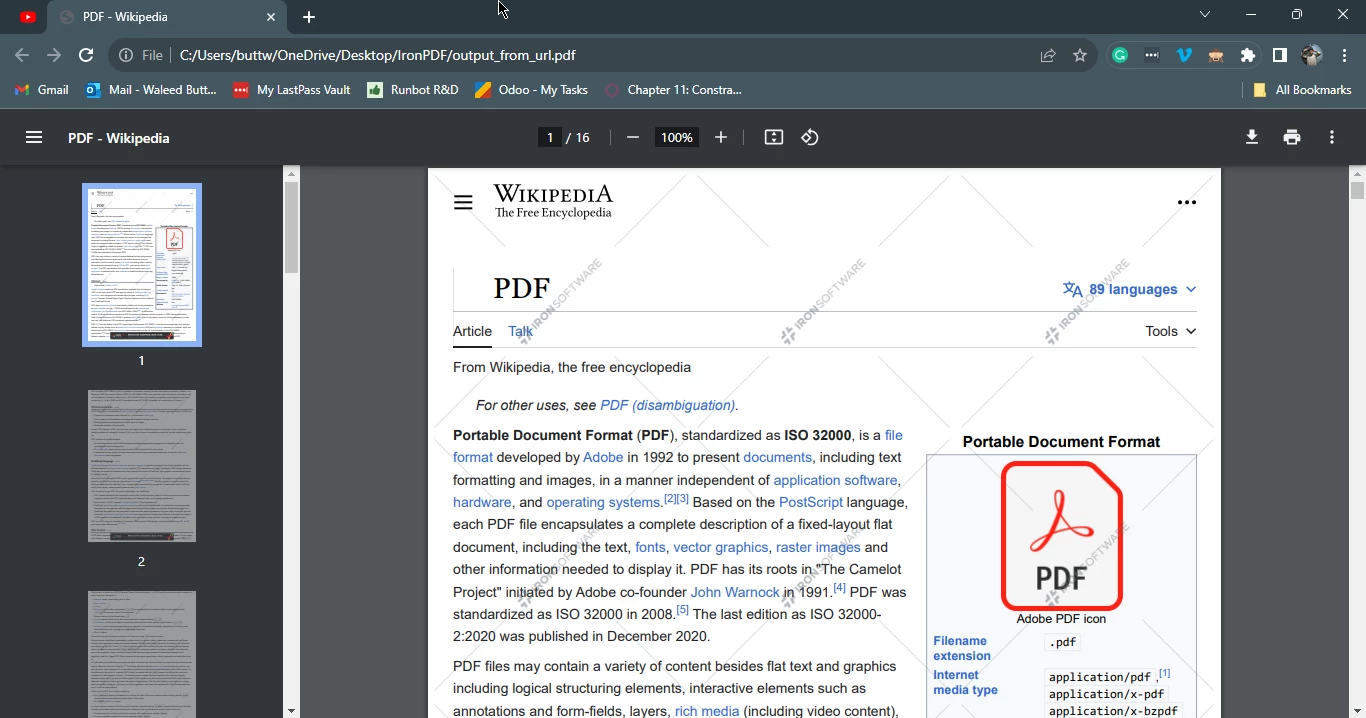
**Salida PDF generada desde una URL usando la biblioteca IronPDF**
### 4.2. Cadena HTML a archivo PDF
Si tiene contenido HTML como cadena y necesita convertirlo a PDF, IronPDF proporciona un método conveniente para este escenario también:
```javascript
import { PdfDocument } from "@ironsoftware/ironpdf";
(async () => {
// Create a PDF from an HTML string
const htmlString = "<h1>Hello Developers! This is an Example PDF created with IronPDF</h1>";
const pdf = await PdfDocument.fromHtml(htmlString);
// Export the PDF to a file
await pdf.saveAs("output.pdf");
})();
```
Este ejemplo de código utiliza la biblioteca IronPDF para convertir rápidamente una cadena HTML simple (una etiqueta de encabezado) en un documento PDF. Luego guarda el PDF generado como "output.pdf". El script es conciso, empleando una función asincrónica para la ejecución secuencial. Esto muestra la simplicidad de crear PDFs a partir de HTML usando IronPDF en un entorno Node.js.
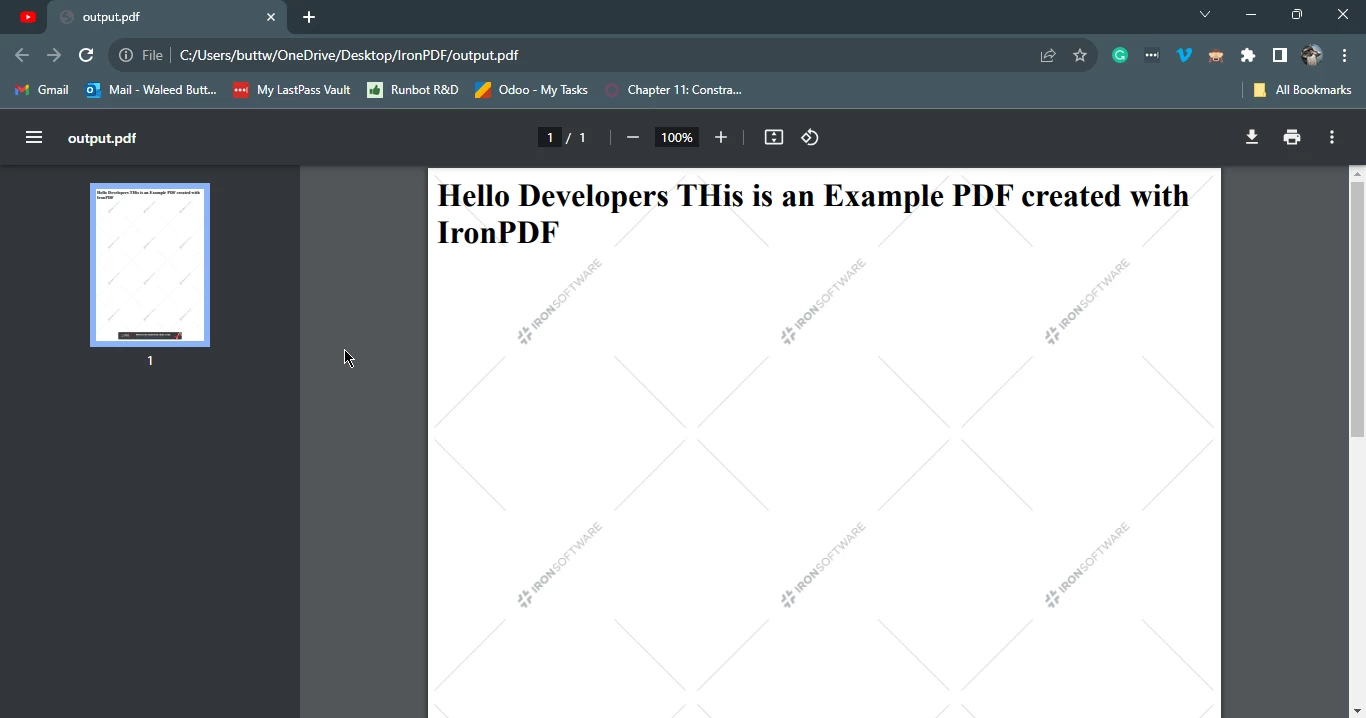
**Salida PDF generada desde una cadena HTML usando la biblioteca IronPDF**
### 4.3. Archivo HTML a PDF
Para situaciones donde el contenido HTML está almacenado en un archivo, IronPDF proporciona un método sencillo para convertirlo a PDF. Aquí hay un ejemplo:
```javascript
import { PdfDocument } from "@ironsoftware/ironpdf";
(async () => {
// Render the HTML file
const pdf = await PdfDocument.fromHtml("label.html");
// Export the PDF document
await pdf.saveAs("output.pdf");
})();
```
Este fragmento de código utiliza la biblioteca IronPDF para convertir el contenido de un archivo HTML ("label.html") en un documento PDF. El PDF renderizado se guarda luego como "output.pdf". La simplicidad de este proceso se destaca por el script conciso, que emplea una función asincrónica para la ejecución secuencial en un entorno Node.js.
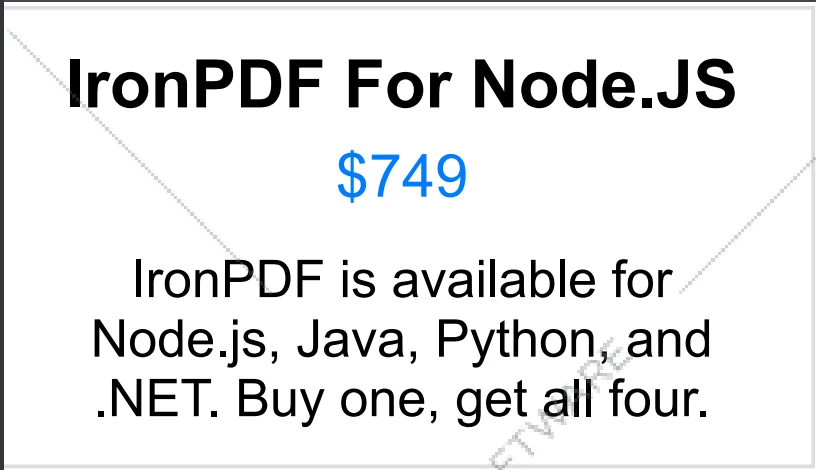
**Salida PDF generada desde un archivo HTML usando la biblioteca IronPDF**
## 5. Conclusión
Esta guía exploró el proceso de convertir HTML a PDF en un entorno Node.js sin depender de Puppeteer. [IronPDF](/nodejs/) resulta ser una alternativa poderosa y eficiente, ofreciendo una gama de características para manejar tareas relacionadas con PDF. Ya sea que necesite convertir una URL, una cadena HTML o un archivo HTML a PDF, o generar un archivo PDF a partir de imágenes PNG, IronPDF proporciona una solución fluida.
A medida que integre la conversión de HTML a PDF en sus aplicaciones Node.js, considere los requisitos específicos de su proyecto y la flexibilidad que IronPDF ofrece. Con su facilidad de uso y amplias capacidades, IronPDF se destaca como una herramienta valiosa para los desarrolladores que buscan una solución confiable y ligera para la generación de PDF en Node.js.
Para saber más sobre [IronPDF for Node.js](/nodejs/), por favor visite la [página de documentación](/nodejs/docs/). El tutorial completo de conversión de HTML a PDF utilizando IronPDF for Node.js está disponible en el siguiente [enlace del tutorial de Node.js](/nodejs/tutorials/html-to-pdf/).
IronPDF ofrece una [licencia de prueba gratuita](trial-license) para que los usuarios comiencen, antes de decidir comprar una [licencia perpetua](licensing).
En el ámbito dinámico y en constante progreso del desarrollo web, la demanda de convertir HTML a PDF surge con notable frecuencia. Esta necesidad abarca un espectro de aplicaciones, que van desde la creación de informes detallados y facturas hasta la tarea esencial de preservar el contenido web en un formato fácilmente imprimible. La conversión fluida de páginas HTML a PDF dentro de un entorno Node.js es un requisito crucial para los desarrolladores que navegan por las complejidades de las aplicaciones web modernas.
Este artículo discutirá la conversión de HTML a PDF en Node.js sin Puppeteer. Mientras que Puppeteer se ejecuta sin cabeza, un navegador sin interfaz gráfica, los desarrolladores ahora tienen acceso a una amplia gama de bibliotecas alternativas. Entre ellas, la biblioteca IronPDF for Node.js surge como una opción destacada: una herramienta excepcionalmente poderosa diseñada explícitamente para ejecutar operaciones relacionadas con PDF dentro del ecosistema Node.js (JavaScript).
1. Cómo convertir HTML a PDF en Node.js sin Puppeteer
Instale la Biblioteca PDF para convertir HTML a PDF en Node.js sin Puppeteer.
Guarda los archivos PDF creados usando el método saveAs.
2. Presentación de IronPDF
IronPDF es una biblioteca PDF versátil para Node.js que ofrece un conjunto robusto de características para trabajar con archivos PDF. Una de sus funcionalidades clave es la capacidad de convertir HTML a formato PDF sin la necesidad de Puppeteer. Esto hace de IronPDF una solución atractiva para los desarrolladores que buscan una forma ligera y eficiente de manejar la conversión de HTML a PDF en sus aplicaciones Node.js. IronPDF también admite la conversión de versiones CSS y encabezados. IronPDF le permite generar PDFs a partir de imágenes que funcionan perfectamente en un entorno de producción.
2.1. Características destacadas de IronPDF
Generación de PDF: IronPDF permite a los desarrolladores crear documentos PDF desde cero, otorgándoles control total sobre el contenido, formato y diseño.
Análisis de PDF: Esta biblioteca facilita la extracción de texto, imágenes y otros elementos de los archivos PDF existentes, proporcionando a los desarrolladores la capacidad de manipular los datos almacenados en estos documentos.
Renderización de PDF: Los desarrolladores que usan IronPDF pueden renderizar archivos PDF en diversos formatos, incluyendo a partir de imágenes o a partir de HTML. Esta versatilidad amplía las opciones para mostrar contenido PDF dentro de aplicaciones web.
Compatibilidad Multiplataforma: Diseñado con la compatibilidad en mente, IronPDF opera perfectamente en diferentes sistemas operativos, asegurando un comportamiento consistente independientemente del entorno de implementación.
3. Instalación de IronPDF
Comenzar con IronPDF es un proceso sencillo. Para instalar IronPDF en su proyecto de Node.js, puede usar NPM, el administrador de paquetes de bibliotecas Node.js. Abre tu terminal y ejecuta el siguiente comando:
> npm i @ironsoftware/ironpdf
npm i @ironsoftware/ironpdf
Este comando descargará e instalará la biblioteca IronPDF, poniéndola a disposición para su uso en su proyecto. Para instalar el motor IronPDF que se requiere para usar la Biblioteca IronPDF, ejecute el siguiente comando en la consola:
Ahora que IronPDF está descargado e instalado, exploremos cómo usarlo para la conversión de HTML a PDF y recorramos tres escenarios comunes: convertir una URL a PDF, convertir una cadena HTML a PDF y convertir un archivo HTML a PDF.
4.1. Creación de archivos PDF a partir de una URL utilizando IronPDF
Convertir una página web a PDF es un requisito frecuente, especialmente cuando se trata de contenido dinámico generado por un servidor. IronPDF hace que este proceso sea simple. Aquí hay un ejemplo básico de código:
import { PdfDocument } from "@ironsoftware/ironpdf";(async () => { // URL of the web page to convert to PDF const url = "https://google.com"; // Create a PDF document from the specified URL const pdf = awaitPdfDocument.fromUrl(url); // Save the PDF to a file await pdf.saveAs("output_from_url.pdf");})();
import { PdfDocument } from "@ironsoftware/ironpdf";

(async () => {
  // URL of the web page to convert to PDF
  const url = "https://google.com";

  // Create a PDF document from the specified URL
  const pdf = await PdfDocument.fromUrl(url);

  // Save the PDF to a file
  await pdf.saveAs("output_from_url.pdf");
})();
JavaScript
Este código utiliza la biblioteca IronPDF para convertir una página web (la página de inicio de Google en este ejemplo) en un archivo PDF. Especifica la URL de la página, genera un PDF con el método PdfDocument.fromUrl y lo guarda como "output_from_url.pdf". Todo el proceso está envuelto en una función asincrónica para asegurar una ejecución secuencial. Este fragmento muestra la simplicidad de aprovechar IronPDF para conversiones de HTML a PDF en Node.js.
Salida PDF generada desde una URL usando la biblioteca IronPDF
4.2. Cadena HTML a archivo PDF
Si tiene contenido HTML como cadena y necesita convertirlo a PDF, IronPDF proporciona un método conveniente para este escenario también:
import { PdfDocument } from "@ironsoftware/ironpdf";(async () => { // Create a PDF from an HTML string const htmlString = "<h1>Hello Developers! This is an Example PDF created with IronPDF</h1>"; const pdf = awaitPdfDocument.fromHtml(htmlString); // Export the PDF to a file await pdf.saveAs("output.pdf");})();
import { PdfDocument } from "@ironsoftware/ironpdf";

(async () => {
  // Create a PDF from an HTML string
  const htmlString = "<h1>Hello Developers! This is an Example PDF created with IronPDF</h1>";
  const pdf = await PdfDocument.fromHtml(htmlString);

  // Export the PDF to a file
  await pdf.saveAs("output.pdf");
})();
JavaScript
Este ejemplo de código utiliza la biblioteca IronPDF para convertir rápidamente una cadena HTML simple (una etiqueta de encabezado) en un documento PDF. Luego guarda el PDF generado como "output.pdf". El script es conciso, empleando una función asincrónica para la ejecución secuencial. Esto muestra la simplicidad de crear PDFs a partir de HTML usando IronPDF en un entorno Node.js.
Salida PDF generada desde una cadena HTML usando la biblioteca IronPDF
4.3. Archivo HTML a PDF
Para situaciones donde el contenido HTML está almacenado en un archivo, IronPDF proporciona un método sencillo para convertirlo a PDF. Aquí hay un ejemplo:
import { PdfDocument } from "@ironsoftware/ironpdf";(async () => { // Render the HTML file const pdf = awaitPdfDocument.fromHtml("label.html"); // Export the PDF document await pdf.saveAs("output.pdf");})();
import { PdfDocument } from "@ironsoftware/ironpdf";

(async () => {
  // Render the HTML file
  const pdf = await PdfDocument.fromHtml("label.html");

  // Export the PDF document
  await pdf.saveAs("output.pdf");
})();
JavaScript
Este fragmento de código utiliza la biblioteca IronPDF para convertir el contenido de un archivo HTML ("label.html") en un documento PDF. El PDF renderizado se guarda luego como "output.pdf". La simplicidad de este proceso se destaca por el script conciso, que emplea una función asincrónica para la ejecución secuencial en un entorno Node.js.
Salida PDF generada desde un archivo HTML usando la biblioteca IronPDF
5. Conclusión
Esta guía exploró el proceso de convertir HTML a PDF en un entorno Node.js sin depender de Puppeteer. IronPDF resulta ser una alternativa poderosa y eficiente, ofreciendo una gama de características para manejar tareas relacionadas con PDF. Ya sea que necesite convertir una URL, una cadena HTML o un archivo HTML a PDF, o generar un archivo PDF a partir de imágenes PNG, IronPDF proporciona una solución fluida.
A medida que integre la conversión de HTML a PDF en sus aplicaciones Node.js, considere los requisitos específicos de su proyecto y la flexibilidad que IronPDF ofrece. Con su facilidad de uso y amplias capacidades, IronPDF se destaca como una herramienta valiosa para los desarrolladores que buscan una solución confiable y ligera para la generación de PDF en Node.js.
Curtis Chau tiene una licenciatura en Ciencias de la Computación (Carleton University) y se especializa en el desarrollo front-end con experiencia en Node.js, TypeScript, JavaScript y React. Apasionado por crear interfaces de usuario intuitivas y estéticamente agradables, disfruta trabajando con frameworks modernos y creando manuales bien estructurados y visualmente atractivos.




 Salida PDF generada desde una URL usando la biblioteca IronPDF
 Salida PDF generada desde una cadena HTML usando la biblioteca IronPDF
 Salida PDF generada desde un archivo HTML usando la biblioteca IronPDF