using IronPdf;

// Disable local disk access or cross-origin requests
Installation.EnableWebSecurity = true;

// Instantiate Renderer
var renderer = new ChromePdfRenderer();

// Create a PDF from a HTML string using C#
var pdf = renderer.RenderHtmlAsPdf("<h1>Hello World</h1>");

// Export to a file or Stream
pdf.SaveAs("output.pdf");

// Advanced Example with HTML Assets
// Load external html assets: Images, CSS and JavaScript.
// An optional BasePath 'C:\site\assets\' is set as the file location to load assets from
var myAdvancedPdf = renderer.RenderHtmlAsPdf("<img src='icons/iron.png'>", @"C:\site\assets\");
myAdvancedPdf.SaveAs("html-with-assets.pdf");
using IronPdf;// Disable local disk access or cross-origin requestsInstallation.EnableWebSecurity = true;// Instantiate Renderervar renderer = new ChromePdfRenderer();// Create a PDF from a HTML string using C#var pdf = renderer.RenderHtmlAsPdf("<h1>Hello World</h1>");// Export to a file or Streampdf.SaveAs("output.pdf");// Advanced Example with HTML Assets// Load external html assets: Images, CSS and JavaScript.// An optional BasePath 'C:\site\assets\' is set as the file location to load assets fromvar myAdvancedPdf = renderer.RenderHtmlAsPdf("<img src='icons/iron.png'>", @"C:\site\assets\");myAdvancedPdf.SaveAs("html-with-assets.pdf");
PM >Install-Package IronPdf
Install-Package IronPdf
ENTWICKLER-UPDATES
C# Action-Delegat (Wie es für Entwickler funktioniert) | IronPDF
In diesem Tutorial werden wir die Konzepte von **C# Action**, **Func-Delegat** und verwandten Themen vorstellen. Dieser Leitfaden ist für Anfänger konzipiert und führt Sie durch die Grundlagen, bietet Beispiele und erklärt Schlüsselbegriffe des [Action-Delegats](https://learn.microsoft.com/en-us/dotnet/api/system.action-1?view=net-8.0).
Beginnen wir damit, zu verstehen, was Delegaten in C# sind. Wir werden [die IronPDF-Bibliothek](/) später im Artikel erkunden.
## Delegate in C#35 verstehen
Delegaten sind eine Programmierstruktur, die als Referenzen auf Methoden wirkt, die durch eine bestimmte Menge von Parametern und einen Rückgabetyp definiert werden und Funktionen wie vordefinierte Delegattypen einkapseln, die es erlauben, Methoden Rückgabewerte zu erhalten.
Dies erlaubt es, Methoden als Argumente zu übergeben. Im Wesentlichen dient ein Delegat als Funktionszeiger, der auf die Methode zeigt, die er repräsentiert. In C# gibt es zwei vordefinierte Delegattypen, die weit verbreitet sind: **Func** und **Action**.
### Was ist ein Func-Delegate?
Der **Func**-Delegat repräsentiert eine Methode, die einen Rückgabewert haben kann. Der letzte Typ-Parameter gibt den Rückgabetyp an, und die vorhergehenden Typen geben die Eingabeparameter an.
Ein Beispiel ist ein **`Func<int, int, string>`**, der zwei Integer-Parameter nimmt und eine Zeichenfolgennachricht zurückgibt.
## Delegate in der Praxis: Beispiele
Werfen wir einen Blick auf einige Beispiele, um zu verstehen, wie **Func**- und **Action**-Delegaten in C# funktionieren.
### Beispiel für einen Aktionsdelegaten
Ein Action-Delegat, ein vordefinierter Delegattyp, wird verwendet, wenn Sie eine Methode ausführen möchten, die keinen spezifischen Rückgabewert zurückgibt, sondern sich stattdessen auf Operationen konzentriert. Hier ist ein einfaches Beispiel:
```csharp
Action<string> display = message => Console.WriteLine(message);
display("Hello, World!");
```
Dieser Code definiert einen Action-Delegat, der die Verwendung einer anonymen Methode veranschaulicht, die einen einzigen Zeichenfolgenparameter nimmt und ihn auf der Konsole ausgibt. Das **=>**-Symbol wird verwendet, um einen Lambda-Ausdruck zu definieren, der eine prägnante Art ist, anonyme Methoden zu schreiben.
### Beispiel für einen Func-Delegaten
Ein **Func**-Delegat, der einen Wert zurückgibt, kann wie folgt verwendet werden:
```csharp
Func<int, int, int> add = (x, y) => x + y;
int result = add(5, 3);
Console.WriteLine(result);
```
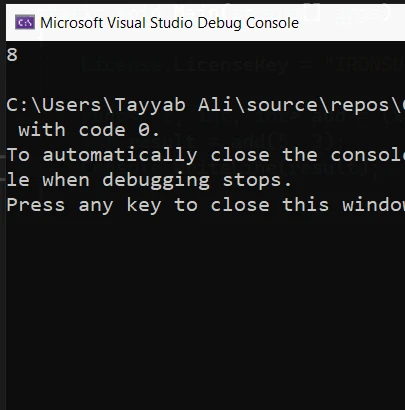
Dieses Beispiel erstellt einen **Func**-Delegat, der zwei Integer-Parameter nimmt und deren Summe zurückgibt. Die Summe wird auf der Konsole wie folgt angezeigt:
## Schlüsselkonzepte
### Anonyme Methoden
Anonyme Methoden in C# bieten eine Möglichkeit, Inline-Methoden ohne Namen zu definieren. Sie werden oft mit Delegaten verwendet, um Delegatinstanzen direkt zu erstellen.
### Lambda-Ausdrücke
Lambda-Ausdrücke sind eine Kurzform zum Schreiben anonymer Methoden. Sie ermöglichen es, weniger Code zu schreiben und dennoch dasselbe Ergebnis zu erzielen.
### Generischer Delegat
Ein generischer Delegat kann mit jedem Datentyp arbeiten. **Func** und **Action** sind Beispiele für generische Delegaten, die mehr Flexibilität bieten, indem sie es Ihnen erlauben, Eingabe- und Ausgabetypen zur Laufzeit zu spezifizieren.
### Instanz delegieren
Eine Delegatinstanz wird mit dem **new**-Schlüsselwort erstellt oder indem einfach eine Methode zugewiesen wird, die dem Signatur des Delegaten entspricht.
### System-Namensraum
Der **System**-Namespace in .NET enthält eingebaute Typen wie **Func** und **Action**, die Teil der Basisklassenbibliothek sind.
## Asynchrone Programmierung mit Delegaten
Delegaten, einschließlich **Action** und **Func**, sind integraler Bestandteil der Verwaltung asynchroner Aufgaben in C#. Sie ermöglichen Entwicklern, eine Referenz auf eine Methode einzukapseln, die dann asynchron ausgeführt werden kann. Das bedeutet, dass der Hauptanwendungs-Thread eine Aufgabe initiieren und dann mit anderen Arbeiten fortfahren kann, bis die Aufgabe abgeschlossen ist.
Eine Callback-Methode, die durch einen Delegaten referenziert wird, verarbeitet das Ergebnis. Dieses Muster ist entscheidend für die Erstellung reaktionsfähiger Benutzeroberflächen, die auch bei Durchführung langlaufender Operationen interaktiv bleiben.
### Beispiel: Asynchrone Dateiverarbeitung
Betrachten Sie eine Anwendung, die eine große Datei verarbeiten muss. Die Verwendung eines **Action**-Delegaten in Verbindung mit asynchronen Programmiermustern wie **Task** kann die Anwendungsleistung erheblich verbessern:
```csharp
public async Task ProcessFileAsync(string filePath, Action<string> onComplete)
{
// Asynchronously read file content
string fileContent = await File.ReadAllTextAsync(filePath);
// Process the file content here (omitted for brevity)
// Once processing is complete, invoke the onComplete callback
onComplete?.Invoke("File processing completed successfully.");
}
```
In diesem Beispiel wird **File.ReadAllTextAsync** verwendet, um den Dateiinhalt zu lesen, ohne den Hauptthread zu blockieren. Sobald die Datei verarbeitet ist, wird ein **Action**-Delegat namens **onComplete** aufgerufen, um den Anrufer darüber zu informieren, dass der Vorgang abgeschlossen ist, was weitere Aktionen wie das Aktualisieren der Benutzeroberfläche oder das Protokollieren von Ergebnissen ermöglicht.
## Einführung in IronPDF: Eine C#-PDF-Bibliothek
[IronPDF](/) ist eine umfassende C# PDF-Bibliothek, die für .NET-Entwickler entwickelt wurde, um PDF-Dateien einfach zu erstellen, zu bearbeiten und zu manipulieren. Es zeichnet sich durch eine Chrome-basierte Render-Engine aus und sorgt für [pixelgenaue PDFs aus HTML-Inhalten](/examples/using-html-to-create-a-pdf/), CSS, JavaScript und Bildern.
IronPDF ist mit einer Vielzahl von .NET-Frameworks und -Umgebungen kompatibel, darunter .NET Standard, .NET Framework und .NET Core, auf Windows-, Linux- und macOS-Plattformen.
### Installation von IronPDF
Um IronPDF in Ihre .NET-Projekte zu integrieren, können Sie NuGet verwenden, das die einfachste Methode ist. Öffnen Sie einfach die Paket-Manager-Konsole in Visual Studio und führen Sie den folgenden Befehl aus:
```shell
:ProductInstall
```
Dieser Befehl ruft das IronPDF-Paket ab und installiert es und richtet Ihr Projekt ein, um mit der PDF-Erstellung und -Bearbeitung mit IronPDF zu beginnen.
### Codebeispiel mit Action Delegate
Hier ist ein einfaches Beispiel, das zeigt, wie man IronPDF in Verbindung mit einem Action-Delegat verwendet, um eine PDF-Erstellung durchzuführen:
```csharp
using IronPdf;
using System;
class Program
{
static void Main(string[] args)
{
var renderer = new ChromePdfRenderer();
// Define an Action delegate that takes HTML content as a string
Action<string> generatePdf = html =>
{
// Render the HTML as a PDF
var pdf = renderer.RenderHtmlAsPdf(html);
// Save the PDF to a file
pdf.SaveAs("example.pdf");
};
// Generate the PDF with the provided HTML
generatePdf("<p>Hello, world!</p>");
Console.WriteLine("PDF generated successfully.");
}
}
```
Dieses Beispiel definiert einen Action-Delegat, der eine Zeichenfolge von HTML nimmt und IronPDF verwendet, um daraus ein PDF-Dokument zu rendern. Das generierte PDF wird dann im Dateisystem gespeichert. Dieser Ansatz zeigt, wie Delegaten verwendet werden können, um Logik für die PDF-Erstellung zu kapseln, was Ihren Code modularer und flexibler macht.

### Lizenzierung
IronPDF bietet verschiedene [Lizenzierungsoptionen für Entwickler](/licensing/), angefangen von Entwicklerlizenzen für Einzelpersonen bis hin zu Unternehmensvereinbarungen. Die Preise für diese Lizenzen beginnen bei `$liteLicense`.
## Abschluss
Bis jetzt sollten Sie ein grundlegendes Verständnis von **Action**- und **Func**-Delegaten in C# sowie davon haben, wie man anonyme Methoden und Lambda-Ausdrücke verwendet. Übung ist der Schlüssel, um die Delegatenkonzepte zu beherrschen. Erstellen Sie Ihre eigenen Beispiele zum Definieren, Zuweisen und Ausführen von Delegaten.
Sie können die Funktionen von IronPDF mit seiner [kostenlosen Testversion](trial-license) nach Belieben erkunden. Sollte es Ihren Projektanforderungen entsprechen, können Sie eine Lizenz sichern, wobei die Preise bei `$liteLicense` beginnen.
In diesem Tutorial werden wir die Konzepte von C# Action, Func-Delegat und verwandten Themen vorstellen. Dieser Leitfaden ist für Anfänger konzipiert und führt Sie durch die Grundlagen, bietet Beispiele und erklärt Schlüsselbegriffe des Action-Delegats.
Beginnen wir damit, zu verstehen, was Delegaten in C# sind. Wir werden die IronPDF-Bibliothek später im Artikel erkunden.
Delegate in C#35 verstehen
Delegaten sind eine Programmierstruktur, die als Referenzen auf Methoden wirkt, die durch eine bestimmte Menge von Parametern und einen Rückgabetyp definiert werden und Funktionen wie vordefinierte Delegattypen einkapseln, die es erlauben, Methoden Rückgabewerte zu erhalten.
Dies erlaubt es, Methoden als Argumente zu übergeben. Im Wesentlichen dient ein Delegat als Funktionszeiger, der auf die Methode zeigt, die er repräsentiert. In C# gibt es zwei vordefinierte Delegattypen, die weit verbreitet sind: Func und Action.
Was ist ein Func-Delegate?
Der Func-Delegat repräsentiert eine Methode, die einen Rückgabewert haben kann. Der letzte Typ-Parameter gibt den Rückgabetyp an, und die vorhergehenden Typen geben die Eingabeparameter an.
Ein Beispiel ist ein Func<int, int, string>, der zwei Integer-Parameter nimmt und eine Zeichenfolgennachricht zurückgibt.
Delegate in der Praxis: Beispiele
Werfen wir einen Blick auf einige Beispiele, um zu verstehen, wie Func- und Action-Delegaten in C# funktionieren.
Beispiel für einen Aktionsdelegaten
Ein Action-Delegat, ein vordefinierter Delegattyp, wird verwendet, wenn Sie eine Methode ausführen möchten, die keinen spezifischen Rückgabewert zurückgibt, sondern sich stattdessen auf Operationen konzentriert. Hier ist ein einfaches Beispiel:
Dim display AsAction(OfString) = Sub(message) Console.WriteLine(message)display("Hello, World!")
Dim display As Action(Of String) = Sub(message) Console.WriteLine(message)
display("Hello, World!")
Dieser Code definiert einen Action-Delegat, der die Verwendung einer anonymen Methode veranschaulicht, die einen einzigen Zeichenfolgenparameter nimmt und ihn auf der Konsole ausgibt. Das =>-Symbol wird verwendet, um einen Lambda-Ausdruck zu definieren, der eine prägnante Art ist, anonyme Methoden zu schreiben.
Beispiel für einen Func-Delegaten
Ein Func-Delegat, der einen Wert zurückgibt, kann wie folgt verwendet werden:
Func<int, int, int> add = (x, y) => x + y;int result = add(5, 3);Console.WriteLine(result);
Func<int, int, int> add = (x, y) => x + y;
int result = add(5, 3);
Console.WriteLine(result);
Dim add AsFunc(OfInteger, Integer, Integer) = Function(x, y) x + yDim result AsInteger = add(5, 3)Console.WriteLine(result)
Dim add As Func(Of Integer, Integer, Integer) = Function(x, y) x + y
Dim result As Integer = add(5, 3)
Console.WriteLine(result)
Dieses Beispiel erstellt einen Func-Delegat, der zwei Integer-Parameter nimmt und deren Summe zurückgibt. Die Summe wird auf der Konsole wie folgt angezeigt:
Schlüsselkonzepte
Anonyme Methoden
Anonyme Methoden in C# bieten eine Möglichkeit, Inline-Methoden ohne Namen zu definieren. Sie werden oft mit Delegaten verwendet, um Delegatinstanzen direkt zu erstellen.
Lambda-Ausdrücke
Lambda-Ausdrücke sind eine Kurzform zum Schreiben anonymer Methoden. Sie ermöglichen es, weniger Code zu schreiben und dennoch dasselbe Ergebnis zu erzielen.
Generischer Delegat
Ein generischer Delegat kann mit jedem Datentyp arbeiten. Func und Action sind Beispiele für generische Delegaten, die mehr Flexibilität bieten, indem sie es Ihnen erlauben, Eingabe- und Ausgabetypen zur Laufzeit zu spezifizieren.
Instanz delegieren
Eine Delegatinstanz wird mit dem new-Schlüsselwort erstellt oder indem einfach eine Methode zugewiesen wird, die dem Signatur des Delegaten entspricht.
System-Namensraum
Der System-Namespace in .NET enthält eingebaute Typen wie Func und Action, die Teil der Basisklassenbibliothek sind.
Asynchrone Programmierung mit Delegaten
Delegaten, einschließlich Action und Func, sind integraler Bestandteil der Verwaltung asynchroner Aufgaben in C#. Sie ermöglichen Entwicklern, eine Referenz auf eine Methode einzukapseln, die dann asynchron ausgeführt werden kann. Das bedeutet, dass der Hauptanwendungs-Thread eine Aufgabe initiieren und dann mit anderen Arbeiten fortfahren kann, bis die Aufgabe abgeschlossen ist.
Eine Callback-Methode, die durch einen Delegaten referenziert wird, verarbeitet das Ergebnis. Dieses Muster ist entscheidend für die Erstellung reaktionsfähiger Benutzeroberflächen, die auch bei Durchführung langlaufender Operationen interaktiv bleiben.
Beispiel: Asynchrone Dateiverarbeitung
Betrachten Sie eine Anwendung, die eine große Datei verarbeiten muss. Die Verwendung eines Action-Delegaten in Verbindung mit asynchronen Programmiermustern wie Task kann die Anwendungsleistung erheblich verbessern:
public async TaskProcessFileAsync(string filePath, Action<string> onComplete){ // Asynchronously read file content string fileContent = awaitFile.ReadAllTextAsync(filePath); // Process the file content here (omitted for brevity) // Once processing is complete, invoke the onComplete callback onComplete?.Invoke("File processing completed successfully.");}
public async Task ProcessFileAsync(string filePath, Action<string> onComplete)
{
    // Asynchronously read file content
    string fileContent = await File.ReadAllTextAsync(filePath);
    // Process the file content here (omitted for brevity)

    // Once processing is complete, invoke the onComplete callback
    onComplete?.Invoke("File processing completed successfully.");
}
PublicAsync Function ProcessFileAsync(filePath AsString, onComplete AsAction(OfString)) AsTask ' Asynchronously read file content Dim fileContent AsString = AwaitFile.ReadAllTextAsync(filePath) ' Process the file content here (omitted for brevity) ' Once processing is complete, invoke the onComplete callback onComplete?.Invoke("File processing completed successfully.")End Function
Public Async Function ProcessFileAsync(filePath As String, onComplete As Action(Of String)) As Task
    ' Asynchronously read file content
    Dim fileContent As String = Await File.ReadAllTextAsync(filePath)
    ' Process the file content here (omitted for brevity)

    ' Once processing is complete, invoke the onComplete callback
    onComplete?.Invoke("File processing completed successfully.")
End Function
In diesem Beispiel wird File.ReadAllTextAsync verwendet, um den Dateiinhalt zu lesen, ohne den Hauptthread zu blockieren. Sobald die Datei verarbeitet ist, wird ein Action-Delegat namens onComplete aufgerufen, um den Anrufer darüber zu informieren, dass der Vorgang abgeschlossen ist, was weitere Aktionen wie das Aktualisieren der Benutzeroberfläche oder das Protokollieren von Ergebnissen ermöglicht.
Einführung in IronPDF: Eine C#-PDF-Bibliothek
IronPDF ist eine umfassende C# PDF-Bibliothek, die für .NET-Entwickler entwickelt wurde, um PDF-Dateien einfach zu erstellen, zu bearbeiten und zu manipulieren. Es zeichnet sich durch eine Chrome-basierte Render-Engine aus und sorgt für pixelgenaue PDFs aus HTML-Inhalten, CSS, JavaScript und Bildern.
IronPDF ist mit einer Vielzahl von .NET-Frameworks und -Umgebungen kompatibel, darunter .NET Standard, .NET Framework und .NET Core, auf Windows-, Linux- und macOS-Plattformen.
Installation von IronPDF
Um IronPDF in Ihre .NET-Projekte zu integrieren, können Sie NuGet verwenden, das die einfachste Methode ist. Öffnen Sie einfach die Paket-Manager-Konsole in Visual Studio und führen Sie den folgenden Befehl aus:
PM > Install-Package IronPdf
Install-Package IronPdf
Dieser Befehl ruft das IronPDF-Paket ab und installiert es und richtet Ihr Projekt ein, um mit der PDF-Erstellung und -Bearbeitung mit IronPDF zu beginnen.
Codebeispiel mit Action Delegate
Hier ist ein einfaches Beispiel, das zeigt, wie man IronPDF in Verbindung mit einem Action-Delegat verwendet, um eine PDF-Erstellung durchzuführen:
using IronPdf;using System;class Program{ static voidMain(string[] args) { var renderer = new ChromePdfRenderer(); // Define an Action delegate that takes HTML content as a string Action<string> generatePdf = html => { // Render the HTML as a PDF var pdf = renderer.RenderHtmlAsPdf(html); // Save the PDF to a file pdf.SaveAs("example.pdf"); }; // Generate the PDF with the provided HTML generatePdf("<p>Hello, world!</p>");Console.WriteLine("PDF generated successfully."); }}
using IronPdf;
using System;

class Program
{
    static void Main(string[] args)
    {
        var renderer = new ChromePdfRenderer();

        // Define an Action delegate that takes HTML content as a string
        Action<string> generatePdf = html =>
        {
            // Render the HTML as a PDF
            var pdf = renderer.RenderHtmlAsPdf(html);

            // Save the PDF to a file
            pdf.SaveAs("example.pdf");
        };

        // Generate the PDF with the provided HTML
        generatePdf("<p>Hello, world!</p>");
        Console.WriteLine("PDF generated successfully.");
    }
}
ImportsIronPdfImportsSystemModuleProgram Sub Main(args AsString()) Dim renderer = New ChromePdfRenderer() ' Define an Action delegate that takes HTML content as a string Dim generatePdf AsAction(OfString) = Sub(html) ' Render the HTML as a PDF Dim pdf = renderer.RenderHtmlAsPdf(html) ' Save the PDF to a file pdf.SaveAs("example.pdf") End Sub ' Generate the PDF with the provided HTML generatePdf("<p>Hello, world!</p>")Console.WriteLine("PDF generated successfully.") End SubEndModule
Imports IronPdf
Imports System

Module Program
    Sub Main(args As String())
        Dim renderer = New ChromePdfRenderer()

        ' Define an Action delegate that takes HTML content as a string
        Dim generatePdf As Action(Of String) = Sub(html)
                                                   ' Render the HTML as a PDF
                                                   Dim pdf = renderer.RenderHtmlAsPdf(html)

                                                   ' Save the PDF to a file
                                                   pdf.SaveAs("example.pdf")
                                               End Sub

        ' Generate the PDF with the provided HTML
        generatePdf("<p>Hello, world!</p>")
        Console.WriteLine("PDF generated successfully.")
    End Sub
End Module
Dieses Beispiel definiert einen Action-Delegat, der eine Zeichenfolge von HTML nimmt und IronPDF verwendet, um daraus ein PDF-Dokument zu rendern. Das generierte PDF wird dann im Dateisystem gespeichert. Dieser Ansatz zeigt, wie Delegaten verwendet werden können, um Logik für die PDF-Erstellung zu kapseln, was Ihren Code modularer und flexibler macht.
Lizenzierung
IronPDF bietet verschiedene Lizenzierungsoptionen für Entwickler, angefangen von Entwicklerlizenzen für Einzelpersonen bis hin zu Unternehmensvereinbarungen. Die Preise für diese Lizenzen beginnen bei $999.
Abschluss
Bis jetzt sollten Sie ein grundlegendes Verständnis von Action- und Func-Delegaten in C# sowie davon haben, wie man anonyme Methoden und Lambda-Ausdrücke verwendet. Übung ist der Schlüssel, um die Delegatenkonzepte zu beherrschen. Erstellen Sie Ihre eigenen Beispiele zum Definieren, Zuweisen und Ausführen von Delegaten.
Sie können die Funktionen von IronPDF mit seiner kostenlosen Testversion nach Belieben erkunden. Sollte es Ihren Projektanforderungen entsprechen, können Sie eine Lizenz sichern, wobei die Preise bei $999 beginnen.
Jacob Mellor ist Chief Technology Officer bei Iron Software und ein visionärer Ingenieur, der Pionierarbeit in der C# PDF-Technologie leistet. Als der ursprüngliche Entwickler hinter der Kern-Codebasis von Iron Software hat er die Produktarchitektur des Unternehmens seit seiner Gründung geprägt und es zusammen mit CEO Cameron Rimington in ein Unternehmen mit mehr als 50 Mitarbeitern verwandelt, das die NASA, Tesla und globale Regierungsbehörden beliefert.

























