using IronPdf;

// Disable local disk access or cross-origin requests
Installation.EnableWebSecurity = true;

// Instantiate Renderer
var renderer = new ChromePdfRenderer();

// Create a PDF from a HTML string using C#
var pdf = renderer.RenderHtmlAsPdf("<h1>Hello World</h1>");

// Export to a file or Stream
pdf.SaveAs("output.pdf");

// Advanced Example with HTML Assets
// Load external html assets: Images, CSS and JavaScript.
// An optional BasePath 'C:\site\assets\' is set as the file location to load assets from
var myAdvancedPdf = renderer.RenderHtmlAsPdf("<img src='icons/iron.png'>", @"C:\site\assets\");
myAdvancedPdf.SaveAs("html-with-assets.pdf");
using IronPdf;// Disable local disk access or cross-origin requestsInstallation.EnableWebSecurity = true;// Instantiate Renderervar renderer = new ChromePdfRenderer();// Create a PDF from a HTML string using C#var pdf = renderer.RenderHtmlAsPdf("<h1>Hello World</h1>");// Export to a file or Streampdf.SaveAs("output.pdf");// Advanced Example with HTML Assets// Load external html assets: Images, CSS and JavaScript.// An optional BasePath 'C:\site\assets\' is set as the file location to load assets fromvar myAdvancedPdf = renderer.RenderHtmlAsPdf("<img src='icons/iron.png'>", @"C:\site\assets\");myAdvancedPdf.SaveAs("html-with-assets.pdf");
Eine verkettete Liste ist eine lineare Datenstruktur, die aus einer Reihe von Knoten besteht, die auch als Elemente bezeichnet werden können. Im Gegensatz zu Arrays, bei denen Elemente/Knoten an aufeinanderfolgenden Speicherorten gespeichert werden, nutzen verkettete Listen die dynamische Speicherzuweisung, sodass Elemente/Knoten über den gesamten Speicher verteilt sein können.
In ihrer einfachsten Form bestehen "verkettete Listen" aus linear miteinander verbundenen Knoten. Jeder Knoten enthält zwei Hauptteile:
1. **Daten:** Nutzdaten, die im Knoten gespeichert sind. Dies kann je nach Implementierung jeder Datentyp sein, wie z. B. Ganzzahlen, Zeichenfolgen, Objekte usw.
2. **Nächster Zeiger:** Eine Referenz (oder ein Zeiger) auf den nächsten Knoten in der Sequenz. Dieser Zeiger zeigt den Speicherort des folgenden Knotens an und zeigt nach vorne in der verketteten Liste.
Der letzte Knoten in einer verketteten Liste zeigt typischerweise auf einen Null-Verweis, was das Ende der Liste anzeigt.
In diesem Artikel werden wir uns die verkettete Liste in C# im Detail ansehen und auch die [IronPDF-Bibliothek](/) erkunden, ein PDF-Generierungs-Tool von [Iron Software](https://ironsoftware.com/).
## Typen von verknüpften Listen
### 1. Einzeln verknüpfte Liste
Eine einfach verkettete Liste hat einen Knoten mit nur einem Verweis, der typischerweise auf den nächsten Knoten in der Sequenz zeigt. Das Durchlaufen der Liste ist auf die Bewegung in eine Richtung beschränkt, typischerweise vom Kopf (dem ersten Knoten) zum Schwanz (dem letzten Knoten).
### 2. doppelt verknüpfte Liste
In einer doppelt verketteten Liste enthält jeder Knoten zwei Verweise: einen, der auf den nächsten Knoten und einen weiteren, der auf den vorherigen Knoten in der Sequenz zeigt. Diese bidirektionale Verknüpfung ermöglicht den Durchlauf in beide Richtungen, vorwärts und rückwärts.
### 3. zirkuläre verknüpfte Liste
In einer zirkulär verketteten Liste zeigt der letzte Knoten zurück auf den ersten Knoten und bildet so eine kreisförmige Struktur. Dieser Typ von verketteter Liste kann entweder mit einfach verketteten oder doppelt verketteten Knoten implementiert werden.
### Grundlegende Operationen mit verknüpften Listen
1. **Einfügen:** Hinzufügen eines neuen Knotens zur Liste an einer bestimmten Position, z. B. am Anfang, Ende oder in der Mitte.
2. **Löschen:** Entfernen eines bestimmten Objektknotens aus der Liste und entsprechendes Anpassen der Zeiger benachbarter Knoten.
3. **Traversierung:** Iterieren durch die Liste, um auf die Daten jedes Knotens zuzugreifen oder diese zu bearbeiten.
4. **Suche:** Auffinden eines bestimmten Knotens in der Liste anhand seines in den Daten angegebenen Wertes.
## Linked List in C#
In C# können Sie eine verkettete Liste mithilfe der [`LinkedList`](https://learn.microsoft.com/en-us/dotnet/api/system.collections.generic.linkedlist-1?view=net-8.0)-Klasse aus dem `System.Collections.Generic` Namespace implementieren. Hier ist ein Beispiel für alle grundlegenden Operationen:
```cs
using System;
using System.Collections.Generic;

namespace CsharpSamples
{
    public class Program
    {
        public static void Main()
        {
            // Create a new linked list of integers
            LinkedList<int> linkedList = new LinkedList<int>();

            // Add elements to the linked list
            linkedList.AddLast(10);
            linkedList.AddLast(20);
            linkedList.AddLast(30);
            linkedList.AddLast(40);

            // Traverse and print the elements of the linked list
            Console.WriteLine("Traverse Linked List elements:");
            foreach (var item in linkedList)
            {
                Console.WriteLine(item);
            }

            // Display number of linked list elements
            Console.WriteLine($"Number of Linked List elements: {linkedList.Count}");

            // Find/Search for an element in the linked list
            Console.WriteLine("\nFind/Search Element Linked List elements: 30");
            var foundNode = linkedList.Find(30);

            if (foundNode != null)
            {
                Console.WriteLine(
                    $"Found Value: {foundNode.Value}, " +
                    $"Next Element: {(foundNode.Next != null ? foundNode.Next.Value.ToString() : "null")}, " +
                    $"Previous Element: {(foundNode.Previous != null ? foundNode.Previous.Value.ToString() : "null")}"
                );
            }

            // Insert an element at a specified node
            LinkedListNode<int> current = linkedList.Find(20);
            if (current != null)
            {
                linkedList.AddAfter(current, 25);
            }

            Console.WriteLine($"\nNumber of Linked List elements: {linkedList.Count}");
            Console.WriteLine("\nLinked List elements after insertion:");
            foreach (var item in linkedList)
            {
                Console.WriteLine(item);
            }

            // Remove an existing node from the linked list
            linkedList.Remove(30);

            Console.WriteLine("\nLinked List elements after removal:");
            foreach (var item in linkedList)
            {
                Console.WriteLine(item);
            }

            Console.WriteLine($"\nNumber of Linked List elements: {linkedList.Count}");
        }
    }
}
```
### Code-Erklärung
1. Erstellen Sie eine neue verkettete Liste von ganzen Zahlen mit `new LinkedList<int>()`.
2. Fügen Sie bestimmte Wertobjekte zur verketteten Liste hinzu.
3. Durchlaufen und drucken Sie die Elemente der verketteten Liste mit einer `foreach` Schleife.
4. Finden/Suchen Sie ein Element in der verketteten Liste.
5. Fügen Sie ein Element an einem angegebenen Knoten mit den `Find` und `AddAfter` Methoden ein.
6. Entfernen Sie einen vorhandenen Knoten aus der verketteten Liste mit der `Remove` Methode.
### Ausgabe
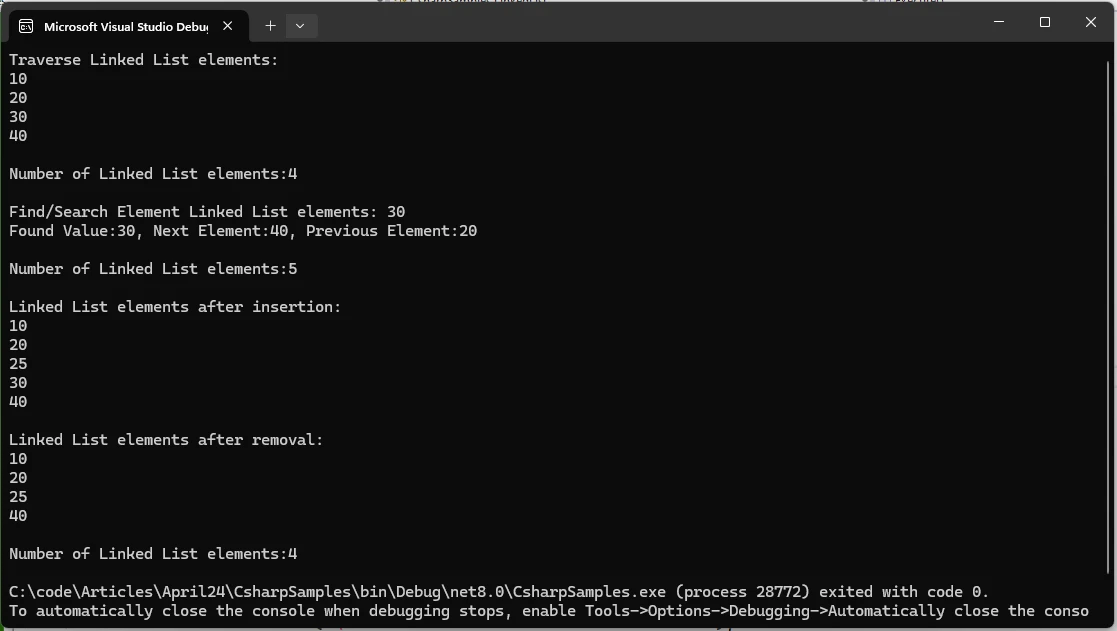
## Einführung in IronPDF
[Entdecken Sie mehr über IronPDF](/), eine leistungsstarke C# PDF-Bibliothek, entwickelt und gepflegt von Iron Software. Sie bietet eine umfassende Reihe von Funktionen zum Erstellen, Bearbeiten und Extrahieren von Inhalten aus PDF-Dokumenten in .NET-Projekten.
## Wichtige Punkte über IronPDF
### HTML-zu-PDF-Konvertierung
IronPDF ermöglicht die Konvertierung von HTML-Inhalten in PDF-Format. Sie können HTML-Seiten, URLs und HTML-Zeichenfolgen mit Leichtigkeit in PDFs rendern.
### Reiche API
Die Bibliothek bietet eine benutzerfreundliche API, mit der Entwickler professionelle PDFs direkt aus HTML generieren können. Egal, ob Sie Rechnungen, Berichte oder andere Dokumente erstellen müssen, IronPDF vereinfacht den Prozess.
### Plattformübergreifende Unterstützung
IronPDF ist mit verschiedenen .NET-Umgebungen kompatibel, einschließlich .NET Core, .NET Standard und .NET Framework. Es läuft auf Windows-, Linux- und macOS-Plattformen.
### Vielseitigkeit
IronPDF unterstützt verschiedene Projekttypen, wie Webanwendungen (Blazor und WebForms), Desktopanwendungen (WPF und MAUI) und Konsolenanwendungen.
### Inhaltsquellen
Sie können PDFs aus verschiedenen Inhaltsquellen generieren, einschließlich HTML-Dateien, Razor-Ansichten (Blazor-Server), CSHTML (MVC und Razor), ASPX (WebForms) und XAML (MAUI).
### Zusätzliche Funktionen
1. Fügen Sie PDFs Kopf- und Fußzeilen hinzu.
2. PDF-Seiten zusammenführen, teilen, hinzufügen, kopieren und löschen.
3. Passwörter, Berechtigungen und digitale Signaturen festlegen.
4. Leistung optimieren mit Multithreading und asynchroner Unterstützung.
### Kompatibilität
IronPDF hält sich an PDF-Standards, einschließlich Versionen 1.2 bis 1.7, PDF/UA und PDF/A. Es unterstützt auch UTF-8-Zeichenkodierung, Basis-URLs und Asset-Kodierung.
## PDF-Dokument mit `LinkedList` erstellen
Erstellen wir jetzt ein PDF-Dokument mit IronPDF und demonstrieren wir auch die Verwendung von `LinkedList` Zeichenfolgen.
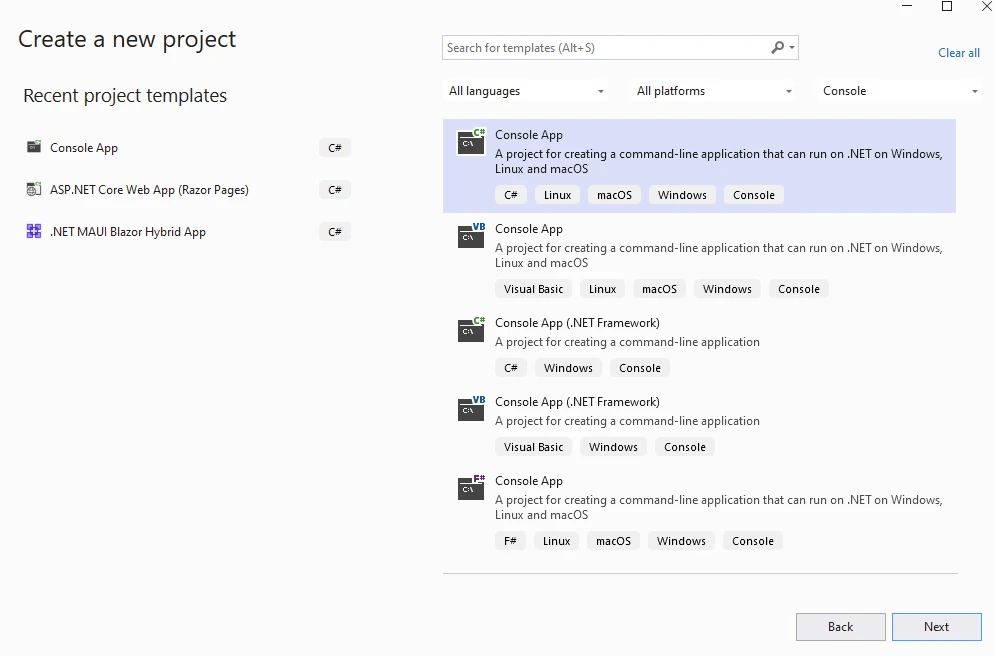
Öffnen Sie zunächst Visual Studio und erstellen Sie eine Konsolenanwendung, indem Sie aus Projektschablonen wie unten gezeigt auswählen.
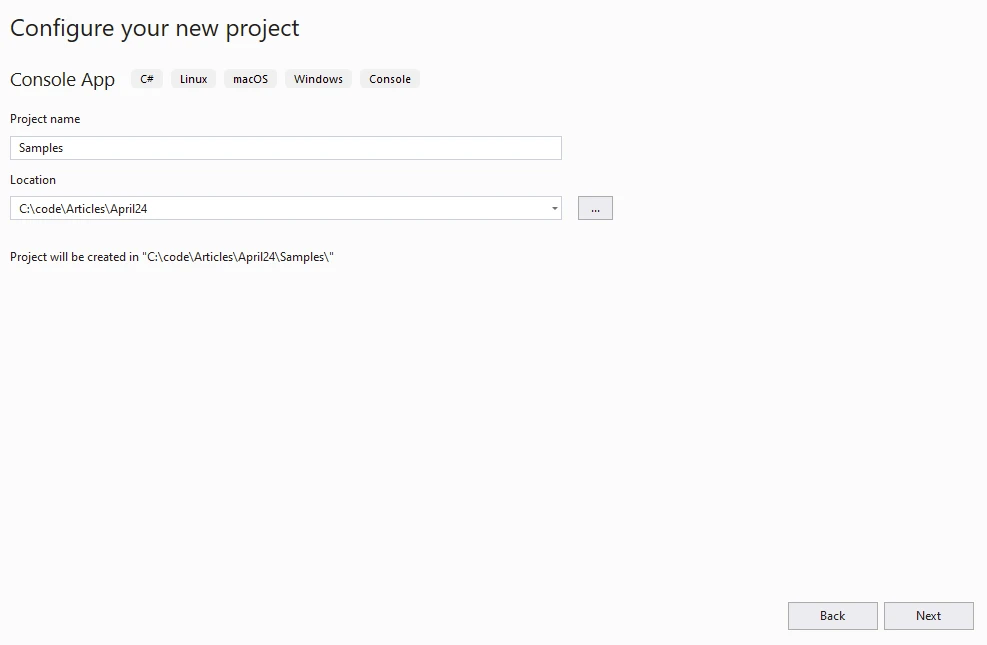
Geben Sie einen Projektnamen und einen Speicherort an.
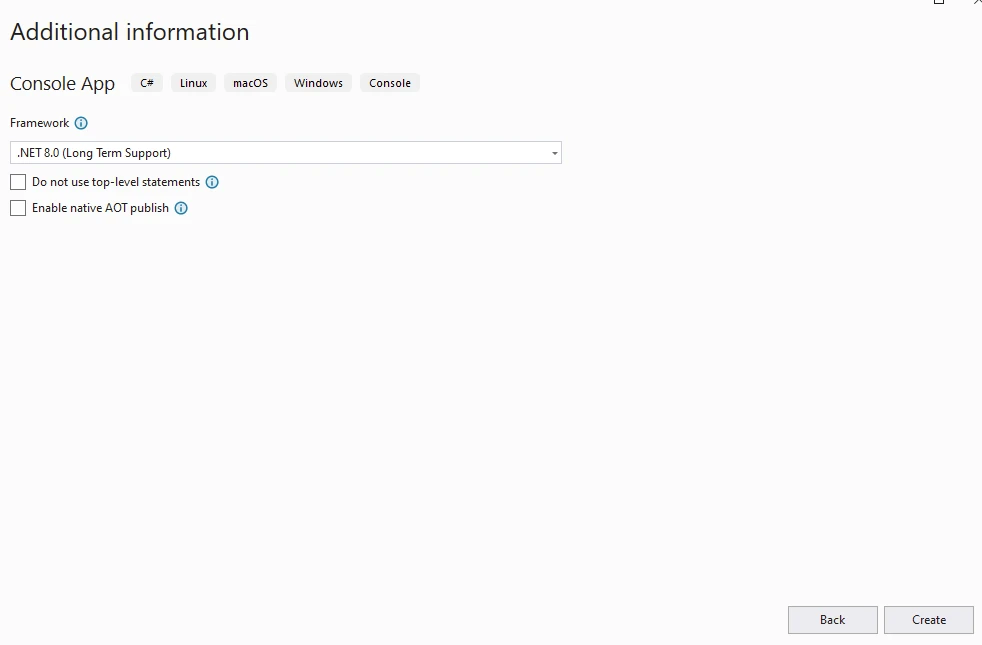
Wählen Sie die erforderliche .NET-Version aus.
Installieren Sie IronPDF über den Visual Studio-Paketmanager wie unten gezeigt.
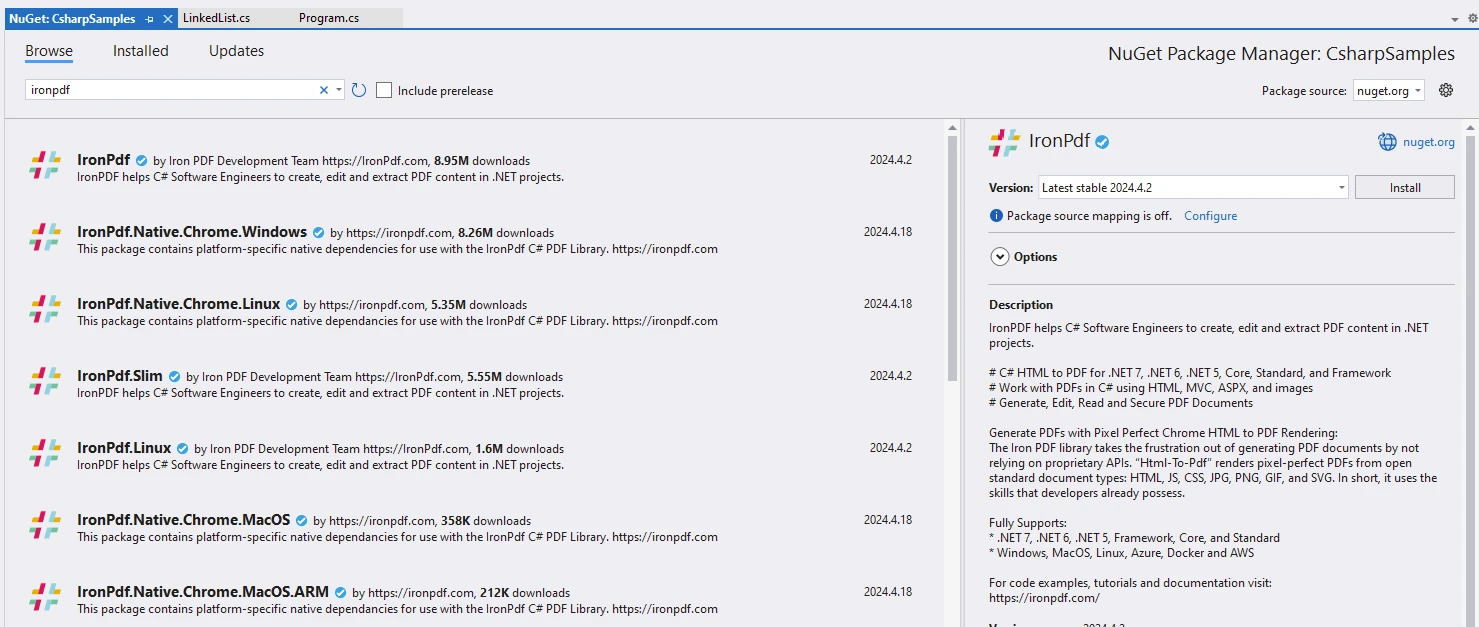
Oder es kann mit dem untenstehenden Befehlszeilenbefehl installiert werden.
```shell
:InstallCmd dotnet add package IronPdf --version 2024.4.2
```
Fügen Sie den folgenden Code hinzu.
```cs
using System;
using System.Collections.Generic;
using IronPdf;
namespace CsharpSamples
{
public class Program
{
public static void Main()
{
var content = "<h1>Demonstrate IronPDF with C# LinkedList</h1>";
content += "<h2>Create a new linked list of strings</h2>";
content += "<p>Create a new linked list of strings with new LinkedList<string>()</p>";
// Create a new linked list of strings
LinkedList<string> linkedList = new LinkedList<string>();
// Add elements to the linked list
content += "<p>Add Apple to linkedList</p>";
linkedList.AddLast("Apple");
content += "<p>Add Banana to linkedList</p>";
linkedList.AddLast("Banana");
content += "<p>Add Orange to linkedList</p>";
linkedList.AddLast("Orange");
content += "<h2>Print the elements of the linked list</h2>";
Console.WriteLine("Linked List elements:");
foreach (var item in linkedList)
{
content += $"<p>{item}</p>";
Console.WriteLine(item);
}
content += "<h2>Insert an element at a specific position</h2>";
LinkedListNode<string> node = linkedList.Find("Banana");
if (node != null)
{
linkedList.AddAfter(node, "Mango");
content += "<p>Find Banana and insert Mango After</p>";
}
Console.WriteLine("\nLinked List elements after insertion:");
content += "<h2>Linked List elements after insertion:</h2>";
foreach (var item in linkedList)
{
content += $"<p>{item}</p>";
Console.WriteLine(item);
}
content += "<h2>Remove an element from the linked list</h2>";
linkedList.Remove("Orange");
content += "<p>Remove Orange from linked list</p>";
Console.WriteLine("\nLinked List elements after removal:");
content += "<h2>Linked List elements after removal:</h2>";
foreach (var item in linkedList)
{
content += $"<p>{item}</p>";
Console.WriteLine(item);
}
// Create a PDF renderer
var renderer = new ChromePdfRenderer();
// Create a PDF from HTML string
var pdf = renderer.RenderHtmlAsPdf(content);
// Save to a file
pdf.SaveAs("AwesomeIronOutput.pdf");
}
}
}
```
### Code-Erklärung
1. Zuerst beginnen wir mit der Erstellung des Inhalts für das PDF mithilfe eines Inhaltszeichenfolgenobjekts. Der Inhalt wird als HTML-Zeichenfolge generiert.
2. Erstellen Sie eine neue verkettete Liste von Zeichenfolgen mit `new LinkedList<string>()`.
3. Fügen Sie der verketteten Liste Elemente hinzu und hängen Sie auch Informationen an die PDF-Inhaltszeichenfolge an.
4. Drucken Sie die Elemente der verketteten Liste und fügen Sie sie dem PDF-Inhalt hinzu.
5. Fügen Sie ein Element an einer bestimmten Position mit der `AddAfter` Methode ein; 6. Entfernen Sie ein Element aus der verketteten Liste mit der `Remove`-Methode und drucken Sie die Liste.
6. Entfernen Sie ein Element aus der verketteten Liste mit der `Remove` Methode, aktualisieren Sie den Inhalt und drucken Sie die resultierende Liste.
7. Speichern Sie schließlich die generierte HTML-Inhaltszeichenfolge mit den `ChromePdfRenderer`, `RenderHtmlAsPdf` und `SaveAs` Methoden in einem PDF-Dokument.
### Ausgabe
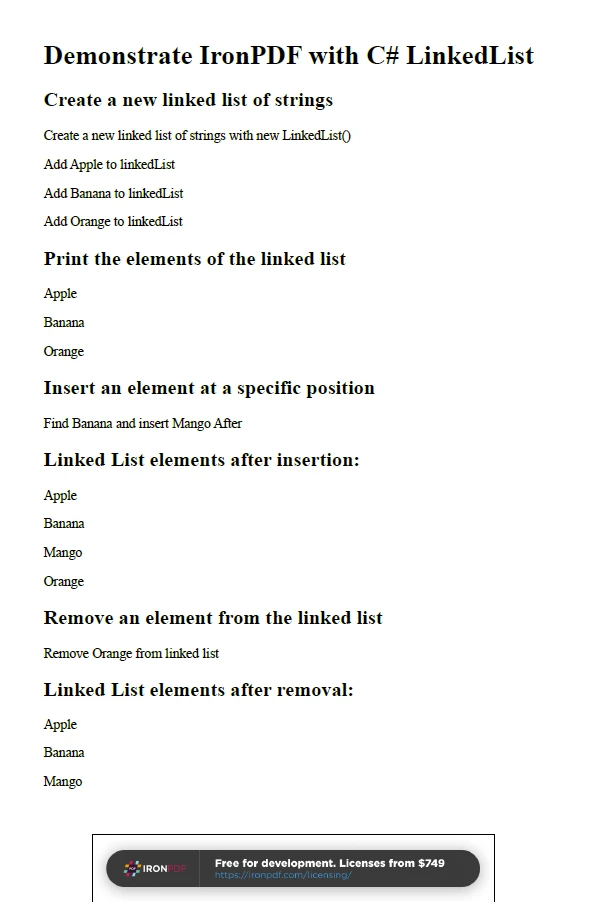
Die Ausgabe hat ein Wasserzeichen, das mit einer gültigen Lizenz von der [IronPDF Lizenzseite](/licensing/) entfernt werden kann.
## IronPDF-Lizenz
Die [IronPDF-Bibliothek benötigt eine Lizenz, um zu funktionieren](trial-license), die von der [Produktlizenzierungsseite](/licensing/) bezogen werden kann.
Fügen Sie den Schlüssel in die Datei appSettings.json unten ein.
```json
{
"IronPdf.License.LicenseKey": "The Key Goes Here"
}
```
## Abschluss
C# `LinkedList` bietet eine vielseitige Datenstruktur zur Verwaltung von Sammlungen von Elementen, die effiziente Einfügungen und Löschungen bietet und eine dynamische Größenanpassung ermöglicht, ähnlich der Standard-Hash-Funktion. Verkettete Listen werden häufig in verschiedenen Anwendungen und Algorithmen verwendet, wie zum Beispiel beim Implementieren von Stapeln, Warteschlangen, Symboltabellen und Speichermanagementsystemen. Das Verständnis der Merkmale und Operationen von verketteten Listen ist entscheidend für den Aufbau effizienter und skalierbarer Softwarelösungen.
Zusammenfassend lässt sich sagen, dass verkettete Listen in bestimmten Szenarien hervorragend abschneiden, wie bei dynamischen Datenstrukturen und häufigen Einfügungen/Löschungen, jedoch möglicherweise nicht die beste Wahl für Anwendungen sind, die häufigen Zufallszugriff erfordern oder mit speicherbeschränkten Umgebungen zu tun haben. Die IronPDF-Bibliothek von Iron Software ermöglicht Entwicklern das einfache Erstellen und Manipulieren von PDF-Dokumenten und fördert fortgeschrittene Fähigkeiten zur Entwicklung moderner Anwendungen.
Die IronPDF-Bibliothek von Iron Software ermöglicht es Entwicklern, mühelos PDF-Dokumente zu erstellen und zu bearbeiten, wodurch fortgeschrittene Fähigkeiten zur Entwicklung moderner Anwendungen ermöglicht werden.
Eine verkettete Liste ist eine lineare Datenstruktur, die aus einer Reihe von Knoten besteht, die auch als Elemente bezeichnet werden können. Im Gegensatz zu Arrays, bei denen Elemente/Knoten an aufeinanderfolgenden Speicherorten gespeichert werden, nutzen verkettete Listen die dynamische Speicherzuweisung, sodass Elemente/Knoten über den gesamten Speicher verteilt sein können.
In ihrer einfachsten Form bestehen "verkettete Listen" aus linear miteinander verbundenen Knoten. Jeder Knoten enthält zwei Hauptteile:
Daten: Nutzdaten, die im Knoten gespeichert sind. Dies kann je nach Implementierung jeder Datentyp sein, wie z. B. Ganzzahlen, Zeichenfolgen, Objekte usw.
Nächster Zeiger: Eine Referenz (oder ein Zeiger) auf den nächsten Knoten in der Sequenz. Dieser Zeiger zeigt den Speicherort des folgenden Knotens an und zeigt nach vorne in der verketteten Liste.
Der letzte Knoten in einer verketteten Liste zeigt typischerweise auf einen Null-Verweis, was das Ende der Liste anzeigt.
In diesem Artikel werden wir uns die verkettete Liste in C# im Detail ansehen und auch die IronPDF-Bibliothek erkunden, ein PDF-Generierungs-Tool von Iron Software.
Typen von verknüpften Listen
1. Einzeln verknüpfte Liste
Eine einfach verkettete Liste hat einen Knoten mit nur einem Verweis, der typischerweise auf den nächsten Knoten in der Sequenz zeigt. Das Durchlaufen der Liste ist auf die Bewegung in eine Richtung beschränkt, typischerweise vom Kopf (dem ersten Knoten) zum Schwanz (dem letzten Knoten).
2. doppelt verknüpfte Liste
In einer doppelt verketteten Liste enthält jeder Knoten zwei Verweise: einen, der auf den nächsten Knoten und einen weiteren, der auf den vorherigen Knoten in der Sequenz zeigt. Diese bidirektionale Verknüpfung ermöglicht den Durchlauf in beide Richtungen, vorwärts und rückwärts.
3. zirkuläre verknüpfte Liste
In einer zirkulär verketteten Liste zeigt der letzte Knoten zurück auf den ersten Knoten und bildet so eine kreisförmige Struktur. Dieser Typ von verketteter Liste kann entweder mit einfach verketteten oder doppelt verketteten Knoten implementiert werden.
Grundlegende Operationen mit verknüpften Listen
Einfügen: Hinzufügen eines neuen Knotens zur Liste an einer bestimmten Position, z. B. am Anfang, Ende oder in der Mitte.
Löschen: Entfernen eines bestimmten Objektknotens aus der Liste und entsprechendes Anpassen der Zeiger benachbarter Knoten.
Traversierung: Iterieren durch die Liste, um auf die Daten jedes Knotens zuzugreifen oder diese zu bearbeiten.
Suche: Auffinden eines bestimmten Knotens in der Liste anhand seines in den Daten angegebenen Wertes.
Linked List in C#
In C# können Sie eine verkettete Liste mithilfe der LinkedList-Klasse aus dem System.Collections.Generic Namespace implementieren. Hier ist ein Beispiel für alle grundlegenden Operationen:
using System;using System.Collections.Generic;namespace CsharpSamples{ public class Program { public static voidMain() { // Create a new linked list of integers LinkedList<int> linkedList = new LinkedList<int>(); // Add elements to the linked list linkedList.AddLast(10); linkedList.AddLast(20); linkedList.AddLast(30); linkedList.AddLast(40); // Traverse and print the elements of the linked listConsole.WriteLine("Traverse Linked List elements:"); foreach (var item in linkedList) {Console.WriteLine(item); } // Display number of linked list elementsConsole.WriteLine($"Number of Linked List elements: {linkedList.Count}"); // Find/Search for an element in the linked listConsole.WriteLine("\nFind/Search Element Linked List elements: 30"); var foundNode = linkedList.Find(30); if (foundNode != null) {Console.WriteLine( $"Found Value: {foundNode.Value}, " + $"Next Element: {(foundNode.Next != null ? foundNode.Next.Value.ToString() : "null")}, " + $"Previous Element: {(foundNode.Previous != null ? foundNode.Previous.Value.ToString() : "null")}" ); } // Insert an element at a specified node LinkedListNode<int> current = linkedList.Find(20); if (current != null) { linkedList.AddAfter(current, 25); }Console.WriteLine($"\nNumber of Linked List elements: {linkedList.Count}");Console.WriteLine("\nLinked List elements after insertion:"); foreach (var item in linkedList) {Console.WriteLine(item); } // Remove an existing node from the linked list linkedList.Remove(30);Console.WriteLine("\nLinked List elements after removal:"); foreach (var item in linkedList) {Console.WriteLine(item); }Console.WriteLine($"\nNumber of Linked List elements: {linkedList.Count}"); } }}
using System;
using System.Collections.Generic;

namespace CsharpSamples
{
    public class Program
    {
        public static void Main()
        {
            // Create a new linked list of integers
            LinkedList<int> linkedList = new LinkedList<int>();

            // Add elements to the linked list
            linkedList.AddLast(10);
            linkedList.AddLast(20);
            linkedList.AddLast(30);
            linkedList.AddLast(40);

            // Traverse and print the elements of the linked list
            Console.WriteLine("Traverse Linked List elements:");
            foreach (var item in linkedList)
            {
                Console.WriteLine(item);
            }

            // Display number of linked list elements
            Console.WriteLine($"Number of Linked List elements: {linkedList.Count}");

            // Find/Search for an element in the linked list
            Console.WriteLine("\nFind/Search Element Linked List elements: 30");
            var foundNode = linkedList.Find(30);

            if (foundNode != null)
            {
                Console.WriteLine(
                    $"Found Value: {foundNode.Value}, " +
                    $"Next Element: {(foundNode.Next != null ? foundNode.Next.Value.ToString() : "null")}, " +
                    $"Previous Element: {(foundNode.Previous != null ? foundNode.Previous.Value.ToString() : "null")}"
                );
            }

            // Insert an element at a specified node
            LinkedListNode<int> current = linkedList.Find(20);
            if (current != null)
            {
                linkedList.AddAfter(current, 25);
            }

            Console.WriteLine($"\nNumber of Linked List elements: {linkedList.Count}");
            Console.WriteLine("\nLinked List elements after insertion:");
            foreach (var item in linkedList)
            {
                Console.WriteLine(item);
            }

            // Remove an existing node from the linked list
            linkedList.Remove(30);

            Console.WriteLine("\nLinked List elements after removal:");
            foreach (var item in linkedList)
            {
                Console.WriteLine(item);
            }

            Console.WriteLine($"\nNumber of Linked List elements: {linkedList.Count}");
        }
    }
}
ImportsSystemImportsSystem.Collections.GenericNamespaceCsharpSamples Public Class Program PublicShared Sub Main() ' Create a new linked list of integers Dim linkedList As New LinkedList(OfInteger)() ' Add elements to the linked list linkedList.AddLast(10) linkedList.AddLast(20) linkedList.AddLast(30) linkedList.AddLast(40) ' Traverse and print the elements of the linked listConsole.WriteLine("Traverse Linked List elements:") For Each item In linkedListConsole.WriteLine(item) Next ' Display number of linked list elementsConsole.WriteLine($"Number of Linked List elements: {linkedList.Count}") ' Find/Search for an element in the linked listConsole.WriteLine(vbCrLf & "Find/Search Element Linked List elements: 30") Dim foundNode = linkedList.Find(30) If foundNode IsNot Nothing ThenConsole.WriteLine( $"Found Value: {foundNode.Value}, " & $"Next Element: {If(foundNode.Next IsNot Nothing, foundNode.Next.Value.ToString(), "null")}, " & $"Previous Element: {If(foundNode.Previous IsNot Nothing, foundNode.Previous.Value.ToString(), "null")}" ) End If ' Insert an element at a specified node Dim current AsLinkedListNode(OfInteger) = linkedList.Find(20) If current IsNot Nothing Then linkedList.AddAfter(current, 25) End IfConsole.WriteLine(vbCrLf & $"Number of Linked List elements: {linkedList.Count}")Console.WriteLine(vbCrLf & "Linked List elements after insertion:") For Each item In linkedListConsole.WriteLine(item) Next ' Remove an existing node from the linked list linkedList.Remove(30)Console.WriteLine(vbCrLf & "Linked List elements after removal:") For Each item In linkedListConsole.WriteLine(item) NextConsole.WriteLine(vbCrLf & $"Number of Linked List elements: {linkedList.Count}") End Sub End ClassEndNamespace
Imports System
Imports System.Collections.Generic

Namespace CsharpSamples
    Public Class Program
        Public Shared Sub Main()
            ' Create a new linked list of integers
            Dim linkedList As New LinkedList(Of Integer)()

            ' Add elements to the linked list
            linkedList.AddLast(10)
            linkedList.AddLast(20)
            linkedList.AddLast(30)
            linkedList.AddLast(40)

            ' Traverse and print the elements of the linked list
            Console.WriteLine("Traverse Linked List elements:")
            For Each item In linkedList
                Console.WriteLine(item)
            Next

            ' Display number of linked list elements
            Console.WriteLine($"Number of Linked List elements: {linkedList.Count}")

            ' Find/Search for an element in the linked list
            Console.WriteLine(vbCrLf & "Find/Search Element Linked List elements: 30")
            Dim foundNode = linkedList.Find(30)

            If foundNode IsNot Nothing Then
                Console.WriteLine(
                    $"Found Value: {foundNode.Value}, " &
                    $"Next Element: {If(foundNode.Next IsNot Nothing, foundNode.Next.Value.ToString(), "null")}, " &
                    $"Previous Element: {If(foundNode.Previous IsNot Nothing, foundNode.Previous.Value.ToString(), "null")}"
                )
            End If

            ' Insert an element at a specified node
            Dim current As LinkedListNode(Of Integer) = linkedList.Find(20)
            If current IsNot Nothing Then
                linkedList.AddAfter(current, 25)
            End If

            Console.WriteLine(vbCrLf & $"Number of Linked List elements: {linkedList.Count}")
            Console.WriteLine(vbCrLf & "Linked List elements after insertion:")
            For Each item In linkedList
                Console.WriteLine(item)
            Next

            ' Remove an existing node from the linked list
            linkedList.Remove(30)

            Console.WriteLine(vbCrLf & "Linked List elements after removal:")
            For Each item In linkedList
                Console.WriteLine(item)
            Next

            Console.WriteLine(vbCrLf & $"Number of Linked List elements: {linkedList.Count}")
        End Sub
    End Class
End Namespace
Code-Erklärung
Erstellen Sie eine neue verkettete Liste von ganzen Zahlen mit new LinkedList<int>().
Fügen Sie bestimmte Wertobjekte zur verketteten Liste hinzu.
Durchlaufen und drucken Sie die Elemente der verketteten Liste mit einer foreach Schleife.
Finden/Suchen Sie ein Element in der verketteten Liste.
Fügen Sie ein Element an einem angegebenen Knoten mit den Find und AddAfter Methoden ein.
Entfernen Sie einen vorhandenen Knoten aus der verketteten Liste mit der Remove Methode.
Ausgabe
Einführung in IronPDF
Entdecken Sie mehr über IronPDF, eine leistungsstarke C# PDF-Bibliothek, entwickelt und gepflegt von Iron Software. Sie bietet eine umfassende Reihe von Funktionen zum Erstellen, Bearbeiten und Extrahieren von Inhalten aus PDF-Dokumenten in .NET-Projekten.
Wichtige Punkte über IronPDF
HTML-zu-PDF-Konvertierung
IronPDF ermöglicht die Konvertierung von HTML-Inhalten in PDF-Format. Sie können HTML-Seiten, URLs und HTML-Zeichenfolgen mit Leichtigkeit in PDFs rendern.
Reiche API
Die Bibliothek bietet eine benutzerfreundliche API, mit der Entwickler professionelle PDFs direkt aus HTML generieren können. Egal, ob Sie Rechnungen, Berichte oder andere Dokumente erstellen müssen, IronPDF vereinfacht den Prozess.
Plattformübergreifende Unterstützung
IronPDF ist mit verschiedenen .NET-Umgebungen kompatibel, einschließlich .NET Core, .NET Standard und .NET Framework. Es läuft auf Windows-, Linux- und macOS-Plattformen.
Vielseitigkeit
IronPDF unterstützt verschiedene Projekttypen, wie Webanwendungen (Blazor und WebForms), Desktopanwendungen (WPF und MAUI) und Konsolenanwendungen.
Inhaltsquellen
Sie können PDFs aus verschiedenen Inhaltsquellen generieren, einschließlich HTML-Dateien, Razor-Ansichten (Blazor-Server), CSHTML (MVC und Razor), ASPX (WebForms) und XAML (MAUI).
Zusätzliche Funktionen
Fügen Sie PDFs Kopf- und Fußzeilen hinzu.
PDF-Seiten zusammenführen, teilen, hinzufügen, kopieren und löschen.
Passwörter, Berechtigungen und digitale Signaturen festlegen.
Leistung optimieren mit Multithreading und asynchroner Unterstützung.
Kompatibilität
IronPDF hält sich an PDF-Standards, einschließlich Versionen 1.2 bis 1.7, PDF/UA und PDF/A. Es unterstützt auch UTF-8-Zeichenkodierung, Basis-URLs und Asset-Kodierung.
PDF-Dokument mit LinkedList erstellen
Erstellen wir jetzt ein PDF-Dokument mit IronPDF und demonstrieren wir auch die Verwendung von LinkedList Zeichenfolgen.
Öffnen Sie zunächst Visual Studio und erstellen Sie eine Konsolenanwendung, indem Sie aus Projektschablonen wie unten gezeigt auswählen.
Geben Sie einen Projektnamen und einen Speicherort an.
Wählen Sie die erforderliche .NET-Version aus.
Installieren Sie IronPDF über den Visual Studio-Paketmanager wie unten gezeigt.
Oder es kann mit dem untenstehenden Befehlszeilenbefehl installiert werden.
> dotnet add package IronPdf --version 2024.4.2
dotnet add package IronPdf --version 2024.4.2
Fügen Sie den folgenden Code hinzu.
using System;using System.Collections.Generic;using IronPdf;namespace CsharpSamples{ public class Program { public static voidMain() { var content = "<h1>Demonstrate IronPDF with C# LinkedList</h1>"; content += "<h2>Create a new linked list of strings</h2>"; content += "<p>Create a new linked list of strings with new LinkedList<string>()</p>"; // Create a new linked list of strings LinkedList<string> linkedList = new LinkedList<string>(); // Add elements to the linked list content += "<p>Add Apple to linkedList</p>"; linkedList.AddLast("Apple"); content += "<p>Add Banana to linkedList</p>"; linkedList.AddLast("Banana"); content += "<p>Add Orange to linkedList</p>"; linkedList.AddLast("Orange"); content += "<h2>Print the elements of the linked list</h2>";Console.WriteLine("Linked List elements:"); foreach (var item in linkedList) { content += $"<p>{item}</p>";Console.WriteLine(item); } content += "<h2>Insert an element at a specific position</h2>"; LinkedListNode<string> node = linkedList.Find("Banana"); if (node != null) { linkedList.AddAfter(node, "Mango"); content += "<p>Find Banana and insert Mango After</p>"; }Console.WriteLine("\nLinked List elements after insertion:"); content += "<h2>Linked List elements after insertion:</h2>"; foreach (var item in linkedList) { content += $"<p>{item}</p>";Console.WriteLine(item); } content += "<h2>Remove an element from the linked list</h2>"; linkedList.Remove("Orange"); content += "<p>Remove Orange from linked list</p>";Console.WriteLine("\nLinked List elements after removal:"); content += "<h2>Linked List elements after removal:</h2>"; foreach (var item in linkedList) { content += $"<p>{item}</p>";Console.WriteLine(item); } // Create a PDF renderer var renderer = new ChromePdfRenderer(); // Create a PDF from HTML string var pdf = renderer.RenderHtmlAsPdf(content); // Save to a file pdf.SaveAs("AwesomeIronOutput.pdf"); } }}
using System;
using System.Collections.Generic;
using IronPdf;
namespace CsharpSamples
{
public class Program
{
public static void Main()
{
var content = "<h1>Demonstrate IronPDF with C# LinkedList</h1>";
content += "<h2>Create a new linked list of strings</h2>";
content += "<p>Create a new linked list of strings with new LinkedList<string>()</p>";
// Create a new linked list of strings
LinkedList<string> linkedList = new LinkedList<string>();
// Add elements to the linked list
content += "<p>Add Apple to linkedList</p>";
linkedList.AddLast("Apple");
content += "<p>Add Banana to linkedList</p>";
linkedList.AddLast("Banana");
content += "<p>Add Orange to linkedList</p>";
linkedList.AddLast("Orange");
content += "<h2>Print the elements of the linked list</h2>";
Console.WriteLine("Linked List elements:");
foreach (var item in linkedList)
{
content += $"<p>{item}</p>";
Console.WriteLine(item);
}
content += "<h2>Insert an element at a specific position</h2>";
LinkedListNode<string> node = linkedList.Find("Banana");
if (node != null)
{
linkedList.AddAfter(node, "Mango");
content += "<p>Find Banana and insert Mango After</p>";
}
Console.WriteLine("\nLinked List elements after insertion:");
content += "<h2>Linked List elements after insertion:</h2>";
foreach (var item in linkedList)
{
content += $"<p>{item}</p>";
Console.WriteLine(item);
}
content += "<h2>Remove an element from the linked list</h2>";
linkedList.Remove("Orange");
content += "<p>Remove Orange from linked list</p>";
Console.WriteLine("\nLinked List elements after removal:");
content += "<h2>Linked List elements after removal:</h2>";
foreach (var item in linkedList)
{
content += $"<p>{item}</p>";
Console.WriteLine(item);
}
// Create a PDF renderer
var renderer = new ChromePdfRenderer();
// Create a PDF from HTML string
var pdf = renderer.RenderHtmlAsPdf(content);
// Save to a file
pdf.SaveAs("AwesomeIronOutput.pdf");
}
}
}
ImportsSystemImportsSystem.Collections.GenericImportsIronPdfNamespaceCsharpSamples Public Class Program PublicShared Sub Main() Dim content AsString = "<h1>Demonstrate IronPDF with C# LinkedList</h1>" content += "<h2>Create a new linked list of strings</h2>" content += "<p>Create a new linked list of strings with new LinkedList<string>()</p>" ' Create a new linked list of strings Dim linkedList As New LinkedList(OfString)() ' Add elements to the linked list content += "<p>Add Apple to linkedList</p>" linkedList.AddLast("Apple") content += "<p>Add Banana to linkedList</p>" linkedList.AddLast("Banana") content += "<p>Add Orange to linkedList</p>" linkedList.AddLast("Orange") content += "<h2>Print the elements of the linked list</h2>"Console.WriteLine("Linked List elements:") For Each item In linkedList content += $"<p>{item}</p>"Console.WriteLine(item) Next content += "<h2>Insert an element at a specific position</h2>" Dim node AsLinkedListNode(OfString) = linkedList.Find("Banana") If node IsNot Nothing Then linkedList.AddAfter(node, "Mango") content += "<p>Find Banana and insert Mango After</p>" End IfConsole.WriteLine(vbCrLf & "Linked List elements after insertion:") content += "<h2>Linked List elements after insertion:</h2>" For Each item In linkedList content += $"<p>{item}</p>"Console.WriteLine(item) Next content += "<h2>Remove an element from the linked list</h2>" linkedList.Remove("Orange") content += "<p>Remove Orange from linked list</p>"Console.WriteLine(vbCrLf & "Linked List elements after removal:") content += "<h2>Linked List elements after removal:</h2>" For Each item In linkedList content += $"<p>{item}</p>"Console.WriteLine(item) Next ' Create a PDF renderer Dim renderer = New ChromePdfRenderer() ' Create a PDF from HTML string Dim pdf = renderer.RenderHtmlAsPdf(content) ' Save to a file pdf.SaveAs("AwesomeIronOutput.pdf") End Sub End ClassEndNamespace
Imports System
Imports System.Collections.Generic
Imports IronPdf
Namespace CsharpSamples
Public Class Program
Public Shared Sub Main()
Dim content As String = "<h1>Demonstrate IronPDF with C# LinkedList</h1>"
content += "<h2>Create a new linked list of strings</h2>"
content += "<p>Create a new linked list of strings with new LinkedList<string>()</p>"
' Create a new linked list of strings
Dim linkedList As New LinkedList(Of String)()
' Add elements to the linked list
content += "<p>Add Apple to linkedList</p>"
linkedList.AddLast("Apple")
content += "<p>Add Banana to linkedList</p>"
linkedList.AddLast("Banana")
content += "<p>Add Orange to linkedList</p>"
linkedList.AddLast("Orange")
content += "<h2>Print the elements of the linked list</h2>"
Console.WriteLine("Linked List elements:")
For Each item In linkedList
content += $"<p>{item}</p>"
Console.WriteLine(item)
Next
content += "<h2>Insert an element at a specific position</h2>"
Dim node As LinkedListNode(Of String) = linkedList.Find("Banana")
If node IsNot Nothing Then
linkedList.AddAfter(node, "Mango")
content += "<p>Find Banana and insert Mango After</p>"
End If
Console.WriteLine(vbCrLf & "Linked List elements after insertion:")
content += "<h2>Linked List elements after insertion:</h2>"
For Each item In linkedList
content += $"<p>{item}</p>"
Console.WriteLine(item)
Next
content += "<h2>Remove an element from the linked list</h2>"
linkedList.Remove("Orange")
content += "<p>Remove Orange from linked list</p>"
Console.WriteLine(vbCrLf & "Linked List elements after removal:")
content += "<h2>Linked List elements after removal:</h2>"
For Each item In linkedList
content += $"<p>{item}</p>"
Console.WriteLine(item)
Next
' Create a PDF renderer
Dim renderer = New ChromePdfRenderer()
' Create a PDF from HTML string
Dim pdf = renderer.RenderHtmlAsPdf(content)
' Save to a file
pdf.SaveAs("AwesomeIronOutput.pdf")
End Sub
End Class
End Namespace
Code-Erklärung
Zuerst beginnen wir mit der Erstellung des Inhalts für das PDF mithilfe eines Inhaltszeichenfolgenobjekts. Der Inhalt wird als HTML-Zeichenfolge generiert.
Erstellen Sie eine neue verkettete Liste von Zeichenfolgen mit new LinkedList<string>().
Fügen Sie der verketteten Liste Elemente hinzu und hängen Sie auch Informationen an die PDF-Inhaltszeichenfolge an.
Drucken Sie die Elemente der verketteten Liste und fügen Sie sie dem PDF-Inhalt hinzu.
Fügen Sie ein Element an einer bestimmten Position mit der AddAfter Methode ein; 6. Entfernen Sie ein Element aus der verketteten Liste mit der Remove-Methode und drucken Sie die Liste.
Entfernen Sie ein Element aus der verketteten Liste mit der Remove Methode, aktualisieren Sie den Inhalt und drucken Sie die resultierende Liste.
Speichern Sie schließlich die generierte HTML-Inhaltszeichenfolge mit den ChromePdfRenderer, RenderHtmlAsPdf und SaveAs Methoden in einem PDF-Dokument.
Ausgabe
Die Ausgabe hat ein Wasserzeichen, das mit einer gültigen Lizenz von der IronPDF Lizenzseite entfernt werden kann.
Fügen Sie den Schlüssel in die Datei appSettings.json unten ein.
{ "IronPdf.License.LicenseKey": "The Key Goes Here"}
{
  "IronPdf.License.LicenseKey": "The Key Goes Here"
}
JSON
Abschluss
C# LinkedList bietet eine vielseitige Datenstruktur zur Verwaltung von Sammlungen von Elementen, die effiziente Einfügungen und Löschungen bietet und eine dynamische Größenanpassung ermöglicht, ähnlich der Standard-Hash-Funktion. Verkettete Listen werden häufig in verschiedenen Anwendungen und Algorithmen verwendet, wie zum Beispiel beim Implementieren von Stapeln, Warteschlangen, Symboltabellen und Speichermanagementsystemen. Das Verständnis der Merkmale und Operationen von verketteten Listen ist entscheidend für den Aufbau effizienter und skalierbarer Softwarelösungen.
Zusammenfassend lässt sich sagen, dass verkettete Listen in bestimmten Szenarien hervorragend abschneiden, wie bei dynamischen Datenstrukturen und häufigen Einfügungen/Löschungen, jedoch möglicherweise nicht die beste Wahl für Anwendungen sind, die häufigen Zufallszugriff erfordern oder mit speicherbeschränkten Umgebungen zu tun haben. Die IronPDF-Bibliothek von Iron Software ermöglicht Entwicklern das einfache Erstellen und Manipulieren von PDF-Dokumenten und fördert fortgeschrittene Fähigkeiten zur Entwicklung moderner Anwendungen.
Die IronPDF-Bibliothek von Iron Software ermöglicht es Entwicklern, mühelos PDF-Dokumente zu erstellen und zu bearbeiten, wodurch fortgeschrittene Fähigkeiten zur Entwicklung moderner Anwendungen ermöglicht werden.
Jacob Mellor ist Chief Technology Officer bei Iron Software und ein visionärer Ingenieur, der Pionierarbeit in der C# PDF-Technologie leistet. Als der ursprüngliche Entwickler hinter der Kern-Codebasis von Iron Software hat er die Produktarchitektur des Unternehmens seit seiner Gründung geprägt und es zusammen mit CEO Cameron Rimington in ein Unternehmen mit mehr als 50 Mitarbeitern verwandelt, das die NASA, Tesla und globale Regierungsbehörden beliefert.





























