using IronPdf;

// Disable local disk access or cross-origin requests
Installation.EnableWebSecurity = true;

// Instantiate Renderer
var renderer = new ChromePdfRenderer();

// Create a PDF from a HTML string using C#
var pdf = renderer.RenderHtmlAsPdf("<h1>Hello World</h1>");

// Export to a file or Stream
pdf.SaveAs("output.pdf");

// Advanced Example with HTML Assets
// Load external html assets: Images, CSS and JavaScript.
// An optional BasePath 'C:\site\assets\' is set as the file location to load assets from
var myAdvancedPdf = renderer.RenderHtmlAsPdf("<img src='icons/iron.png'>", @"C:\site\assets\");
myAdvancedPdf.SaveAs("html-with-assets.pdf");
using IronPdf;// Disable local disk access or cross-origin requestsInstallation.EnableWebSecurity = true;// Instantiate Renderervar renderer = new ChromePdfRenderer();// Create a PDF from a HTML string using C#var pdf = renderer.RenderHtmlAsPdf("<h1>Hello World</h1>");// Export to a file or Streampdf.SaveAs("output.pdf");// Advanced Example with HTML Assets// Load external html assets: Images, CSS and JavaScript.// An optional BasePath 'C:\site\assets\' is set as the file location to load assets fromvar myAdvancedPdf = renderer.RenderHtmlAsPdf("<img src='icons/iron.png'>", @"C:\site\assets\");myAdvancedPdf.SaveAs("html-with-assets.pdf");
PM >Install-Package IronPdf
Install-Package IronPdf
ENTWICKLER-UPDATES
C# LINQ Join-Abfragesyntax (Funktionsweise für Entwickler)
In der Vielseitigkeit der C#-Programmierung sticht LINQ (Language Integrated Query) als leistungsfähiges Werkzeug zum Abfragen und Manipulieren von Objektkollektionen hervor. Unter den zahlreichen von LINQ angebotenen Operatoren ist der **Join**-Operator ein Schlüsselspieler, wenn es darum geht, Daten aus mehreren Quellen zu verbinden.
In diesem Artikel werden wir tief in die Komplexität des [**C# LINQ Join-Operators**](https://learn.microsoft.com/en-us/dotnet/csharp/linq/perform-inner-joins) eintauchen, seine Funktionalität, Syntax und Anwendungsbeispiele aus der Praxis entschlüsseln.
## Grundlagen der Join-Klausel verstehen
Im Kern ist der LINQ-Join-Operator darauf ausgelegt, Elemente aus zwei oder mehr Sammlungen basierend auf einer bestimmten Bedingung zu kombinieren. Dieser Operator ermöglicht es Entwicklern, SQL-ähnliche Joins bei In-Memory-Kollektionen durchzuführen, was das Zusammenführen von Daten aus unterschiedlichen Quellen erleichtert.
### Syntax des LINQ Join Operators
Die Syntax für den LINQ-Join-Operator ist ausdrucksstark und folgt einem Muster, das SQL-Joins ähnelt. Die grundlegende Syntax lautet wie folgt:
```csharp
var queryResult =
    from element1 in collection1
    join element2 in collection2 on element1.Key equals element2.Key
    select new { element1, element2 };
```
In dieser Syntax:
* **element1** und **element2** sind Variablen, die Elemente aus **collection1** und **collection2** darstellen.
* **element1.Key** und **element2.Key** sind die Eigenschaften, die als Basis für die Join-Operation verwendet werden.
* Das Schlüsselwort **equals** legt die Bedingung für den Join fest.
* Die **select**-Klausel erstellt ein neues Objekt, das Elemente aus beiden Sammlungen kombiniert.
### Typen von LINQ Joins
LINQ unterstützt mehrere Arten von Joins, darunter:
1. **Inner Join:** Gibt nur die Elemente zurück, die übereinstimmende Schlüssel in beiden Sammlungen haben.
```csharp
var innerJoin = from customer in customers
join order in orders on customer.CustomerID equals order.CustomerID // join orders to customers based on the customer ID key
select new { customer.CustomerID, customer.CustomerName, order.OrderID }; // create a new anonymous object based on the objects obtained from the join
```
2. **Left Outer Join (Standard):** Gibt alle Elemente aus der linken Sammlung und die übereinstimmenden Elemente aus der rechten Sammlung zurück. 3. **Group Join:** Gruppen Sie Elemente aus der linken Sammlung mit den passenden Elementen aus der rechten Sammlung.
```csharp
var leftOuterJoin = from customer in customers
join order in orders on customer.CustomerID equals order.CustomerID into customerOrders
from co in customerOrders.DefaultIfEmpty()
select new { customer.CustomerID, customer.CustomerName, OrderID = co?.OrderID ?? -1 };
```
3. **Group Join:** Gruppen mit übereinstimmenden Elementen aus der rechten Sammlung in der linken Sammlung.
```csharp
var groupJoin = from customer in customers
join order in orders on customer.CustomerID equals order.CustomerID into customerOrders
select new { customer.CustomerID, customer.CustomerName, Orders = customerOrders };
```
## Real-world Application: Kombinieren von Kunden- und Auftragsdaten
Betrachten wir ein praktisches Beispiel, bei dem wir zwei Sammlungen haben: **customers** und **orders**. Wir möchten ein Ergebnisset erstellen, das Kundeninformationen mit ihren entsprechenden Bestellungen unter Verwendung des LINQ-Join-Operators kombiniert.
```csharp
var customerOrderInfo =
from customer in customers
join order in orders on customer.CustomerID equals order.CustomerID
select new { customer.CustomerID, customer.CustomerName, order.OrderID, order.OrderDate };
```
In diesem Beispiel enthält das Ergebnisset Einträge mit Kundeninformationen zusammen mit ihren zugeordneten Bestellungen. Die Join-Erweiterungsmethodensyntax hilft C#-Entwicklern, SQL-ähnliche Join-Operationen durchzuführen.
## Einführung in IronPDF
[**PDF-Lösungen mit IronPDF entwickeln**](https://ironpdf.com) ist eine umfassende C#-Bibliothek zur Erstellung, Bearbeitung und Verarbeitung von PDF-Dokumenten. Sie ermöglicht es Entwicklern, PDFs dynamisch aus verschiedenen Datenquellen zu generieren und bietet somit eine vielseitige Lösung für Anwendungen, die die Erstellung von PDF-Dokumenten erfordern.
### Installation von IronPDF: Ein Schnellstart
Um die IronPDF-Bibliothek in Ihrem C#-Projekt zu nutzen, können Sie einfach das IronPDF NuGet-Paket installieren. Verwenden Sie den folgenden Befehl in Ihrer Paket-Manager-Konsole:
```shell
:InstallCmd Install-Package IronPdf
```
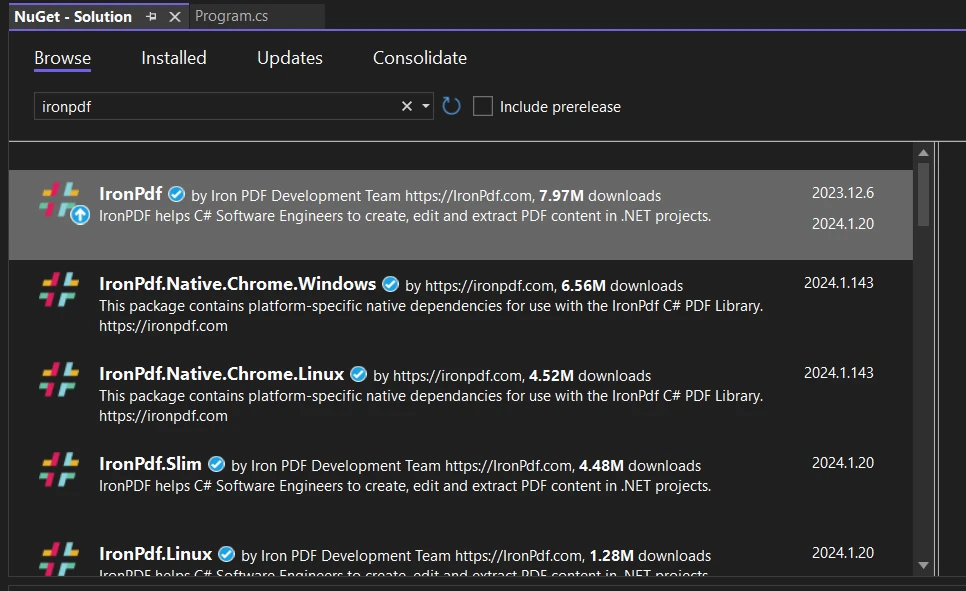
Alternativ können Sie im NuGet-Paketmanager nach 'IronPDF' suchen und es von dort aus installieren.
## LINQ Join und IronPDF: Ein dynamisches Duo?
Der LINQ-Join-Operator ist bekannt für seine Fähigkeit, Daten aus unterschiedlichen Quellen zu verbinden, und kann in Szenarien, in denen die Datenintegration von entscheidender Bedeutung ist, ein wertvolles Instrument sein. Bei der Nutzung des LINQ Join mit IronPDF ist die Art der Daten, die Sie in das PDF-Dokument integrieren möchten, von grundlegender Bedeutung.
Das Highlight von IronPDF ist die [**HTML-zu-PDF-Konvertierung**](/tutorials/html-to-pdf/)-Funktion, die Ihre Layouts und Stile intakt hält. Diese Funktion ermöglicht die PDF-Erzeugung aus Webinhalten, ideal für Berichte, Rechnungen und Dokumentation. HTML-Dateien, URLs und HTML-Strings können nahtlos in PDFs umgewandelt werden.
```csharp
using IronPdf;
class Program
{
static void Main(string[] args)
{
var renderer = new ChromePdfRenderer();
// 1. Convert HTML String to PDF
var htmlContent = "<h1>Hello, IronPDF!</h1><p>This is a PDF from an HTML string.</p>";
var pdfFromHtmlString = renderer.RenderHtmlAsPdf(htmlContent);
pdfFromHtmlString.SaveAs("HTMLStringToPDF.pdf");
// 2. Convert HTML File to PDF
var htmlFilePath = "path_to_your_html_file.html"; // Specify the path to your HTML file
var pdfFromHtmlFile = renderer.RenderHtmlFileAsPdf(htmlFilePath);
pdfFromHtmlFile.SaveAs("HTMLFileToPDF.pdf");
// 3. Convert URL to PDF
var url = "http://ironpdf.com"; // Specify the URL
var pdfFromUrl = renderer.RenderUrlAsPdf(url);
pdfFromUrl.SaveAs("URLToPDF.pdf");
}
}
```
### Szenario 1: Kombinieren von Daten vor der PDF-Erzeugung
Wenn Ihr Ziel darin besteht, Daten aus verschiedenen Datenquellen zu kombinieren, bevor Sie den PDF-Erzeugungsprozess einleiten, kann der LINQ Join unabhängig eingesetzt werden. Sobald Sie einen einheitlichen Datensatz haben, können Sie IronPDF verwenden, um basierend auf den integrierten Daten dynamisch ein PDF-Dokument zu generieren.
Hier ist ein vereinfachtes Beispiel:
```csharp
// Assume 'customerOrderInfo' is a result set obtained using LINQ Join
var pdfDocument = new IronPdf.ChromePdfRenderer();
foreach (var entry in customerOrderInfo)
{
// Use IronPDF to add content to the PDF based on integrated data
pdfDocument.AddHTML($"<p>Customer ID: {entry.CustomerID}, Order ID: {entry.OrderID}</p>");
}
// Save or render the PDF document as needed
pdfDocument.SaveAs("IntegratedDataDocument.pdf");
```
Entdecken Sie weitere Möglichkeiten der PDF-Dokumentenerzeugung und wie Sie LINQ Join mit IronPDF verwenden können, indem Sie die [**IronPDF-Dokumentation**](/docs/) besuchen.
### Szenario 2: Dynamische Datenintegration während der PDF-Erstellung
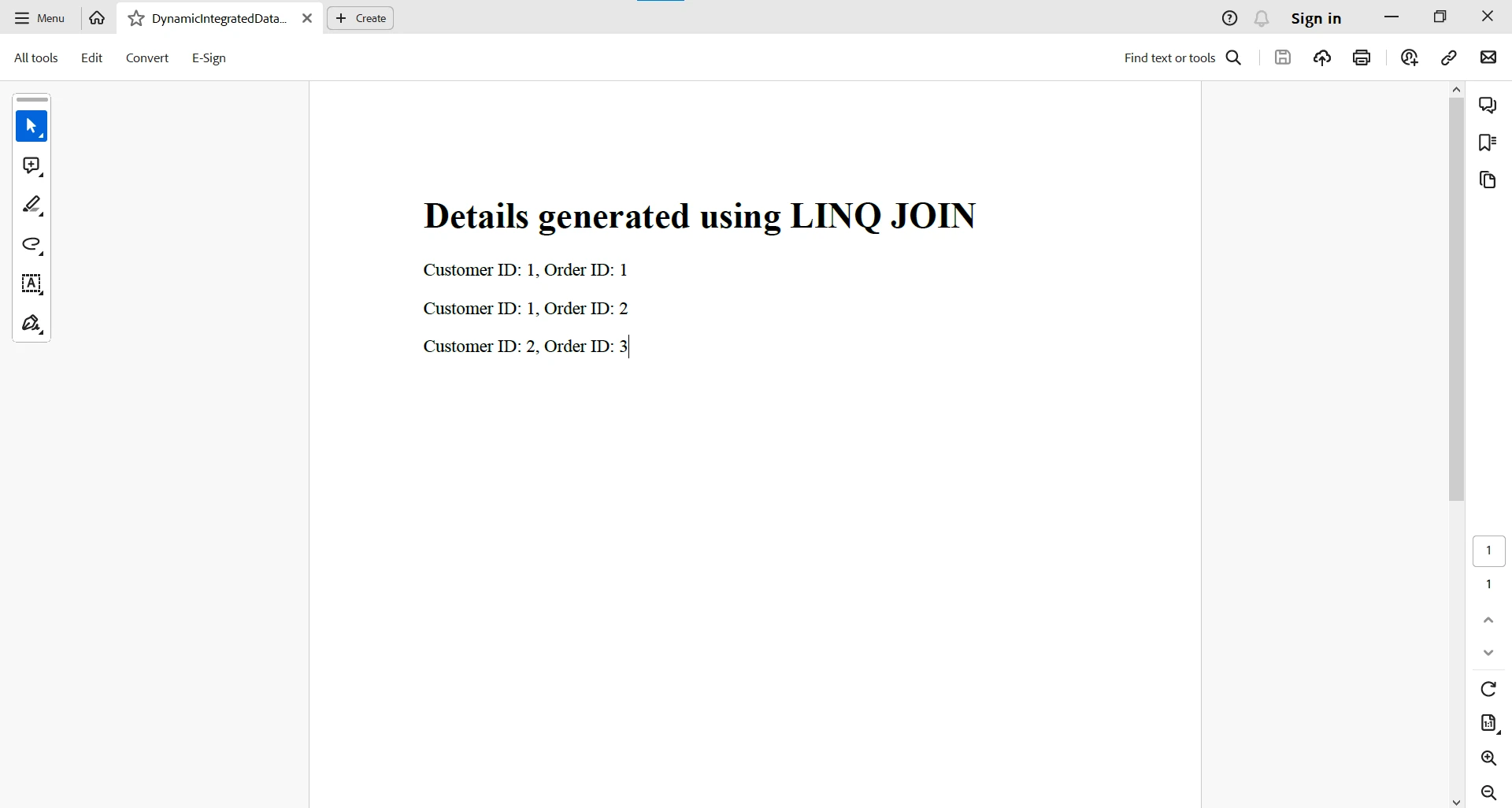
IronPDF ermöglicht die dynamische Hinzufügung von Inhalten zu PDF-Dokumenten und ermöglicht es, Daten während des PDF-Erzeugungsprozesses selbst mit LINQ Join zu integrieren. Hier erstellen wir die Kunden- und Bestellklasse zur Darstellung der praktischen Anwendung. Die Datenquellen können eine SQL-Datenbank oder ein strukturiertes Format sein, in diesem Fall eine Liste von Objekten, die eine Reihe von Datenattributen enthalten, ähnlich wie Tabellen in der Datenbank. Das folgende Beispiel zeigt eine detaillierte Integration der LINQ Join-Methode mit IronPDF, wenn wir [**HTML-Strings zur PDF-Erzeugung**](/examples/using-html-to-create-a-pdf/) verwenden, um das Dokument zu erstellen:
```csharp
using System;
using System.Collections.Generic;
using System.Linq;
using IronPdf;
class Order
{
public int OrderID { get; set; }
public int CustomerID { get; set; }
// Other order-related properties...
}
class Customer
{
public int CustomerID { get; set; }
// Other customer-related properties...
}
class Program
{
static void Main()
{
// Sample orders collection
var orders = new List<Order>
{
new Order { OrderID = 1, CustomerID = 1 },
new Order { OrderID = 2, CustomerID = 1 },
new Order { OrderID = 3, CustomerID = 2 },
};
// Sample customers collection
var customers = new List<Customer>
{
new Customer { CustomerID = 1 },
new Customer { CustomerID = 2 },
};
var pdfDocument = new ChromePdfRenderer();
string htmlContent = "<h1>Details generated using LINQ JOIN</h1>";
// Use join to find customer orders
var query = from customer in customers
join order in orders on customer.CustomerID equals order.CustomerID
select new { CustomerID = customer.CustomerID, OrderID = order.OrderID };
foreach (var result in query)
{
// Use IronPDF to dynamically add content to the PDF based on integrated data
htmlContent += $"<p>Customer ID: {result.CustomerID}, Order ID: {result.OrderID}</p>";
}
// Save or render the PDF document as needed
pdfDocument.RenderHtmlAsPdf(htmlContent)
.SaveAs("DynamicIntegratedDataDocument.pdf");
}
}
```
Dieser Code verwendet das **join** Schlüsselwort, das hilft, die passenden Bestellungen für jeden Kunden zu finden, und die Abfrage prägnanter und ausdrucksstärker macht.
## Abschluss
Zusammenfassend dient IronPDF als robuste Lösung für die PDF-Erstellung in C#-Anwendungen. In Kombination mit dem leistungsstarken LINQ-Join-Operator können Entwickler eine nahtlose Datenintegration vor oder während des PDF-Erstellungsprozesses erreichen. Egal, ob Sie Kundeninformationen mit Bestellungen kombinieren oder Daten aus verschiedenen Quellen zusammenführen müssen, das dynamische Duo von LINQ Join und IronPDF bietet einen flexiblen und effizienten Ansatz zur Verbesserung Ihrer PDF-Erstellungsmöglichkeiten in C#-Anwendungen.
Zusammenfassend ist der C# LINQ Join-Operator ein beeindruckendes Werkzeug zur nahtlosen Integration von Daten aus mehreren Quellen. Egal, ob Sie mit Datenbanken, API-Antworten oder In-Memory-Kollektionen arbeiten, vereinfacht der LINQ Join-Operator den Prozess des Kombinierens von Daten basierend auf festgelegten Bedingungen. Während Sie die vielfältigen Möglichkeiten der Datenverbindungen in Ihren C#-Anwendungen erkunden, sollten Sie sich die Leistungsfähigkeit und Flexibilität, die der LINQ Join-Operator Ihrem Datenintegrationstoolkit bietet, bewusst machen. Das Beherrschen dieses Operators eröffnet neue Möglichkeiten für ein effizientes Arbeiten mit und das Manipulieren von Daten, was die Fähigkeiten Ihrer C#-Anwendungen verbessert.
IronPDF bietet eine [**kostenlose Testversion für Evaluierungszwecke**](trial-license) an, um die vollständige Funktionalität auszuprobieren. Es muss jedoch [**ordnungsgemäß lizenziert**](licensing) werden, sobald der Testzeitraum abgelaufen ist.
In der Vielseitigkeit der C#-Programmierung sticht LINQ (Language Integrated Query) als leistungsfähiges Werkzeug zum Abfragen und Manipulieren von Objektkollektionen hervor. Unter den zahlreichen von LINQ angebotenen Operatoren ist der Join-Operator ein Schlüsselspieler, wenn es darum geht, Daten aus mehreren Quellen zu verbinden.
In diesem Artikel werden wir tief in die Komplexität des C# LINQ Join-Operators eintauchen, seine Funktionalität, Syntax und Anwendungsbeispiele aus der Praxis entschlüsseln.
Grundlagen der Join-Klausel verstehen
Im Kern ist der LINQ-Join-Operator darauf ausgelegt, Elemente aus zwei oder mehr Sammlungen basierend auf einer bestimmten Bedingung zu kombinieren. Dieser Operator ermöglicht es Entwicklern, SQL-ähnliche Joins bei In-Memory-Kollektionen durchzuführen, was das Zusammenführen von Daten aus unterschiedlichen Quellen erleichtert.
Syntax des LINQ Join Operators
Die Syntax für den LINQ-Join-Operator ist ausdrucksstark und folgt einem Muster, das SQL-Joins ähnelt. Die grundlegende Syntax lautet wie folgt:
var queryResult = from element1 in collection1 join element2 in collection2 on element1.Keyequals element2.Key select new { element1, element2 };
var queryResult =
    from element1 in collection1
    join element2 in collection2 on element1.Key equals element2.Key
    select new { element1, element2 };
Dim queryResult = From element1 In collection1Join element2 In collection2 On element1.KeyEquals element2.Key Select New With {Key element1,Key element2 }
Dim queryResult = From element1 In collection1
	Join element2 In collection2 On element1.Key Equals element2.Key
	Select New With {
		Key element1,
		Key element2
	}
In dieser Syntax:
element1 und element2 sind Variablen, die Elemente aus collection1 und collection2 darstellen.
element1.Key und element2.Key sind die Eigenschaften, die als Basis für die Join-Operation verwendet werden.
Das Schlüsselwort equals legt die Bedingung für den Join fest.
Die select-Klausel erstellt ein neues Objekt, das Elemente aus beiden Sammlungen kombiniert.
Typen von LINQ Joins
LINQ unterstützt mehrere Arten von Joins, darunter:
Inner Join: Gibt nur die Elemente zurück, die übereinstimmende Schlüssel in beiden Sammlungen haben.
var innerJoin = from customer in customers join order in orders on customer.CustomerIDequals order.CustomerID// join orders to customers based on the customer ID key select new { customer.CustomerID, customer.CustomerName, order.OrderID }; // create a new anonymous object based on the objects obtained from the join
var innerJoin = from customer in customers
                join order in orders on customer.CustomerID equals order.CustomerID // join orders to customers based on the customer ID key
                select new { customer.CustomerID, customer.CustomerName, order.OrderID }; // create a new anonymous object based on the objects obtained from the join
Dim innerJoin = From customer In customers ' create a new anonymous object based on the objects obtained from the joinJoin order In orders On customer.CustomerIDEquals order.CustomerID Select New With {Key customer.CustomerID,Key customer.CustomerName,Key order.OrderID }
Dim innerJoin = From customer In customers ' create a new anonymous object based on the objects obtained from the join
	Join order In orders On customer.CustomerID Equals order.CustomerID
	Select New With {
		Key customer.CustomerID,
		Key customer.CustomerName,
		Key order.OrderID
	}
Left Outer Join (Standard): Gibt alle Elemente aus der linken Sammlung und die übereinstimmenden Elemente aus der rechten Sammlung zurück. 3. Group Join: Gruppen Sie Elemente aus der linken Sammlung mit den passenden Elementen aus der rechten Sammlung.
var leftOuterJoin = from customer in customers join order in orders on customer.CustomerIDequals order.CustomerIDinto customerOrders from co in customerOrders.DefaultIfEmpty() select new { customer.CustomerID, customer.CustomerName, OrderID = co?.OrderID ?? -1 };
var leftOuterJoin = from customer in customers
                    join order in orders on customer.CustomerID equals order.CustomerID into customerOrders
                    from co in customerOrders.DefaultIfEmpty()
                    select new { customer.CustomerID, customer.CustomerName, OrderID = co?.OrderID ?? -1 };
Dim leftOuterJoin = From customer In customersGroupJoin order In orders On customer.CustomerIDEquals order.CustomerIDInto customerOrders = GroupFrom co In customerOrders.DefaultIfEmpty() Select New With {Key customer.CustomerID,Key customer.CustomerName,Key .OrderID = If(co?.OrderID, -1) }
Dim leftOuterJoin = From customer In customers
	Group Join order In orders On customer.CustomerID Equals order.CustomerID Into customerOrders = Group
	From co In customerOrders.DefaultIfEmpty()
	Select New With {
		Key customer.CustomerID,
		Key customer.CustomerName,
		Key .OrderID = If(co?.OrderID, -1)
	}
Group Join: Gruppen mit übereinstimmenden Elementen aus der rechten Sammlung in der linken Sammlung.
var groupJoin = from customer in customers join order in orders on customer.CustomerIDequals order.CustomerIDinto customerOrders select new { customer.CustomerID, customer.CustomerName, Orders = customerOrders };
var groupJoin = from customer in customers
                join order in orders on customer.CustomerID equals order.CustomerID into customerOrders
                select new { customer.CustomerID, customer.CustomerName, Orders = customerOrders };
Dim groupJoin = From customer In customersGroupJoin order In orders On customer.CustomerIDEquals order.CustomerIDInto customerOrders = Group Select New With {Key customer.CustomerID,Key customer.CustomerName,Key .Orders = customerOrders }
Dim groupJoin = From customer In customers
	Group Join order In orders On customer.CustomerID Equals order.CustomerID Into customerOrders = Group
	Select New With {
		Key customer.CustomerID,
		Key customer.CustomerName,
		Key .Orders = customerOrders
	}
Real-world Application: Kombinieren von Kunden- und Auftragsdaten
Betrachten wir ein praktisches Beispiel, bei dem wir zwei Sammlungen haben: customers und orders. Wir möchten ein Ergebnisset erstellen, das Kundeninformationen mit ihren entsprechenden Bestellungen unter Verwendung des LINQ-Join-Operators kombiniert.
var customerOrderInfo = from customer in customers join order in orders on customer.CustomerIDequals order.CustomerID select new { customer.CustomerID, customer.CustomerName, order.OrderID, order.OrderDate };
var customerOrderInfo =
    from customer in customers
    join order in orders on customer.CustomerID equals order.CustomerID
    select new { customer.CustomerID, customer.CustomerName, order.OrderID, order.OrderDate };
Dim customerOrderInfo = From customer In customersJoin order In orders On customer.CustomerIDEquals order.CustomerID Select New With {Key customer.CustomerID,Key customer.CustomerName,Key order.OrderID,Key order.OrderDate }
Dim customerOrderInfo = From customer In customers
	Join order In orders On customer.CustomerID Equals order.CustomerID
	Select New With {
		Key customer.CustomerID,
		Key customer.CustomerName,
		Key order.OrderID,
		Key order.OrderDate
	}
In diesem Beispiel enthält das Ergebnisset Einträge mit Kundeninformationen zusammen mit ihren zugeordneten Bestellungen. Die Join-Erweiterungsmethodensyntax hilft C#-Entwicklern, SQL-ähnliche Join-Operationen durchzuführen.
Einführung in IronPDF
PDF-Lösungen mit IronPDF entwickeln ist eine umfassende C#-Bibliothek zur Erstellung, Bearbeitung und Verarbeitung von PDF-Dokumenten. Sie ermöglicht es Entwicklern, PDFs dynamisch aus verschiedenen Datenquellen zu generieren und bietet somit eine vielseitige Lösung für Anwendungen, die die Erstellung von PDF-Dokumenten erfordern.
Installation von IronPDF: Ein Schnellstart
Um die IronPDF-Bibliothek in Ihrem C#-Projekt zu nutzen, können Sie einfach das IronPDF NuGet-Paket installieren. Verwenden Sie den folgenden Befehl in Ihrer Paket-Manager-Konsole:
PM > Install-Package IronPdf
Install-Package IronPdf
Alternativ können Sie im NuGet-Paketmanager nach 'IronPDF' suchen und es von dort aus installieren.
LINQ Join und IronPDF: Ein dynamisches Duo?
Der LINQ-Join-Operator ist bekannt für seine Fähigkeit, Daten aus unterschiedlichen Quellen zu verbinden, und kann in Szenarien, in denen die Datenintegration von entscheidender Bedeutung ist, ein wertvolles Instrument sein. Bei der Nutzung des LINQ Join mit IronPDF ist die Art der Daten, die Sie in das PDF-Dokument integrieren möchten, von grundlegender Bedeutung.
Das Highlight von IronPDF ist die HTML-zu-PDF-Konvertierung-Funktion, die Ihre Layouts und Stile intakt hält. Diese Funktion ermöglicht die PDF-Erzeugung aus Webinhalten, ideal für Berichte, Rechnungen und Dokumentation. HTML-Dateien, URLs und HTML-Strings können nahtlos in PDFs umgewandelt werden.
using IronPdf;class Program{ static voidMain(string[] args) { var renderer = new ChromePdfRenderer(); // 1. Convert HTML String to PDF var htmlContent = "<h1>Hello, IronPDF!</h1><p>This is a PDF from an HTML string.</p>"; var pdfFromHtmlString = renderer.RenderHtmlAsPdf(htmlContent); pdfFromHtmlString.SaveAs("HTMLStringToPDF.pdf"); // 2. Convert HTML File to PDF var htmlFilePath = "path_to_your_html_file.html"; // Specify the path to your HTML file var pdfFromHtmlFile = renderer.RenderHtmlFileAsPdf(htmlFilePath); pdfFromHtmlFile.SaveAs("HTMLFileToPDF.pdf"); // 3. Convert URL to PDF var url = "http://ironpdf.com"; // Specify the URL var pdfFromUrl = renderer.RenderUrlAsPdf(url); pdfFromUrl.SaveAs("URLToPDF.pdf"); }}
using IronPdf;

class Program
{
    static void Main(string[] args)
    {
        var renderer = new ChromePdfRenderer();

        // 1. Convert HTML String to PDF
        var htmlContent = "<h1>Hello, IronPDF!</h1><p>This is a PDF from an HTML string.</p>";
        var pdfFromHtmlString = renderer.RenderHtmlAsPdf(htmlContent);
        pdfFromHtmlString.SaveAs("HTMLStringToPDF.pdf");

        // 2. Convert HTML File to PDF
        var htmlFilePath = "path_to_your_html_file.html"; // Specify the path to your HTML file
        var pdfFromHtmlFile = renderer.RenderHtmlFileAsPdf(htmlFilePath);
        pdfFromHtmlFile.SaveAs("HTMLFileToPDF.pdf");

        // 3. Convert URL to PDF
        var url = "http://ironpdf.com"; // Specify the URL
        var pdfFromUrl = renderer.RenderUrlAsPdf(url);
        pdfFromUrl.SaveAs("URLToPDF.pdf");
    }
}
ImportsIronPdfFriend Class ProgramShared Sub Main(ByVal args() AsString) Dim renderer = New ChromePdfRenderer() ' 1. Convert HTML String to PDF Dim htmlContent = "<h1>Hello, IronPDF!</h1><p>This is a PDF from an HTML string.</p>" Dim pdfFromHtmlString = renderer.RenderHtmlAsPdf(htmlContent) pdfFromHtmlString.SaveAs("HTMLStringToPDF.pdf") ' 2. Convert HTML File to PDF Dim htmlFilePath = "path_to_your_html_file.html" ' Specify the path to your HTML file Dim pdfFromHtmlFile = renderer.RenderHtmlFileAsPdf(htmlFilePath) pdfFromHtmlFile.SaveAs("HTMLFileToPDF.pdf") ' 3. Convert URL to PDF Dim url = "http://ironpdf.com" ' Specify the URL Dim pdfFromUrl = renderer.RenderUrlAsPdf(url) pdfFromUrl.SaveAs("URLToPDF.pdf") End SubEnd Class
Imports IronPdf

Friend Class Program
	Shared Sub Main(ByVal args() As String)
		Dim renderer = New ChromePdfRenderer()

		' 1. Convert HTML String to PDF
		Dim htmlContent = "<h1>Hello, IronPDF!</h1><p>This is a PDF from an HTML string.</p>"
		Dim pdfFromHtmlString = renderer.RenderHtmlAsPdf(htmlContent)
		pdfFromHtmlString.SaveAs("HTMLStringToPDF.pdf")

		' 2. Convert HTML File to PDF
		Dim htmlFilePath = "path_to_your_html_file.html" ' Specify the path to your HTML file
		Dim pdfFromHtmlFile = renderer.RenderHtmlFileAsPdf(htmlFilePath)
		pdfFromHtmlFile.SaveAs("HTMLFileToPDF.pdf")

		' 3. Convert URL to PDF
		Dim url = "http://ironpdf.com" ' Specify the URL
		Dim pdfFromUrl = renderer.RenderUrlAsPdf(url)
		pdfFromUrl.SaveAs("URLToPDF.pdf")
	End Sub
End Class
Szenario 1: Kombinieren von Daten vor der PDF-Erzeugung
Wenn Ihr Ziel darin besteht, Daten aus verschiedenen Datenquellen zu kombinieren, bevor Sie den PDF-Erzeugungsprozess einleiten, kann der LINQ Join unabhängig eingesetzt werden. Sobald Sie einen einheitlichen Datensatz haben, können Sie IronPDF verwenden, um basierend auf den integrierten Daten dynamisch ein PDF-Dokument zu generieren.
Hier ist ein vereinfachtes Beispiel:
// Assume 'customerOrderInfo' is a result set obtained using LINQ Joinvar pdfDocument = new IronPdf.ChromePdfRenderer();foreach (var entry in customerOrderInfo){ // Use IronPDF to add content to the PDF based on integrated data pdfDocument.AddHTML($"<p>Customer ID: {entry.CustomerID}, Order ID: {entry.OrderID}</p>");}// Save or render the PDF document as neededpdfDocument.SaveAs("IntegratedDataDocument.pdf");
// Assume 'customerOrderInfo' is a result set obtained using LINQ Join
var pdfDocument = new IronPdf.ChromePdfRenderer();
foreach (var entry in customerOrderInfo)
{
    // Use IronPDF to add content to the PDF based on integrated data
    pdfDocument.AddHTML($"<p>Customer ID: {entry.CustomerID}, Order ID: {entry.OrderID}</p>");
}
// Save or render the PDF document as needed
pdfDocument.SaveAs("IntegratedDataDocument.pdf");
' Assume 'customerOrderInfo' is a result set obtained using LINQ JoinDim pdfDocument = New IronPdf.ChromePdfRenderer()For Each entry In customerOrderInfo ' Use IronPDF to add content to the PDF based on integrated data pdfDocument.AddHTML($"<p>Customer ID: {entry.CustomerID}, Order ID: {entry.OrderID}</p>")Next entry' Save or render the PDF document as neededpdfDocument.SaveAs("IntegratedDataDocument.pdf")
' Assume 'customerOrderInfo' is a result set obtained using LINQ Join
Dim pdfDocument = New IronPdf.ChromePdfRenderer()
For Each entry In customerOrderInfo
	' Use IronPDF to add content to the PDF based on integrated data
	pdfDocument.AddHTML($"<p>Customer ID: {entry.CustomerID}, Order ID: {entry.OrderID}</p>")
Next entry
' Save or render the PDF document as needed
pdfDocument.SaveAs("IntegratedDataDocument.pdf")
Entdecken Sie weitere Möglichkeiten der PDF-Dokumentenerzeugung und wie Sie LINQ Join mit IronPDF verwenden können, indem Sie die IronPDF-Dokumentation besuchen.
Szenario 2: Dynamische Datenintegration während der PDF-Erstellung
IronPDF ermöglicht die dynamische Hinzufügung von Inhalten zu PDF-Dokumenten und ermöglicht es, Daten während des PDF-Erzeugungsprozesses selbst mit LINQ Join zu integrieren. Hier erstellen wir die Kunden- und Bestellklasse zur Darstellung der praktischen Anwendung. Die Datenquellen können eine SQL-Datenbank oder ein strukturiertes Format sein, in diesem Fall eine Liste von Objekten, die eine Reihe von Datenattributen enthalten, ähnlich wie Tabellen in der Datenbank. Das folgende Beispiel zeigt eine detaillierte Integration der LINQ Join-Methode mit IronPDF, wenn wir HTML-Strings zur PDF-Erzeugung verwenden, um das Dokument zu erstellen:
using System;using System.Collections.Generic;using System.Linq;using IronPdf;class Order{ public intOrderID { get; set; } public intCustomerID { get; set; } // Other order-related properties...}class Customer{ public intCustomerID { get; set; } // Other customer-related properties...}class Program{ static voidMain() { // Sample orders collection var orders = new List<Order> { new Order { OrderID = 1, CustomerID = 1 }, new Order { OrderID = 2, CustomerID = 1 }, new Order { OrderID = 3, CustomerID = 2 }, }; // Sample customers collection var customers = new List<Customer> { new Customer { CustomerID = 1 }, new Customer { CustomerID = 2 }, }; var pdfDocument = new ChromePdfRenderer(); string htmlContent = "<h1>Details generated using LINQ JOIN</h1>"; // Use join to find customer orders var query = from customer in customers join order in orders on customer.CustomerIDequals order.CustomerID select new { CustomerID = customer.CustomerID, OrderID = order.OrderID }; foreach (var result in query) { // Use IronPDF to dynamically add content to the PDF based on integrated data htmlContent += $"<p>Customer ID: {result.CustomerID}, Order ID: {result.OrderID}</p>"; } // Save or render the PDF document as needed pdfDocument.RenderHtmlAsPdf(htmlContent) .SaveAs("DynamicIntegratedDataDocument.pdf"); }}
using System;
using System.Collections.Generic;
using System.Linq;
using IronPdf;

class Order
{
    public int OrderID { get; set; }
    public int CustomerID { get; set; }
    // Other order-related properties...
}

class Customer
{
    public int CustomerID { get; set; }
    // Other customer-related properties...
}

class Program
{
    static void Main()
    {
        // Sample orders collection
        var orders = new List<Order>
        {
            new Order { OrderID = 1, CustomerID = 1 },
            new Order { OrderID = 2, CustomerID = 1 },
            new Order { OrderID = 3, CustomerID = 2 },
        };

        // Sample customers collection
        var customers = new List<Customer>
        {
            new Customer { CustomerID = 1 },
            new Customer { CustomerID = 2 },
        };

        var pdfDocument = new ChromePdfRenderer();
        string htmlContent = "<h1>Details generated using LINQ JOIN</h1>";

        // Use join to find customer orders
        var query = from customer in customers
                    join order in orders on customer.CustomerID equals order.CustomerID
                    select new { CustomerID = customer.CustomerID, OrderID = order.OrderID };

        foreach (var result in query)
        {
            // Use IronPDF to dynamically add content to the PDF based on integrated data
            htmlContent += $"<p>Customer ID: {result.CustomerID}, Order ID: {result.OrderID}</p>";
        }

        // Save or render the PDF document as needed
        pdfDocument.RenderHtmlAsPdf(htmlContent)
                   .SaveAs("DynamicIntegratedDataDocument.pdf");
    }
}
ImportsSystemImportsSystem.Collections.GenericImportsSystem.LinqImportsIronPdfClass Order Public Property OrderIDAsInteger Public Property CustomerIDAsInteger ' Other order-related properties...End ClassClass Customer Public Property CustomerIDAsInteger ' Other customer-related properties...End ClassModuleProgram Sub Main() ' Sample orders collection Dim orders = New List(OfOrder) From { New OrderWith {.OrderID = 1, .CustomerID = 1}, New OrderWith {.OrderID = 2, .CustomerID = 1}, New OrderWith {.OrderID = 3, .CustomerID = 2} } ' Sample customers collection Dim customers = New List(OfCustomer) From { New CustomerWith {.CustomerID = 1}, New CustomerWith {.CustomerID = 2} } Dim pdfDocument = New ChromePdfRenderer() Dim htmlContent AsString = "<h1>Details generated using LINQ JOIN</h1>" ' Use join to find customer orders Dim query = From customer In customersJoin order In orders On customer.CustomerIDEquals order.CustomerID Select New With {Key .CustomerID = customer.CustomerID, Key .OrderID = order.OrderID} For Each result In query ' Use IronPDF to dynamically add content to the PDF based on integrated data htmlContent += $"<p>Customer ID: {result.CustomerID}, Order ID: {result.OrderID}</p>" Next ' Save or render the PDF document as needed pdfDocument.RenderHtmlAsPdf(htmlContent).SaveAs("DynamicIntegratedDataDocument.pdf") End SubEndModule
Imports System
Imports System.Collections.Generic
Imports System.Linq
Imports IronPdf

Class Order
    Public Property OrderID As Integer
    Public Property CustomerID As Integer
    ' Other order-related properties...
End Class

Class Customer
    Public Property CustomerID As Integer
    ' Other customer-related properties...
End Class

Module Program
    Sub Main()
        ' Sample orders collection
        Dim orders = New List(Of Order) From {
            New Order With {.OrderID = 1, .CustomerID = 1},
            New Order With {.OrderID = 2, .CustomerID = 1},
            New Order With {.OrderID = 3, .CustomerID = 2}
        }

        ' Sample customers collection
        Dim customers = New List(Of Customer) From {
            New Customer With {.CustomerID = 1},
            New Customer With {.CustomerID = 2}
        }

        Dim pdfDocument = New ChromePdfRenderer()
        Dim htmlContent As String = "<h1>Details generated using LINQ JOIN</h1>"

        ' Use join to find customer orders
        Dim query = From customer In customers
                    Join order In orders On customer.CustomerID Equals order.CustomerID
                    Select New With {Key .CustomerID = customer.CustomerID, Key .OrderID = order.OrderID}

        For Each result In query
            ' Use IronPDF to dynamically add content to the PDF based on integrated data
            htmlContent += $"<p>Customer ID: {result.CustomerID}, Order ID: {result.OrderID}</p>"
        Next

        ' Save or render the PDF document as needed
        pdfDocument.RenderHtmlAsPdf(htmlContent).SaveAs("DynamicIntegratedDataDocument.pdf")
    End Sub
End Module
Dieser Code verwendet das join Schlüsselwort, das hilft, die passenden Bestellungen für jeden Kunden zu finden, und die Abfrage prägnanter und ausdrucksstärker macht.
Abschluss
Zusammenfassend dient IronPDF als robuste Lösung für die PDF-Erstellung in C#-Anwendungen. In Kombination mit dem leistungsstarken LINQ-Join-Operator können Entwickler eine nahtlose Datenintegration vor oder während des PDF-Erstellungsprozesses erreichen. Egal, ob Sie Kundeninformationen mit Bestellungen kombinieren oder Daten aus verschiedenen Quellen zusammenführen müssen, das dynamische Duo von LINQ Join und IronPDF bietet einen flexiblen und effizienten Ansatz zur Verbesserung Ihrer PDF-Erstellungsmöglichkeiten in C#-Anwendungen.
Zusammenfassend ist der C# LINQ Join-Operator ein beeindruckendes Werkzeug zur nahtlosen Integration von Daten aus mehreren Quellen. Egal, ob Sie mit Datenbanken, API-Antworten oder In-Memory-Kollektionen arbeiten, vereinfacht der LINQ Join-Operator den Prozess des Kombinierens von Daten basierend auf festgelegten Bedingungen. Während Sie die vielfältigen Möglichkeiten der Datenverbindungen in Ihren C#-Anwendungen erkunden, sollten Sie sich die Leistungsfähigkeit und Flexibilität, die der LINQ Join-Operator Ihrem Datenintegrationstoolkit bietet, bewusst machen. Das Beherrschen dieses Operators eröffnet neue Möglichkeiten für ein effizientes Arbeiten mit und das Manipulieren von Daten, was die Fähigkeiten Ihrer C#-Anwendungen verbessert.
Jacob Mellor ist Chief Technology Officer bei Iron Software und ein visionärer Ingenieur, der Pionierarbeit in der C# PDF-Technologie leistet. Als der ursprüngliche Entwickler hinter der Kern-Codebasis von Iron Software hat er die Produktarchitektur des Unternehmens seit seiner Gründung geprägt und es zusammen mit CEO Cameron Rimington in ein Unternehmen mit mehr als 50 Mitarbeitern verwandelt, das die NASA, Tesla und globale Regierungsbehörden beliefert.