using IronPdf;

// Disable local disk access or cross-origin requests
Installation.EnableWebSecurity = true;

// Instantiate Renderer
var renderer = new ChromePdfRenderer();

// Create a PDF from a HTML string using C#
var pdf = renderer.RenderHtmlAsPdf("<h1>Hello World</h1>");

// Export to a file or Stream
pdf.SaveAs("output.pdf");

// Advanced Example with HTML Assets
// Load external html assets: Images, CSS and JavaScript.
// An optional BasePath 'C:\site\assets\' is set as the file location to load assets from
var myAdvancedPdf = renderer.RenderHtmlAsPdf("<img src='icons/iron.png'>", @"C:\site\assets\");
myAdvancedPdf.SaveAs("html-with-assets.pdf");
using IronPdf;// Disable local disk access or cross-origin requestsInstallation.EnableWebSecurity = true;// Instantiate Renderervar renderer = new ChromePdfRenderer();// Create a PDF from a HTML string using C#var pdf = renderer.RenderHtmlAsPdf("<h1>Hello World</h1>");// Export to a file or Streampdf.SaveAs("output.pdf");// Advanced Example with HTML Assets// Load external html assets: Images, CSS and JavaScript.// An optional BasePath 'C:\site\assets\' is set as the file location to load assets fromvar myAdvancedPdf = renderer.RenderHtmlAsPdf("<img src='icons/iron.png'>", @"C:\site\assets\");myAdvancedPdf.SaveAs("html-with-assets.pdf");
## Deedle C#
[`Deedle`](https://github.com/fslaborg/Deedle) ist eine leistungsstarke Bibliothek für Datenmanipulation und Datenanalyse. Es bietet vollständige Datenrahmen und -serien, mit denen Sie strukturierte Datenrahmen effizient verwalten können. Deedle bietet Werkzeuge für fehlende Daten, das Ausrichten von Daten und das Anwenden von Hilfsfunktionen mit statischen Mitgliedern `ofNullables` und `ofObservations`. Es wird in der Datenwissenschaft aufgrund seiner Flexibilität und Leistung häufig verwendet.
[`IronPDF`](/) ist eine Bibliothek zum Erstellen und Bearbeiten von PDF-Dokumenten in .NET. Es hilft Ihnen, PDFs aus HTML zu generieren, Bilder in PDFs zu konvertieren und Inhalte aus PDF-Dateien zu extrahieren. IronPDF vereinfacht PDF-Aufgaben in Ihren .NET-Projekten.
In diesem Artikel erfahren Sie, wie Sie mit Deedle für C# loslegen, es in Ihren .NET-Projekten mit Visual Studio einrichten und wichtige Funktionen mit automatisch generierter Dokumentation implementieren. Sie werden Codebeispiele und Erklärungen sehen, die Ihnen helfen zu verstehen, wie Sie Deedle effektiv nutzen können, einschließlich der Anwendung einer spezifizierten Funktion.
## Getting Started with Deedle C#
### Einrichten von Deedle in .NET-Projekten
Um zu beginnen, erstellen Sie ein neues C#-Konsolenanwendungsprojekt in [Visual Studio](https://visualstudio.microsoft.com/).
Um Deedle in Ihrem .NET-Projekt zu verwenden, müssen Sie das Deedle-NuGet-Paket installieren. Führen Sie den folgenden Befehl in der NuGet-Konsole aus:
```powershell
Install-Package Deedle
```
Sobald es installiert ist, müssen Sie den Deedle-Namespace in Ihr Projekt importieren:
```csharp
using Deedle;
```
### Ein grundlegendes Code-Beispiel
Beginnen wir mit einem einfachen Beispiel zur Erstellung und Bearbeitung eines Datenrahmens. Dies hilft Ihnen, die Grundlagen von Deedle zu verstehen.
```csharp
using System;
using Deedle;

class Program
{
    static void Main()
    {
        // Creating a series with integer keys and double values
        var series = new Series<int, double>(new[] { 1, 2, 3 }, new[] { 3.5, 4.2, 5.1 });
        Console.WriteLine("Series:");
        Console.WriteLine(series);

        // Creating a data frame from a 2D array
        var rowIndex = new[] { 1, 2, 3 };
        var colIndex = new[] { "A", "B" };
        var data = new double[,] { { 1.0, 3.5 }, { 2.0, 4.2 }, { 3.0, 5.1 } };
        var dataFrame = Frame.FromArray2D(data)
                             .IndexRowsWith(rowIndex)
                             .IndexColumnsWith(colIndex);
        Console.WriteLine("Data Frame:");
        Console.WriteLine(dataFrame);
    }
}
```
In diesem Beispiel erstellen Sie eine Serie mit ganzzahligen Zeilenschlüsseln und doppelt genutzten Werten. Dann erstellen Sie einen Datenrahmen mit einem 2D-Array von doppelten Werten. Sie indexieren die Zeilen mit ganzen Zahlen und die Spalten mit Zeichenfolgen.
## Implementing Features of Deedle C#
### Behandlung fehlender Werte
Der Umgang mit fehlenden Werten ist entscheidend bei der Datenmanipulation. Deedle bietet robuste Unterstützung für fehlende Daten. Sie können eine Serie mit fehlenden Werten erstellen und Operationen zur Handhabung dieser durchführen.
```csharp
using System;
using Deedle;
class Program
{
static void Main()
{
// Creating a series with nullable doubles to represent missing values
var series = new Series<int, double?>(
new[] { 75, 8, 47, 5 },
new double?[] { 75.0, null, 47.0, 5.0 }
);
Console.WriteLine("Original Series with Missing Values:");
Console.WriteLine(series);
// Fill missing values with a specified value (e.g., 0.0)
var filledSeries = series.FillMissing(0.0);
Console.WriteLine("Series after Filling Missing Values:");
Console.WriteLine(filledSeries);
}
}
```
Dieses Beispiel erstellt eine Serie mit fehlenden Werten und füllt sie mit einem angegebenen Wert. Sie können auch statische Mitgliedsmethoden wie `ofOptionalObservations` und `ofValues` für komplexere Szenarien verwenden.
### Datenmanipulation
Deedle ermöglicht Ihnen die Durchführung verschiedener Datenmanipulationsaufgaben. Sie können Daten in Datenrahmen filtern, transformieren und aggregieren.
```csharp
using System;
using Deedle;
class Program
{
static void Main()
{
// Creating a data frame
var rowIndex = new[] { 1, 2, 3 };
var colIndex = new[] { "A", "B" };
var data = new double[,] { { 1.0, 3.5 }, { 2.0, 4.2 }, { 3.0, 5.1 } };
var dataFrame = Frame.FromArray2D(data)
.IndexRowsWith(rowIndex)
.IndexColumnsWith(colIndex);
Console.WriteLine("Original Data Frame:");
Console.WriteLine(dataFrame);
// Filter rows where column 'A' is greater than 1.5
var filteredFrame = dataFrame.Where(row => row.Value.GetAs<double>("A") > 1.5);
Console.WriteLine("Filtered Data Frame:");
Console.WriteLine(filteredFrame);
// Add a new column 'C' which is the sum of columns 'A' and 'B'
dataFrame.AddColumn("C", dataFrame["A"] + dataFrame["B"]);
Console.WriteLine("Transformed Data Frame with New Column 'C':");
Console.WriteLine(dataFrame);
}
}
```
Dieses Beispiel demonstriert das Filtern von Zeilen basierend auf einer Bedingung und das Hinzufügen einer neuen Spalte mit transformierten Daten. Deedle implementiert standardmäßige Frame-Erweiterungsmethoden, um die Datenanalyse einfach zu gestalten.
### Statistische Funktionen
Deedle bietet standardmäßige statistische Funktionen zur Analyse von Daten. Mit den statistischen Funktionen können Sie den Durchschnitt, die Standardabweichung und andere statistische Maße berechnen.
```csharp
using System;
using Deedle;
class Program
{
static void Main()
{
// Creating a series with integer keys and double values
var series = new Series<int, double>(
new[] { 1, 2, 3, 4 },
new[] { 1.0, 2.0, 3.0, 4.0 }
);
Console.WriteLine("Series:");
Console.WriteLine(series);
// Calculate the mean of the series
var mean = series.Mean();
Console.WriteLine($"Mean: {mean}");
// Calculate the standard deviation of the series
var stddev = series.StdDev();
Console.WriteLine($"Standard Deviation: {stddev}");
}
}
```
Dieses Deedle-Codebeispiel implementiert die Standardstatistikfunktionen `Mean()` und `StdDev()`, um den Mittelwert und die Standardabweichung einer Serie zu berechnen.
### Erstellen von Datenrahmen aus CSV
Deedle ermöglicht es Ihnen, Datenrahmen aus CSV-Dateien einfach zu erstellen. Dies ist nützlich für das Laden und Analysieren von strukturierten Daten.
```csharp
using System;
using Deedle;
class Program
{
static void Main()
{
// Load a data frame from a CSV file
var dataFrame = Frame.ReadCsv("data.csv");
Console.WriteLine("Data Frame from CSV:");
Console.WriteLine(dataFrame);
// Aggregate rows by a specified column and compute sum
var summary = dataFrame.AggregateRowsBy<string, double>(
new[] { "ColumnName" }, // rowKeys
null, // columnKeys, you can pass null if not required
v => v.Sum() // aggFunc
);
Console.WriteLine("Summary of Data Frame:");
Console.WriteLine(summary);
}
}
```
Dieses Beispiel liest eine CSV-Datei in einen Datenrahmen ein und führt eine Zusammenfassungsoperation an den Daten durch.
## Integration von Deedle mit IronPDF
### Einführung in IronPDF
IronPDF ist eine leistungsstarke Bibliothek, die es Ihnen ermöglicht, Inhalte aus PDF-Dateien in .NET-Anwendungen zu erstellen, zu manipulieren und zu extrahieren. Es ist äußerst vielseitig und kann verschiedene PDF-bezogene Aufgaben wie das Generieren von [PDFs aus HTML](/examples/using-html-to-create-a-pdf/), Extrahieren von Text, Zusammenführen von PDFs und vieles mehr handhaben. Die Integration von IronPDF mit Deedle kann insbesondere für Datenanalyse- und Berichtsszenarien nützlich sein, bei denen Sie dynamische Berichte aus Datenrahmen generieren müssen.
### Installation von IronPDF
Um IronPDF in Ihrem .NET-Projekt mit dem NuGet-Paket-Manager-Konsolenbefehls installieren, fügen Sie den folgenden Befehl hinzu:
```shell
:ProductInstall
```
Oder Sie können IronPDF auch über den NuGet-Paket-Manager für Lösungen installieren. Suchen Sie in den Suchergebnissen nach dem [IronPDF-Paket auf NuGet](https://www.nuget.org/packages/IronPdf), wählen Sie es aus und klicken Sie dann auf die Schaltfläche "Installieren". Visual Studio kümmert sich automatisch um den Download und die Installation.
Nach Abschluss der Installation kann IronPDF in Ihrem Projekt genutzt werden.
### Benutzungsfall der Zusammenführung von IronPDF mit Deedle
Stellen Sie sich vor, Sie haben einen Datenrahmen mit einigen statistischen Daten, die Sie in einem PDF-Bericht präsentieren möchten. Deedle kann den Teil der Datenmanipulation und -analyse übernehmen, während IronPDF verwendet werden kann, um den endgültigen Bericht zu formatieren und zu generieren. Zum Beispiel können Sie ein PDF generieren, das Tabellen, Diagramme und deskriptive Statistiken enthält, um die Daten einfach zu teilen und zu präsentieren.
### Code-Beispiel für Anwendungsfall
Hier ist ein vollständiges Codebeispiel, das zeigt, wie man Deedle mit IronPDF integriert. Wir erstellen einen einfachen Bericht aus einem Deedle-Datenrahmen und generieren ein PDF mit IronPDF.
```csharp
using System;
using System.Linq;
using Deedle;
using IronPdf;
namespace Deedle IronPDFIntegration
{
class Program
{
static void Main(string[] args)
{
// Set IronPDF license key
IronPdf.License.LicenseKey = "License-Key";
// Create a sample data frame from in-memory records
var data = new[]
{
new { Name = "Robert", Age = 30, City = "New York" },
new { Name = "Johnny", Age = 25, City = "San Francisco" },
new { Name = "Charlie", Age = 35, City = "Los Angeles" }
};
var frame = Frame.FromRecords(data);
// Convert the data frame to an HTML table format
var htmlTable = "<table border='1' cellpadding='5' cellspacing='0'><thead><tr><th>Name</th><th>Age</th><th>City</th></tr></thead><tbody>" +
string.Join("", frame.Rows.Select(row =>
$"<tr><td>{row.Value.GetAs<string>("Name")}</td><td>{row.Value.GetAs<int>("Age")}</td><td>{row.Value.GetAs<string>("City")}</td></tr>")
) +
"</tbody></table>";
// Wrap the HTML table in basic HTML structure with CSS styling
var htmlContent = $@"
<html>
<head>
<style>
table {{width: 100%;
border-collapse: collapse;}}
th, td {{border: 1px solid black;
padding: 8px;
text-align: left;}}
th {{background-color: #f2f2f2;}}
</style>
</head>
<body>
{htmlTable}
</body>
</html>";
// Create a PDF from the HTML content
var renderer = new ChromePdfRenderer();
var pdfDocument = renderer.RenderHtmlAsPdf(htmlContent);
// Save the generated PDF to a file
pdfDocument.SaveAs("f:\\DeedleReport.pdf");
Console.WriteLine("PDF report created successfully!");
}
}
}
```
#### Ausgabe
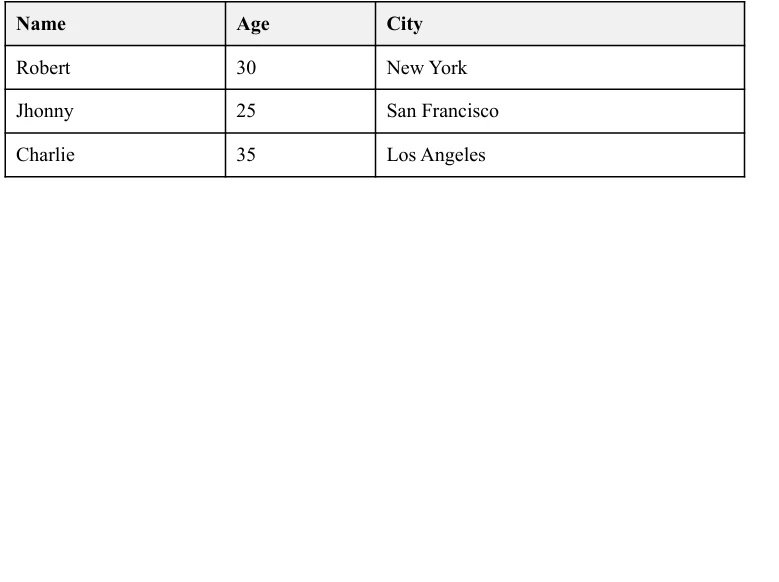
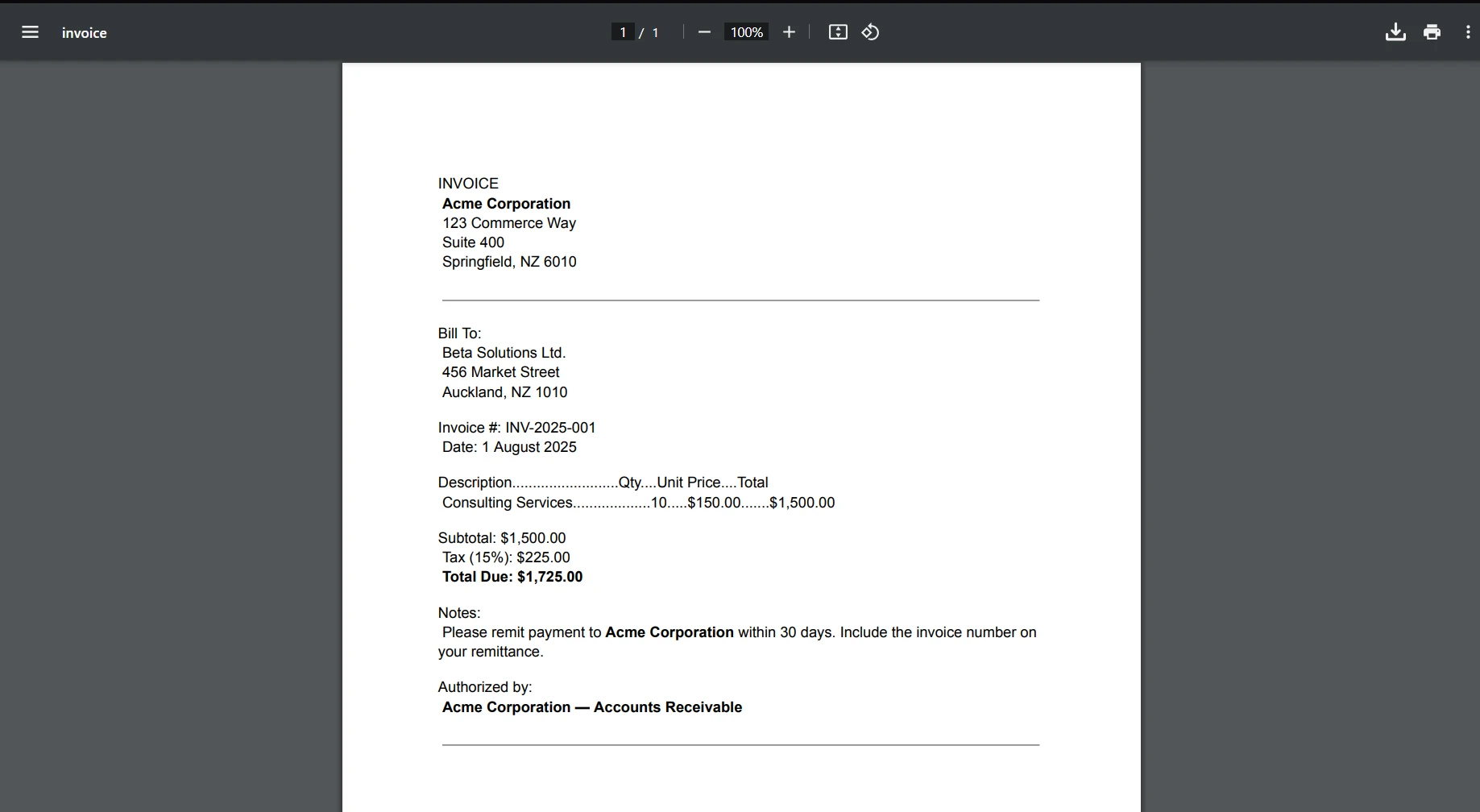
Und das war's! Sie haben gerade eine voll funktionsfähige Anwendung erstellt, die komplexe Daten von [Deedle](https://github.com/fslaborg/Deedle) nimmt und sie in einem formatierten PDF-Bericht mit der [IronPDF's .NET PDF Library](/) umwandelt. Es ist eine leistungsstarke Methode, um Ihre Datenanalyseergebnisse in einem professionellen Format zu kommunizieren.
## Abschluss
In diesem Artikel haben wir untersucht, wie man [Deedle](https://github.com/fslaborg/Deedle) mit [IronPDF](/) integriert, um dynamische PDF-Berichte aus Datenrahmen zu erstellen. Mit Deedle können Sie Daten effizient manipulieren und analysieren, während IronPDF die Erstellung und Formatierung des endgültigen PDF-Dokuments übernimmt. Diese Kombination ermöglicht es Ihnen, professionelle Berichte mit Leichtigkeit zu erstellen und den Prozess von der Datenanalyse bis zur Präsentation zu automatisieren.
IronPDF bietet detaillierte [Dokumentation zu Funktionen und Nutzung](/docs/) zusammen mit verschiedenen [IronPDF-Codebeispielen](/examples/using-html-to-create-a-pdf/) zur Orientierung, wie man anfängt und die umfangreichen Funktionen effektiv nutzt.
[Erkunden Sie die IronPDF-Lizenzierungsoptionen](/licensing/) beginnend bei `$liteLicense`. Probieren Sie es aus und sehen Sie, wie es Ihre Berichtsfähigkeiten verbessern kann.
Deedle ist eine leistungsstarke Bibliothek für Datenmanipulation und Datenanalyse. Es bietet vollständige Datenrahmen und -serien, mit denen Sie strukturierte Datenrahmen effizient verwalten können. Deedle bietet Werkzeuge für fehlende Daten, das Ausrichten von Daten und das Anwenden von Hilfsfunktionen mit statischen Mitgliedern ofNullables und ofObservations. Es wird in der Datenwissenschaft aufgrund seiner Flexibilität und Leistung häufig verwendet.
IronPDF ist eine Bibliothek zum Erstellen und Bearbeiten von PDF-Dokumenten in .NET. Es hilft Ihnen, PDFs aus HTML zu generieren, Bilder in PDFs zu konvertieren und Inhalte aus PDF-Dateien zu extrahieren. IronPDF vereinfacht PDF-Aufgaben in Ihren .NET-Projekten.
In diesem Artikel erfahren Sie, wie Sie mit Deedle für C# loslegen, es in Ihren .NET-Projekten mit Visual Studio einrichten und wichtige Funktionen mit automatisch generierter Dokumentation implementieren. Sie werden Codebeispiele und Erklärungen sehen, die Ihnen helfen zu verstehen, wie Sie Deedle effektiv nutzen können, einschließlich der Anwendung einer spezifizierten Funktion.
Getting Started with Deedle C#
Einrichten von Deedle in .NET-Projekten
Um zu beginnen, erstellen Sie ein neues C#-Konsolenanwendungsprojekt in Visual Studio.
Um Deedle in Ihrem .NET-Projekt zu verwenden, müssen Sie das Deedle-NuGet-Paket installieren. Führen Sie den folgenden Befehl in der NuGet-Konsole aus:
Install-Package Deedle
Install-Package Deedle
PowerShell
Sobald es installiert ist, müssen Sie den Deedle-Namespace in Ihr Projekt importieren:
using Deedle;
using Deedle;
ImportsDeedle
Imports Deedle
Ein grundlegendes Code-Beispiel
Beginnen wir mit einem einfachen Beispiel zur Erstellung und Bearbeitung eines Datenrahmens. Dies hilft Ihnen, die Grundlagen von Deedle zu verstehen.
using System;using Deedle;class Program{ static voidMain() { // Creating a series with integer keys and double values var series = new Series<int, double>(new[] { 1, 2, 3 }, new[] { 3.5, 4.2, 5.1 });Console.WriteLine("Series:");Console.WriteLine(series); // Creating a data frame from a 2D array var rowIndex = new[] { 1, 2, 3 }; var colIndex = new[] { "A", "B" }; var data = new double[,] { { 1.0, 3.5 }, { 2.0, 4.2 }, { 3.0, 5.1 } }; var dataFrame = Frame.FromArray2D(data) .IndexRowsWith(rowIndex) .IndexColumnsWith(colIndex);Console.WriteLine("Data Frame:");Console.WriteLine(dataFrame); }}
using System;
using Deedle;

class Program
{
    static void Main()
    {
        // Creating a series with integer keys and double values
        var series = new Series<int, double>(new[] { 1, 2, 3 }, new[] { 3.5, 4.2, 5.1 });
        Console.WriteLine("Series:");
        Console.WriteLine(series);

        // Creating a data frame from a 2D array
        var rowIndex = new[] { 1, 2, 3 };
        var colIndex = new[] { "A", "B" };
        var data = new double[,] { { 1.0, 3.5 }, { 2.0, 4.2 }, { 3.0, 5.1 } };
        var dataFrame = Frame.FromArray2D(data)
                             .IndexRowsWith(rowIndex)
                             .IndexColumnsWith(colIndex);
        Console.WriteLine("Data Frame:");
        Console.WriteLine(dataFrame);
    }
}
ImportsSystemImportsDeedleFriend Class ProgramShared Sub Main() ' Creating a series with integer keys and double values Dim series As New Series(OfInteger, Double)( { 1, 2, 3 }, { 3.5, 4.2, 5.1 })Console.WriteLine("Series:")Console.WriteLine(series) ' Creating a data frame from a 2D array Dim rowIndex = { 1, 2, 3 } Dim colIndex = { "A", "B" } Dim data = New Double(, ) { { 1.0, 3.5 }, { 2.0, 4.2 }, { 3.0, 5.1 } } Dim dataFrame = Frame.FromArray2D(data).IndexRowsWith(rowIndex).IndexColumnsWith(colIndex)Console.WriteLine("Data Frame:")Console.WriteLine(dataFrame) End SubEnd Class
Imports System
Imports Deedle

Friend Class Program
	Shared Sub Main()
		' Creating a series with integer keys and double values
		Dim series As New Series(Of Integer, Double)( { 1, 2, 3 }, { 3.5, 4.2, 5.1 })
		Console.WriteLine("Series:")
		Console.WriteLine(series)

		' Creating a data frame from a 2D array
		Dim rowIndex = { 1, 2, 3 }
		Dim colIndex = { "A", "B" }
		Dim data = New Double(, ) {
			{ 1.0, 3.5 },
			{ 2.0, 4.2 },
			{ 3.0, 5.1 }
		}
		Dim dataFrame = Frame.FromArray2D(data).IndexRowsWith(rowIndex).IndexColumnsWith(colIndex)
		Console.WriteLine("Data Frame:")
		Console.WriteLine(dataFrame)
	End Sub
End Class
In diesem Beispiel erstellen Sie eine Serie mit ganzzahligen Zeilenschlüsseln und doppelt genutzten Werten. Dann erstellen Sie einen Datenrahmen mit einem 2D-Array von doppelten Werten. Sie indexieren die Zeilen mit ganzen Zahlen und die Spalten mit Zeichenfolgen.
Implementing Features of Deedle C#
Behandlung fehlender Werte
Der Umgang mit fehlenden Werten ist entscheidend bei der Datenmanipulation. Deedle bietet robuste Unterstützung für fehlende Daten. Sie können eine Serie mit fehlenden Werten erstellen und Operationen zur Handhabung dieser durchführen.
using System;using Deedle;class Program{ static voidMain() { // Creating a series with nullable doubles to represent missing values var series = new Series<int, double?>( new[] { 75, 8, 47, 5 }, new double?[] { 75.0, null, 47.0, 5.0 } );Console.WriteLine("Original Series with Missing Values:");Console.WriteLine(series); // Fill missing values with a specified value (e.g., 0.0) var filledSeries = series.FillMissing(0.0);Console.WriteLine("Series after Filling Missing Values:");Console.WriteLine(filledSeries); }}
using System;
using Deedle;

class Program
{
    static void Main()
    {
        // Creating a series with nullable doubles to represent missing values
        var series = new Series<int, double?>(
            new[] { 75, 8, 47, 5 },
            new double?[] { 75.0, null, 47.0, 5.0 }
        );
        Console.WriteLine("Original Series with Missing Values:");
        Console.WriteLine(series);

        // Fill missing values with a specified value (e.g., 0.0)
        var filledSeries = series.FillMissing(0.0);
        Console.WriteLine("Series after Filling Missing Values:");
        Console.WriteLine(filledSeries);
    }
}
ImportsSystemImportsDeedleFriend Class ProgramShared Sub Main() ' Creating a series with nullable doubles to represent missing values Dim series As New Series(OfInteger, Double?)( { 75, 8, 47, 5 }, New Double?() { 75.0, Nothing, 47.0, 5.0 })Console.WriteLine("Original Series with Missing Values:")Console.WriteLine(series) ' Fill missing values with a specified value (e.g., 0.0) Dim filledSeries = series.FillMissing(0.0)Console.WriteLine("Series after Filling Missing Values:")Console.WriteLine(filledSeries) End SubEnd Class
Imports System
Imports Deedle

Friend Class Program
	Shared Sub Main()
		' Creating a series with nullable doubles to represent missing values
		Dim series As New Series(Of Integer, Double?)( { 75, 8, 47, 5 }, New Double?() { 75.0, Nothing, 47.0, 5.0 })
		Console.WriteLine("Original Series with Missing Values:")
		Console.WriteLine(series)

		' Fill missing values with a specified value (e.g., 0.0)
		Dim filledSeries = series.FillMissing(0.0)
		Console.WriteLine("Series after Filling Missing Values:")
		Console.WriteLine(filledSeries)
	End Sub
End Class
Dieses Beispiel erstellt eine Serie mit fehlenden Werten und füllt sie mit einem angegebenen Wert. Sie können auch statische Mitgliedsmethoden wie ofOptionalObservations und ofValues für komplexere Szenarien verwenden.
Datenmanipulation
Deedle ermöglicht Ihnen die Durchführung verschiedener Datenmanipulationsaufgaben. Sie können Daten in Datenrahmen filtern, transformieren und aggregieren.
using System;using Deedle;class Program{ static voidMain() { // Creating a data frame var rowIndex = new[] { 1, 2, 3 }; var colIndex = new[] { "A", "B" }; var data = new double[,] { { 1.0, 3.5 }, { 2.0, 4.2 }, { 3.0, 5.1 } }; var dataFrame = Frame.FromArray2D(data) .IndexRowsWith(rowIndex) .IndexColumnsWith(colIndex);Console.WriteLine("Original Data Frame:");Console.WriteLine(dataFrame); // Filter rows where column 'A' is greater than 1.5 var filteredFrame = dataFrame.Where(row => row.Value.GetAs<double>("A") > 1.5);Console.WriteLine("Filtered Data Frame:");Console.WriteLine(filteredFrame); // Add a new column 'C' which is the sum of columns 'A' and 'B' dataFrame.AddColumn("C", dataFrame["A"] + dataFrame["B"]);Console.WriteLine("Transformed Data Frame with New Column 'C':");Console.WriteLine(dataFrame); }}
using System;
using Deedle;

class Program
{
    static void Main()
    {
        // Creating a data frame
        var rowIndex = new[] { 1, 2, 3 };
        var colIndex = new[] { "A", "B" };
        var data = new double[,] { { 1.0, 3.5 }, { 2.0, 4.2 }, { 3.0, 5.1 } };
        var dataFrame = Frame.FromArray2D(data)
                             .IndexRowsWith(rowIndex)
                             .IndexColumnsWith(colIndex);
        Console.WriteLine("Original Data Frame:");
        Console.WriteLine(dataFrame);

        // Filter rows where column 'A' is greater than 1.5
        var filteredFrame = dataFrame.Where(row => row.Value.GetAs<double>("A") > 1.5);
        Console.WriteLine("Filtered Data Frame:");
        Console.WriteLine(filteredFrame);

        // Add a new column 'C' which is the sum of columns 'A' and 'B'
        dataFrame.AddColumn("C", dataFrame["A"] + dataFrame["B"]);
        Console.WriteLine("Transformed Data Frame with New Column 'C':");
        Console.WriteLine(dataFrame);
    }
}
ImportsSystemImportsDeedleFriend Class ProgramShared Sub Main() ' Creating a data frame Dim rowIndex = { 1, 2, 3 } Dim colIndex = { "A", "B" } Dim data = New Double(, ) { { 1.0, 3.5 }, { 2.0, 4.2 }, { 3.0, 5.1 } } Dim dataFrame = Frame.FromArray2D(data).IndexRowsWith(rowIndex).IndexColumnsWith(colIndex)Console.WriteLine("Original Data Frame:")Console.WriteLine(dataFrame) ' Filter rows where column 'A' is greater than 1.5 Dim filteredFrame = dataFrame.Where(Function(row) row.Value.GetAs(OfDouble)("A") > 1.5)Console.WriteLine("Filtered Data Frame:")Console.WriteLine(filteredFrame) ' Add a new column 'C' which is the sum of columns 'A' and 'B' dataFrame.AddColumn("C", dataFrame("A") + dataFrame("B"))Console.WriteLine("Transformed Data Frame with New Column 'C':")Console.WriteLine(dataFrame) End SubEnd Class
Imports System
Imports Deedle

Friend Class Program
	Shared Sub Main()
		' Creating a data frame
		Dim rowIndex = { 1, 2, 3 }
		Dim colIndex = { "A", "B" }
		Dim data = New Double(, ) {
			{ 1.0, 3.5 },
			{ 2.0, 4.2 },
			{ 3.0, 5.1 }
		}
		Dim dataFrame = Frame.FromArray2D(data).IndexRowsWith(rowIndex).IndexColumnsWith(colIndex)
		Console.WriteLine("Original Data Frame:")
		Console.WriteLine(dataFrame)

		' Filter rows where column 'A' is greater than 1.5
		Dim filteredFrame = dataFrame.Where(Function(row) row.Value.GetAs(Of Double)("A") > 1.5)
		Console.WriteLine("Filtered Data Frame:")
		Console.WriteLine(filteredFrame)

		' Add a new column 'C' which is the sum of columns 'A' and 'B'
		dataFrame.AddColumn("C", dataFrame("A") + dataFrame("B"))
		Console.WriteLine("Transformed Data Frame with New Column 'C':")
		Console.WriteLine(dataFrame)
	End Sub
End Class
Dieses Beispiel demonstriert das Filtern von Zeilen basierend auf einer Bedingung und das Hinzufügen einer neuen Spalte mit transformierten Daten. Deedle implementiert standardmäßige Frame-Erweiterungsmethoden, um die Datenanalyse einfach zu gestalten.
Statistische Funktionen
Deedle bietet standardmäßige statistische Funktionen zur Analyse von Daten. Mit den statistischen Funktionen können Sie den Durchschnitt, die Standardabweichung und andere statistische Maße berechnen.
using System;using Deedle;class Program{ static voidMain() { // Creating a series with integer keys and double values var series = new Series<int, double>( new[] { 1, 2, 3, 4 }, new[] { 1.0, 2.0, 3.0, 4.0 } );Console.WriteLine("Series:");Console.WriteLine(series); // Calculate the mean of the series var mean = series.Mean();Console.WriteLine($"Mean: {mean}"); // Calculate the standard deviation of the series var stddev = series.StdDev();Console.WriteLine($"Standard Deviation: {stddev}"); }}
using System;
using Deedle;

class Program
{
    static void Main()
    {
        // Creating a series with integer keys and double values
        var series = new Series<int, double>(
            new[] { 1, 2, 3, 4 },
            new[] { 1.0, 2.0, 3.0, 4.0 }
        );
        Console.WriteLine("Series:");
        Console.WriteLine(series);

        // Calculate the mean of the series
        var mean = series.Mean();
        Console.WriteLine($"Mean: {mean}");

        // Calculate the standard deviation of the series
        var stddev = series.StdDev();
        Console.WriteLine($"Standard Deviation: {stddev}");
    }
}
ImportsSystemImportsDeedleFriend Class ProgramShared Sub Main() ' Creating a series with integer keys and double values Dim series As New Series(OfInteger, Double)( { 1, 2, 3, 4 }, { 1.0, 2.0, 3.0, 4.0 })Console.WriteLine("Series:")Console.WriteLine(series) ' Calculate the mean of the series Dim mean = series.Mean()Console.WriteLine($"Mean: {mean}") ' Calculate the standard deviation of the series Dim stddev = series.StdDev()Console.WriteLine($"Standard Deviation: {stddev}") End SubEnd Class
Imports System
Imports Deedle

Friend Class Program
	Shared Sub Main()
		' Creating a series with integer keys and double values
		Dim series As New Series(Of Integer, Double)( { 1, 2, 3, 4 }, { 1.0, 2.0, 3.0, 4.0 })
		Console.WriteLine("Series:")
		Console.WriteLine(series)

		' Calculate the mean of the series
		Dim mean = series.Mean()
		Console.WriteLine($"Mean: {mean}")

		' Calculate the standard deviation of the series
		Dim stddev = series.StdDev()
		Console.WriteLine($"Standard Deviation: {stddev}")
	End Sub
End Class
Dieses Deedle-Codebeispiel implementiert die Standardstatistikfunktionen Mean() und StdDev(), um den Mittelwert und die Standardabweichung einer Serie zu berechnen.
Erstellen von Datenrahmen aus CSV
Deedle ermöglicht es Ihnen, Datenrahmen aus CSV-Dateien einfach zu erstellen. Dies ist nützlich für das Laden und Analysieren von strukturierten Daten.
using System;using Deedle;class Program{ static voidMain() { // Load a data frame from a CSV file var dataFrame = Frame.ReadCsv("data.csv");Console.WriteLine("Data Frame from CSV:");Console.WriteLine(dataFrame); // Aggregate rows by a specified column and compute sum var summary = dataFrame.AggregateRowsBy<string, double>( new[] { "ColumnName" }, // rowKeys null, // columnKeys, you can pass null if not required v => v.Sum() // aggFunc );Console.WriteLine("Summary of Data Frame:");Console.WriteLine(summary); }}
using System;
using Deedle;

class Program
{
    static void Main()
    {
        // Load a data frame from a CSV file
        var dataFrame = Frame.ReadCsv("data.csv");
        Console.WriteLine("Data Frame from CSV:");
        Console.WriteLine(dataFrame);

        // Aggregate rows by a specified column and compute sum
        var summary = dataFrame.AggregateRowsBy<string, double>(
            new[] { "ColumnName" }, // rowKeys
            null, // columnKeys, you can pass null if not required
            v => v.Sum() // aggFunc
        );
        Console.WriteLine("Summary of Data Frame:");
        Console.WriteLine(summary);
    }
}
ImportsSystemImportsDeedleFriend Class ProgramShared Sub Main() ' Load a data frame from a CSV file Dim dataFrame = Frame.ReadCsv("data.csv")Console.WriteLine("Data Frame from CSV:")Console.WriteLine(dataFrame) ' Aggregate rows by a specified column and compute sum Dim summary = dataFrame.AggregateRowsBy(OfString, Double)( { "ColumnName" }, Nothing, Function(v) v.Sum())Console.WriteLine("Summary of Data Frame:")Console.WriteLine(summary) End SubEnd Class
Imports System
Imports Deedle

Friend Class Program
	Shared Sub Main()
		' Load a data frame from a CSV file
		Dim dataFrame = Frame.ReadCsv("data.csv")
		Console.WriteLine("Data Frame from CSV:")
		Console.WriteLine(dataFrame)

		' Aggregate rows by a specified column and compute sum
		Dim summary = dataFrame.AggregateRowsBy(Of String, Double)( { "ColumnName" }, Nothing, Function(v) v.Sum())
		Console.WriteLine("Summary of Data Frame:")
		Console.WriteLine(summary)
	End Sub
End Class
Dieses Beispiel liest eine CSV-Datei in einen Datenrahmen ein und führt eine Zusammenfassungsoperation an den Daten durch.
Integration von Deedle mit IronPDF
Einführung in IronPDF
IronPDF ist eine leistungsstarke Bibliothek, die es Ihnen ermöglicht, Inhalte aus PDF-Dateien in .NET-Anwendungen zu erstellen, zu manipulieren und zu extrahieren. Es ist äußerst vielseitig und kann verschiedene PDF-bezogene Aufgaben wie das Generieren von PDFs aus HTML, Extrahieren von Text, Zusammenführen von PDFs und vieles mehr handhaben. Die Integration von IronPDF mit Deedle kann insbesondere für Datenanalyse- und Berichtsszenarien nützlich sein, bei denen Sie dynamische Berichte aus Datenrahmen generieren müssen.
Installation von IronPDF
Um IronPDF in Ihrem .NET-Projekt mit dem NuGet-Paket-Manager-Konsolenbefehls installieren, fügen Sie den folgenden Befehl hinzu:
PM > Install-Package IronPdf
Install-Package IronPdf
Oder Sie können IronPDF auch über den NuGet-Paket-Manager für Lösungen installieren. Suchen Sie in den Suchergebnissen nach dem IronPDF-Paket auf NuGet, wählen Sie es aus und klicken Sie dann auf die Schaltfläche "Installieren". Visual Studio kümmert sich automatisch um den Download und die Installation.
Nach Abschluss der Installation kann IronPDF in Ihrem Projekt genutzt werden.
Benutzungsfall der Zusammenführung von IronPDF mit Deedle
Stellen Sie sich vor, Sie haben einen Datenrahmen mit einigen statistischen Daten, die Sie in einem PDF-Bericht präsentieren möchten. Deedle kann den Teil der Datenmanipulation und -analyse übernehmen, während IronPDF verwendet werden kann, um den endgültigen Bericht zu formatieren und zu generieren. Zum Beispiel können Sie ein PDF generieren, das Tabellen, Diagramme und deskriptive Statistiken enthält, um die Daten einfach zu teilen und zu präsentieren.
Code-Beispiel für Anwendungsfall
Hier ist ein vollständiges Codebeispiel, das zeigt, wie man Deedle mit IronPDF integriert. Wir erstellen einen einfachen Bericht aus einem Deedle-Datenrahmen und generieren ein PDF mit IronPDF.
using System;using System.Linq;using Deedle;using IronPdf;namespace Deedle IronPDFIntegration{ class Program { static voidMain(string[] args) { // Set IronPDF license keyIronPdf.License.LicenseKey = "License-Key"; // Create a sample data frame from in-memory records var data = new[] { new { Name = "Robert", Age = 30, City = "New York" }, new { Name = "Johnny", Age = 25, City = "San Francisco" }, new { Name = "Charlie", Age = 35, City = "Los Angeles" } }; var frame = Frame.FromRecords(data); // Convert the data frame to an HTML table format var htmlTable = "<table border='1' cellpadding='5' cellspacing='0'><thead><tr><th>Name</th><th>Age</th><th>City</th></tr></thead><tbody>" + string.Join("", frame.Rows.Select(row => $"<tr><td>{row.Value.GetAs<string>("Name")}</td><td>{row.Value.GetAs<int>("Age")}</td><td>{row.Value.GetAs<string>("City")}</td></tr>") ) + "</tbody></table>"; // Wrap the HTML table in basic HTML structure with CSS styling var htmlContent = $@" <html> <head> <style> table {{width: 100%; border-collapse: collapse;}} th, td {{border: 1px solid black; padding: 8px; text-align: left;}} th {{background-color: #f2f2f2;}} </style> </head> <body> {htmlTable} </body> </html>"; // Create a PDF from the HTML content var renderer = new ChromePdfRenderer(); var pdfDocument = renderer.RenderHtmlAsPdf(htmlContent); // Save the generated PDF to a file pdfDocument.SaveAs("f:\\DeedleReport.pdf");Console.WriteLine("PDF report created successfully!"); } }}
using System;
using System.Linq;
using Deedle;
using IronPdf;

namespace Deedle IronPDFIntegration
{
    class Program
    {
        static void Main(string[] args)
        {
            // Set IronPDF license key
            IronPdf.License.LicenseKey = "License-Key";

            // Create a sample data frame from in-memory records
            var data = new[]
            {
                new { Name = "Robert", Age = 30, City = "New York" },
                new { Name = "Johnny", Age = 25, City = "San Francisco" },
                new { Name = "Charlie", Age = 35, City = "Los Angeles" }
            };
            var frame = Frame.FromRecords(data);

            // Convert the data frame to an HTML table format
            var htmlTable = "<table border='1' cellpadding='5' cellspacing='0'><thead><tr><th>Name</th><th>Age</th><th>City</th></tr></thead><tbody>" +
                            string.Join("", frame.Rows.Select(row =>
                                $"<tr><td>{row.Value.GetAs<string>("Name")}</td><td>{row.Value.GetAs<int>("Age")}</td><td>{row.Value.GetAs<string>("City")}</td></tr>")
                            ) +
                            "</tbody></table>";

            // Wrap the HTML table in basic HTML structure with CSS styling
            var htmlContent = $@"
            <html>
            <head>
                <style>
                    table {{width: 100%;
                        border-collapse: collapse;}}
                    th, td {{border: 1px solid black;
                        padding: 8px;
                        text-align: left;}}
                    th {{background-color: #f2f2f2;}}
                </style>
            </head>
            <body>
                {htmlTable}
            </body>
            </html>";

            // Create a PDF from the HTML content
            var renderer = new ChromePdfRenderer();
            var pdfDocument = renderer.RenderHtmlAsPdf(htmlContent);

            // Save the generated PDF to a file
            pdfDocument.SaveAs("f:\\DeedleReport.pdf");
            Console.WriteLine("PDF report created successfully!");
        }
    }
}
C#
Ausgabe
Und das war's! Sie haben gerade eine voll funktionsfähige Anwendung erstellt, die komplexe Daten von Deedle nimmt und sie in einem formatierten PDF-Bericht mit der IronPDF's .NET PDF Library umwandelt. Es ist eine leistungsstarke Methode, um Ihre Datenanalyseergebnisse in einem professionellen Format zu kommunizieren.
Abschluss
In diesem Artikel haben wir untersucht, wie man Deedle mit IronPDF integriert, um dynamische PDF-Berichte aus Datenrahmen zu erstellen. Mit Deedle können Sie Daten effizient manipulieren und analysieren, während IronPDF die Erstellung und Formatierung des endgültigen PDF-Dokuments übernimmt. Diese Kombination ermöglicht es Ihnen, professionelle Berichte mit Leichtigkeit zu erstellen und den Prozess von der Datenanalyse bis zur Präsentation zu automatisieren.
Jacob Mellor ist Chief Technology Officer bei Iron Software und ein visionärer Ingenieur, der Pionierarbeit in der C# PDF-Technologie leistet. Als der ursprüngliche Entwickler hinter der Kern-Codebasis von Iron Software hat er die Produktarchitektur des Unternehmens seit seiner Gründung geprägt und es zusammen mit CEO Cameron Rimington in ein Unternehmen mit mehr als 50 Mitarbeitern verwandelt, das die NASA, Tesla und globale Regierungsbehörden beliefert.