Im heutigen digitalen Zeitalter bleibt E-Mail ein Eckpfeiler der Kommunikation für Unternehmen und Einzelpersonen. Die Integration robuster E-Mail-Funktionalität in ASP.NET-Core-Anwendungen ist unerlässlich, um Benachrichtigungen zu automatisieren, Newsletter zu senden und Kundeninteraktionen zu erleichtern. FluentEmail, eine leistungsstarke Bibliothek für .NET, bietet Entwicklern in Kombination mit API-Schlüsseln von Mailgun eine nahtlose Lösung zur Verbesserung der E-Mail-Funktionen mit Zuverlässigkeit und Skalierbarkeit. Später in diesem Artikel werden wir uns auch die IronPDF-Bibliothek auf IronSoftware.com ansehen, um PDF-Dokumente zu erstellen und zu verwalten.
FluentEmail vereinfacht den Prozess, mehrere E-Mails programmgesteuert innerhalb von .NET-Anwendungen zu senden. Es bietet eine intuitive und flüssige Benutzeroberfläche zum Konfigurieren von E-Mail-Nachrichten, Verwalten von Anhängen und Verarbeiten von Empfängerlisten. Diese Bibliothek abstrahiert die Komplexität der SMTP-Konfiguration und unterstützt mehrere Anbieter von Vorlagen-Renderern und Dienstanbieter für Test-E-Mails, darunter Mailgun.
FluentEmail.NET ist eine beliebte Bibliothek im .NET-Core-Ökosystem zum Senden von E-Mails und unterstützt Razor-E-Mail-Vorlagen sowie Liquid-Vorlagen zur dynamischen Erstellung von E-Mail-Inhalten. Die Verwendung des Razor-Vorlagen-Renderers mit FluentEmail.NET ermöglicht es Ihnen, die Leistungsfähigkeit der Razor-Syntax zu nutzen, um gut formatierte, dynamische E-Mail-Inhalte zu erstellen und Layoutdateien aufzulösen.
Hier ist ein grundlegender Leitfaden zur Verwendung von FluentEmail.NET mit ASP.NET Core Razor-Vorlagen.
Schritt 1: FluentEmail installieren
Zuerst müssen Sie das FluentEmail-Paket und das Paket für Razor-Vorlagen-Renderer installieren, entweder mit dem Befehl Install-Package oder dem .NET-Befehl zum Hinzufügen von Paketen:
# Install packages using the Package Manager Console
Install-Package FluentEmail.Core
Install-Package FluentEmail.Razor

# Or install packages using the .NET CLI
dotnet add package FluentEmail.Core
dotnet add package FluentEmail.Razor
# Install packages using the Package Manager Console
Install-Package FluentEmail.Core
Install-Package FluentEmail.Razor

# Or install packages using the .NET CLI
dotnet add package FluentEmail.Core
dotnet add package FluentEmail.Razor
SHELL
Schritt 2: Erstellen einer Razor-Vorlage
Erstellen Sie eine Razor-Vorlage für den E-Mail-Inhalt. Dies kann eine .cshtml Datei sein, die HTML und gültige Razor-Code-Syntax enthält. Erstellen Sie zum Beispiel eine Datei mit dem Namen EmailTemplate.cshtml:
@model YourNamespace.EmailViewModel
<!DOCTYPE html>
<html>
<head>
    <title>Email Template</title>
</head>
<body>
    <h1>Hello, @Model.Name!</h1>
    <p>This is a sample email template.</p>
</body>
</html>
@model YourNamespace.EmailViewModel
<!DOCTYPE html>
<html>
<head>
    <title>Email Template</title>
</head>
<body>
    <h1>Hello, @Model.Name!</h1>
    <p>This is a sample email template.</p>
</body>
</html>
HTML
Stellen Sie sicher, dass Sie YourNamespace.EmailViewModel durch den tatsächlichen Namespace und Klassennamen Ihres View-Models oder einfach des Domain-Modells ersetzen, das Sie an diese Vorlage übergeben.
Schritt 3: FluentEmail mit Razor Renderer einrichten
Konfigurieren Sie FluentEmail, um den Razor-Renderer zu verwenden und die erforderlichen Abhängigkeiten bereitzustellen:
using FluentEmail.Core;
using FluentEmail.Razor;

public void ConfigureFluentEmail()
{
    // Set up the Razor renderer
    Email.DefaultRenderer = new RazorRenderer();

    // Set up SMTP sender address
    Email.DefaultSender = new SmtpSender(new SmtpClient("smtp.yourserver.com"));
}
using FluentEmail.Core;
using FluentEmail.Razor;

public void ConfigureFluentEmail()
{
    // Set up the Razor renderer
    Email.DefaultRenderer = new RazorRenderer();

    // Set up SMTP sender address
    Email.DefaultSender = new SmtpSender(new SmtpClient("smtp.yourserver.com"));
}
Imports FluentEmail.Core
Imports FluentEmail.Razor
Public Sub ConfigureFluentEmail()
' Set up the Razor renderer
Email.DefaultRenderer = New RazorRenderer()
' Set up SMTP sender address
Email.DefaultSender = New SmtpSender(New SmtpClient("smtp.yourserver.com"))
End Sub
Imports FluentEmail.Core
Imports FluentEmail.Razor

Public Sub ConfigureFluentEmail()
	' Set up the Razor renderer
	Email.DefaultRenderer = New RazorRenderer()

	' Set up SMTP sender address
	Email.DefaultSender = New SmtpSender(New SmtpClient("smtp.yourserver.com"))
End Sub
Schritt 4: Rendering und Versand der E-Mail
Rendern Sie in Ihrem Anwendungscode die Razor-Vorlage mit dem gewünschten Modell und senden Sie die E-Mail:
using FluentEmail.Core;
using FluentEmail.Razor;

public void SendEmail()
{
    // Specify the template file
    var template = "EmailTemplate.cshtml";

    // Create the email
    var email = Email
        .From("sender@example.com") // Set the sender's email address
        .To("recipient@example.com") // Set the recipient's email address
        .Subject("Sample Email"); // Set the email subject

    // Define the model to pass to the template
    var model = new EmailViewModel { Name = "John Doe" };

    // Render the template with the model
    email.UsingTemplateFromFile(template, model);

    // Send the email
    email.Send();
}
using FluentEmail.Core;
using FluentEmail.Razor;

public void SendEmail()
{
    // Specify the template file
    var template = "EmailTemplate.cshtml";

    // Create the email
    var email = Email
        .From("sender@example.com") // Set the sender's email address
        .To("recipient@example.com") // Set the recipient's email address
        .Subject("Sample Email"); // Set the email subject

    // Define the model to pass to the template
    var model = new EmailViewModel { Name = "John Doe" };

    // Render the template with the model
    email.UsingTemplateFromFile(template, model);

    // Send the email
    email.Send();
}
Imports FluentEmail.Core
Imports FluentEmail.Razor
Public Sub SendEmail()
' Specify the template file
Dim template = "EmailTemplate.cshtml"
' Create the email
Dim email = Email.From("sender@example.com").To("recipient@example.com").Subject("Sample Email") ' Set the email subject
' Define the model to pass to the template
Dim model = New EmailViewModel With {.Name = "John Doe"}
' Render the template with the model
email.UsingTemplateFromFile(template, model)
' Send the email
email.Send()
End Sub
Imports FluentEmail.Core
Imports FluentEmail.Razor

Public Sub SendEmail()
	' Specify the template file
	Dim template = "EmailTemplate.cshtml"

	' Create the email
	Dim email = Email.From("sender@example.com").To("recipient@example.com").Subject("Sample Email") ' Set the email subject

	' Define the model to pass to the template
	Dim model = New EmailViewModel With {.Name = "John Doe"}

	' Render the template with the model
	email.UsingTemplateFromFile(template, model)

	' Send the email
	email.Send()
End Sub
Stellen Sie sicher, dass EmailViewModel dem Modell entspricht, das in Ihrer Razor-Vorlage (EmailTemplate.cshtml) definiert ist. Dieses Modell sollte Eigenschaften enthalten, auf die Sie in Ihrer Razor-Vorlage (@Model.Name, zum Beispiel) verweisen.
Einbindung von Mailgun API-Schlüsseln
Mailgun ist ein beliebter E-Mail-Dienstanbieter, der für seine Zuverlässigkeit, Zustellbarkeit und umfangreichen Funktionen bekannt ist. Durch die Integration von Mailgun-API-Schlüsseln mit FluentEmail können Entwickler die Infrastruktur von Mailgun nutzen, um E-Mails effizient und sicher zu senden.
Schritte zur Integration von Mailgun API-Schlüsseln in FluentEmail
-
Mailgun-API-Schlüssel beschaffen:
- Registrieren Sie sich für ein Mailgun-Konto, falls noch nicht geschehen.
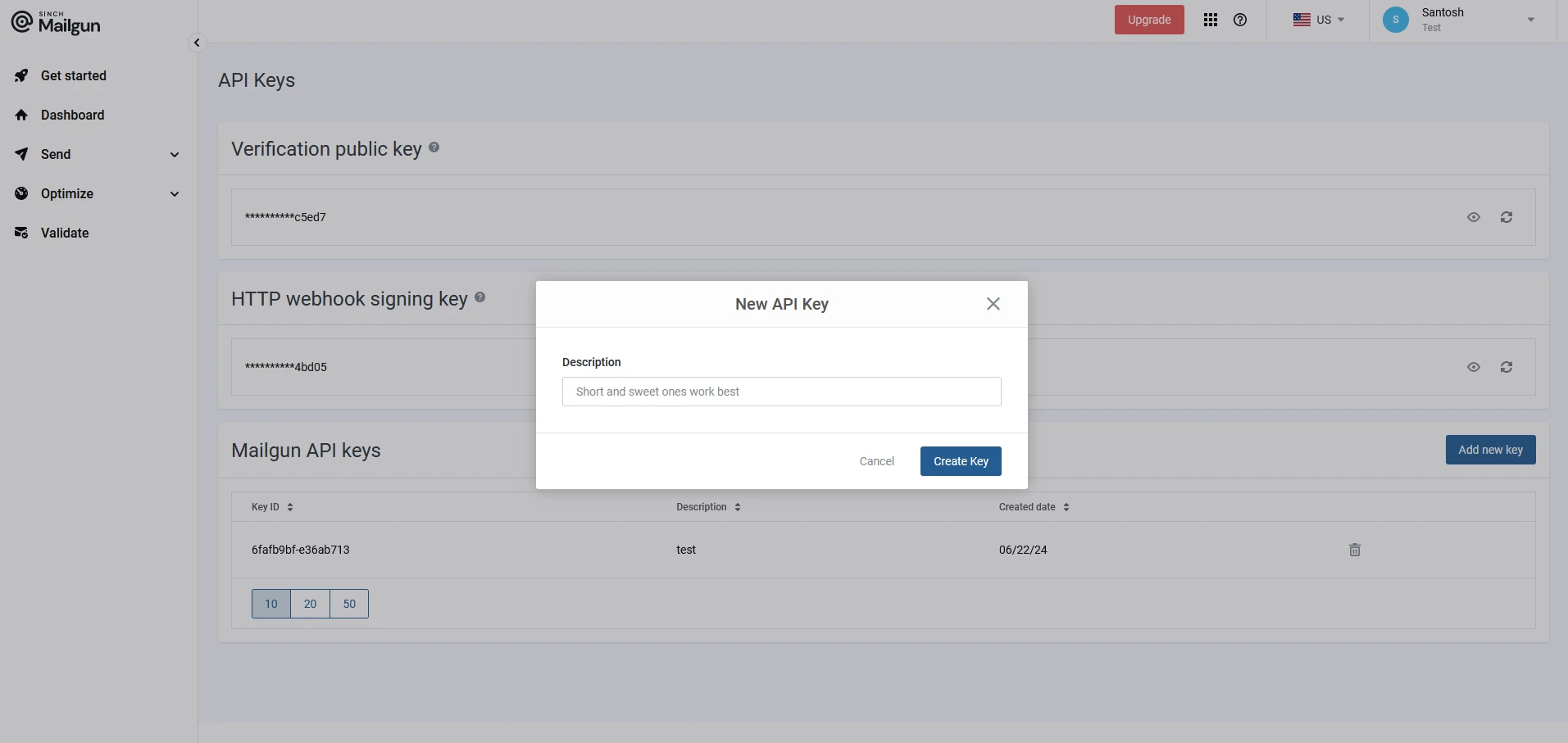
- Navigieren Sie zum Mailgun-Dashboard und erstellen Sie einen neuen API-Schlüssel. Geben Sie eine Beschreibung an.
-
Installieren Sie das FluentEmail-Paket:
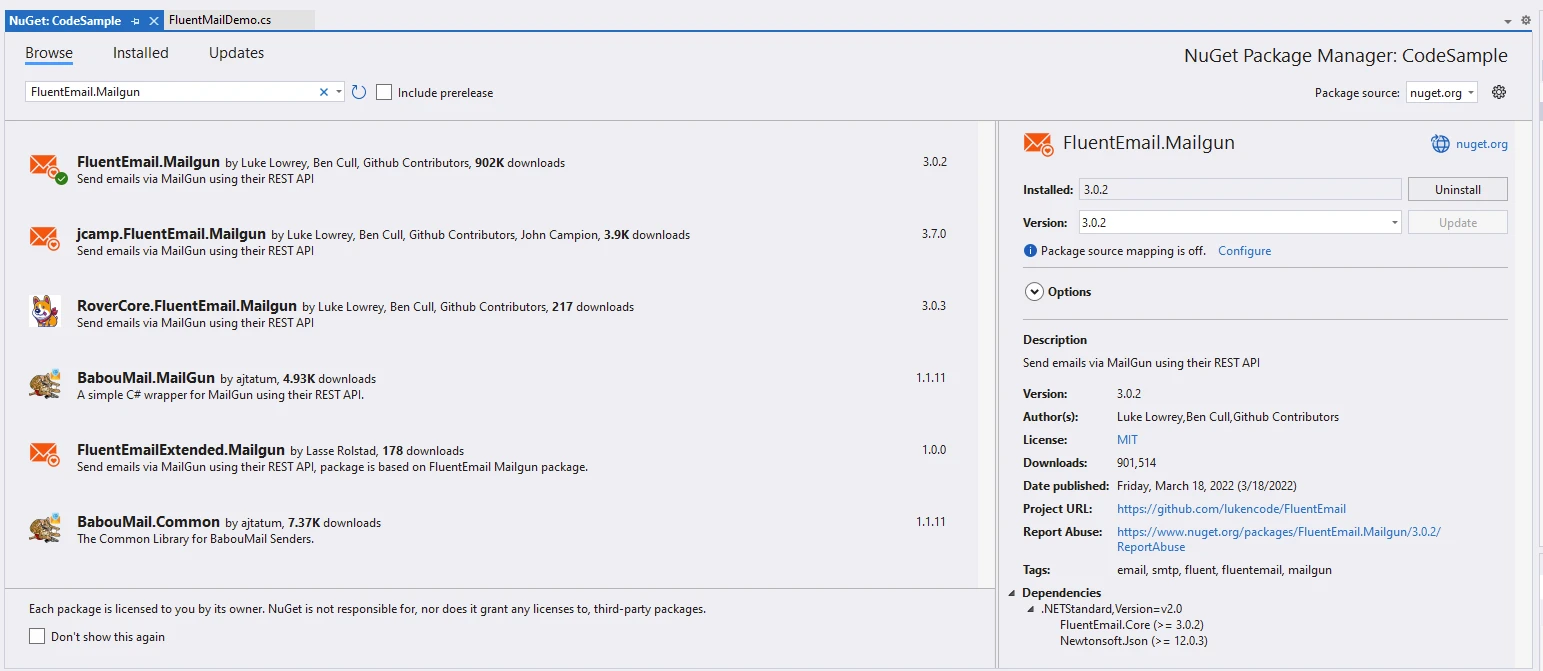
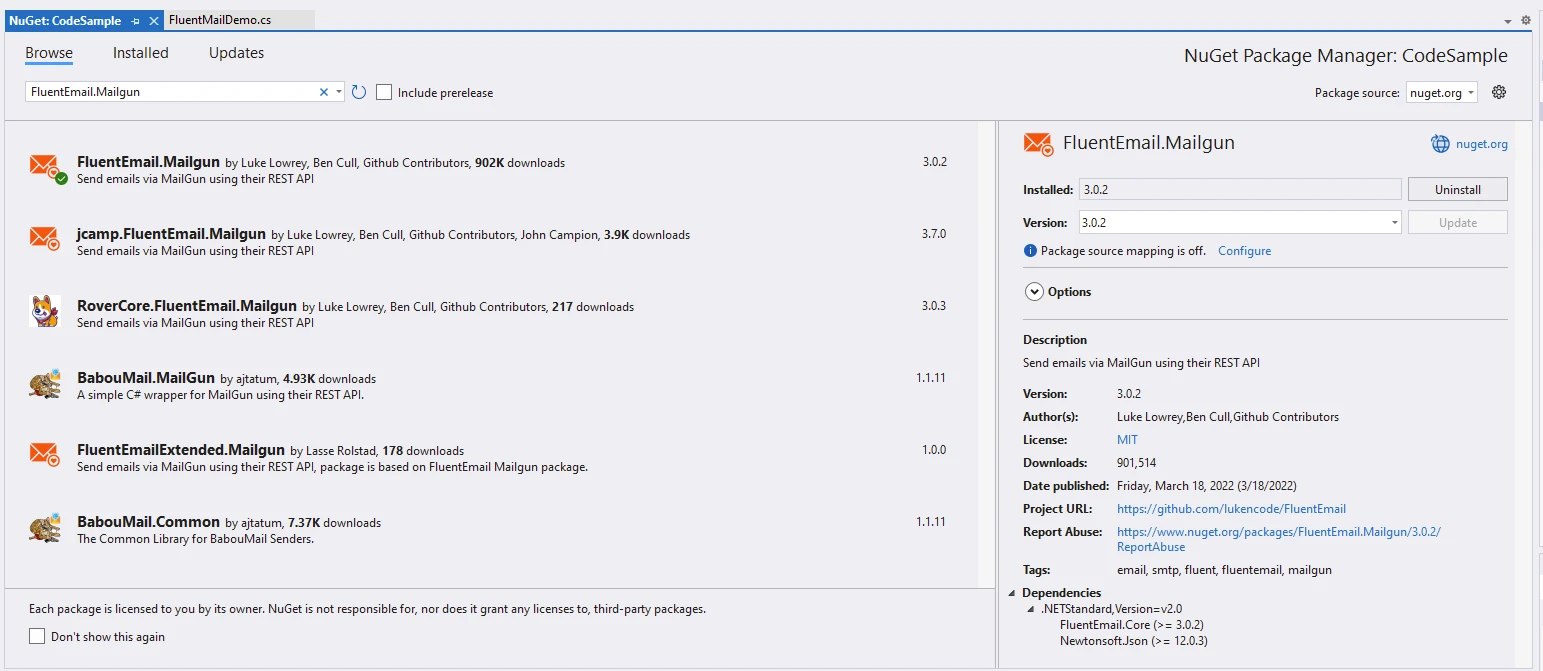
Verwenden Sie den NuGet-Paket-Manager oder die Paket-Manager-Konsole in Visual Studio, um FluentMail zu installieren:
# Install the FluentEmail.Mailgun package
Install-Package FluentEmail.Mailgun
# Install the FluentEmail.Mailgun package
Install-Package FluentEmail.Mailgun
SHELL
oder aus Visual Studio:
- FluentEmail mit Mailgun-API-Schlüsseln konfigurieren:
Richten Sie FluentEmail so ein, dass Mailgun als E-Mail-Dienstanbieter oder SMTP-Sender verwendet wird, indem Sie Ihre API-Schlüssel konfigurieren:
using FluentEmail.Core;
using FluentEmail.Mailgun;

// Create an instance of MailgunSender
var sender = new MailgunSender("your-domain.com", "your-mailgun-api-key");

// Set the default sender for all emails
Email.DefaultSender = sender;
using FluentEmail.Core;
using FluentEmail.Mailgun;

// Create an instance of MailgunSender
var sender = new MailgunSender("your-domain.com", "your-mailgun-api-key");

// Set the default sender for all emails
Email.DefaultSender = sender;
Imports FluentEmail.Core
Imports FluentEmail.Mailgun
' Create an instance of MailgunSender
Private sender = New MailgunSender("your-domain.com", "your-mailgun-api-key")
' Set the default sender for all emails
Email.DefaultSender = sender
Imports FluentEmail.Core
Imports FluentEmail.Mailgun

' Create an instance of MailgunSender
Private sender = New MailgunSender("your-domain.com", "your-mailgun-api-key")

' Set the default sender for all emails
Email.DefaultSender = sender
-
E-Mails verfassen und versenden:
Verwenden Sie die flüssige Schnittstelle von FluentEmail, um E-Mails zu verfassen und zu senden:
var email = Email
    .From("sender@example.com")
    .To("recipient@example.com")
    .Subject("Your Subject Here")
    .Body("Hello, this is a test email sent via FluentMail and Mailgun!")
    .Send();
var email = Email
    .From("sender@example.com")
    .To("recipient@example.com")
    .Subject("Your Subject Here")
    .Body("Hello, this is a test email sent via FluentMail and Mailgun!")
    .Send();
Dim email = Email _
.From("sender@example.com") _
.To("recipient@example.com") _
.Subject("Your Subject Here") _
.Body("Hello, this is a test email sent via FluentMail and Mailgun!") _
.Send()
Dim email = Email _
    .From("sender@example.com") _
    .To("recipient@example.com") _
    .Subject("Your Subject Here") _
    .Body("Hello, this is a test email sent via FluentMail and Mailgun!") _
    .Send()
-
Erweiterte Konfiguration:
- Passen Sie E-Mail-Einstellungen wie Anhänge, HTML-Formatierung, CC/BCC-Empfänger und E-Mail-Header mit FluentEmails flüssiger API an.
Vorteile der Verwendung von FluentEmail mit Mailgun
- Einfachheit: FluentEmail abstrahiert die Komplexität der SMTP-Konfiguration und ermöglicht so das einfache Versenden von E-Mails mit minimalem Aufwand.
- Zuverlässigkeit: Durch die Nutzung der Mailgun-Infrastruktur werden hohe Zustellbarkeitsraten und robuste E-Mail-Verarbeitungsfunktionen gewährleistet.
- Skalierbarkeit: Mit der skalierbaren Infrastruktur von Mailgun können Sie Ihre E-Mail-Versandanforderungen mühelos skalieren. Sie eignet sich sowohl für kleine Anwendungen als auch für Lösungen auf Unternehmensebene.
- Umfangreiche Funktionen: Nutzen Sie die Funktionen von Mailgun wie Tracking, Analysen und erweiterte E-Mail-Validierung, um Ihre E-Mail-Kampagnen zu optimieren.
Einführung in IronPDF
IronPDF ist eine Node.js-PDF-Bibliothek, die es ermöglicht, Inhalte aus PDF-Dokumenten in .NET-Projekten zu generieren, zu verwalten und zu extrahieren. Hier sind einige wichtige Funktionen:
-
HTML-zu-PDF-Konvertierung:
- Konvertieren Sie HTML-, CSS- und JavaScript-Inhalte in PDF-Dokumente.
- Chrome Rendering Engine für pixelgenaue PDFs.
- Generieren Sie PDFs aus URLs, HTML-Dateien oder HTML-Strings als Eingabe.
-
Bild- und Inhaltskonvertierung:
- Konvertieren Sie Bilder zu und von PDFs.
- Extrahieren Sie Text und Bilder aus bestehenden PDF-Dokumenten.
- Unterstützung für verschiedene Bildformate wie JPG, PNG usw.
-
Bearbeitung und Manipulation:
- Eigenschaften, Sicherheit und Berechtigungen für PDFs festlegen.
- Hinzufügen digitaler Signaturen.
- Metadaten und Versionsverlauf bearbeiten.
IronPDF überzeugt in der HTML-zu-PDF-Konvertierung, indem es den originalen Layouts und Stilen präzise erhält. Es ist ideal zur Erstellung von PDFs aus webbasierten Inhalten wie Berichten, Rechnungen und Dokumentationen. Mit Unterstützung für HTML-Dateien, URLs und rohe HTML-Strings erstellt IronPDF problemlos hochwertige PDF-Dokumente.
using IronPdf;

class Program
{
    static void Main(string[] args)
    {
        // Create a ChromePdfRenderer instance
        var renderer = new ChromePdfRenderer();

        // 1. Convert HTML String to PDF
        var htmlContent = "<h1>Hello, IronPDF!</h1><p>This is a PDF from an HTML string.</p>";
        var pdfFromHtmlString = renderer.RenderHtmlAsPdf(htmlContent);
        pdfFromHtmlString.SaveAs("HTMLStringToPDF.pdf");

        // 2. Convert HTML File to PDF
        var htmlFilePath = "path_to_your_html_file.html"; // Specify the path to your HTML file
        var pdfFromHtmlFile = renderer.RenderHtmlFileAsPdf(htmlFilePath);
        pdfFromHtmlFile.SaveAs("HTMLFileToPDF.pdf");

        // 3. Convert URL to PDF
        var url = "http://ironpdf.com"; // Specify the URL
        var pdfFromUrl = renderer.RenderUrlAsPdf(url);
        pdfFromUrl.SaveAs("URLToPDF.pdf");
    }
}
using IronPdf;

class Program
{
    static void Main(string[] args)
    {
        // Create a ChromePdfRenderer instance
        var renderer = new ChromePdfRenderer();

        // 1. Convert HTML String to PDF
        var htmlContent = "<h1>Hello, IronPDF!</h1><p>This is a PDF from an HTML string.</p>";
        var pdfFromHtmlString = renderer.RenderHtmlAsPdf(htmlContent);
        pdfFromHtmlString.SaveAs("HTMLStringToPDF.pdf");

        // 2. Convert HTML File to PDF
        var htmlFilePath = "path_to_your_html_file.html"; // Specify the path to your HTML file
        var pdfFromHtmlFile = renderer.RenderHtmlFileAsPdf(htmlFilePath);
        pdfFromHtmlFile.SaveAs("HTMLFileToPDF.pdf");

        // 3. Convert URL to PDF
        var url = "http://ironpdf.com"; // Specify the URL
        var pdfFromUrl = renderer.RenderUrlAsPdf(url);
        pdfFromUrl.SaveAs("URLToPDF.pdf");
    }
}
Imports IronPdf
Friend Class Program
Shared Sub Main(ByVal args() As String)
' Create a ChromePdfRenderer instance
Dim renderer = New ChromePdfRenderer()
' 1. Convert HTML String to PDF
Dim htmlContent = "<h1>Hello, IronPDF!</h1><p>This is a PDF from an HTML string.</p>"
Dim pdfFromHtmlString = renderer.RenderHtmlAsPdf(htmlContent)
pdfFromHtmlString.SaveAs("HTMLStringToPDF.pdf")
' 2. Convert HTML File to PDF
Dim htmlFilePath = "path_to_your_html_file.html" ' Specify the path to your HTML file
Dim pdfFromHtmlFile = renderer.RenderHtmlFileAsPdf(htmlFilePath)
pdfFromHtmlFile.SaveAs("HTMLFileToPDF.pdf")
' 3. Convert URL to PDF
Dim url = "http://ironpdf.com" ' Specify the URL
Dim pdfFromUrl = renderer.RenderUrlAsPdf(url)
pdfFromUrl.SaveAs("URLToPDF.pdf")
End Sub
End Class
Imports IronPdf

Friend Class Program
	Shared Sub Main(ByVal args() As String)
		' Create a ChromePdfRenderer instance
		Dim renderer = New ChromePdfRenderer()

		' 1. Convert HTML String to PDF
		Dim htmlContent = "<h1>Hello, IronPDF!</h1><p>This is a PDF from an HTML string.</p>"
		Dim pdfFromHtmlString = renderer.RenderHtmlAsPdf(htmlContent)
		pdfFromHtmlString.SaveAs("HTMLStringToPDF.pdf")

		' 2. Convert HTML File to PDF
		Dim htmlFilePath = "path_to_your_html_file.html" ' Specify the path to your HTML file
		Dim pdfFromHtmlFile = renderer.RenderHtmlFileAsPdf(htmlFilePath)
		pdfFromHtmlFile.SaveAs("HTMLFileToPDF.pdf")

		' 3. Convert URL to PDF
		Dim url = "http://ironpdf.com" ' Specify the URL
		Dim pdfFromUrl = renderer.RenderUrlAsPdf(url)
		pdfFromUrl.SaveAs("URLToPDF.pdf")
	End Sub
End Class
PDF-Dokumente mit IronPDF und FluentEmail .NET mit Mailgun-Sender generieren
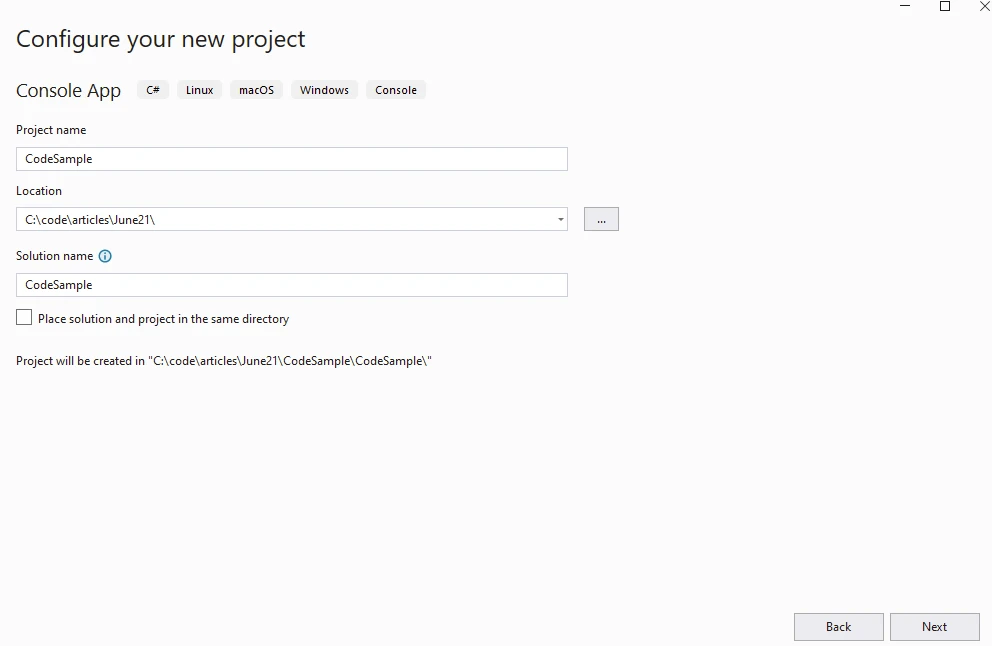
Erstellen Sie zunächst eine Konsolenanwendung mit Visual Studio wie unten beschrieben.
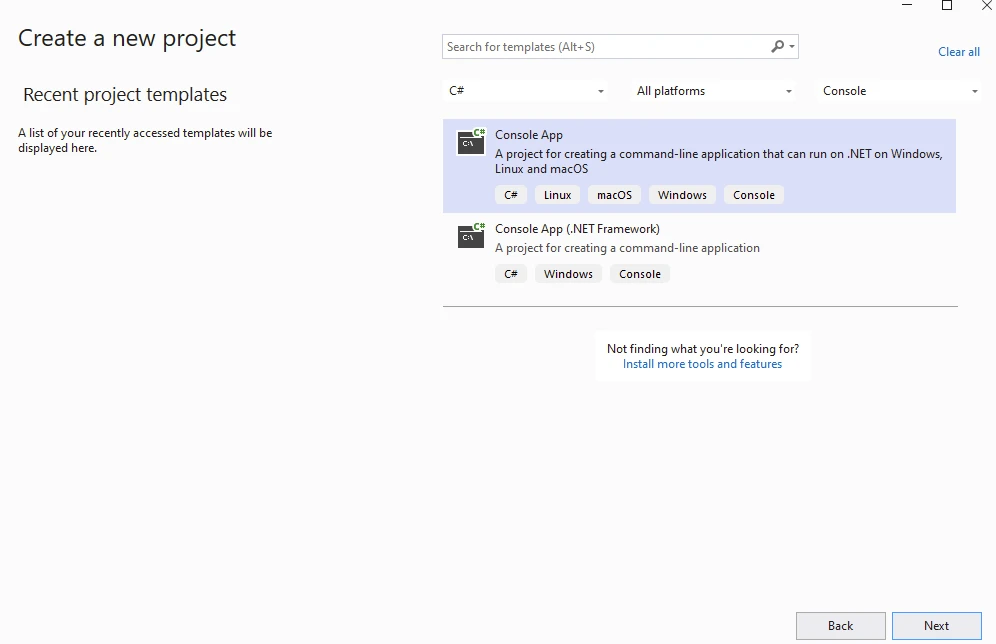
Projektname bereitstellen.
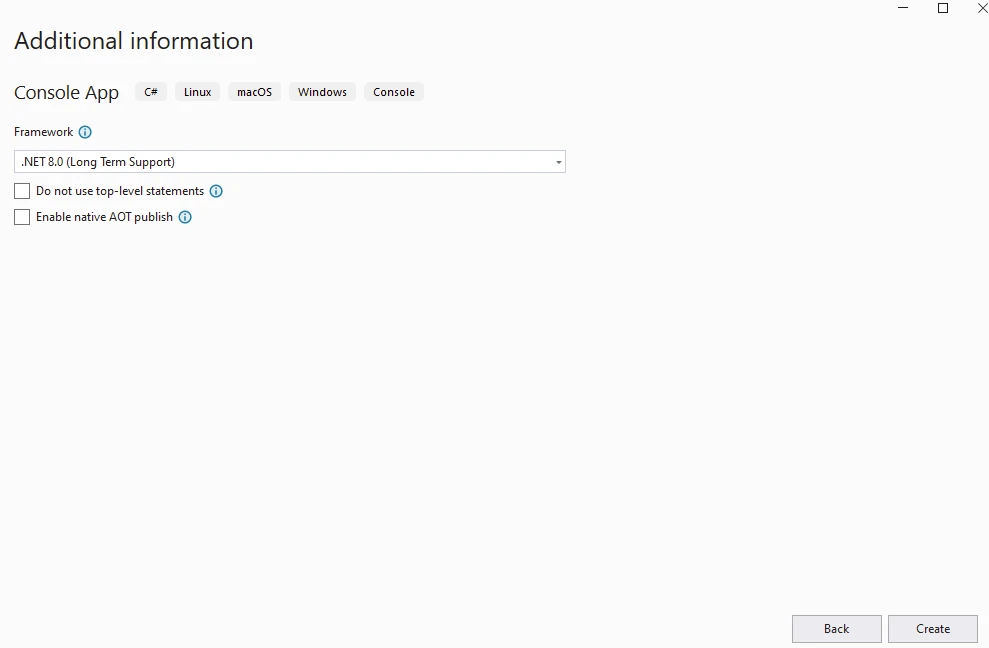
Geben Sie die .NET-Version an.
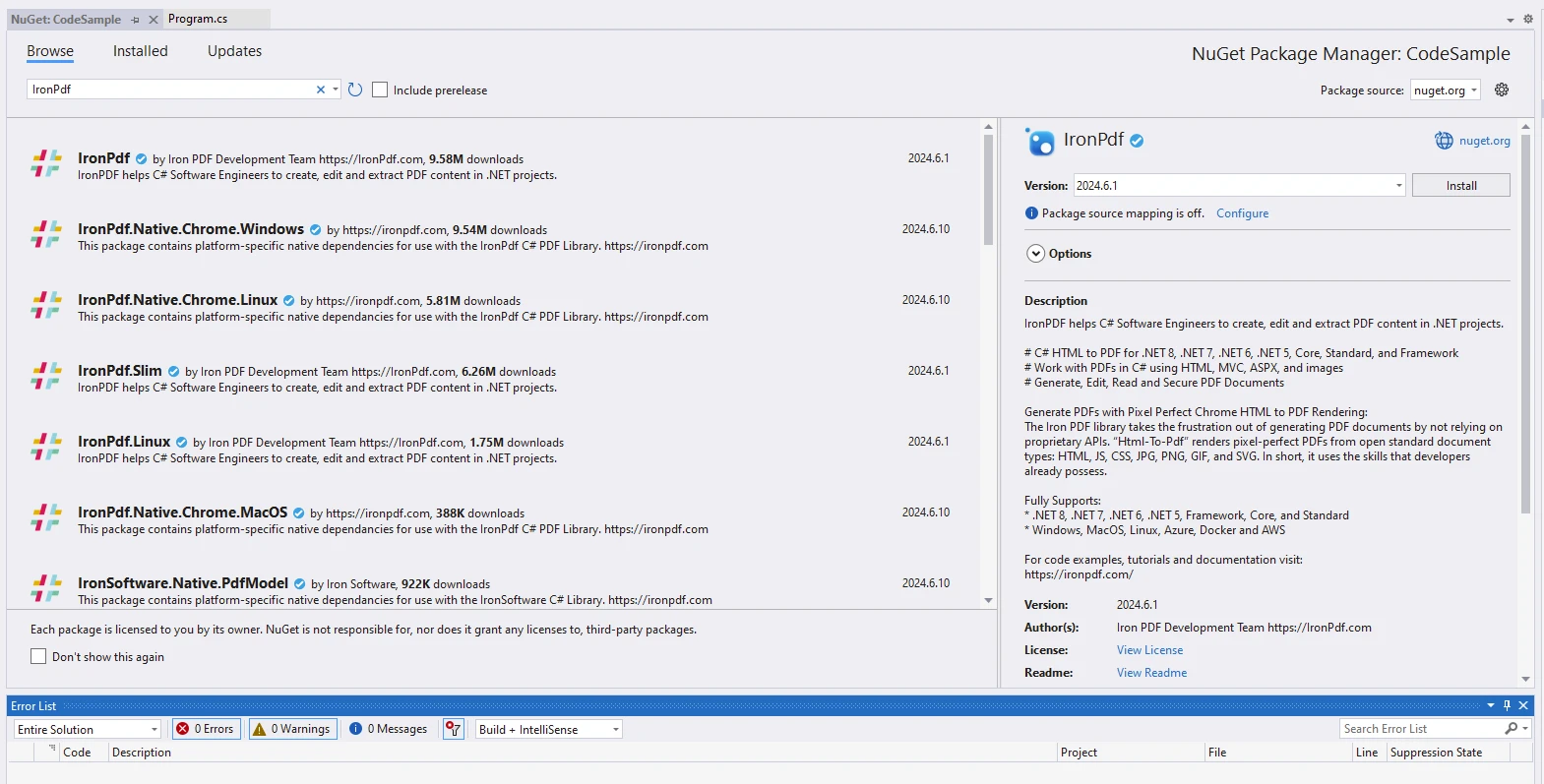
IronPDF-Paket installieren.
Installieren Sie FluentEmail Mailgun.
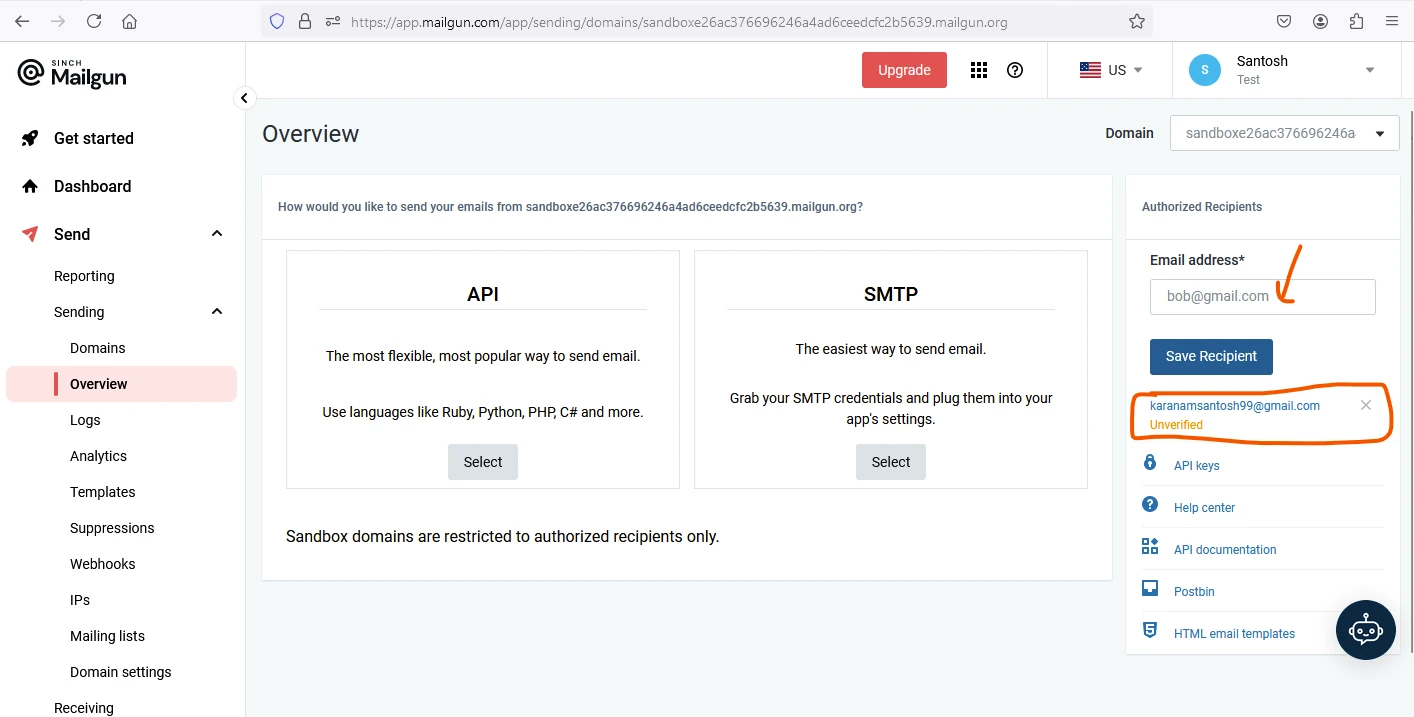
Um E-Mail-Nachrichten im kostenlosen Test zu empfangen, sollte die Empfänger-E-Mail im Dashboard auf dem Mailgun-Registrierungs-Dashboard registriert werden, wie unten gezeigt.
using FluentEmail.Core;
using FluentEmail.Mailgun;
using IronPdf;
using System;
using System.IO;

namespace CodeSample
{
    public static class FluentMailDemo
    {
        public static void Execute()
        {
            // Instantiate Renderer
            var renderer = new ChromePdfRenderer();

            // HTML Content to be converted into PDF and used in Email
            var content = "<h1>Demo FluentEmail with Mailgun and IronPDF</h1>";
            content += "<h2>Create MailgunSender</h2>";
            content += "<p>1. Get API key from app.mailgun.com</p>";

            var domain = "your-domain.com"; // Use your Mailgun domain
            var sender = new MailgunSender(domain, "your-mailgun-api-key"); // Use your Mailgun API key
            Email.DefaultSender = sender;

            content += "<h2>Prepare Email</h2>";
            content += $"<p>Sender: example@{domain}</p>";
            content += $"<p>Receiver: recipient@example.com</p>";
            content += $"<p>Subject: Checkout the New Awesome IronPDF Library from Iron Software</p>";
            content += $"<p>Body: IronPDF is the leading C# PDF library for generating & editing PDFs. It has friendly API and allows developers to rapidly deliver high quality PDFs from HTML in .NET projects.</p>";

            // Render HTML content to PDF
            var pdf = renderer.RenderHtmlAsPdf(content);

            // Export the PDF to a file
            pdf.SaveAs("AwesomeFluentEmailAndIron.pdf");

            // Compose and send the email
            var email = Email
                .From($"example@{domain}")
                .To("recipient@example.com")
                .Subject("Checkout the New Awesome IronPDF Library from Iron Software")
                .Body("IronPDF is the leading C# PDF library for generating & editing PDFs. It has a friendly API and allows developers to rapidly deliver high quality PDFs from HTML in .NET projects.")
                .Attach(new FluentEmail.Core.Models.Attachment
                {
                    Data = File.OpenRead("AwesomeFluentEmailAndIron.pdf"),
                    Filename = "AwesomeFluentEmailAndIron.pdf",
                    ContentType = "application/pdf"
                })
                .Send();

            Console.WriteLine($"Is Send Success: {email.Successful}");
        }
    }
}
using FluentEmail.Core;
using FluentEmail.Mailgun;
using IronPdf;
using System;
using System.IO;

namespace CodeSample
{
    public static class FluentMailDemo
    {
        public static void Execute()
        {
            // Instantiate Renderer
            var renderer = new ChromePdfRenderer();

            // HTML Content to be converted into PDF and used in Email
            var content = "<h1>Demo FluentEmail with Mailgun and IronPDF</h1>";
            content += "<h2>Create MailgunSender</h2>";
            content += "<p>1. Get API key from app.mailgun.com</p>";

            var domain = "your-domain.com"; // Use your Mailgun domain
            var sender = new MailgunSender(domain, "your-mailgun-api-key"); // Use your Mailgun API key
            Email.DefaultSender = sender;

            content += "<h2>Prepare Email</h2>";
            content += $"<p>Sender: example@{domain}</p>";
            content += $"<p>Receiver: recipient@example.com</p>";
            content += $"<p>Subject: Checkout the New Awesome IronPDF Library from Iron Software</p>";
            content += $"<p>Body: IronPDF is the leading C# PDF library for generating & editing PDFs. It has friendly API and allows developers to rapidly deliver high quality PDFs from HTML in .NET projects.</p>";

            // Render HTML content to PDF
            var pdf = renderer.RenderHtmlAsPdf(content);

            // Export the PDF to a file
            pdf.SaveAs("AwesomeFluentEmailAndIron.pdf");

            // Compose and send the email
            var email = Email
                .From($"example@{domain}")
                .To("recipient@example.com")
                .Subject("Checkout the New Awesome IronPDF Library from Iron Software")
                .Body("IronPDF is the leading C# PDF library for generating & editing PDFs. It has a friendly API and allows developers to rapidly deliver high quality PDFs from HTML in .NET projects.")
                .Attach(new FluentEmail.Core.Models.Attachment
                {
                    Data = File.OpenRead("AwesomeFluentEmailAndIron.pdf"),
                    Filename = "AwesomeFluentEmailAndIron.pdf",
                    ContentType = "application/pdf"
                })
                .Send();

            Console.WriteLine($"Is Send Success: {email.Successful}");
        }
    }
}
Imports FluentEmail.Core
Imports FluentEmail.Mailgun
Imports IronPdf
Imports System
Imports System.IO
Namespace CodeSample
Public Module FluentMailDemo
Public Sub Execute()
' Instantiate Renderer
Dim renderer = New ChromePdfRenderer()
' HTML Content to be converted into PDF and used in Email
Dim content = "<h1>Demo FluentEmail with Mailgun and IronPDF</h1>"
content &= "<h2>Create MailgunSender</h2>"
content &= "<p>1. Get API key from app.mailgun.com</p>"
Dim domain = "your-domain.com" ' Use your Mailgun domain
Dim sender = New MailgunSender(domain, "your-mailgun-api-key") ' Use your Mailgun API key
Email.DefaultSender = sender
content &= "<h2>Prepare Email</h2>"
content &= $"<p>Sender: example@{domain}</p>"
content &= $"<p>Receiver: recipient@example.com</p>"
content &= $"<p>Subject: Checkout the New Awesome IronPDF Library from Iron Software</p>"
content &= $"<p>Body: IronPDF is the leading C# PDF library for generating & editing PDFs. It has friendly API and allows developers to rapidly deliver high quality PDFs from HTML in .NET projects.</p>"
' Render HTML content to PDF
Dim pdf = renderer.RenderHtmlAsPdf(content)
' Export the PDF to a file
pdf.SaveAs("AwesomeFluentEmailAndIron.pdf")
' Compose and send the email
Dim email = Email.From($"example@{domain}").To("recipient@example.com").Subject("Checkout the New Awesome IronPDF Library from Iron Software").Body("IronPDF is the leading C# PDF library for generating & editing PDFs. It has a friendly API and allows developers to rapidly deliver high quality PDFs from HTML in .NET projects.").Attach(New FluentEmail.Core.Models.Attachment With {
.Data = File.OpenRead("AwesomeFluentEmailAndIron.pdf"),
.Filename = "AwesomeFluentEmailAndIron.pdf",
.ContentType = "application/pdf"
}).Send()
Console.WriteLine($"Is Send Success: {email.Successful}")
End Sub
End Module
End Namespace
Imports FluentEmail.Core
Imports FluentEmail.Mailgun
Imports IronPdf
Imports System
Imports System.IO

Namespace CodeSample
	Public Module FluentMailDemo
		Public Sub Execute()
			' Instantiate Renderer
			Dim renderer = New ChromePdfRenderer()

			' HTML Content to be converted into PDF and used in Email
			Dim content = "<h1>Demo FluentEmail with Mailgun and IronPDF</h1>"
			content &= "<h2>Create MailgunSender</h2>"
			content &= "<p>1. Get API key from app.mailgun.com</p>"

			Dim domain = "your-domain.com" ' Use your Mailgun domain
			Dim sender = New MailgunSender(domain, "your-mailgun-api-key") ' Use your Mailgun API key
			Email.DefaultSender = sender

			content &= "<h2>Prepare Email</h2>"
			content &= $"<p>Sender: example@{domain}</p>"
			content &= $"<p>Receiver: recipient@example.com</p>"
			content &= $"<p>Subject: Checkout the New Awesome IronPDF Library from Iron Software</p>"
			content &= $"<p>Body: IronPDF is the leading C# PDF library for generating & editing PDFs. It has friendly API and allows developers to rapidly deliver high quality PDFs from HTML in .NET projects.</p>"

			' Render HTML content to PDF
			Dim pdf = renderer.RenderHtmlAsPdf(content)

			' Export the PDF to a file
			pdf.SaveAs("AwesomeFluentEmailAndIron.pdf")

			' Compose and send the email
			Dim email = Email.From($"example@{domain}").To("recipient@example.com").Subject("Checkout the New Awesome IronPDF Library from Iron Software").Body("IronPDF is the leading C# PDF library for generating & editing PDFs. It has a friendly API and allows developers to rapidly deliver high quality PDFs from HTML in .NET projects.").Attach(New FluentEmail.Core.Models.Attachment With {
				.Data = File.OpenRead("AwesomeFluentEmailAndIron.pdf"),
				.Filename = "AwesomeFluentEmailAndIron.pdf",
				.ContentType = "application/pdf"
			}).Send()

			Console.WriteLine($"Is Send Success: {email.Successful}")
		End Sub
	End Module
End Namespace
Code-Erklärung
-
Integration von FluentEmail und Mailgun:
- FluentEmail.Core: Bietet eine flüssige Schnittstelle zum Verfassen und Versenden von E-Mails.
- FluentEmail.Mailgun: Ermöglicht die Integration mit Mailgun für die E-Mail-Zustellung.
-
ChromePdfRenderer:
- Dies wird als Instanz von ChromePdfRenderer aus der IronPDF-Bibliothek verstanden, die verwendet wird, um HTML-Inhalte in ein PDF-Dokument zu rendern.
-
Inhaltsvorbereitung:
- HTML-Inhalt (
content) wird erstellt, einschließlich Details über IronPDF. Dieser Inhalt wird sowohl zur Generierung des PDFs (renderer.RenderHtmlAsPdf(content)) als auch für den E-Mail-Text verwendet.
-
MailgunSender-Einrichtung:
MailgunSender wird mit den Mailgun-API-Zugangsdaten (Domain und API-Schlüssel) initialisiert. Der Email.DefaultSender ist auf diesen Absender gesetzt, wodurch alle folgenden E-Mails zur Lieferung Mailgun verwenden.
-
PDF-Erstellung und -Anhang:
- Der HTML-Inhalt (
content) wird mit der Methode RenderHtmlAsPdf von IronPDF in ein PDF (pdf) gerendert.
- Das erzeugte PDF wird als "AwesomeFluentEmailAndIron.pdf" gespeichert.
-
E-Mail-Erstellung und -Versand:
- Eine E-Mail wird unter Verwendung der flüssigen API von FluentEmail verfasst:
- Die Adresse "Von" wird mit der Domäne des Absenders gesetzt.
- Die Adresse "An" wird auf die E-Mail des Empfängers gesetzt.
- Der Betreff und der Inhalt der E-Mail sind definiert.
- Die PDF-Datei "AwesomeFluentEmailAndIron.pdf" wird an die E-Mail angehängt.
- Die E-Mail wird mit
.Send() gesendet, und der Erfolgstatus (email.Successful) wird an die Konsole ausgegeben.
-
Konsolenausgabe:
- Nach dem Versuch, die E-Mail zu senden, gibt der Code aus, ob die E-Mail erfolgreich gesendet wurde (
Is Send Success: true/false).
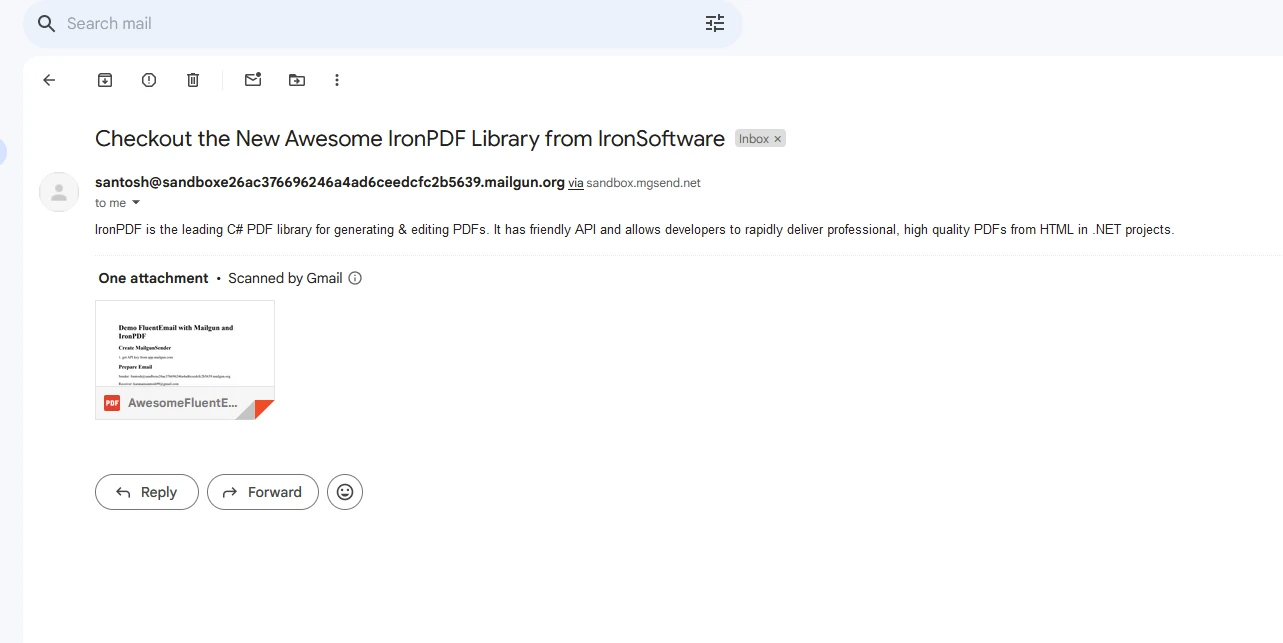
Ausgangs-E-Mail-Nachricht
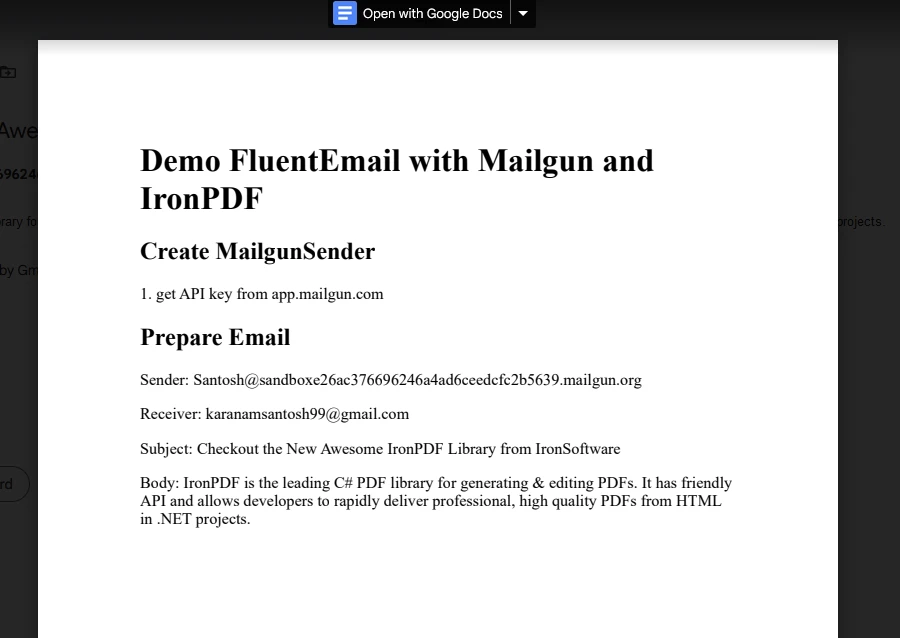
Angehängte PDF-Datei
IronPDF Lizenzierung
Das IronPDF-Paket erfordert eine Lizenz zum Ausführen und Erstellen des PDFs. Fügen Sie den folgenden Code am Anfang der Anwendung hinzu, bevor das Paket aufgerufen wird.
IronPdf.License.LicenseKey = "IRONPDF-LICENSE-KEY";
IronPdf.License.LicenseKey = "IRONPDF-LICENSE-KEY";
Imports IronPdf

IronPdf.License.LicenseKey = "IRONPDF-LICENSE-KEY"
Imports IronPdf

IronPdf.License.LicenseKey = "IRONPDF-LICENSE-KEY"
Eine Testlizenz ist unter IronPDF-Lizenzierung und Testversion verfügbar.
Abschluss
FluentEmail in Kombination mit Mailgun-API-Schlüsseln ermöglicht es .NET-Entwicklern, E-Mail-Funktionen in ihren Anwendungen zu optimieren. Egal, ob es sich um den Versand von Transaktions-E-Mails, Newslettern oder Benachrichtigungen handelt, diese Integration gewährleistet Zuverlässigkeit, Skalierbarkeit und Benutzerfreundlichkeit. Durch die Verschleierung der Komplexität der E-Mail-Zustellung ermöglicht FluentEmail Entwicklern, sich auf den Aufbau robuster Anwendungen zu konzentrieren und gleichzeitig die leistungsstarke E-Mail-Infrastruktur von Mailgun zu nutzen. Nutzen Sie die Leistungsfähigkeit von FluentEmail und Mailgun, um Ihre E-Mail-Kommunikationsmöglichkeiten in .NET-Anwendungen zu verbessern.
IronPDF hingegen ist eine robuste C#-Bibliothek zum Erstellen, Bearbeiten und Konvertieren von PDF-Dokumenten in .NET-Anwendungen. Es zeichnet sich durch die HTML-zu-PDF-Konvertierung aus, bietet umfassende PDF-Manipulationsfunktionen und integriert sich nahtlos in .NET-Frameworks, um sichere und vielseitige PDF-Bearbeitungslösungen zu bieten.























