using IronPdf;

// Disable local disk access or cross-origin requests
Installation.EnableWebSecurity = true;

// Instantiate Renderer
var renderer = new ChromePdfRenderer();

// Create a PDF from a HTML string using C#
var pdf = renderer.RenderHtmlAsPdf("<h1>Hello World</h1>");

// Export to a file or Stream
pdf.SaveAs("output.pdf");

// Advanced Example with HTML Assets
// Load external html assets: Images, CSS and JavaScript.
// An optional BasePath 'C:\site\assets\' is set as the file location to load assets from
var myAdvancedPdf = renderer.RenderHtmlAsPdf("<img src='icons/iron.png'>", @"C:\site\assets\");
myAdvancedPdf.SaveAs("html-with-assets.pdf");
using IronPdf;// Disable local disk access or cross-origin requestsInstallation.EnableWebSecurity = true;// Instantiate Renderervar renderer = new ChromePdfRenderer();// Create a PDF from a HTML string using C#var pdf = renderer.RenderHtmlAsPdf("<h1>Hello World</h1>");// Export to a file or Streampdf.SaveAs("output.pdf");// Advanced Example with HTML Assets// Load external html assets: Images, CSS and JavaScript.// An optional BasePath 'C:\site\assets\' is set as the file location to load assets fromvar myAdvancedPdf = renderer.RenderHtmlAsPdf("<img src='icons/iron.png'>", @"C:\site\assets\");myAdvancedPdf.SaveAs("html-with-assets.pdf");
Dieses Einsteiger-Tutorial wurde entwickelt, um Sie durch die Integration von zwei leistungsstarken Bibliotheken zu führen: Math.NET für mathematische Operationen und IronPDF zum Erstellen von PDF-Dokumenten. Ideal für verschiedene Anwendungen, von der wissenschaftlichen Forschung bis zur Finanzanalyse, bieten diese Tools einen umfassenden Ansatz zur Handhabung komplexer Daten und deren effektive Präsentation.
[Math.NET](https://github.com/mathnet/mathnet-numerics), eine renommierte Bibliothek im .NET-Ökosystem, bietet eine umfangreiche Palette an mathematischen Funktionalitäten. Ob es sich um lineare Algebra, Statistik oder numerische Analyse handelt, Math.NET rüstet Sie mit den Werkzeugen aus, um komplexe Berechnungen einfach durchzuführen.
[Entdecken Sie die IronPDF-Features](https://ironpdf.com), um zu lernen, wie Sie komplexe mathematische Berechnungen oder Math.NET-Untersuchungen in gut strukturierte PDF-Dokumente umwandeln können. Diese Funktion ist besonders wertvoll, wenn Sie Ergebnisse berichten, Ergebnisse teilen oder Daten archivieren müssen.
## Einstieg mit Math.NET
Math.NET ist ein leistungsstarkes Tool für mathematisches Rechnen im .NET-Framework, das in der Lage ist, eine breite Palette von mathematischen Aufgaben zu bewältigen. Dieser Abschnitt führt Sie in die Grundlagen der Einrichtung von Math.NET in einem C#-Projekt ein und zeigt einige erste Operationen, um Ihnen den Einstieg zu erleichtern.
### Installation von Math.NET
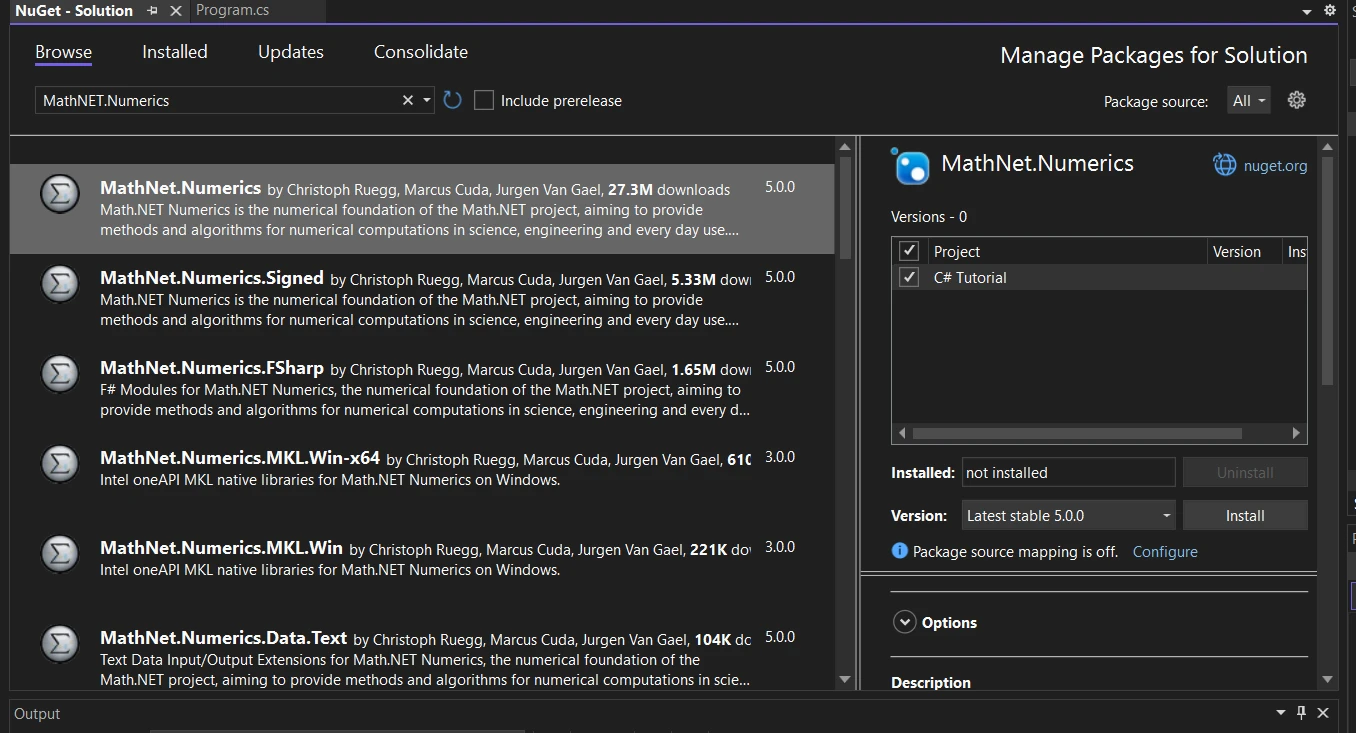
**Schrittweise Installation:** Um Math .NET in Ihr C#-Projekt zu integrieren, verwenden Sie den NuGet Paketmanager. Suchen Sie nach "MathNET.Numerics" und installieren Sie es in Ihrem Projekt. Dieser Prozess rüstet Ihre Anwendung mit den notwendigen Bibliotheken aus, um komplexe mathematische Berechnungen durchzuführen.
### Erste mathematische Operationen
**Einfache Berechnungen:** Beginnen Sie mit grundlegenden mathematischen Operationen, um sich mit der Benutzeroberfläche von Math.NET vertraut zu machen. Erforschen Sie zum Beispiel einfache arithmetische oder statistische Funktionen, die von der Bibliothek bereitgestellt werden.
**Erkunden von Daten und mathematischen Funktionen:** Experimentieren Sie mit komplexeren Funktionen, wie z. B. Matrixoperationen oder statistischen Analysen, um die Bandbreite der Möglichkeiten von Math.NET zu verstehen.
### Praktisches Beispiel: Grundlegende Arithmetik
```csharp
using MathNet.Numerics;

public class BasicMathOperations
{
    public void PerformCalculations()
    {
        // Example of basic arithmetic operation
        // Using basic trigonometric function from Math.NET
        double result = 2 * MathNet.Numerics.Trig.Cos(45);
        Console.WriteLine($"The result is: {result}");
    }
}
```
In diesem Beispiel verwenden wir eine grundlegende trigonometrische Funktion von Math.NET, um eine Berechnung durchzuführen und zu zeigen, wie einfach es ist, mathematische Logik in Ihre C#-Anwendungen zu integrieren.
## Erforschung der erweiterten Math.NET-Funktionen
Nachdem Sie sich mit den Grundlagen vertraut gemacht haben, ist es Zeit, einige der fortgeschrittenen Funktionen von Math.NET zu erkunden. Diese Funktionalitäten ermöglichen anspruchsvollere mathematische Operationen, ideal für komplexe Datenanalysen und Problemlösungen in verschiedenen Anwendungen.
### Fortgeschrittene mathematische Operationen
**Lineare Algebra:** Tauchen Sie ein in die Operationen der linearen Algebra, die für viele wissenschaftliche Berechnungen unerlässlich sind. Math.NET stellt Klassen für Matrizen und Vektoren bereit, die Operationen wie Matrixmultiplikation, Inversion und Zerlegung ermöglichen.
**Statistische Funktionen:** Nutzen Sie die statistischen Werkzeuge von Math.NET zur Datenanalyse. Funktionen umfassen Berechnungen von Mittelwert, Median, Varianz und Standardabweichung, die in statistischen Bewertungen grundlegend sind.
### Praktisches Beispiel: Statistische Analyse
Stellen Sie sich ein Szenario vor, in dem das Los Angeles Police Department mit dem New York City Precinct zusammenarbeitet, um eine Serie von Verbrechen unter Verwendung fortschrittlicher statistischer Analyse zu lösen. Hier spielen die statistischen Funktionen von Math.NET eine entscheidende Rolle bei der Analyse von Kriminaldaten, der Aufdeckung von Mustern und der Unterstützung von Ermittlungen.
```csharp
using MathNet.Numerics.Statistics;
using System;
public class CrimeDataAnalysis
{
public void AnalyzeCrimeData()
{
// Hypothetical crime rate data for a series of districts
var crimeRates = new double[] { 5.2, 3.8, 4.6, 2.9, 3.5 };
// Calculating statistical metrics to understand crime trends
double meanCrimeRate = Statistics.Mean(crimeRates);
double varianceCrimeRate = Statistics.Variance(crimeRates);
// Outputting the analysis results
Console.WriteLine($"Average Crime Rate: {meanCrimeRate}, Variance in Crime Rate: {varianceCrimeRate}");
// Additional analysis can be added here to further assist in the crime-solving process
// For instance, correlating crime rates with different variables (like time, location, etc.)
}
}
class Program
{
static void Main(string[] args)
{
// Simulating a scenario where LAPD and New York City start collaborating using statistical analysis
Console.WriteLine("Los Angeles Police Department and New York City Precinct Collaboration:");
CrimeDataAnalysis crimeDataAnalysis = new CrimeDataAnalysis();
crimeDataAnalysis.AnalyzeCrimeData();
}
}
```
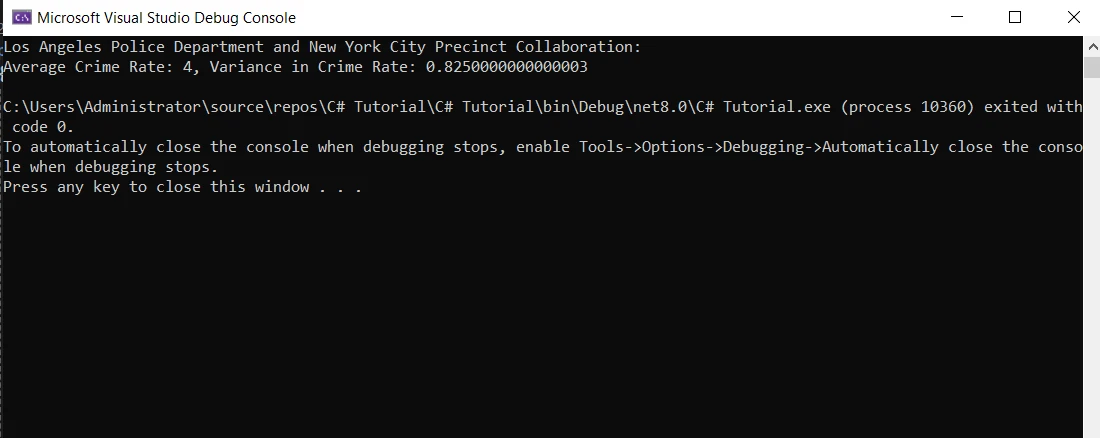
In diesem Beispiel berechnen wir den Mittelwert und die Varianz eines Datensatzes, um zu veranschaulichen, wie Math.NET komplexe statistische Operationen vereinfacht.
## Einführung in IronPDF
IronPDF ist ein leistungsstarkes Tool für C#-Entwickler, das die Erstellung und Manipulation von PDF-Dokumenten innerhalb von .NET-Anwendungen ermöglicht. Es ergänzt Math.NET, indem es Ihnen ermöglicht, komplexe mathematische Berichte und Datenvisualisierungen in zugängliche und freigabefähige PDF-Formate umzuwandeln.
Möchten Sie eine Webseite oder URL in eine PDF umwandeln, die wie das Original aussieht? IronPDF ist hier, um zu helfen! Es ist ideal, um PDFs von Berichten, Rechnungen und allen Online-Inhalten, die Sie speichern müssen, zu erstellen. Wenn Sie bereit sind, [HTML in PDF zu konvertieren](/tutorials/html-to-pdf/), dann ist dies das Tool, das Sie ausprobieren sollten.
```csharp
using IronPdf;
class Program
{
static void Main(string[] args)
{
// Create an instance of ChromePdfRenderer
var renderer = new ChromePdfRenderer();
// 1. Convert HTML String to PDF
var htmlContent = "<h1>Hello, IronPDF!</h1><p>This is a PDF from an HTML string.</p>";
var pdfFromHtmlString = renderer.RenderHtmlAsPdf(htmlContent);
pdfFromHtmlString.SaveAs("HTMLStringToPDF.pdf");
// 2. Convert HTML File to PDF
var htmlFilePath = "path_to_your_html_file.html"; // Specify the path to your HTML file
var pdfFromHtmlFile = renderer.RenderHtmlFileAsPdf(htmlFilePath);
pdfFromHtmlFile.SaveAs("HTMLFileToPDF.pdf");
// 3. Convert URL to PDF
var url = "http://ironpdf.com"; // Specify the URL
var pdfFromUrl = renderer.RenderUrlAsPdf(url);
pdfFromUrl.SaveAs("URLToPDF.pdf");
}
}
```
### Erste Schritte mit IronPDF
## IronPDF-Bibliothek installieren
### Installation mit NuGet Package Manager
Um IronPDF in Ihr Math.NET C#-Projekt mit dem NuGet-Paketmanager zu integrieren, folgen Sie diesen Schritten:
1. Öffnen Sie Visual Studio und klicken Sie im Lösungsexplorer mit der rechten Maustaste auf Ihr Projekt.
2. Wählen Sie im Kontextmenü "NuGet-Pakete verwalten…" aus.
3. Gehe zum Durchsuchen-Tab und suche nach IronPDF.
4. Wählen Sie IronPDF aus den Ergebnissen und klicken Sie auf 'Installieren'.
5. Akzeptieren Sie alle Lizenzvereinbarungen.
Wenn Sie IronPDF über die Paket-Manager-Konsole in Ihr Projekt einbinden möchten, führen Sie den folgenden Befehl in der Paket-Manager-Konsole aus:
```shell
:ProductInstall
```
Es wird IronPDF in Ihr Projekt holen und installieren.
### Installation über die NuGet-Paket-Seite
Für einen detaillierten Überblick über IronPDF, einschließlich seiner Features, Kompatibilität und weiterer Download-Optionen, besuchen Sie die [IronPDF NuGet-Seite](https://www.nuget.org/packages/IronPdf).
### Installation über DLL
Alternativ können Sie IronPDF direkt in Ihr Projekt integrieren, indem Sie die DLL-Datei verwenden. Laden Sie die ZIP-Datei mit der DLL von der [IronPDF Download-Seite](https://ironpdf.com/packages/IronPdf.zip) herunter. Entpacken Sie es und nehmen Sie die DLL in Ihr Projekt auf.
### Einfaches Beispiel: Erstellen einer PDF-Datei
```csharp
using IronPdf;
public class PdfGenerator
{
public void CreatePdf()
{
// Create an instance of ChromePdfRenderer for PDF generation
var Renderer = new ChromePdfRenderer();
// Render a simple HTML string as a PDF
var PDF = Renderer.RenderHtmlAsPdf("<h1>Hello, IronPDF!</h1>");
// Save the generated PDF to a file
PDF.SaveAs("Hello IronPDF.pdf");
}
}
```
In diesem Beispiel wird eine [einfache HTML-Zeichenkette in ein PDF-Dokument umgewandelt](/examples/using-html-to-create-a-pdf/), um die einfache PDF-Erstellung mit IronPDF zu veranschaulichen.
## Integration von Math.NET mit IronPDF
Da Sie nun mit sowohl Math.NET für mathematische Berechnungen als auch IronPDF zur Erstellung von PDFs vertraut sind, lassen Sie uns erkunden, wie diese beiden Bibliotheken integriert werden können. Diese Kombination ist besonders nützlich für die Erstellung von Berichten und Dokumentationen auf Basis mathematischer Analysen.
### Mathematische Daten mit Math.NET generieren
**Komplexe Berechnungen:** Nutzen Sie Math .NET , um komplexe Berechnungen oder Datenanalysen durchzuführen. Dies kann von statistischen Berechnungen bis zu Matrizenoperationen reichen.
### Konvertierung von MathNET-Ergebnissen in PDF
**IronPDF für die Dokumentation:** Nach der Datenverarbeitung mit .NET können Sie mit IronPDF die Ergebnisse und alle zugehörigen Diagramme oder Grafiken in ein PDF-Dokument konvertieren.
**Erstellung informativer Berichte:** Integrieren Sie detaillierte Analysen, Diagramme und erläuternde Texte in Ihre PDFs, um sie umfassend und bereit für Präsentationen oder die Archivierung zu machen.
### Beispiel: Statistischer Bericht im PDF-Format
```csharp
using MathNet.Numerics.Statistics;
using IronPdf;
public class StatisticalReport
{
public void CreateReport(double[] data)
{
// Calculate statistical metrics from data
double mean = Statistics.Mean(data);
double variance = Statistics.Variance(data);
// Create a PDF renderer
var Renderer = new ChromePdfRenderer();
// Render statistical metrics as HTML and convert it to a PDF
var PDF = Renderer.RenderHtmlAsPdf($"<h1>Statistical Report</h1><p>Mean: {mean}</p><p>Variance: {variance}</p>");
// Save the generated PDF
PDF.SaveAs("StatisticalReport.pdf");
}
}
```
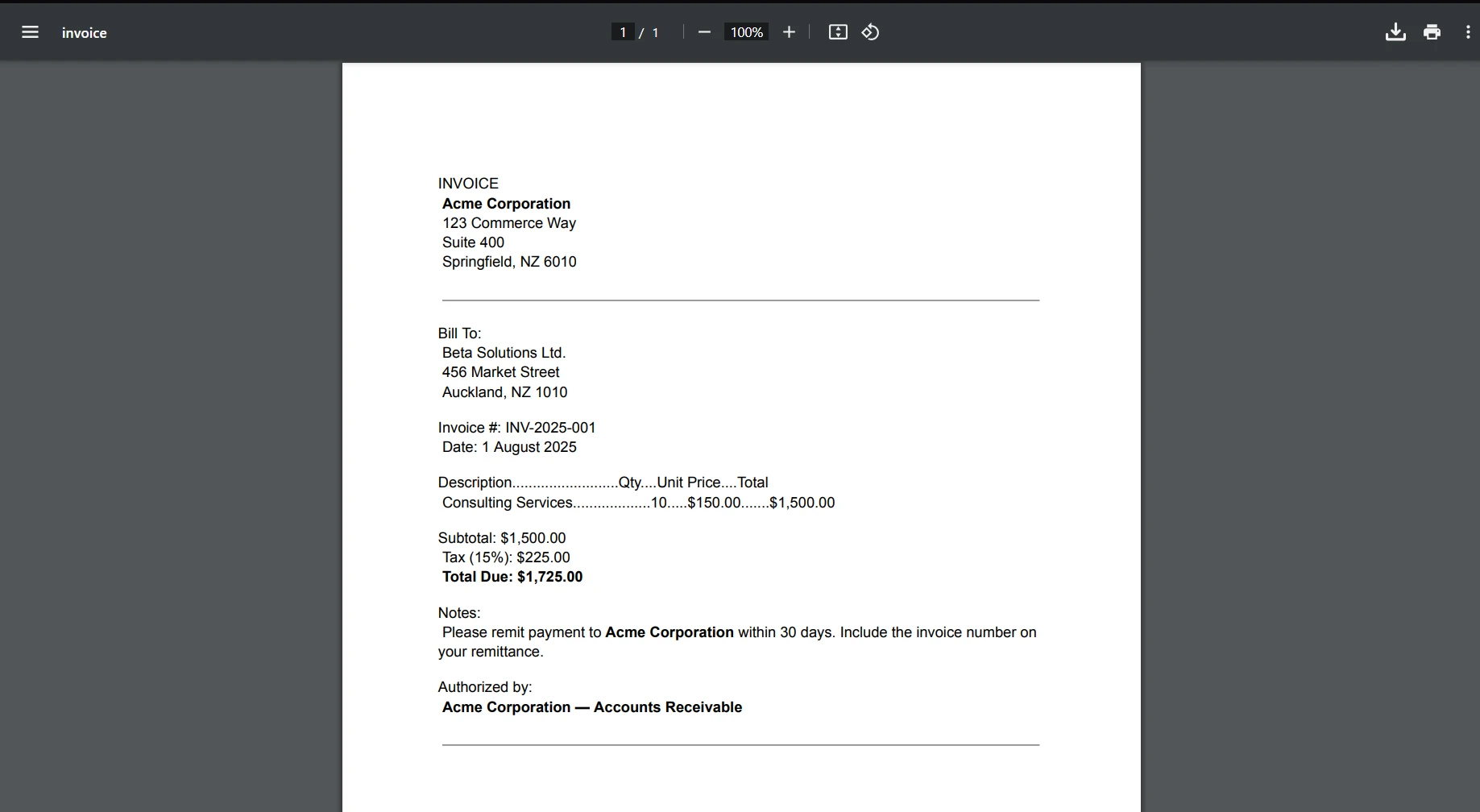
Hier ist der von IronPDF generierte PDF-Bericht:
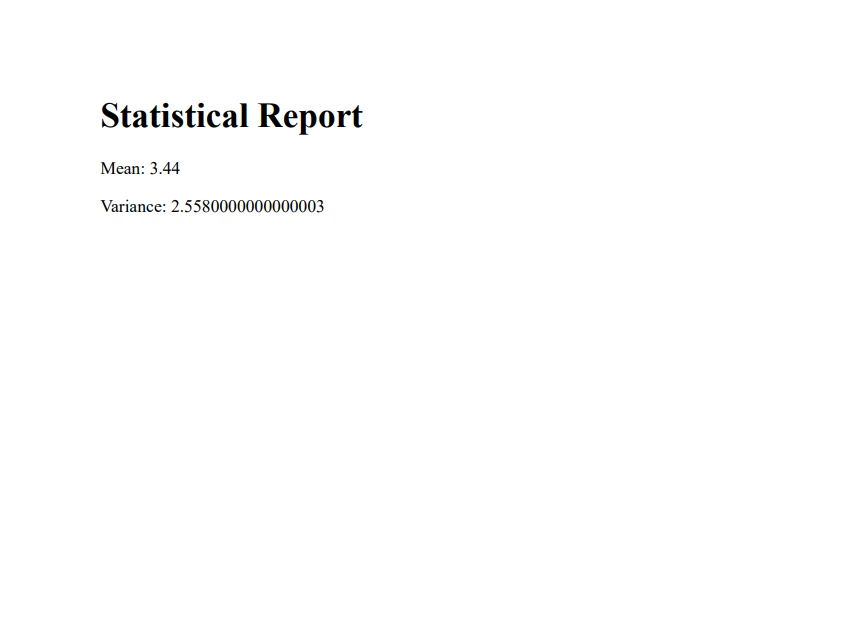
In diesem Beispiel berechnen wir zunächst statistische Werte mit Math.NET und erstellen dann mit IronPDF einen PDF-Bericht, um die Synergie zwischen analytischer Berechnung und Dokumentenerstellung zu zeigen.
## Abschluss
Wenn wir dieses Tutorial abschließen, haben Sie jetzt ein grundlegendes Verständnis davon, wie Sie die Möglichkeiten von Math.NET für fortgeschrittene mathematische Berechnungen und IronPDF für eine effiziente PDF-Erstellung in Ihren C#-Anwendungen nutzen können. Diese leistungsstarke Kombination eröffnet mehrere Möglichkeiten für Datenanalyse, Berichtswesen und Dokumentation.
IronPDF bietet eine [kostenlose Testversion von IronPDF](trial-license) für diejenigen, die seine Funktionen erkunden möchten, und für die erweiterte Nutzung beginnen die Lizenzen für IronPDF ab `$liteLicense`.
Dieses Einsteiger-Tutorial wurde entwickelt, um Sie durch die Integration von zwei leistungsstarken Bibliotheken zu führen: Math.NET für mathematische Operationen und IronPDF zum Erstellen von PDF-Dokumenten. Ideal für verschiedene Anwendungen, von der wissenschaftlichen Forschung bis zur Finanzanalyse, bieten diese Tools einen umfassenden Ansatz zur Handhabung komplexer Daten und deren effektive Präsentation.
Math.NET, eine renommierte Bibliothek im .NET-Ökosystem, bietet eine umfangreiche Palette an mathematischen Funktionalitäten. Ob es sich um lineare Algebra, Statistik oder numerische Analyse handelt, Math.NET rüstet Sie mit den Werkzeugen aus, um komplexe Berechnungen einfach durchzuführen.
Entdecken Sie die IronPDF-Features, um zu lernen, wie Sie komplexe mathematische Berechnungen oder Math.NET-Untersuchungen in gut strukturierte PDF-Dokumente umwandeln können. Diese Funktion ist besonders wertvoll, wenn Sie Ergebnisse berichten, Ergebnisse teilen oder Daten archivieren müssen.
Einstieg mit Math.NET
Math.NET ist ein leistungsstarkes Tool für mathematisches Rechnen im .NET-Framework, das in der Lage ist, eine breite Palette von mathematischen Aufgaben zu bewältigen. Dieser Abschnitt führt Sie in die Grundlagen der Einrichtung von Math.NET in einem C#-Projekt ein und zeigt einige erste Operationen, um Ihnen den Einstieg zu erleichtern.
Installation von Math.NET
Schrittweise Installation: Um Math .NET in Ihr C#-Projekt zu integrieren, verwenden Sie den NuGet Paketmanager. Suchen Sie nach "MathNET.Numerics" und installieren Sie es in Ihrem Projekt. Dieser Prozess rüstet Ihre Anwendung mit den notwendigen Bibliotheken aus, um komplexe mathematische Berechnungen durchzuführen.
Erste mathematische Operationen
Einfache Berechnungen: Beginnen Sie mit grundlegenden mathematischen Operationen, um sich mit der Benutzeroberfläche von Math.NET vertraut zu machen. Erforschen Sie zum Beispiel einfache arithmetische oder statistische Funktionen, die von der Bibliothek bereitgestellt werden.
Erkunden von Daten und mathematischen Funktionen: Experimentieren Sie mit komplexeren Funktionen, wie z. B. Matrixoperationen oder statistischen Analysen, um die Bandbreite der Möglichkeiten von Math.NET zu verstehen.
Praktisches Beispiel: Grundlegende Arithmetik
using MathNet.Numerics;public class BasicMathOperations{ public voidPerformCalculations() { // Example of basic arithmetic operation // Using basic trigonometric function from Math.NET double result = 2 * MathNet.Numerics.Trig.Cos(45);Console.WriteLine($"The result is: {result}"); }}
using MathNet.Numerics;

public class BasicMathOperations
{
    public void PerformCalculations()
    {
        // Example of basic arithmetic operation
        // Using basic trigonometric function from Math.NET
        double result = 2 * MathNet.Numerics.Trig.Cos(45);
        Console.WriteLine($"The result is: {result}");
    }
}
ImportsMathNet.NumericsPublic Class BasicMathOperations Public Sub PerformCalculations() ' Example of basic arithmetic operation ' Using basic trigonometric function from Math.NET Dim result AsDouble = 2 * MathNet.Numerics.Trig.Cos(45)Console.WriteLine($"The result is: {result}") End SubEnd Class
Imports MathNet.Numerics

Public Class BasicMathOperations
	Public Sub PerformCalculations()
		' Example of basic arithmetic operation
		' Using basic trigonometric function from Math.NET
		Dim result As Double = 2 * MathNet.Numerics.Trig.Cos(45)
		Console.WriteLine($"The result is: {result}")
	End Sub
End Class
In diesem Beispiel verwenden wir eine grundlegende trigonometrische Funktion von Math.NET, um eine Berechnung durchzuführen und zu zeigen, wie einfach es ist, mathematische Logik in Ihre C#-Anwendungen zu integrieren.
Erforschung der erweiterten Math.NET-Funktionen
Nachdem Sie sich mit den Grundlagen vertraut gemacht haben, ist es Zeit, einige der fortgeschrittenen Funktionen von Math.NET zu erkunden. Diese Funktionalitäten ermöglichen anspruchsvollere mathematische Operationen, ideal für komplexe Datenanalysen und Problemlösungen in verschiedenen Anwendungen.
Fortgeschrittene mathematische Operationen
Lineare Algebra: Tauchen Sie ein in die Operationen der linearen Algebra, die für viele wissenschaftliche Berechnungen unerlässlich sind. Math.NET stellt Klassen für Matrizen und Vektoren bereit, die Operationen wie Matrixmultiplikation, Inversion und Zerlegung ermöglichen.
Statistische Funktionen: Nutzen Sie die statistischen Werkzeuge von Math.NET zur Datenanalyse. Funktionen umfassen Berechnungen von Mittelwert, Median, Varianz und Standardabweichung, die in statistischen Bewertungen grundlegend sind.
Praktisches Beispiel: Statistische Analyse
Stellen Sie sich ein Szenario vor, in dem das Los Angeles Police Department mit dem New York City Precinct zusammenarbeitet, um eine Serie von Verbrechen unter Verwendung fortschrittlicher statistischer Analyse zu lösen. Hier spielen die statistischen Funktionen von Math.NET eine entscheidende Rolle bei der Analyse von Kriminaldaten, der Aufdeckung von Mustern und der Unterstützung von Ermittlungen.
using MathNet.Numerics.Statistics;using System;public class CrimeDataAnalysis{ public voidAnalyzeCrimeData() { // Hypothetical crime rate data for a series of districts var crimeRates = new double[] { 5.2, 3.8, 4.6, 2.9, 3.5 }; // Calculating statistical metrics to understand crime trends double meanCrimeRate = Statistics.Mean(crimeRates); double varianceCrimeRate = Statistics.Variance(crimeRates); // Outputting the analysis resultsConsole.WriteLine($"Average Crime Rate: {meanCrimeRate}, Variance in Crime Rate: {varianceCrimeRate}"); // Additional analysis can be added here to further assist in the crime-solving process // For instance, correlating crime rates with different variables (like time, location, etc.) }}class Program{ static voidMain(string[] args) { // Simulating a scenario where LAPD and New York City start collaborating using statistical analysisConsole.WriteLine("Los Angeles Police Department and New York City Precinct Collaboration:"); CrimeDataAnalysis crimeDataAnalysis = new CrimeDataAnalysis(); crimeDataAnalysis.AnalyzeCrimeData(); }}
using MathNet.Numerics.Statistics;
using System;

public class CrimeDataAnalysis
{
    public void AnalyzeCrimeData()
    {
        // Hypothetical crime rate data for a series of districts
        var crimeRates = new double[] { 5.2, 3.8, 4.6, 2.9, 3.5 };

        // Calculating statistical metrics to understand crime trends
        double meanCrimeRate = Statistics.Mean(crimeRates);
        double varianceCrimeRate = Statistics.Variance(crimeRates);

        // Outputting the analysis results
        Console.WriteLine($"Average Crime Rate: {meanCrimeRate}, Variance in Crime Rate: {varianceCrimeRate}");

        // Additional analysis can be added here to further assist in the crime-solving process
        // For instance, correlating crime rates with different variables (like time, location, etc.)
    }
}

class Program
{
    static void Main(string[] args)
    {
        // Simulating a scenario where LAPD and New York City start collaborating using statistical analysis
        Console.WriteLine("Los Angeles Police Department and New York City Precinct Collaboration:");
        CrimeDataAnalysis crimeDataAnalysis = new CrimeDataAnalysis();
        crimeDataAnalysis.AnalyzeCrimeData();
    }
}
ImportsMathNet.Numerics.StatisticsImportsSystemPublic Class CrimeDataAnalysis Public Sub AnalyzeCrimeData() ' Hypothetical crime rate data for a series of districts Dim crimeRates AsDouble() = {5.2, 3.8, 4.6, 2.9, 3.5} ' Calculating statistical metrics to understand crime trends Dim meanCrimeRate AsDouble = Statistics.Mean(crimeRates) Dim varianceCrimeRate AsDouble = Statistics.Variance(crimeRates) ' Outputting the analysis resultsConsole.WriteLine($"Average Crime Rate: {meanCrimeRate}, Variance in Crime Rate: {varianceCrimeRate}") ' Additional analysis can be added here to further assist in the crime-solving process ' For instance, correlating crime rates with different variables (like time, location, etc.) End SubEnd ClassModuleProgram Sub Main(args AsString()) ' Simulating a scenario where LAPD and New York City start collaborating using statistical analysisConsole.WriteLine("Los Angeles Police Department and New York City Precinct Collaboration:") Dim crimeDataAnalysis As New CrimeDataAnalysis() crimeDataAnalysis.AnalyzeCrimeData() End SubEndModule
Imports MathNet.Numerics.Statistics
Imports System

Public Class CrimeDataAnalysis
    Public Sub AnalyzeCrimeData()
        ' Hypothetical crime rate data for a series of districts
        Dim crimeRates As Double() = {5.2, 3.8, 4.6, 2.9, 3.5}

        ' Calculating statistical metrics to understand crime trends
        Dim meanCrimeRate As Double = Statistics.Mean(crimeRates)
        Dim varianceCrimeRate As Double = Statistics.Variance(crimeRates)

        ' Outputting the analysis results
        Console.WriteLine($"Average Crime Rate: {meanCrimeRate}, Variance in Crime Rate: {varianceCrimeRate}")

        ' Additional analysis can be added here to further assist in the crime-solving process
        ' For instance, correlating crime rates with different variables (like time, location, etc.)
    End Sub
End Class

Module Program
    Sub Main(args As String())
        ' Simulating a scenario where LAPD and New York City start collaborating using statistical analysis
        Console.WriteLine("Los Angeles Police Department and New York City Precinct Collaboration:")
        Dim crimeDataAnalysis As New CrimeDataAnalysis()
        crimeDataAnalysis.AnalyzeCrimeData()
    End Sub
End Module
In diesem Beispiel berechnen wir den Mittelwert und die Varianz eines Datensatzes, um zu veranschaulichen, wie Math.NET komplexe statistische Operationen vereinfacht.
Einführung in IronPDF
IronPDF ist ein leistungsstarkes Tool für C#-Entwickler, das die Erstellung und Manipulation von PDF-Dokumenten innerhalb von .NET-Anwendungen ermöglicht. Es ergänzt Math.NET, indem es Ihnen ermöglicht, komplexe mathematische Berichte und Datenvisualisierungen in zugängliche und freigabefähige PDF-Formate umzuwandeln.
Möchten Sie eine Webseite oder URL in eine PDF umwandeln, die wie das Original aussieht? IronPDF ist hier, um zu helfen! Es ist ideal, um PDFs von Berichten, Rechnungen und allen Online-Inhalten, die Sie speichern müssen, zu erstellen. Wenn Sie bereit sind, HTML in PDF zu konvertieren, dann ist dies das Tool, das Sie ausprobieren sollten.
using IronPdf;class Program{ static voidMain(string[] args) { // Create an instance of ChromePdfRenderer var renderer = new ChromePdfRenderer(); // 1. Convert HTML String to PDF var htmlContent = "<h1>Hello, IronPDF!</h1><p>This is a PDF from an HTML string.</p>"; var pdfFromHtmlString = renderer.RenderHtmlAsPdf(htmlContent); pdfFromHtmlString.SaveAs("HTMLStringToPDF.pdf"); // 2. Convert HTML File to PDF var htmlFilePath = "path_to_your_html_file.html"; // Specify the path to your HTML file var pdfFromHtmlFile = renderer.RenderHtmlFileAsPdf(htmlFilePath); pdfFromHtmlFile.SaveAs("HTMLFileToPDF.pdf"); // 3. Convert URL to PDF var url = "http://ironpdf.com"; // Specify the URL var pdfFromUrl = renderer.RenderUrlAsPdf(url); pdfFromUrl.SaveAs("URLToPDF.pdf"); }}
using IronPdf;

class Program
{
    static void Main(string[] args)
    {
        // Create an instance of ChromePdfRenderer
        var renderer = new ChromePdfRenderer();

        // 1. Convert HTML String to PDF
        var htmlContent = "<h1>Hello, IronPDF!</h1><p>This is a PDF from an HTML string.</p>";
        var pdfFromHtmlString = renderer.RenderHtmlAsPdf(htmlContent);
        pdfFromHtmlString.SaveAs("HTMLStringToPDF.pdf");

        // 2. Convert HTML File to PDF
        var htmlFilePath = "path_to_your_html_file.html"; // Specify the path to your HTML file
        var pdfFromHtmlFile = renderer.RenderHtmlFileAsPdf(htmlFilePath);
        pdfFromHtmlFile.SaveAs("HTMLFileToPDF.pdf");

        // 3. Convert URL to PDF
        var url = "http://ironpdf.com"; // Specify the URL
        var pdfFromUrl = renderer.RenderUrlAsPdf(url);
        pdfFromUrl.SaveAs("URLToPDF.pdf");
    }
}
ImportsIronPdfFriend Class ProgramShared Sub Main(ByVal args() AsString) ' Create an instance of ChromePdfRenderer Dim renderer = New ChromePdfRenderer() ' 1. Convert HTML String to PDF Dim htmlContent = "<h1>Hello, IronPDF!</h1><p>This is a PDF from an HTML string.</p>" Dim pdfFromHtmlString = renderer.RenderHtmlAsPdf(htmlContent) pdfFromHtmlString.SaveAs("HTMLStringToPDF.pdf") ' 2. Convert HTML File to PDF Dim htmlFilePath = "path_to_your_html_file.html" ' Specify the path to your HTML file Dim pdfFromHtmlFile = renderer.RenderHtmlFileAsPdf(htmlFilePath) pdfFromHtmlFile.SaveAs("HTMLFileToPDF.pdf") ' 3. Convert URL to PDF Dim url = "http://ironpdf.com" ' Specify the URL Dim pdfFromUrl = renderer.RenderUrlAsPdf(url) pdfFromUrl.SaveAs("URLToPDF.pdf") End SubEnd Class
Imports IronPdf

Friend Class Program
	Shared Sub Main(ByVal args() As String)
		' Create an instance of ChromePdfRenderer
		Dim renderer = New ChromePdfRenderer()

		' 1. Convert HTML String to PDF
		Dim htmlContent = "<h1>Hello, IronPDF!</h1><p>This is a PDF from an HTML string.</p>"
		Dim pdfFromHtmlString = renderer.RenderHtmlAsPdf(htmlContent)
		pdfFromHtmlString.SaveAs("HTMLStringToPDF.pdf")

		' 2. Convert HTML File to PDF
		Dim htmlFilePath = "path_to_your_html_file.html" ' Specify the path to your HTML file
		Dim pdfFromHtmlFile = renderer.RenderHtmlFileAsPdf(htmlFilePath)
		pdfFromHtmlFile.SaveAs("HTMLFileToPDF.pdf")

		' 3. Convert URL to PDF
		Dim url = "http://ironpdf.com" ' Specify the URL
		Dim pdfFromUrl = renderer.RenderUrlAsPdf(url)
		pdfFromUrl.SaveAs("URLToPDF.pdf")
	End Sub
End Class
Erste Schritte mit IronPDF
IronPDF-Bibliothek installieren
Installation mit NuGet Package Manager
Um IronPDF in Ihr Math.NET C#-Projekt mit dem NuGet-Paketmanager zu integrieren, folgen Sie diesen Schritten:
Öffnen Sie Visual Studio und klicken Sie im Lösungsexplorer mit der rechten Maustaste auf Ihr Projekt.
Wählen Sie im Kontextmenü "NuGet-Pakete verwalten…" aus.
Gehe zum Durchsuchen-Tab und suche nach IronPDF.
Wählen Sie IronPDF aus den Ergebnissen und klicken Sie auf 'Installieren'.
Akzeptieren Sie alle Lizenzvereinbarungen.
Wenn Sie IronPDF über die Paket-Manager-Konsole in Ihr Projekt einbinden möchten, führen Sie den folgenden Befehl in der Paket-Manager-Konsole aus:
PM > Install-Package IronPdf
Install-Package IronPdf
Es wird IronPDF in Ihr Projekt holen und installieren.
Installation über die NuGet-Paket-Seite
Für einen detaillierten Überblick über IronPDF, einschließlich seiner Features, Kompatibilität und weiterer Download-Optionen, besuchen Sie die IronPDF NuGet-Seite.
Installation über DLL
Alternativ können Sie IronPDF direkt in Ihr Projekt integrieren, indem Sie die DLL-Datei verwenden. Laden Sie die ZIP-Datei mit der DLL von der IronPDF Download-Seite herunter. Entpacken Sie es und nehmen Sie die DLL in Ihr Projekt auf.
Einfaches Beispiel: Erstellen einer PDF-Datei
using IronPdf;public class PdfGenerator{ public voidCreatePdf() { // Create an instance of ChromePdfRenderer for PDF generation varRenderer = new ChromePdfRenderer(); // Render a simple HTML string as a PDF varPDF = Renderer.RenderHtmlAsPdf("<h1>Hello, IronPDF!</h1>"); // Save the generated PDF to a filePDF.SaveAs("Hello IronPDF.pdf"); }}
using IronPdf;

public class PdfGenerator
{
    public void CreatePdf()
    {
        // Create an instance of ChromePdfRenderer for PDF generation
        var Renderer = new ChromePdfRenderer();
        // Render a simple HTML string as a PDF
        var PDF = Renderer.RenderHtmlAsPdf("<h1>Hello, IronPDF!</h1>");
        // Save the generated PDF to a file
        PDF.SaveAs("Hello IronPDF.pdf");
    }
}
Da Sie nun mit sowohl Math.NET für mathematische Berechnungen als auch IronPDF zur Erstellung von PDFs vertraut sind, lassen Sie uns erkunden, wie diese beiden Bibliotheken integriert werden können. Diese Kombination ist besonders nützlich für die Erstellung von Berichten und Dokumentationen auf Basis mathematischer Analysen.
Mathematische Daten mit Math.NET generieren
Komplexe Berechnungen: Nutzen Sie Math .NET , um komplexe Berechnungen oder Datenanalysen durchzuführen. Dies kann von statistischen Berechnungen bis zu Matrizenoperationen reichen.
Konvertierung von MathNET-Ergebnissen in PDF
IronPDF für die Dokumentation: Nach der Datenverarbeitung mit .NET können Sie mit IronPDF die Ergebnisse und alle zugehörigen Diagramme oder Grafiken in ein PDF-Dokument konvertieren.
Erstellung informativer Berichte: Integrieren Sie detaillierte Analysen, Diagramme und erläuternde Texte in Ihre PDFs, um sie umfassend und bereit für Präsentationen oder die Archivierung zu machen.
Beispiel: Statistischer Bericht im PDF-Format
using MathNet.Numerics.Statistics;using IronPdf;public class StatisticalReport{ public voidCreateReport(double[] data) { // Calculate statistical metrics from data double mean = Statistics.Mean(data); double variance = Statistics.Variance(data); // Create a PDF renderer varRenderer = new ChromePdfRenderer(); // Render statistical metrics as HTML and convert it to a PDF varPDF = Renderer.RenderHtmlAsPdf($"<h1>Statistical Report</h1><p>Mean: {mean}</p><p>Variance: {variance}</p>"); // Save the generated PDFPDF.SaveAs("StatisticalReport.pdf"); }}
using MathNet.Numerics.Statistics;
using IronPdf;

public class StatisticalReport
{
    public void CreateReport(double[] data)
    {
        // Calculate statistical metrics from data
        double mean = Statistics.Mean(data);
        double variance = Statistics.Variance(data);

        // Create a PDF renderer
        var Renderer = new ChromePdfRenderer();
        // Render statistical metrics as HTML and convert it to a PDF
        var PDF = Renderer.RenderHtmlAsPdf($"<h1>Statistical Report</h1><p>Mean: {mean}</p><p>Variance: {variance}</p>");
        // Save the generated PDF
        PDF.SaveAs("StatisticalReport.pdf");
    }
}
ImportsMathNet.Numerics.StatisticsImportsIronPdfPublic Class StatisticalReport Public Sub CreateReport(data AsDouble()) ' Calculate statistical metrics from data Dim mean AsDouble = Statistics.Mean(data) Dim variance AsDouble = Statistics.Variance(data) ' Create a PDF renderer DimRenderer = New ChromePdfRenderer() ' Render statistical metrics as HTML and convert it to a PDF DimPDF = Renderer.RenderHtmlAsPdf($"<h1>Statistical Report</h1><p>Mean: {mean}</p><p>Variance: {variance}</p>") ' Save the generated PDFPDF.SaveAs("StatisticalReport.pdf") End SubEnd Class
Imports MathNet.Numerics.Statistics
Imports IronPdf

Public Class StatisticalReport
    Public Sub CreateReport(data As Double())
        ' Calculate statistical metrics from data
        Dim mean As Double = Statistics.Mean(data)
        Dim variance As Double = Statistics.Variance(data)

        ' Create a PDF renderer
        Dim Renderer = New ChromePdfRenderer()
        ' Render statistical metrics as HTML and convert it to a PDF
        Dim PDF = Renderer.RenderHtmlAsPdf($"<h1>Statistical Report</h1><p>Mean: {mean}</p><p>Variance: {variance}</p>")
        ' Save the generated PDF
        PDF.SaveAs("StatisticalReport.pdf")
    End Sub
End Class
Hier ist der von IronPDF generierte PDF-Bericht:
In diesem Beispiel berechnen wir zunächst statistische Werte mit Math.NET und erstellen dann mit IronPDF einen PDF-Bericht, um die Synergie zwischen analytischer Berechnung und Dokumentenerstellung zu zeigen.
Abschluss
Wenn wir dieses Tutorial abschließen, haben Sie jetzt ein grundlegendes Verständnis davon, wie Sie die Möglichkeiten von Math.NET für fortgeschrittene mathematische Berechnungen und IronPDF für eine effiziente PDF-Erstellung in Ihren C#-Anwendungen nutzen können. Diese leistungsstarke Kombination eröffnet mehrere Möglichkeiten für Datenanalyse, Berichtswesen und Dokumentation.
IronPDF bietet eine kostenlose Testversion von IronPDF für diejenigen, die seine Funktionen erkunden möchten, und für die erweiterte Nutzung beginnen die Lizenzen für IronPDF ab $999.
Jacob Mellor ist Chief Technology Officer bei Iron Software und ein visionärer Ingenieur, der Pionierarbeit in der C# PDF-Technologie leistet. Als der ursprüngliche Entwickler hinter der Kern-Codebasis von Iron Software hat er die Produktarchitektur des Unternehmens seit seiner Gründung geprägt und es zusammen mit CEO Cameron Rimington in ein Unternehmen mit mehr als 50 Mitarbeitern verwandelt, das die NASA, Tesla und globale Regierungsbehörden beliefert.