Razor und Blazor sind zwei der beliebtesten Web-UI-Frameworks zur Erstellung von Webanwendungen in der Entwicklungsumgebung Visual Studio. Dieser Blogbeitrag wird die Ähnlichkeiten und Unterschiede zwischen diesen beiden .NET-Technologien basierend auf ihrer Syntax, ihren Interaktionen, Vorteilen und Nachteilen untersuchen. Er wird auch einige Anwendungsfälle mit einigen Codebeispielen demonstrieren.
Was sind Razor und Blazor in ASP.NET Core?
Razor
Razor ist eine serverseitige Markup-Sprache, die Entwicklern ermöglicht, dynamisch Webseiten mit HTML und eingebettetem .NET-Servercode zu erstellen. Razor generiert Webseiten aus Razor-Seiten, Webseitentemplate-Dateien, die mit C# oder VB geschrieben sind. Razor-Seiten, die mit VB-Code geschrieben wurden, verwenden die Dateierweiterung .vbhtml, und Razor-Seiten, die mit C#-Code geschrieben wurden, verwenden die Dateierweiterung .cshtml.
Moderne ASP.NET-Webanwendungen unterstützen Razor und es kann anstelle des traditionellen ASP.NET-Markups verwendet werden, um Anwendungsansichtskomponenten zu generieren.
Blazor
Blazor ist ein Webanwendungs-Framework, das es Entwicklern ermöglicht, interaktive, clientseitige Oberflächen mit .NET-Programmiersprachen zu erstellen. Mit Blazor erstellte Webanwendungen sind Single-Page-Anwendungen (SPA), die innerhalb eines Webbrowser-Clients (nicht auf einem Webserver) ausgeführt werden. Die Ausführung von Apps auf Browserseite wird durch WebAssembly ermöglicht, eine plattformübergreifende Befehlssatzbibliothek, die auf allen modernen Webbrowsern zu finden ist und .NET-Quellcode ausführen kann.
Mit Blazor können Entwickler wiederverwendbare, interaktive clientseitige Webkomponenten mit C#, HTML und CSS erstellen (ohne JavaScript integrieren zu müssen). Da diese Komponenten in C# geschrieben sind, haben Entwickler die Flexibilität, Implementierungsdetails bei Bedarf zwischen Client und Server als Quellcode und Bibliotheken hin- und her zu bewegen.
Verwendet Blazor Razor Components?
Blazor unterstützt vollständig die Razor-Syntax. Man kann Blazor-Apps mit dem vollständigen Markup-Feature-Set von Razor erstellen: mit Schleifen, Bedingungen usw. Betrachten Sie folgendes Beispiel.
@page "/HelloWorld"

<h1>
   Example Component
</h1>

@foreach (var person in People)
{
    <h2>@person.FirstName</h2>
}
@page "/HelloWorld"

<h1>
   Example Component
</h1>

@foreach (var person in People)
{
    <h2>@person.FirstName</h2>
}
Text
Diese Razor-Komponente verwendet eine foreach-Schleife, um über eine Kollektion namens People zu iterieren, wobei der Vorname jeder Person innerhalb von <h2>-Tags ausgegeben wird.
Verbindung zwischen Razor und Blazor
Wir können deutlich sehen, dass es eine Beziehung zwischen Blazor und Razor gibt. Schließlich ist Blazors Name selbst eine Kombination der Wörter "Browser" und "Razor".
Razor und Blazor werden beide verwendet, um Webanwendungen mit HTML und C# zu erstellen. Da sie Open Source und kostenlos sind, können Entwickler sie sofort ohne Einschränkung nutzen. Bei der Entwicklung von ASP.NET-Webanwendungen verwenden wir die Razor-Syntax, weil sie eher ASP.NET Core und ASP.NET MVC entspricht.
Blazor baut flexible, interaktive Benutzeroberflächen aus einer oder mehreren Komponenten, die mit Razor-Syntax geschrieben sind.
An diesem Punkt müssen wir einen signifikanten Unterschied in der Verwendung von Razor in Blazor machen: Es wird verwendet, um Komponenten (Buttons, Seitenelemente usw.) und nicht ganze Seiten zu erstellen.
Zusätzlich werden Razor-Dateien (Dateien mit der Erweiterung .cshtml) innerhalb von Blazor formal als Razor-Komponenten bezeichnet, nicht als Blazor-Komponenten (obwohl beide Begriffe in vielen Entwicklerkreisen austauschbar verwendet werden).
Arbeitsweise von Razor Pages und Blazor Server
Razor arbeitet innerhalb von MVC-Anwendungen, um dem Browser gesamte Seiten bereitzustellen.
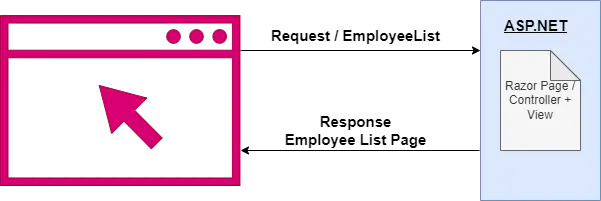
Razor Pages in Aktion
Wenn ein Benutzer auf eine Schaltfläche oder einen Link klickt, sendet der Browser eine Anforderung an den Server, der auf die Datenbank zugreift, die .cshtml Razor-Ansichten (oder Razor-Seite) abruft, die Daten und Markups zusammenführt und das gesamte dann an den Browser zurückgibt (woraufhin die gesamte Seite neu gerendert wird).
Blazor hingegen erlaubt es, eine gesamte Webseite mit einer Reihe kleinerer Komponenten zu erstellen, die in Razor-Syntax geschrieben sind.
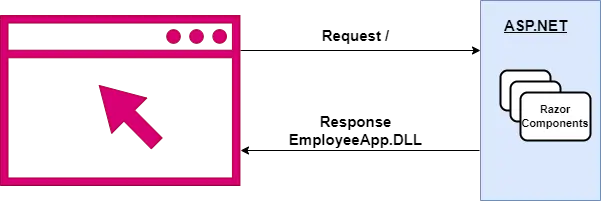
Blazor in Aktion
Dies veranschaulicht den Betrieb von Blazor WebAssembly (Blazor WASM).
Der erste Aufruf Ihrer Blazor-WASM-Anwendung gibt das vollständige Programm zurück, einschließlich aller von Ihnen definierten Komponenten, ähnlich wie bei einer Single-Page-Anwendung, die mit JavaScript erstellt wurde.
Jetzt, wo der Browser Zugriff auf diese Elemente hat, kann er sie in Reaktion auf Informationen und Ereignisse anzeigen, ausblenden und aktualisieren.
In dieser Hinsicht sind Blazor-Apps den Anwendungen ähnlicher, die man mit einer "modernen" JavaScript-Bibliothek/framework wie Vue oder Angular entwickeln würde. Blazor-Anwendungen führen Netzwerkanrufe an ein Backend aus, während sie im Browser ausgeführt werden, um Daten abzurufen und zu senden.
Nun, lass uns einige Vor- und Nachteile der Blazor-App und des Razor-View-Engines besprechen.
Vor- und Nachteile von Blazor und Razor
Wenn es darum geht, interaktive Webanwendungen auf Basis des .NET-Frameworks zu erstellen, sind Blazor und Razor beide hoch geschätzt. Diese Technologien bieten einen neuartigen Übergang von der Verwendung von C# als Hauptprogrammiersprache für Standard-JavaScript-Projekte.
Hier sind einige Vorteile und Nachteile, die bei der Erstellung von Webanwendungen mit Razor oder Blazor berücksichtigt werden sollten.
Vorteile von Blazor
- Clientseitiges Blazor führt .NET-Code direkt im Browser aus, indem es WebAssembly verwendet (was es schneller und weniger netzwerkbandbreitenintensiv macht) und liefert dynamische Webinhalte.
- Es verwendet die gleiche Syntax und Logik wie serverseitige Sprachen, wodurch es mit allen .NET-Bibliotheken und -Werkzeugen kompatibel ist.
Nachteile von Blazor
- Es gibt eine begrenzte Anzahl von .NET-Werkzeugen und Debug-Unterstützung für die clientseitige .NET-Anwendungsausführung mit Blazor.
- Die Leistungsvorteile von clientseitigem Blazor sind in der serverseitigen Implementierung nicht vorhanden.
Vorteile von Razor
- Razor ermöglicht die logische (bedingte) Einfügung von C#-Code in Webseiten.
- Razor ist hochflexibel und kann für die Erstellung einer Vielzahl von Apps verwendet werden.
- Die Struktur von Razor ist gut organisiert.
Nachteile von Razor
- JavaScript ist erforderlich, um dynamische, clientseitige Interaktionen zu implementieren.
- Mehrere eigenständige Seiten könnten mit Razor schwierig zu verwalten und zu pflegen sein.
Ein herausragendes Merkmal von IronPDF ist die Umwandlung von HTML in PDF mit IronPDF, wodurch Layouts und Stile erhalten bleiben. Diese Funktion ist ideal zum Erstellen von PDFs aus webbasierenden Inhalten wie Berichten, Rechnungen und Dokumentationen. HTML-Dateien, URLs und HTML-Zeichenfolgen können alle in PDFs konvertiert werden.
using IronPdf;

class Program
{
    static void Main(string[] args)
    {
        var renderer = new ChromePdfRenderer();

        // Convert HTML String to PDF
        var htmlContent = "<h1>Hello, IronPDF!</h1><p>This is a PDF from an HTML string.</p>";
        var pdfFromHtmlString = renderer.RenderHtmlAsPdf(htmlContent);
        pdfFromHtmlString.SaveAs("HTMLStringToPDF.pdf");

        // Convert HTML File to PDF
        var htmlFilePath = "path_to_your_html_file.html"; // Specify the path to your HTML file
        var pdfFromHtmlFile = renderer.RenderHtmlFileAsPdf(htmlFilePath);
        pdfFromHtmlFile.SaveAs("HTMLFileToPDF.pdf");

        // Convert URL to PDF
        var url = "http://ironpdf.com"; // Specify the URL
        var pdfFromUrl = renderer.RenderUrlAsPdf(url);
        pdfFromUrl.SaveAs("URLToPDF.pdf");
    }
}
using IronPdf;

class Program
{
    static void Main(string[] args)
    {
        var renderer = new ChromePdfRenderer();

        // Convert HTML String to PDF
        var htmlContent = "<h1>Hello, IronPDF!</h1><p>This is a PDF from an HTML string.</p>";
        var pdfFromHtmlString = renderer.RenderHtmlAsPdf(htmlContent);
        pdfFromHtmlString.SaveAs("HTMLStringToPDF.pdf");

        // Convert HTML File to PDF
        var htmlFilePath = "path_to_your_html_file.html"; // Specify the path to your HTML file
        var pdfFromHtmlFile = renderer.RenderHtmlFileAsPdf(htmlFilePath);
        pdfFromHtmlFile.SaveAs("HTMLFileToPDF.pdf");

        // Convert URL to PDF
        var url = "http://ironpdf.com"; // Specify the URL
        var pdfFromUrl = renderer.RenderUrlAsPdf(url);
        pdfFromUrl.SaveAs("URLToPDF.pdf");
    }
}
Imports IronPdf
Module Program
Sub Main(args As String())
Dim renderer = New ChromePdfRenderer()
' Convert HTML String to PDF
Dim htmlContent = "<h1>Hello, IronPDF!</h1><p>This is a PDF from an HTML string.</p>"
Dim pdfFromHtmlString = renderer.RenderHtmlAsPdf(htmlContent)
pdfFromHtmlString.SaveAs("HTMLStringToPDF.pdf")
' Convert HTML File to PDF
Dim htmlFilePath = "path_to_your_html_file.html" ' Specify the path to your HTML file
Dim pdfFromHtmlFile = renderer.RenderHtmlFileAsPdf(htmlFilePath)
pdfFromHtmlFile.SaveAs("HTMLFileToPDF.pdf")
' Convert URL to PDF
Dim url = "http://ironpdf.com" ' Specify the URL
Dim pdfFromUrl = renderer.RenderUrlAsPdf(url)
pdfFromUrl.SaveAs("URLToPDF.pdf")
End Sub
End Module
Imports IronPdf

Module Program
    Sub Main(args As String())
        Dim renderer = New ChromePdfRenderer()

        ' Convert HTML String to PDF
        Dim htmlContent = "<h1>Hello, IronPDF!</h1><p>This is a PDF from an HTML string.</p>"
        Dim pdfFromHtmlString = renderer.RenderHtmlAsPdf(htmlContent)
        pdfFromHtmlString.SaveAs("HTMLStringToPDF.pdf")

        ' Convert HTML File to PDF
        Dim htmlFilePath = "path_to_your_html_file.html" ' Specify the path to your HTML file
        Dim pdfFromHtmlFile = renderer.RenderHtmlFileAsPdf(htmlFilePath)
        pdfFromHtmlFile.SaveAs("HTMLFileToPDF.pdf")

        ' Convert URL to PDF
        Dim url = "http://ironpdf.com" ' Specify the URL
        Dim pdfFromUrl = renderer.RenderUrlAsPdf(url)
        pdfFromUrl.SaveAs("URLToPDF.pdf")
    End Sub
End Module
Dieses C#-Programm demonstriert die Verwendung von IronPdf zur Umwandlung von HTML-Inhalten in PDF-Dokumente. Es unterstützt Konvertierungen von einer HTML-Zeichenfolge, einer HTML-Datei und einer URL.
Abschluss
Razor kann API-Logik und serverseitige Vorlagenhandhabung durchführen, aber es kann keine clientseitige Logik handhaben, die nicht auf JavaScript basiert. Blazor ermöglicht es Programmierern, sowohl Client- als auch Serverfunktionalitäten nur mit C# zu handhaben. Razor ist eine Markup-Syntax für Vorlagen, die serverseitigen Code in das HTML integriert. Blazor hingegen ist ein SPA-Framework, das je nach Situation entweder auf Blazor WebAssembly oder dem Blazor-Server laufen kann.
Entdecken Sie IronPDF, um auf einfachste Weise PDF-Dateien sowohl in Razor-Anwendungen als auch in Blazor-Anwendungen zu erstellen, zu lesen, zu aktualisieren und zu manipulieren. IronPDF ist ein Teil von Iron Softwares Iron Suite, die fünf nützliche Bibliotheken enthält, die beim Erstellen von Razor- oder Blazor-Webapps mit Excel, PDF, Barcodes, QR-Codes und Bildern hilfreich sind.
Iron Suite ist für die private Nutzung kostenlos verfügbar. Für weitere Informationen über den Erwerb einer kommerziellen Lizenz, besuchen Sie bitte die Iron Suite Lizenzierungsinformation.