using IronPdf;

// Disable local disk access or cross-origin requests
Installation.EnableWebSecurity = true;

// Instantiate Renderer
var renderer = new ChromePdfRenderer();

// Create a PDF from a HTML string using C#
var pdf = renderer.RenderHtmlAsPdf("<h1>Hello World</h1>");

// Export to a file or Stream
pdf.SaveAs("output.pdf");

// Advanced Example with HTML Assets
// Load external html assets: Images, CSS and JavaScript.
// An optional BasePath 'C:\site\assets\' is set as the file location to load assets from
var myAdvancedPdf = renderer.RenderHtmlAsPdf("<img src='icons/iron.png'>", @"C:\site\assets\");
myAdvancedPdf.SaveAs("html-with-assets.pdf");
using IronPdf;// Disable local disk access or cross-origin requestsInstallation.EnableWebSecurity = true;// Instantiate Renderervar renderer = new ChromePdfRenderer();// Create a PDF from a HTML string using C#var pdf = renderer.RenderHtmlAsPdf("<h1>Hello World</h1>");// Export to a file or Streampdf.SaveAs("output.pdf");// Advanced Example with HTML Assets// Load external html assets: Images, CSS and JavaScript.// An optional BasePath 'C:\site\assets\' is set as the file location to load assets fromvar myAdvancedPdf = renderer.RenderHtmlAsPdf("<img src='icons/iron.png'>", @"C:\site\assets\");myAdvancedPdf.SaveAs("html-with-assets.pdf");
PM >Install-Package IronPdf
Install-Package IronPdf
ENTWICKLER-UPDATES
WebGrease .NET Core (Wie es für Entwickler funktioniert)
Die Integration von WebGrease mit IronPDF und .NET Core bietet eine potente Methode zur Erstellung hochwertiger PDF-Dokumente und zur Optimierung der Leistung von Webanwendungen. Durch die Verwendung von JavaScript-Komprimierung, Bildoptimierung und CSS-Minimierung ist WebGrease ein funktionsreiches Paket, das Websites für Entwickler schneller und reibungsloser laufen lässt. Entwickler können mit IronPDF, einem leistungsstarken .NET-Toolkit zur Erstellung und Bearbeitung von PDF-Dokumenten, einfach dynamische PDFs aus verschiedenen Quellen erstellen, einschließlich HTML und MVC-Ansichten.
Mit dieser Integration bleiben Webanwendungen flüssig und anpassungsfähig, wodurch effektives Ressourcenmanagement und die dynamische Erstellung von PDFs ermöglicht werden. WebGrease und IronPDF sind vollständig kompatibel mit .NET Core, was Entwicklern ermöglicht, plattformübergreifende Anwendungen zu erstellen, die auf [Linux](https://en.wikipedia.org/wiki/Linux), macOS und Windows einwandfrei funktionieren. Dies führt zu einer verbesserten Benutzererfahrung dank optimierter Leistung und einer überlegenen Dokumentenverarbeitung.
## Was ist WebGrease?
Ursprünglich als Bestandteil des ASP.NET-Stacks entwickelt, ist [WebGrease](https://www.nuget.org/packages/WebGrease/) ein Tool zur Automatisierung von Prozessen wie der Optimierung von JavaScript, der Komprimierung, der Bildoptimierung und der CSS-Minimierung statischer Dateien, um die Webleistung zu verbessern. Diese Optimierungen tragen zur Reduzierung der Webressourcengröße bei, was die Leistung von Webanwendungen verbessert und die Ladezeiten verkürzt.
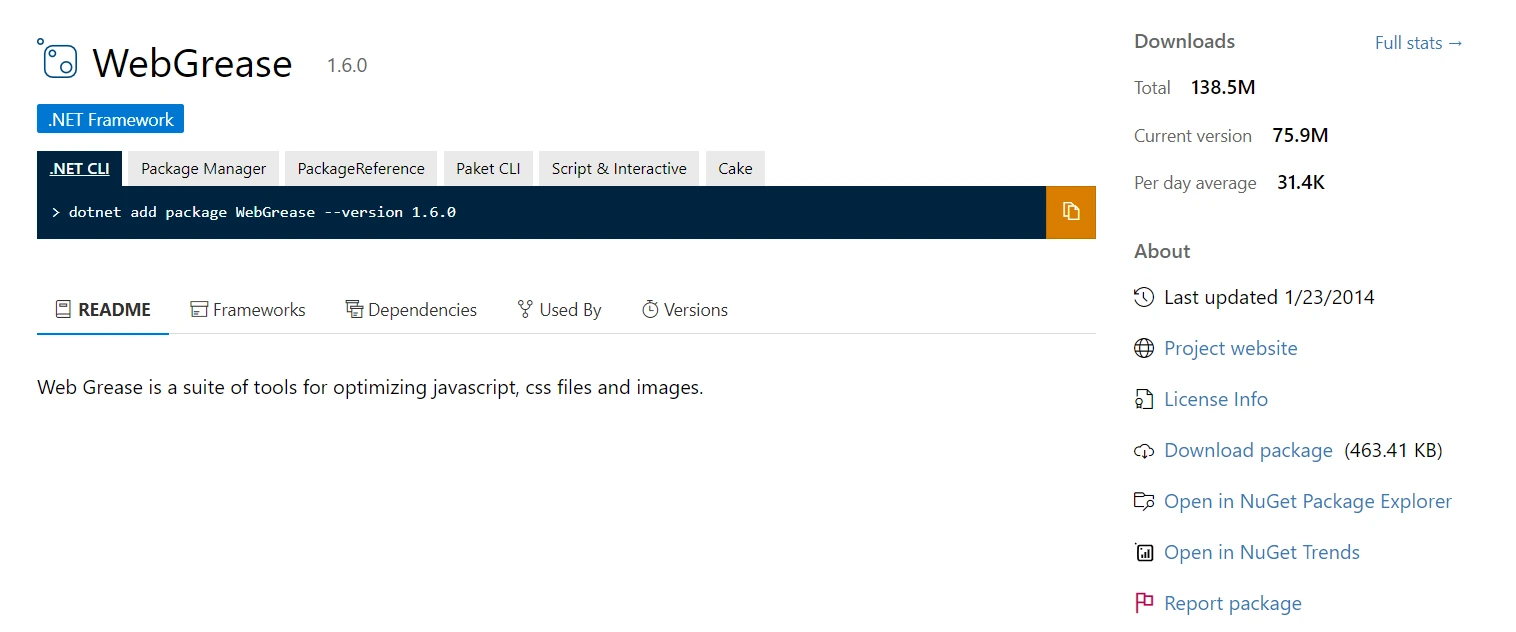
Im Kontext von .NET Core sprechen wir, wenn wir über WebGrease sprechen, von der Anwendung dieser Optimierungsmethoden auf .NET Core-Anwendungen. Microsoft hat das plattformübergreifende, quelloffene .NET Core-Framework erstellt, um Entwicklern die Erstellung fortschrittlicher, skalierbarer und leistungsfähiger Anwendungen zu ermöglichen. Entwickler können Performance-Optimierungstechniken von herkömmlichen ASP.NET-Anwendungen auf ihre .NET Core-Projekte anwenden, indem sie WebGrease integrieren. Auf diese Weise können Entwickler sicherstellen, dass ihre Webanwendungen effizient und leistungsfähig auf verschiedenen Plattformen wie Windows, Linux und macOS sind.
### Funktionen von WebGrease
Innerhalb des Rahmens von .NET Core bietet WebGrease eine Reihe von Funktionen, die auf die Verbesserung der Effizienz und Geschwindigkeit von Webanwendungen abzielen. Die herausragenden Merkmale sind wie folgt:
**CSS-Minimierung:**
- Entfernt überflüssige Formatierungen, Kommentare und Leerzeichen aus CSS-Dateien.
- Verringert HTTP-Anfragen, indem zahlreiche CSS-Dateien zu einer einzigen Datei kombiniert werden.
- Verbessert die Leistung und verkürzt die Ladezeiten von CSS.
**JavaScript-Komprimierung:**
- Minimiert JavaScript-Dateien durch Entfernen unnötiger Zeichen.
- Kombiniert mehrere JavaScript-Dateien zu einer.
- Reduziert die Größe von JavaScript-Dateien, um Download- und Ausführungszeiten zu beschleunigen.
**Bildoptimierung:**
- Komprimiert Bilder, ohne die Qualität signifikant zu vermindern.
- Konvertiert Bilder in effizientere Formate, wenn angemessen.
- Optimiert Bildressourcen, um die Ladegeschwindigkeit zu erhöhen.
**HTML-Minimierung:**
- Entfernt Leerzeichen und Kommentare aus HTML-Dateien.
- Vereinfacht HTML-Dateien für schnelleres Parsen und Rendern durch den Browser.
**Ressourcenbündelung:**
- Kombiniert mehrere JavaScript- und CSS-Dateien zu einer einzigen Datei.
- Reduziert die Anzahl der HTTP-Anfragen, die zum Laden einer Seite erforderlich sind, und verbessert die Ladezeiten.
**Configuration Flexibility:**
- Bietet Optionen zur Konfiguration des Optimierungsprozesses.
- Ermöglicht Entwicklern die Auswahl, welche Verzeichnisse und Dateien optimiert oder ausgeschlossen werden sollen.
**Plattformübergreifende Kompatibilität:**
- Vollständig kompatibel mit .NET Core, was die Nutzung auf Windows, Linux und macOS ermöglicht.
- Gewährleistet, dass Leistungsverbesserungen in verschiedenen Umgebungen gut funktionieren.
**Integration with Build Processes:**
- Kann in Build-Prozesse integriert werden, um Ressourcen während der Bereitstellung und Entwicklung automatisch zu optimieren.
- Unterstützt automatisierte Prozesse, um eine konsistente Optimierung über die Phasen der Entwicklung hinweg sicherzustellen.
**Verbesserte Leistung:**
- Minimiert die Ressourcen, die geladen werden müssen, wodurch die Gesamtleistung der Webanwendung verbessert wird.
- Verbessert die Benutzererfahrung und verkürzt die Seitenladezeiten.
### Erstellen und Konfigurieren von WebGrease
Um WebGrease in einer .NET Core-Anwendung zu verwenden, installieren Sie die erforderlichen Pakete, konfigurieren Sie den Build-Prozess und richten Sie Optimierungsaufgaben ein. Die folgenden Schritte helfen Ihnen bei der Einrichtung und Konfiguration von WebGrease in einer .NET Core-Anwendung:
### Erstellen Sie ein .NET Core Projekt
Erstellen Sie zuerst eine neue .NET Core-Webanwendung. Sie können hierfür das .NET CLI verwenden.
```bash
dotnet new web -n WebGreaseApp
cd WebGreaseApp
```
### Erforderliche Pakete hinzufügen
Obwohl es kein direktes .NET Core-Paket für WebGrease gibt, können Sie ähnliche Funktionen mit anderen Programmen wie BundlerMinifier erzielen. Fügen Sie dieses Paket zu Ihrem Projekt hinzu.
```bash
dotnet add package BundlerMinifier.Core
```
### Bündelung und Minifizierung konfigurieren
Erstellen Sie eine `bundleconfig.json`-Datei im Projektstammverzeichnis, um die Einstellungen zum Bündeln und Minimieren Ihrer CSS- und JavaScript-Dateien bereitzustellen. Hier ist ein Beispiel für eine Konfiguration.
```json
[
{
"outputFileName": "wwwroot/css/site.min.css",
"inputFiles": [
"wwwroot/css/site.css"
],
"minify": {
"enabled": true,
"renameLocals": true
}
},
{
"outputFileName": "wwwroot/js/site.min.js",
"inputFiles": [
"wwwroot/js/site.js"
],
"minify": {
"enabled": true
}
}
]
```
### Integration in den Build-Prozess
Fügen Sie Anweisungen hinzu, um die Bündelungs- und Minimierungsoperationen während des Build-Prozesses in Ihrer Projektdatei (.csproj) auszuführen.
Fügen Sie das folgende Element innerhalb des `<Project>`-Elements in Ihrer .csproj-Datei hinzu:
```xml
<Target Name="PrepublishScript" BeforeTargets="PrepareForPublish">
<Exec Command="dotnet bundle" />
</Target>
```
#### Installieren und Ausführen von BundlerMinifier
Um das Tool BundlerMinifier zu verwenden, müssen Sie das .NET-Dienstprogramm installieren. Führen Sie den folgenden Befehl aus:
```bash
dotnet tool install -g BundlerMinifier.Core
```
Um Ihre Dateien zu bündeln und zu minimieren, führen Sie Folgendes aus:
```bash
dotnet bundle
```
#### Bilder optimieren
Sie können ImageSharp oder andere bildoptimierungstools für .NET Core-kompatible Bildoptimierung verwenden.
#### ImageSharp installieren
Installieren Sie das SixLabors.ImageSharp-Paket:
```bash
dotnet add package SixLabors.ImageSharp
```
Hier ist ein Beispiel für einen Codeausschnitt zur Bildoptimierung:
```csharp
using SixLabors.ImageSharp;
using SixLabors.ImageSharp.Processing;
using System.IO;
public void OptimizeImage(string inputPath, string outputPath)
{
// Load the image
using (var image = Image.Load(inputPath))
{
// Resize and optimize the image
image.Mutate(x => x.Resize(new ResizeOptions
{
Mode = ResizeMode.Max,
Size = new Size(800, 600)
}));
// Save the image in an optimized format
image.Save(outputPath); // Automatic encoder selected based on file extension.
}
}
```
Führen Sie Ihre Anwendung aus, um sicherzustellen, dass Bündelung und Minimierung wie vorgesehen funktionieren. Öffnen Sie Ihre Anwendung im Browser und überprüfen Sie, dass die JavaScript- und CSS-Dateien minimiert sind.
Wenn Sie diesen Schritten folgen, können Sie eine WebGrease-ähnliche Optimierung für eine .NET Core-Anwendung einrichten und konfigurieren, indem Sie mit dem aktuellen .NET-Umfeld kompatible Tools verwenden.
## Einstieg mit IronPDF
Die Einrichtung der Leistungsoptimierung für Ihre Webressourcen und die Verwendung von IronPDF zur PDF-Erstellung und -manipulation sind beide notwendig, um eine WebGrease-ähnliche Optimierung mit IronPDF in einer .NET Core-Anwendung zu integrieren. So geht's Schritt für Schritt:
### Was ist IronPDF?
Die funktionsreiche .NET-Bibliothek [IronPDF](https://ironpdf.com) ermöglicht es C#-Programmen, PDF-Dokumente zu erstellen, zu lesen und zu bearbeiten. Mit diesem Programm können Entwickler HTML-, CSS- und JavaScript-Informationen mit Leichtigkeit in hochwertige, druckfertige PDFs umwandeln. Zu den wichtigsten Aufgaben gehören das Hinzufügen von Kopf- und Fußzeilen, das Teilen und Kombinieren von PDFs, das Hinzufügen von Wasserzeichen zu Dokumenten und die Umwandlung von HTML in PDF.
IronPDF ist für eine Vielzahl von Anwendungen nützlich, da es sowohl .NET Framework als auch .NET Core unterstützt. Da PDFs benutzerfreundlich sind und umfassende Inhalte enthalten, können Entwickler sie einfach in ihre Produkte einbinden. Da IronPDF komplexe Datenlayouts und Formatierungen verarbeiten kann, entsprechen die durch das Programm erzeugten PDFs als Ausgabe eng den ursprünglich von Kunden bereitgestellten HTML-Texten.
### Funktionen von IronPDF
**PDF-Erstellung aus HTML**
- Konvertiert JavaScript, HTML und CSS zu PDF.
- Unterstützt Medienabfragen und responsive Design, entspricht modernen Webstandards.
- Nützlich zur dynamischen Gestaltung von PDF-Dokumenten, Berichten und Rechnungen mittels HTML und CSS.
**PDF-Bearbeitung**
- Ermöglicht das Hinzufügen von Texten, Bildern und anderen Inhalten zu bestehenden PDFs.
- Extrahiert Texte und Bilder aus PDF-Dateien.
- Fusioniert mehrere PDFs zu einem.
- Teilt PDF-Dateien in separate Dokumente.
- Enthält Wasserzeichen, Anmerkungen, Kopf- und Fußzeilen.
**PDF-Konvertierung**
- Konvertiert eine Vielzahl von Dateiformaten zu PDF, darunter Word-, Excel- und Bilddateien.
- Ermöglicht die Konvertierung von PDF zu Bild (PNG, JPEG, etc.).
**Leistung und Zuverlässigkeit**
- Hohe Leistung und Zuverlässigkeit, geeignet für industrielle Anwendungen.
- Verarbeitet große Dokumentenmengen mühelos.
### IronPDF installieren
Um die Tools zu erhalten, die Sie benötigen, um mit PDFs in .NET-Projekten zu arbeiten, installieren Sie das IronPDF-Paket.
```bash
:InstallCmd dotnet add package IronPdf
```
#### Bündelung und Minifizierung konfigurieren
Stellen Sie sicher, dass die `bundleconfig.json`-Konfigurationsdatei vorhanden ist, um die Bündelungs- und Minimierungseinstellungen bei Bedarf erneut bereitzustellen:
```json
[
{
"outputFileName": "wwwroot/css/site.min.css",
"inputFiles": [
"wwwroot/css/site.css"
],
"minify": {
"enabled": true,
"renameLocals": true
}
},
{
"outputFileName": "wwwroot/js/site.min.js",
"inputFiles": [
"wwwroot/js/site.js"
],
"minify": {
"enabled": true
}
}
]
```
#### Verbinden Sie mit dem Bauprozess
Stellen Sie sicher, dass Ihre .csproj-Datei Anweisungen für die Ausführung der Minimierungs- und Bündelungsoperationen während des Build-Prozesses enthält. Fügen Sie das folgende Ziel innerhalb des `<Project>`-Elements hinzu:
```xml
<Target Name="PrepublishScript" BeforeTargets="PrepareForPublish">
<Exec Command="dotnet bundle" />
</Target>
```
#### Integrieren Sie IronPDF
Erstellen Sie einen Controller mit IronPDF, um PDFs zu erzeugen. Erstellen Sie einen neuen PdfController.
```csharp
using Microsoft.AspNetCore.Mvc;
using IronPdf;
namespace WebGreaseIronPdfApp.Controllers
{
public class PdfController : Controller
{
public IActionResult GeneratePdf()
{
// Create a PDF from a simple HTML string
var renderer = new ChromePdfRenderer();
var pdf = renderer.RenderHtmlAsPdf("<h1>Hello, IronPDF!</h1><p>This is a generated PDF document.</p>");
// Save the PDF to a byte array
var pdfBytes = pdf.BinaryData;
// Return the PDF file as a download
return File(pdfBytes, "application/pdf", "example.pdf");
}
}
}
```
Das erste, was wir im PdfController-Code machen, ist das Importieren der benötigten Namespaces, nämlich Microsoft.AspNetCore.Mvc für ASP.NET Core MVC-Funktionalität und IronPDF zur PDF-Erstellung. Da sie sich von Controller ableitet, handelt es sich bei der PdfController-Klasse um einen MVC-Controller. Die `GeneratePdf`-Methode in dieser Klasse ist definiert, um die Erstellung von PDFs zu verwalten.
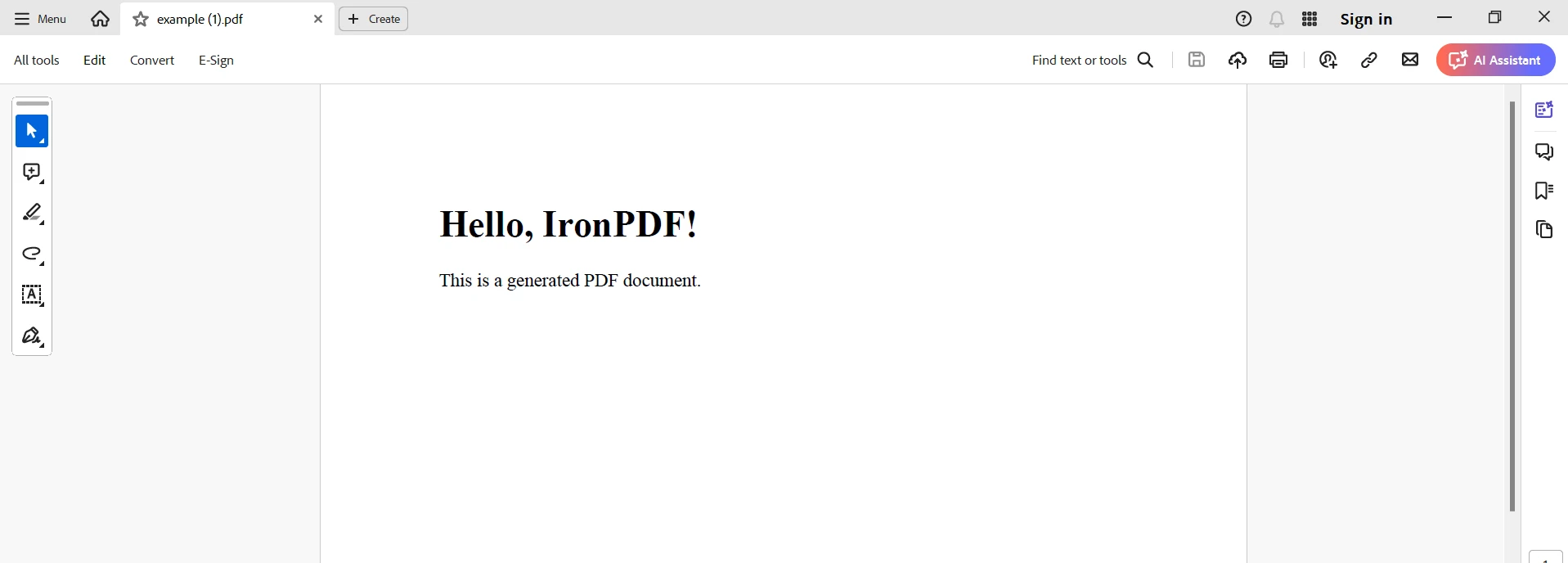
Um HTML-Material in ein PDF zu konvertieren, erstellt diese Funktion eine Instanz von IronPDF's `ChromePdfRenderer`. Ein einfacher HTML-String kann mit der `RenderHtmlAsPdf`-Funktion in ein PDF-Dokument umgewandelt werden. Das `BinaryData`-Attribut wird dann verwendet, um dieses PDF in einem Byte-Array zu speichern. Zuletzt wird die PDF-Datei als herunterladbare Antwort mit der `File`-Methode zurückgegeben, zusammen mit dem angeforderten Dateinamen (`example.pdf`) und dem korrekten MIME-Typ (`application/pdf`). Durch diese Integration kann das Programm nun dynamisch PDF-Dokumente basierend auf HTML-Inhalten erstellen und bereitstellen.
#### Leitfaden zur PDF-Erzeugung
Stellen Sie sicher, dass die PDF-Generierungs-Routing in Ihrer `Startup.cs`-Datei enthalten ist.
```csharp
public void Configure(IApplicationBuilder app, IWebHostEnvironment env)
{
if (env.IsDevelopment())
{
app.UseDeveloperExceptionPage();
}
else
{
app.UseExceptionHandler("/Home/Error");
app.UseHsts();
}
app.UseHttpsRedirection();
app.UseStaticFiles();
app.UseRouting();
app.UseAuthorization();
app.UseEndpoints(endpoints =>
{
endpoints.MapControllerRoute(
name: "default",
pattern: "{controller=Home}/{action=Index}/{id?}");
endpoints.MapControllerRoute(
name: "pdf",
pattern: "pdf",
defaults: new { controller = "Pdf", action = "GeneratePdf" });
});
}
```
#### Ausführen und Überprüfen
Führen Sie Ihre Anwendung aus, um sicherzustellen, dass Sie PDFs erstellen können und dass die Bündelung und Minimierung ordnungsgemäß funktionieren.
```bash
dotnet run
```
Öffnen Sie den Browser und navigieren Sie zu Ihrer Anwendung. Es sollte möglich sein, zu `/pdf` zu navigieren und ein PDF-Dokument herunterzuladen.
## Abschluss
Die Kombination aus IronPDF und WebGrease-ähnlicher Optimierung bietet eine potente Lösung zur Verbesserung der Online-Performance und zur Erstellung hochwertiger PDF-Dokumente in .NET Core-Anwendungen. Entwickler können sicherstellen, dass ihre Anwendungen effizient und flexibel sind, indem sie Tools wie IronPDF für die PDF-Erstellung und BundlerMinifier für die Ressourcenoptimierung verwenden. Neben der Bildkomprimierung tragen auch Ressourcenoptimierungsstrategien wie CSS- und JavaScript-Minimierung dazu bei, Seitenladezeiten zu verkürzen und die Benutzererfahrung zu verbessern. Gleichzeitig bietet IronPDF leistungsstarke Funktionen zur dynamischen Erstellung von PDFs aus HTML-Texten, was den Prozess der Erstellung gut vorbereiteter Dokumente wie Rechnungen, Berichte und mehr vereinfacht.
Diese Integration bietet eine vollständige Lösung für moderne Webentwicklungsbedürfnisse innerhalb des .NET Core-Frameworks, indem sie nicht nur die Online-Anwendungsleistung verbessert, sondern auch nützliche Funktionen zur Verarbeitung von PDFs hinzufügt.
Mit [IronPDF](licensing) und [Iron Software](https://ironsoftware.com/) können Sie Ihr Toolkit für die .NET-Entwicklung erweitern, indem Sie OCR, Barcode-Scannen, PDF-Erstellung, Excel-Konnektivität und vieles mehr nutzen. IronPDF bietet Entwicklern ab einem wettbewerbsfähigen Preis Zugang zu mehr Webanwendungen und Funktionen sowie eine effizientere Entwicklung, indem es seine Kernkonzepte mit dem äußerst flexiblen Iron Software-Werkzeugkasten kombiniert.
Die gut definierten Lizenzoptionen für das Projekt erleichtern es Entwicklern, das optimale Modell zu wählen, was zur prompten, gut organisierten und effizienten Umsetzung von Lösungen für eine Vielzahl von Problemen beiträgt.
Die Integration von WebGrease mit IronPDF und .NET Core bietet eine potente Methode zur Erstellung hochwertiger PDF-Dokumente und zur Optimierung der Leistung von Webanwendungen. Durch die Verwendung von JavaScript-Komprimierung, Bildoptimierung und CSS-Minimierung ist WebGrease ein funktionsreiches Paket, das Websites für Entwickler schneller und reibungsloser laufen lässt. Entwickler können mit IronPDF, einem leistungsstarken .NET-Toolkit zur Erstellung und Bearbeitung von PDF-Dokumenten, einfach dynamische PDFs aus verschiedenen Quellen erstellen, einschließlich HTML und MVC-Ansichten.
Mit dieser Integration bleiben Webanwendungen flüssig und anpassungsfähig, wodurch effektives Ressourcenmanagement und die dynamische Erstellung von PDFs ermöglicht werden. WebGrease und IronPDF sind vollständig kompatibel mit .NET Core, was Entwicklern ermöglicht, plattformübergreifende Anwendungen zu erstellen, die auf Linux, macOS und Windows einwandfrei funktionieren. Dies führt zu einer verbesserten Benutzererfahrung dank optimierter Leistung und einer überlegenen Dokumentenverarbeitung.
Was ist WebGrease?
Ursprünglich als Bestandteil des ASP.NET-Stacks entwickelt, ist WebGrease ein Tool zur Automatisierung von Prozessen wie der Optimierung von JavaScript, der Komprimierung, der Bildoptimierung und der CSS-Minimierung statischer Dateien, um die Webleistung zu verbessern. Diese Optimierungen tragen zur Reduzierung der Webressourcengröße bei, was die Leistung von Webanwendungen verbessert und die Ladezeiten verkürzt.
Im Kontext von .NET Core sprechen wir, wenn wir über WebGrease sprechen, von der Anwendung dieser Optimierungsmethoden auf .NET Core-Anwendungen. Microsoft hat das plattformübergreifende, quelloffene .NET Core-Framework erstellt, um Entwicklern die Erstellung fortschrittlicher, skalierbarer und leistungsfähiger Anwendungen zu ermöglichen. Entwickler können Performance-Optimierungstechniken von herkömmlichen ASP.NET-Anwendungen auf ihre .NET Core-Projekte anwenden, indem sie WebGrease integrieren. Auf diese Weise können Entwickler sicherstellen, dass ihre Webanwendungen effizient und leistungsfähig auf verschiedenen Plattformen wie Windows, Linux und macOS sind.
Funktionen von WebGrease
Innerhalb des Rahmens von .NET Core bietet WebGrease eine Reihe von Funktionen, die auf die Verbesserung der Effizienz und Geschwindigkeit von Webanwendungen abzielen. Die herausragenden Merkmale sind wie folgt:
CSS-Minimierung:
Entfernt überflüssige Formatierungen, Kommentare und Leerzeichen aus CSS-Dateien.
Verringert HTTP-Anfragen, indem zahlreiche CSS-Dateien zu einer einzigen Datei kombiniert werden.
Verbessert die Leistung und verkürzt die Ladezeiten von CSS.
JavaScript-Komprimierung:
Minimiert JavaScript-Dateien durch Entfernen unnötiger Zeichen.
Kombiniert mehrere JavaScript-Dateien zu einer.
Reduziert die Größe von JavaScript-Dateien, um Download- und Ausführungszeiten zu beschleunigen.
Bildoptimierung:
Komprimiert Bilder, ohne die Qualität signifikant zu vermindern.
Konvertiert Bilder in effizientere Formate, wenn angemessen.
Optimiert Bildressourcen, um die Ladegeschwindigkeit zu erhöhen.
HTML-Minimierung:
Entfernt Leerzeichen und Kommentare aus HTML-Dateien.
Vereinfacht HTML-Dateien für schnelleres Parsen und Rendern durch den Browser.
Ressourcenbündelung:
Kombiniert mehrere JavaScript- und CSS-Dateien zu einer einzigen Datei.
Reduziert die Anzahl der HTTP-Anfragen, die zum Laden einer Seite erforderlich sind, und verbessert die Ladezeiten.
Configuration Flexibility:
Bietet Optionen zur Konfiguration des Optimierungsprozesses.
Ermöglicht Entwicklern die Auswahl, welche Verzeichnisse und Dateien optimiert oder ausgeschlossen werden sollen.
Plattformübergreifende Kompatibilität:
Vollständig kompatibel mit .NET Core, was die Nutzung auf Windows, Linux und macOS ermöglicht.
Gewährleistet, dass Leistungsverbesserungen in verschiedenen Umgebungen gut funktionieren.
Integration with Build Processes:
Kann in Build-Prozesse integriert werden, um Ressourcen während der Bereitstellung und Entwicklung automatisch zu optimieren.
Unterstützt automatisierte Prozesse, um eine konsistente Optimierung über die Phasen der Entwicklung hinweg sicherzustellen.
Verbesserte Leistung:
Minimiert die Ressourcen, die geladen werden müssen, wodurch die Gesamtleistung der Webanwendung verbessert wird.
Verbessert die Benutzererfahrung und verkürzt die Seitenladezeiten.
Erstellen und Konfigurieren von WebGrease
Um WebGrease in einer .NET Core-Anwendung zu verwenden, installieren Sie die erforderlichen Pakete, konfigurieren Sie den Build-Prozess und richten Sie Optimierungsaufgaben ein. Die folgenden Schritte helfen Ihnen bei der Einrichtung und Konfiguration von WebGrease in einer .NET Core-Anwendung:
Erstellen Sie ein .NET Core Projekt
Erstellen Sie zuerst eine neue .NET Core-Webanwendung. Sie können hierfür das .NET CLI verwenden.
dotnet new web -n WebGreaseAppcd WebGreaseApp
dotnet new web -n WebGreaseApp
cd WebGreaseApp
SHELL
Erforderliche Pakete hinzufügen
Obwohl es kein direktes .NET Core-Paket für WebGrease gibt, können Sie ähnliche Funktionen mit anderen Programmen wie BundlerMinifier erzielen. Fügen Sie dieses Paket zu Ihrem Projekt hinzu.
dotnet add package BundlerMinifier.Core
dotnet add package BundlerMinifier.Core
SHELL
Bündelung und Minifizierung konfigurieren
Erstellen Sie eine bundleconfig.json-Datei im Projektstammverzeichnis, um die Einstellungen zum Bündeln und Minimieren Ihrer CSS- und JavaScript-Dateien bereitzustellen. Hier ist ein Beispiel für eine Konfiguration.
Um das Tool BundlerMinifier zu verwenden, müssen Sie das .NET-Dienstprogramm installieren. Führen Sie den folgenden Befehl aus:
dotnet tool install -g BundlerMinifier.Core
dotnet tool install -g BundlerMinifier.Core
SHELL
Um Ihre Dateien zu bündeln und zu minimieren, führen Sie Folgendes aus:
dotnet bundle
dotnet bundle
SHELL
Bilder optimieren
Sie können ImageSharp oder andere bildoptimierungstools für .NET Core-kompatible Bildoptimierung verwenden.
ImageSharp installieren
Installieren Sie das SixLabors.ImageSharp-Paket:
dotnet add package SixLabors.ImageSharp
dotnet add package SixLabors.ImageSharp
SHELL
Hier ist ein Beispiel für einen Codeausschnitt zur Bildoptimierung:
using SixLabors.ImageSharp;using SixLabors.ImageSharp.Processing;using System.IO;public voidOptimizeImage(string inputPath, string outputPath){ // Load the image using (var image = Image.Load(inputPath)) { // Resize and optimize the image image.Mutate(x => x.Resize(new ResizeOptions {Mode = ResizeMode.Max,Size = new Size(800, 600) })); // Save the image in an optimized format image.Save(outputPath); // Automatic encoder selected based on file extension. }}
using SixLabors.ImageSharp;
using SixLabors.ImageSharp.Processing;
using System.IO;

public void OptimizeImage(string inputPath, string outputPath)
{
    // Load the image
    using (var image = Image.Load(inputPath))
    {
        // Resize and optimize the image
        image.Mutate(x => x.Resize(new ResizeOptions
        {
            Mode = ResizeMode.Max,
            Size = new Size(800, 600)
        }));
        // Save the image in an optimized format
        image.Save(outputPath); // Automatic encoder selected based on file extension.
    }
}
ImportsSixLabors.ImageSharpImportsSixLabors.ImageSharp.ProcessingImportsSystem.IOPublic Sub OptimizeImage(ByVal inputPath AsString, ByVal outputPath AsString) ' Load the imageUsing image = System.Drawing.Image.Load(inputPath) ' Resize and optimize the image image.Mutate(Function(x) x.Resize(New ResizeOptionsWith { .Mode = ResizeMode.Max, .Size = New Size(800, 600) })) ' Save the image in an optimized format image.Save(outputPath) ' Automatic encoder selected based on file extension.EndUsingEnd Sub
Imports SixLabors.ImageSharp
Imports SixLabors.ImageSharp.Processing
Imports System.IO

Public Sub OptimizeImage(ByVal inputPath As String, ByVal outputPath As String)
	' Load the image
	Using image = System.Drawing.Image.Load(inputPath)
		' Resize and optimize the image
		image.Mutate(Function(x) x.Resize(New ResizeOptions With {
			.Mode = ResizeMode.Max,
			.Size = New Size(800, 600)
		}))
		' Save the image in an optimized format
		image.Save(outputPath) ' Automatic encoder selected based on file extension.
	End Using
End Sub
Führen Sie Ihre Anwendung aus, um sicherzustellen, dass Bündelung und Minimierung wie vorgesehen funktionieren. Öffnen Sie Ihre Anwendung im Browser und überprüfen Sie, dass die JavaScript- und CSS-Dateien minimiert sind.
Wenn Sie diesen Schritten folgen, können Sie eine WebGrease-ähnliche Optimierung für eine .NET Core-Anwendung einrichten und konfigurieren, indem Sie mit dem aktuellen .NET-Umfeld kompatible Tools verwenden.
Einstieg mit IronPDF
Die Einrichtung der Leistungsoptimierung für Ihre Webressourcen und die Verwendung von IronPDF zur PDF-Erstellung und -manipulation sind beide notwendig, um eine WebGrease-ähnliche Optimierung mit IronPDF in einer .NET Core-Anwendung zu integrieren. So geht's Schritt für Schritt:
Was ist IronPDF?
Die funktionsreiche .NET-Bibliothek IronPDF ermöglicht es C#-Programmen, PDF-Dokumente zu erstellen, zu lesen und zu bearbeiten. Mit diesem Programm können Entwickler HTML-, CSS- und JavaScript-Informationen mit Leichtigkeit in hochwertige, druckfertige PDFs umwandeln. Zu den wichtigsten Aufgaben gehören das Hinzufügen von Kopf- und Fußzeilen, das Teilen und Kombinieren von PDFs, das Hinzufügen von Wasserzeichen zu Dokumenten und die Umwandlung von HTML in PDF.
IronPDF ist für eine Vielzahl von Anwendungen nützlich, da es sowohl .NET Framework als auch .NET Core unterstützt. Da PDFs benutzerfreundlich sind und umfassende Inhalte enthalten, können Entwickler sie einfach in ihre Produkte einbinden. Da IronPDF komplexe Datenlayouts und Formatierungen verarbeiten kann, entsprechen die durch das Programm erzeugten PDFs als Ausgabe eng den ursprünglich von Kunden bereitgestellten HTML-Texten.
Funktionen von IronPDF
PDF-Erstellung aus HTML
Konvertiert JavaScript, HTML und CSS zu PDF.
Unterstützt Medienabfragen und responsive Design, entspricht modernen Webstandards.
Nützlich zur dynamischen Gestaltung von PDF-Dokumenten, Berichten und Rechnungen mittels HTML und CSS.
PDF-Bearbeitung
Ermöglicht das Hinzufügen von Texten, Bildern und anderen Inhalten zu bestehenden PDFs.
Extrahiert Texte und Bilder aus PDF-Dateien.
Fusioniert mehrere PDFs zu einem.
Teilt PDF-Dateien in separate Dokumente.
Enthält Wasserzeichen, Anmerkungen, Kopf- und Fußzeilen.
PDF-Konvertierung
Konvertiert eine Vielzahl von Dateiformaten zu PDF, darunter Word-, Excel- und Bilddateien.
Ermöglicht die Konvertierung von PDF zu Bild (PNG, JPEG, etc.).
Leistung und Zuverlässigkeit
Hohe Leistung und Zuverlässigkeit, geeignet für industrielle Anwendungen.
Verarbeitet große Dokumentenmengen mühelos.
IronPDF installieren
Um die Tools zu erhalten, die Sie benötigen, um mit PDFs in .NET-Projekten zu arbeiten, installieren Sie das IronPDF-Paket.
> dotnet add package IronPdf
dotnet add package IronPdf
Bündelung und Minifizierung konfigurieren
Stellen Sie sicher, dass die bundleconfig.json-Konfigurationsdatei vorhanden ist, um die Bündelungs- und Minimierungseinstellungen bei Bedarf erneut bereitzustellen:
Stellen Sie sicher, dass Ihre .csproj-Datei Anweisungen für die Ausführung der Minimierungs- und Bündelungsoperationen während des Build-Prozesses enthält. Fügen Sie das folgende Ziel innerhalb des <Project>-Elements hinzu:
Erstellen Sie einen Controller mit IronPDF, um PDFs zu erzeugen. Erstellen Sie einen neuen PdfController.
using Microsoft.AspNetCore.Mvc;using IronPdf;namespace WebGreaseIronPdfApp.Controllers{ public class PdfController : Controller { public IActionResultGeneratePdf() { // Create a PDF from a simple HTML string var renderer = new ChromePdfRenderer(); var pdf = renderer.RenderHtmlAsPdf("<h1>Hello, IronPDF!</h1><p>This is a generated PDF document.</p>"); // Save the PDF to a byte array var pdfBytes = pdf.BinaryData; // Return the PDF file as a download returnFile(pdfBytes, "application/pdf", "example.pdf"); } }}
using Microsoft.AspNetCore.Mvc;
using IronPdf;

namespace WebGreaseIronPdfApp.Controllers
{
    public class PdfController : Controller
    {
        public IActionResult GeneratePdf()
        {
            // Create a PDF from a simple HTML string
            var renderer = new ChromePdfRenderer();
            var pdf = renderer.RenderHtmlAsPdf("<h1>Hello, IronPDF!</h1><p>This is a generated PDF document.</p>");

            // Save the PDF to a byte array
            var pdfBytes = pdf.BinaryData;

            // Return the PDF file as a download
            return File(pdfBytes, "application/pdf", "example.pdf");
        }
    }
}
ImportsMicrosoft.AspNetCore.MvcImportsIronPdfNamespaceWebGreaseIronPdfApp.Controllers Public Class PdfControllerInheritsController Public Function GeneratePdf() AsIActionResult ' Create a PDF from a simple HTML string Dim renderer = New ChromePdfRenderer() Dim pdf = renderer.RenderHtmlAsPdf("<h1>Hello, IronPDF!</h1><p>This is a generated PDF document.</p>") ' Save the PDF to a byte array Dim pdfBytes = pdf.BinaryData ' Return the PDF file as a download ReturnFile(pdfBytes, "application/pdf", "example.pdf") End Function End ClassEndNamespace
Imports Microsoft.AspNetCore.Mvc
Imports IronPdf

Namespace WebGreaseIronPdfApp.Controllers
    Public Class PdfController
        Inherits Controller

        Public Function GeneratePdf() As IActionResult
            ' Create a PDF from a simple HTML string
            Dim renderer = New ChromePdfRenderer()
            Dim pdf = renderer.RenderHtmlAsPdf("<h1>Hello, IronPDF!</h1><p>This is a generated PDF document.</p>")

            ' Save the PDF to a byte array
            Dim pdfBytes = pdf.BinaryData

            ' Return the PDF file as a download
            Return File(pdfBytes, "application/pdf", "example.pdf")
        End Function
    End Class
End Namespace
Das erste, was wir im PdfController-Code machen, ist das Importieren der benötigten Namespaces, nämlich Microsoft.AspNetCore.Mvc für ASP.NET Core MVC-Funktionalität und IronPDF zur PDF-Erstellung. Da sie sich von Controller ableitet, handelt es sich bei der PdfController-Klasse um einen MVC-Controller. Die GeneratePdf-Methode in dieser Klasse ist definiert, um die Erstellung von PDFs zu verwalten.
Um HTML-Material in ein PDF zu konvertieren, erstellt diese Funktion eine Instanz von IronPDF's ChromePdfRenderer. Ein einfacher HTML-String kann mit der RenderHtmlAsPdf-Funktion in ein PDF-Dokument umgewandelt werden. Das BinaryData-Attribut wird dann verwendet, um dieses PDF in einem Byte-Array zu speichern. Zuletzt wird die PDF-Datei als herunterladbare Antwort mit der File-Methode zurückgegeben, zusammen mit dem angeforderten Dateinamen (example.pdf) und dem korrekten MIME-Typ (application/pdf). Durch diese Integration kann das Programm nun dynamisch PDF-Dokumente basierend auf HTML-Inhalten erstellen und bereitstellen.
Leitfaden zur PDF-Erzeugung
Stellen Sie sicher, dass die PDF-Generierungs-Routing in Ihrer Startup.cs-Datei enthalten ist.
Public Sub Configure(app AsIApplicationBuilder, env AsIWebHostEnvironment) If env.IsDevelopment() Then app.UseDeveloperExceptionPage() Else app.UseExceptionHandler("/Home/Error") app.UseHsts() End If app.UseHttpsRedirection() app.UseStaticFiles() app.UseRouting() app.UseAuthorization() app.UseEndpoints(Sub(endpoints) endpoints.MapControllerRoute( name: "default", pattern: "{controller=Home}/{action=Index}/{id?}") endpoints.MapControllerRoute( name: "pdf", pattern: "pdf", defaults:=New With {.controller = "Pdf", .action = "GeneratePdf"}) End Sub)End Sub
Public Sub Configure(app As IApplicationBuilder, env As IWebHostEnvironment)
    If env.IsDevelopment() Then
        app.UseDeveloperExceptionPage()
    Else
        app.UseExceptionHandler("/Home/Error")
        app.UseHsts()
    End If
    app.UseHttpsRedirection()
    app.UseStaticFiles()
    app.UseRouting()
    app.UseAuthorization()
    app.UseEndpoints(Sub(endpoints)
        endpoints.MapControllerRoute(
            name: "default",
            pattern: "{controller=Home}/{action=Index}/{id?}")
        endpoints.MapControllerRoute(
            name: "pdf",
            pattern: "pdf",
            defaults:=New With {.controller = "Pdf", .action = "GeneratePdf"})
    End Sub)
End Sub
Ausführen und Überprüfen
Führen Sie Ihre Anwendung aus, um sicherzustellen, dass Sie PDFs erstellen können und dass die Bündelung und Minimierung ordnungsgemäß funktionieren.
dotnet run
dotnet run
SHELL
Öffnen Sie den Browser und navigieren Sie zu Ihrer Anwendung. Es sollte möglich sein, zu /pdf zu navigieren und ein PDF-Dokument herunterzuladen.
Abschluss
Die Kombination aus IronPDF und WebGrease-ähnlicher Optimierung bietet eine potente Lösung zur Verbesserung der Online-Performance und zur Erstellung hochwertiger PDF-Dokumente in .NET Core-Anwendungen. Entwickler können sicherstellen, dass ihre Anwendungen effizient und flexibel sind, indem sie Tools wie IronPDF für die PDF-Erstellung und BundlerMinifier für die Ressourcenoptimierung verwenden. Neben der Bildkomprimierung tragen auch Ressourcenoptimierungsstrategien wie CSS- und JavaScript-Minimierung dazu bei, Seitenladezeiten zu verkürzen und die Benutzererfahrung zu verbessern. Gleichzeitig bietet IronPDF leistungsstarke Funktionen zur dynamischen Erstellung von PDFs aus HTML-Texten, was den Prozess der Erstellung gut vorbereiteter Dokumente wie Rechnungen, Berichte und mehr vereinfacht.
Diese Integration bietet eine vollständige Lösung für moderne Webentwicklungsbedürfnisse innerhalb des .NET Core-Frameworks, indem sie nicht nur die Online-Anwendungsleistung verbessert, sondern auch nützliche Funktionen zur Verarbeitung von PDFs hinzufügt.
Mit IronPDF und Iron Software können Sie Ihr Toolkit für die .NET-Entwicklung erweitern, indem Sie OCR, Barcode-Scannen, PDF-Erstellung, Excel-Konnektivität und vieles mehr nutzen. IronPDF bietet Entwicklern ab einem wettbewerbsfähigen Preis Zugang zu mehr Webanwendungen und Funktionen sowie eine effizientere Entwicklung, indem es seine Kernkonzepte mit dem äußerst flexiblen Iron Software-Werkzeugkasten kombiniert.
Die gut definierten Lizenzoptionen für das Projekt erleichtern es Entwicklern, das optimale Modell zu wählen, was zur prompten, gut organisierten und effizienten Umsetzung von Lösungen für eine Vielzahl von Problemen beiträgt.
Jacob Mellor ist Chief Technology Officer bei Iron Software und ein visionärer Ingenieur, der Pionierarbeit in der C# PDF-Technologie leistet. Als der ursprüngliche Entwickler hinter der Kern-Codebasis von Iron Software hat er die Produktarchitektur des Unternehmens seit seiner Gründung geprägt und es zusammen mit CEO Cameron Rimington in ein Unternehmen mit mehr als 50 Mitarbeitern verwandelt, das die NASA, Tesla und globale Regierungsbehörden beliefert.