Introducción a CQRS
CQRS significa Segregación de Responsabilidad de Comandos y Consultas. Es un patrón que se enfoca en separar la lectura de datos de su escritura. Esta distinción es crucial por varias razones. Primero, permite una optimización más flexible de cada operación, mejorando el rendimiento y la escalabilidad de la aplicación. Cuando separas los comandos (escrituras) y las consultas (lecturas), puedes optimizarlos de forma independiente.
Por ejemplo, una aplicación compleja puede requerir operaciones de lectura rápidas pero puede tolerar operaciones de escritura más lentas. Al aplicar CQRS, los desarrolladores pueden usar diferentes modelos de datos para las lecturas y escrituras, segregando la capa de acceso a datos para adaptarse a las necesidades específicas de cada operación. En este artículo, exploraremos los conceptos del patrón CQRS y la biblioteca *IronPDF para desarrolladores de .NET.
Conceptos básicos y componentes
El corazón de CQRS radica en separar las operaciones de comandos y consultas, cada una manejando diferentes aspectos de la interacción con los datos. Entender estos componentes es crucial para implementar el patrón de manera efectiva.
-
Comandos: Son los encargados de actualizar los datos. Los comandos encarnan lógica de negocio compleja y pueden cambiar el estado de los datos en el almacenamiento al actuar sin devolver ninguna información. Los comandos tienen el papel exclusivo de manejar las tareas de escritura de datos, influyendo directamente en el estado de la aplicación sin producir ninguna salida. Por ejemplo, agregar un nuevo usuario o actualizar los detalles de un producto existente son acciones realizadas por comandos.
-
Consultas: Las consultas, administradas por un controlador de consultas, recuperan datos u objetos de transferencia de datos sin cambiar el estado del sistema. Son las preguntas que haces sobre tus datos. Por ejemplo, obtener el perfil de un usuario o listar todos los productos disponibles en un inventario son consultas. Las consultas devuelven datos pero aseguran que no modifican los datos ni su estado.
Una de las herramientas populares para implementar CQRS en aplicaciones .NET es MediatR, una biblioteca de patrones mediadores. Ayuda a reducir el acoplamiento entre los componentes de una aplicación, permitiendo que se comuniquen de manera indirecta. MediatR facilita el manejo de comandos y consultas al mediar entre el comando/consulta y su manejador.
Implementación práctica con ASP.NET Core
Implementar el patrón CQRS en ASP.NET Core implica configurar tu proyecto para separar comandos y consultas, usando una biblioteca como MediatR para mediar entre ellos. Aquí hay una descripción simplificada de cómo puedes configurar CQRS en tu aplicación ASP.NET Core.
-
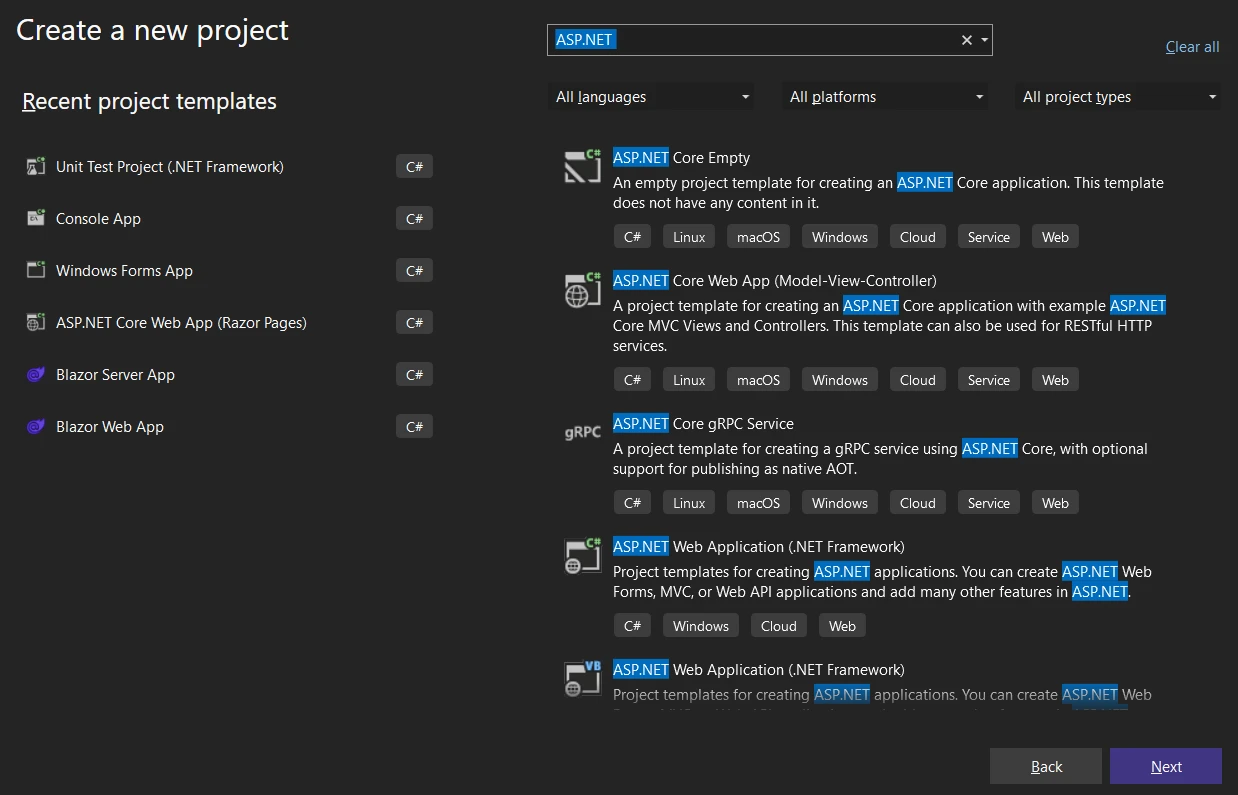
Inicia Visual Studio y elige crear un nuevo proyecto.
-
Busca y selecciona un tipo de proyecto 'Aplicación Web ASP.NET Core'. Haz clic en Siguiente.
-
Dale un nombre a tu proyecto y establece su ubicación. Haga clic en Crear.
-
Elige la plantilla 'Aplicación Web (Modelo-Vista-Controlador)' para ASP.NET Core. Asegúrate de que estás apuntando a la versión de .NET Core que se adapta a tus requisitos. Haga clic en Crear.
Paso 2
A continuación, querrás organizar tu proyecto para CQRS. Puedes hacerlo agregando carpetas para separar comandos, consultas y las interfaces comunes que usarán. En el Explorador de Soluciones, haz clic derecho en tu proyecto, ve a 'Agregar', luego 'Nueva Carpeta'. Crea tres carpetas: 'Comandos', 'Consultas' e 'Interfaces'.
En la carpeta 'Interfaces', agrega interfaces para tus comandos y consultas. Para un comando, podrías tener una interfaz ICommandHandler con un método Handle que toma un comando y realiza la acción. Para una consulta, podrías tener una interfaz IQueryHandler con un método Handle que toma una consulta y devuelve datos.
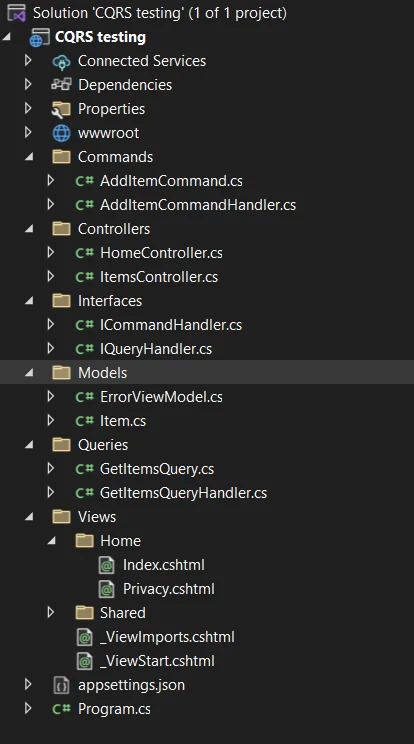
Paso 3
Ahora, vamos a agregar un comando y una consulta para demostrar. Supongamos que tu aplicación gestiona tareas, y quieres agregar una tarea (comando) y recuperar tareas (consulta).
En la carpeta 'Interfaces', agrega dos interfaces:
// Define interfaces for your handlers:
public interface ICommandHandler<TCommand>
{
    void Handle(TCommand command);
}

public interface IQueryHandler<TQuery, TResult>
{
    TResult Handle(TQuery query);
}
// Define interfaces for your handlers:
public interface ICommandHandler<TCommand>
{
    void Handle(TCommand command);
}

public interface IQueryHandler<TQuery, TResult>
{
    TResult Handle(TQuery query);
}
' Define interfaces for your handlers:
Public Interface ICommandHandler(Of TCommand)
Sub Handle(ByVal command As TCommand)
End Interface
Public Interface IQueryHandler(Of TQuery, TResult)
Function Handle(ByVal query As TQuery) As TResult
End Interface
' Define interfaces for your handlers:
Public Interface ICommandHandler(Of TCommand)
	Sub Handle(ByVal command As TCommand)
End Interface

Public Interface IQueryHandler(Of TQuery, TResult)
	Function Handle(ByVal query As TQuery) As TResult
End Interface
En la carpeta 'Comandos', agrega una clase AddItemCommand con propiedades para los detalles de la tarea. Además, agrega una clase AddItemCommandHandler que implemente ICommandHandler y contenga la lógica para agregar una tarea a la base de datos.
En la carpeta 'Consultas', agrega una clase GetTasksQuery que representa una solicitud de tareas. Agrega otra clase GetTasksQueryHandler que implemente IQueryHandler y contenga la lógica para recuperar tareas de la base de datos.
Para un ejemplo simple, tu AddItemCommand podría verse así:
public class AddItemCommand
{
    public string Name { get; set; }
    public int Quantity { get; set; }

    // Constructor
    public AddItemCommand(string name, int quantity)
    {
        Name = name;
        Quantity = quantity;
    }
}
public class AddItemCommand
{
    public string Name { get; set; }
    public int Quantity { get; set; }

    // Constructor
    public AddItemCommand(string name, int quantity)
    {
        Name = name;
        Quantity = quantity;
    }
}
Public Class AddItemCommand
Public Property Name() As String
Public Property Quantity() As Integer
' Constructor
Public Sub New(ByVal name As String, ByVal quantity As Integer)
Me.Name = name
Me.Quantity = quantity
End Sub
End Class
Public Class AddItemCommand
	Public Property Name() As String
	Public Property Quantity() As Integer

	' Constructor
	Public Sub New(ByVal name As String, ByVal quantity As Integer)
		Me.Name = name
		Me.Quantity = quantity
	End Sub
End Class
Y el AddItemCommandHandler:
public class AddItemCommandHandler : ICommandHandler<AddItemCommand>
{
    public void Handle(AddItemCommand command)
    {
        // Here, you'd add the item to your database, for example, to have employee data stored
        Console.WriteLine($"Adding item: {command.Name} with quantity {command.Quantity}");
        // Add database logic here
    }
}
public class AddItemCommandHandler : ICommandHandler<AddItemCommand>
{
    public void Handle(AddItemCommand command)
    {
        // Here, you'd add the item to your database, for example, to have employee data stored
        Console.WriteLine($"Adding item: {command.Name} with quantity {command.Quantity}");
        // Add database logic here
    }
}
Public Class AddItemCommandHandler
Implements ICommandHandler(Of AddItemCommand)
Public Sub Handle(ByVal command As AddItemCommand)
' Here, you'd add the item to your database, for example, to have employee data stored
Console.WriteLine($"Adding item: {command.Name} with quantity {command.Quantity}")
' Add database logic here
End Sub
End Class
Public Class AddItemCommandHandler
	Implements ICommandHandler(Of AddItemCommand)

	Public Sub Handle(ByVal command As AddItemCommand)
		' Here, you'd add the item to your database, for example, to have employee data stored
		Console.WriteLine($"Adding item: {command.Name} with quantity {command.Quantity}")
		' Add database logic here
	End Sub
End Class
Tu GetItemsQuery podría estar vacío si no necesita ningún parámetro para obtener tareas, y GetItemsQueryHandler podría verse como:
public class GetItemsQuery
{
    // This class might not need any properties, depending on your query
}

namespace CQRS_testing.Queries
{
    using CQRS_testing.Interfaces;

    public class GetItemsQueryHandler : IQueryHandler<GetItemsQuery, IEnumerable<string>>
    {
        public IEnumerable<string> Handle(GetItemsQuery query)
        {
            // Here, you'd fetch items from your database
            return new List<string> { "Item1", "Item2" };
        }
    }
}
public class GetItemsQuery
{
    // This class might not need any properties, depending on your query
}

namespace CQRS_testing.Queries
{
    using CQRS_testing.Interfaces;

    public class GetItemsQueryHandler : IQueryHandler<GetItemsQuery, IEnumerable<string>>
    {
        public IEnumerable<string> Handle(GetItemsQuery query)
        {
            // Here, you'd fetch items from your database
            return new List<string> { "Item1", "Item2" };
        }
    }
}
Imports CQRS_testing.Interfaces
Public Class GetItemsQuery
' This class might not need any properties, depending on your query
End Class
Namespace CQRS_testing.Queries
Public Class GetItemsQueryHandler
Implements IQueryHandler(Of GetItemsQuery, IEnumerable(Of String))
Public Function Handle(ByVal query As GetItemsQuery) As IEnumerable(Of String)
' Here, you'd fetch items from your database
Return New List(Of String) From {"Item1", "Item2"}
End Function
End Class
End Namespace
Imports CQRS_testing.Interfaces

Public Class GetItemsQuery
	' This class might not need any properties, depending on your query
End Class

Namespace CQRS_testing.Queries

	Public Class GetItemsQueryHandler
		Implements IQueryHandler(Of GetItemsQuery, IEnumerable(Of String))

		Public Function Handle(ByVal query As GetItemsQuery) As IEnumerable(Of String)
			' Here, you'd fetch items from your database
			Return New List(Of String) From {"Item1", "Item2"}
		End Function
	End Class
End Namespace
En tus controladores ASP.NET, usarás estos manejadores para procesar comandos y consultas. Para agregar una tarea, la acción del controlador crearía un AddTaskCommand, establecería sus propiedades desde el formulario de datos, y luego lo pasaría a una instancia de AddTaskCommandHandler para manejarlo. Para recuperar tareas, llamaría a un GetTasksQueryHandler para obtener los datos y pasarlos a la vista.
Cableado en un controlador
Con tus comandos y consultas configurados, ahora puedes usarlos en tus controladores. Así es como podrías hacer eso en una clase ItemsController:
public class ItemsController : Controller
{
    private readonly ICommandHandler<AddItemCommand> _addItemHandler;
    private readonly IQueryHandler<GetItemsQuery, IEnumerable<string>> _getItemsHandler;

    // Constructor injection is correctly utilized here
    public ItemsController(ICommandHandler<AddItemCommand> addItemHandler, IQueryHandler<GetItemsQuery, IEnumerable<string>> getItemsHandler)
    {
        _addItemHandler = addItemHandler;
        _getItemsHandler = getItemsHandler;
    }

    public IActionResult Index()
    {
        // Use the injected _getItemsHandler instead of creating a new instance
        var query = new GetItemsQuery();
        var items = _getItemsHandler.Handle(query);
        return View(items);
    }

    [HttpPost]
    public IActionResult Add(string name, int quantity)
    {
        // Use the injected _addItemHandler instead of creating a new instance
        var command = new AddItemCommand(name, quantity);
        _addItemHandler.Handle(command);
        return RedirectToAction("Index");
    }
}
public class ItemsController : Controller
{
    private readonly ICommandHandler<AddItemCommand> _addItemHandler;
    private readonly IQueryHandler<GetItemsQuery, IEnumerable<string>> _getItemsHandler;

    // Constructor injection is correctly utilized here
    public ItemsController(ICommandHandler<AddItemCommand> addItemHandler, IQueryHandler<GetItemsQuery, IEnumerable<string>> getItemsHandler)
    {
        _addItemHandler = addItemHandler;
        _getItemsHandler = getItemsHandler;
    }

    public IActionResult Index()
    {
        // Use the injected _getItemsHandler instead of creating a new instance
        var query = new GetItemsQuery();
        var items = _getItemsHandler.Handle(query);
        return View(items);
    }

    [HttpPost]
    public IActionResult Add(string name, int quantity)
    {
        // Use the injected _addItemHandler instead of creating a new instance
        var command = new AddItemCommand(name, quantity);
        _addItemHandler.Handle(command);
        return RedirectToAction("Index");
    }
}
Public Class ItemsController
Inherits Controller
Private ReadOnly _addItemHandler As ICommandHandler(Of AddItemCommand)
Private ReadOnly _getItemsHandler As IQueryHandler(Of GetItemsQuery, IEnumerable(Of String))
' Constructor injection is correctly utilized here
Public Sub New(ByVal addItemHandler As ICommandHandler(Of AddItemCommand), ByVal getItemsHandler As IQueryHandler(Of GetItemsQuery, IEnumerable(Of String)))
_addItemHandler = addItemHandler
_getItemsHandler = getItemsHandler
End Sub
Public Function Index() As IActionResult
' Use the injected _getItemsHandler instead of creating a new instance
Dim query = New GetItemsQuery()
Dim items = _getItemsHandler.Handle(query)
Return View(items)
End Function
<HttpPost>
Public Function Add(ByVal name As String, ByVal quantity As Integer) As IActionResult
' Use the injected _addItemHandler instead of creating a new instance
Dim command = New AddItemCommand(name, quantity)
_addItemHandler.Handle(command)
Return RedirectToAction("Index")
End Function
End Class
Public Class ItemsController
	Inherits Controller

	Private ReadOnly _addItemHandler As ICommandHandler(Of AddItemCommand)
	Private ReadOnly _getItemsHandler As IQueryHandler(Of GetItemsQuery, IEnumerable(Of String))

	' Constructor injection is correctly utilized here
	Public Sub New(ByVal addItemHandler As ICommandHandler(Of AddItemCommand), ByVal getItemsHandler As IQueryHandler(Of GetItemsQuery, IEnumerable(Of String)))
		_addItemHandler = addItemHandler
		_getItemsHandler = getItemsHandler
	End Sub

	Public Function Index() As IActionResult
		' Use the injected _getItemsHandler instead of creating a new instance
		Dim query = New GetItemsQuery()
		Dim items = _getItemsHandler.Handle(query)
		Return View(items)
	End Function

	<HttpPost>
	Public Function Add(ByVal name As String, ByVal quantity As Integer) As IActionResult
		' Use the injected _addItemHandler instead of creating a new instance
		Dim command = New AddItemCommand(name, quantity)
		_addItemHandler.Handle(command)
		Return RedirectToAction("Index")
	End Function
End Class
Para conectar todo, especialmente si estás usando Inyección de Dependencias (DI) en ASP.NET Core, necesitarás registrar tus manejadores de comandos y consultas con el contenedor DI en el archivo Startup.cs. De esta manera, ASP.NET puede proporcionar instancias de tus manejadores cuando se necesiten.
Aquí tienes un ejemplo muy básico de registro de un manejador:
builder.Services.AddTransient<ICommandHandler<AddItemCommand>, AddItemCommandHandler>();
builder.Services.AddTransient<IQueryHandler<GetItemsQuery, IEnumerable<string>>, GetItemsQueryHandler>();
builder.Services.AddTransient<ICommandHandler<AddItemCommand>, AddItemCommandHandler>();
builder.Services.AddTransient<IQueryHandler<GetItemsQuery, IEnumerable<string>>, GetItemsQueryHandler>();
builder.Services.AddTransient(Of ICommandHandler(Of AddItemCommand), AddItemCommandHandler)()
builder.Services.AddTransient(Of IQueryHandler(Of GetItemsQuery, IEnumerable(Of String)), GetItemsQueryHandler)()
builder.Services.AddTransient(Of ICommandHandler(Of AddItemCommand), AddItemCommandHandler)()
builder.Services.AddTransient(Of IQueryHandler(Of GetItemsQuery, IEnumerable(Of String)), GetItemsQueryHandler)()
En la aplicación práctica de CQRS, la distinción entre el modelo de datos para operaciones de escritura y el de operaciones de lectura es fundamental, asegurando que la arquitectura soporte enfoques variados y optimizados para manejar datos.
IronPDF: Biblioteca PDF de C#
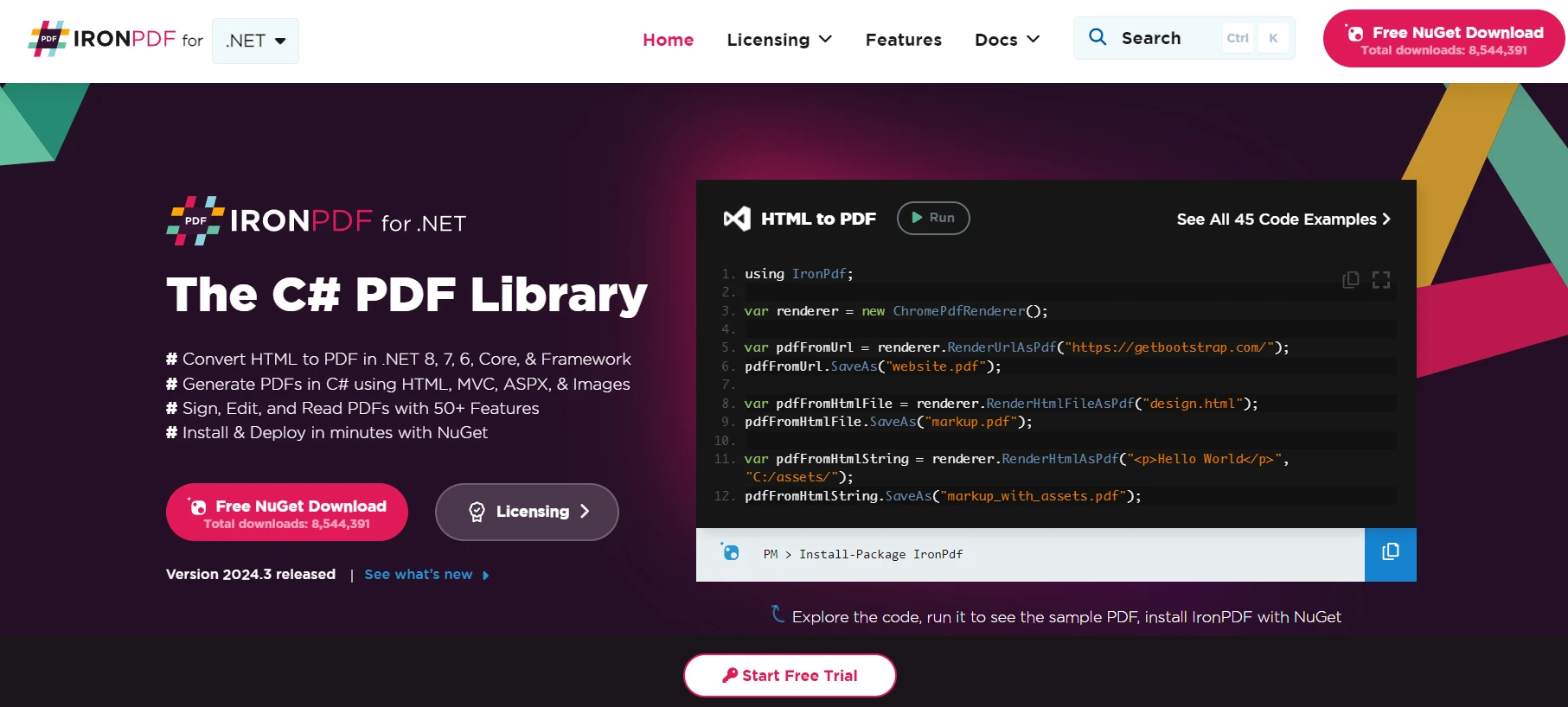
Explora IronPDF para la gestión de PDFs es una herramienta para desarrolladores que trabajan con el lenguaje de programación C#, permitiéndoles crear, leer y editar documentos PDF directamente dentro de sus aplicaciones. Esta biblioteca es fácil de usar, lo que facilita la integración de funcionalidades PDF, como generar informes PDF, facturas o crear PDFs desde código HTML. IronPDF soporta varias características, incluyendo la edición de texto e imágenes en PDFs, establecer seguridad de documentos y convertir páginas web a formato PDF. Su versatilidad y facilidad de uso la convierten en un recurso valioso para los desarrolladores que buscan implementar operaciones PDF en sus proyectos.
IronPDF sobresale en su capacidad de conversión de HTML a PDF, manteniendo todos los diseños y estilos intactos. Crea PDFs desde contenido web, apropiados para informes, facturas y documentación. Archivos HTML, URLs y cadenas de HTML pueden ser convertidos a PDFs sin inconvenientes.
using IronPdf;

class Program
{
    static void Main(string[] args)
    {
        var renderer = new ChromePdfRenderer();

        // 1. Convert HTML String to PDF
        var htmlContent = "<h1>Hello, IronPDF!</h1><p>This is a PDF from an HTML string.</p>";
        var pdfFromHtmlString = renderer.RenderHtmlAsPdf(htmlContent);
        pdfFromHtmlString.SaveAs("HTMLStringToPDF.pdf");

        // 2. Convert HTML File to PDF
        var htmlFilePath = "path_to_your_html_file.html"; // Specify the path to your HTML file
        var pdfFromHtmlFile = renderer.RenderHtmlFileAsPdf(htmlFilePath);
        pdfFromHtmlFile.SaveAs("HTMLFileToPDF.pdf");

        // 3. Convert URL to PDF
        var url = "http://ironpdf.com"; // Specify the URL
        var pdfFromUrl = renderer.RenderUrlAsPdf(url);
        pdfFromUrl.SaveAs("URLToPDF.pdf");
    }
}
using IronPdf;

class Program
{
    static void Main(string[] args)
    {
        var renderer = new ChromePdfRenderer();

        // 1. Convert HTML String to PDF
        var htmlContent = "<h1>Hello, IronPDF!</h1><p>This is a PDF from an HTML string.</p>";
        var pdfFromHtmlString = renderer.RenderHtmlAsPdf(htmlContent);
        pdfFromHtmlString.SaveAs("HTMLStringToPDF.pdf");

        // 2. Convert HTML File to PDF
        var htmlFilePath = "path_to_your_html_file.html"; // Specify the path to your HTML file
        var pdfFromHtmlFile = renderer.RenderHtmlFileAsPdf(htmlFilePath);
        pdfFromHtmlFile.SaveAs("HTMLFileToPDF.pdf");

        // 3. Convert URL to PDF
        var url = "http://ironpdf.com"; // Specify the URL
        var pdfFromUrl = renderer.RenderUrlAsPdf(url);
        pdfFromUrl.SaveAs("URLToPDF.pdf");
    }
}
Imports IronPdf
Friend Class Program
Shared Sub Main(ByVal args() As String)
Dim renderer = New ChromePdfRenderer()
' 1. Convert HTML String to PDF
Dim htmlContent = "<h1>Hello, IronPDF!</h1><p>This is a PDF from an HTML string.</p>"
Dim pdfFromHtmlString = renderer.RenderHtmlAsPdf(htmlContent)
pdfFromHtmlString.SaveAs("HTMLStringToPDF.pdf")
' 2. Convert HTML File to PDF
Dim htmlFilePath = "path_to_your_html_file.html" ' Specify the path to your HTML file
Dim pdfFromHtmlFile = renderer.RenderHtmlFileAsPdf(htmlFilePath)
pdfFromHtmlFile.SaveAs("HTMLFileToPDF.pdf")
' 3. Convert URL to PDF
Dim url = "http://ironpdf.com" ' Specify the URL
Dim pdfFromUrl = renderer.RenderUrlAsPdf(url)
pdfFromUrl.SaveAs("URLToPDF.pdf")
End Sub
End Class
Imports IronPdf

Friend Class Program
	Shared Sub Main(ByVal args() As String)
		Dim renderer = New ChromePdfRenderer()

		' 1. Convert HTML String to PDF
		Dim htmlContent = "<h1>Hello, IronPDF!</h1><p>This is a PDF from an HTML string.</p>"
		Dim pdfFromHtmlString = renderer.RenderHtmlAsPdf(htmlContent)
		pdfFromHtmlString.SaveAs("HTMLStringToPDF.pdf")

		' 2. Convert HTML File to PDF
		Dim htmlFilePath = "path_to_your_html_file.html" ' Specify the path to your HTML file
		Dim pdfFromHtmlFile = renderer.RenderHtmlFileAsPdf(htmlFilePath)
		pdfFromHtmlFile.SaveAs("HTMLFileToPDF.pdf")

		' 3. Convert URL to PDF
		Dim url = "http://ironpdf.com" ' Specify the URL
		Dim pdfFromUrl = renderer.RenderUrlAsPdf(url)
		pdfFromUrl.SaveAs("URLToPDF.pdf")
	End Sub
End Class
Ejemplo de código
Ahora, exploremos cómo puede utilizarse IronPDF dentro de una aplicación C# siguiendo el patrón de Segregación de Responsabilidad de Comandos y Consultas (CQRS). A continuación hay un ejemplo simplificado que demuestra cómo podrías usar IronPDF dentro de una configuración CQRS para generar un informe PDF. Este ejemplo es conceptual y se enfoca en la generación de un documento PDF como un comando.
using IronPdf;
using System.Threading.Tasks;

namespace PdfGenerationApp.Commands
{
    public class GeneratePdfReportCommand
    {
        // Command handler that generates a PDF report
        public async Task GenerateReportAsync(string reportContent, string outputPath)
        {
            // Initialize the IronPDF HTML to PDF renderer
            var renderer = new ChromePdfRenderer();
            // Use IronPDF to generate a PDF from HTML content
            var pdf = await Task.Run(() => renderer.RenderHtmlAsPdf(reportContent));
            // Save the generated PDF to a specified path
            pdf.SaveAs(outputPath);
        }
    }
}
using IronPdf;
using System.Threading.Tasks;

namespace PdfGenerationApp.Commands
{
    public class GeneratePdfReportCommand
    {
        // Command handler that generates a PDF report
        public async Task GenerateReportAsync(string reportContent, string outputPath)
        {
            // Initialize the IronPDF HTML to PDF renderer
            var renderer = new ChromePdfRenderer();
            // Use IronPDF to generate a PDF from HTML content
            var pdf = await Task.Run(() => renderer.RenderHtmlAsPdf(reportContent));
            // Save the generated PDF to a specified path
            pdf.SaveAs(outputPath);
        }
    }
}
Imports IronPdf
Imports System.Threading.Tasks
Namespace PdfGenerationApp.Commands
Public Class GeneratePdfReportCommand
' Command handler that generates a PDF report
Public Async Function GenerateReportAsync(ByVal reportContent As String, ByVal outputPath As String) As Task
' Initialize the IronPDF HTML to PDF renderer
Dim renderer = New ChromePdfRenderer()
' Use IronPDF to generate a PDF from HTML content
Dim pdf = Await Task.Run(Function() renderer.RenderHtmlAsPdf(reportContent))
' Save the generated PDF to a specified path
pdf.SaveAs(outputPath)
End Function
End Class
End Namespace
Imports IronPdf
Imports System.Threading.Tasks

Namespace PdfGenerationApp.Commands
	Public Class GeneratePdfReportCommand
		' Command handler that generates a PDF report
		Public Async Function GenerateReportAsync(ByVal reportContent As String, ByVal outputPath As String) As Task
			' Initialize the IronPDF HTML to PDF renderer
			Dim renderer = New ChromePdfRenderer()
			' Use IronPDF to generate a PDF from HTML content
			Dim pdf = Await Task.Run(Function() renderer.RenderHtmlAsPdf(reportContent))
			' Save the generated PDF to a specified path
			pdf.SaveAs(outputPath)
		End Function
	End Class
End Namespace
En este ejemplo, GeneratePdfReportCommand representa un comando en el patrón CQRS. Incluye un método GenerateReportAsync que toma reportContent como una cadena de HTML y un outputPath donde se guardará el informe PDF. La clase HtmlToPdf de IronPDF se utiliza para convertir el contenido HTML a formato PDF, que luego se guarda en la ruta especificada. Esta configuración ilustra cómo puedes integrar la funcionalidad de generación de PDF en la arquitectura de tu aplicación, especialmente en escenarios que requieren una clara separación de responsabilidades como lo promueve CQRS.

Conclusión
Para concluir, el patrón de Segregación de Responsabilidad de Comandos y Consultas (CQRS) ofrece un enfoque estructurado para separar las responsabilidades de lectura y escritura de datos en tus aplicaciones. Esta separación no solo aclara la arquitectura, sino que también mejora la flexibilidad, escalabilidad y rendimiento de tus sistemas. Siguiendo los pasos descritos anteriormente, puedes implementar CQRS en tus aplicaciones ASP.NET Core, utilizando herramientas como MediatR para agilizar la comunicación entre comandos, consultas y sus manejadores.
Integrar IronPDF en tu aplicación basada en CQRS amplía aún más sus capacidades, permitiéndote crear, manipular y almacenar documentos PDF sin esfuerzo. Ya sea que estés generando informes, facturas o cualquier forma de documento, las características comprehensivas y la sintaxis sencilla de IronPDF lo convierten en una herramienta poderosa en tu caja de herramientas de desarrollo. IronPDF ofrece una prueba gratuita, dándote la oportunidad de explorar sus capacidades antes de comprometerte. Para uso continuo, las licencias comienzan desde $999, proporcionando varias opciones para satisfacer las necesidades de su proyecto.