using IronPdf;

// Disable local disk access or cross-origin requests
Installation.EnableWebSecurity = true;

// Instantiate Renderer
var renderer = new ChromePdfRenderer();

// Create a PDF from a HTML string using C#
var pdf = renderer.RenderHtmlAsPdf("<h1>Hello World</h1>");

// Export to a file or Stream
pdf.SaveAs("output.pdf");

// Advanced Example with HTML Assets
// Load external html assets: Images, CSS and JavaScript.
// An optional BasePath 'C:\site\assets\' is set as the file location to load assets from
var myAdvancedPdf = renderer.RenderHtmlAsPdf("<img src='icons/iron.png'>", @"C:\site\assets\");
myAdvancedPdf.SaveAs("html-with-assets.pdf");
using IronPdf;// Disable local disk access or cross-origin requestsInstallation.EnableWebSecurity = true;// Instantiate Renderervar renderer = new ChromePdfRenderer();// Create a PDF from a HTML string using C#var pdf = renderer.RenderHtmlAsPdf("<h1>Hello World</h1>");// Export to a file or Streampdf.SaveAs("output.pdf");// Advanced Example with HTML Assets// Load external html assets: Images, CSS and JavaScript.// An optional BasePath 'C:\site\assets\' is set as the file location to load assets fromvar myAdvancedPdf = renderer.RenderHtmlAsPdf("<img src='icons/iron.png'>", @"C:\site\assets\");myAdvancedPdf.SaveAs("html-with-assets.pdf");
PM >Install-Package IronPdf
Install-Package IronPdf
ACTUALIZACIONES PARA DESARROLLADORES
C# Linked List (Cómo Funciona para Desarrolladores)
Una lista enlazada es una estructura de datos lineal compuesta por una serie de nodos, que también se pueden llamar elementos. A diferencia de los arreglos, donde los elementos/nodos se almacenan en ubicaciones de memoria contiguas, las listas enlazadas utilizan asignación de memoria dinámica, permitiendo que los elementos/nodos estén dispersos por toda la memoria.
En su forma más simple, las "listas enlazadas" consisten en nodos enlazados juntos linealmente. Cada nodo contiene dos partes principales:
1. **Datos:** Carga útil almacenada en el nodo. Esto puede ser de cualquier tipo de datos dependiendo de la implementación, como enteros, cadenas, objetos, etc.
2. **Siguiente puntero:** una referencia (o puntero) al siguiente nodo en la secuencia. Este puntero indica la ubicación de memoria del siguiente nodo y apunta hacia adelante en la lista enlazada.
El último nodo en una lista enlazada generalmente apunta a una referencia nula, indicando el final de la lista.
En este artículo, examinaremos en detalle la lista enlazada en C# y también exploraremos la [biblioteca IronPDF](/), una herramienta de generación de PDF de [Iron Software](https://ironsoftware.com/).
## Tipos de listas enlazadas
### 1. Lista enlazada simple
Una lista enlazada simple tiene un nodo con solo una referencia, que normalmente apunta al siguiente nodo en la secuencia. El recorrido de la lista se limita al movimiento en una dirección, típicamente desde la cabeza (el nodo inicial) hasta la cola (el nodo final).
### 2. Lista doblemente enlazada
En una lista enlazada doble, cada nodo contiene dos referencias: una que apunta al siguiente nodo y otra que apunta al nodo anterior en la secuencia. Este enlace bidireccional permite el recorrido en ambas direcciones, hacia adelante y hacia atrás.
### 3. Lista enlazada circular
En una lista enlazada circular, el último nodo apunta de nuevo al primer nodo, formando una estructura circular. Este tipo de lista enlazada puede implementarse utilizando nodos enlazados simples o dobles.
### Operaciones básicas con listas enlazadas
1. **Inserción:** agregar un nuevo nodo a la lista en una posición específica, como el principio, el final o el medio.
2. **Eliminación:** eliminar un nodo de objeto específico de la lista y ajustar los punteros de los nodos vecinos en consecuencia.
3. **Recorrido:** iterar a través de la lista para acceder o manipular los datos de cada nodo.
4. **Buscar:** encontrar un nodo específico en la lista según su valor especificado en los datos.
## Linked List in C#
En C#, puedes implementar una lista enlazada usando la [`LinkedList`](https://learn.microsoft.com/en-us/dotnet/api/system.collections.generic.linkedlist-1?view=net-8.0) clase del espacio de nombres `System.Collections.Generic`. Aquí hay un ejemplo de todas las operaciones básicas:
```cs
using System;
using System.Collections.Generic;

namespace CsharpSamples
{
    public class Program
    {
        public static void Main()
        {
            // Create a new linked list of integers
            LinkedList<int> linkedList = new LinkedList<int>();

            // Add elements to the linked list
            linkedList.AddLast(10);
            linkedList.AddLast(20);
            linkedList.AddLast(30);
            linkedList.AddLast(40);

            // Traverse and print the elements of the linked list
            Console.WriteLine("Traverse Linked List elements:");
            foreach (var item in linkedList)
            {
                Console.WriteLine(item);
            }

            // Display number of linked list elements
            Console.WriteLine($"Number of Linked List elements: {linkedList.Count}");

            // Find/Search for an element in the linked list
            Console.WriteLine("\nFind/Search Element Linked List elements: 30");
            var foundNode = linkedList.Find(30);

            if (foundNode != null)
            {
                Console.WriteLine(
                    $"Found Value: {foundNode.Value}, " +
                    $"Next Element: {(foundNode.Next != null ? foundNode.Next.Value.ToString() : "null")}, " +
                    $"Previous Element: {(foundNode.Previous != null ? foundNode.Previous.Value.ToString() : "null")}"
                );
            }

            // Insert an element at a specified node
            LinkedListNode<int> current = linkedList.Find(20);
            if (current != null)
            {
                linkedList.AddAfter(current, 25);
            }

            Console.WriteLine($"\nNumber of Linked List elements: {linkedList.Count}");
            Console.WriteLine("\nLinked List elements after insertion:");
            foreach (var item in linkedList)
            {
                Console.WriteLine(item);
            }

            // Remove an existing node from the linked list
            linkedList.Remove(30);

            Console.WriteLine("\nLinked List elements after removal:");
            foreach (var item in linkedList)
            {
                Console.WriteLine(item);
            }

            Console.WriteLine($"\nNumber of Linked List elements: {linkedList.Count}");
        }
    }
}
```
### Explicación del código
1. Crea una nueva lista enlazada de enteros usando `new LinkedList<int>()`.
2. Agregar objetos de valor especificado a la lista enlazada.
3. Recorre e imprime los elementos de la lista enlazada usando un bucle `foreach`.
4. Buscar un elemento en la lista enlazada.
5. Inserta un elemento en un nodo especificado usando los métodos `Find` y `AddAfter`.
6. Elimina un nodo existente de la lista enlazada usando el método `Remove`.
### Resultado
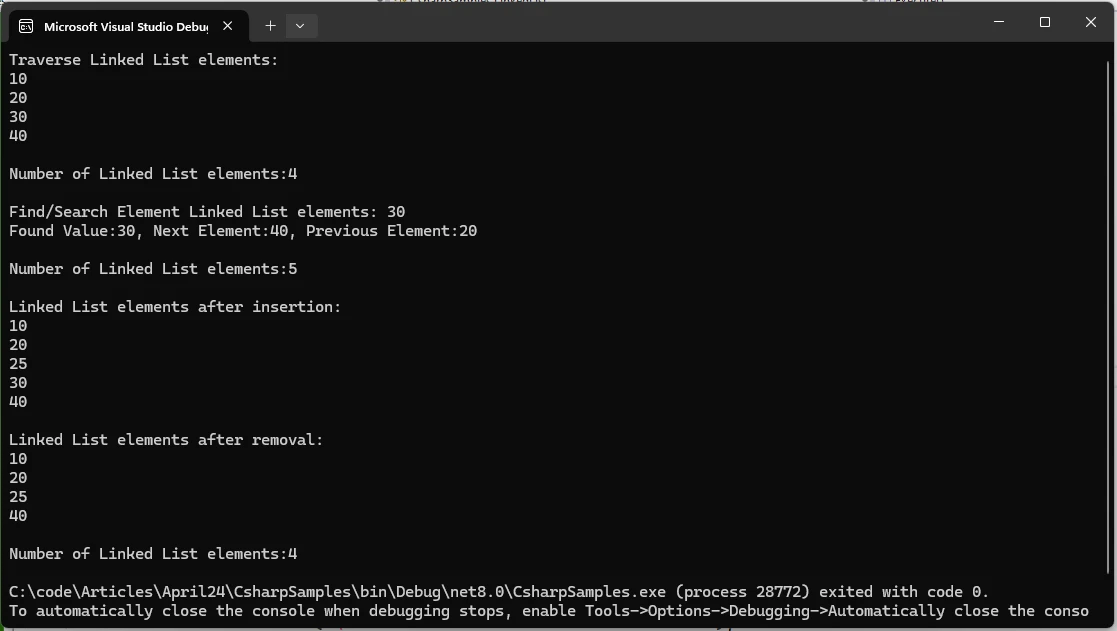
## Presentando IronPDF
[Descubre más sobre IronPDF](/) es una poderosa biblioteca de PDF en C# desarrollada y mantenida por Iron Software. Proporciona un conjunto completo de características para crear, editar y extraer contenido de documentos PDF dentro de proyectos .NET.
## Puntos clave sobre IronPDF
### Conversión de HTML a PDF
IronPDF te permite convertir contenido HTML a formato PDF. Puedes renderizar páginas HTML, URLs y cadenas HTML en PDFs con facilidad.
### Aplicaciones API
La biblioteca ofrece una API fácil de usar que permite a los desarrolladores generar PDFs de calidad profesional directamente desde HTML. Ya sea que necesites crear facturas, informes u otros documentos, IronPDF simplifica el proceso.
### Compatibilidad multiplataforma
IronPDF es compatible con varios entornos .NET, incluidos .NET Core, .NET Standard y .NET Framework. Funciona en plataformas Windows, Linux y macOS.
### Versatilidad
IronPDF es compatible con diferentes tipos de proyectos, como aplicaciones web (Blazor y WebForms), aplicaciones de escritorio (WPF y MAUI) y aplicaciones de consola.
### Fuentes de contenido
Puedes generar PDFs a partir de varias fuentes de contenido, incluidos archivos HTML, vistas de Razor (Blazor Server), CSHTML (MVC y Razor), ASPX (WebForms) y XAML (MAUI).
### Características adicionales
1. Agregar encabezados y pies de página a PDFs.
2. Unir, dividir, agregar, copiar y eliminar páginas de PDF.
3. Establecer contraseñas, permisos y firmas digitales.
4. Optimizar el rendimiento con soporte multihilo y asincrónico.
### Compatibilidad
IronPDF se adhiere a los estándares PDF, incluidas las versiones 1.2 a 1.7, PDF/UA y PDF/A. También admite la codificación de caracteres UTF-8, URLs base y codificación de activos.
## Generar Documento PDF Usando `LinkedList`
Ahora, vamos a crear un documento PDF usando IronPDF y también demostraremos el uso de cadenas `LinkedList`.
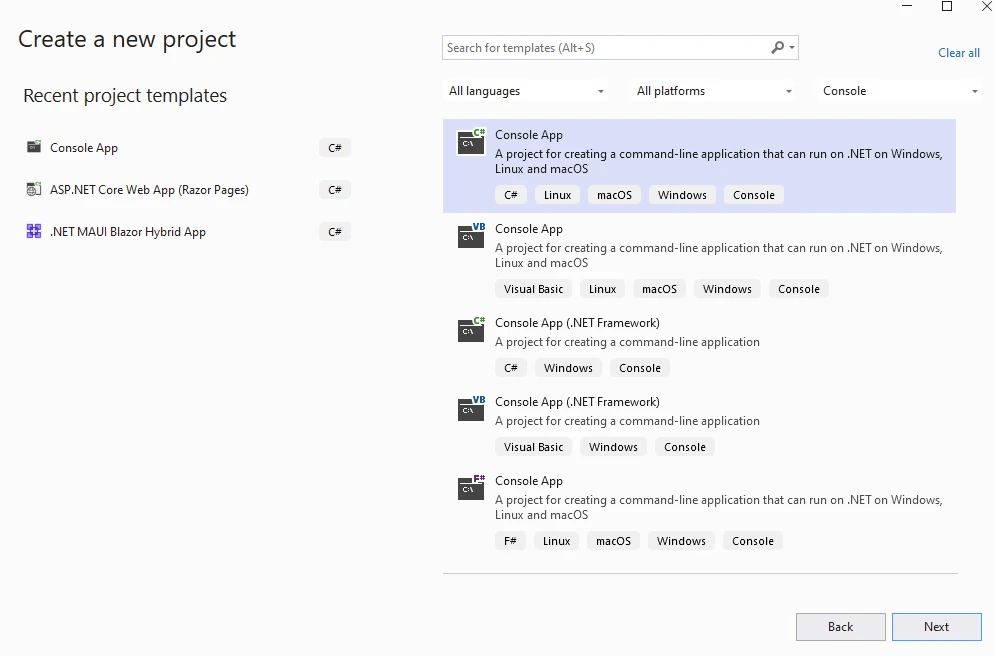
Para empezar, abre Visual Studio y crea una aplicación de consola seleccionando de las plantillas de proyectos como se muestra a continuación.
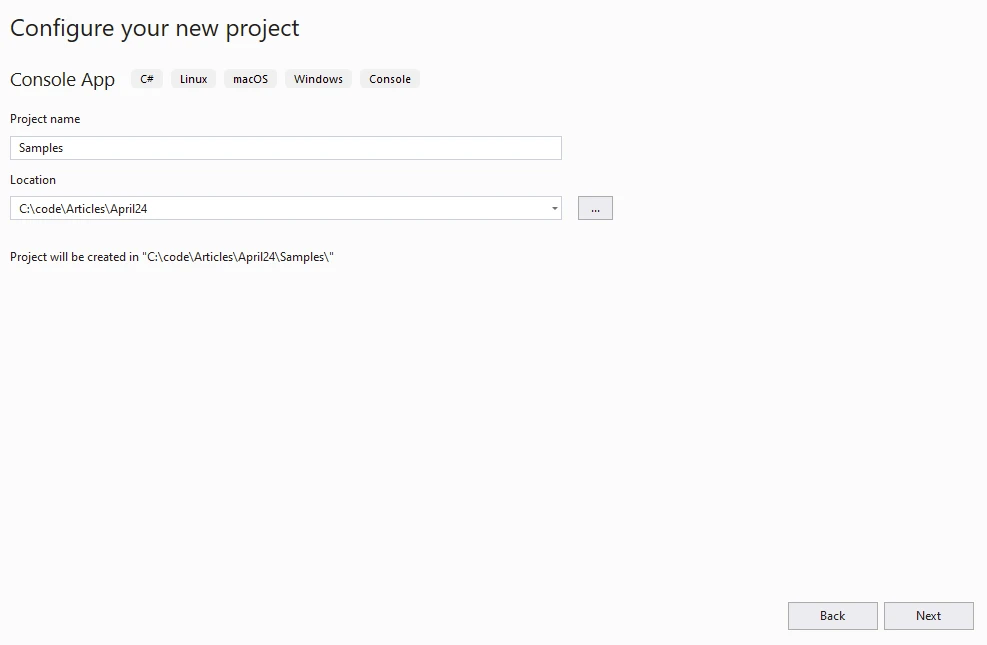
Proporciona un nombre de proyecto y una ubicación.
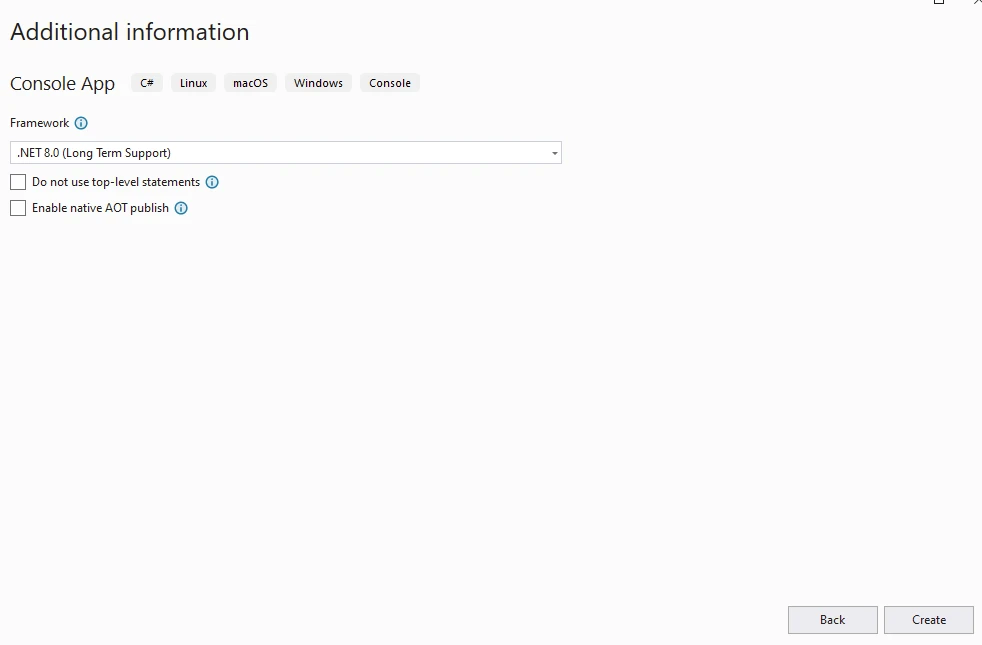
Seleccione la versión .NET requerida.
Instala IronPDF desde el administrador de paquetes de Visual Studio como el de abajo.
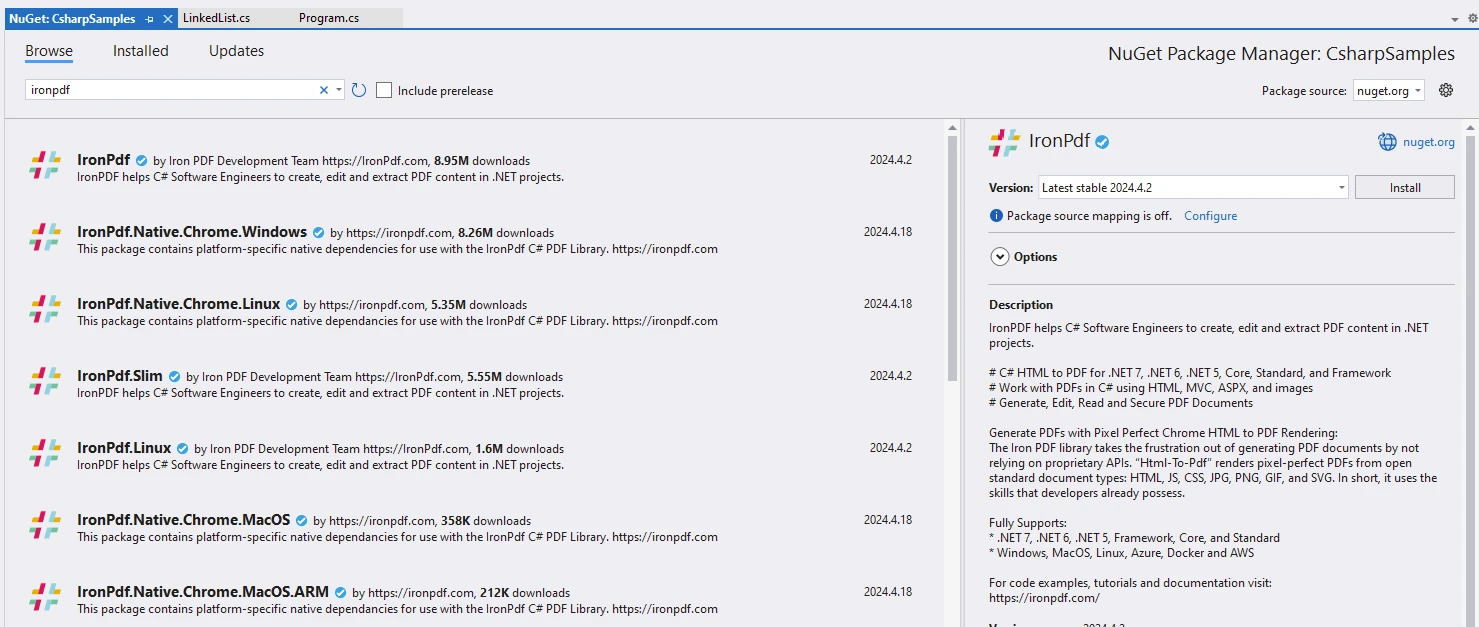
O se puede instalar usando la línea de comandos a continuación.
```shell
:InstallCmd dotnet add package IronPdf --version 2024.4.2
```
Agrega el siguiente código.
```cs
using System;
using System.Collections.Generic;
using IronPdf;
namespace CsharpSamples
{
public class Program
{
public static void Main()
{
var content = "<h1>Demonstrate IronPDF with C# LinkedList</h1>";
content += "<h2>Create a new linked list of strings</h2>";
content += "<p>Create a new linked list of strings with new LinkedList<string>()</p>";
// Create a new linked list of strings
LinkedList<string> linkedList = new LinkedList<string>();
// Add elements to the linked list
content += "<p>Add Apple to linkedList</p>";
linkedList.AddLast("Apple");
content += "<p>Add Banana to linkedList</p>";
linkedList.AddLast("Banana");
content += "<p>Add Orange to linkedList</p>";
linkedList.AddLast("Orange");
content += "<h2>Print the elements of the linked list</h2>";
Console.WriteLine("Linked List elements:");
foreach (var item in linkedList)
{
content += $"<p>{item}</p>";
Console.WriteLine(item);
}
content += "<h2>Insert an element at a specific position</h2>";
LinkedListNode<string> node = linkedList.Find("Banana");
if (node != null)
{
linkedList.AddAfter(node, "Mango");
content += "<p>Find Banana and insert Mango After</p>";
}
Console.WriteLine("\nLinked List elements after insertion:");
content += "<h2>Linked List elements after insertion:</h2>";
foreach (var item in linkedList)
{
content += $"<p>{item}</p>";
Console.WriteLine(item);
}
content += "<h2>Remove an element from the linked list</h2>";
linkedList.Remove("Orange");
content += "<p>Remove Orange from linked list</p>";
Console.WriteLine("\nLinked List elements after removal:");
content += "<h2>Linked List elements after removal:</h2>";
foreach (var item in linkedList)
{
content += $"<p>{item}</p>";
Console.WriteLine(item);
}
// Create a PDF renderer
var renderer = new ChromePdfRenderer();
// Create a PDF from HTML string
var pdf = renderer.RenderHtmlAsPdf(content);
// Save to a file
pdf.SaveAs("AwesomeIronOutput.pdf");
}
}
}
```
### Explicación del código
1. Primero, comenzamos creando el contenido para el PDF, utilizando un objeto de cadena de contenido. El contenido se genera como una cadena HTML.
2. Crea una nueva lista enlazada de cadenas con `new LinkedList<string>()`.
3. Agrega elementos a la lista enlazada y también adjunta información a la cadena de contenido del PDF.
4. Imprime los elementos de la lista enlazada y agrégalos al contenido del PDF.
5. Inserta un elemento en una posición específica usando el método `AddAfter`; 6. Elimina un elemento de la lista con `Remove`; actualiza el contenido e imprime la lista.
6. Elimina un elemento de la lista enlazada usando el método `Remove`, actualiza el contenido e imprime la lista resultante.
7. Finalmente, guarda el contenido HTML generado en un documento PDF usando los métodos `ChromePdfRenderer`, `RenderHtmlAsPdf` y `SaveAs`.
### Resultado
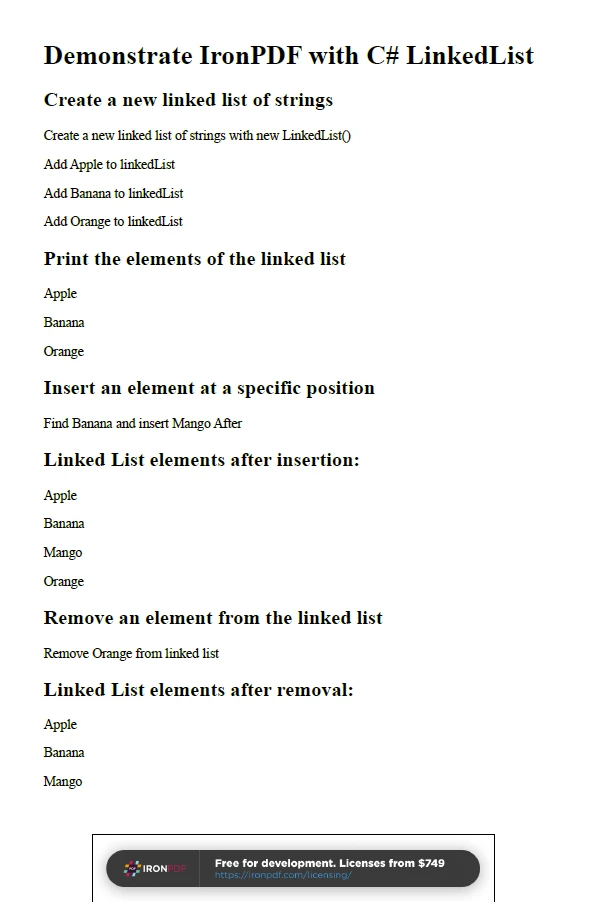
La [biblioteca IronPDF requiere una licencia para funcionar](trial-license), y se puede obtener en la [página de licencias del producto](/licensing/).
## Licencia de IronPDF
La [biblioteca IronPDF requiere una licencia para funcionar](trial-license), y se puede obtener de la [página de licencias del producto](/licensing/).
Pega la clave en appSettings.json abajo.
```json
{
"IronPdf.License.LicenseKey": "The Key Goes Here"
}
```
## Conclusión
C# `LinkedList` ofrece una estructura de datos versátil para gestionar colecciones de elementos, ofreciendo inserciones y eliminaciones eficientes mientras acomoda una redimensión dinámica, similar a la función hash por defecto. Comprender las características y operaciones de las listas enlazadas es esencial para construir soluciones de software eficientes y escalables. Entender listas enlazadas es esencial para construir aplicaciones eficientes.
Una consideración cuidadosa de los requisitos específicos y las características de los datos puede guiar la selección de la estructura de datos más apropiada para la tarea en cuestión. La biblioteca IronPDF de Iron Software permite a los desarrolladores crear y manipular documentos PDF sin esfuerzo, permitiendo habilidades avanzadas para desarrollar aplicaciones modernas.
La biblioteca IronPDF de Iron Software permite a los desarrolladores crear y manipular documentos PDF sin esfuerzo, lo que permite desarrollar aplicaciones modernas con conocimientos avanzados.
Una lista enlazada es una estructura de datos lineal compuesta por una serie de nodos, que también se pueden llamar elementos. A diferencia de los arreglos, donde los elementos/nodos se almacenan en ubicaciones de memoria contiguas, las listas enlazadas utilizan asignación de memoria dinámica, permitiendo que los elementos/nodos estén dispersos por toda la memoria.
En su forma más simple, las "listas enlazadas" consisten en nodos enlazados juntos linealmente. Cada nodo contiene dos partes principales:
Datos: Carga útil almacenada en el nodo. Esto puede ser de cualquier tipo de datos dependiendo de la implementación, como enteros, cadenas, objetos, etc.
Siguiente puntero: una referencia (o puntero) al siguiente nodo en la secuencia. Este puntero indica la ubicación de memoria del siguiente nodo y apunta hacia adelante en la lista enlazada.
El último nodo en una lista enlazada generalmente apunta a una referencia nula, indicando el final de la lista.
En este artículo, examinaremos en detalle la lista enlazada en C# y también exploraremos la biblioteca IronPDF, una herramienta de generación de PDF de Iron Software.
Tipos de listas enlazadas
1. Lista enlazada simple
Una lista enlazada simple tiene un nodo con solo una referencia, que normalmente apunta al siguiente nodo en la secuencia. El recorrido de la lista se limita al movimiento en una dirección, típicamente desde la cabeza (el nodo inicial) hasta la cola (el nodo final).
2. Lista doblemente enlazada
En una lista enlazada doble, cada nodo contiene dos referencias: una que apunta al siguiente nodo y otra que apunta al nodo anterior en la secuencia. Este enlace bidireccional permite el recorrido en ambas direcciones, hacia adelante y hacia atrás.
3. Lista enlazada circular
En una lista enlazada circular, el último nodo apunta de nuevo al primer nodo, formando una estructura circular. Este tipo de lista enlazada puede implementarse utilizando nodos enlazados simples o dobles.
Operaciones básicas con listas enlazadas
Inserción: agregar un nuevo nodo a la lista en una posición específica, como el principio, el final o el medio.
Eliminación: eliminar un nodo de objeto específico de la lista y ajustar los punteros de los nodos vecinos en consecuencia.
Recorrido: iterar a través de la lista para acceder o manipular los datos de cada nodo.
Buscar: encontrar un nodo específico en la lista según su valor especificado en los datos.
Linked List in C#
En C#, puedes implementar una lista enlazada usando la LinkedList clase del espacio de nombres System.Collections.Generic. Aquí hay un ejemplo de todas las operaciones básicas:
using System;using System.Collections.Generic;namespace CsharpSamples{ public class Program { public static voidMain() { // Create a new linked list of integers LinkedList<int> linkedList = new LinkedList<int>(); // Add elements to the linked list linkedList.AddLast(10); linkedList.AddLast(20); linkedList.AddLast(30); linkedList.AddLast(40); // Traverse and print the elements of the linked listConsole.WriteLine("Traverse Linked List elements:"); foreach (var item in linkedList) {Console.WriteLine(item); } // Display number of linked list elementsConsole.WriteLine($"Number of Linked List elements: {linkedList.Count}"); // Find/Search for an element in the linked listConsole.WriteLine("\nFind/Search Element Linked List elements: 30"); var foundNode = linkedList.Find(30); if (foundNode != null) {Console.WriteLine( $"Found Value: {foundNode.Value}, " + $"Next Element: {(foundNode.Next != null ? foundNode.Next.Value.ToString() : "null")}, " + $"Previous Element: {(foundNode.Previous != null ? foundNode.Previous.Value.ToString() : "null")}" ); } // Insert an element at a specified node LinkedListNode<int> current = linkedList.Find(20); if (current != null) { linkedList.AddAfter(current, 25); }Console.WriteLine($"\nNumber of Linked List elements: {linkedList.Count}");Console.WriteLine("\nLinked List elements after insertion:"); foreach (var item in linkedList) {Console.WriteLine(item); } // Remove an existing node from the linked list linkedList.Remove(30);Console.WriteLine("\nLinked List elements after removal:"); foreach (var item in linkedList) {Console.WriteLine(item); }Console.WriteLine($"\nNumber of Linked List elements: {linkedList.Count}"); } }}
using System;
using System.Collections.Generic;

namespace CsharpSamples
{
    public class Program
    {
        public static void Main()
        {
            // Create a new linked list of integers
            LinkedList<int> linkedList = new LinkedList<int>();

            // Add elements to the linked list
            linkedList.AddLast(10);
            linkedList.AddLast(20);
            linkedList.AddLast(30);
            linkedList.AddLast(40);

            // Traverse and print the elements of the linked list
            Console.WriteLine("Traverse Linked List elements:");
            foreach (var item in linkedList)
            {
                Console.WriteLine(item);
            }

            // Display number of linked list elements
            Console.WriteLine($"Number of Linked List elements: {linkedList.Count}");

            // Find/Search for an element in the linked list
            Console.WriteLine("\nFind/Search Element Linked List elements: 30");
            var foundNode = linkedList.Find(30);

            if (foundNode != null)
            {
                Console.WriteLine(
                    $"Found Value: {foundNode.Value}, " +
                    $"Next Element: {(foundNode.Next != null ? foundNode.Next.Value.ToString() : "null")}, " +
                    $"Previous Element: {(foundNode.Previous != null ? foundNode.Previous.Value.ToString() : "null")}"
                );
            }

            // Insert an element at a specified node
            LinkedListNode<int> current = linkedList.Find(20);
            if (current != null)
            {
                linkedList.AddAfter(current, 25);
            }

            Console.WriteLine($"\nNumber of Linked List elements: {linkedList.Count}");
            Console.WriteLine("\nLinked List elements after insertion:");
            foreach (var item in linkedList)
            {
                Console.WriteLine(item);
            }

            // Remove an existing node from the linked list
            linkedList.Remove(30);

            Console.WriteLine("\nLinked List elements after removal:");
            foreach (var item in linkedList)
            {
                Console.WriteLine(item);
            }

            Console.WriteLine($"\nNumber of Linked List elements: {linkedList.Count}");
        }
    }
}
ImportsSystemImportsSystem.Collections.GenericNamespaceCsharpSamples Public Class Program PublicShared Sub Main() ' Create a new linked list of integers Dim linkedList As New LinkedList(OfInteger)() ' Add elements to the linked list linkedList.AddLast(10) linkedList.AddLast(20) linkedList.AddLast(30) linkedList.AddLast(40) ' Traverse and print the elements of the linked listConsole.WriteLine("Traverse Linked List elements:") For Each item In linkedListConsole.WriteLine(item) Next ' Display number of linked list elementsConsole.WriteLine($"Number of Linked List elements: {linkedList.Count}") ' Find/Search for an element in the linked listConsole.WriteLine(vbCrLf & "Find/Search Element Linked List elements: 30") Dim foundNode = linkedList.Find(30) If foundNode IsNot Nothing ThenConsole.WriteLine( $"Found Value: {foundNode.Value}, " & $"Next Element: {If(foundNode.Next IsNot Nothing, foundNode.Next.Value.ToString(), "null")}, " & $"Previous Element: {If(foundNode.Previous IsNot Nothing, foundNode.Previous.Value.ToString(), "null")}" ) End If ' Insert an element at a specified node Dim current AsLinkedListNode(OfInteger) = linkedList.Find(20) If current IsNot Nothing Then linkedList.AddAfter(current, 25) End IfConsole.WriteLine(vbCrLf & $"Number of Linked List elements: {linkedList.Count}")Console.WriteLine(vbCrLf & "Linked List elements after insertion:") For Each item In linkedListConsole.WriteLine(item) Next ' Remove an existing node from the linked list linkedList.Remove(30)Console.WriteLine(vbCrLf & "Linked List elements after removal:") For Each item In linkedListConsole.WriteLine(item) NextConsole.WriteLine(vbCrLf & $"Number of Linked List elements: {linkedList.Count}") End Sub End ClassEndNamespace
Imports System
Imports System.Collections.Generic

Namespace CsharpSamples
    Public Class Program
        Public Shared Sub Main()
            ' Create a new linked list of integers
            Dim linkedList As New LinkedList(Of Integer)()

            ' Add elements to the linked list
            linkedList.AddLast(10)
            linkedList.AddLast(20)
            linkedList.AddLast(30)
            linkedList.AddLast(40)

            ' Traverse and print the elements of the linked list
            Console.WriteLine("Traverse Linked List elements:")
            For Each item In linkedList
                Console.WriteLine(item)
            Next

            ' Display number of linked list elements
            Console.WriteLine($"Number of Linked List elements: {linkedList.Count}")

            ' Find/Search for an element in the linked list
            Console.WriteLine(vbCrLf & "Find/Search Element Linked List elements: 30")
            Dim foundNode = linkedList.Find(30)

            If foundNode IsNot Nothing Then
                Console.WriteLine(
                    $"Found Value: {foundNode.Value}, " &
                    $"Next Element: {If(foundNode.Next IsNot Nothing, foundNode.Next.Value.ToString(), "null")}, " &
                    $"Previous Element: {If(foundNode.Previous IsNot Nothing, foundNode.Previous.Value.ToString(), "null")}"
                )
            End If

            ' Insert an element at a specified node
            Dim current As LinkedListNode(Of Integer) = linkedList.Find(20)
            If current IsNot Nothing Then
                linkedList.AddAfter(current, 25)
            End If

            Console.WriteLine(vbCrLf & $"Number of Linked List elements: {linkedList.Count}")
            Console.WriteLine(vbCrLf & "Linked List elements after insertion:")
            For Each item In linkedList
                Console.WriteLine(item)
            Next

            ' Remove an existing node from the linked list
            linkedList.Remove(30)

            Console.WriteLine(vbCrLf & "Linked List elements after removal:")
            For Each item In linkedList
                Console.WriteLine(item)
            Next

            Console.WriteLine(vbCrLf & $"Number of Linked List elements: {linkedList.Count}")
        End Sub
    End Class
End Namespace
Explicación del código
Crea una nueva lista enlazada de enteros usando new LinkedList<int>().
Agregar objetos de valor especificado a la lista enlazada.
Recorre e imprime los elementos de la lista enlazada usando un bucle foreach.
Buscar un elemento en la lista enlazada.
Inserta un elemento en un nodo especificado usando los métodos Find y AddAfter.
Elimina un nodo existente de la lista enlazada usando el método Remove.
Resultado
Presentando IronPDF
Descubre más sobre IronPDF es una poderosa biblioteca de PDF en C# desarrollada y mantenida por Iron Software. Proporciona un conjunto completo de características para crear, editar y extraer contenido de documentos PDF dentro de proyectos .NET.
Puntos clave sobre IronPDF
Conversión de HTML a PDF
IronPDF te permite convertir contenido HTML a formato PDF. Puedes renderizar páginas HTML, URLs y cadenas HTML en PDFs con facilidad.
Aplicaciones API
La biblioteca ofrece una API fácil de usar que permite a los desarrolladores generar PDFs de calidad profesional directamente desde HTML. Ya sea que necesites crear facturas, informes u otros documentos, IronPDF simplifica el proceso.
Compatibilidad multiplataforma
IronPDF es compatible con varios entornos .NET, incluidos .NET Core, .NET Standard y .NET Framework. Funciona en plataformas Windows, Linux y macOS.
Versatilidad
IronPDF es compatible con diferentes tipos de proyectos, como aplicaciones web (Blazor y WebForms), aplicaciones de escritorio (WPF y MAUI) y aplicaciones de consola.
Fuentes de contenido
Puedes generar PDFs a partir de varias fuentes de contenido, incluidos archivos HTML, vistas de Razor (Blazor Server), CSHTML (MVC y Razor), ASPX (WebForms) y XAML (MAUI).
Características adicionales
Agregar encabezados y pies de página a PDFs.
Unir, dividir, agregar, copiar y eliminar páginas de PDF.
Establecer contraseñas, permisos y firmas digitales.
Optimizar el rendimiento con soporte multihilo y asincrónico.
Compatibilidad
IronPDF se adhiere a los estándares PDF, incluidas las versiones 1.2 a 1.7, PDF/UA y PDF/A. También admite la codificación de caracteres UTF-8, URLs base y codificación de activos.
Generar Documento PDF Usando LinkedList
Ahora, vamos a crear un documento PDF usando IronPDF y también demostraremos el uso de cadenas LinkedList.
Para empezar, abre Visual Studio y crea una aplicación de consola seleccionando de las plantillas de proyectos como se muestra a continuación.
Proporciona un nombre de proyecto y una ubicación.
Seleccione la versión .NET requerida.
Instala IronPDF desde el administrador de paquetes de Visual Studio como el de abajo.
O se puede instalar usando la línea de comandos a continuación.
> dotnet add package IronPdf --version 2024.4.2
dotnet add package IronPdf --version 2024.4.2
Agrega el siguiente código.
using System;using System.Collections.Generic;using IronPdf;namespace CsharpSamples{ public class Program { public static voidMain() { var content = "<h1>Demonstrate IronPDF with C# LinkedList</h1>"; content += "<h2>Create a new linked list of strings</h2>"; content += "<p>Create a new linked list of strings with new LinkedList<string>()</p>"; // Create a new linked list of strings LinkedList<string> linkedList = new LinkedList<string>(); // Add elements to the linked list content += "<p>Add Apple to linkedList</p>"; linkedList.AddLast("Apple"); content += "<p>Add Banana to linkedList</p>"; linkedList.AddLast("Banana"); content += "<p>Add Orange to linkedList</p>"; linkedList.AddLast("Orange"); content += "<h2>Print the elements of the linked list</h2>";Console.WriteLine("Linked List elements:"); foreach (var item in linkedList) { content += $"<p>{item}</p>";Console.WriteLine(item); } content += "<h2>Insert an element at a specific position</h2>"; LinkedListNode<string> node = linkedList.Find("Banana"); if (node != null) { linkedList.AddAfter(node, "Mango"); content += "<p>Find Banana and insert Mango After</p>"; }Console.WriteLine("\nLinked List elements after insertion:"); content += "<h2>Linked List elements after insertion:</h2>"; foreach (var item in linkedList) { content += $"<p>{item}</p>";Console.WriteLine(item); } content += "<h2>Remove an element from the linked list</h2>"; linkedList.Remove("Orange"); content += "<p>Remove Orange from linked list</p>";Console.WriteLine("\nLinked List elements after removal:"); content += "<h2>Linked List elements after removal:</h2>"; foreach (var item in linkedList) { content += $"<p>{item}</p>";Console.WriteLine(item); } // Create a PDF renderer var renderer = new ChromePdfRenderer(); // Create a PDF from HTML string var pdf = renderer.RenderHtmlAsPdf(content); // Save to a file pdf.SaveAs("AwesomeIronOutput.pdf"); } }}
using System;
using System.Collections.Generic;
using IronPdf;
namespace CsharpSamples
{
public class Program
{
public static void Main()
{
var content = "<h1>Demonstrate IronPDF with C# LinkedList</h1>";
content += "<h2>Create a new linked list of strings</h2>";
content += "<p>Create a new linked list of strings with new LinkedList<string>()</p>";
// Create a new linked list of strings
LinkedList<string> linkedList = new LinkedList<string>();
// Add elements to the linked list
content += "<p>Add Apple to linkedList</p>";
linkedList.AddLast("Apple");
content += "<p>Add Banana to linkedList</p>";
linkedList.AddLast("Banana");
content += "<p>Add Orange to linkedList</p>";
linkedList.AddLast("Orange");
content += "<h2>Print the elements of the linked list</h2>";
Console.WriteLine("Linked List elements:");
foreach (var item in linkedList)
{
content += $"<p>{item}</p>";
Console.WriteLine(item);
}
content += "<h2>Insert an element at a specific position</h2>";
LinkedListNode<string> node = linkedList.Find("Banana");
if (node != null)
{
linkedList.AddAfter(node, "Mango");
content += "<p>Find Banana and insert Mango After</p>";
}
Console.WriteLine("\nLinked List elements after insertion:");
content += "<h2>Linked List elements after insertion:</h2>";
foreach (var item in linkedList)
{
content += $"<p>{item}</p>";
Console.WriteLine(item);
}
content += "<h2>Remove an element from the linked list</h2>";
linkedList.Remove("Orange");
content += "<p>Remove Orange from linked list</p>";
Console.WriteLine("\nLinked List elements after removal:");
content += "<h2>Linked List elements after removal:</h2>";
foreach (var item in linkedList)
{
content += $"<p>{item}</p>";
Console.WriteLine(item);
}
// Create a PDF renderer
var renderer = new ChromePdfRenderer();
// Create a PDF from HTML string
var pdf = renderer.RenderHtmlAsPdf(content);
// Save to a file
pdf.SaveAs("AwesomeIronOutput.pdf");
}
}
}
ImportsSystemImportsSystem.Collections.GenericImportsIronPdfNamespaceCsharpSamples Public Class Program PublicShared Sub Main() Dim content AsString = "<h1>Demonstrate IronPDF with C# LinkedList</h1>" content += "<h2>Create a new linked list of strings</h2>" content += "<p>Create a new linked list of strings with new LinkedList<string>()</p>" ' Create a new linked list of strings Dim linkedList As New LinkedList(OfString)() ' Add elements to the linked list content += "<p>Add Apple to linkedList</p>" linkedList.AddLast("Apple") content += "<p>Add Banana to linkedList</p>" linkedList.AddLast("Banana") content += "<p>Add Orange to linkedList</p>" linkedList.AddLast("Orange") content += "<h2>Print the elements of the linked list</h2>"Console.WriteLine("Linked List elements:") For Each item In linkedList content += $"<p>{item}</p>"Console.WriteLine(item) Next content += "<h2>Insert an element at a specific position</h2>" Dim node AsLinkedListNode(OfString) = linkedList.Find("Banana") If node IsNot Nothing Then linkedList.AddAfter(node, "Mango") content += "<p>Find Banana and insert Mango After</p>" End IfConsole.WriteLine(vbCrLf & "Linked List elements after insertion:") content += "<h2>Linked List elements after insertion:</h2>" For Each item In linkedList content += $"<p>{item}</p>"Console.WriteLine(item) Next content += "<h2>Remove an element from the linked list</h2>" linkedList.Remove("Orange") content += "<p>Remove Orange from linked list</p>"Console.WriteLine(vbCrLf & "Linked List elements after removal:") content += "<h2>Linked List elements after removal:</h2>" For Each item In linkedList content += $"<p>{item}</p>"Console.WriteLine(item) Next ' Create a PDF renderer Dim renderer = New ChromePdfRenderer() ' Create a PDF from HTML string Dim pdf = renderer.RenderHtmlAsPdf(content) ' Save to a file pdf.SaveAs("AwesomeIronOutput.pdf") End Sub End ClassEndNamespace
Imports System
Imports System.Collections.Generic
Imports IronPdf
Namespace CsharpSamples
Public Class Program
Public Shared Sub Main()
Dim content As String = "<h1>Demonstrate IronPDF with C# LinkedList</h1>"
content += "<h2>Create a new linked list of strings</h2>"
content += "<p>Create a new linked list of strings with new LinkedList<string>()</p>"
' Create a new linked list of strings
Dim linkedList As New LinkedList(Of String)()
' Add elements to the linked list
content += "<p>Add Apple to linkedList</p>"
linkedList.AddLast("Apple")
content += "<p>Add Banana to linkedList</p>"
linkedList.AddLast("Banana")
content += "<p>Add Orange to linkedList</p>"
linkedList.AddLast("Orange")
content += "<h2>Print the elements of the linked list</h2>"
Console.WriteLine("Linked List elements:")
For Each item In linkedList
content += $"<p>{item}</p>"
Console.WriteLine(item)
Next
content += "<h2>Insert an element at a specific position</h2>"
Dim node As LinkedListNode(Of String) = linkedList.Find("Banana")
If node IsNot Nothing Then
linkedList.AddAfter(node, "Mango")
content += "<p>Find Banana and insert Mango After</p>"
End If
Console.WriteLine(vbCrLf & "Linked List elements after insertion:")
content += "<h2>Linked List elements after insertion:</h2>"
For Each item In linkedList
content += $"<p>{item}</p>"
Console.WriteLine(item)
Next
content += "<h2>Remove an element from the linked list</h2>"
linkedList.Remove("Orange")
content += "<p>Remove Orange from linked list</p>"
Console.WriteLine(vbCrLf & "Linked List elements after removal:")
content += "<h2>Linked List elements after removal:</h2>"
For Each item In linkedList
content += $"<p>{item}</p>"
Console.WriteLine(item)
Next
' Create a PDF renderer
Dim renderer = New ChromePdfRenderer()
' Create a PDF from HTML string
Dim pdf = renderer.RenderHtmlAsPdf(content)
' Save to a file
pdf.SaveAs("AwesomeIronOutput.pdf")
End Sub
End Class
End Namespace
Explicación del código
Primero, comenzamos creando el contenido para el PDF, utilizando un objeto de cadena de contenido. El contenido se genera como una cadena HTML.
Crea una nueva lista enlazada de cadenas con new LinkedList<string>().
Agrega elementos a la lista enlazada y también adjunta información a la cadena de contenido del PDF.
Imprime los elementos de la lista enlazada y agrégalos al contenido del PDF.
Inserta un elemento en una posición específica usando el método AddAfter; 6. Elimina un elemento de la lista con Remove; actualiza el contenido e imprime la lista.
Elimina un elemento de la lista enlazada usando el método Remove, actualiza el contenido e imprime la lista resultante.
Finalmente, guarda el contenido HTML generado en un documento PDF usando los métodos ChromePdfRenderer, RenderHtmlAsPdf y SaveAs.
{ "IronPdf.License.LicenseKey": "The Key Goes Here"}
{
  "IronPdf.License.LicenseKey": "The Key Goes Here"
}
JSON
Conclusión
C# LinkedList ofrece una estructura de datos versátil para gestionar colecciones de elementos, ofreciendo inserciones y eliminaciones eficientes mientras acomoda una redimensión dinámica, similar a la función hash por defecto. Comprender las características y operaciones de las listas enlazadas es esencial para construir soluciones de software eficientes y escalables. Entender listas enlazadas es esencial para construir aplicaciones eficientes.
Una consideración cuidadosa de los requisitos específicos y las características de los datos puede guiar la selección de la estructura de datos más apropiada para la tarea en cuestión. La biblioteca IronPDF de Iron Software permite a los desarrolladores crear y manipular documentos PDF sin esfuerzo, permitiendo habilidades avanzadas para desarrollar aplicaciones modernas.
La biblioteca IronPDF de Iron Software permite a los desarrolladores crear y manipular documentos PDF sin esfuerzo, lo que permite desarrollar aplicaciones modernas con conocimientos avanzados.
Jacob Mellor es Director de Tecnología de Iron Software y un ingeniero visionario pionero en la tecnología C# PDF. Como desarrollador original de la base de código principal de Iron Software, ha dado forma a la arquitectura de productos de la empresa desde su creación, transformándola, junto con el director ejecutivo Cameron Rimington, en una empresa de más de 50 personas que presta servicios a la NASA, Tesla y organismos gubernamentales de todo el mundo.





























