En este artículo, profundizamos en los fundamentos de Task.Run en C#, una poderosa construcción en programación asincrónica. La programación asincrónica es esencial para escribir aplicaciones receptivas y eficientes, especialmente al tratar con operaciones que pueden bloquear la ejecución de su aplicación, como llamadas de red o tareas computacionales intensas. Task.Run es uno de los métodos asincrónicos comúnmente utilizados para descargar estas operaciones a un hilo en segundo plano, mejorando el rendimiento y la capacidad de respuesta de las aplicaciones. Exploraremos el método Task.Run y las funcionalidades integrales de la biblioteca IronPDF con él.
Comprensión de Task.Run
Task.Run es un método de llamada proporcionado por .NET Core que permite a los desarrolladores ejecutar código dependiente de CPU o operaciones dependientes de E/S de forma asincrónica en un hilo separado del pool de hilos. Este método es beneficioso para mantener su hilo de interfaz de usuario receptivo utilizando un hilo asincrónico para realizar operaciones de larga duración. Simplifica el inicio de una nueva operación asincrónica en un hilo diferente, que luego se puede esperar usando la palabra clave await.
Uso básico de Task.Run
Considere un ejemplo simple donde necesita realizar un cálculo extenso. En lugar de ejecutar esto directamente en el hilo principal, lo que bloquearía la UI, puede utilizar Task.Run para manejarlo en segundo plano:
using System;
using System.Threading.Tasks;

static async Task PerformComputation()
{
    int result = await Task.Run(() =>
    {
        int sum = 0;
        for (int i = 0; i < 1000000; i++)
        {
            sum += i;
        }
        return sum;
    });
    Console.WriteLine($"The result is {result}");
}
using System;
using System.Threading.Tasks;

static async Task PerformComputation()
{
    int result = await Task.Run(() =>
    {
        int sum = 0;
        for (int i = 0; i < 1000000; i++)
        {
            sum += i;
        }
        return sum;
    });
    Console.WriteLine($"The result is {result}");
}
Imports System
Imports System.Threading.Tasks
Shared Async Function PerformComputation() As Task
Dim result As Integer = Await Task.Run(Function()
Dim sum As Integer = 0
For i As Integer = 0 To 999999
sum += i
Next i
Return sum
End Function)
Console.WriteLine($"The result is {result}")
End Function
Imports System
Imports System.Threading.Tasks

Shared Async Function PerformComputation() As Task
	Dim result As Integer = Await Task.Run(Function()
		Dim sum As Integer = 0
		For i As Integer = 0 To 999999
			sum += i
		Next i
		Return sum
	End Function)
	Console.WriteLine($"The result is {result}")
End Function
Resultado
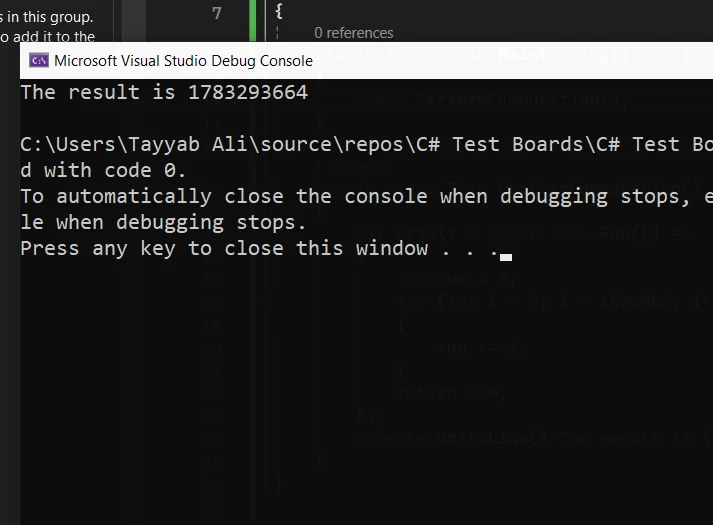
En el ejemplo anterior, la expresión lambda dentro de Task.Run representa un bloque de código dependiente de la CPU que suma un gran rango de números. Al usar Task.Run, este cálculo se descarga a un hilo en segundo plano, permitiendo que el hilo principal se mantenga receptivo. La palabra clave await se usa para esperar asincrónicamente hasta que la tarea finalice, sin bloquear el hilo actual.
Explora las tareas asíncronas y los subprocesos
Cuando invoca Task.Run, el .NET Framework asigna un hilo del pool de hilos para ejecutar la tarea especificada. Esto es eficiente ya que evita la sobrecarga de crear nuevos hilos para cada tarea y ayuda a usar los recursos del sistema de manera más efectiva. El pool de hilos gestiona un conjunto de hilos de trabajo para su aplicación, que pueden ejecutar múltiples tareas simultáneamente en múltiples núcleos.
Gestión de múltiples tareas
Puede ejecutar una nueva tarea concurrentemente usando Task.Run, lo cual es beneficioso para aplicaciones que necesitan realizar varias operaciones independientes simultáneamente. Aquí se muestra cómo puede iniciar múltiples tareas:
using System;
using System.Threading.Tasks;

static async Task HandleMultipleTasks()
{
    Task<int> task1 = Task.Run(() =>
    {
        return PerformLongRunningWork("Task 1");
    });

    Task<int> task2 = Task.Run(() =>
    {
        return PerformLongRunningWork("Task 2");
    });

    // Wait for tasks to finish and print the results
    int[] results = await Task.WhenAll(task1, task2);
    Console.WriteLine($"Results of Task 1: {results[0]}, Task 2: {results[1]}");
}

static int PerformLongRunningWork(string taskName)
{
    int result = 0;
    for (int i = 0; i < 500000; i++)
    {
        result += i;
    }
    Console.WriteLine($"{taskName} completed.");
    return result;
}
using System;
using System.Threading.Tasks;

static async Task HandleMultipleTasks()
{
    Task<int> task1 = Task.Run(() =>
    {
        return PerformLongRunningWork("Task 1");
    });

    Task<int> task2 = Task.Run(() =>
    {
        return PerformLongRunningWork("Task 2");
    });

    // Wait for tasks to finish and print the results
    int[] results = await Task.WhenAll(task1, task2);
    Console.WriteLine($"Results of Task 1: {results[0]}, Task 2: {results[1]}");
}

static int PerformLongRunningWork(string taskName)
{
    int result = 0;
    for (int i = 0; i < 500000; i++)
    {
        result += i;
    }
    Console.WriteLine($"{taskName} completed.");
    return result;
}
Imports System
Imports System.Threading.Tasks
Shared Async Function HandleMultipleTasks() As Task
Dim task1 As Task(Of Integer) = Task.Run(Function()
Return PerformLongRunningWork("Task 1")
End Function)
Dim task2 As Task(Of Integer) = Task.Run(Function()
Return PerformLongRunningWork("Task 2")
End Function)
' Wait for tasks to finish and print the results
Dim results() As Integer = Await Task.WhenAll(task1, task2)
Console.WriteLine($"Results of Task 1: {results(0)}, Task 2: {results(1)}")
End Function
Shared Function PerformLongRunningWork(ByVal taskName As String) As Integer
Dim result As Integer = 0
For i As Integer = 0 To 499999
result += i
Next i
Console.WriteLine($"{taskName} completed.")
Return result
End Function
Imports System
Imports System.Threading.Tasks

Shared Async Function HandleMultipleTasks() As Task
	Dim task1 As Task(Of Integer) = Task.Run(Function()
		Return PerformLongRunningWork("Task 1")
	End Function)

	Dim task2 As Task(Of Integer) = Task.Run(Function()
		Return PerformLongRunningWork("Task 2")
	End Function)

	' Wait for tasks to finish and print the results
	Dim results() As Integer = Await Task.WhenAll(task1, task2)
	Console.WriteLine($"Results of Task 1: {results(0)}, Task 2: {results(1)}")
End Function

Shared Function PerformLongRunningWork(ByVal taskName As String) As Integer
	Dim result As Integer = 0
	For i As Integer = 0 To 499999
		result += i
	Next i
	Console.WriteLine($"{taskName} completed.")
	Return result
End Function
Resultado
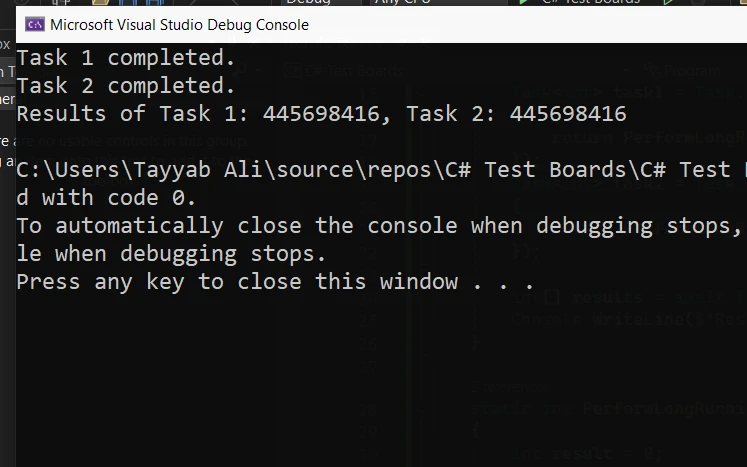
En este ejemplo, HandleMultipleTasks inicia dos tareas asincrónicas. El método Task.WhenAll se usa para esperar cada tarea asincrónica, lo que les permite ejecutarse de manera concurrente. Una vez que ambas tareas se completan, continúa con la siguiente línea de código.
Bestes prácticas y consideraciones
Aunque Task.Run es una herramienta valiosa para la programación asincrónica, es importante usarlo sabiamente para evitar escollos comunes como usar en exceso los recursos del sistema o causar comportamientos inesperados en su aplicación.
Utilizar Task.Run para operaciones ligadas a la CPU
Es mejor usar Task.Run para trabajos dependientes de CPU y no para operaciones dependientes de E/S. Para tareas dependientes de E/S, use operaciones de E/S asincrónicas disponibles en las bibliotecas .NET.
Tenga cuidado con los hilos de thread pool
Recuerde que Task.Run usa hilos de pool de hilos. Agotar estos hilos ejecutando demasiadas operaciones concurrentes puede llevar a retrasos en los tiempos de inicio de tareas y lentitud general de la aplicación.
Evite el código síncrono
Al esperar tareas iniciadas por Task.Run, evite usar esperas sincrónicas como los métodos Task.Result o Task.Wait, ya que pueden llevar a bloqueos, especialmente en contextos como aplicaciones UI.
Presentación de IronPDF
IronPDF es una biblioteca de C# que le permite generar y gestionar archivos PDF directamente desde HTML, CSS y JavaScript. Está diseñada para desarrolladores .NET y simplifica la creación de PDFs mediante el uso de contenido web que ya tiene, asegurando que lo que ve en el navegador es lo que obtiene en el PDF. Es adecuada para diversas aplicaciones .NET, ya sean web, de escritorio o basadas en servidores, y ofrece características como edición de PDF, manejo de formularios y creación de documentos seguros.
En términos más simples, IronPDF le ayuda a convertir páginas web en PDFs fácil y precisamente. No necesita lidiar con APIs complejas; simplemente diseñe su página en HTML e IronPDF hace el resto. Funciona en diferentes plataformas .NET y ofrece herramientas para ajustar, asegurar e interactuar con sus PDFs.
IronPDF con Task.Run
Ejemplo de código
Aquí hay un ejemplo simple de cómo usar IronPDF con Task.Run en C#. Este ejemplo demuestra cómo generar un PDF a partir de contenido HTML de forma asincrónica. Esto es particularmente útil para evitar congelamiento de la interfaz de usuario en aplicaciones de escritorio o para gestionar la carga en aplicaciones web:
using IronPdf;
using System.Threading.Tasks;

public class PdfGenerator
{
    public static async Task CreatePdfAsync()
    {
        var renderer = new ChromePdfRenderer();
        var htmlContent = "<h1>Hello, IronPDF!</h1><p>This is an async PDF generation.</p>";

        // Run the PDF generation in a separate task
        var pdf = await Task.Run(() => renderer.RenderHtmlAsPdf(htmlContent));

        // Save the PDF to a file
        pdf.SaveAs("async IronPDF.pdf");
    }

    // Main method to execute the PDF generation
    public static void Main()
    {
        // Set the license key for IronPDF
        License.LicenseKey = "License-Key";

        // Calling the async PDF generation method and blocking the Main thread until completion
        Task.Run(async () => await PdfGenerator.CreatePdfAsync()).Wait();

        // Inform the user that the PDF generation is complete
        System.Console.WriteLine("PDF generated.");
    }
}
using IronPdf;
using System.Threading.Tasks;

public class PdfGenerator
{
    public static async Task CreatePdfAsync()
    {
        var renderer = new ChromePdfRenderer();
        var htmlContent = "<h1>Hello, IronPDF!</h1><p>This is an async PDF generation.</p>";

        // Run the PDF generation in a separate task
        var pdf = await Task.Run(() => renderer.RenderHtmlAsPdf(htmlContent));

        // Save the PDF to a file
        pdf.SaveAs("async IronPDF.pdf");
    }

    // Main method to execute the PDF generation
    public static void Main()
    {
        // Set the license key for IronPDF
        License.LicenseKey = "License-Key";

        // Calling the async PDF generation method and blocking the Main thread until completion
        Task.Run(async () => await PdfGenerator.CreatePdfAsync()).Wait();

        // Inform the user that the PDF generation is complete
        System.Console.WriteLine("PDF generated.");
    }
}
C#
Resultado
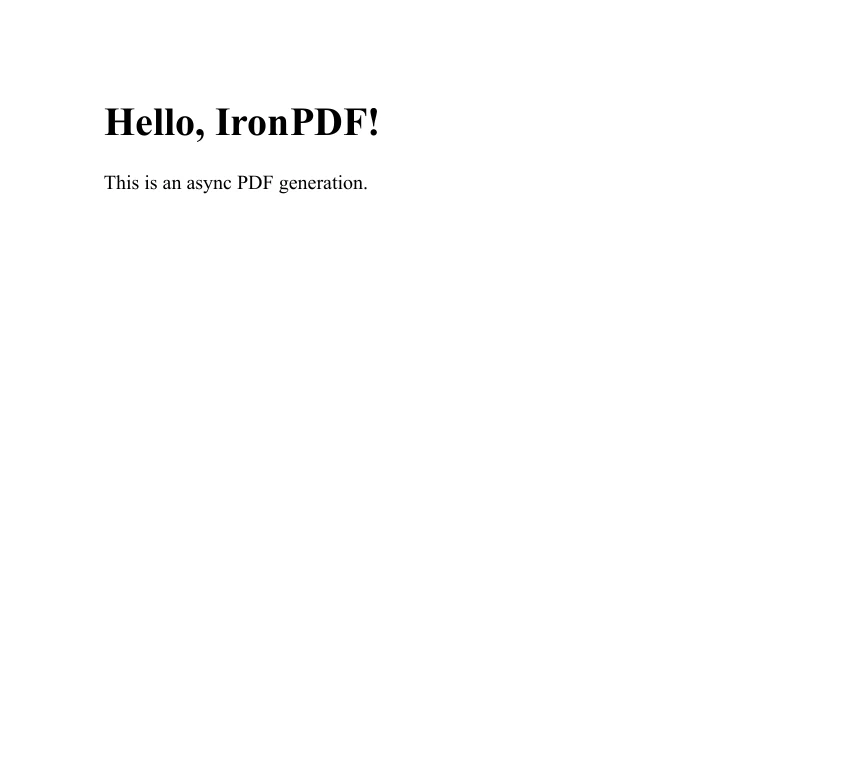
Este ejemplo encapsula la generación de PDF dentro de una Task, haciéndolo adecuado para aplicaciones que requieren operaciones no bloqueantes.
Conclusión
Task.Run es una característica poderosa en C# para gestionar tareas asincrónicas de manera efectiva. Al comprender cómo usarlo correctamente, puede mejorar el rendimiento y la capacidad de respuesta de sus aplicaciones. Recuerde considerar si una tarea es dependiente de CPU o de E/S al decidir cómo implementar operaciones asincrónicas, y siempre procure mantener el hilo de interfaz de usuario libre de tareas de procesamiento pesado.
Los desarrolladores pueden probar IronPDF usando su prueba gratuita antes de decidir comprar. El precio inicial para una licencia es $999.























