Objetos Datetime en C# (Cómo Funciona para Desarrolladores)

DateTime Los objetos en C# son fundamentales para trabajar con fechas y horas en aplicaciones .NET Framework . Proporcionan un conjunto robusto de funcionalidades para manipular, formatear y comparar fechas y horas.
Este artículo tiene como objetivo proporcionar una descripción general completa de los objetos DateTime en C#, cubriendo su creación, manipulación, formato y casos de uso comunes. Al final del artículo, también exploraremos cómo IronPDF de Iron Software puede generar un documento PDF en tiempo real en aplicaciones C#.
Creación de objetos DateTime
Crear un objeto DateTime en C# es sencillo. Hay varios constructores disponibles para inicializar un objeto DateTime con diferentes parámetros:
// Current date and time
DateTime currentDateTime = DateTime.Now;
// Specific date and time
DateTime specificDateTime = new DateTime(2024, 3, 16, 10, 30, 0);
// Date only
DateTime dateOnly = DateTime.Today;
// Date and time in UTC
DateTime utcDateTime = DateTime.UtcNow;
// Current date and time
DateTime currentDateTime = DateTime.Now;
// Specific date and time
DateTime specificDateTime = new DateTime(2024, 3, 16, 10, 30, 0);
// Date only
DateTime dateOnly = DateTime.Today;
// Date and time in UTC
DateTime utcDateTime = DateTime.UtcNow;' Current date and time
Dim currentDateTime As DateTime = DateTime.Now
' Specific date and time
Dim specificDateTime As New DateTime(2024, 3, 16, 10, 30, 0)
' Date only
Dim dateOnly As DateTime = DateTime.Today
' Date and time in UTC
Dim utcDateTime As DateTime = DateTime.UtcNowManipulación de objetos DateTime
Los objetos DateTime proporcionan varios métodos para manipular fechas y horas, como agregar o restar intervalos de tiempo, extraer componentes y convertir entre zonas horarias.
DateTime now = DateTime.Now;
// Adding days
DateTime futureDate = now.AddDays(7);
// Subtracting hours
DateTime pastTime = now.AddHours(-3);
// Getting components
int year = now.Year;
int month = now.Month;
int day = now.Day;
int hour = now.Hour;
int minute = now.Minute;
int second = now.Second;
// Converting between time zones
DateTime utcTime = DateTime.UtcNow;
DateTime localTime = utcTime.ToLocalTime();
DateTime now = DateTime.Now;
// Adding days
DateTime futureDate = now.AddDays(7);
// Subtracting hours
DateTime pastTime = now.AddHours(-3);
// Getting components
int year = now.Year;
int month = now.Month;
int day = now.Day;
int hour = now.Hour;
int minute = now.Minute;
int second = now.Second;
// Converting between time zones
DateTime utcTime = DateTime.UtcNow;
DateTime localTime = utcTime.ToLocalTime();Dim now As DateTime = DateTime.Now
' Adding days
Dim futureDate As DateTime = now.AddDays(7)
' Subtracting hours
Dim pastTime As DateTime = now.AddHours(-3)
' Getting components
Dim year As Integer = now.Year
Dim month As Integer = now.Month
Dim day As Integer = now.Day
Dim hour As Integer = now.Hour
Dim minute As Integer = now.Minute
Dim second As Integer = now.Second
' Converting between time zones
Dim utcTime As DateTime = DateTime.UtcNow
Dim localTime As DateTime = utcTime.ToLocalTime()Formato de objetos DateTime
DateTime Los objetos se pueden formatear en cadenas utilizando varios especificadores de formato para representarlos en el formato requerido.
DateTime dateTime = DateTime.Now;
// Standard date and time format
string standardFormat = dateTime.ToString("G");
// Custom format
string customFormat = dateTime.ToString("dd/MM/yyyy HH:mm:ss");
// Format for sorting
string sortableFormat = dateTime.ToString("yyyy-MM-ddTHH:mm:ss");
DateTime dateTime = DateTime.Now;
// Standard date and time format
string standardFormat = dateTime.ToString("G");
// Custom format
string customFormat = dateTime.ToString("dd/MM/yyyy HH:mm:ss");
// Format for sorting
string sortableFormat = dateTime.ToString("yyyy-MM-ddTHH:mm:ss");Imports System
Dim dateTime As DateTime = DateTime.Now
' Standard date and time format
Dim standardFormat As String = dateTime.ToString("G")
' Custom format
Dim customFormat As String = dateTime.ToString("dd/MM/yyyy HH:mm:ss")
' Format for sorting
Dim sortableFormat As String = dateTime.ToString("yyyy-MM-ddTHH:mm:ss")Comparación de objetos DateTime
C# proporciona operadores de comparación estándar (<, >, <=, >=, ==, !=) que se pueden usar para comparar dos objetos DateTime directamente. Estos operadores comparan los ticks subyacentes de los objetos DateTime, que representan la cantidad de intervalos de 100 nanosegundos que han transcurrido desde el 1 de enero de 0001, a las 00:00:00.000 en el calendario gregoriano.
A continuación se muestra un ejemplo que demuestra el uso de operadores de comparación:
DateTime date1 = DateTime.Now;
DateTime date2 = DateTime.Now.AddDays(1);
if (date1 < date2)
{
    Console.WriteLine("date1 is earlier than date2.");
}
else if (date1 > date2)
{
    Console.WriteLine("date1 is later than date2.");
}
else
{
    Console.WriteLine("date1 is equal to date2.");
}
DateTime date1 = DateTime.Now;
DateTime date2 = DateTime.Now.AddDays(1);
if (date1 < date2)
{
Console.WriteLine("date1 is earlier than date2.");
}
else if (date1 > date2)
{
Console.WriteLine("date1 is later than date2.");
}
else
{
Console.WriteLine("date1 is equal to date2.");
}Dim date1 As DateTime = DateTime.Now
Dim date2 As DateTime = DateTime.Now.AddDays(1)
If date1 < date2 Then
Console.WriteLine("date1 is earlier than date2.")
ElseIf date1 > date2 Then
Console.WriteLine("date1 is later than date2.")
Else
Console.WriteLine("date1 is equal to date2.")
End IfUso del método C# DateTime.Compare
Además de los operadores de comparación, los objetos DateTime también proporcionan métodos para comparar los valores relativos entre esos objetos. Estos métodos ofrecen más flexibilidad y legibilidad en ciertos escenarios. El método CompareTo() compara dos objetos DateTime y devuelve un valor entero que indica si uno es anterior, posterior o igual que el otro.
DateTime date1 = DateTime.Now;
DateTime date2 = DateTime.Now.AddDays(1);
int result = date1.CompareTo(date2);
if (result < 0)
{
    Console.WriteLine("date1 is earlier than date2.");
}
else if (result > 0)
{
    Console.WriteLine("date1 is later than date2.");
}
else
{
    Console.WriteLine("date1 is equal to date2.");
}
DateTime date1 = DateTime.Now;
DateTime date2 = DateTime.Now.AddDays(1);
int result = date1.CompareTo(date2);
if (result < 0)
{
Console.WriteLine("date1 is earlier than date2.");
}
else if (result > 0)
{
Console.WriteLine("date1 is later than date2.");
}
else
{
Console.WriteLine("date1 is equal to date2.");
}Dim date1 As DateTime = DateTime.Now
Dim date2 As DateTime = DateTime.Now.AddDays(1)
Dim result As Integer = date1.CompareTo(date2)
If result < 0 Then
Console.WriteLine("date1 is earlier than date2.")
ElseIf result > 0 Then
Console.WriteLine("date1 is later than date2.")
Else
Console.WriteLine("date1 is equal to date2.")
End IfComparación de objetos DateTime con tolerancia
Para comparar objetos DateTime, especialmente cuando se trata de cálculos que involucran intervalos de tiempo, es importante considerar un nivel de tolerancia debido a posibles diferencias en la precisión.
Esto se puede lograr comparando la diferencia absoluta entre dos valores DateTime con un umbral de tolerancia predefinido.
class Program
{
    public static void Main()
    {
        DateTime date1 = DateTime.Now;
        DateTime date2 = DateTime.Now.AddMilliseconds(10);
        TimeSpan tolerance = TimeSpan.FromMilliseconds(5);
        bool isEqual = Math.Abs((date1 - date2).TotalMilliseconds) <= tolerance.TotalMilliseconds;
        if (isEqual)
        {
            Console.WriteLine("date1 is considered equal to date2 within the tolerance.");
        }
        else
        {
            Console.WriteLine("date1 is not equal to date2 within the tolerance.");
        }
    }
}
class Program
{
public static void Main()
{
DateTime date1 = DateTime.Now;
DateTime date2 = DateTime.Now.AddMilliseconds(10);
TimeSpan tolerance = TimeSpan.FromMilliseconds(5);
bool isEqual = Math.Abs((date1 - date2).TotalMilliseconds) <= tolerance.TotalMilliseconds;
if (isEqual)
{
Console.WriteLine("date1 is considered equal to date2 within the tolerance.");
}
else
{
Console.WriteLine("date1 is not equal to date2 within the tolerance.");
}
}
}Friend Class Program
Public Shared Sub Main()
Dim date1 As DateTime = DateTime.Now
Dim date2 As DateTime = DateTime.Now.AddMilliseconds(10)
Dim tolerance As TimeSpan = TimeSpan.FromMilliseconds(5)
Dim isEqual As Boolean = Math.Abs((date1.Subtract(date2)).TotalMilliseconds) <= tolerance.TotalMilliseconds
If isEqual Then
Console.WriteLine("date1 is considered equal to date2 within the tolerance.")
Else
Console.WriteLine("date1 is not equal to date2 within the tolerance.")
End If
End Sub
End ClassManejo de la zona horaria y del horario de verano
DateTime Los objetos en C# pueden representar tanto la hora local como el tiempo universal coordinado (UTC). Es importante estar al tanto de las conversiones de zonas horarias, especialmente cuando se trabaja con aplicaciones globales.
DateTime localTime = DateTime.Now;
DateTime utcTime = DateTime.UtcNow;
Console.WriteLine("Local Time: " + localTime);
Console.WriteLine("UTC Time: " + utcTime);
DateTime localTime = DateTime.Now;
DateTime utcTime = DateTime.UtcNow;
Console.WriteLine("Local Time: " + localTime);
Console.WriteLine("UTC Time: " + utcTime);Dim localTime As DateTime = DateTime.Now
Dim utcTime As DateTime = DateTime.UtcNow
Console.WriteLine("Local Time: " & localTime)
Console.WriteLine("UTC Time: " & utcTime)IronPDF para generar documentos PDF en C
IronPDF de Iron Software es una biblioteca de generación de PDF eficiente y fácil de usar. Puede instalarlo usando el Administrador de Paquetes NuGet:
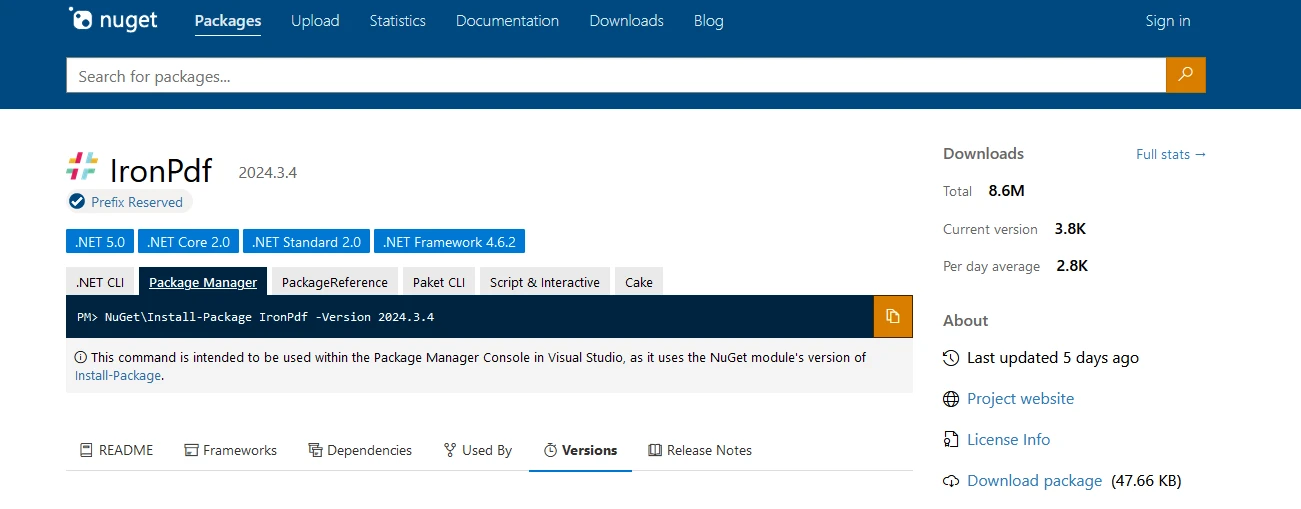
dotnet add package IronPdf --version 2024.3.4
O desde Visual Studio como se muestra a continuación:

Ahora profundicemos en la generación de PDF para demostrar un objeto DateTime.
using IronPdf;

class Program
{
    static void Main()
    {
        Console.WriteLine("-----------Iron Software-------------");

        // Create a new instance of ChromePdfRenderer
        var renderer = new ChromePdfRenderer();

        // HTML content for the PDF
        var content = "<h1> Iron Software is Awesome </h1> Made with IronPDF!";
        content += "<h2>Demo Datetime Objects in C#</h2>";

        // Current date and time
        content += "<h3>Current date and time</h3>";
        DateTime currentDateTime = DateTime.Now;
        content += $"<p>Current date and time: {currentDateTime:U}</p>";
        Console.WriteLine($"Current date and time: {currentDateTime:U}");

        // Specific date and time
        content += "<h3>Specific date and time</h3>";
        DateTime specificDateTime = new DateTime(2024, 3, 16, 10, 30, 0);
        content += $"<p>Specific date and time: {specificDateTime:U}</p>";
        Console.WriteLine($"Specific date and time: {specificDateTime:U}");

        // Date only
        content += "<h3>Date Only</h3>";
        DateTime dateOnly = DateTime.Today;
        content += $"<p>Date only: {dateOnly:U}</p>";
        Console.WriteLine($"Date only: {dateOnly:U}");

        // Date and time in UTC
        content += "<h3>Date and time in UTC</h3>";
        DateTime utcDateTime = DateTime.UtcNow;
        content += $"<p>Date and time in UTC: {utcDateTime:U}</p>";
        Console.WriteLine($"Date and time in UTC: {utcDateTime:U}");

        // Compare dates with Operators
        content += "<h3>Compare dates with Operators</h3>";
        DateTime date1 = DateTime.Now;
        DateTime date2 = DateTime.Now.AddDays(1);
        content += $"<p>Compare date1 {date1:d}, date2 {date2:d}: {CompareDates(date1, date2)}</p>";
        Console.WriteLine($"Compare date1 {date1:U}, date2 {date2:U}: {CompareDates(date1, date2)}");

        // Compare dates with Compare Method
        content += "<h3>Compare dates with Compare Method</h3>";
        content += $"<p>Compare date1 {date1:d}, date2 {date2:d}: {CompareDatesWithCompare(date1, date2)}</p>";
        Console.WriteLine($"Compare date1 {date1:U}, date2 {date2:U}: {CompareDatesWithCompare(date1, date2)}");

        // Render the content to PDF
        var pdf = renderer.RenderHtmlAsPdf(content);

        // Save the PDF to the output file
        pdf.SaveAs("outputDate.pdf");
    }

    // Compare two dates using CompareTo method
    public static string CompareDatesWithCompare(DateTime date1, DateTime date2)
    {
        int result = date1.CompareTo(date2);
        string resultString;
        if (result < 0)
        {
            resultString = "date1 is earlier than date2.";
            Console.WriteLine(resultString);
        }
        else if (result > 0)
        {
            resultString = "date1 is later than date2.";
            Console.WriteLine(resultString);
        }
        else
        {
            resultString = "date1 is equal to date2.";
            Console.WriteLine(resultString);
        }
        return resultString;
    }

    // Compare two dates using basic comparison operators
    public static string CompareDates(DateTime date1, DateTime date2)
    {
        string result;
        if (CheckLessor(date1, date2))
        {
            result = "date1 is earlier than date2.";
            Console.WriteLine(result);
        }
        else if (CheckGreater(date1, date2))
        {
            result = "date1 is later than date2.";
            Console.WriteLine(result);
        }
        else
        {
            result = "date1 is equal to date2.";
            Console.WriteLine(result);
        }
        return result;
    }

    // Helper method to check if the first date is greater than the second date
    public static bool CheckGreater(DateTime date1, DateTime date2)
    {
        return date1 > date2;
    }

    // Helper method to check if the first date is less than the second date
    public static bool CheckLessor(DateTime date1, DateTime date2)
    {
        return date1 < date2;
    }
}
using IronPdf;
class Program
{
static void Main()
{
Console.WriteLine("-----------Iron Software-------------");
// Create a new instance of ChromePdfRenderer
var renderer = new ChromePdfRenderer();
// HTML content for the PDF
var content = "<h1> Iron Software is Awesome </h1> Made with IronPDF!";
content += "<h2>Demo Datetime Objects in C#</h2>";
// Current date and time
content += "<h3>Current date and time</h3>";
DateTime currentDateTime = DateTime.Now;
content += $"<p>Current date and time: {currentDateTime:U}</p>";
Console.WriteLine($"Current date and time: {currentDateTime:U}");
// Specific date and time
content += "<h3>Specific date and time</h3>";
DateTime specificDateTime = new DateTime(2024, 3, 16, 10, 30, 0);
content += $"<p>Specific date and time: {specificDateTime:U}</p>";
Console.WriteLine($"Specific date and time: {specificDateTime:U}");
// Date only
content += "<h3>Date Only</h3>";
DateTime dateOnly = DateTime.Today;
content += $"<p>Date only: {dateOnly:U}</p>";
Console.WriteLine($"Date only: {dateOnly:U}");
// Date and time in UTC
content += "<h3>Date and time in UTC</h3>";
DateTime utcDateTime = DateTime.UtcNow;
content += $"<p>Date and time in UTC: {utcDateTime:U}</p>";
Console.WriteLine($"Date and time in UTC: {utcDateTime:U}");
// Compare dates with Operators
content += "<h3>Compare dates with Operators</h3>";
DateTime date1 = DateTime.Now;
DateTime date2 = DateTime.Now.AddDays(1);
content += $"<p>Compare date1 {date1:d}, date2 {date2:d}: {CompareDates(date1, date2)}</p>";
Console.WriteLine($"Compare date1 {date1:U}, date2 {date2:U}: {CompareDates(date1, date2)}");
// Compare dates with Compare Method
content += "<h3>Compare dates with Compare Method</h3>";
content += $"<p>Compare date1 {date1:d}, date2 {date2:d}: {CompareDatesWithCompare(date1, date2)}</p>";
Console.WriteLine($"Compare date1 {date1:U}, date2 {date2:U}: {CompareDatesWithCompare(date1, date2)}");
// Render the content to PDF
var pdf = renderer.RenderHtmlAsPdf(content);
// Save the PDF to the output file
pdf.SaveAs("outputDate.pdf");
}
// Compare two dates using CompareTo method
public static string CompareDatesWithCompare(DateTime date1, DateTime date2)
{
int result = date1.CompareTo(date2);
string resultString;
if (result < 0)
{
resultString = "date1 is earlier than date2.";
Console.WriteLine(resultString);
}
else if (result > 0)
{
resultString = "date1 is later than date2.";
Console.WriteLine(resultString);
}
else
{
resultString = "date1 is equal to date2.";
Console.WriteLine(resultString);
}
return resultString;
}
// Compare two dates using basic comparison operators
public static string CompareDates(DateTime date1, DateTime date2)
{
string result;
if (CheckLessor(date1, date2))
{
result = "date1 is earlier than date2.";
Console.WriteLine(result);
}
else if (CheckGreater(date1, date2))
{
result = "date1 is later than date2.";
Console.WriteLine(result);
}
else
{
result = "date1 is equal to date2.";
Console.WriteLine(result);
}
return result;
}
// Helper method to check if the first date is greater than the second date
public static bool CheckGreater(DateTime date1, DateTime date2)
{
return date1 > date2;
}
// Helper method to check if the first date is less than the second date
public static bool CheckLessor(DateTime date1, DateTime date2)
{
return date1 < date2;
}
}Imports IronPdf
Friend Class Program
Shared Sub Main()
Console.WriteLine("-----------Iron Software-------------")
' Create a new instance of ChromePdfRenderer
Dim renderer = New ChromePdfRenderer()
' HTML content for the PDF
Dim content = "<h1> Iron Software is Awesome </h1> Made with IronPDF!"
content &= "<h2>Demo Datetime Objects in C#</h2>"
' Current date and time
content &= "<h3>Current date and time</h3>"
Dim currentDateTime As DateTime = DateTime.Now
content &= $"<p>Current date and time: {currentDateTime:U}</p>"
Console.WriteLine($"Current date and time: {currentDateTime:U}")
' Specific date and time
content &= "<h3>Specific date and time</h3>"
Dim specificDateTime As New DateTime(2024, 3, 16, 10, 30, 0)
content &= $"<p>Specific date and time: {specificDateTime:U}</p>"
Console.WriteLine($"Specific date and time: {specificDateTime:U}")
' Date only
content &= "<h3>Date Only</h3>"
Dim dateOnly As DateTime = DateTime.Today
content &= $"<p>Date only: {dateOnly:U}</p>"
Console.WriteLine($"Date only: {dateOnly:U}")
' Date and time in UTC
content &= "<h3>Date and time in UTC</h3>"
Dim utcDateTime As DateTime = DateTime.UtcNow
content &= $"<p>Date and time in UTC: {utcDateTime:U}</p>"
Console.WriteLine($"Date and time in UTC: {utcDateTime:U}")
' Compare dates with Operators
content &= "<h3>Compare dates with Operators</h3>"
Dim date1 As DateTime = DateTime.Now
Dim date2 As DateTime = DateTime.Now.AddDays(1)
content &= $"<p>Compare date1 {date1:d}, date2 {date2:d}: {CompareDates(date1, date2)}</p>"
Console.WriteLine($"Compare date1 {date1:U}, date2 {date2:U}: {CompareDates(date1, date2)}")
' Compare dates with Compare Method
content &= "<h3>Compare dates with Compare Method</h3>"
content &= $"<p>Compare date1 {date1:d}, date2 {date2:d}: {CompareDatesWithCompare(date1, date2)}</p>"
Console.WriteLine($"Compare date1 {date1:U}, date2 {date2:U}: {CompareDatesWithCompare(date1, date2)}")
' Render the content to PDF
Dim pdf = renderer.RenderHtmlAsPdf(content)
' Save the PDF to the output file
pdf.SaveAs("outputDate.pdf")
End Sub
' Compare two dates using CompareTo method
Public Shared Function CompareDatesWithCompare(ByVal date1 As DateTime, ByVal date2 As DateTime) As String
Dim result As Integer = date1.CompareTo(date2)
Dim resultString As String
If result < 0 Then
resultString = "date1 is earlier than date2."
Console.WriteLine(resultString)
ElseIf result > 0 Then
resultString = "date1 is later than date2."
Console.WriteLine(resultString)
Else
resultString = "date1 is equal to date2."
Console.WriteLine(resultString)
End If
Return resultString
End Function
' Compare two dates using basic comparison operators
Public Shared Function CompareDates(ByVal date1 As DateTime, ByVal date2 As DateTime) As String
Dim result As String
If CheckLessor(date1, date2) Then
result = "date1 is earlier than date2."
Console.WriteLine(result)
ElseIf CheckGreater(date1, date2) Then
result = "date1 is later than date2."
Console.WriteLine(result)
Else
result = "date1 is equal to date2."
Console.WriteLine(result)
End If
Return result
End Function
' Helper method to check if the first date is greater than the second date
Public Shared Function CheckGreater(ByVal date1 As DateTime, ByVal date2 As DateTime) As Boolean
Return date1 > date2
End Function
' Helper method to check if the first date is less than the second date
Public Shared Function CheckLessor(ByVal date1 As DateTime, ByVal date2 As DateTime) As Boolean
Return date1 < date2
End Function
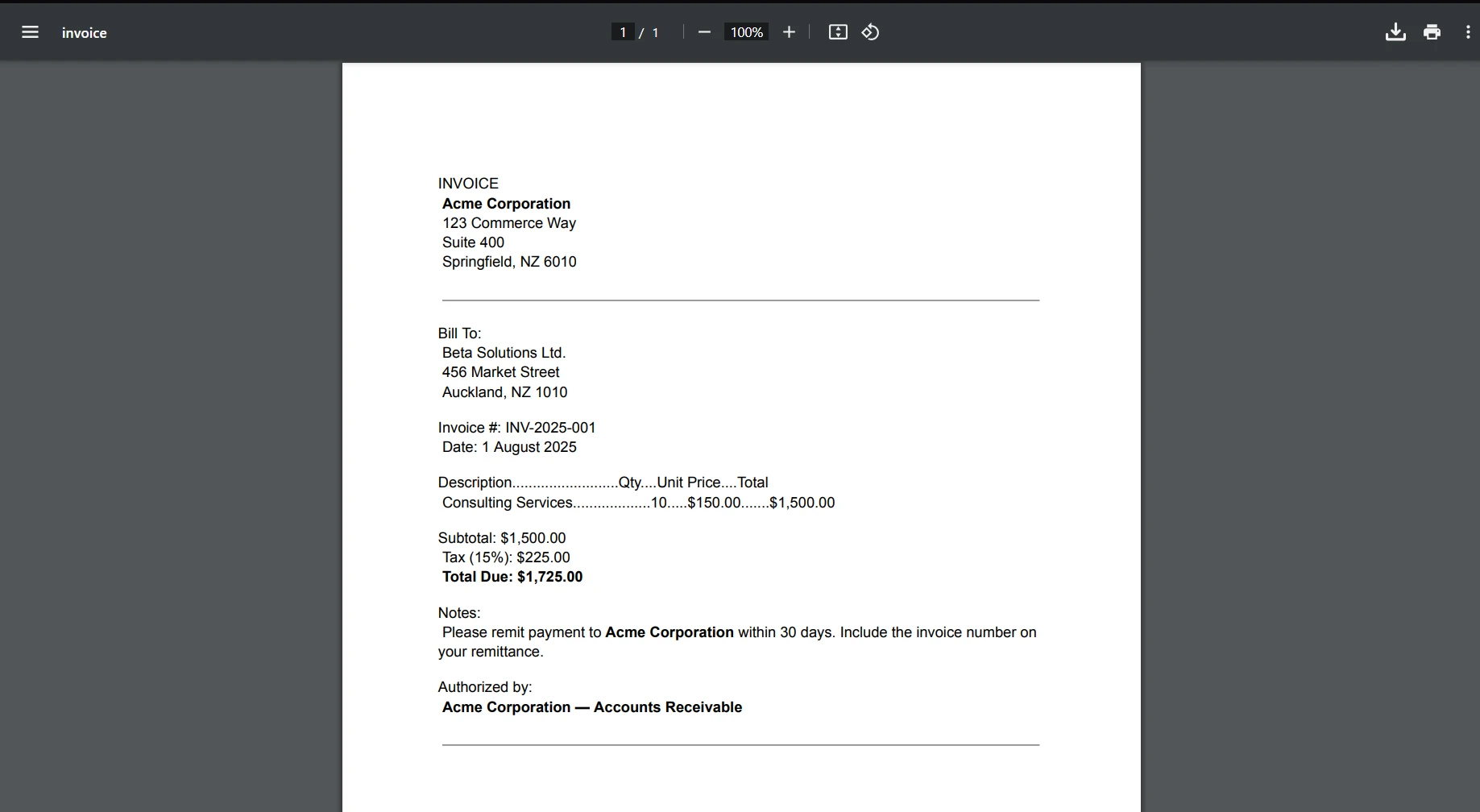
End ClassLa siguiente salida muestra el PDF generado con objetos DateTime:
DateTime Objetos en C# (Cómo funciona para desarrolladores): Figura 3
Licencia de prueba de IronPDF
IronPDF requiere una licencia de prueba para su funcionalidad completa. Proporcione un ID de correo electrónico para generar una clave de licencia que se enviará a su correo.
"IronPdf.LicenseKey": "<Your Key>"Coloque la clave de licencia en el archivo AppSettings.json.
Conclusión
DateTime Los objetos en C# proporcionan una forma poderosa de trabajar con fechas y horas en aplicaciones .NET . Ofrecen una amplia gama de funcionalidades para crear, manipular, formatear y comparar valores de fecha y hora. Comprender cómo utilizar eficazmente los objetos DateTime es esencial para crear funcionalidades de fecha y hora confiables y precisas en aplicaciones C#.
Al aprovechar las capacidades de los objetos DateTime, los desarrolladores pueden garantizar que sus aplicaciones manejen fechas y horas correctamente, independientemente de los requisitos o escenarios específicos que encuentren.
Ya sea para calcular duraciones, programar tareas o mostrar fechas y horas a los usuarios, los objetos DateTime juegan un papel crucial en muchos aspectos de la programación en C# relacionados con la gestión de fechas y horas.
Preguntas Frecuentes
¿Para qué se utilizan los objetos DateTime en C#?
Los objetos DateTime en C# se utilizan para manejar fechas y horas dentro de aplicaciones del .NET Framework. Ofrecen funcionalidades para manipular, formatear y comparar fechas y horas, lo que los hace esenciales para cualquier aplicación que maneje datos de tiempo.
¿Cómo puedo crear un objeto DateTime para una fecha específica en C#?
Para crear un objeto DateTime para una fecha específica en C#, puede usar el constructor con parámetros. Por ejemplo, DateTime specificDate = new DateTime(2023, 12, 31); crea un objeto DateTime para el 31 de diciembre de 2023.
¿Cómo se formatean los objetos DateTime como cadenas en C#?
Puede formatear objetos DateTime como cadenas en C# usando el método ToString() con especificadores de formato. Por ejemplo, dateTime.ToString("yyyy-MM-dd") formatea la fecha como '2023-12-31'.
¿Cómo puedo convertir la hora local a UTC usando DateTime en C#?
Puede convertir la hora local a UTC en C# utilizando el método ToUniversalTime() en un objeto DateTime. Esto es útil para estandarizar datos de fecha y hora en diferentes zonas horarias.
¿Qué métodos están disponibles para comparar objetos DateTime en C#?
En C#, los objetos DateTime pueden compararse usando operadores como <, >, <=, >=, == y !=. Además, el método CompareTo() proporciona una manera de determinar el orden relativo de dos instancias de DateTime.
¿Cómo se puede utilizar IronPDF para generar documentos PDF con objetos DateTime en C#?
IronPDF permite a los desarrolladores crear documentos PDF en C# que incluyen información de DateTime. Puede insertar cadenas DateTime formateadas en el contenido del PDF para mostrar datos de tiempo y fecha dinámicos.
¿Cómo maneja los cambios de hora de verano con DateTime en C#?
El horario de verano se puede gestionar en C# convirtiendo objetos DateTime hacia y desde UTC usando ToLocalTime() y considerando los ajustes de zona horaria para asegurar una representación correcta del tiempo.
¿Por qué es importante la propiedad DateTime.UtcNow en las aplicaciones de C#?
La propiedad DateTime.UtcNow proporciona la fecha y hora UTC actuales, lo cual es esencial para aplicaciones que requieren una referencia de tiempo consistente e independiente de la zona horaria para el registro y la sincronización de datos.
¿Pueden los objetos DateTime en C# ser formateados usando formatos personalizados?
Sí, los objetos DateTime en C# pueden ser formateados usando formatos personalizados proporcionando una cadena de formato al método ToString(). Esto le permite mostrar la fecha y hora en cualquier formato deseado.
¿Cuál es la importancia de convertir objetos DateTime al formato de cadena en C#?
Convertir objetos DateTime al formato de cadena en C# es significativo para mostrar información de fecha y hora en interfaces de usuario, informes y registros. Asegura que los datos se presenten de una manera legible y consistente.
















 Comience gratis
 Comience gratis
 Reserve demostración en vivo gratis





 No se requiere tarjeta de crédito ni creación de cuenta