from ironpdf import *

# Instantiate Renderer
renderer = ChromePdfRenderer()

# Create a PDF from a HTML string using Python
pdf = renderer.RenderHtmlAsPdf("<h1>Hello World</h1>")

# Export to a file or Stream
pdf.SaveAs("output.pdf")

# Advanced Example with HTML Assets
# Load external html assets: Images, CSS and JavaScript.
# An optional BasePath 'C:\site\assets\' is set as the file location to load assets from
myAdvancedPdf = renderer.RenderHtmlAsPdf("<img src='icons/iron.png'>", r"C:\site\assets")
myAdvancedPdf.SaveAs("html-with-assets.pdf")
from ironpdf import *# Instantiate Rendererrenderer = ChromePdfRenderer()# Create a PDF from a HTML string using Pythonpdf = renderer.RenderHtmlAsPdf("<h1>Hello World</h1>")# Export to a file or Streampdf.SaveAs("output.pdf")# Advanced Example with HTML Assets# Load external html assets: Images, CSS and JavaScript.# An optional BasePath 'C:\site\assets\' is set as the file location to load assets frommyAdvancedPdf = renderer.RenderHtmlAsPdf("<img src='icons/iron.png'>", r"C:\site\assets")myAdvancedPdf.SaveAs("html-with-assets.pdf")
En el mundo actual impulsado por los datos, producir [informes](https://es.wikipedia.org/wiki/Informe) completos y visualmente atractivos es crucial para que las empresas y organizaciones comuniquen ideas de manera efectiva. Python, con su multitud de bibliotecas y flexibilidad, proporciona una base robusta para el análisis y manipulación de datos. Sin embargo, los desarrolladores a menudo buscan herramientas poderosas para simplificar el proceso de creación de informes profesionales. IronPDF ofrece una solución para cerrar la brecha en la generación de archivos PDF. Esta publicación discutirá cómo podemos usar Python para crear archivos PDF utilizando IronPDF, mostrando los esfuerzos de investigación sobre la biblioteca de Python.
## Cómo usar Python para crear informes en PDF
1. Crea un nuevo proyecto en Python.
2. Descarga la biblioteca IronPDF e importa IronPDF.
3. Crea una instancia de IronPDF.
4. Renderiza el lenguaje de marcado de hipertexto como PDF.
5. Guarda el PDF en un archivo.
6. Opcionalmente, abre el PDF en el visor predeterminado.
## IronPDF
Con [IronPDF](/python/), los científicos de datos pueden acelerar la generación de informes, una tarea tradicionalmente que consume mucho tiempo. IronPDF permite la transformación de un DataFrame en informes PDF estéticamente agradables para que puedan comunicar hallazgos de manera eficiente sin un formato extenso.
Esto acelera el proceso de descubrimiento al permitir que los científicos de datos se concentren en el análisis y la exploración. El uso de IronPDF elimina la necesidad de imágenes estáticas y la preparación manual de archivos, lo que abre la puerta a la posibilidad de incluir gráficos interactivos en los informes PDF (aunque IronPDF en sí mismo no ofrece esta funcionalidad de forma nativa). Esto tiene el potencial de mejorar aún más la interacción del usuario con los informes y la presentación de datos.
El paquete IronPDF for Python simplifica la creación y modificación de informes PDF en aplicaciones Python. Al convertir código HTML, contenido de páginas web (URLs) o incluso archivos HTML existentes en documentos PDF con el formato adecuado, funciona como un puente. Para mayor seguridad, puedes modificar diseños, incluir tablas e imágenes, e incluso proteger con contraseña informes importantes. Con la integración fluida en scripts Python, IronPDF se convierte en una herramienta valiosa para producir informes PDF informativos y pulidos.
### Características de IronPDF
* **Generación de PDF:** utilizando código Python, IronPDF permite la creación dinámica de documentos PDF. Puedes empezar desde cero o convertir información HTML existente, incluidas páginas web o plantillas, en formato PDF.
* **Conversión de HTML a PDF:** IronPDF mantiene el diseño, los estilos y los elementos del HTML original mientras lo convierte al formato PDF. Esta funcionalidad permite generar facturas, informes y otros documentos PDF utilizando plantillas HTML.
* **Manipulación de PDF:** IronPDF puede manipular documentos PDF. Puede fusionar múltiples PDFs en uno, dividir un PDF en distintos documentos, extraer páginas y agregar o eliminar páginas.
* **Renderizado de texto e imágenes:** renderice texto e imágenes contenidos en documentos PDF utilizando IronPDF. Esto incluye incrustar texto con fuentes, tamaños y colores especificados, y agregar imágenes.
* **Seguridad y cifrado:** IronPDF ofrece funciones para proteger documentos PDF. Se puede imponer cifrado de protección por contraseña para controlar el acceso, restringir la impresión o copia, y configurar otras opciones de seguridad.
Ten en cuenta que la disponibilidad y funcionalidad de IronPDF en Python puede cambiar con el tiempo, por lo que consulta la [documentación](/python/docs/) oficial de IronPDF u otros recursos para obtener la información más precisa y actualizada.
### Nuevo proyecto en PyCharm
Esta sesión usará PyCharm, un IDE para desarrollar programas en Python.
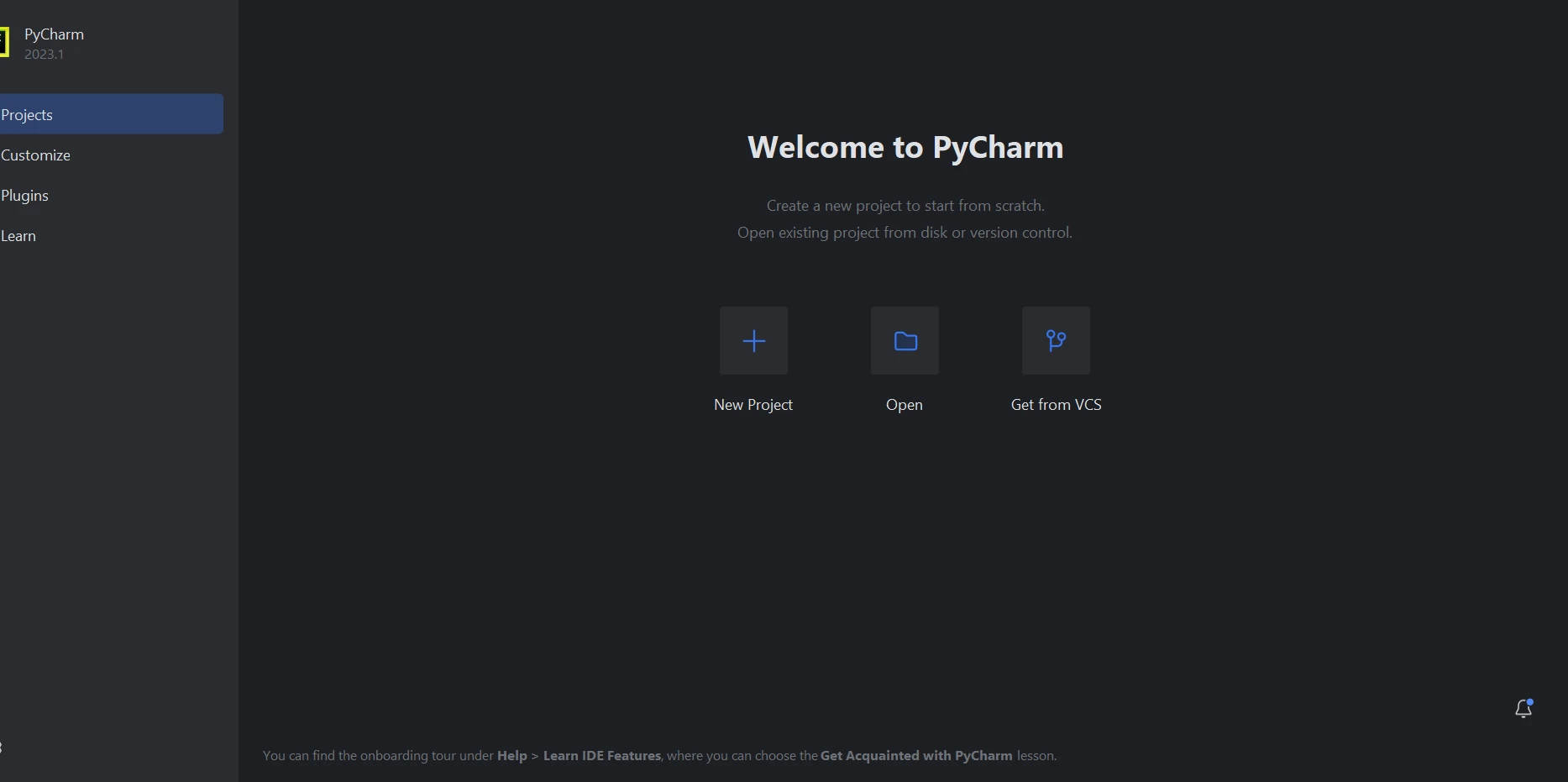
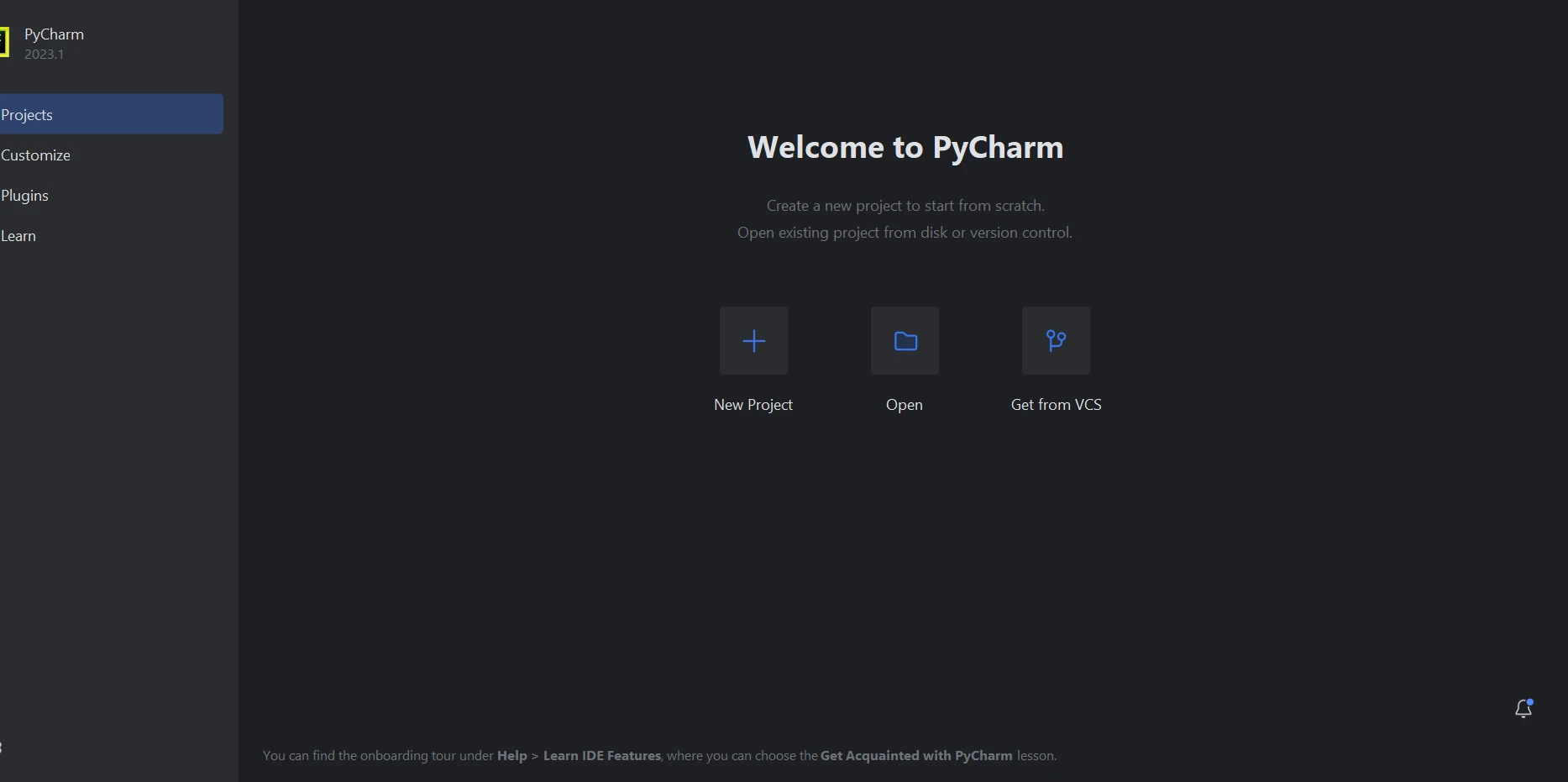
Después de lanzar PyCharm IDE, selecciona "Nuevo proyecto".
Al seleccionar "Nuevo proyecto", puedes personalizar la ubicación y el entorno del proyecto en una nueva ventana. La siguiente captura de pantalla muestra esta nueva ventana en acción.
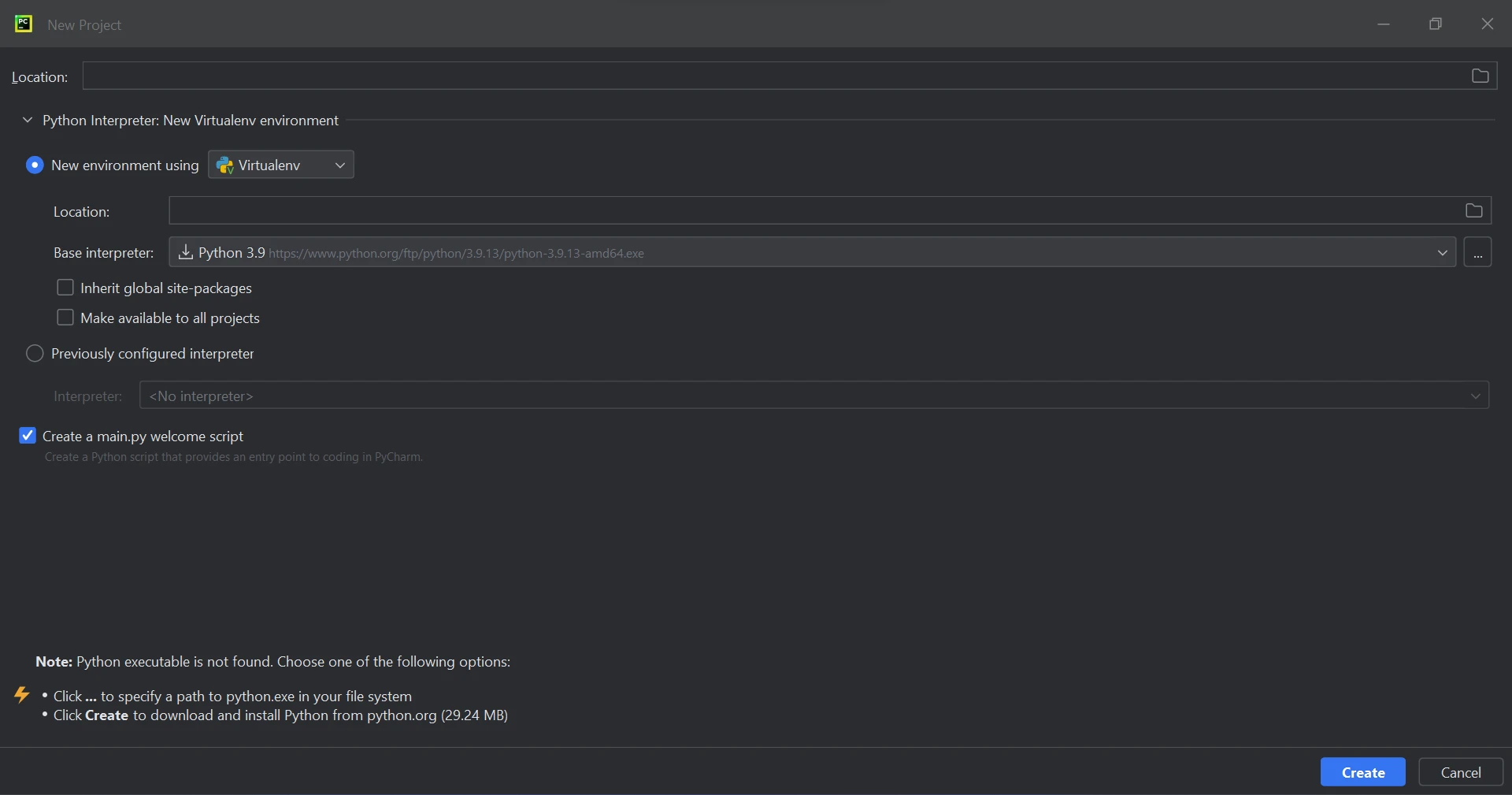
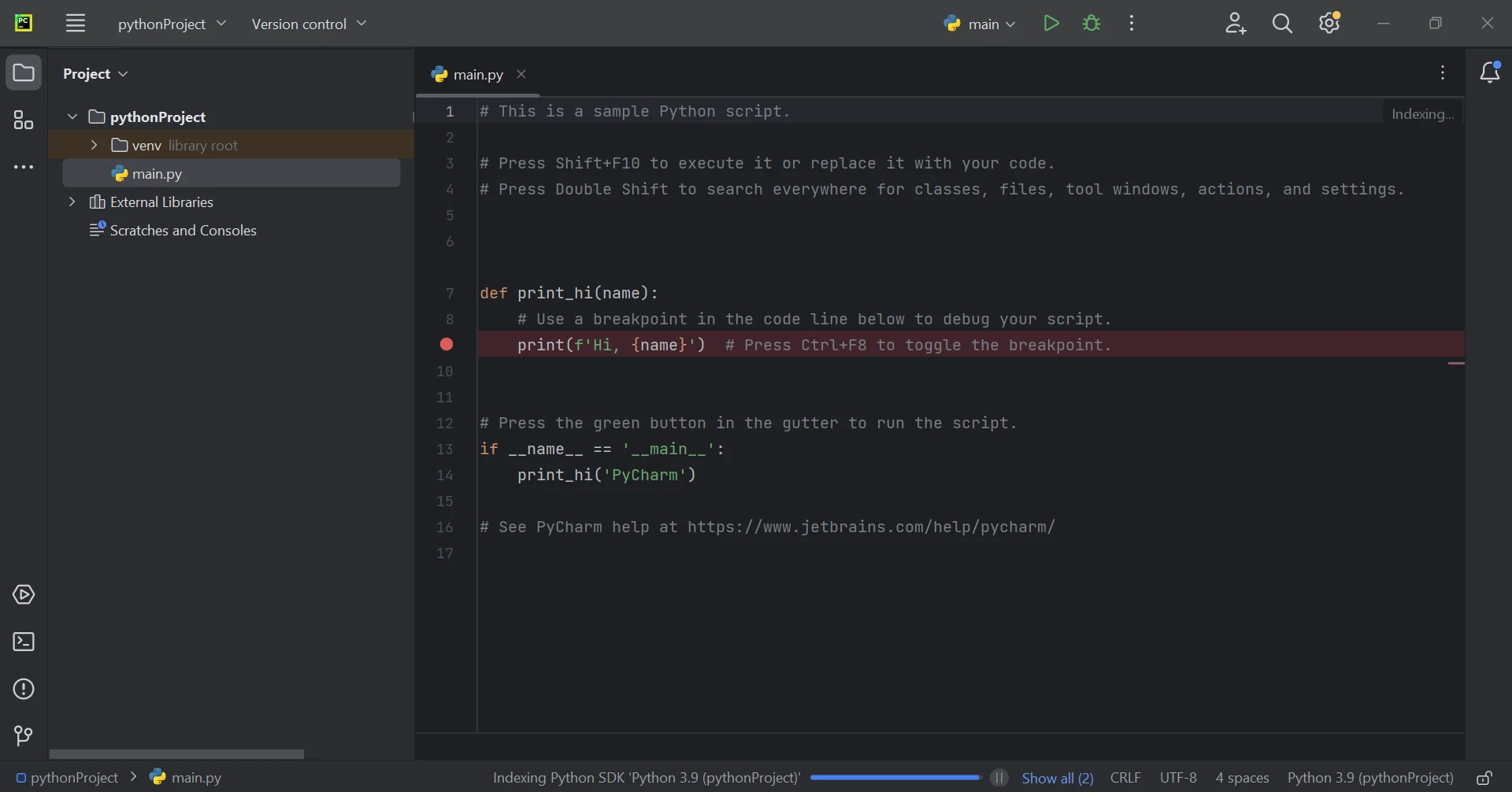
Haz clic en el botón "Crear" para iniciar un nuevo proyecto después de elegir la ubicación del proyecto y configurar el entorno Python. Una vez creado, el proyecto se abrirá en una nueva pestaña.
## Requisitos para utilizar IronPDF
Asegúrate de que se cumplan los siguientes requisitos previos antes de revisar los ejemplos de código:
* **Python:** IronPDF requiere la versión Python 3.7 o superior.
* **.NET 6.0 Runtime:** Las características principales de IronPDF se basan en el entorno de ejecución .NET 6.0. Descarga e instala el entorno de ejecución adecuado desde el sitio web oficial de .NET según tu sistema operativo.
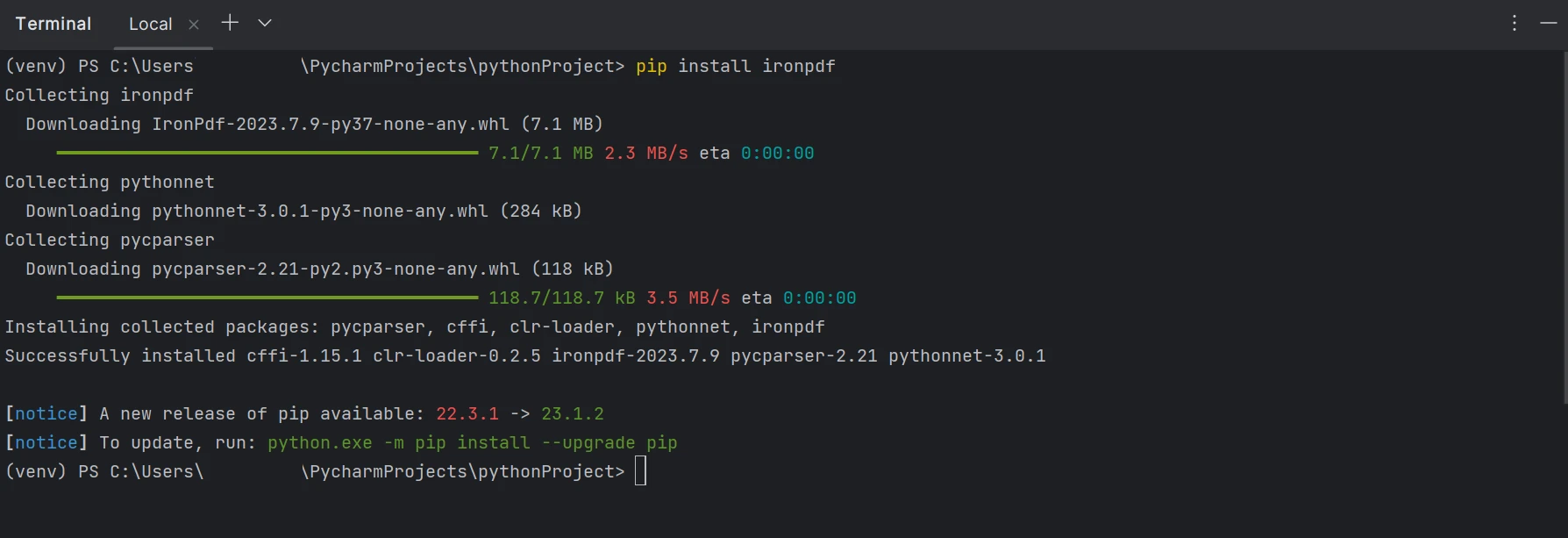
* **Instalación de la biblioteca IronPDF :** Instale la biblioteca IronPDF en su entorno Python utilizando el administrador de paquetes pip. Ejecuta el siguiente comando en una terminal o consola de comandos abierta:
```shell
:ProductInstall
```
La siguiente captura de pantalla muestra cómo se configura el paquete 'IronPDF'.
## Generación de un informe PDF básico a partir de una cadena HTML
Comencemos con un ejemplo básico que muestra cómo transformar una cadena HTML en un informe PDF. Aquí está el código Python:
```python
from ironpdf import ChromePdfRenderer

# Define the HTML content of your report
html_content = """
<h1>Sales Report - Q1 2024</h1>
<p>This report summarizes sales figures for the first quarter of 2024.</p>
<table>
    <thead>
        <tr>
            <th>Product</th>
            <th>Quantity Sold</th>
            <th>Total Revenue</th>
        </tr>
    </thead>
    <tbody>
        <tr>
            <td>Widget A</td>
            <td>100</td>
            <td>$1000</td>
        </tr>
        <tr>
            <td>Widget B</td>
            <td>75</td>
            <td>$750</td>
        </tr>
    </tbody>
</table>
"""

# Create a ChromePdfRenderer instance
renderer = ChromePdfRenderer()

# Render the HTML string as a PDF document
pdf = renderer.RenderHtmlAsPdf(html_content)

# Save the PDF document with a filename
pdf.saveAs("sales_report.pdf")
print("PDF report generated successfully!")
```
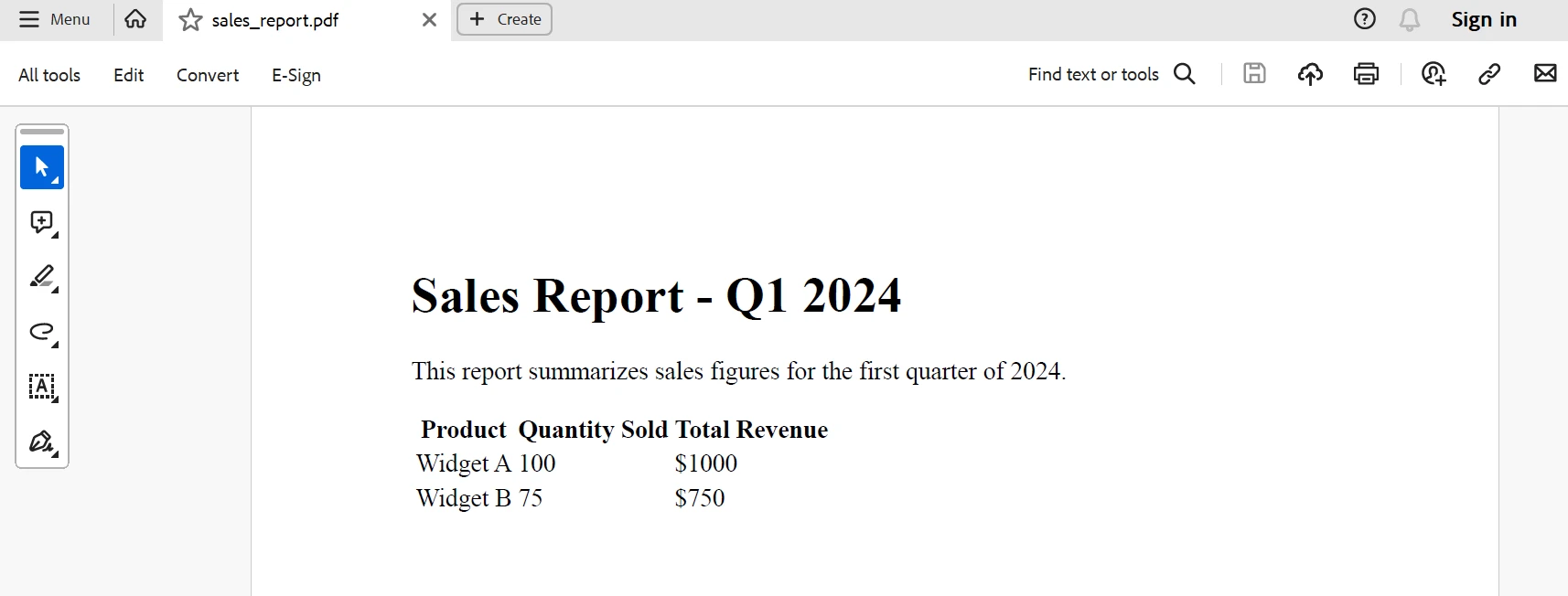
Este código comienza definiendo la cadena HTML que delinea la estructura y los datos del informe. A continuación, se crea una instancia de `ChromePdfRenderer`, que actúa como motor de conversión de HTML a PDF. La función `RenderHtmlAsPdf` crea entonces un documento PDF a partir de la cadena HTML. Por último, el PDF creado se guarda con un nombre de archivo especificado utilizando la función `saveAs`.
- A continuación, el informe generado del código anterior.
## Creación de un informe PDF a partir de un archivo HTML
IronPDF es una opción conveniente si prefieres almacenar el contenido del informe en un archivo HTML separado. Aquí tienes un ejemplo de script en Python:
```python
from ironpdf import ChromePdfRenderer
# Define the path to your HTML report file
html_file_path = "report.html"
# Create a ChromePdfRenderer instance
renderer = ChromePdfRenderer()
# Render the HTML file as a PDF document
pdf = renderer.RenderHtmlFileAsPdf(html_file_path)
# Save the PDF document with a filename
pdf.saveAs("report.pdf")
print("PDF report generated from HTML file!")
```
Este código especifica el archivo HTML que contiene el diseño y los datos de tu informe. A continuación, se llama a la función `RenderHtmlFileAsPdf`, pasando la ruta del archivo. Los pasos subsiguientes para guardar el PDF son idénticos a los del ejemplo anterior.
## Generación de un informe PDF a partir de una URL
Con IronPDF, puedes generar informes PDF utilizando contenido proveniente de sitios web. Aquí tienes cómo hacerlo realidad:
```python
from ironpdf import ChromePdfRenderer
# Define the URL of the web page you want to convert
url = "https://www.example.com/report"
# Create a ChromePdfRenderer instance
renderer = ChromePdfRenderer()
# Render the URL content as a PDF
pdf = renderer.RenderUrlAsPdf(url)
# Save the PDF document with a filename
pdf.saveAs("web_report.pdf")
print("PDF report generated from URL!")
```
Para aprender más sobre el código de IronPDF, consulta [este enlace](/python/examples/using-html-to-create-a-pdf/).
## Conclusión
Para los desarrolladores de Python que aspiran a crear informes en PDF fácil y profesionalmente, IronPDF abre un mundo de posibilidades. Al integrar Python y IronPDF, los desarrolladores pueden aprovechar el poder de .NET dentro de su entorno Python, permitiendo una integración fluida y capacidades robustas de generación de PDF. Ya sea para crear facturas, informes financieros o percepciones empresariales, IronPDF permite a los desarrolladores de Python producir informes en PDF pulidos que transmiten información de manera clara y profesional. Con su rendimiento, versatilidad y facilidad de uso, IronPDF es una herramienta fundamental para mejorar la generación de documentos en aplicaciones Python.
El paquete `$liteLicense` Lite incluye una licencia permanente, un año de asistencia técnica y ofrece opciones de actualización, con restricciones en cuanto a la redistribución y la duración. Para obtener más información sobre el coste de la edición de prueba y las licencias, visite el [sitio web](licensing) de IronPDF. Descubre más sobre las ofertas de Iron Software haciendo clic [aquí](https://ironsoftware.com/).
En el mundo actual impulsado por los datos, producir informes completos y visualmente atractivos es crucial para que las empresas y organizaciones comuniquen ideas de manera efectiva. Python, con su multitud de bibliotecas y flexibilidad, proporciona una base robusta para el análisis y manipulación de datos. Sin embargo, los desarrolladores a menudo buscan herramientas poderosas para simplificar el proceso de creación de informes profesionales. IronPDF ofrece una solución para cerrar la brecha en la generación de archivos PDF. Esta publicación discutirá cómo podemos usar Python para crear archivos PDF utilizando IronPDF, mostrando los esfuerzos de investigación sobre la biblioteca de Python.
Cómo usar Python para crear informes en PDF
Crea un nuevo proyecto en Python.
Descarga la biblioteca IronPDF e importa IronPDF.
Crea una instancia de IronPDF.
Renderiza el lenguaje de marcado de hipertexto como PDF.
Guarda el PDF en un archivo.
Opcionalmente, abre el PDF en el visor predeterminado.
IronPDF
Con IronPDF, los científicos de datos pueden acelerar la generación de informes, una tarea tradicionalmente que consume mucho tiempo. IronPDF permite la transformación de un DataFrame en informes PDF estéticamente agradables para que puedan comunicar hallazgos de manera eficiente sin un formato extenso.
Esto acelera el proceso de descubrimiento al permitir que los científicos de datos se concentren en el análisis y la exploración. El uso de IronPDF elimina la necesidad de imágenes estáticas y la preparación manual de archivos, lo que abre la puerta a la posibilidad de incluir gráficos interactivos en los informes PDF (aunque IronPDF en sí mismo no ofrece esta funcionalidad de forma nativa). Esto tiene el potencial de mejorar aún más la interacción del usuario con los informes y la presentación de datos.
El paquete IronPDF for Python simplifica la creación y modificación de informes PDF en aplicaciones Python. Al convertir código HTML, contenido de páginas web (URLs) o incluso archivos HTML existentes en documentos PDF con el formato adecuado, funciona como un puente. Para mayor seguridad, puedes modificar diseños, incluir tablas e imágenes, e incluso proteger con contraseña informes importantes. Con la integración fluida en scripts Python, IronPDF se convierte en una herramienta valiosa para producir informes PDF informativos y pulidos.
Características de IronPDF
Generación de PDF: utilizando código Python, IronPDF permite la creación dinámica de documentos PDF. Puedes empezar desde cero o convertir información HTML existente, incluidas páginas web o plantillas, en formato PDF.
Conversión de HTML a PDF: IronPDF mantiene el diseño, los estilos y los elementos del HTML original mientras lo convierte al formato PDF. Esta funcionalidad permite generar facturas, informes y otros documentos PDF utilizando plantillas HTML.
Manipulación de PDF: IronPDF puede manipular documentos PDF. Puede fusionar múltiples PDFs en uno, dividir un PDF en distintos documentos, extraer páginas y agregar o eliminar páginas.
Renderizado de texto e imágenes: renderice texto e imágenes contenidos en documentos PDF utilizando IronPDF. Esto incluye incrustar texto con fuentes, tamaños y colores especificados, y agregar imágenes.
Seguridad y cifrado: IronPDF ofrece funciones para proteger documentos PDF. Se puede imponer cifrado de protección por contraseña para controlar el acceso, restringir la impresión o copia, y configurar otras opciones de seguridad.
Ten en cuenta que la disponibilidad y funcionalidad de IronPDF en Python puede cambiar con el tiempo, por lo que consulta la documentación oficial de IronPDF u otros recursos para obtener la información más precisa y actualizada.
Nuevo proyecto en PyCharm
Esta sesión usará PyCharm, un IDE para desarrollar programas en Python.
Después de lanzar PyCharm IDE, selecciona "Nuevo proyecto".
Al seleccionar "Nuevo proyecto", puedes personalizar la ubicación y el entorno del proyecto en una nueva ventana. La siguiente captura de pantalla muestra esta nueva ventana en acción.
Haz clic en el botón "Crear" para iniciar un nuevo proyecto después de elegir la ubicación del proyecto y configurar el entorno Python. Una vez creado, el proyecto se abrirá en una nueva pestaña.
Requisitos para utilizar IronPDF
Asegúrate de que se cumplan los siguientes requisitos previos antes de revisar los ejemplos de código:
Python: IronPDF requiere la versión Python 3.7 o superior.
.NET 6.0 Runtime: Las características principales de IronPDF se basan en el entorno de ejecución .NET 6.0. Descarga e instala el entorno de ejecución adecuado desde el sitio web oficial de .NET según tu sistema operativo.
Instalación de la biblioteca IronPDF : Instale la biblioteca IronPDF en su entorno Python utilizando el administrador de paquetes pip. Ejecuta el siguiente comando en una terminal o consola de comandos abierta:
> pip install ironpdf
pip install ironpdf
La siguiente captura de pantalla muestra cómo se configura el paquete 'IronPDF'.
Generación de un informe PDF básico a partir de una cadena HTML
Comencemos con un ejemplo básico que muestra cómo transformar una cadena HTML en un informe PDF. Aquí está el código Python:
from ironpdf importChromePdfRenderer# Define the HTML content of your reporthtml_content = """<h1>Sales Report - Q1 2024</h1><p>This report summarizes sales figures for the first quarter of 2024.</p><table> <thead> <tr> <th>Product</th> <th>Quantity Sold</th> <th>Total Revenue</th> </tr> </thead> <tbody> <tr> <td>Widget A</td> <td>100</td> <td>$1000</td> </tr> <tr> <td>Widget B</td> <td>75</td> <td>$750</td> </tr> </tbody></table>"""# Create a ChromePdfRenderer instancerenderer = ChromePdfRenderer()# Render the HTML string as a PDF documentpdf = renderer.RenderHtmlAsPdf(html_content)# Save the PDF document with a filenamepdf.saveAs("sales_report.pdf")print("PDF report generated successfully!")
from ironpdf import ChromePdfRenderer

# Define the HTML content of your report
html_content = """
<h1>Sales Report - Q1 2024</h1>
<p>This report summarizes sales figures for the first quarter of 2024.</p>
<table>
    <thead>
        <tr>
            <th>Product</th>
            <th>Quantity Sold</th>
            <th>Total Revenue</th>
        </tr>
    </thead>
    <tbody>
        <tr>
            <td>Widget A</td>
            <td>100</td>
            <td>$1000</td>
        </tr>
        <tr>
            <td>Widget B</td>
            <td>75</td>
            <td>$750</td>
        </tr>
    </tbody>
</table>
"""

# Create a ChromePdfRenderer instance
renderer = ChromePdfRenderer()

# Render the HTML string as a PDF document
pdf = renderer.RenderHtmlAsPdf(html_content)

# Save the PDF document with a filename
pdf.saveAs("sales_report.pdf")
print("PDF report generated successfully!")
Python
Este código comienza definiendo la cadena HTML que delinea la estructura y los datos del informe. A continuación, se crea una instancia de ChromePdfRenderer, que actúa como motor de conversión de HTML a PDF. La función RenderHtmlAsPdf crea entonces un documento PDF a partir de la cadena HTML. Por último, el PDF creado se guarda con un nombre de archivo especificado utilizando la función saveAs.
A continuación, el informe generado del código anterior.
Creación de un informe PDF a partir de un archivo HTML
IronPDF es una opción conveniente si prefieres almacenar el contenido del informe en un archivo HTML separado. Aquí tienes un ejemplo de script en Python:
from ironpdf importChromePdfRenderer# Define the path to your HTML report filehtml_file_path = "report.html"# Create a ChromePdfRenderer instancerenderer = ChromePdfRenderer()# Render the HTML file as a PDF documentpdf = renderer.RenderHtmlFileAsPdf(html_file_path)# Save the PDF document with a filenamepdf.saveAs("report.pdf")print("PDF report generated from HTML file!")
from ironpdf import ChromePdfRenderer

# Define the path to your HTML report file
html_file_path = "report.html"

# Create a ChromePdfRenderer instance
renderer = ChromePdfRenderer()

# Render the HTML file as a PDF document
pdf = renderer.RenderHtmlFileAsPdf(html_file_path)

# Save the PDF document with a filename
pdf.saveAs("report.pdf")
print("PDF report generated from HTML file!")
Python
Este código especifica el archivo HTML que contiene el diseño y los datos de tu informe. A continuación, se llama a la función RenderHtmlFileAsPdf, pasando la ruta del archivo. Los pasos subsiguientes para guardar el PDF son idénticos a los del ejemplo anterior.
Generación de un informe PDF a partir de una URL
Con IronPDF, puedes generar informes PDF utilizando contenido proveniente de sitios web. Aquí tienes cómo hacerlo realidad:
from ironpdf importChromePdfRenderer# Define the URL of the web page you want to converturl = "https://www.example.com/report"# Create a ChromePdfRenderer instancerenderer = ChromePdfRenderer()# Render the URL content as a PDFpdf = renderer.RenderUrlAsPdf(url)# Save the PDF document with a filenamepdf.saveAs("web_report.pdf")print("PDF report generated from URL!")
from ironpdf import ChromePdfRenderer

# Define the URL of the web page you want to convert
url = "https://www.example.com/report"

# Create a ChromePdfRenderer instance
renderer = ChromePdfRenderer()

# Render the URL content as a PDF
pdf = renderer.RenderUrlAsPdf(url)

# Save the PDF document with a filename
pdf.saveAs("web_report.pdf")
print("PDF report generated from URL!")
Python
Para aprender más sobre el código de IronPDF, consulta este enlace.
Conclusión
Para los desarrolladores de Python que aspiran a crear informes en PDF fácil y profesionalmente, IronPDF abre un mundo de posibilidades. Al integrar Python y IronPDF, los desarrolladores pueden aprovechar el poder de .NET dentro de su entorno Python, permitiendo una integración fluida y capacidades robustas de generación de PDF. Ya sea para crear facturas, informes financieros o percepciones empresariales, IronPDF permite a los desarrolladores de Python producir informes en PDF pulidos que transmiten información de manera clara y profesional. Con su rendimiento, versatilidad y facilidad de uso, IronPDF es una herramienta fundamental para mejorar la generación de documentos en aplicaciones Python.
El paquete $999 Lite incluye una licencia permanente, un año de asistencia técnica y ofrece opciones de actualización, con restricciones en cuanto a la redistribución y la duración. Para obtener más información sobre el coste de la edición de prueba y las licencias, visite el sitio web de IronPDF. Descubre más sobre las ofertas de Iron Software haciendo clic aquí.
Curtis Chau tiene una licenciatura en Ciencias de la Computación (Carleton University) y se especializa en el desarrollo front-end con experiencia en Node.js, TypeScript, JavaScript y React. Apasionado por crear interfaces de usuario intuitivas y estéticamente agradables, disfruta trabajando con frameworks modernos y creando manuales bien estructurados y visualmente atractivos.