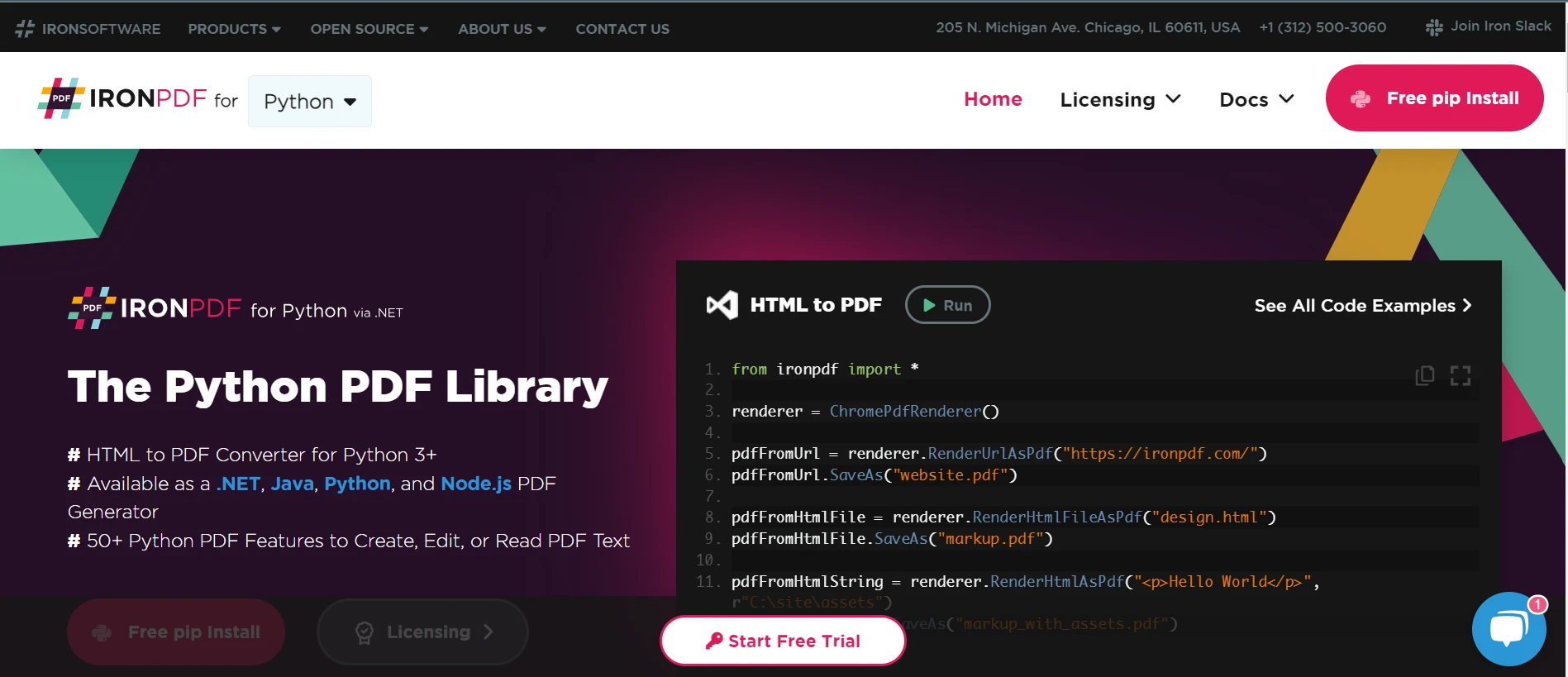
from ironpdf import *

# Instantiate Renderer
renderer = ChromePdfRenderer()

# Create a PDF from a HTML string using Python
pdf = renderer.RenderHtmlAsPdf("<h1>Hello World</h1>")

# Export to a file or Stream
pdf.SaveAs("output.pdf")

# Advanced Example with HTML Assets
# Load external html assets: Images, CSS and JavaScript.
# An optional BasePath 'C:\site\assets\' is set as the file location to load assets from
myAdvancedPdf = renderer.RenderHtmlAsPdf("<img src='icons/iron.png'>", r"C:\site\assets")
myAdvancedPdf.SaveAs("html-with-assets.pdf")
from ironpdf import *# Instantiate Rendererrenderer = ChromePdfRenderer()# Create a PDF from a HTML string using Pythonpdf = renderer.RenderHtmlAsPdf("<h1>Hello World</h1>")# Export to a file or Streampdf.SaveAs("output.pdf")# Advanced Example with HTML Assets# Load external html assets: Images, CSS and JavaScript.# An optional BasePath 'C:\site\assets\' is set as the file location to load assets frommyAdvancedPdf = renderer.RenderHtmlAsPdf("<img src='icons/iron.png'>", r"C:\site\assets")myAdvancedPdf.SaveAs("html-with-assets.pdf")
Generar informes de archivos PDF es un requisito común para el análisis de datos y los científicos de datos. IronPDF es una biblioteca versátil que permite la creación de archivos PDF de tablas en aplicaciones de código Python, similar a la biblioteca FPDF en PHP. Este tutorial te guiará en el uso de IronPDF para crear y escribir informes en PDF a partir de plantillas HTML o URLs, lo cual puede ser un proceso tedioso si no se realiza correctamente.
## IronPDF: Biblioteca PDF de Python
[IronPDF](/) es una biblioteca integral diseñada para aplicaciones de Python para crear PDFs, editar y extraer contenido de archivos PDF. Es una herramienta poderosa que satisface las necesidades de los ingenieros de software que a menudo enfrentan el desafío de generar resultados finales para documentos PDF a partir de diversas fuentes de datos o plantillas. Con IronPDF, los usuarios pueden [transformar contenido HTML o URLs en archivos PDF](/python/tutorials/html-to-pdf/) sin esfuerzo, manipular contenido PDF, e integrar estas capacidades en proyectos de código en Python, convirtiéndose en una biblioteca esencial para cualquier desarrollador de Python que maneje tareas de generación y manipulación de PDF.
IronPDF también te permite crear [formularios interactivos](/python/examples/form-data/), [dividir](/python/blog/using-ironpdf-for-python/split-pdf-python-tutorial/) y [combinar](/python/how-to/python-merge-pdf/) archivos PDF, [extraer texto e imágenes](/python/blog/using-ironpdf-for-python/extract-data-from-pdf-python-tutorial/) de archivos PDF, buscar ciertas palabras dentro de un archivo PDF, [rasterizar páginas de PDF en imágenes](/python/examples/rasterize-a-pdf-to-images/), así como [imprimir archivos PDF](/python/how-to/python-print-pdf/).
## Requisitos previos
El primer paso es asegurarte de cumplir con los siguientes prerrequisitos:
1. Python 3.7 o superior instalado en tu sistema.
2. Tiempo de ejecución .NET 6.0 instalado ya que la biblioteca de IronPDF depende de .NET 6.0 como su tecnología subyacente.
Puedes instalar el tiempo de ejecución .NET 6.0 desde la [página oficial de descargas de .NET](https://dotnet.microsoft.com/en-us/download/dotnet/6.0).
## Instalación
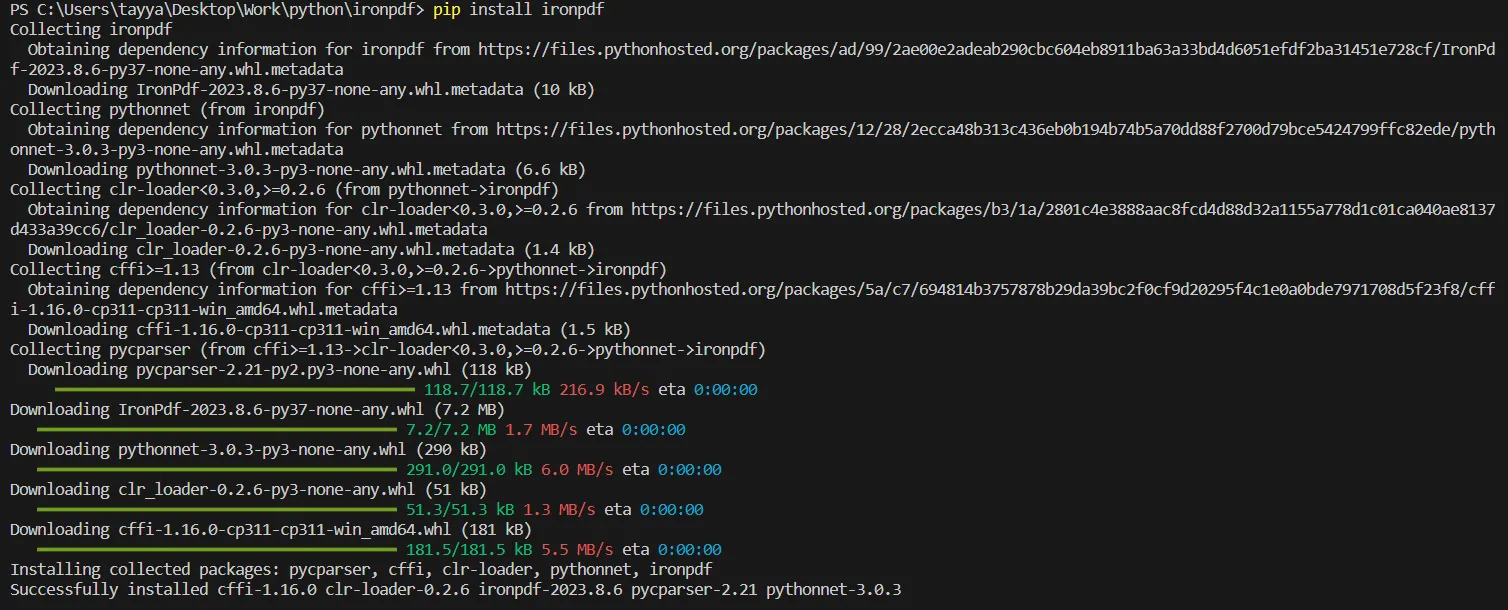
Para usar IronPDF, necesitas instalar el paquete a través de pip:
```bash
:ProductInstall
```
**Instalar IronPDF**
IronPDF descargará automáticamente dependencias adicionales en su primera ejecución.
## Creación de un documento PDF sencillo
Aquí tienes un ejemplo de código para generar un documento PDF simple utilizando una plantilla HTML:
```python
from ironpdf import ChromePdfRenderer

# Create a PDF renderer using the ChromePdfRenderer class
renderer = ChromePdfRenderer()

# Render an HTML string as a PDF document
pdf = renderer.RenderHtmlAsPdf("<h1>Hello World</h1>")

# Save the rendered PDF to a file
pdf.SaveAs("hello_world.pdf")
```
Esta porción de código convierte una cadena HTML en un archivo PDF y lo guarda en la misma carpeta que tu script de Python.
## Generación de PDF a partir de URL
IronPDF también puede crear un PDF desde una URL de página web con el siguiente ejemplo de código:
```python
from ironpdf import ChromePdfRenderer
# Create a PDF renderer using the ChromePdfRenderer class
renderer = ChromePdfRenderer()
# Render a URL as a PDF document
pdf = renderer.RenderUrlAsPdf("https://ironpdf.com/python/")
# Save the rendered PDF to a file
pdf.SaveAs("website_snapshot.pdf")
```
## Generación de informes PDF con marcos de datos
Crear informes PDF con apariencia profesional es sencillo con IronPDF y Python. Aquí está cómo puedes generar un informe mejorado utilizando marcos de datos detallados y un estilo HTML personalizado:
### Paso 1: Importación de bibliotecas
Primero, necesitas importar las bibliotecas requeridas. `ChromePdfRenderer` de IronPDF es esencial para el proceso de generación de PDF. Esta biblioteca permite la conversión de contenido HTML a documentos PDF. Además, importa pandas, una poderosa biblioteca de manipulación de datos, para crear y gestionar marcos de datos. Pandas se utilizará para estructurar los datos de tu informe en un formato tabular.
```python
from ironpdf import ChromePdfRenderer
import pandas as pd
```
### Paso 2: Configuración de la clave de licencia
Activar IronPDF requiere establecer tu clave de licencia. Este paso es crucial, ya que desbloquea todas las funciones de IronPDF, permitiéndote generar PDFs sin marcas de agua ni limitaciones. Es un paso simple pero vital para el uso profesional de la biblioteca.
```python
License.LicenseKey = "Your-License-Key"
```
### Paso 3: Creación de un marco de datos
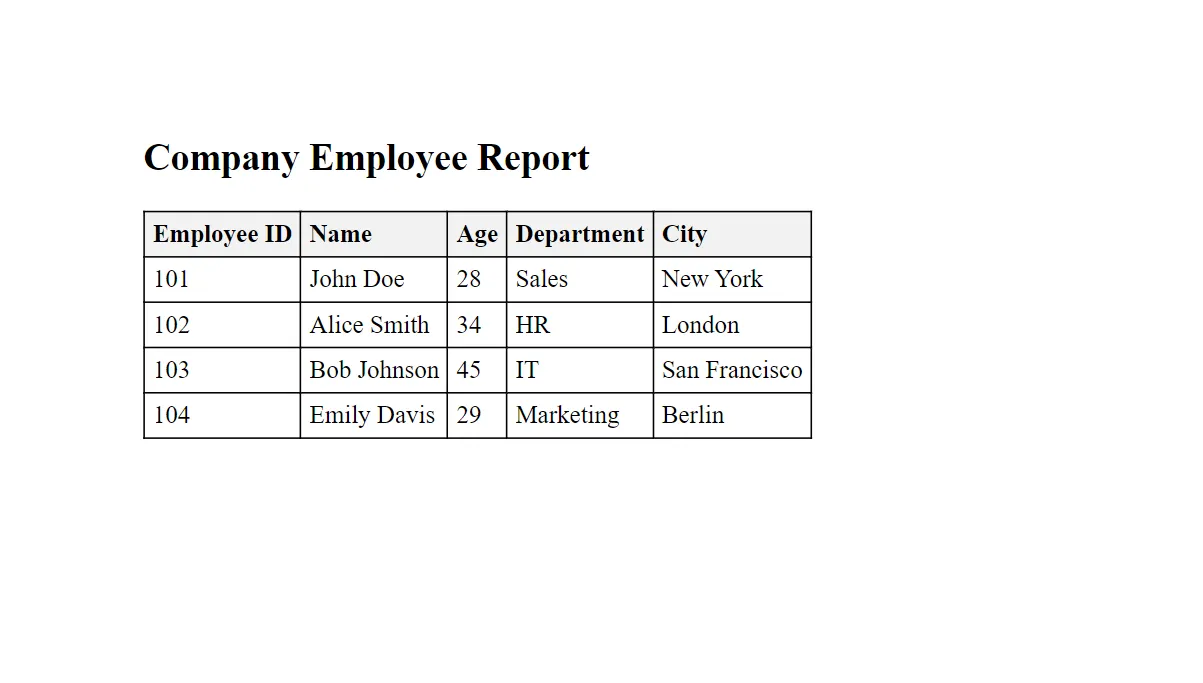
Aquí, crearás un marco de datos usando Pandas. Este marco de datos actúa como la fuente de datos para tu informe. El ejemplo proporcionado incluye información detallada de empleados, demostrando la capacidad de Pandas para manejar y estructurar conjuntos de datos complejos. El marco de datos se puede personalizar según las especificaciones del informe que pretendas crear.
```python
data = {
'Employee ID': [101, 102, 103, 104],
'Name': ['John Doe', 'Alice Smith', 'Bob Johnson', 'Emily Davis'],
'Age': [28, 34, 45, 29],
'Department': ['Sales', 'HR', 'IT', 'Marketing'],
'City': ['New York', 'London', 'San Francisco', 'Berlin']
}
df = pd.DataFrame(data)
```
### Paso 4: Diseño de la plantilla HTML
En este paso, diseñarás una plantilla HTML con estilo CSS. Esta plantilla define la presentación visual de tu informe PDF. El estilo CSS mejora el atractivo visual y la legibilidad de los datos presentados en el informe. La inserción dinámica del marco de datos en esta plantilla HTML se maneja a través del formateo de cadenas en Python.
```python
# HTML styling for the PDF report
html_style="""
<html>
<head>
<style>
table, th, td {
border: 1px solid black;
border-collapse: collapse;
padding: 5px;
text-align: left;
}
th {
background-color: #f2f2f2;
}
</style>
</head>
<body>
<h2>Company Employee Report</h2>
{table}
</body>
</html>
"""
# Replace {table} with the HTML representation of the data frame
html_content = html_style.format(table=df.to_html(index=False, border=0))
```
### Paso 5: Renderizar y guardar el PDF
Finalmente, utiliza el ChromePdfRenderer de IronPDF para convertir el contenido HTML en un documento PDF. El método RenderHtmlAsPdf procesa el HTML y CSS, convirtiéndolo en un archivo PDF. Luego se utiliza la función SaveAs para guardar este archivo, resultando en un informe PDF bien formado y visualmente atractivo. Este paso encapsula el proceso de conversión, combinando los datos y la plantilla en un documento final.
```python
# Render the HTML string to a PDF document
renderer = ChromePdfRenderer()
pdf = renderer.RenderHtmlAsPdf(html_content)
# Save the rendered PDF to a file
pdf.SaveAs("enhanced_employee_report.pdf")
```
### Resultado
Aquí está el informe de salida en PDF:
**Informe de Empleados de la Empresa**
## Creación de un documento PDF sencillo
Aquí tienes un ejemplo de código para generar un documento PDF simple utilizando una plantilla HTML:
```python
from ironpdf import ChromePdfRenderer

# Create a PDF renderer using the ChromePdfRenderer class
renderer = ChromePdfRenderer()

# Render an HTML string as a PDF document
pdf = renderer.RenderHtmlAsPdf("<h1>Hello World</h1>")

# Save the rendered PDF to a file
pdf.SaveAs("hello_world.pdf")
```
Esta porción de código convierte una cadena HTML en un archivo PDF y lo guarda en la misma carpeta que tu script de Python.
## Generación de PDF a partir de URL
IronPDF también puede crear un PDF desde una URL de página web con el siguiente ejemplo de código:
```python
from ironpdf import ChromePdfRenderer

# Create a PDF renderer using the ChromePdfRenderer class
renderer = ChromePdfRenderer()

# Render a URL as a PDF document
pdf = renderer.RenderUrlAsPdf("https://ironpdf.com/python/")

# Save the rendered PDF to a file
pdf.SaveAs("website_snapshot.pdf")
```
Esto guardará una instantánea PDF de la página web especificada.
## Conclusión
IronPDF es una herramienta poderosa para desarrolladores de Python y científicos de datos para generar informes PDF. Siguiendo esta guía, puedes integrar fácilmente la generación de PDFs en tus proyectos de Python, ya sea que estés creando PDFs a partir de plantillas HTML, URLs o marcos de datos. Recuerda explorar la documentación y ejemplos extensos de IronPDF para aprovechar al máximo sus capacidades para tus tareas de PDF como agregar un gráfico circular.
Sigue experimentando con diferentes características y opciones que IronPDF ofrece para crear informes PDF que satisfagan tus necesidades. Con el enfoque correcto, lo que parece una tarea tediosa puede convertirse en una parte eficiente y automatizada de tu flujo de trabajo.
IronPDF ofrece una [prueba gratuita](trial-license), permitiendo a los usuarios explorar completamente sus funciones antes de realizar una compra. Además, es gratuito para propósitos de desarrollo, proporcionando una solución rentable para los desarrolladores durante la fase de desarrollo. Para el despliegue comercial, la licencia de IronPDF comienza en `$liteLicense`, atendiendo a las necesidades profesionales y de nivel empresarial.
Generar informes de archivos PDF es un requisito común para el análisis de datos y los científicos de datos. IronPDF es una biblioteca versátil que permite la creación de archivos PDF de tablas en aplicaciones de código Python, similar a la biblioteca FPDF en PHP. Este tutorial te guiará en el uso de IronPDF para crear y escribir informes en PDF a partir de plantillas HTML o URLs, lo cual puede ser un proceso tedioso si no se realiza correctamente.
IronPDF: Biblioteca PDF de Python
IronPDF es una biblioteca integral diseñada para aplicaciones de Python para crear PDFs, editar y extraer contenido de archivos PDF. Es una herramienta poderosa que satisface las necesidades de los ingenieros de software que a menudo enfrentan el desafío de generar resultados finales para documentos PDF a partir de diversas fuentes de datos o plantillas. Con IronPDF, los usuarios pueden transformar contenido HTML o URLs en archivos PDF sin esfuerzo, manipular contenido PDF, e integrar estas capacidades en proyectos de código en Python, convirtiéndose en una biblioteca esencial para cualquier desarrollador de Python que maneje tareas de generación y manipulación de PDF.
Para usar IronPDF, necesitas instalar el paquete a través de pip:
> pip install ironpdf
pip install ironpdf
Instalar IronPDF
IronPDF descargará automáticamente dependencias adicionales en su primera ejecución.
Creación de un documento PDF sencillo
Aquí tienes un ejemplo de código para generar un documento PDF simple utilizando una plantilla HTML:
from ironpdf importChromePdfRenderer# Create a PDF renderer using the ChromePdfRenderer classrenderer = ChromePdfRenderer()# Render an HTML string as a PDF documentpdf = renderer.RenderHtmlAsPdf("<h1>Hello World</h1>")# Save the rendered PDF to a filepdf.SaveAs("hello_world.pdf")
from ironpdf import ChromePdfRenderer
# Create a PDF renderer using the ChromePdfRenderer class
renderer = ChromePdfRenderer()
# Render an HTML string as a PDF document
pdf = renderer.RenderHtmlAsPdf("<h1>Hello World</h1>")
# Save the rendered PDF to a file
pdf.SaveAs("hello_world.pdf")
Python
Esta porción de código convierte una cadena HTML en un archivo PDF y lo guarda en la misma carpeta que tu script de Python.
Generación de PDF a partir de URL
IronPDF también puede crear un PDF desde una URL de página web con el siguiente ejemplo de código:
from ironpdf importChromePdfRenderer# Create a PDF renderer using the ChromePdfRenderer classrenderer = ChromePdfRenderer()# Render a URL as a PDF documentpdf = renderer.RenderUrlAsPdf("https://ironpdf.com/python/")# Save the rendered PDF to a filepdf.SaveAs("website_snapshot.pdf")
from ironpdf import ChromePdfRenderer

# Create a PDF renderer using the ChromePdfRenderer class
renderer = ChromePdfRenderer()

# Render a URL as a PDF document
pdf = renderer.RenderUrlAsPdf("https://ironpdf.com/python/")

# Save the rendered PDF to a file
pdf.SaveAs("website_snapshot.pdf")
Python
Generación de informes PDF con marcos de datos
Crear informes PDF con apariencia profesional es sencillo con IronPDF y Python. Aquí está cómo puedes generar un informe mejorado utilizando marcos de datos detallados y un estilo HTML personalizado:
Paso 1: Importación de bibliotecas
Primero, necesitas importar las bibliotecas requeridas. ChromePdfRenderer de IronPDF es esencial para el proceso de generación de PDF. Esta biblioteca permite la conversión de contenido HTML a documentos PDF. Además, importa pandas, una poderosa biblioteca de manipulación de datos, para crear y gestionar marcos de datos. Pandas se utilizará para estructurar los datos de tu informe en un formato tabular.
from ironpdf importChromePdfRendererimport pandas as pd
from ironpdf import ChromePdfRenderer
import pandas as pd
Python
Paso 2: Configuración de la clave de licencia
Activar IronPDF requiere establecer tu clave de licencia. Este paso es crucial, ya que desbloquea todas las funciones de IronPDF, permitiéndote generar PDFs sin marcas de agua ni limitaciones. Es un paso simple pero vital para el uso profesional de la biblioteca.
License.LicenseKey = "Your-License-Key"
License.LicenseKey = "Your-License-Key"
Python
Paso 3: Creación de un marco de datos
Aquí, crearás un marco de datos usando Pandas. Este marco de datos actúa como la fuente de datos para tu informe. El ejemplo proporcionado incluye información detallada de empleados, demostrando la capacidad de Pandas para manejar y estructurar conjuntos de datos complejos. El marco de datos se puede personalizar según las especificaciones del informe que pretendas crear.
En este paso, diseñarás una plantilla HTML con estilo CSS. Esta plantilla define la presentación visual de tu informe PDF. El estilo CSS mejora el atractivo visual y la legibilidad de los datos presentados en el informe. La inserción dinámica del marco de datos en esta plantilla HTML se maneja a través del formateo de cadenas en Python.
# HTML styling for the PDF reporthtml_style="""<html><head><style> table, th, td { border: 1px solid black; border-collapse: collapse; padding: 5px; text-align: left; } th { background-color: #f2f2f2; }</style></head><body> <h2>Company Employee Report</h2> {table}</body></html>"""# Replace {table} with the HTML representation of the data framehtml_content = html_style.format(table=df.to_html(index=False, border=0))
# HTML styling for the PDF report
html_style="""
<html>
<head>
<style>
  table, th, td {
    border: 1px solid black;
    border-collapse: collapse;
    padding: 5px;
    text-align: left;
  }
  th {
    background-color: #f2f2f2;
  }
</style>
</head>
<body>
  <h2>Company Employee Report</h2>
  {table}
</body>
</html>
"""

# Replace {table} with the HTML representation of the data frame
html_content = html_style.format(table=df.to_html(index=False, border=0))
Python
Paso 5: Renderizar y guardar el PDF
Finalmente, utiliza el ChromePdfRenderer de IronPDF para convertir el contenido HTML en un documento PDF. El método RenderHtmlAsPdf procesa el HTML y CSS, convirtiéndolo en un archivo PDF. Luego se utiliza la función SaveAs para guardar este archivo, resultando en un informe PDF bien formado y visualmente atractivo. Este paso encapsula el proceso de conversión, combinando los datos y la plantilla en un documento final.
# Render the HTML string to a PDF documentrenderer = ChromePdfRenderer()pdf = renderer.RenderHtmlAsPdf(html_content)# Save the rendered PDF to a filepdf.SaveAs("enhanced_employee_report.pdf")
# Render the HTML string to a PDF document
renderer = ChromePdfRenderer()
pdf = renderer.RenderHtmlAsPdf(html_content)

# Save the rendered PDF to a file
pdf.SaveAs("enhanced_employee_report.pdf")
Python
Resultado
Aquí está el informe de salida en PDF:
Informe de Empleados de la Empresa
Creación de un documento PDF sencillo
Aquí tienes un ejemplo de código para generar un documento PDF simple utilizando una plantilla HTML:
from ironpdf importChromePdfRenderer# Create a PDF renderer using the ChromePdfRenderer classrenderer = ChromePdfRenderer()# Render an HTML string as a PDF documentpdf = renderer.RenderHtmlAsPdf("<h1>Hello World</h1>")# Save the rendered PDF to a filepdf.SaveAs("hello_world.pdf")
from ironpdf import ChromePdfRenderer

# Create a PDF renderer using the ChromePdfRenderer class
renderer = ChromePdfRenderer()

# Render an HTML string as a PDF document
pdf = renderer.RenderHtmlAsPdf("<h1>Hello World</h1>")

# Save the rendered PDF to a file
pdf.SaveAs("hello_world.pdf")
Python
Esta porción de código convierte una cadena HTML en un archivo PDF y lo guarda en la misma carpeta que tu script de Python.
Generación de PDF a partir de URL
IronPDF también puede crear un PDF desde una URL de página web con el siguiente ejemplo de código:
from ironpdf importChromePdfRenderer# Create a PDF renderer using the ChromePdfRenderer classrenderer = ChromePdfRenderer()# Render a URL as a PDF documentpdf = renderer.RenderUrlAsPdf("https://ironpdf.com/python/")# Save the rendered PDF to a filepdf.SaveAs("website_snapshot.pdf")
from ironpdf import ChromePdfRenderer

# Create a PDF renderer using the ChromePdfRenderer class
renderer = ChromePdfRenderer()

# Render a URL as a PDF document
pdf = renderer.RenderUrlAsPdf("https://ironpdf.com/python/")

# Save the rendered PDF to a file
pdf.SaveAs("website_snapshot.pdf")
Python
Esto guardará una instantánea PDF de la página web especificada.
Conclusión
IronPDF es una herramienta poderosa para desarrolladores de Python y científicos de datos para generar informes PDF. Siguiendo esta guía, puedes integrar fácilmente la generación de PDFs en tus proyectos de Python, ya sea que estés creando PDFs a partir de plantillas HTML, URLs o marcos de datos. Recuerda explorar la documentación y ejemplos extensos de IronPDF para aprovechar al máximo sus capacidades para tus tareas de PDF como agregar un gráfico circular.
Sigue experimentando con diferentes características y opciones que IronPDF ofrece para crear informes PDF que satisfagan tus necesidades. Con el enfoque correcto, lo que parece una tarea tediosa puede convertirse en una parte eficiente y automatizada de tu flujo de trabajo.
IronPDF ofrece una prueba gratuita, permitiendo a los usuarios explorar completamente sus funciones antes de realizar una compra. Además, es gratuito para propósitos de desarrollo, proporcionando una solución rentable para los desarrolladores durante la fase de desarrollo. Para el despliegue comercial, la licencia de IronPDF comienza en $999, atendiendo a las necesidades profesionales y de nivel empresarial.
Curtis Chau tiene una licenciatura en Ciencias de la Computación (Carleton University) y se especializa en el desarrollo front-end con experiencia en Node.js, TypeScript, JavaScript y React. Apasionado por crear interfaces de usuario intuitivas y estéticamente agradables, disfruta trabajando con frameworks modernos y creando manuales bien estructurados y visualmente atractivos.




 Instalar IronPDF
 Informe de Empleados de la Empresa