from ironpdf import *

# Instantiate Renderer
renderer = ChromePdfRenderer()

# Create a PDF from a HTML string using Python
pdf = renderer.RenderHtmlAsPdf("<h1>Hello World</h1>")

# Export to a file or Stream
pdf.SaveAs("output.pdf")

# Advanced Example with HTML Assets
# Load external html assets: Images, CSS and JavaScript.
# An optional BasePath 'C:\site\assets\' is set as the file location to load assets from
myAdvancedPdf = renderer.RenderHtmlAsPdf("<img src='icons/iron.png'>", r"C:\site\assets")
myAdvancedPdf.SaveAs("html-with-assets.pdf")
from ironpdf import *# Instantiate Rendererrenderer = ChromePdfRenderer()# Create a PDF from a HTML string using Pythonpdf = renderer.RenderHtmlAsPdf("<h1>Hello World</h1>")# Export to a file or Streampdf.SaveAs("output.pdf")# Advanced Example with HTML Assets# Load external html assets: Images, CSS and JavaScript.# An optional BasePath 'C:\site\assets\' is set as the file location to load assets frommyAdvancedPdf = renderer.RenderHtmlAsPdf("<img src='icons/iron.png'>", r"C:\site\assets")myAdvancedPdf.SaveAs("html-with-assets.pdf")
Este artículo profundizará en el fascinante ámbito del uso de IronPDF for Python, explorando cómo esta [poderosa biblioteca](/python/docs/) permite una manipulación sin problemas de PDF, permitiendo a los desarrolladores crear, editar y transformar documentos sin esfuerzo. Descubre las innumerables posibilidades que te esperan mientras te embarcas en tu viaje de edición de PDF en Python.
## Cómo abrir archivos PDF en Python
1. Descarga e instala la biblioteca IronPDF for Python.
2. Utilice el objeto `PdfDocument` para cargar los archivos PDF existentes.
3. Genera un PDF a partir de una cadena HTML utilizando el método `RenderHtmlAsPdf`.
4. Guarde el PDF utilizando el método `SaveAs`.
5. Abre el archivo PDF en el navegador predeterminado utilizando `webbrowser`.
## 1. IronPDF for Python
[IronPDF](/python/) es una biblioteca revolucionaria para Python, llena de poder y una gran cantidad de funciones que redefinen cómo los desarrolladores interactúan con los archivos PDF. Aprovechando la potencia de C# y las tecnologías .NET, IronPDF se integra sin problemas con Python, ofreciendo un conjunto completo de funcionalidades avanzadas para [crear](/python/how-to/python-create-pdf/), [editar](/python/blog/using-ironpdf-for-python/python-pdf-editor-tutorial/) y manipular documentos PDF sin esfuerzo. Sus características van desde generar informes y formularios PDF dinámicos y visualmente impactantes, hasta extraer datos valiosos de archivos PDF preexistentes, proporcionar la capacidad de [rotar páginas en PDF](/python/examples/pdf-page-orientation/) y permitir a los usuarios fusionar archivos PDF. IronPDF empodera a los desarrolladores para desbloquear todo el potencial de Python en el ámbito de la manipulación de PDF. Este artículo se embarca en un viaje para explorar las impresionantes capacidades de IronPDF for Python, revelando cómo esta notable biblioteca simplifica las tareas relacionadas con PDF y eleva la experiencia de desarrollo general, permitiendo la creación sin problemas de documentos de calidad profesional con facilidad. Ya seas un desarrollador experimentado o un recién llegado a Python, prepárate para asombrarte ante las infinitas posibilidades que IronPDF ofrece.
## 2. Instalación de IronPDF for Python
Esta sección discutirá cómo puedes instalar IronPDF for Python.
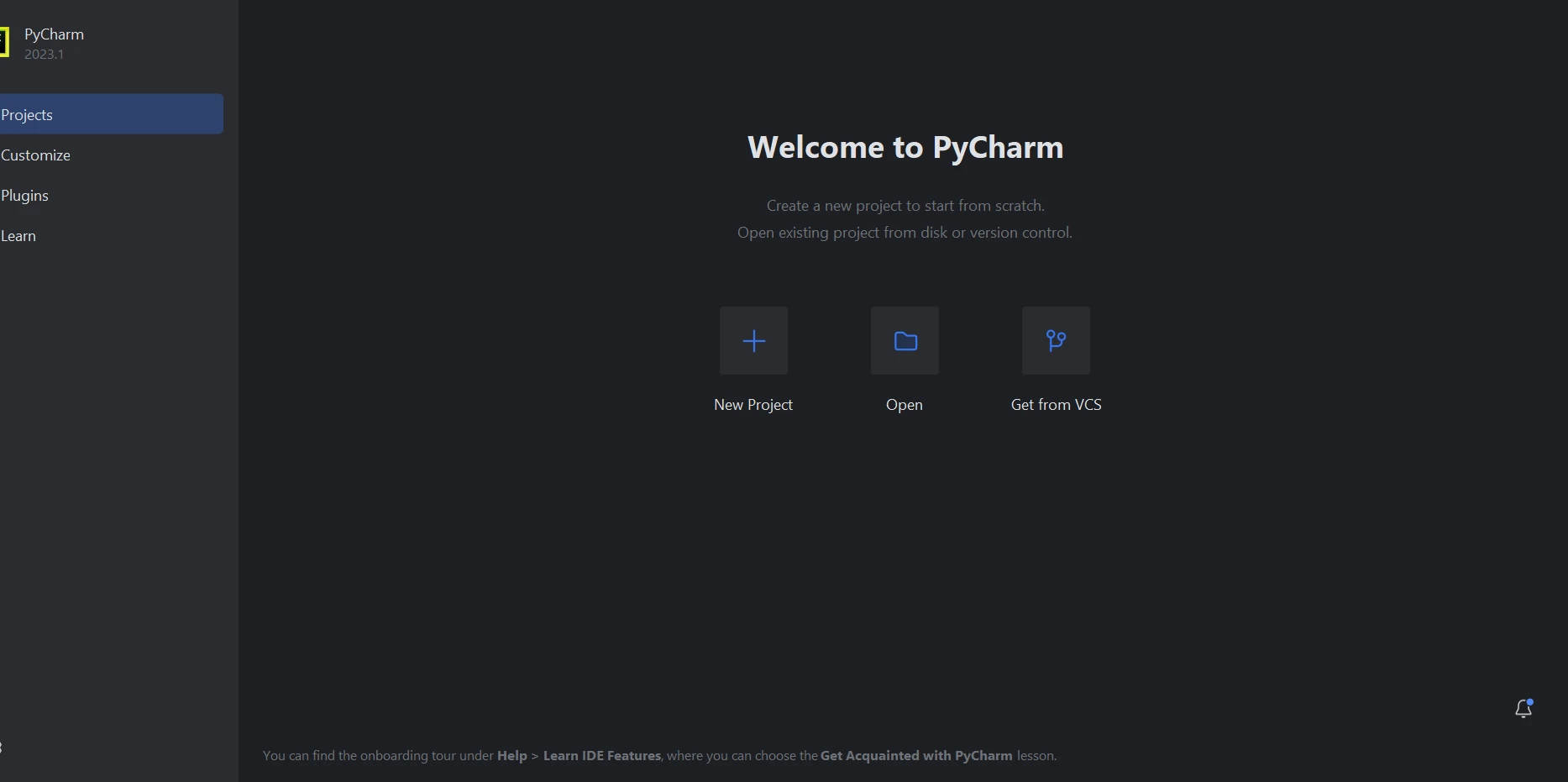
1. Crea un nuevo proyecto de Python en PyCharm o abre uno existente.
2. Abre el terminal dentro del entorno creado para el proyecto específico. Esto asegura que los paquetes que instales estén aislados al proyecto y no interfieran con otros proyectos o el entorno global de Python.
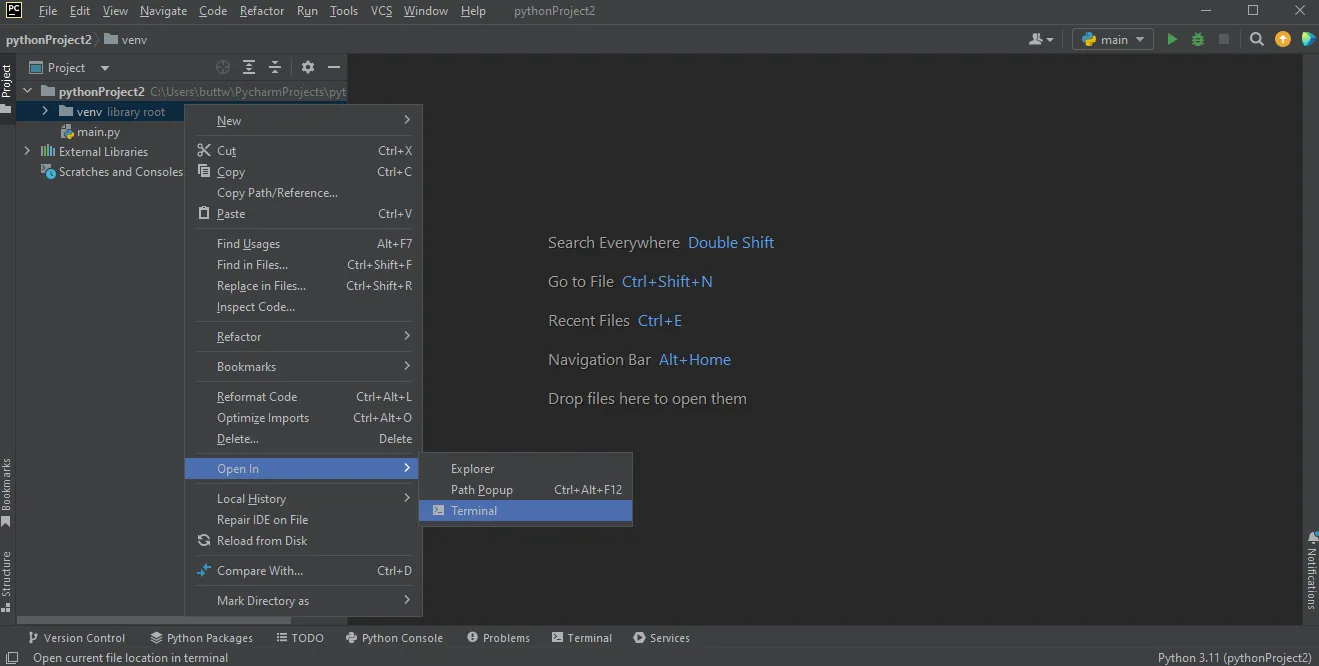
**Abrir terminal en PyCharm**
3. Escribe el siguiente comando y presiona enter para instalar IronPDF.
```shell
:ProductInstall
```
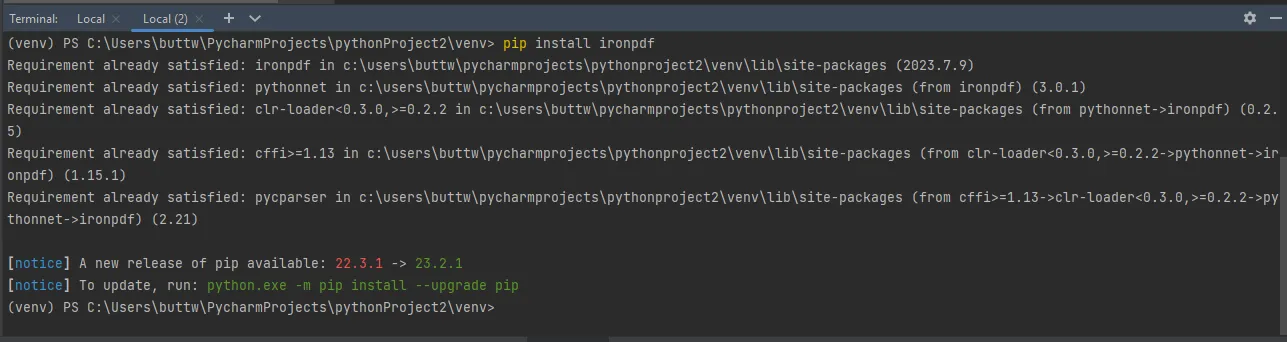
**Instalar paquete de IronPDF**
4. Espera un par de minutos; se descargará e instalará IronPDF en tu sistema.
using IronPDF; Ahora has instalado IronPDF for Python en tu proyecto de PyCharm, y puedes comenzar a usarlo para tareas de procesamiento de PDF dentro de tu código de Python. Recuerda que la funcionalidad y el uso específicos de IronPDF dependerán de la documentación y API proporcionada por la biblioteca. Asegúrate de consultar la documentación oficial de IronPDF para obtener más detalles sobre cómo usarlo de manera efectiva.
## 3. Abrir un archivo PDF con la biblioteca IronPDF for Python
Puedes abrir fácilmente un documento PDF usando IronPDF. Para hacerlo, primero necesitas crear un nuevo archivo PDF, guardarlo y luego abrirlo. IronPDF proporciona una forma sencilla de manejar archivos PDF, permitiéndote generar, modificar e interactuar con documentos PDF sin esfuerzo. En caso de que necesites manejar documentos protegidos por contraseña de usuario, IronPDF también proporciona los [métodos necesarios](/python/examples/security-and-metadata/) para manejar tales casos.
### 3.1. Abrir un nuevo archivo PDF en el visor de PDF predeterminado
El siguiente fragmento de código explica el proceso de creación de archivos PDF y su apertura en el visor PDF predeterminado de tu sistema.
```python
from ironpdf import *  # Import IronPDF for PDF rendering
import webbrowser      # Import webbrowser to open files in browser

# Specify the output path for the PDF file
output_path = "C:\\Users\\buttw\\OneDrive\\Desktop\\url.pdf"

# Create a PDF renderer object using ChromePdfRenderer
renderer = ChromePdfRenderer()

# Render the PDF from a URL
pdf = renderer.RenderUrlAsPdf("https://www.google.com/")

# Save the rendered PDF to the specified path
pdf.SaveAs(output_path)

# Automatically open the PDF in the default PDF viewer
webbrowser.open(output_path)
```
En el código anterior, importamos las dependencias necesarias: IronPDF para el manejo de PDF y `webbrowser` para abrir el PDF en el visor predeterminado. A continuación, configuramos el `output_path` donde se guardará el PDF. Se instanciará un objeto `ChromePdfRenderer` para gestionar la representación del PDF. Al llamar a `RenderUrlAsPdf`, convertimos la URL especificada en un PDF, tras lo cual `SaveAs` guarda el PDF en la ruta de salida definida. Por último, `webbrowser.open` se utiliza para abrir el PDF automáticamente en el visor de PDF predeterminado.
#### 3.1.1. Captura de pantalla de salida
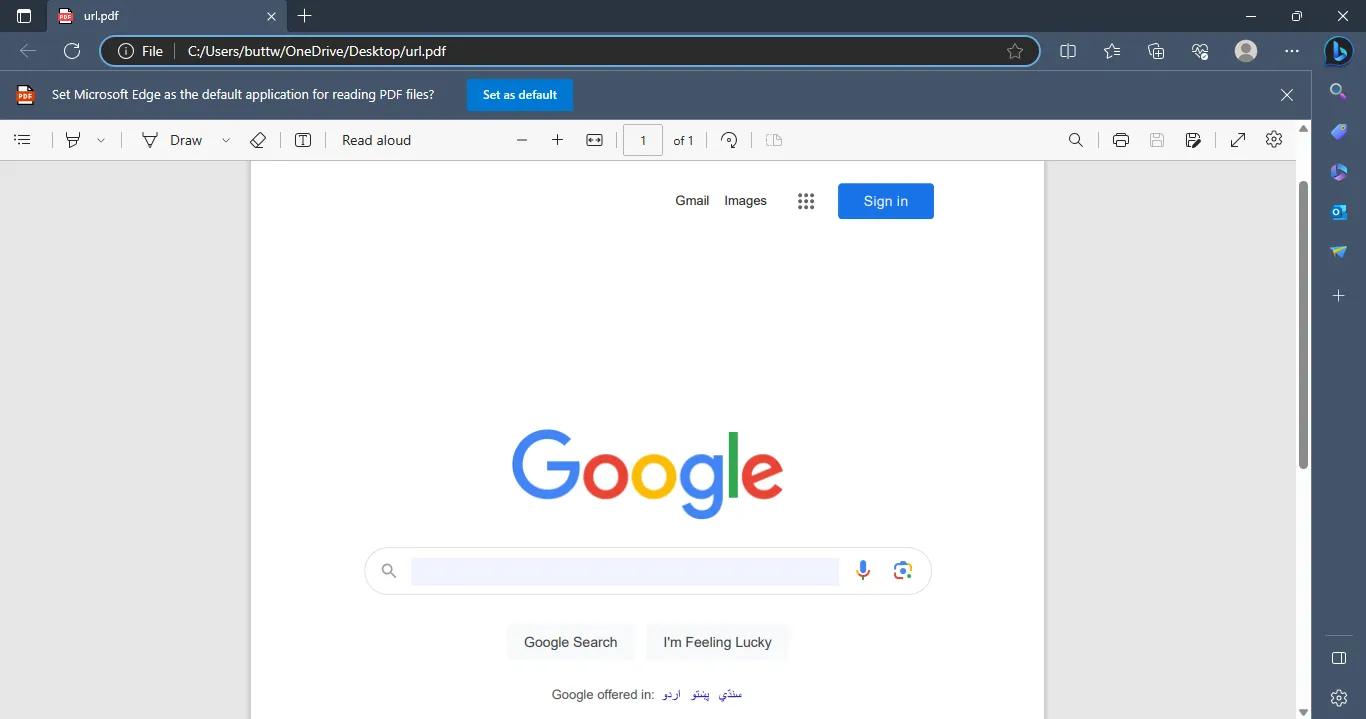
**El archivo PDF de salida**
### 3.2. Abrir un archivo PDF en Google Chrome
Para abrir páginas PDF en Google Chrome, debes repetir todos los pasos y solo reemplazar la última línea de código.
```python
from ironpdf import * # Import IronPDF for PDF rendering
import webbrowser # Import webbrowser to open files in browser
# Specify the output path for the PDF file
output_path = "C:\\Users\\buttw\\OneDrive\\Desktop\\url.pdf"
# Create a PDF renderer object using ChromePdfRenderer
renderer = ChromePdfRenderer()
# Render the PDF from a URL
pdf = renderer.RenderUrlAsPdf("https://www.google.com/")
# Save the rendered PDF to the specified path
pdf.SaveAs(output_path)
# Register Google Chrome as a browser in webbrowser module
webbrowser.register(
"chrome",
None,
webbrowser.BackgroundBrowser(
"C:\\Program Files\\Google\\Chrome\\Application\\chrome.exe"
),
)
# Open the PDF in Google Chrome
webbrowser.get("chrome").open(output_path)
```
En este script, tras configurar la renderización de PDF como antes, registramos Google Chrome como un nuevo navegador utilizando `webbrowser.register`. Esto nos permite especificar Chrome explícitamente al abrir el PDF, utilizando `webbrowser.get("chrome").open(output_path)` para garantizar que el archivo se abra en Chrome.
#### 3.2.1. Captura de pantalla de salida
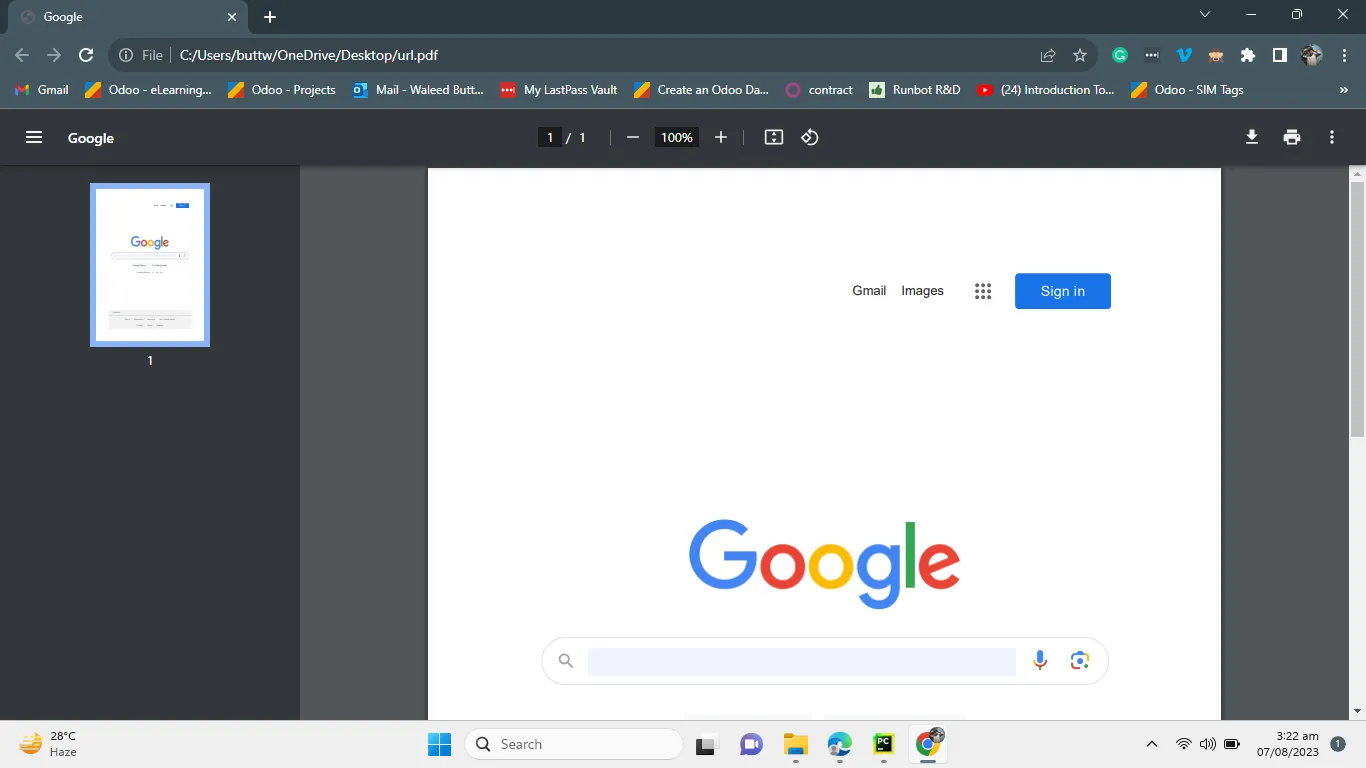
**El archivo PDF de salida**
## 4. Conclusión
La versatilidad y capacidades inherentes de Python lo convierten en una excelente opción para manejar archivos PDF en varias aplicaciones. Con bibliotecas como IronPDF, los desarrolladores pueden manipular e interactuar con documentos de página PDF sin esfuerzo, permitiéndoles extraer información, analizar datos y generar informes con facilidad. IronPDF, siendo una poderosa biblioteca para Python, se integra perfectamente con el lenguaje, ofreciendo una gran cantidad de funcionalidades avanzadas para crear, transformar y modificar archivos PDF. El proceso de instalación de IronPDF es sencillo, haciéndolo accesible tanto para desarrolladores experimentados como para principiantes. Al usar IronPDF, los desarrolladores pueden abrir archivos PDF, generar nuevos a partir de cadenas HTML y guardarlos en varias ubicaciones. Además, permite a los usuarios abrir PDFs en visualizadores de PDF predeterminados como Microsoft Edge o Google Chrome. Esta notable biblioteca revoluciona la forma en que los desarrolladores de Python trabajan con PDFs, desatando infinitas posibilidades para crear documentos de calidad profesional y mejorando la experiencia de desarrollo general. Ya sea que estés desarrollando aplicaciones complejas o scripts simples, rotando páginas PDF, fusionando archivos PDF, dividiendo múltiples páginas o leyendo archivos PDF, IronPDF te permite aprovechar todo el potencial de Python en el ámbito de la manipulación de PDF, convirtiéndola en una herramienta imprescindible para cualquier desarrollador que trabaje con archivos PDF.
[IronPDF for Python](/python/) es una de las mejores bibliotecas de PDF que existen, disponible en tres lenguajes de programación diferentes, y lo interesante es que solo necesitas una [licencia](licensing) para usar los tres lenguajes. Para saber más sobre la conversión de HTML a PDF usando IronPDF, ve a este [tutorial de Python](/python/tutorials/html-to-pdf/). El tutorial sobre lectura de PDF en Python se puede encontrar en este [enlace del tutorial](/python/blog/python-pdf-tools/python-read-pdf-tutorial/).
Este artículo profundizará en el fascinante ámbito del uso de IronPDF for Python, explorando cómo esta poderosa biblioteca permite una manipulación sin problemas de PDF, permitiendo a los desarrolladores crear, editar y transformar documentos sin esfuerzo. Descubre las innumerables posibilidades que te esperan mientras te embarcas en tu viaje de edición de PDF en Python.
Cómo abrir archivos PDF en Python
Descarga e instala la biblioteca IronPDF for Python.
Utilice el objeto PdfDocument para cargar los archivos PDF existentes.
Genera un PDF a partir de una cadena HTML utilizando el método RenderHtmlAsPdf.
Guarde el PDF utilizando el método SaveAs.
Abre el archivo PDF en el navegador predeterminado utilizando webbrowser.
1. IronPDF for Python
IronPDF es una biblioteca revolucionaria para Python, llena de poder y una gran cantidad de funciones que redefinen cómo los desarrolladores interactúan con los archivos PDF. Aprovechando la potencia de C# y las tecnologías .NET, IronPDF se integra sin problemas con Python, ofreciendo un conjunto completo de funcionalidades avanzadas para crear, editar y manipular documentos PDF sin esfuerzo. Sus características van desde generar informes y formularios PDF dinámicos y visualmente impactantes, hasta extraer datos valiosos de archivos PDF preexistentes, proporcionar la capacidad de rotar páginas en PDF y permitir a los usuarios fusionar archivos PDF. IronPDF empodera a los desarrolladores para desbloquear todo el potencial de Python en el ámbito de la manipulación de PDF. Este artículo se embarca en un viaje para explorar las impresionantes capacidades de IronPDF for Python, revelando cómo esta notable biblioteca simplifica las tareas relacionadas con PDF y eleva la experiencia de desarrollo general, permitiendo la creación sin problemas de documentos de calidad profesional con facilidad. Ya seas un desarrollador experimentado o un recién llegado a Python, prepárate para asombrarte ante las infinitas posibilidades que IronPDF ofrece.
2. Instalación de IronPDF for Python
Esta sección discutirá cómo puedes instalar IronPDF for Python.
Crea un nuevo proyecto de Python en PyCharm o abre uno existente.
Abre el terminal dentro del entorno creado para el proyecto específico. Esto asegura que los paquetes que instales estén aislados al proyecto y no interfieran con otros proyectos o el entorno global de Python.
Abrir terminal en PyCharm
Escribe el siguiente comando y presiona enter para instalar IronPDF.
> pip install ironpdf
pip install ironpdf
Instalar paquete de IronPDF
Espera un par de minutos; se descargará e instalará IronPDF en tu sistema.
using IronPDF; Ahora has instalado IronPDF for Python en tu proyecto de PyCharm, y puedes comenzar a usarlo para tareas de procesamiento de PDF dentro de tu código de Python. Recuerda que la funcionalidad y el uso específicos de IronPDF dependerán de la documentación y API proporcionada por la biblioteca. Asegúrate de consultar la documentación oficial de IronPDF para obtener más detalles sobre cómo usarlo de manera efectiva.
3. Abrir un archivo PDF con la biblioteca IronPDF for Python
Puedes abrir fácilmente un documento PDF usando IronPDF. Para hacerlo, primero necesitas crear un nuevo archivo PDF, guardarlo y luego abrirlo. IronPDF proporciona una forma sencilla de manejar archivos PDF, permitiéndote generar, modificar e interactuar con documentos PDF sin esfuerzo. En caso de que necesites manejar documentos protegidos por contraseña de usuario, IronPDF también proporciona los métodos necesarios para manejar tales casos.
3.1. Abrir un nuevo archivo PDF en el visor de PDF predeterminado
El siguiente fragmento de código explica el proceso de creación de archivos PDF y su apertura en el visor PDF predeterminado de tu sistema.
from ironpdf import * # Import IronPDF for PDF renderingimport webbrowser # Import webbrowser to open files in browser# Specify the output path for the PDF fileoutput_path = "C:\\Users\\buttw\\OneDrive\\Desktop\\url.pdf"# Create a PDF renderer object using ChromePdfRendererrenderer = ChromePdfRenderer()# Render the PDF from a URLpdf = renderer.RenderUrlAsPdf("https://www.google.com/")# Save the rendered PDF to the specified pathpdf.SaveAs(output_path)# Automatically open the PDF in the default PDF viewerwebbrowser.open(output_path)
from ironpdf import *  # Import IronPDF for PDF rendering
import webbrowser      # Import webbrowser to open files in browser

# Specify the output path for the PDF file
output_path = "C:\\Users\\buttw\\OneDrive\\Desktop\\url.pdf"

# Create a PDF renderer object using ChromePdfRenderer
renderer = ChromePdfRenderer()

# Render the PDF from a URL
pdf = renderer.RenderUrlAsPdf("https://www.google.com/")

# Save the rendered PDF to the specified path
pdf.SaveAs(output_path)

# Automatically open the PDF in the default PDF viewer
webbrowser.open(output_path)
Python
En el código anterior, importamos las dependencias necesarias: IronPDF para el manejo de PDF y webbrowser para abrir el PDF en el visor predeterminado. A continuación, configuramos el output_path donde se guardará el PDF. Se instanciará un objeto ChromePdfRenderer para gestionar la representación del PDF. Al llamar a RenderUrlAsPdf, convertimos la URL especificada en un PDF, tras lo cual SaveAs guarda el PDF en la ruta de salida definida. Por último, webbrowser.open se utiliza para abrir el PDF automáticamente en el visor de PDF predeterminado.
3.1.1. Captura de pantalla de salida
El archivo PDF de salida
3.2. Abrir un archivo PDF en Google Chrome
Para abrir páginas PDF en Google Chrome, debes repetir todos los pasos y solo reemplazar la última línea de código.
from ironpdf import * # Import IronPDF for PDF renderingimport webbrowser # Import webbrowser to open files in browser# Specify the output path for the PDF fileoutput_path = "C:\\Users\\buttw\\OneDrive\\Desktop\\url.pdf"# Create a PDF renderer object using ChromePdfRendererrenderer = ChromePdfRenderer()# Render the PDF from a URLpdf = renderer.RenderUrlAsPdf("https://www.google.com/")# Save the rendered PDF to the specified pathpdf.SaveAs(output_path)# Register Google Chrome as a browser in webbrowser modulewebbrowser.register( "chrome", None, webbrowser.BackgroundBrowser( "C:\\Program Files\\Google\\Chrome\\Application\\chrome.exe" ),)# Open the PDF in Google Chromewebbrowser.get("chrome").open(output_path)
from ironpdf import *  # Import IronPDF for PDF rendering
import webbrowser      # Import webbrowser to open files in browser

# Specify the output path for the PDF file
output_path = "C:\\Users\\buttw\\OneDrive\\Desktop\\url.pdf"

# Create a PDF renderer object using ChromePdfRenderer
renderer = ChromePdfRenderer()

# Render the PDF from a URL
pdf = renderer.RenderUrlAsPdf("https://www.google.com/")

# Save the rendered PDF to the specified path
pdf.SaveAs(output_path)

# Register Google Chrome as a browser in webbrowser module
webbrowser.register(
    "chrome",
    None,
    webbrowser.BackgroundBrowser(
        "C:\\Program Files\\Google\\Chrome\\Application\\chrome.exe"
    ),
)

# Open the PDF in Google Chrome
webbrowser.get("chrome").open(output_path)
Python
En este script, tras configurar la renderización de PDF como antes, registramos Google Chrome como un nuevo navegador utilizando webbrowser.register. Esto nos permite especificar Chrome explícitamente al abrir el PDF, utilizando webbrowser.get("chrome").open(output_path) para garantizar que el archivo se abra en Chrome.
3.2.1. Captura de pantalla de salida
El archivo PDF de salida
4. Conclusión
La versatilidad y capacidades inherentes de Python lo convierten en una excelente opción para manejar archivos PDF en varias aplicaciones. Con bibliotecas como IronPDF, los desarrolladores pueden manipular e interactuar con documentos de página PDF sin esfuerzo, permitiéndoles extraer información, analizar datos y generar informes con facilidad. IronPDF, siendo una poderosa biblioteca para Python, se integra perfectamente con el lenguaje, ofreciendo una gran cantidad de funcionalidades avanzadas para crear, transformar y modificar archivos PDF. El proceso de instalación de IronPDF es sencillo, haciéndolo accesible tanto para desarrolladores experimentados como para principiantes. Al usar IronPDF, los desarrolladores pueden abrir archivos PDF, generar nuevos a partir de cadenas HTML y guardarlos en varias ubicaciones. Además, permite a los usuarios abrir PDFs en visualizadores de PDF predeterminados como Microsoft Edge o Google Chrome. Esta notable biblioteca revoluciona la forma en que los desarrolladores de Python trabajan con PDFs, desatando infinitas posibilidades para crear documentos de calidad profesional y mejorando la experiencia de desarrollo general. Ya sea que estés desarrollando aplicaciones complejas o scripts simples, rotando páginas PDF, fusionando archivos PDF, dividiendo múltiples páginas o leyendo archivos PDF, IronPDF te permite aprovechar todo el potencial de Python en el ámbito de la manipulación de PDF, convirtiéndola en una herramienta imprescindible para cualquier desarrollador que trabaje con archivos PDF.
IronPDF for Python es una de las mejores bibliotecas de PDF que existen, disponible en tres lenguajes de programación diferentes, y lo interesante es que solo necesitas una licencia para usar los tres lenguajes. Para saber más sobre la conversión de HTML a PDF usando IronPDF, ve a este tutorial de Python. El tutorial sobre lectura de PDF en Python se puede encontrar en este enlace del tutorial.
Curtis Chau tiene una licenciatura en Ciencias de la Computación (Carleton University) y se especializa en el desarrollo front-end con experiencia en Node.js, TypeScript, JavaScript y React. Apasionado por crear interfaces de usuario intuitivas y estéticamente agradables, disfruta trabajando con frameworks modernos y creando manuales bien estructurados y visualmente atractivos.




 Abrir terminal en PyCharm
 Instalar paquete de IronPDF
 El archivo PDF de salida
 El archivo PDF de salida