



已更新 2026年4月23日
简化 .NET 与 Microsoft.Extensions.AI 的 LLM 集成
AI正在改变软件开发,但将大型语言模型(LLM)集成到.NET中直到现在一直很复杂。通过IronPdf.AI,将AI集成更进一步,该产品为.NET应用程序带来了OpenAI驱动的PDF解析、数据提取和内容摘要。
阅读更多

Span 是一种在 C# 7.2 中引入的类型,作为 System 命名空间中 Span 结构的一部分。 它旨在表示任意内存的连续区域。 与数组或集合(如托管堆)不同,Span 不拥有其指向的堆栈内存或内存区域; 相反,它提供了对现有内存块的轻量级视图。 这种特性使得 Span 对于需要有效地处理内存缓冲而不增加额外开销和不安全代码场景的情况尤其强大。 在本文后面,我们还将看到 IronPDF 库 来自 Iron Software 的介绍。
C# 中的 Span 允许开发人员直接处理内存,而无需借助传统的堆分配。 它提供了一种从现有数组或其他内存来源创建内存切片的方法,消除了额外的内存拷贝需求。
C# Span 的一个突出功能是其零拷贝抽象。 Span 提供了一种高效引用现有内存的方法,而不是复制数据。 这对需要处理大量数据且复制成本过高或不切实际的场景尤其有益。
虽然 C# 传统上是高级且安全的语言,但 Span 引入了一些类似于在 C 或 C++ 等语言中处理指针的低级内存操作能力。 开发人员可以执行类指针操作而不牺牲 C# 的安全性和托管特性。
尽管具有低级内存访问能力,C# Span 仍然是不变的。 这意味着,尽管它允许操作内存,但通过防止意外修改来确保安全性。
using System;

class Program
{
    static void Main()
    {
        int[] array = { 1, 2, 3, 4, 5 };

        // Create a span that points to the entire array
        Span<int> span = array;

        // Modify the data using the span
        span[2] = 10;

        // Print the modified array
        foreach (var item in array)
        {
            Console.WriteLine(item);
        }
    }
}Imports System
Friend Class Program
Shared Sub Main()
Dim array() As Integer = { 1, 2, 3, 4, 5 }
' Create a span that points to the entire array
Dim span As Span(Of Integer) = array
' Modify the data using the span
span(2) = 10
' Print the modified array
For Each item In array
Console.WriteLine(item)
Next item
End Sub
End Class虽然 Span<t> 是可变的并允许对底层数据进行修改,但 ReadOnlySpan<t> 是内存的不可变视图。 它为一块连续内存区域提供了只读接口,使其适合仅需读取数据而不修改数据的场景。
这里有几个要点。
顾名思义,ReadOnlySpan<t> 允许您创建一块内存的只读视图。 这意味着您不能通过 ReadOnlySpan<t> 修改元素。
与 Span<t> 类似,ReadOnlySpan<t> 并不拥有它指向的内存。 它引用现有内存,可以指向数组、堆栈分配的内存或本机内存。
与 Span<t> 类似,ReadOnlySpan<t> 在处理大量数据时相比传统集合类型可以提供更好的性能,因为它减少了复制的需要。
和 Span<t> 一样,ReadOnlySpan<t> 不进行边界检查。 开发人员有责任确保操作保持在底层内存的范围内。
ReadOnlySpan<t> 支持切片,使您能够创建引用原始内存一部分的子切片。
using System;

class Program
{
    static void Main()
    {
        int[] array = { 1, 2, 3, 4, 5 };

        // Create a read-only span that points to the entire array
        ReadOnlySpan<int> readOnlySpan = array;

        // Access and print the data through the read-only span
        foreach (var item in readOnlySpan)
        {
            Console.WriteLine(item);
        }

        // Note: The following line would result in a compilation error since readOnlySpan is read-only.
        // readOnlySpan[2] = 10;
    }
}Imports System
Friend Class Program
Shared Sub Main()
Dim array() As Integer = { 1, 2, 3, 4, 5 }
' Create a read-only span that points to the entire array
Dim readOnlySpan As ReadOnlySpan(Of Integer) = array
' Access and print the data through the read-only span
For Each item In readOnlySpan
Console.WriteLine(item)
Next item
' Note: The following line would result in a compilation error since readOnlySpan is read-only.
' readOnlySpan[2] = 10;
End Sub
End Class有多种不同方法可以创建和使用 ReadOnlySpan。 以下是一些示例。
string msg = "Hello, World!";
ReadOnlySpan<char> span1 = msg.AsSpan();
// Read-only manipulation
char firstChar = span1[0];
Console.WriteLine(firstChar); // Outputs: HDim msg As String = "Hello, World!"
Dim span1 As ReadOnlySpan(Of Char) = msg.AsSpan()
' Read-only manipulation
Dim firstChar As Char = span1(0)
Console.WriteLine(firstChar) ' Outputs: H在ReadOnlySpan<char>上使用Slice
// Example usage of Slice method on ReadOnlySpan<char>
ReadOnlySpan<char> spanFromString = "Sample String".AsSpan();
ReadOnlySpan<char> substringSpan = spanFromString.Slice(7, 6); // Extracts 'String'' Example usage of Slice method on ReadOnlySpan<char>
Dim spanFromString As ReadOnlySpan(Of Char) = "Sample String".AsSpan()
Dim substringSpan As ReadOnlySpan(Of Char) = spanFromString.Slice(7, 6) ' Extracts 'String'将 ReadOnlySpan<char> 作为参数传递给方法。
void ProcessSubstringfromReadOnlySpan(ReadOnlySpan<char> substring)
{
    // Perform operations on the substring
}

// Usage
ReadOnlySpan<char> spanFromString = "Sample String".AsSpan();
ProcessSubstringfromReadOnlySpan(spanFromString.Slice(7, 6));Private Sub ProcessSubstringfromReadOnlySpan(ByVal substring As ReadOnlySpan(Of Char))
' Perform operations on the substring
End Sub
' Usage
Private spanFromString As ReadOnlySpan(Of Char) = "Sample String".AsSpan()
ProcessSubstringfromReadOnlySpan(spanFromString.Slice(7, 6))ReadOnlySpan<char>用于在字符串中搜索,并使用IndexOf()。
ReadOnlySpan<char> stringSpan = "Hello, World!".AsSpan();
int index = stringSpan.IndexOf('W');
Console.WriteLine(index); // Outputs: 7Dim stringSpan As ReadOnlySpan(Of Char) = "Hello, World!".AsSpan()
Dim index As Integer = stringSpan.IndexOf("W"c)
Console.WriteLine(index) ' Outputs: 7ReadOnlySpan<char> 在内存映射文件中表现得更加高效。
using System;
using System.IO.MemoryMappedFiles;

class Program
{
    static void ProcessData(ReadOnlySpan<byte> data)
    {
        // Process data directly from the memory-mapped file
    }

    static void Main()
    {
        using (var memmf = MemoryMappedFile.CreateFromFile("data.bin"))
        {
            using (var accessor = memmf.CreateViewAccessor())
            {
                byte[] buffer = new byte[accessor.Capacity];
                accessor.ReadArray(0, buffer, 0, buffer.Length);

                ReadOnlySpan<byte> dataSpan = new ReadOnlySpan<byte>(buffer);
                ProcessData(dataSpan);
            }
        }
    }
}Imports System
Imports System.IO.MemoryMappedFiles
Friend Class Program
Private Shared Sub ProcessData(ByVal data As ReadOnlySpan(Of Byte))
' Process data directly from the memory-mapped file
End Sub
Shared Sub Main()
Using memmf = MemoryMappedFile.CreateFromFile("data.bin")
Using accessor = memmf.CreateViewAccessor()
Dim buffer(accessor.Capacity - 1) As Byte
accessor.ReadArray(0, buffer, 0, buffer.Length)
Dim dataSpan As New ReadOnlySpan(Of Byte)(buffer)
ProcessData(dataSpan)
End Using
End Using
End Sub
End ClassReadOnlySpan<char> 可用于高效的字符串操作。
Span<char> newSpan = new char[6];
ReadOnlySpan<char> spanFromString = "Sample String".AsSpan().Slice(7, 6);
spanFromString.CopyTo(newSpan);
Console.WriteLine(new string(newSpan)); // Outputs: StringDim newSpan As Span(Of Char) = New Char(5){}
Dim spanFromString As ReadOnlySpan(Of Char) = "Sample String".AsSpan().Slice(7, 6)
spanFromString.CopyTo(newSpan)
Console.WriteLine(New String(newSpan)) ' Outputs: String在与操作字符 Span 的外部库或 API 一起使用时。
void ExternalApiMethod(ReadOnlySpan<char> data)
{
    // Call the external API with the character span
}

// Usage
ReadOnlySpan<char> spanFromString = "Sample String".AsSpan();
ExternalApiMethod(spanFromString.Slice(7, 6));Private Sub ExternalApiMethod(ByVal data As ReadOnlySpan(Of Char))
' Call the external API with the character span
End Sub
' Usage
Private spanFromString As ReadOnlySpan(Of Char) = "Sample String".AsSpan()
ExternalApiMethod(spanFromString.Slice(7, 6))ReadOnlySpan<char> 提供了一种更高效处理字符串的方法,特别在需要最大限度减少内存分配和拷贝的情况下。 这是一种优化性能关键代码的强大工具,在处理大量字符串数据时尤其有益。
虽然 C# 中的 Span 是一种强大的特性,具备众多优势,但在连续和非连续内存的背景下,的确有其某些限制和考虑。 让我们探讨这些限制:
Span 不管理其指向的内存。 这意味着如果底层托管内存被释放或超出范围,使用 Span<t> 将导致未定义的行为或潜在的崩溃。 开发人员需要确保在使用 Span<t> 时底层内存仍然有效。
由于 Span<t> 不拥有内存,因此不受垃圾收集的影响。 因此,在处理堆栈分配的内存或生命周期比 Span<t> 本身短的内存时,需要特别小心。
Span<t> 和 ReadOnlySpan<t> 默认不执行边界检查。 这可能导致如果使用不当,访问无效的内存位置。 开发人员需要手动确保对 Span<t> 的操作保持在底层内存的边界内。
Span<t> 的设计旨在与连续内存一起工作。 如果您有不连续的内存或需要表示更复杂的数据结构,则 Span<t> 可能不是最合适的选择。
虽然 Span<t> 支持许多常见的操作,如切片、索引和迭代,但并不是所有操作都受到支持。 例如,您不能调整 Span<t> 的大小,并且不允许涉及更改底层内存长度的某些操作。
虽然 Span<t> 是 .NET Standard 和 .NET Core 的一部分,但它可能在并非所有平台或环境中可用。 确保您的目标平台支持 Span<t> 是至关重要的,如果您计划在代码中使用它。
ReadOnlySpan<t> 主要设计用于与连续的内存块或缓冲区无缝工作。 对于涉及非连续内存缓冲区或有内存间隙的结构的场景,它可能不是最佳选择。
某些依赖不连续内存的数据结构或场景可能与 ReadOnlySpan<t> 不太匹配。 例如,像链表或图结构这样的数据结构可能不太适合,因为 ReadOnlySpan<t> 对连续内存的要求。
在涉及不连续内存的情况下,特别是那些需要复杂指针运算的情况,ReadOnlySpan<t> 可能不会提供与 C++ 等语言中的原始指针相同的低级控制和灵活性。 在这种情况下,使用不安全代码与指针可能更合适。
与连续内存类似,重要的是要注意,并非所有 API 或库都可能直接支持由 ReadOnlySpan 表示的非连续内存。 适应此类场景可能需要额外的中间步骤或转换以确保兼容性。
在 C# 中,Span 可以有效地与非托管内存结合使用,以进行受控和高效的内存相关操作。 非托管内存是指不由 .NET 运行时的垃圾收集器管理的内存,通常涉及使用本机内存分配和释放。 以下是 Span 在 C# 中与非托管内存结合使用的方法。
要分配非托管内存,可以使用 System.Runtime.InteropServices.MemoryMarshal 类。 Marshal.AllocHGlobal 方法分配内存并返回指向已分配块的指针。 已分配的内存或内存地址存储在 unmanagedMemory 指针中,并具有读写权限。 内存的连续区域可以轻松访问。
using System;
using System.Runtime.InteropServices;

class Program
{
    static void Main()
    {
        const int bufferSize = 100;
        IntPtr unmanagedMemory = Marshal.AllocHGlobal(bufferSize);

        // Create a Span from the unmanaged memory
        Span<byte> span = new Span<byte>(unmanagedMemory.ToPointer(), bufferSize);

        // Use the Span as needed...

        // Don't forget to free the unmanaged memory when done
        Marshal.FreeHGlobal(unmanagedMemory);
    }
}Imports System
Imports System.Runtime.InteropServices
Module Program
Sub Main()
Const bufferSize As Integer = 100
Dim unmanagedMemory As IntPtr = Marshal.AllocHGlobal(bufferSize)
' Create a Span from the unmanaged memory
Dim span As Span(Of Byte) = New Span(Of Byte)(unmanagedMemory.ToPointer(), bufferSize)
' Use the Span as needed...
' Don't forget to free the unmanaged memory when done
Marshal.FreeHGlobal(unmanagedMemory)
End Sub
End Module在上述源代码中,我们使用Span<byte>。 这允许我们使用熟悉的 Span API 与非托管内存交互。 需要注意的是,在处理非托管内存时,您有责任管理内存的分配和释放。
Span提供了例如ToArray的方法,可用于在托管和非托管内存之间高效地复制数据。
using System;
using System.Runtime.InteropServices;

class Program
{
    static void Main()
    {
        // Managed array to copy data from
        int[] sourceArray = { 1, 2, 3, 4, 5 };

        // Allocate unmanaged memory for the destination data
        IntPtr destinationPointer = Marshal.AllocHGlobal(sourceArray.Length * sizeof(int));
        try
        {
            // Create a Span<int> from the source array
            Span<int> sourceSpan = sourceArray;

            // Create a Span<int> from the allocated unmanaged memory
            Span<int> destinationSpan = new Span<int>(destinationPointer.ToPointer(), sourceArray.Length);

            // Copy data from the source Span<int> to the destination Span<int>
            sourceSpan.CopyTo(destinationSpan);

            // Print the values in the destination memory
            Console.WriteLine("Values in the destination memory:");
            foreach (var value in destinationSpan)
            {
                Console.Write($"{value} ");
            }
        }
        finally
        {
            // Deallocate the unmanaged memory when done
            Marshal.FreeHGlobal(destinationPointer);
        }
    }
}Imports System
Imports System.Runtime.InteropServices
Module Program
Sub Main()
' Managed array to copy data from
Dim sourceArray As Integer() = {1, 2, 3, 4, 5}
' Allocate unmanaged memory for the destination data
Dim destinationPointer As IntPtr = Marshal.AllocHGlobal(sourceArray.Length * Marshal.SizeOf(Of Integer)())
Try
' Create a Span(Of Integer) from the source array
Dim sourceSpan As Span(Of Integer) = sourceArray
' Create a Span(Of Integer) from the allocated unmanaged memory
Dim destinationSpan As New Span(Of Integer)(destinationPointer.ToPointer(), sourceArray.Length)
' Copy data from the source Span(Of Integer) to the destination Span(Of Integer)
sourceSpan.CopyTo(destinationSpan)
' Print the values in the destination memory
Console.WriteLine("Values in the destination memory:")
For Each value In destinationSpan
Console.Write($"{value} ")
Next
Finally
' Deallocate the unmanaged memory when done
Marshal.FreeHGlobal(destinationPointer)
End Try
End Sub
End Module在此示例中:
Marshal.AllocHGlobal为目标数据分配非托管内存。Span<int>。sourceSpan.CopyTo(destinationSpan)方法将数据从托管数组复制到非托管内存。Marshal.FreeHGlobal(destinationPointer)方法释放非托管内存。在处理非托管内存时,您也可以使用带有指针的不安全代码。 在这种情况下,可以使用 Unsafe.AsPointer() 方法从 Span 获取指针。
using System;
using System.Runtime.InteropServices;
using System.Runtime.CompilerServices;

class Program
{
    static void Main()
    {
        const int bufferSize = 100;
        IntPtr unmanagedMemory = Marshal.AllocHGlobal(bufferSize);

        // Create a Span from the unmanaged memory
        Span<byte> span = new Span<byte>(unmanagedMemory.ToPointer(), bufferSize);

        // Use unsafe code to work with pointers
        unsafe
        {
            byte* pointer = (byte*)Unsafe.AsPointer(ref MemoryMarshal.GetReference(span));
            // Use the pointer as needed...
        }

        // Don't forget to free the unmanaged memory when done
        Marshal.FreeHGlobal(unmanagedMemory);
    }
}Imports System
Imports System.Runtime.InteropServices
Imports System.Runtime.CompilerServices
Friend Class Program
Shared Sub Main()
Const bufferSize As Integer = 100
Dim unmanagedMemory As IntPtr = Marshal.AllocHGlobal(bufferSize)
' Create a Span from the unmanaged memory
Dim span As New Span(Of Byte)(unmanagedMemory.ToPointer(), bufferSize)
' Use unsafe code to work with pointers
'INSTANT VB TODO TASK: C# 'unsafe' code is not converted by Instant VB:
' unsafe
' {
' byte* pointer = (byte*)Unsafe.AsPointer(ref MemoryMarshal.GetReference(span));
' ' Use the pointer as needed...
' }
' Don't forget to free the unmanaged memory when done
Marshal.FreeHGlobal(unmanagedMemory)
End Sub
End Class在此示例中,我们使用 Unsafe.AsPointer 方法从 Span 获取指针。 这允许我们在直接处理指针时使用不安全代码。
请记住,在处理非托管内存时,正确管理内存的分配和释放以避免内存泄漏至关重要。 始终使用合适的方法释放非托管内存,例如Marshal.FreeHGlobal()。 此外,使用不安全代码时务必小心,因为如果处理不当可能会引入潜在的安全风险。
在 C# 中将 Span 与异步方法结合使用,适用于处理大量数据或 I/O 操作。 目标是不进行不必要的数据拷贝高效处理异步操作。 让我们探讨如何在异步场景中利用 Span:
在处理异步 I/O 操作时,例如读取或写入流的数据,您可以使用 Memory 或 Span 高效地处理数据,而无需创建额外的缓冲区。
using System;
using System.IO;
using System.Threading.Tasks;

class Program
{
    static async Task ProcessDataAsync(Stream stream)
    {
        const int bufferSize = 4096;
        byte[] buffer = new byte[bufferSize];
        while (true)
        {
            int bytesRead = await stream.ReadAsync(buffer.AsMemory());
            if (bytesRead == 0)
                break;

            // Process the data using Span without unnecessary copying
            ProcessData(buffer.AsSpan(0, bytesRead));
        }
    }

    static void ProcessData(Span<byte> data)
    {
        // Perform operations on the data
    }
}Imports System
Imports System.IO
Imports System.Threading.Tasks
Friend Class Program
Private Shared Async Function ProcessDataAsync(ByVal stream As Stream) As Task
Const bufferSize As Integer = 4096
Dim buffer(bufferSize - 1) As Byte
Do
Dim bytesRead As Integer = Await stream.ReadAsync(buffer.AsMemory())
If bytesRead = 0 Then
Exit Do
End If
' Process the data using Span without unnecessary copying
ProcessData(buffer.AsSpan(0, bytesRead))
Loop
End Function
Private Shared Sub ProcessData(ByVal data As Span(Of Byte))
' Perform operations on the data
End Sub
End Class在此示例中,ReadAsync 方法异步从流中读取数据到缓冲区。 然后 ProcessData 方法直接从 Span<byte> 中处理数据而不将其复制到另一个缓冲区。
与 I/O 操作类似,在处理异步文件操作时,可以使用 Span 来高效处理数据,而无需额外拷贝。
using System;
using System.IO;
using System.Threading.Tasks;

class Program
{
    static async Task ProcessFileAsync(string filePath)
    {
        const int bufferSize = 4096;
        using (FileStream fileStream = new FileStream(filePath, FileMode.Open, FileAccess.Read))
        {
            byte[] buffer = new byte[bufferSize];
            while (true)
            {
                int bytesRead = await fileStream.ReadAsync(buffer.AsMemory());
                if (bytesRead == 0)
                    break;

                // Process the data using Span without unnecessary copying
                ProcessData(buffer.AsSpan(0, bytesRead));
            }
        }
    }

    static void ProcessData(Span<byte> data)
    {
        // Perform operations on the data
    }
}Imports System
Imports System.IO
Imports System.Threading.Tasks
Friend Class Program
Private Shared Async Function ProcessFileAsync(ByVal filePath As String) As Task
Const bufferSize As Integer = 4096
Using fileStream As New FileStream(filePath, FileMode.Open, FileAccess.Read)
Dim buffer(bufferSize - 1) As Byte
Do
Dim bytesRead As Integer = Await fileStream.ReadAsync(buffer.AsMemory())
If bytesRead = 0 Then
Exit Do
End If
' Process the data using Span without unnecessary copying
ProcessData(buffer.AsSpan(0, bytesRead))
Loop
End Using
End Function
Private Shared Sub ProcessData(ByVal data As Span(Of Byte))
' Perform operations on the data
End Sub
End Class此处,ReadAsync 方法从文件流中读取数据到缓冲区,然后 ProcessData 方法直接从 Span<byte> 中处理数据。
在处理产生或消费数据的异步任务时,您可以使用 Memory 或 Span 来避免不必要的复制。
using System;
using System.Linq;
using System.Threading.Tasks;

class Program
{
    static async Task<int> ProcessDataAsync(int[] data)
    {
        // Asynchronous processing of data
        await Task.Delay(1000);
        // Returning the length of the processed data
        return data.Length;
    }

    static async Task Main()
    {
        int[] inputData = Enumerable.Range(1, 1000).ToArray();

        // Process the data asynchronously without copying
        int processedLength = await ProcessDataAsync(inputData.AsMemory());
        Console.WriteLine($"Processed data length: {processedLength}");
    }
}Imports System
Imports System.Linq
Imports System.Threading.Tasks
Module Program
Private Async Function ProcessDataAsync(data As Integer()) As Task(Of Integer)
' Asynchronous processing of data
Await Task.Delay(1000)
' Returning the length of the processed data
Return data.Length
End Function
Private Async Function Main() As Task
Dim inputData As Integer() = Enumerable.Range(1, 1000).ToArray()
' Process the data asynchronously without copying
Dim processedLength As Integer = Await ProcessDataAsync(inputData.AsMemory())
Console.WriteLine($"Processed data length: {processedLength}")
End Function
End Module在此示例中,ProcessDataAsync 方法异步处理数据并返回处理数据的长度而不需要额外的副本。
IronPDF 库概述 是来自 Iron Software 的最新 C# PDF 库,可以使用 C# 代码动态生成精美的 PDF 文档。 IronPDF 提供了多种功能,例如从 HTML 生成 PDF、将 HTML 内容转换为 PDF、合并或拆分 PDF 文件等。
IronPDF 的主要功能是其 HTML 到 PDF 功能,可以保留布局和样式。 它可以从网页内容生成 PDF,让它非常适合报告、发票和文档。 此工具支持将 HTML 文件、URL 和 HTML 字符串转换为 PDF 文件。
using IronPdf;

class Program
{
    static void Main(string[] args)
    {
        var renderer = new ChromePdfRenderer();

        // 1. Convert HTML String to PDF
        var htmlContent = "<h1>Hello, IronPDF!</h1><p>This is a PDF from an HTML string.</p>";
        var pdfFromHtmlString = renderer.RenderHtmlAsPdf(htmlContent);
        pdfFromHtmlString.SaveAs("HTMLStringToPDF.pdf");

        // 2. Convert HTML File to PDF
        var htmlFilePath = "path_to_your_html_file.html"; // Specify the path to your HTML file
        var pdfFromHtmlFile = renderer.RenderHtmlFileAsPdf(htmlFilePath);
        pdfFromHtmlFile.SaveAs("HTMLFileToPDF.pdf");

        // 3. Convert URL to PDF
        var url = "http://ironpdf.com"; // Specify the URL
        var pdfFromUrl = renderer.RenderUrlAsPdf(url);
        pdfFromUrl.SaveAs("URLToPDF.pdf");
    }
}Imports IronPdf
Friend Class Program
Shared Sub Main(ByVal args() As String)
Dim renderer = New ChromePdfRenderer()
' 1. Convert HTML String to PDF
Dim htmlContent = "<h1>Hello, IronPDF!</h1><p>This is a PDF from an HTML string.</p>"
Dim pdfFromHtmlString = renderer.RenderHtmlAsPdf(htmlContent)
pdfFromHtmlString.SaveAs("HTMLStringToPDF.pdf")
' 2. Convert HTML File to PDF
Dim htmlFilePath = "path_to_your_html_file.html" ' Specify the path to your HTML file
Dim pdfFromHtmlFile = renderer.RenderHtmlFileAsPdf(htmlFilePath)
pdfFromHtmlFile.SaveAs("HTMLFileToPDF.pdf")
' 3. Convert URL to PDF
Dim url = "http://ironpdf.com" ' Specify the URL
Dim pdfFromUrl = renderer.RenderUrlAsPdf(url)
pdfFromUrl.SaveAs("URLToPDF.pdf")
End Sub
End ClassIronPDF 可以通过 NuGet 包管理器用于 IronPDF 控制台或使用 Visual Studio 包管理器安装。

using System;
using IronPdf;

class Program
{
    static void Main()
    {
        Console.WriteLine("Generating PDF using IronPDF.");
        var displayFirstName = "<p>First Name is Joe</p>".AsSpan();
        var displayLastName = "<p>Last Name is Doe</p>".AsSpan();
        var displayAddress = "<p>12th Main, 7Th Cross, New York</p>".AsSpan();
        var start = "<html><body>".AsSpan();
        var end = "</body></html>".AsSpan();
        var content = string.Concat(start.ToString(), displayFirstName.ToString(), displayLastName.ToString(), displayAddress.ToString(), end.ToString());
        var pdfDocument = new ChromePdfRenderer();
        pdfDocument.RenderHtmlAsPdf(content).SaveAs("span.pdf");
    }
}Imports System
Imports IronPdf
Friend Class Program
Shared Sub Main()
Console.WriteLine("Generating PDF using IronPDF.")
Dim displayFirstName = "<p>First Name is Joe</p>".AsSpan()
Dim displayLastName = "<p>Last Name is Doe</p>".AsSpan()
Dim displayAddress = "<p>12th Main, 7Th Cross, New York</p>".AsSpan()
Dim start = "<html><body>".AsSpan()
Dim [end] = "</body></html>".AsSpan()
Dim content = String.Concat(start.ToString(), displayFirstName.ToString(), displayLastName.ToString(), displayAddress.ToString(), [end].ToString())
Dim pdfDocument = New ChromePdfRenderer()
pdfDocument.RenderHtmlAsPdf(content).SaveAs("span.pdf")
End Sub
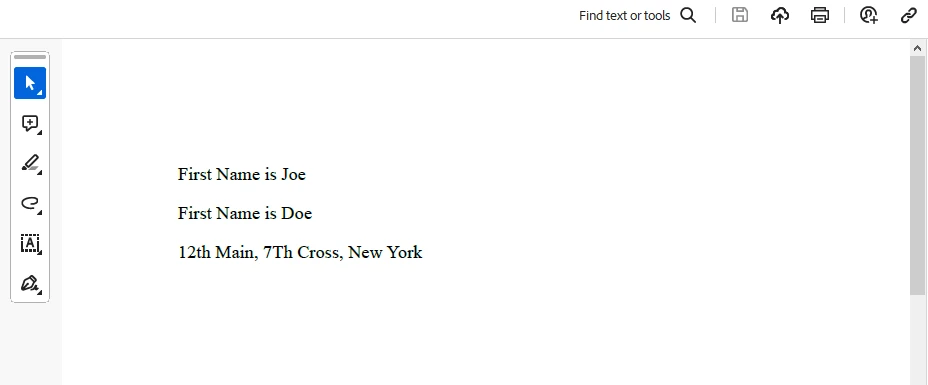
End Class在此示例中,我们使用 Span 结合 IronPDF 生成 PDF 文档。
输出:

生成的PDF:
IronPDF 许可证信息。 该密钥需要放在appsettings.json中。
"IronPdf.LicenseKey": "your license key"提供您的电子邮件以获取试用许可证。
C# 中的 Span 提供了一种强大而有效的内存处理方式,在性能和灵活性方面具有优势。 其不持有对象的连续特性让其特别适合于需要将内存分配和拷贝最小化的场景。 通过利用 Span,开发人员可以在各种应用程序中获得更好的性能,从字符串操作到高性能数字处理。 通过了解其特性并考虑其局限性,开发人员可以安全有效地利用 Span 进行各种内存操作任务。 与 IronPDF 库概述 相结合,可在不需要"等待"和"生成"边界的情况下生成出色的 PDF 文档。
请访问 IronPDF 的快速入门文档页面 页面。

Jacob Mellor 是 Iron Software 的首席技术官,也是一位开创 C# PDF 技术的有远见的工程师。作为 Iron Software 核心代码库的原始开发者,他从公司成立之初就开始塑造公司的产品架构,与首席执行官 Cameron Rimington 一起将公司转变为一家拥有 50 多名员工的公司,为 NASA、特斯拉和全球政府机构提供服务。

当您需要PDF看起来像HTML时,速度快。













