Einführung von Anonymous Object
Anonyme Typen in C# bieten einen Mechanismus, um öffentliche schreibgeschützte Eigenschaften in einem einzelnen anonymen Typobjekt zu kapseln, ohne eine formale Klassendeklaration explizit festzulegen. Sie sind nützlich für die Erstellung von Einweg-Datenstrukturen. Diese sind vom Compiler generierte Typen, die direkt von System.Object abgeleitet sind und Objekteigenschaften effizient kapseln und als leichte, unveränderliche Datencontainer dienen. Diese Typen sind versiegelte Klassen, bei denen der Compiler den Typnamen automatisch ableitet und generiert, der auf der Quellcodeebene unzugänglich bleibt. Wir werden auch IronPDF als PDF-Bibliothek für .NET-Projekte entdecken.
Wichtige Merkmale
- Anonyme Typen haben streng begrenzte Fähigkeiten:
- Eigenschaften werden innerhalb der Eigenschaftendefinition eines anonymen Typs automatisch als öffentliche schreibgeschützte implementiert.
- Benutzer können innerhalb dieser keine Methoden, Ereignisse oder andere Klassenmitglieder wie Equals oder GetHashCode-Methoden explizit definieren.
- Können nicht mit Nullwerten, anonymen Funktionen oder Zeigertypen initialisiert werden, um die Integrität anonymer Typen zu gewährleisten.
Gängige Anwendungsfälle
LINQ-Vorgänge
Anonyme Datentyp-Objekte glänzen in LINQ-Abfrageausdrücken, insbesondere in Select-Klauseln für anonyme Typobjekte, in denen sie effizient spezifische Eigenschaftsuntergruppen aus größeren Objekten zurückgeben. Dieser Ansatz optimiert die Speichernutzung durch die Erstellung temporärer Objekte, die nur die notwendigen Daten enthalten.
Temporäre Datengruppierung
Sie dienen als effiziente Container für temporäre Datenstrukturen, wenn die Erstellung einer formalen Klasse überflüssig wäre. Dies ist besonders nützlich für kurzlebige Datentransformationen oder Zwischenberechnungen.
Eigenschaftskapselung
Der anonyme Datentyp bietet eine klare Methode, um verwandte Objekteigenschaften mit schreibgeschützten Eigenschaften zu bündeln. Der Compiler gewährleistet Typsicherheit, während er eine prägnante Syntax für den Eigenschaftszugriff beibehält.
Syntax und Struktur
Die Erstellung von anonymen Typen folgt einem spezifischen Muster mit dem var Schlüsselwort zusammen mit dem new Operator und der Objektinitialisierungs-Syntax. Der Compiler generiert automatisch einen Typnamen, der auf der Quellcodeebene unzugänglich bleibt.
var person = new { FirstName = "Iron", LastName = "Dev", Age = 35 }; // public int age in this anonymous type
var person = new { FirstName = "Iron", LastName = "Dev", Age = 35 }; // public int age in this anonymous typePrivate person = New With {
Key .FirstName = "Iron",
Key .LastName = "Dev",
Key .Age = 35
}
Private person = New With {
	Key .FirstName = "Iron",
	Key .LastName = "Dev",
	Key .Age = 35
}
Eigenschaftsinitialisierungsregeln
Der Compiler erzwingt strenge Regeln für die Eigenschaftsinitialisierung in anonymen Typen. Alle Eigenschaften müssen während der Objekterstellung initialisiert werden und können nicht mit Nullwerten oder Zeigertypen zugewiesen werden. Einmal initialisieren, können Eigenschaftswerte mit der Standardpunktnotation abgerufen werden, aber sie können aufgrund ihrer schreibgeschützten Natur nach der Initialisierung nicht geändert werden.
Typ-Inferenz und Matching
var person1 = new { Name = "Iron", Age = 30 };
var person2 = new { Name = "Dev", Age = 25 };
var person1 = new { Name = "Iron", Age = 30 };
var person2 = new { Name = "Dev", Age = 25 };
Dim person1 = New With {
Key .Name = "Iron",
Key .Age = 30
}
Dim person2 = New With {
Key .Name = "Dev",
Key .Age = 25
}
Dim person1 = New With {
	Key .Name = "Iron",
	Key .Age = 30
}
Dim person2 = New With {
	Key .Name = "Dev",
	Key .Age = 25
}
Der Compiler generiert identische Typinformationen für anonyme Typen mit übereinstimmenden Eigenschaftsnamen, -typen und -reihenfolge. Dies ermöglicht die Typkompatibilität zwischen Instanzen, die in Sammlungen verwendet oder innerhalb derselben Assembly als Methodenparameter übergeben werden.
Anonyme verschachtelte Typen
Anonyme Datentypen unterstützen komplexe verschachtelte Strukturen mit anonymen Typ-Objekteigenschaften. Dies ist hilfreich für die Erstellung hierarchischer Datenrepräsentationen:
var student = new {
    Id = 1,
    PersonalInfo = new {
        Name = "James",
        Contact = new {
            Email = "james@email.com",
            Phone = "123-456-7890"
        }
    },
    Grades = new { Math = 95, Science = 88 }
};
var student = new {
    Id = 1,
    PersonalInfo = new {
        Name = "James",
        Contact = new {
            Email = "james@email.com",
            Phone = "123-456-7890"
        }
    },
    Grades = new { Math = 95, Science = 88 }
};
Dim student = New With {
Key .Id = 1,
Key .PersonalInfo = New With {
Key .Name = "James",
Key .Contact = New With {
Key .Email = "james@email.com",
Key .Phone = "123-456-7890"
}
},
Key .Grades = New With {
Key .Math = 95,
Key .Science = 88
}
}
Dim student = New With {
	Key .Id = 1,
	Key .PersonalInfo = New With {
		Key .Name = "James",
		Key .Contact = New With {
			Key .Email = "james@email.com",
			Key .Phone = "123-456-7890"
		}
	},
	Key .Grades = New With {
		Key .Math = 95,
		Key .Science = 88
	}
}
Sammlungsoperationen
Anonyme Typen glänzen in Szenarien, die die Manipulation von Sammlungen und Datenumwandlung beinhalten:
var items = new[] {
    new { ProductId = 1, Name = "Laptop", Price = 1200.00m },
    new { ProductId = 2, Name = "Mouse", Price = 25.99m },
    new { ProductId = 3, Name = "Keyboard", Price = 45.50m }
};
var items = new[] {
    new { ProductId = 1, Name = "Laptop", Price = 1200.00m },
    new { ProductId = 2, Name = "Mouse", Price = 25.99m },
    new { ProductId = 3, Name = "Keyboard", Price = 45.50m }
};
Dim items = {
New With {
Key .ProductId = 1,
Key .Name = "Laptop",
Key .Price = 1200.00D
},
New With {
Key .ProductId = 2,
Key .Name = "Mouse",
Key .Price = 25.99D
},
New With {
Key .ProductId = 3,
Key .Name = "Keyboard",
Key .Price = 45.50D
}
}
Dim items = {
	New With {
		Key .ProductId = 1,
		Key .Name = "Laptop",
		Key .Price = 1200.00D
	},
	New With {
		Key .ProductId = 2,
		Key .Name = "Mouse",
		Key .Price = 25.99D
	},
	New With {
		Key .ProductId = 3,
		Key .Name = "Keyboard",
		Key .Price = 45.50D
	}
}
IronPDF: C# PDF-Bibliothek
IronPDF ist eine leistungsstarke Bibliothek zum Erstellen, Bearbeiten und Verwalten von PDF-Dokumenten in .NET-Anwendungen. Bei der Arbeit mit C# verwenden Entwickler häufig anonyme Objekte für leichte und ad-hoc-Datenstrukturen, insbesondere für Szenarien, in denen die Erstellung einer gesamten Klasse nicht notwendig ist. Diese anonymen Objekte können nahtlos mit IronPDF genutzt werden, um dynamisch PDF-Dokumente zu erstellen. Es hilft bei der Erstellung einer flexiblen Lösung für schnelle Daten-zu-PDF-Workflows. Hier ist ein Beispiel zur Veranschaulichung, wie IronPDF mit anonymen Objekten arbeitet:
Beispiel: Verwendung von anonymen Objekten zum Auffüllen einer PDF-Datei
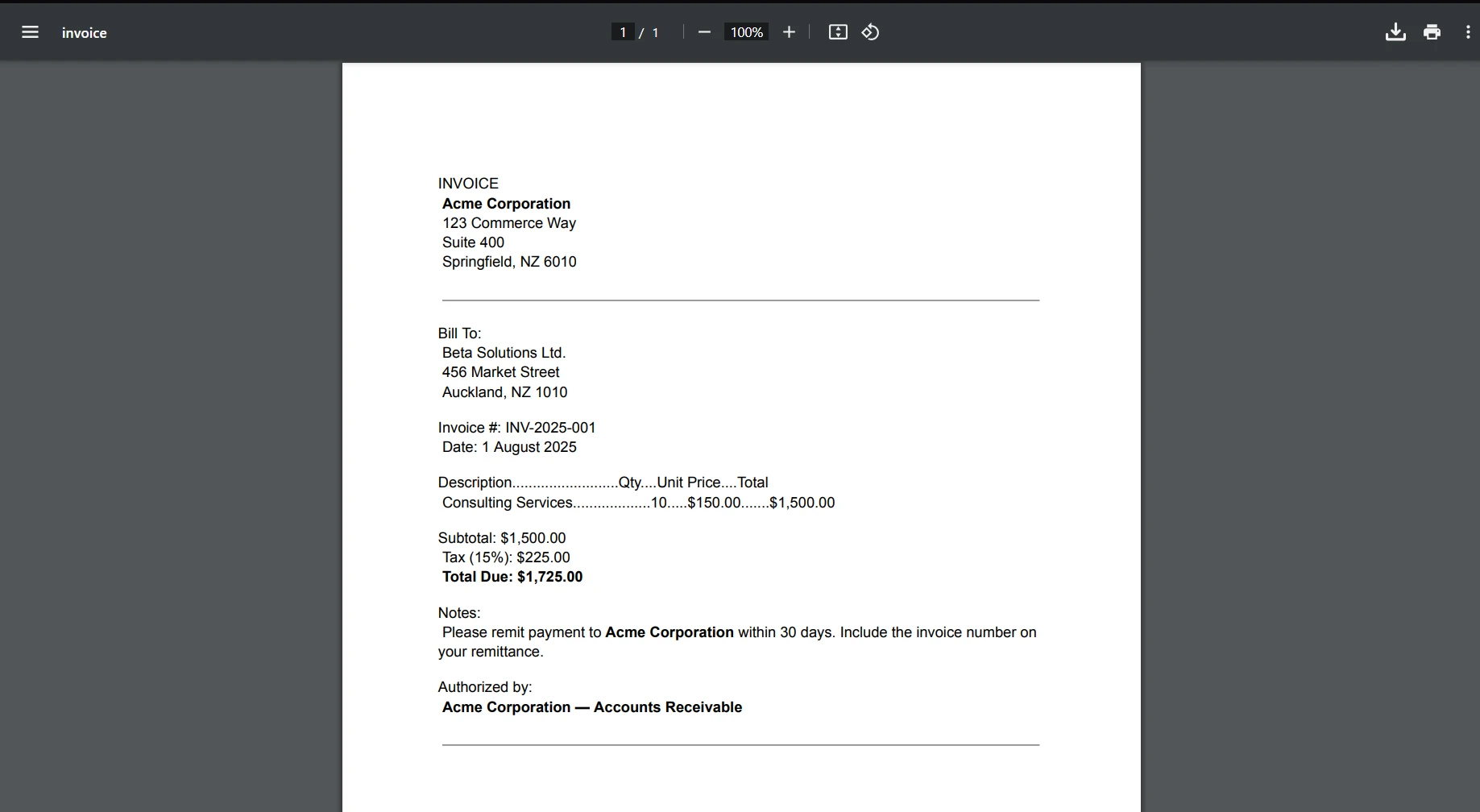
Stellen Sie sich vor, Sie haben eine Liste von Verkaufsdaten, die Sie als Tabelle in einem PDF wiedergeben möchten. Anstatt eine formale Klasse zu erstellen, können Sie ein anonymes Objekt verwenden, um die Daten schnell für die Darstellung zu formatieren.
using IronPdf;
using System;
using System.Linq;

class Program
{
    static void Main()
    {
        // Set your IronPDF license key here
        License.LicenseKey = "Your-Licence-Key";

        // Sample data using anonymous objects
        var salesData = new[]
        {
            new { Product = "Laptop", Quantity = 2, Price = 1200.50 },
            new { Product = "Smartphone", Quantity = 5, Price = 800.00 },
            new { Product = "Headphones", Quantity = 10, Price = 150.75 }
        };

        // Create an HTML string dynamically using the anonymous object data
        var htmlContent = @"
        <html>
        <head><style>table {border-collapse: collapse;} th, td {border: 1px solid black; padding: 5px;}</style></head>
        <body>
        <h1>Sales Report</h1>
        <table>
            <thead>
                <tr>
                    <th>Product</th>
                    <th>Quantity</th>
                    <th>Price</th>
                </tr>
            </thead>
            <tbody>
                " +
            string.Join("", salesData.Select(item =>
                $"<tr><td>{item.Product}</td><td>{item.Quantity}</td><td>{item.Price:C}</td></tr>")) +
            @"
            </tbody>
        </table>
        </body>
        </html>";

        // Generate the PDF
        var renderer = new ChromePdfRenderer();
        var pdf = renderer.RenderHtmlAsPdf(htmlContent);

        // Save the PDF
        pdf.SaveAs("SalesReport.pdf");
        Console.WriteLine("PDF generated successfully!");
    }
}
using IronPdf;
using System;
using System.Linq;

class Program
{
    static void Main()
    {
        // Set your IronPDF license key here
        License.LicenseKey = "Your-Licence-Key";

        // Sample data using anonymous objects
        var salesData = new[]
        {
            new { Product = "Laptop", Quantity = 2, Price = 1200.50 },
            new { Product = "Smartphone", Quantity = 5, Price = 800.00 },
            new { Product = "Headphones", Quantity = 10, Price = 150.75 }
        };

        // Create an HTML string dynamically using the anonymous object data
        var htmlContent = @"
        <html>
        <head><style>table {border-collapse: collapse;} th, td {border: 1px solid black; padding: 5px;}</style></head>
        <body>
        <h1>Sales Report</h1>
        <table>
            <thead>
                <tr>
                    <th>Product</th>
                    <th>Quantity</th>
                    <th>Price</th>
                </tr>
            </thead>
            <tbody>
                " +
            string.Join("", salesData.Select(item =>
                $"<tr><td>{item.Product}</td><td>{item.Quantity}</td><td>{item.Price:C}</td></tr>")) +
            @"
            </tbody>
        </table>
        </body>
        </html>";

        // Generate the PDF
        var renderer = new ChromePdfRenderer();
        var pdf = renderer.RenderHtmlAsPdf(htmlContent);

        // Save the PDF
        pdf.SaveAs("SalesReport.pdf");
        Console.WriteLine("PDF generated successfully!");
    }
}
Imports IronPdf
Imports System
Imports System.Linq
Friend Class Program
Shared Sub Main()
' Set your IronPDF license key here
License.LicenseKey = "Your-Licence-Key"
' Sample data using anonymous objects
Dim salesData = {
New With {
Key .Product = "Laptop",
Key .Quantity = 2,
Key .Price = 1200.50
},
New With {
Key .Product = "Smartphone",
Key .Quantity = 5,
Key .Price = 800.00
},
New With {
Key .Product = "Headphones",
Key .Quantity = 10,
Key .Price = 150.75
}
}
' Create an HTML string dynamically using the anonymous object data
Dim htmlContent = "
<html>
<head><style>table {border-collapse: collapse;} th, td {border: 1px solid black; padding: 5px;}</style></head>
<body>
<h1>Sales Report</h1>
<table>
<thead>
<tr>
<th>Product</th>
<th>Quantity</th>
<th>Price</th>
</tr>
</thead>
<tbody>
" & String.Join("", salesData.Select(Function(item) $"<tr><td>{item.Product}</td><td>{item.Quantity}</td><td>{item.Price:C}</td></tr>")) & "
</tbody>
</table>
</body>
</html>"
' Generate the PDF
Dim renderer = New ChromePdfRenderer()
Dim pdf = renderer.RenderHtmlAsPdf(htmlContent)
' Save the PDF
pdf.SaveAs("SalesReport.pdf")
Console.WriteLine("PDF generated successfully!")
End Sub
End Class
Imports IronPdf
Imports System
Imports System.Linq

Friend Class Program
	Shared Sub Main()
		' Set your IronPDF license key here
		License.LicenseKey = "Your-Licence-Key"

		' Sample data using anonymous objects
		Dim salesData = {
			New With {
				Key .Product = "Laptop",
				Key .Quantity = 2,
				Key .Price = 1200.50
			},
			New With {
				Key .Product = "Smartphone",
				Key .Quantity = 5,
				Key .Price = 800.00
			},
			New With {
				Key .Product = "Headphones",
				Key .Quantity = 10,
				Key .Price = 150.75
			}
		}

		' Create an HTML string dynamically using the anonymous object data
		Dim htmlContent = "
        <html>
        <head><style>table {border-collapse: collapse;} th, td {border: 1px solid black; padding: 5px;}</style></head>
        <body>
        <h1>Sales Report</h1>
        <table>
            <thead>
                <tr>
                    <th>Product</th>
                    <th>Quantity</th>
                    <th>Price</th>
                </tr>
            </thead>
            <tbody>
                " & String.Join("", salesData.Select(Function(item) $"<tr><td>{item.Product}</td><td>{item.Quantity}</td><td>{item.Price:C}</td></tr>")) & "
            </tbody>
        </table>
        </body>
        </html>"

		' Generate the PDF
		Dim renderer = New ChromePdfRenderer()
		Dim pdf = renderer.RenderHtmlAsPdf(htmlContent)

		' Save the PDF
		pdf.SaveAs("SalesReport.pdf")
		Console.WriteLine("PDF generated successfully!")
	End Sub
End Class

Abschluss
Anonyme Typen in C# bieten eine flexible und effiziente Methode zur Erstellung temporärer Datenstrukturen, ohne die Notwendigkeit für formale Klassendeklarationen. Sie sind besonders nützlich bei der Arbeit mit LINQ-Abfragen, Datenumwandlungen und Bibliotheken wie IronPDF. Die Kombination anonymer Typen mit den PDF-Erstellungsfunktionen von IronPDF bietet eine leistungsstarke Lösung zur Erstellung dynamischer, datengetriebener PDFs mit minimalem Codeaufwand.
IronPDF ermöglicht es Entwicklern, seine Funktionen über eine kostenlose Testversion auszuprobieren, was es einfach macht, seine Möglichkeiten in Ihren .NET-Anwendungen zu erforschen. Kommerzielle Lizenzen beginnen bei $999 und gewähren Zugriff auf das vollständige Funktionsspektrum, einschließlich leistungsstarkem HTML-zu-PDF-Rendering, PDF-Bearbeitung und Sicherheitsfunktionen.