using IronPdf;

// Disable local disk access or cross-origin requests
Installation.EnableWebSecurity = true;

// Instantiate Renderer
var renderer = new ChromePdfRenderer();

// Create a PDF from a HTML string using C#
var pdf = renderer.RenderHtmlAsPdf("<h1>Hello World</h1>");

// Export to a file or Stream
pdf.SaveAs("output.pdf");

// Advanced Example with HTML Assets
// Load external html assets: Images, CSS and JavaScript.
// An optional BasePath 'C:\site\assets\' is set as the file location to load assets from
var myAdvancedPdf = renderer.RenderHtmlAsPdf("<img src='icons/iron.png'>", @"C:\site\assets\");
myAdvancedPdf.SaveAs("html-with-assets.pdf");
using IronPdf;// Disable local disk access or cross-origin requestsInstallation.EnableWebSecurity = true;// Instantiate Renderervar renderer = new ChromePdfRenderer();// Create a PDF from a HTML string using C#var pdf = renderer.RenderHtmlAsPdf("<h1>Hello World</h1>");// Export to a file or Streampdf.SaveAs("output.pdf");// Advanced Example with HTML Assets// Load external html assets: Images, CSS and JavaScript.// An optional BasePath 'C:\site\assets\' is set as the file location to load assets fromvar myAdvancedPdf = renderer.RenderHtmlAsPdf("<img src='icons/iron.png'>", @"C:\site\assets\");myAdvancedPdf.SaveAs("html-with-assets.pdf");
Die Abfragesprache Language-integrated query (LINQ), ein mächtiges Sprachfeature in C#, ermöglicht Programmierern das Erstellen klarer, ausdrucksstarker Abfragen für eine Vielzahl von Datenquellen. Dieser Beitrag wird die Verwendung von [IronPDF](/), einer vielseitigen C#-Bibliothek zur Arbeit mit PDF-Dokumenten, unter Verwendung der Funktion [LINQ's Distinct](https://learn.microsoft.com/en-us/dotnet/csharp/linq/) diskutieren. Wir werden zeigen, wie diese Kombination den Prozess der Erstellung einzigartiger Dokumente aus einer Sammlung erleichtern kann. In diesem Artikel werden wir die C# LINQ distinct Funktion mit IronPDF kennenlernen.
### Wie man die C# LINQ Distinct-Methode verwendet
1. Erstellen Sie ein neues Konsolenprojekt.
2. Importieren Sie den `System.Linq`-Namespace.
3. Erstellen Sie eine Liste mit mehreren Elementen.
4. Rufen Sie die Methode `Distinct()` aus der Liste auf.
5. Erhalten Sie die eindeutigen Werte und zeigen Sie das Ergebnis in der Konsole an.
6. Entsorgen Sie alle erstellten Objekte.
## Was ist LINQ
Entwickler können mit dem LINQ (Language Integrated Query) Feature von C# direkt in ihrem Code klare und ausdrucksstarke Abfragen zur Datenmanipulation erstellen. Erstmals in .NET Framework 3.5 eingeführt, bietet LINQ eine standardisierte Syntax für Abfragen an eine Vielzahl von Datenquellen, einschließlich Datenbanken und Sammlungen. LINQ macht einfache Aufgaben wie Filtern und Projektion einfacher durch die Verwendung von Operatoren wie `Where` und `Select`, was die Lesbarkeit des Codes verbessert. Da es eine verzögerte Ausführung für optimale Geschwindigkeit ermöglicht, ist dieses Feature für C#-Entwickler entscheidend, um sicherzustellen, dass Datenmanipulationsoperationen schnell und natürlich in einer SQL-ähnlichen Weise abgeschlossen werden.
### LINQ Distinct verstehen
Doppelte Elemente können aus einer Sammlung oder Sequenz entfernt werden, indem die LINQ-Funktion `Distinct` verwendet wird. In Abwesenheit eines benutzerdefinierten Vergleichers vergleicht es Elemente mit ihrem Standardvergleicher. Dies macht es zu einer großartigen Option in Situationen, in denen Sie mit einer einzigartigen Sammlung arbeiten und doppelte Komponenten entfernen müssen. Die Technik `Distinct` verwendet die Standard-Gleichheitsvergleichsmethoden, um Werte zu bewerten. Es wird Duplikate ausschließen, um nur eindeutige Elemente zurückzugeben.
#### Grundlegende Verwendung
Um eindeutige Elemente zu erhalten, ist es der einfachste Weg, die Methode `Distinct` direkt auf einer Sammlung zu verwenden.
```csharp
using System.Linq;
using System.Collections.Generic;

public class DistinctExample
{
    public static void Example()
    {
        // Example list with duplicate integers
        List<int> numbers = new List<int> { 1, 2, 2, 3, 4, 4, 5 };

        // Using Distinct to remove duplicates
        var distinctNumbers = numbers.Distinct();

        // Display the distinct numbers
        foreach (var number in distinctNumbers)
        {
            Console.WriteLine(number);
        }
    }
}
```
#### Benutzerdefinierter Gleichheitsvergleicher
Sie können einen benutzerdefinierten Gleichheitsvergleich definieren, indem Sie eine Überladung der Funktion `Distinct` verwenden. Dies ist hilfreich, wenn Sie Elemente gemäß bestimmten Kriterien vergleichen möchten. Bitte beachten Sie das folgende Beispiel:
```csharp
using System;
using System.Collections.Generic;
using System.Linq;
public class Person
{
public string FirstName { get; set; }
public string LastName { get; set; }
}
public class PersonEqualityComparer : IEqualityComparer<Person>
{
public bool Equals(Person x, Person y)
{
return x.FirstName == y.FirstName && x.LastName == y.LastName;
}
public int GetHashCode(Person obj)
{
return obj.FirstName.GetHashCode() ^ obj.LastName.GetHashCode();
}
}
public class DistinctCustomComparerExample
{
public static void Example()
{
// Example list of people
List<Person> people = new List<Person>
{
new Person { FirstName = "John", LastName = "Doe" },
new Person { FirstName = "Jane", LastName = "Doe" },
new Person { FirstName = "John", LastName = "Doe" }
};
// Using Distinct with a custom equality comparer
var distinctPeople = people.Distinct(new PersonEqualityComparer());
// Display distinct people
foreach (var person in distinctPeople)
{
Console.WriteLine($"{person.FirstName} {person.LastName}");
}
}
}
```
#### Verwendung von Distinct mit Werttypen
Es ist nicht erforderlich, einen benutzerdefinierten Gleichheitsvergleich bereitzustellen, wenn Sie die Methode `Distinct` mit Wertetypen verwenden.
```csharp
using System;
using System.Collections.Generic;
using System.Linq;
public class DistinctValueTypeExample
{
public static void Example()
{
List<int> integers = new List<int> { 1, 2, 2, 3, 4, 4, 5 };
// Using Distinct to remove duplicates
var distinctIntegers = integers.Distinct();
// Display distinct integers
foreach (var integer in distinctIntegers)
{
Console.WriteLine(integer);
}
}
}
```
#### Verwendung von Distinct mit anonymen Typen
`Distinct` kann mit anonymen Typen verwendet werden, um Duplikate basierend auf bestimmten Attributen zu entfernen. Bitte beachten Sie das folgende Beispiel:
```csharp
using System;
using System.Collections.Generic;
using System.Linq;
public class Person
{
public string FirstName { get; set; }
public string LastName { get; set; }
}
public class DistinctAnonymousTypesExample
{
public static void Example()
{
List<Person> people = new List<Person>
{
new Person { FirstName = "John", LastName = "Doe" },
new Person { FirstName = "Jane", LastName = "Doe" },
new Person { FirstName = "John", LastName = "Doe" }
};
// Using Distinct with anonymous types
var distinctPeople = people
.Select(p => new { p.FirstName, p.LastName })
.Distinct();
// Display distinct anonymous types
foreach (var person in distinctPeople)
{
Console.WriteLine($"{person.FirstName} {person.LastName}");
}
}
}
```
#### Unterscheidung durch eine bestimmte Eigenschaft
Beim Arbeiten mit Objekten können Sie entweder Ihre eigene Logik zum Unterscheiden nach einem bestimmten Attribut erstellen oder die `DistinctBy`-Erweiterungsmethode von Drittanbieter-Bibliotheken (wie MoreLINQ) verwenden.
```csharp
// Ensure to include the MoreLINQ Library
using MoreLinq;
using System;
using System.Collections.Generic;
using System.Linq;
public class Person
{
public int Id { get; set; }
public string FirstName { get; set; }
public string LastName { get; set; }
}
public class DistinctByExample
{
public static void Example()
{
List<Person> people = new List<Person>
{
new Person { Id = 1, FirstName = "John", LastName = "Doe" },
new Person { Id = 2, FirstName = "Jane", LastName = "Doe" },
new Person { Id = 1, FirstName = "John", LastName = "Doe" }
};
// Using DistinctBy to filter distinct people by Id
var distinctPeople = people.DistinctBy(p => p.Id);
// Display distinct people
foreach (var person in distinctPeople)
{
Console.WriteLine($"{person.Id}: {person.FirstName} {person.LastName}");
}
}
}
```
### IronPDF
Programmierer können mit Hilfe der .NET-Bibliothek [IronPDF Website](/) PDF-Dokumente unter Verwendung der C#-Sprache erstellen, bearbeiten und ändern. Das Programm bietet eine Reihe von Werkzeugen und Funktionen, um verschiedene Aufgaben im Zusammenhang mit PDF-Dateien zu ermöglichen, wie das Erstellen von PDFs aus HTML, das Konvertieren von HTML in PDF, das Zusammenführen oder Aufteilen von PDF-Dokumenten und das Hinzufügen von Text, Bildern und Anmerkungen zu bereits vorhandenen PDFs. Um mehr über IronPDF zu erfahren, beachten Sie bitte die [IronPDF Dokumentation](/docs/).
Das Hauptmerkmal von IronPDF ist die [**HTML zu PDF Konvertierung**](/tutorials/html-to-pdf/), die Ihre Layouts und Stile intakt hält. Sie können PDFs aus Webinhalten erstellen, ideal für Berichte, Rechnungen und Dokumentationen. Es unterstützt die Konvertierung von HTML-Dateien, URLs und HTML-Zeichenfolgen in PDF-Dateien.
```csharp
using IronPdf;
class Program
{
static void Main(string[] args)
{
var renderer = new ChromePdfRenderer();
// 1. Convert HTML String to PDF
var htmlContent = "<h1>Hello, IronPDF!</h1><p>This is a PDF from an HTML string.</p>";
var pdfFromHtmlString = renderer.RenderHtmlAsPdf(htmlContent);
pdfFromHtmlString.SaveAs("HTMLStringToPDF.pdf");
// 2. Convert HTML File to PDF
var htmlFilePath = "path_to_your_html_file.html"; // Specify the path to your HTML file
var pdfFromHtmlFile = renderer.RenderHtmlFileAsPdf(htmlFilePath);
pdfFromHtmlFile.SaveAs("HTMLFileToPDF.pdf");
// 3. Convert URL to PDF
var url = "http://ironpdf.com"; // Specify the URL
var pdfFromUrl = renderer.RenderUrlAsPdf(url);
pdfFromUrl.SaveAs("URLToPDF.pdf");
}
}
```
### Funktionen von IronPDF
* **HTML in PDF konvertieren:** Sie können IronPDF verwenden, um jede Art von HTML-Daten - einschließlich Dateien, URLs und HTML-Code-Zeichenfolgen - in PDF-Dokumente zu konvertieren.
* **PDF-Erzeugung:** Text, Bilder und andere Elemente können programmgesteuert mit der C#-Programmiersprache zu PDF-Dokumenten hinzugefügt werden.
* **PDF-Bearbeitung:** IronPDF kann eine PDF-Datei in mehrere Dateien aufteilen, mehrere PDF-Dokumente in eine Datei zusammenführen und bereits vorhandene PDFs bearbeiten.
* **PDF-Formulare:** Die Bibliothek ermöglicht es Benutzern, PDF-Formulare zu erstellen und auszufüllen, wodurch sie in Szenarien nützlich ist, in denen Formulardaten gesammelt und verarbeitet werden müssen.
* **Sicherheitsfunktionen:** IronPDF kann verwendet werden, um PDF-Dokumente zu verschlüsseln und Passwort- und Berechtigungsschutz bereitzustellen.
* **Textextraktion:** Text aus PDF-Dateien kann mit IronPDF extrahiert werden.
### IronPDF installieren
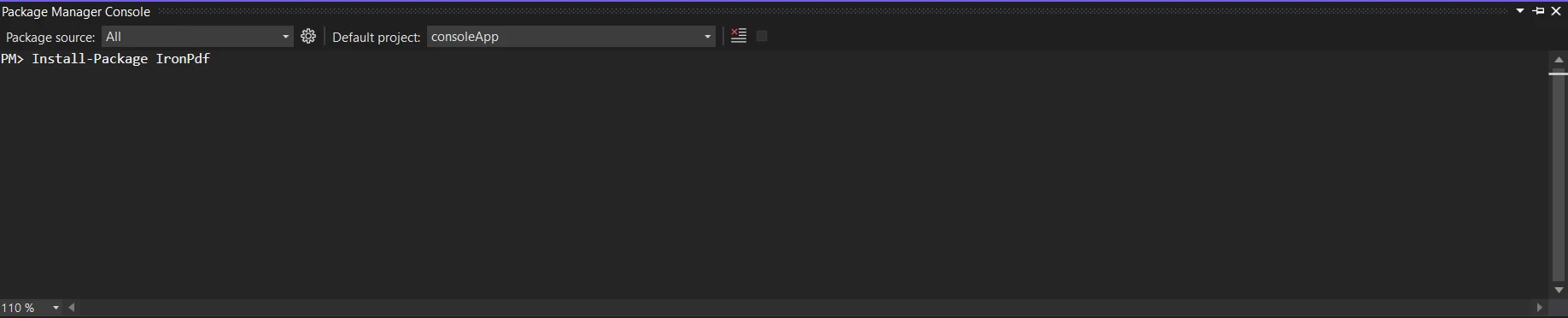
Holen Sie sich die IronPDF-Bibliothek; es wird benötigt, um Ihr Projekt einzurichten. Geben Sie den folgenden Code in die NuGet-Paketmanager-Konsole ein, um dies zu erreichen:
```shell
:ProductInstall
```
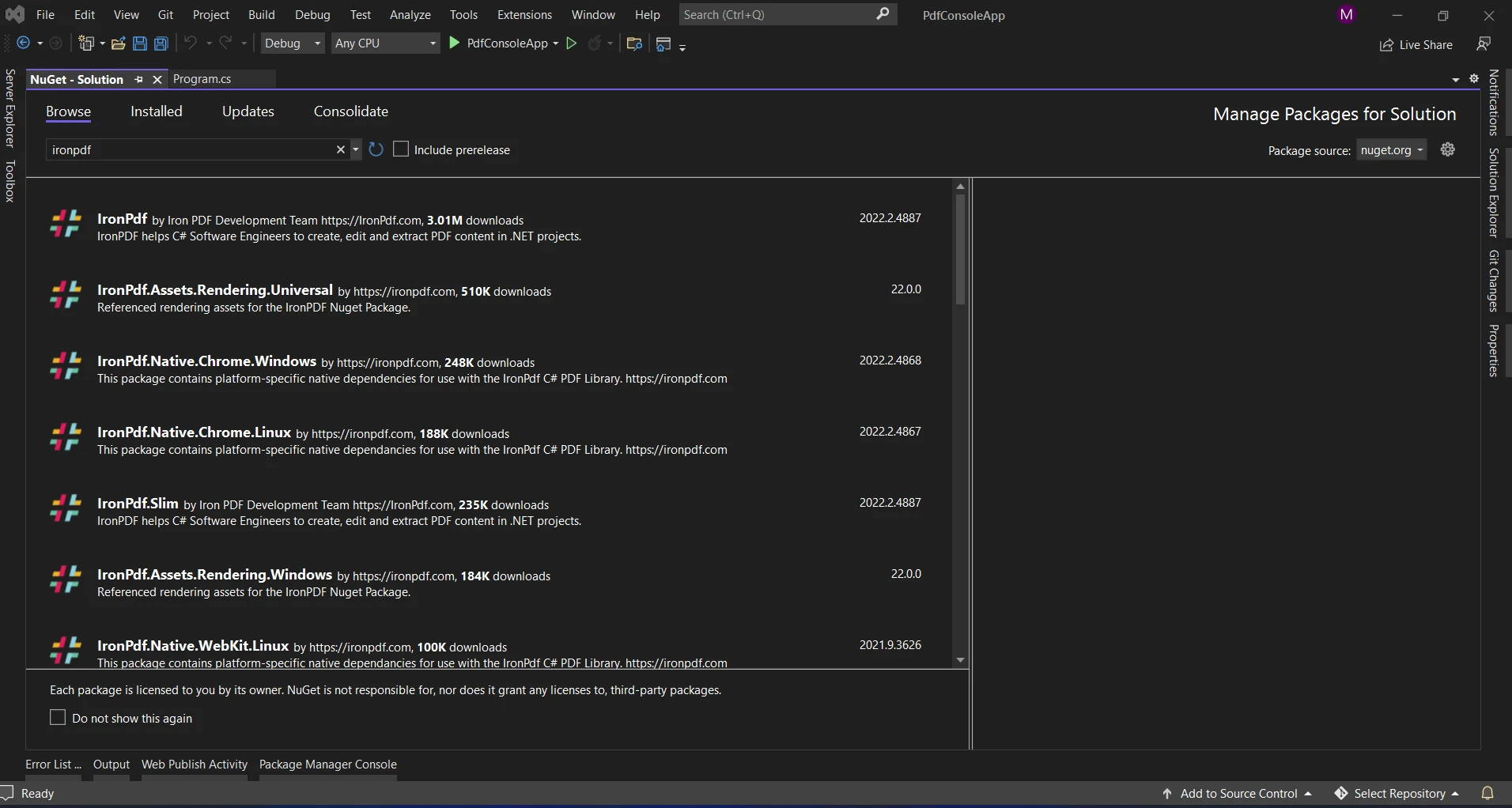
Die Verwendung des NuGet-Paketmanagers zur Suche nach dem Paket "IronPDF" ist eine weitere Option. Wir können aus dieser Liste der mit IronPDF verbundenen NuGet-Pakete das benötigte Paket auswählen und herunterladen.
### LINQ mit IronPDF
Betrachten Sie eine Situation, in der Sie einen Satz von Daten haben und verschiedene PDF-Dokumente gemäß unterschiedlichen Werten in diesem Satz erstellen möchten. Hier zeigt sich die Nützlichkeit von LINQs `Distinct`, insbesondere wenn es mit IronPDF verwendet wird, um schnell Dokumente zu erstellen.
### Erzeugung eindeutiger PDFs mit LINQ und IronPDF
```csharp
using IronPdf;
using System;
using System.Collections.Generic;
using System.Linq;
public class DocumentGenerator
{
public static void Main()
{
// Sample data representing categories
List<string> categories = new List<string>
{
"Technology",
"Business",
"Health",
"Technology",
"Science",
"Business",
"Health"
};
// Use LINQ Distinct to filter out duplicate values
var distinctCategories = categories.Distinct();
// Generate a distinct elements PDF document for each category
foreach (var category in distinctCategories)
{
GeneratePdfDocument(category);
}
}
private static void GeneratePdfDocument(string category)
{
// Create a new PDF document using IronPDF
IronPdf.HtmlToPdf renderer = new IronPdf.HtmlToPdf();
PdfDocument pdf = renderer.RenderHtmlAsPdf($"<h1>{category} Report</h1>");
// Save the PDF to a file
string pdfFilePath = $"{category}_Report.pdf";
pdf.SaveAs(pdfFilePath);
// Display a message with the file path
Console.WriteLine($"PDF generated successfully. File saved at: {pdfFilePath}");
}
}
```
In diesem Beispiel wird eine Reihe von eindeutigen Kategorien erhalten, indem die Methode `Distinct` für die Kategorien-Sammlung verwendet wird. Es hilft, doppelte Elemente aus einer Sequenz zu entfernen. Anschließend wird IronPDF verwendet, um ein PDF-Dokument mit diesen einzigartigen Elementen zu erstellen. Diese Methode gewährleistet, dass separate PDF-Dokumente ausschließlich für eindeutige Kategorien erstellt werden.
#### Konsole OUTPUT

#### Generierte PDF-Ausgabe
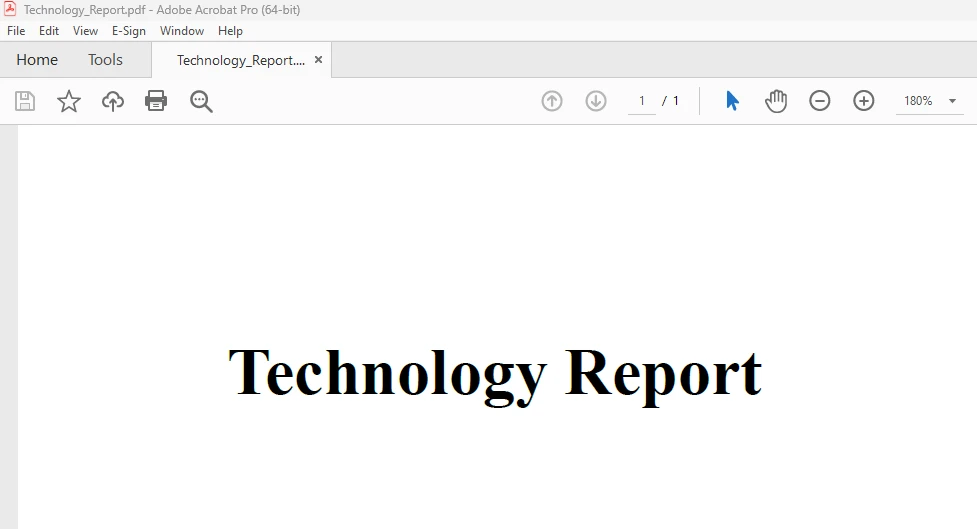
Um mehr über das IronPDF-Codebeispiel zur PDF-Generierung mit HTML zu erfahren, beziehen Sie sich bitte auf den [IronPDF HTML zu PDF Beispielcode](/examples/using-html-to-create-a-pdf/).
### Abschluss
Die LINQ-`Distinct`-Erweiterungsmethode in Verbindung mit IronPDF bietet einen robusten und effizienten Mechanismus zur Erstellung einzigartiger PDF-Dokumente basierend auf Werten. Diese Methode strafft den Code und gewährleistet eine effektive Dokumentengenerierung, egal ob Sie mit Kategorien, Tags oder anderen Daten arbeiten, bei denen separate Dokumente benötigt werden.
Sie können eine zuverlässige und ausdrucksstarke Lösung zur Verwaltung verschiedener Aspekte Ihrer C#-Anwendungen entwickeln, indem Sie LINQ für die Datenverarbeitung und IronPDF für die Dokumentenerstellung verwenden. Wenn Sie diese Strategien für Ihre Projekte verwenden, denken Sie an die besonderen Anforderungen Ihrer Anwendung und passen Sie die Implementierung an, um maximale Zuverlässigkeit und Leistung zu erreichen.
Die Abfragesprache Language-integrated query (LINQ), ein mächtiges Sprachfeature in C#, ermöglicht Programmierern das Erstellen klarer, ausdrucksstarker Abfragen für eine Vielzahl von Datenquellen. Dieser Beitrag wird die Verwendung von IronPDF, einer vielseitigen C#-Bibliothek zur Arbeit mit PDF-Dokumenten, unter Verwendung der Funktion LINQ's Distinct diskutieren. Wir werden zeigen, wie diese Kombination den Prozess der Erstellung einzigartiger Dokumente aus einer Sammlung erleichtern kann. In diesem Artikel werden wir die C# LINQ distinct Funktion mit IronPDF kennenlernen.
Wie man die C# LINQ Distinct-Methode verwendet
Erstellen Sie ein neues Konsolenprojekt.
Importieren Sie den System.Linq-Namespace.
Erstellen Sie eine Liste mit mehreren Elementen.
Rufen Sie die Methode Distinct() aus der Liste auf.
Erhalten Sie die eindeutigen Werte und zeigen Sie das Ergebnis in der Konsole an.
Entsorgen Sie alle erstellten Objekte.
Was ist LINQ
Entwickler können mit dem LINQ (Language Integrated Query) Feature von C# direkt in ihrem Code klare und ausdrucksstarke Abfragen zur Datenmanipulation erstellen. Erstmals in .NET Framework 3.5 eingeführt, bietet LINQ eine standardisierte Syntax für Abfragen an eine Vielzahl von Datenquellen, einschließlich Datenbanken und Sammlungen. LINQ macht einfache Aufgaben wie Filtern und Projektion einfacher durch die Verwendung von Operatoren wie Where und Select, was die Lesbarkeit des Codes verbessert. Da es eine verzögerte Ausführung für optimale Geschwindigkeit ermöglicht, ist dieses Feature für C#-Entwickler entscheidend, um sicherzustellen, dass Datenmanipulationsoperationen schnell und natürlich in einer SQL-ähnlichen Weise abgeschlossen werden.
LINQ Distinct verstehen
Doppelte Elemente können aus einer Sammlung oder Sequenz entfernt werden, indem die LINQ-Funktion Distinct verwendet wird. In Abwesenheit eines benutzerdefinierten Vergleichers vergleicht es Elemente mit ihrem Standardvergleicher. Dies macht es zu einer großartigen Option in Situationen, in denen Sie mit einer einzigartigen Sammlung arbeiten und doppelte Komponenten entfernen müssen. Die Technik Distinct verwendet die Standard-Gleichheitsvergleichsmethoden, um Werte zu bewerten. Es wird Duplikate ausschließen, um nur eindeutige Elemente zurückzugeben.
Grundlegende Verwendung
Um eindeutige Elemente zu erhalten, ist es der einfachste Weg, die Methode Distinct direkt auf einer Sammlung zu verwenden.
using System.Linq;using System.Collections.Generic;public class DistinctExample{ public static voidExample() { // Example list with duplicate integers List<int> numbers = new List<int> { 1, 2, 2, 3, 4, 4, 5 }; // Using Distinct to remove duplicates var distinctNumbers = numbers.Distinct(); // Display the distinct numbers foreach (var number in distinctNumbers) {Console.WriteLine(number); } }}
using System.Linq;
using System.Collections.Generic;

public class DistinctExample
{
    public static void Example()
    {
        // Example list with duplicate integers
        List<int> numbers = new List<int> { 1, 2, 2, 3, 4, 4, 5 };

        // Using Distinct to remove duplicates
        var distinctNumbers = numbers.Distinct();

        // Display the distinct numbers
        foreach (var number in distinctNumbers)
        {
            Console.WriteLine(number);
        }
    }
}
ImportsSystem.LinqImportsSystem.Collections.GenericPublic Class DistinctExample PublicShared Sub Example() ' Example list with duplicate integers Dim numbers As New List(OfInteger) From {1, 2, 2, 3, 4, 4, 5} ' Using Distinct to remove duplicates Dim distinctNumbers = numbers.Distinct() ' Display the distinct numbers For Each number In distinctNumbersConsole.WriteLine(number) Next number End SubEnd Class
Imports System.Linq
Imports System.Collections.Generic

Public Class DistinctExample
	Public Shared Sub Example()
		' Example list with duplicate integers
		Dim numbers As New List(Of Integer) From {1, 2, 2, 3, 4, 4, 5}

		' Using Distinct to remove duplicates
		Dim distinctNumbers = numbers.Distinct()

		' Display the distinct numbers
		For Each number In distinctNumbers
			Console.WriteLine(number)
		Next number
	End Sub
End Class
Benutzerdefinierter Gleichheitsvergleicher
Sie können einen benutzerdefinierten Gleichheitsvergleich definieren, indem Sie eine Überladung der Funktion Distinct verwenden. Dies ist hilfreich, wenn Sie Elemente gemäß bestimmten Kriterien vergleichen möchten. Bitte beachten Sie das folgende Beispiel:
using System;using System.Collections.Generic;using System.Linq;public class Person{ public stringFirstName { get; set; } public stringLastName { get; set; }}public class PersonEqualityComparer : IEqualityComparer<Person>{ public boolEquals(Person x, Person y) { return x.FirstName == y.FirstName && x.LastName == y.LastName; } public intGetHashCode(Person obj) { return obj.FirstName.GetHashCode() ^ obj.LastName.GetHashCode(); }}public class DistinctCustomComparerExample{ public static voidExample() { // Example list of people List<Person> people = new List<Person> { new Person { FirstName = "John", LastName = "Doe" }, new Person { FirstName = "Jane", LastName = "Doe" }, new Person { FirstName = "John", LastName = "Doe" } }; // Using Distinct with a custom equality comparer var distinctPeople = people.Distinct(new PersonEqualityComparer()); // Display distinct people foreach (var person in distinctPeople) {Console.WriteLine($"{person.FirstName} {person.LastName}"); } }}
using System;
using System.Collections.Generic;
using System.Linq;

public class Person
{
    public string FirstName { get; set; }
    public string LastName { get; set; }
}

public class PersonEqualityComparer : IEqualityComparer<Person>
{
    public bool Equals(Person x, Person y)
    {
        return x.FirstName == y.FirstName && x.LastName == y.LastName;
    }

    public int GetHashCode(Person obj)
    {
        return obj.FirstName.GetHashCode() ^ obj.LastName.GetHashCode();
    }
}

public class DistinctCustomComparerExample
{
    public static void Example()
    {
        // Example list of people
        List<Person> people = new List<Person>
        {
            new Person { FirstName = "John", LastName = "Doe" },
            new Person { FirstName = "Jane", LastName = "Doe" },
            new Person { FirstName = "John", LastName = "Doe" }
        };

        // Using Distinct with a custom equality comparer
        var distinctPeople = people.Distinct(new PersonEqualityComparer());

        // Display distinct people
        foreach (var person in distinctPeople)
        {
            Console.WriteLine($"{person.FirstName} {person.LastName}");
        }
    }
}
ImportsSystemImportsSystem.Collections.GenericImportsSystem.LinqPublic Class Person Public Property FirstName() AsString Public Property LastName() AsStringEnd ClassPublic Class PersonEqualityComparerImplementsIEqualityComparer(OfPerson) Public Function Equals(ByVal x AsPerson, ByVal y AsPerson) AsBooleanImplementsIEqualityComparer(OfPerson).Equals Return x.FirstName = y.FirstNameAndAlso x.LastName = y.LastName End Function Public Function GetHashCode(ByVal obj AsPerson) AsIntegerImplementsIEqualityComparer(OfPerson).GetHashCode Return obj.FirstName.GetHashCode() Xor obj.LastName.GetHashCode() End FunctionEnd ClassPublic Class DistinctCustomComparerExample PublicShared Sub Example() ' Example list of people Dim people As New List(OfPerson) From { New PersonWith { .FirstName = "John", .LastName = "Doe" }, New PersonWith { .FirstName = "Jane", .LastName = "Doe" }, New PersonWith { .FirstName = "John", .LastName = "Doe" } } ' Using Distinct with a custom equality comparer Dim distinctPeople = people.Distinct(New PersonEqualityComparer()) ' Display distinct people For Each person In distinctPeopleConsole.WriteLine($"{person.FirstName} {person.LastName}") Next person End SubEnd Class
Imports System
Imports System.Collections.Generic
Imports System.Linq

Public Class Person
	Public Property FirstName() As String
	Public Property LastName() As String
End Class

Public Class PersonEqualityComparer
	Implements IEqualityComparer(Of Person)

	Public Function Equals(ByVal x As Person, ByVal y As Person) As Boolean Implements IEqualityComparer(Of Person).Equals
		Return x.FirstName = y.FirstName AndAlso x.LastName = y.LastName
	End Function

	Public Function GetHashCode(ByVal obj As Person) As Integer Implements IEqualityComparer(Of Person).GetHashCode
		Return obj.FirstName.GetHashCode() Xor obj.LastName.GetHashCode()
	End Function
End Class

Public Class DistinctCustomComparerExample
	Public Shared Sub Example()
		' Example list of people
		Dim people As New List(Of Person) From {
			New Person With {
				.FirstName = "John",
				.LastName = "Doe"
			},
			New Person With {
				.FirstName = "Jane",
				.LastName = "Doe"
			},
			New Person With {
				.FirstName = "John",
				.LastName = "Doe"
			}
		}

		' Using Distinct with a custom equality comparer
		Dim distinctPeople = people.Distinct(New PersonEqualityComparer())

		' Display distinct people
		For Each person In distinctPeople
			Console.WriteLine($"{person.FirstName} {person.LastName}")
		Next person
	End Sub
End Class
Verwendung von Distinct mit Werttypen
Es ist nicht erforderlich, einen benutzerdefinierten Gleichheitsvergleich bereitzustellen, wenn Sie die Methode Distinct mit Wertetypen verwenden.
using System;using System.Collections.Generic;using System.Linq;public class DistinctValueTypeExample{ public static voidExample() { List<int> integers = new List<int> { 1, 2, 2, 3, 4, 4, 5 }; // Using Distinct to remove duplicates var distinctIntegers = integers.Distinct(); // Display distinct integers foreach (var integer in distinctIntegers) {Console.WriteLine(integer); } }}
using System;
using System.Collections.Generic;
using System.Linq;

public class DistinctValueTypeExample
{
    public static void Example()
    {
        List<int> integers = new List<int> { 1, 2, 2, 3, 4, 4, 5 };

        // Using Distinct to remove duplicates
        var distinctIntegers = integers.Distinct();

        // Display distinct integers
        foreach (var integer in distinctIntegers)
        {
            Console.WriteLine(integer);
        }
    }
}
ImportsSystemImportsSystem.Collections.GenericImportsSystem.LinqPublic Class DistinctValueTypeExample PublicShared Sub Example() Dim integers As New List(OfInteger) From {1, 2, 2, 3, 4, 4, 5} ' Using Distinct to remove duplicates Dim distinctIntegers = integers.Distinct() ' Display distinct integers For Each [integer] In distinctIntegersConsole.WriteLine([integer]) Next [integer] End SubEnd Class
Imports System
Imports System.Collections.Generic
Imports System.Linq

Public Class DistinctValueTypeExample
	Public Shared Sub Example()
		Dim integers As New List(Of Integer) From {1, 2, 2, 3, 4, 4, 5}

		' Using Distinct to remove duplicates
		Dim distinctIntegers = integers.Distinct()

		' Display distinct integers
		For Each [integer] In distinctIntegers
			Console.WriteLine([integer])
		Next [integer]
	End Sub
End Class
Verwendung von Distinct mit anonymen Typen
Distinct kann mit anonymen Typen verwendet werden, um Duplikate basierend auf bestimmten Attributen zu entfernen. Bitte beachten Sie das folgende Beispiel:
using System;using System.Collections.Generic;using System.Linq;public class Person{ public stringFirstName { get; set; } public stringLastName { get; set; }}public class DistinctAnonymousTypesExample{ public static voidExample() { List<Person> people = new List<Person> { new Person { FirstName = "John", LastName = "Doe" }, new Person { FirstName = "Jane", LastName = "Doe" }, new Person { FirstName = "John", LastName = "Doe" } }; // Using Distinct with anonymous types var distinctPeople = people .Select(p => new { p.FirstName, p.LastName }) .Distinct(); // Display distinct anonymous types foreach (var person in distinctPeople) {Console.WriteLine($"{person.FirstName} {person.LastName}"); } }}
using System;
using System.Collections.Generic;
using System.Linq;

public class Person
{
    public string FirstName { get; set; }
    public string LastName { get; set; }
}

public class DistinctAnonymousTypesExample
{
    public static void Example()
    {
        List<Person> people = new List<Person>
        {
            new Person { FirstName = "John", LastName = "Doe" },
            new Person { FirstName = "Jane", LastName = "Doe" },
            new Person { FirstName = "John", LastName = "Doe" }
        };

        // Using Distinct with anonymous types
        var distinctPeople = people
            .Select(p => new { p.FirstName, p.LastName })
            .Distinct();

        // Display distinct anonymous types
        foreach (var person in distinctPeople)
        {
            Console.WriteLine($"{person.FirstName} {person.LastName}");
        }
    }
}
ImportsSystemImportsSystem.Collections.GenericImportsSystem.LinqPublic Class Person Public Property FirstName() AsString Public Property LastName() AsStringEnd ClassPublic Class DistinctAnonymousTypesExample PublicShared Sub Example() Dim people As New List(OfPerson) From { New PersonWith { .FirstName = "John", .LastName = "Doe" }, New PersonWith { .FirstName = "Jane", .LastName = "Doe" }, New PersonWith { .FirstName = "John", .LastName = "Doe" } } ' Using Distinct with anonymous types Dim distinctPeople = people.Select(Function(p) New With {Key p.FirstName,Key p.LastName }).Distinct() ' Display distinct anonymous types For Each person In distinctPeopleConsole.WriteLine($"{person.FirstName} {person.LastName}") Next person End SubEnd Class
Imports System
Imports System.Collections.Generic
Imports System.Linq

Public Class Person
	Public Property FirstName() As String
	Public Property LastName() As String
End Class

Public Class DistinctAnonymousTypesExample
	Public Shared Sub Example()
		Dim people As New List(Of Person) From {
			New Person With {
				.FirstName = "John",
				.LastName = "Doe"
			},
			New Person With {
				.FirstName = "Jane",
				.LastName = "Doe"
			},
			New Person With {
				.FirstName = "John",
				.LastName = "Doe"
			}
		}

		' Using Distinct with anonymous types
		Dim distinctPeople = people.Select(Function(p) New With {
			Key p.FirstName,
			Key p.LastName
		}).Distinct()

		' Display distinct anonymous types
		For Each person In distinctPeople
			Console.WriteLine($"{person.FirstName} {person.LastName}")
		Next person
	End Sub
End Class
Unterscheidung durch eine bestimmte Eigenschaft
Beim Arbeiten mit Objekten können Sie entweder Ihre eigene Logik zum Unterscheiden nach einem bestimmten Attribut erstellen oder die DistinctBy-Erweiterungsmethode von Drittanbieter-Bibliotheken (wie MoreLINQ) verwenden.
// Ensure to include the MoreLINQ Libraryusing MoreLinq;using System;using System.Collections.Generic;using System.Linq;public class Person{ public intId { get; set; } public stringFirstName { get; set; } public stringLastName { get; set; }}public class DistinctByExample{ public static voidExample() { List<Person> people = new List<Person> { new Person { Id = 1, FirstName = "John", LastName = "Doe" }, new Person { Id = 2, FirstName = "Jane", LastName = "Doe" }, new Person { Id = 1, FirstName = "John", LastName = "Doe" } }; // Using DistinctBy to filter distinct people by Id var distinctPeople = people.DistinctBy(p => p.Id); // Display distinct people foreach (var person in distinctPeople) {Console.WriteLine($"{person.Id}: {person.FirstName} {person.LastName}"); } }}
// Ensure to include the MoreLINQ Library
using MoreLinq;
using System;
using System.Collections.Generic;
using System.Linq;

public class Person
{
    public int Id { get; set; }
    public string FirstName { get; set; }
    public string LastName { get; set; }
}

public class DistinctByExample
{
    public static void Example()
    {
        List<Person> people = new List<Person>
        {
            new Person { Id = 1, FirstName = "John", LastName = "Doe" },
            new Person { Id = 2, FirstName = "Jane", LastName = "Doe" },
            new Person { Id = 1, FirstName = "John", LastName = "Doe" }
        };

        // Using DistinctBy to filter distinct people by Id
        var distinctPeople = people.DistinctBy(p => p.Id);

        // Display distinct people
        foreach (var person in distinctPeople)
        {
            Console.WriteLine($"{person.Id}: {person.FirstName} {person.LastName}");
        }
    }
}
' Ensure to include the MoreLINQ LibraryImportsMoreLinqImportsSystemImportsSystem.Collections.GenericImportsSystem.LinqPublic Class Person Public Property Id() AsInteger Public Property FirstName() AsString Public Property LastName() AsStringEnd ClassPublic Class DistinctByExample PublicShared Sub Example() Dim people As New List(OfPerson) From { New PersonWith { .Id = 1, .FirstName = "John", .LastName = "Doe" }, New PersonWith { .Id = 2, .FirstName = "Jane", .LastName = "Doe" }, New PersonWith { .Id = 1, .FirstName = "John", .LastName = "Doe" } } ' Using DistinctBy to filter distinct people by Id Dim distinctPeople = people.DistinctBy(Function(p) p.Id) ' Display distinct people For Each person In distinctPeopleConsole.WriteLine($"{person.Id}: {person.FirstName} {person.LastName}") Next person End SubEnd Class
' Ensure to include the MoreLINQ Library
Imports MoreLinq
Imports System
Imports System.Collections.Generic
Imports System.Linq

Public Class Person
	Public Property Id() As Integer
	Public Property FirstName() As String
	Public Property LastName() As String
End Class

Public Class DistinctByExample
	Public Shared Sub Example()
		Dim people As New List(Of Person) From {
			New Person With {
				.Id = 1,
				.FirstName = "John",
				.LastName = "Doe"
			},
			New Person With {
				.Id = 2,
				.FirstName = "Jane",
				.LastName = "Doe"
			},
			New Person With {
				.Id = 1,
				.FirstName = "John",
				.LastName = "Doe"
			}
		}

		' Using DistinctBy to filter distinct people by Id
		Dim distinctPeople = people.DistinctBy(Function(p) p.Id)

		' Display distinct people
		For Each person In distinctPeople
			Console.WriteLine($"{person.Id}: {person.FirstName} {person.LastName}")
		Next person
	End Sub
End Class
IronPDF
Programmierer können mit Hilfe der .NET-Bibliothek IronPDF Website PDF-Dokumente unter Verwendung der C#-Sprache erstellen, bearbeiten und ändern. Das Programm bietet eine Reihe von Werkzeugen und Funktionen, um verschiedene Aufgaben im Zusammenhang mit PDF-Dateien zu ermöglichen, wie das Erstellen von PDFs aus HTML, das Konvertieren von HTML in PDF, das Zusammenführen oder Aufteilen von PDF-Dokumenten und das Hinzufügen von Text, Bildern und Anmerkungen zu bereits vorhandenen PDFs. Um mehr über IronPDF zu erfahren, beachten Sie bitte die IronPDF Dokumentation.
Das Hauptmerkmal von IronPDF ist die HTML zu PDF Konvertierung, die Ihre Layouts und Stile intakt hält. Sie können PDFs aus Webinhalten erstellen, ideal für Berichte, Rechnungen und Dokumentationen. Es unterstützt die Konvertierung von HTML-Dateien, URLs und HTML-Zeichenfolgen in PDF-Dateien.
using IronPdf;class Program{ static voidMain(string[] args) { var renderer = new ChromePdfRenderer(); // 1. Convert HTML String to PDF var htmlContent = "<h1>Hello, IronPDF!</h1><p>This is a PDF from an HTML string.</p>"; var pdfFromHtmlString = renderer.RenderHtmlAsPdf(htmlContent); pdfFromHtmlString.SaveAs("HTMLStringToPDF.pdf"); // 2. Convert HTML File to PDF var htmlFilePath = "path_to_your_html_file.html"; // Specify the path to your HTML file var pdfFromHtmlFile = renderer.RenderHtmlFileAsPdf(htmlFilePath); pdfFromHtmlFile.SaveAs("HTMLFileToPDF.pdf"); // 3. Convert URL to PDF var url = "http://ironpdf.com"; // Specify the URL var pdfFromUrl = renderer.RenderUrlAsPdf(url); pdfFromUrl.SaveAs("URLToPDF.pdf"); }}
using IronPdf;

class Program
{
    static void Main(string[] args)
    {
        var renderer = new ChromePdfRenderer();

        // 1. Convert HTML String to PDF
        var htmlContent = "<h1>Hello, IronPDF!</h1><p>This is a PDF from an HTML string.</p>";
        var pdfFromHtmlString = renderer.RenderHtmlAsPdf(htmlContent);
        pdfFromHtmlString.SaveAs("HTMLStringToPDF.pdf");

        // 2. Convert HTML File to PDF
        var htmlFilePath = "path_to_your_html_file.html"; // Specify the path to your HTML file
        var pdfFromHtmlFile = renderer.RenderHtmlFileAsPdf(htmlFilePath);
        pdfFromHtmlFile.SaveAs("HTMLFileToPDF.pdf");

        // 3. Convert URL to PDF
        var url = "http://ironpdf.com"; // Specify the URL
        var pdfFromUrl = renderer.RenderUrlAsPdf(url);
        pdfFromUrl.SaveAs("URLToPDF.pdf");
    }
}
ImportsIronPdfFriend Class ProgramShared Sub Main(ByVal args() AsString) Dim renderer = New ChromePdfRenderer() ' 1. Convert HTML String to PDF Dim htmlContent = "<h1>Hello, IronPDF!</h1><p>This is a PDF from an HTML string.</p>" Dim pdfFromHtmlString = renderer.RenderHtmlAsPdf(htmlContent) pdfFromHtmlString.SaveAs("HTMLStringToPDF.pdf") ' 2. Convert HTML File to PDF Dim htmlFilePath = "path_to_your_html_file.html" ' Specify the path to your HTML file Dim pdfFromHtmlFile = renderer.RenderHtmlFileAsPdf(htmlFilePath) pdfFromHtmlFile.SaveAs("HTMLFileToPDF.pdf") ' 3. Convert URL to PDF Dim url = "http://ironpdf.com" ' Specify the URL Dim pdfFromUrl = renderer.RenderUrlAsPdf(url) pdfFromUrl.SaveAs("URLToPDF.pdf") End SubEnd Class
Imports IronPdf

Friend Class Program
	Shared Sub Main(ByVal args() As String)
		Dim renderer = New ChromePdfRenderer()

		' 1. Convert HTML String to PDF
		Dim htmlContent = "<h1>Hello, IronPDF!</h1><p>This is a PDF from an HTML string.</p>"
		Dim pdfFromHtmlString = renderer.RenderHtmlAsPdf(htmlContent)
		pdfFromHtmlString.SaveAs("HTMLStringToPDF.pdf")

		' 2. Convert HTML File to PDF
		Dim htmlFilePath = "path_to_your_html_file.html" ' Specify the path to your HTML file
		Dim pdfFromHtmlFile = renderer.RenderHtmlFileAsPdf(htmlFilePath)
		pdfFromHtmlFile.SaveAs("HTMLFileToPDF.pdf")

		' 3. Convert URL to PDF
		Dim url = "http://ironpdf.com" ' Specify the URL
		Dim pdfFromUrl = renderer.RenderUrlAsPdf(url)
		pdfFromUrl.SaveAs("URLToPDF.pdf")
	End Sub
End Class
Funktionen von IronPDF
HTML in PDF konvertieren: Sie können IronPDF verwenden, um jede Art von HTML-Daten - einschließlich Dateien, URLs und HTML-Code-Zeichenfolgen - in PDF-Dokumente zu konvertieren.
PDF-Erzeugung: Text, Bilder und andere Elemente können programmgesteuert mit der C#-Programmiersprache zu PDF-Dokumenten hinzugefügt werden.
PDF-Bearbeitung: IronPDF kann eine PDF-Datei in mehrere Dateien aufteilen, mehrere PDF-Dokumente in eine Datei zusammenführen und bereits vorhandene PDFs bearbeiten.
PDF-Formulare: Die Bibliothek ermöglicht es Benutzern, PDF-Formulare zu erstellen und auszufüllen, wodurch sie in Szenarien nützlich ist, in denen Formulardaten gesammelt und verarbeitet werden müssen.
Sicherheitsfunktionen: IronPDF kann verwendet werden, um PDF-Dokumente zu verschlüsseln und Passwort- und Berechtigungsschutz bereitzustellen.
Textextraktion: Text aus PDF-Dateien kann mit IronPDF extrahiert werden.
IronPDF installieren
Holen Sie sich die IronPDF-Bibliothek; es wird benötigt, um Ihr Projekt einzurichten. Geben Sie den folgenden Code in die NuGet-Paketmanager-Konsole ein, um dies zu erreichen:
PM > Install-Package IronPdf
Install-Package IronPdf
Die Verwendung des NuGet-Paketmanagers zur Suche nach dem Paket "IronPDF" ist eine weitere Option. Wir können aus dieser Liste der mit IronPDF verbundenen NuGet-Pakete das benötigte Paket auswählen und herunterladen.
LINQ mit IronPDF
Betrachten Sie eine Situation, in der Sie einen Satz von Daten haben und verschiedene PDF-Dokumente gemäß unterschiedlichen Werten in diesem Satz erstellen möchten. Hier zeigt sich die Nützlichkeit von LINQs Distinct, insbesondere wenn es mit IronPDF verwendet wird, um schnell Dokumente zu erstellen.
Erzeugung eindeutiger PDFs mit LINQ und IronPDF
using IronPdf;using System;using System.Collections.Generic;using System.Linq;public class DocumentGenerator{ public static voidMain() { // Sample data representing categories List<string> categories = new List<string> { "Technology", "Business", "Health", "Technology", "Science", "Business", "Health" }; // Use LINQ Distinct to filter out duplicate values var distinctCategories = categories.Distinct(); // Generate a distinct elements PDF document for each category foreach (var category in distinctCategories) {GeneratePdfDocument(category); } } private static voidGeneratePdfDocument(string category) { // Create a new PDF document using IronPDF IronPdf.HtmlToPdf renderer = new IronPdf.HtmlToPdf(); PdfDocument pdf = renderer.RenderHtmlAsPdf($"<h1>{category} Report</h1>"); // Save the PDF to a file string pdfFilePath = $"{category}_Report.pdf"; pdf.SaveAs(pdfFilePath); // Display a message with the file pathConsole.WriteLine($"PDF generated successfully. File saved at: {pdfFilePath}"); }}
using IronPdf;
using System;
using System.Collections.Generic;
using System.Linq;

public class DocumentGenerator
{
    public static void Main()
    {
        // Sample data representing categories
        List<string> categories = new List<string>
        {
            "Technology",
            "Business",
            "Health",
            "Technology",
            "Science",
            "Business",
            "Health"
        };

        // Use LINQ Distinct to filter out duplicate values
        var distinctCategories = categories.Distinct();

        // Generate a distinct elements PDF document for each category
        foreach (var category in distinctCategories)
        {
            GeneratePdfDocument(category);
        }
    }

    private static void GeneratePdfDocument(string category)
    {
        // Create a new PDF document using IronPDF
        IronPdf.HtmlToPdf renderer = new IronPdf.HtmlToPdf();
        PdfDocument pdf = renderer.RenderHtmlAsPdf($"<h1>{category} Report</h1>");

        // Save the PDF to a file
        string pdfFilePath = $"{category}_Report.pdf";
        pdf.SaveAs(pdfFilePath);

        // Display a message with the file path
        Console.WriteLine($"PDF generated successfully. File saved at: {pdfFilePath}");
    }
}
ImportsIronPdfImportsSystemImportsSystem.Collections.GenericImportsSystem.LinqPublic Class DocumentGenerator PublicShared Sub Main() ' Sample data representing categories Dim categories As New List(OfString) From { "Technology", "Business", "Health", "Technology", "Science", "Business", "Health" } ' Use LINQ Distinct to filter out duplicate values Dim distinctCategories = categories.Distinct() ' Generate a distinct elements PDF document for each category For Each category In distinctCategoriesGeneratePdfDocument(category) Next End Sub PrivateShared Sub GeneratePdfDocument(ByVal category AsString) ' Create a new PDF document using IronPDF Dim renderer As New IronPdf.HtmlToPdf() Dim pdf AsPdfDocument = renderer.RenderHtmlAsPdf($"<h1>{category} Report</h1>") ' Save the PDF to a file Dim pdfFilePath AsString = $"{category}_Report.pdf" pdf.SaveAs(pdfFilePath) ' Display a message with the file pathConsole.WriteLine($"PDF generated successfully. File saved at: {pdfFilePath}") End SubEnd Class
Imports IronPdf
Imports System
Imports System.Collections.Generic
Imports System.Linq

Public Class DocumentGenerator
    Public Shared Sub Main()
        ' Sample data representing categories
        Dim categories As New List(Of String) From {
            "Technology",
            "Business",
            "Health",
            "Technology",
            "Science",
            "Business",
            "Health"
        }

        ' Use LINQ Distinct to filter out duplicate values
        Dim distinctCategories = categories.Distinct()

        ' Generate a distinct elements PDF document for each category
        For Each category In distinctCategories
            GeneratePdfDocument(category)
        Next
    End Sub

    Private Shared Sub GeneratePdfDocument(ByVal category As String)
        ' Create a new PDF document using IronPDF
        Dim renderer As New IronPdf.HtmlToPdf()
        Dim pdf As PdfDocument = renderer.RenderHtmlAsPdf($"<h1>{category} Report</h1>")

        ' Save the PDF to a file
        Dim pdfFilePath As String = $"{category}_Report.pdf"
        pdf.SaveAs(pdfFilePath)

        ' Display a message with the file path
        Console.WriteLine($"PDF generated successfully. File saved at: {pdfFilePath}")
    End Sub
End Class
In diesem Beispiel wird eine Reihe von eindeutigen Kategorien erhalten, indem die Methode Distinct für die Kategorien-Sammlung verwendet wird. Es hilft, doppelte Elemente aus einer Sequenz zu entfernen. Anschließend wird IronPDF verwendet, um ein PDF-Dokument mit diesen einzigartigen Elementen zu erstellen. Diese Methode gewährleistet, dass separate PDF-Dokumente ausschließlich für eindeutige Kategorien erstellt werden.
Konsole OUTPUT
Generierte PDF-Ausgabe
Um mehr über das IronPDF-Codebeispiel zur PDF-Generierung mit HTML zu erfahren, beziehen Sie sich bitte auf den IronPDF HTML zu PDF Beispielcode.
Abschluss
Die LINQ-Distinct-Erweiterungsmethode in Verbindung mit IronPDF bietet einen robusten und effizienten Mechanismus zur Erstellung einzigartiger PDF-Dokumente basierend auf Werten. Diese Methode strafft den Code und gewährleistet eine effektive Dokumentengenerierung, egal ob Sie mit Kategorien, Tags oder anderen Daten arbeiten, bei denen separate Dokumente benötigt werden.
Sie können eine zuverlässige und ausdrucksstarke Lösung zur Verwaltung verschiedener Aspekte Ihrer C#-Anwendungen entwickeln, indem Sie LINQ für die Datenverarbeitung und IronPDF für die Dokumentenerstellung verwenden. Wenn Sie diese Strategien für Ihre Projekte verwenden, denken Sie an die besonderen Anforderungen Ihrer Anwendung und passen Sie die Implementierung an, um maximale Zuverlässigkeit und Leistung zu erreichen.
Jacob Mellor ist Chief Technology Officer bei Iron Software und ein visionärer Ingenieur, der Pionierarbeit in der C# PDF-Technologie leistet. Als der ursprüngliche Entwickler hinter der Kern-Codebasis von Iron Software hat er die Produktarchitektur des Unternehmens seit seiner Gründung geprägt und es zusammen mit CEO Cameron Rimington in ein Unternehmen mit mehr als 50 Mitarbeitern verwandelt, das die NASA, Tesla und globale Regierungsbehörden beliefert.



























