using IronPdf;

// Disable local disk access or cross-origin requests
Installation.EnableWebSecurity = true;

// Instantiate Renderer
var renderer = new ChromePdfRenderer();

// Create a PDF from a HTML string using C#
var pdf = renderer.RenderHtmlAsPdf("<h1>Hello World</h1>");

// Export to a file or Stream
pdf.SaveAs("output.pdf");

// Advanced Example with HTML Assets
// Load external html assets: Images, CSS and JavaScript.
// An optional BasePath 'C:\site\assets\' is set as the file location to load assets from
var myAdvancedPdf = renderer.RenderHtmlAsPdf("<img src='icons/iron.png'>", @"C:\site\assets\");
myAdvancedPdf.SaveAs("html-with-assets.pdf");
using IronPdf;// Disable local disk access or cross-origin requestsInstallation.EnableWebSecurity = true;// Instantiate Renderervar renderer = new ChromePdfRenderer();// Create a PDF from a HTML string using C#var pdf = renderer.RenderHtmlAsPdf("<h1>Hello World</h1>");// Export to a file or Streampdf.SaveAs("output.pdf");// Advanced Example with HTML Assets// Load external html assets: Images, CSS and JavaScript.// An optional BasePath 'C:\site\assets\' is set as the file location to load assets fromvar myAdvancedPdf = renderer.RenderHtmlAsPdf("<img src='icons/iron.png'>", @"C:\site\assets\");myAdvancedPdf.SaveAs("html-with-assets.pdf");
In C# ist der **short**-Datentyp einer der C#-Datentypen und wird verwendet, um Ganzzahlwerte innerhalb eines begrenzten Bereichs darzustellen. Trotz seiner kleineren Größe im Vergleich zu **int**- oder **long**-Werttypen kann **short** in Szenarien von Vorteil sein, in denen Speichereffizienz oder spezifische Wertbereichsanforderungen entscheidend sind. Es kann numerische Typen sowohl positiver als auch negativer Werte halten und kann leicht in andere Datentypen umgewandelt werden. Dieser Leitfaden taucht in die Feinheiten des [C# short](https://en.wikibooks.org/wiki/C_Sharp_Programming/Keywords/short) ein und behandelt seine Merkmale, Anwendungsszenarien, häufige Operationen und bewährte Verfahren. Zusätzlich werden wir Beispiele erkunden, die die Vielseitigkeit des **short-Schlüsselworts** in verschiedenen Programmierkontexten zeigen.
Wir werden die grundlegenden Konzepte von [IronPDF](/) untersuchen und seine Vielseitigkeit durch ein praktisches Beispiel demonstrieren, bei dem der **short**-Datentyp in C# verwendet wird, um eine PDF-Datei zu erstellen und zu konvertieren.
## 1. Erforschung der Bedeutung der Kurzform von .NET
Bevor wir in technische Details eintauchen, lassen Sie uns die Bedeutung des **short**-Datentyps in C# verstehen.
### 1.1. Speichereffizienz
Der **short**-Datentyp beansprucht maximal nur 16 Bit (2 Byte) Speicher und ist somit speichereffizienter als **int**-Typ (32 Bit) oder **long** (64 Bit). In speicherbeschränkten Umgebungen oder beim Umgang mit großen Datensätzen kann die Nutzung von **short** Benutzereingaben zu erheblichen Speicherersparnissen führen.
### 1.2. Bereichseinschränkungen
Als 16-Bit-Vorzeichen-Ganzzahl hat **short** einen begrenzten Bereich im Vergleich zu **int** oder **long**. Es kann Ganzzahl-Minimum- und -Maximumwerte von -32.768 bis 32.767 inklusive darstellen. Trotz seiner Bereichseinschränkungen ist **short** für Szenarien geeignet, in denen die Größenordnung der Werte innerhalb seines Bereichs liegt.
## 2. praktische Anwendungsszenarien
### 2.1. Speicher-Optimierung
Beim Entwerfen von Datenstrukturen oder Algorithmen, die mit einer großen und variablen Anzahl von Ganzzahlwerten innerhalb des **short**-Bereichs arbeiten, kann durch Deklarieren von Kurzwertvariablen Speicher gespart und die Leistung verbessert werden.
### 2.2. Interoperabilität
In Szenarien, die Interop mit externen Systemen oder Bibliotheken erfordert, die 16-Bit-Ganzzahlwerte erwarten, wie bestimmte Hardwaregeräte oder Altsysteme, bietet **short** nahtlose Kompatibilität.
### 2.3. Signalverarbeitung
In Signalverarbeitungsanwendungen oder numerischen Berechnungen, bei denen Speichereffizienz und Rechengeschwindigkeit entscheidend sind, kann **short** bevorzugt werden, um Wellenformdaten, Sensorwerte oder Audiodaten zu speichern.
## 3. arbeiten mit short in C#
### 3.1. Deklaration und Initialisierung
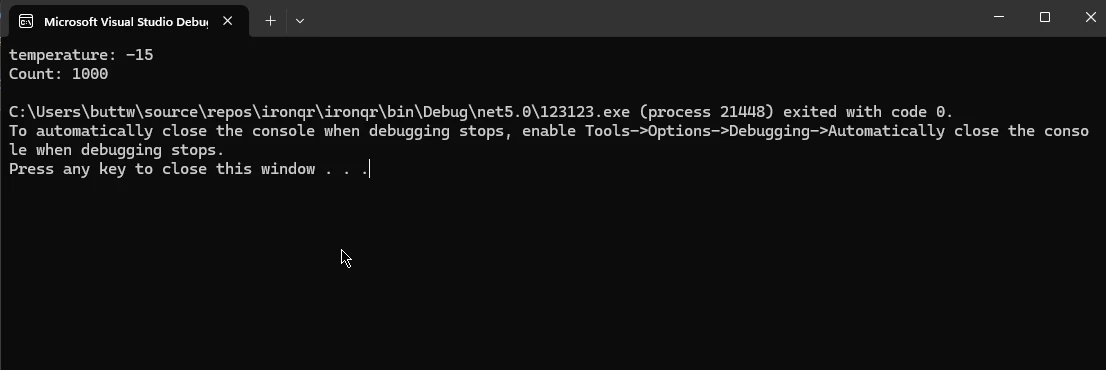
```csharp
// Declaring and initializing short variables
short temperature = -15; // Default temperature value
short count = 1000;      // Example count value
```
#### Ausgabe
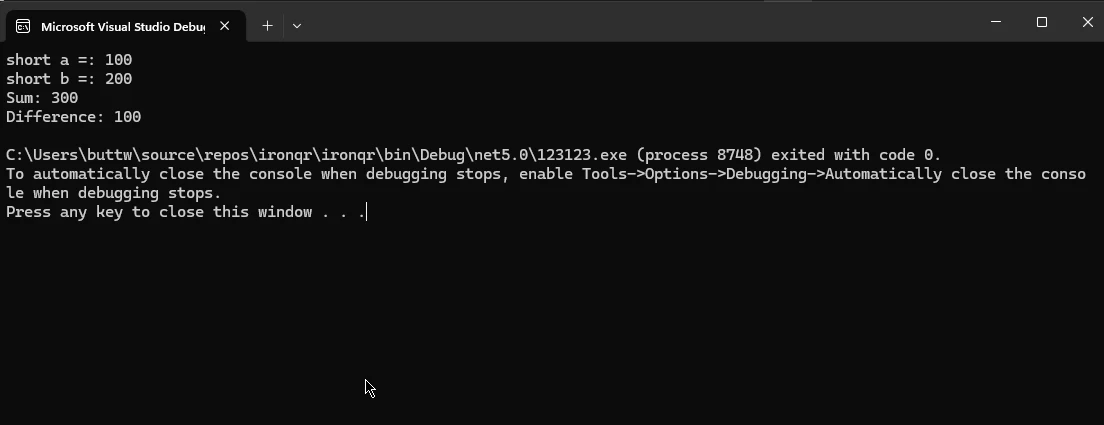
### 3.2. Arithmetische Operationen
```csharp
// Performing arithmetic operations on short variables
short a = 100;
short b = 200;
short sum = (short)(a + b); // Explicit casting for arithmetic operation
short difference = (short)(b - a);
```
#### Ausgabe
### 3.3. Vergleich und logische Operationen
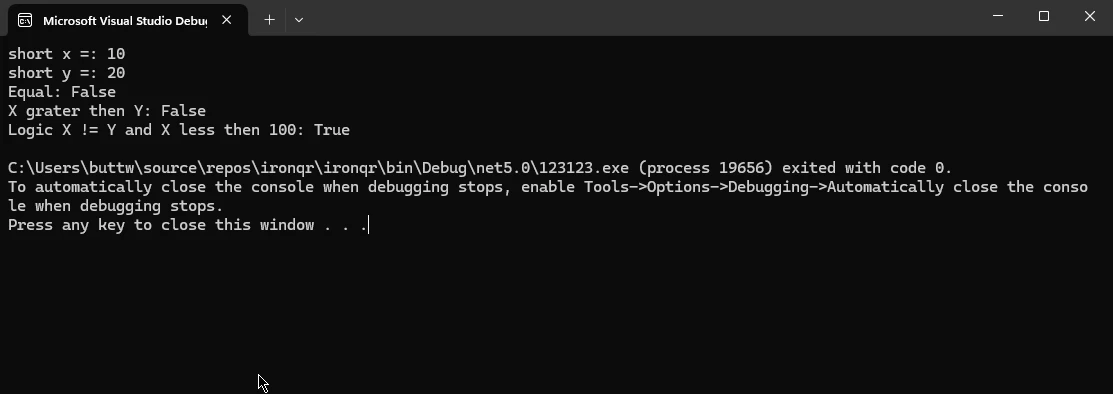
```csharp
// Demonstrating comparison and logical operations with short
short x = 10;
short y = 20;
bool isEqual = (x == y); // Check if x is equal to y
bool isGreater = (x > y); // Check if x is greater than y
bool logicalResult = (x != y) && (x < 100); // Logical operation combining conditions
```
#### Ausgabe
### 3.4. Arrays und Sammlungen
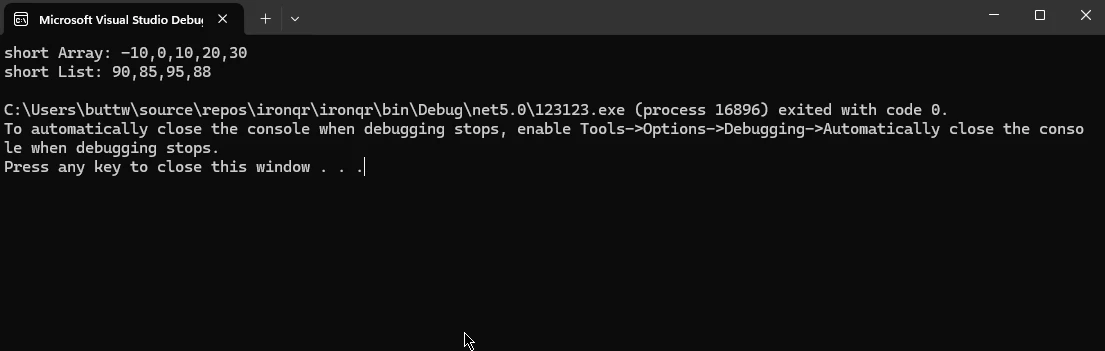
```csharp
// Initializing arrays and collections with short
short[] temperatures = new short[] { -10, 0, 10, 20, 30 }; // Array of short temperatures
List<short> scores = new List<short>() { 90, 85, 95, 88 }; // List of short scores
```
#### Ausgabe
## 4. bewährte Praktiken für kurze Verwendungszwecke
### 4.1. Bereichseinschränkungen verstehen
Seien Sie sich der Bereichseinschränkungen von **short** bewusst (-32.768 bis 32.767) und stellen Sie sicher, dass die zugewiesenen, implizit konvertierten oder berechneten Werte innerhalb dieses Minimal- und Maximalbereichs liegen.
### 4.2. Unnötiges Casting vermeiden
Während arithmetische Operationen mit **short** möglicherweise eine explizite Umwandlung erfordern, vermeiden Sie übermäßige Umwandlung, um die Lesbarkeit des Codes zu erhalten und die Komplexität zu reduzieren.
### 4.3. Intention des Dokuments
Stellen Sie klare Dokumentationen oder Kommentare bereit, wenn Sie **short** verwenden, um seinen Zweck anzugeben, insbesondere in Szenarien wie dem obigen Beispiel, wo die Verwendung möglicherweise nicht sofort ersichtlich ist.
## 5. Einführung in IronPDF
IronPDF ist eine Eckpfeiler-Lösung im Bereich der C#-Entwicklung und bietet Entwicklern ein leistungsstarkes Toolkit zum nahtlosen Erstellen, Bearbeiten und Verarbeiten von PDF-Dokumenten innerhalb ihrer Anwendungen. Mit seiner intuitiven API und umfassenden Feature-Set befähigt IronPDF Entwickler, PDF-Funktionen mühelos in ihre C#-Projekte zu integrieren und eine Vielzahl von Möglichkeiten in der Dokumentenerstellung, Berichterstellung und Inhaltsverteilung zu eröffnen.
Um IronPDF in Ihrer C#-Anwendung zu installieren, führen Sie den folgenden Befehl in der NuGet-Paketmanager-Konsole aus.
```shell
:ProductInstall
```
### 5.1. Die Leistungsfähigkeit von C# Short mit IronPDF nutzen: Ein praktisches Beispiel
Nun wollen wir in ein praktisches Beispiel eintauchen, das die Integration des **short**-Datentyps in C# mit IronPDF zur Erstellung einer PDF-Datei zeigt. Stellen Sie sich in diesem Szenario eine Temperaturüberwachungsanwendung vor, die Sensordaten sammelt und einen kurzen Bericht erstellt, der die Temperaturmessungen zusammenfasst. Wir werden die Kompaktheit des **short**-Datentyps nutzen, um Temperaturwerte effizient darzustellen, und IronPDF nutzen, um diesen PDF-Bericht dynamisch zu erstellen.
```csharp
using IronPdf;
using System;
class Program
{
static void Main(string[] args)
{
// Sample temperature data represented as short integers
short[] temperatureData = { 25, 28, 30, 27, 26 };
// Initialize the ChromePdfRenderer to generate PDFs
var pdfRenderer = new ChromePdfRenderer();
// Prepare HTML content for the PDF report
var htmlContent = "<h1>Temperature Report</h1><hr/><ul>";
foreach (var temperature in temperatureData)
{
// Append each temperature reading as a list item
htmlContent += $"<li>{temperature}°C</li>";
}
htmlContent += "</ul>";
// Convert the HTML content into a PDF document
var pdfDocument = pdfRenderer.RenderHtmlAsPdf(htmlContent);
// Define the output path for the PDF file
var outputPath = "Temperature_Report.pdf";
// Save the generated PDF to the specified file path
pdfDocument.SaveAs(outputPath);
// Notify the user that the PDF report was generated successfully
Console.WriteLine($"PDF report generated successfully: {outputPath}");
}
}
```
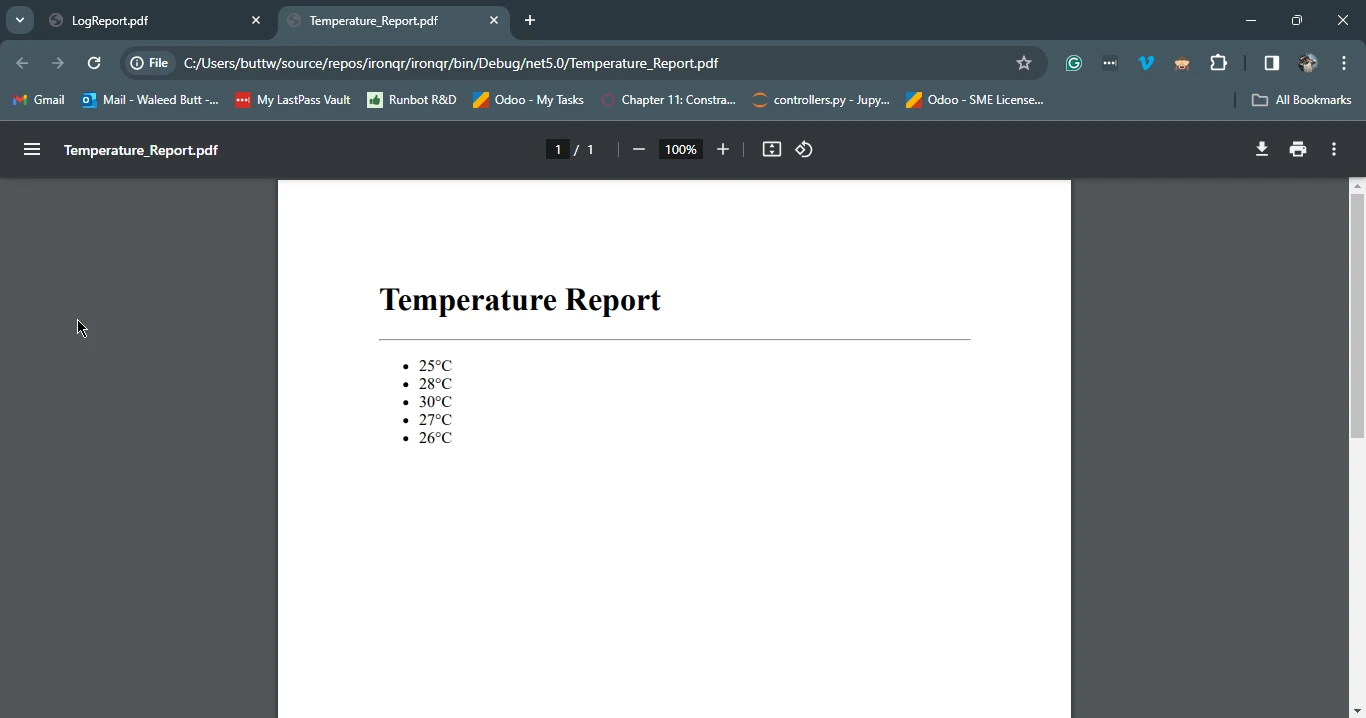
Das obige Beispiel mit einem C#-Codeausschnitt demonstriert die Erstellung eines PDF-Berichts mithilfe der IronPDF-Bibliothek. Es beginnt mit der Definition eines Arrays **temperatureData**, das Beispiel-Temperaturmessungen als **short**-Ganzzahlen enthält. Anschließend wird dynamisch HTML-Inhalt für den PDF-Bericht erstellt, der die Temperaturwerte in ein strukturiertes Format integriert.
Durch die Nutzung der **ChromePdfRenderer**-Funktion von IronPDF wird der HTML-Inhalt dann in ein PDF-Dokument umgewandelt. Schließlich wird der erzeugte PDF-Bericht unter dem Namen "Temperature_Report.pdf" gespeichert, und eine Erfolgsmeldung, die die Erstellung bestätigt, wird in der Konsole angezeigt. Insgesamt zeigt dieser Code die nahtlose Integration von C#-Code mit IronPDF zur Erstellung ansprechender PDF-Berichte.
#### Ausgabe
## 6. Fazit
Der **short**-Datentyp in C# dient als ein kompaktes, aber leistungsstarkes Werkzeug zur Handhabung von Ganzzahlwerten innerhalb eines begrenzten Bereichs. Seine Speichereffizienz und Bereichseinschränkungen machen ihn ideal für Szenarien, in denen Speicheroptimierung und Kompatibilität entscheidend sind. Egal, ob Sie Sensordaten speichern, die Speicherung in Datenstrukturen optimieren oder mit Altsystemen interagieren, **short** bietet Vielseitigkeit und Effektivität.
Durch die Befolgung bewährter Praktiken und das Verständnis seiner Feinheiten können Entwickler den potenziellen Wert von **short** nutzen, um die Leistung und Effizienz ihrer C#-Anwendungen zu verbessern. In Kombination mit Tools wie [IronPDF](/), die die PDF-Erstellung vereinfachen, wird **short** noch wertvoller und ermöglicht die nahtlose Integration von Daten in prägnante und optisch ansprechende Berichte.
[IronPDF-Lizenz](licensing) beginnt bei `$liteLicense`, es wird auch eine kostenlose Testlizenz angeboten, die eine großartige Gelegenheit bietet, die IronPDF-Funktionalität kennenzulernen. Für weitere Informationen zur IronPDF HTML-zu-PDF-Konvertierung besuchen Sie die [Konvertierungsseite](/tutorials/html-to-pdf/).
In C# ist der short-Datentyp einer der C#-Datentypen und wird verwendet, um Ganzzahlwerte innerhalb eines begrenzten Bereichs darzustellen. Trotz seiner kleineren Größe im Vergleich zu int- oder long-Werttypen kann short in Szenarien von Vorteil sein, in denen Speichereffizienz oder spezifische Wertbereichsanforderungen entscheidend sind. Es kann numerische Typen sowohl positiver als auch negativer Werte halten und kann leicht in andere Datentypen umgewandelt werden. Dieser Leitfaden taucht in die Feinheiten des C# short ein und behandelt seine Merkmale, Anwendungsszenarien, häufige Operationen und bewährte Verfahren. Zusätzlich werden wir Beispiele erkunden, die die Vielseitigkeit des short-Schlüsselworts in verschiedenen Programmierkontexten zeigen.
Wir werden die grundlegenden Konzepte von IronPDF untersuchen und seine Vielseitigkeit durch ein praktisches Beispiel demonstrieren, bei dem der short-Datentyp in C# verwendet wird, um eine PDF-Datei zu erstellen und zu konvertieren.
1. Erforschung der Bedeutung der Kurzform von .NET
Bevor wir in technische Details eintauchen, lassen Sie uns die Bedeutung des short-Datentyps in C# verstehen.
1.1. Speichereffizienz
Der short-Datentyp beansprucht maximal nur 16 Bit (2 Byte) Speicher und ist somit speichereffizienter als int-Typ (32 Bit) oder long (64 Bit). In speicherbeschränkten Umgebungen oder beim Umgang mit großen Datensätzen kann die Nutzung von short Benutzereingaben zu erheblichen Speicherersparnissen führen.
1.2. Bereichseinschränkungen
Als 16-Bit-Vorzeichen-Ganzzahl hat short einen begrenzten Bereich im Vergleich zu int oder long. Es kann Ganzzahl-Minimum- und -Maximumwerte von -32.768 bis 32.767 inklusive darstellen. Trotz seiner Bereichseinschränkungen ist short für Szenarien geeignet, in denen die Größenordnung der Werte innerhalb seines Bereichs liegt.
2. praktische Anwendungsszenarien
2.1. Speicher-Optimierung
Beim Entwerfen von Datenstrukturen oder Algorithmen, die mit einer großen und variablen Anzahl von Ganzzahlwerten innerhalb des short-Bereichs arbeiten, kann durch Deklarieren von Kurzwertvariablen Speicher gespart und die Leistung verbessert werden.
2.2. Interoperabilität
In Szenarien, die Interop mit externen Systemen oder Bibliotheken erfordert, die 16-Bit-Ganzzahlwerte erwarten, wie bestimmte Hardwaregeräte oder Altsysteme, bietet short nahtlose Kompatibilität.
2.3. Signalverarbeitung
In Signalverarbeitungsanwendungen oder numerischen Berechnungen, bei denen Speichereffizienz und Rechengeschwindigkeit entscheidend sind, kann short bevorzugt werden, um Wellenformdaten, Sensorwerte oder Audiodaten zu speichern.
3. arbeiten mit short in C#
3.1. Deklaration und Initialisierung
// Declaring and initializing short variablesshort temperature = -15; // Default temperature valueshort count = 1000; // Example count value
// Declaring and initializing short variables
short temperature = -15; // Default temperature value
short count = 1000;      // Example count value
' Declaring and initializing short variablesDim temperature AsShort = -15 ' Default temperature valueDim count AsShort = 1000 ' Example count value
' Declaring and initializing short variables
Dim temperature As Short = -15 ' Default temperature value
Dim count As Short = 1000 ' Example count value
Ausgabe
3.2. Arithmetische Operationen
// Performing arithmetic operations on short variablesshort a = 100;short b = 200;short sum = (short)(a + b); // Explicit casting for arithmetic operationshort difference = (short)(b - a);
// Performing arithmetic operations on short variables
short a = 100;
short b = 200;
short sum = (short)(a + b);       // Explicit casting for arithmetic operation
short difference = (short)(b - a);
' Performing arithmetic operations on short variablesDim a AsShort = 100Dim b AsShort = 200Dim sum AsShort = CShort(a + b) ' Explicit casting for arithmetic operationDim difference AsShort = CShort(b - a)
' Performing arithmetic operations on short variables
Dim a As Short = 100
Dim b As Short = 200
Dim sum As Short = CShort(a + b) ' Explicit casting for arithmetic operation
Dim difference As Short = CShort(b - a)
Ausgabe
3.3. Vergleich und logische Operationen
// Demonstrating comparison and logical operations with shortshort x = 10;short y = 20;bool isEqual = (x == y); // Check if x is equal to ybool isGreater = (x > y); // Check if x is greater than ybool logicalResult = (x != y) && (x < 100); // Logical operation combining conditions
// Demonstrating comparison and logical operations with short
short x = 10;
short y = 20;
bool isEqual = (x == y);        // Check if x is equal to y
bool isGreater = (x > y);       // Check if x is greater than y
bool logicalResult = (x != y) && (x < 100); // Logical operation combining conditions
' Demonstrating comparison and logical operations with shortDim x AsShort = 10Dim y AsShort = 20Dim isEqual AsBoolean = (x = y) ' Check if x is equal to yDim isGreater AsBoolean = (x > y) ' Check if x is greater than yDim logicalResult AsBoolean = (x <> y) AndAlso (x < 100) ' Logical operation combining conditions
' Demonstrating comparison and logical operations with short
Dim x As Short = 10
Dim y As Short = 20
Dim isEqual As Boolean = (x = y) ' Check if x is equal to y
Dim isGreater As Boolean = (x > y) ' Check if x is greater than y
Dim logicalResult As Boolean = (x <> y) AndAlso (x < 100) ' Logical operation combining conditions
Ausgabe
3.4. Arrays und Sammlungen
// Initializing arrays and collections with shortshort[] temperatures = new short[] { -10, 0, 10, 20, 30 }; // Array of short temperaturesList<short> scores = new List<short>() { 90, 85, 95, 88 }; // List of short scores
// Initializing arrays and collections with short
short[] temperatures = new short[] { -10, 0, 10, 20, 30 }; // Array of short temperatures
List<short> scores = new List<short>() { 90, 85, 95, 88 }; // List of short scores
' Initializing arrays and collections with shortDim temperatures() AsShort = { -10, 0, 10, 20, 30 } ' Array of short temperaturesDim scores As New List(OfShort)() From {90, 85, 95, 88} ' List of short scores
' Initializing arrays and collections with short
Dim temperatures() As Short = { -10, 0, 10, 20, 30 } ' Array of short temperatures
Dim scores As New List(Of Short)() From {90, 85, 95, 88} ' List of short scores
Ausgabe
4. bewährte Praktiken für kurze Verwendungszwecke
4.1. Bereichseinschränkungen verstehen
Seien Sie sich der Bereichseinschränkungen von short bewusst (-32.768 bis 32.767) und stellen Sie sicher, dass die zugewiesenen, implizit konvertierten oder berechneten Werte innerhalb dieses Minimal- und Maximalbereichs liegen.
4.2. Unnötiges Casting vermeiden
Während arithmetische Operationen mit short möglicherweise eine explizite Umwandlung erfordern, vermeiden Sie übermäßige Umwandlung, um die Lesbarkeit des Codes zu erhalten und die Komplexität zu reduzieren.
4.3. Intention des Dokuments
Stellen Sie klare Dokumentationen oder Kommentare bereit, wenn Sie short verwenden, um seinen Zweck anzugeben, insbesondere in Szenarien wie dem obigen Beispiel, wo die Verwendung möglicherweise nicht sofort ersichtlich ist.
5. Einführung in IronPDF
IronPDF ist eine Eckpfeiler-Lösung im Bereich der C#-Entwicklung und bietet Entwicklern ein leistungsstarkes Toolkit zum nahtlosen Erstellen, Bearbeiten und Verarbeiten von PDF-Dokumenten innerhalb ihrer Anwendungen. Mit seiner intuitiven API und umfassenden Feature-Set befähigt IronPDF Entwickler, PDF-Funktionen mühelos in ihre C#-Projekte zu integrieren und eine Vielzahl von Möglichkeiten in der Dokumentenerstellung, Berichterstellung und Inhaltsverteilung zu eröffnen.
Um IronPDF in Ihrer C#-Anwendung zu installieren, führen Sie den folgenden Befehl in der NuGet-Paketmanager-Konsole aus.
PM > Install-Package IronPdf
Install-Package IronPdf
5.1. Die Leistungsfähigkeit von C# Short mit IronPDF nutzen: Ein praktisches Beispiel
Nun wollen wir in ein praktisches Beispiel eintauchen, das die Integration des short-Datentyps in C# mit IronPDF zur Erstellung einer PDF-Datei zeigt. Stellen Sie sich in diesem Szenario eine Temperaturüberwachungsanwendung vor, die Sensordaten sammelt und einen kurzen Bericht erstellt, der die Temperaturmessungen zusammenfasst. Wir werden die Kompaktheit des short-Datentyps nutzen, um Temperaturwerte effizient darzustellen, und IronPDF nutzen, um diesen PDF-Bericht dynamisch zu erstellen.
using IronPdf;using System;class Program{ static voidMain(string[] args) { // Sample temperature data represented as short integers short[] temperatureData = { 25, 28, 30, 27, 26 }; // Initialize the ChromePdfRenderer to generate PDFs var pdfRenderer = new ChromePdfRenderer(); // Prepare HTML content for the PDF report var htmlContent = "<h1>Temperature Report</h1><hr/><ul>"; foreach (var temperature in temperatureData) { // Append each temperature reading as a list item htmlContent += $"<li>{temperature}°C</li>"; } htmlContent += "</ul>"; // Convert the HTML content into a PDF document var pdfDocument = pdfRenderer.RenderHtmlAsPdf(htmlContent); // Define the output path for the PDF file var outputPath = "Temperature_Report.pdf"; // Save the generated PDF to the specified file path pdfDocument.SaveAs(outputPath); // Notify the user that the PDF report was generated successfullyConsole.WriteLine($"PDF report generated successfully: {outputPath}"); }}
using IronPdf;
using System;

class Program
{
    static void Main(string[] args)
    {
        // Sample temperature data represented as short integers
        short[] temperatureData = { 25, 28, 30, 27, 26 };

        // Initialize the ChromePdfRenderer to generate PDFs
        var pdfRenderer = new ChromePdfRenderer();

        // Prepare HTML content for the PDF report
        var htmlContent = "<h1>Temperature Report</h1><hr/><ul>";
        foreach (var temperature in temperatureData)
        {
            // Append each temperature reading as a list item
            htmlContent += $"<li>{temperature}°C</li>";
        }
        htmlContent += "</ul>";

        // Convert the HTML content into a PDF document
        var pdfDocument = pdfRenderer.RenderHtmlAsPdf(htmlContent);

        // Define the output path for the PDF file
        var outputPath = "Temperature_Report.pdf";

        // Save the generated PDF to the specified file path
        pdfDocument.SaveAs(outputPath);

        // Notify the user that the PDF report was generated successfully
        Console.WriteLine($"PDF report generated successfully: {outputPath}");
    }
}
ImportsIronPdfImportsSystemModuleProgram Sub Main(args AsString()) ' Sample temperature data represented as short integers Dim temperatureData AsShort() = {25, 28, 30, 27, 26} ' Initialize the ChromePdfRenderer to generate PDFs Dim pdfRenderer = New ChromePdfRenderer() ' Prepare HTML content for the PDF report Dim htmlContent = "<h1>Temperature Report</h1><hr/><ul>" For Each temperature In temperatureData ' Append each temperature reading as a list item htmlContent += $"<li>{temperature}°C</li>" Next htmlContent += "</ul>" ' Convert the HTML content into a PDF document Dim pdfDocument = pdfRenderer.RenderHtmlAsPdf(htmlContent) ' Define the output path for the PDF file Dim outputPath = "Temperature_Report.pdf" ' Save the generated PDF to the specified file path pdfDocument.SaveAs(outputPath) ' Notify the user that the PDF report was generated successfullyConsole.WriteLine($"PDF report generated successfully: {outputPath}") End SubEndModule
Imports IronPdf
Imports System

Module Program
    Sub Main(args As String())
        ' Sample temperature data represented as short integers
        Dim temperatureData As Short() = {25, 28, 30, 27, 26}

        ' Initialize the ChromePdfRenderer to generate PDFs
        Dim pdfRenderer = New ChromePdfRenderer()

        ' Prepare HTML content for the PDF report
        Dim htmlContent = "<h1>Temperature Report</h1><hr/><ul>"
        For Each temperature In temperatureData
            ' Append each temperature reading as a list item
            htmlContent += $"<li>{temperature}°C</li>"
        Next
        htmlContent += "</ul>"

        ' Convert the HTML content into a PDF document
        Dim pdfDocument = pdfRenderer.RenderHtmlAsPdf(htmlContent)

        ' Define the output path for the PDF file
        Dim outputPath = "Temperature_Report.pdf"

        ' Save the generated PDF to the specified file path
        pdfDocument.SaveAs(outputPath)

        ' Notify the user that the PDF report was generated successfully
        Console.WriteLine($"PDF report generated successfully: {outputPath}")
    End Sub
End Module
Das obige Beispiel mit einem C#-Codeausschnitt demonstriert die Erstellung eines PDF-Berichts mithilfe der IronPDF-Bibliothek. Es beginnt mit der Definition eines Arrays temperatureData, das Beispiel-Temperaturmessungen als short-Ganzzahlen enthält. Anschließend wird dynamisch HTML-Inhalt für den PDF-Bericht erstellt, der die Temperaturwerte in ein strukturiertes Format integriert.
Durch die Nutzung der ChromePdfRenderer-Funktion von IronPDF wird der HTML-Inhalt dann in ein PDF-Dokument umgewandelt. Schließlich wird der erzeugte PDF-Bericht unter dem Namen "Temperature_Report.pdf" gespeichert, und eine Erfolgsmeldung, die die Erstellung bestätigt, wird in der Konsole angezeigt. Insgesamt zeigt dieser Code die nahtlose Integration von C#-Code mit IronPDF zur Erstellung ansprechender PDF-Berichte.
Ausgabe
6. Fazit
Der short-Datentyp in C# dient als ein kompaktes, aber leistungsstarkes Werkzeug zur Handhabung von Ganzzahlwerten innerhalb eines begrenzten Bereichs. Seine Speichereffizienz und Bereichseinschränkungen machen ihn ideal für Szenarien, in denen Speicheroptimierung und Kompatibilität entscheidend sind. Egal, ob Sie Sensordaten speichern, die Speicherung in Datenstrukturen optimieren oder mit Altsystemen interagieren, short bietet Vielseitigkeit und Effektivität.
Durch die Befolgung bewährter Praktiken und das Verständnis seiner Feinheiten können Entwickler den potenziellen Wert von short nutzen, um die Leistung und Effizienz ihrer C#-Anwendungen zu verbessern. In Kombination mit Tools wie IronPDF, die die PDF-Erstellung vereinfachen, wird short noch wertvoller und ermöglicht die nahtlose Integration von Daten in prägnante und optisch ansprechende Berichte.
IronPDF-Lizenz beginnt bei $999, es wird auch eine kostenlose Testlizenz angeboten, die eine großartige Gelegenheit bietet, die IronPDF-Funktionalität kennenzulernen. Für weitere Informationen zur IronPDF HTML-zu-PDF-Konvertierung besuchen Sie die Konvertierungsseite.
Jacob Mellor ist Chief Technology Officer bei Iron Software und ein visionärer Ingenieur, der Pionierarbeit in der C# PDF-Technologie leistet. Als der ursprüngliche Entwickler hinter der Kern-Codebasis von Iron Software hat er die Produktarchitektur des Unternehmens seit seiner Gründung geprägt und es zusammen mit CEO Cameron Rimington in ein Unternehmen mit mehr als 50 Mitarbeitern verwandelt, das die NASA, Tesla und globale Regierungsbehörden beliefert.