using IronPdf;

// Disable local disk access or cross-origin requests
Installation.EnableWebSecurity = true;

// Instantiate Renderer
var renderer = new ChromePdfRenderer();

// Create a PDF from a HTML string using C#
var pdf = renderer.RenderHtmlAsPdf("<h1>Hello World</h1>");

// Export to a file or Stream
pdf.SaveAs("output.pdf");

// Advanced Example with HTML Assets
// Load external html assets: Images, CSS and JavaScript.
// An optional BasePath 'C:\site\assets\' is set as the file location to load assets from
var myAdvancedPdf = renderer.RenderHtmlAsPdf("<img src='icons/iron.png'>", @"C:\site\assets\");
myAdvancedPdf.SaveAs("html-with-assets.pdf");
using IronPdf;// Disable local disk access or cross-origin requestsInstallation.EnableWebSecurity = true;// Instantiate Renderervar renderer = new ChromePdfRenderer();// Create a PDF from a HTML string using C#var pdf = renderer.RenderHtmlAsPdf("<h1>Hello World</h1>");// Export to a file or Streampdf.SaveAs("output.pdf");// Advanced Example with HTML Assets// Load external html assets: Images, CSS and JavaScript.// An optional BasePath 'C:\site\assets\' is set as the file location to load assets fromvar myAdvancedPdf = renderer.RenderHtmlAsPdf("<img src='icons/iron.png'>", @"C:\site\assets\");myAdvancedPdf.SaveAs("html-with-assets.pdf");
PM >Install-Package IronPdf
Install-Package IronPdf
ENTWICKLER-UPDATES
C# String-Interpolation (Wie es für Entwickler funktioniert)
## Was ist String-Interpolation?
Programmierer können Zeichenfolgen mithilfe der Stringinterpolation erstellen, bei der Ausdrücke oder Variablen sofort ausgewertet und in das konstante Zeichenfolgenobjektliteral eingefügt werden. Wortwörtliche Zeichenfolgen, die Platzhalter enthalten, die durch die Werte angegebenen Ausdrücke oder Variablen ersetzt werden, können mit interpolierten Zeichenfolgen erstellt werden.
Im Vergleich zu konventionelleren Techniken wie der Zeichenfolgenverkettung oder der Verwendung von Formatzeichenspezifizierern erleichtert die Darstellung interpolierter Zeichenfolgen das Kombinieren von Text mit dynamischen Daten in einer Vielzahl von Programmiersprachen, die diese Funktion unterstützen, was den Code besser lesbar und prägnanter macht. In diesem Artikel werden wir die [Stringinterpolationsfunktion in C#](https://learn.microsoft.com/en-us/dotnet/csharp/language-reference/tokens/interpolated) kennenlernen.
Die folgenden sind die resultierenden Funktionen der Stringinterpolation:
3. Bessere Lesbarkeit: Durch die Möglichkeit, Werte direkt in Zeichenfolgen zu setzen, ohne sie umwandeln oder verketten zu müssen, wird die Lesbarkeit des Codes verbessert. Typischerweise umschließen spezielle Symbole oder Zeichen (wie `{}`, `$()`, `{{}}` usw.) die Platzhalter für die String-Interpolation.
2. Auswertung von Ausdrücken: Zur Laufzeit werden die in den Platzhaltern enthaltenen Variablen oder Ausdrücke ausgewertet und ihre Ergebnisse sofort in die rohe Zeichenfolge eingefügt.
3. Bessere Lesbarkeit: Entwicklern wird ermöglicht, Werte direkt in Zeichenfolgen zu setzen, ohne sie umwandeln zu müssen.
## Wie man String-Interpolation verwendet
1. Erstellen Sie ein neues C# Projekt.
2. Stellen Sie sicher, dass die erforderliche C#-Version installiert ist.
3. Erstellen Sie eine Stringinterpolation mit den Symbolen oder Zeichen.
4. Verwenden Sie die interpolierte Zeichenfolge nach Bedarf.
5. Führen Sie den Code aus.
## String Interpolation in C#
Die Stringinterpolation in C# erlaubt es Entwicklern, Ausdrücke oder Variablen direkt in Zeichenfolgenliteralen einzubetten. Sie vereinfacht den Prozess des Aufbaus von mehrzeiligen Zeichenfolgen, indem sie eine prägnante und lesbare Syntax bietet. Wenn wir die String-Interpolation direkt verwenden, wird der Compiler die `string.Format` Methode an seiner Stelle platzieren.
Komponenten der Struktur der wortwörtlichen Stringinterpolation:
* Das `$` Zeichen zeigt an, dass das String-Literal interpoliert wird und vor ihm steht. Es unterscheidet gewöhnliche Zeichenfolgenliterale von interpolierten Zeichenfolgen.
* String-Literal mit Platzhaltern: Geschweifte Klammern `{}` umschließen Platzhalter für Ausdrücke oder Variablen innerhalb des String-Literals, das für die Interpolation mit `$` vorgesehen ist. Diese Platzhalter zeigen die Orte an, an denen die Werte der Ausdrücke oder Variablen eingegeben werden.
* Ausdrücke oder Variablen innerhalb von Platzhaltern: Im endgültig interpolierten String werden Platzhalter durch die Werte der Ausdrücke oder Variablen ersetzt, die in geschweiften Klammern eingeschlossen sind (`{}`).
* Finale interpolierte Zeichenfolge: Dies ist die Zeichenfolge, die nach der Interpolation verbleibt, bei der Platzhalter durch die ausgewerteten Werte von Variablen oder Ausdrücken ersetzt wurden.
## Structure Of Interpolation C#
Fügen Sie das `$` Zeichen an den Anfang eines String-Literals hinzu, um anzuzeigen, dass es sich um einen interpolierten String handelt. Zwischen dem `$` und dem `"`, das ein String-Literal startet, darf kein Leerzeichen erscheinen.
```csharp
{<interpolationExpression>[,<alignment>][:<formatString>]} //constant expression
```
## Zeichenfolgen-Interpolation mit Verbatim- und Rohzeichenfolgen
Verwenden Sie mehrere `$` Zeichen, um ein interpoliertes Roh-String-Literal zu beginnen, um `{` und `}` Zeichen im zurückgegebenen String zu integrieren. Jede Sequenz von `{` oder `}` Zeichen, die kleiner ist als die Gesamtzahl der `$` Zeichen, wird in den Ausgabestring eingefügt, wenn Sie das tun. Um einen beliebigen Interpolationsausdruck in diesem String zu kapseln, muss die Anzahl der verwendeten Klammern der Anzahl der `$` Zeichen entsprechen. Wie das folgende Beispiel unten zeigt:
```csharp
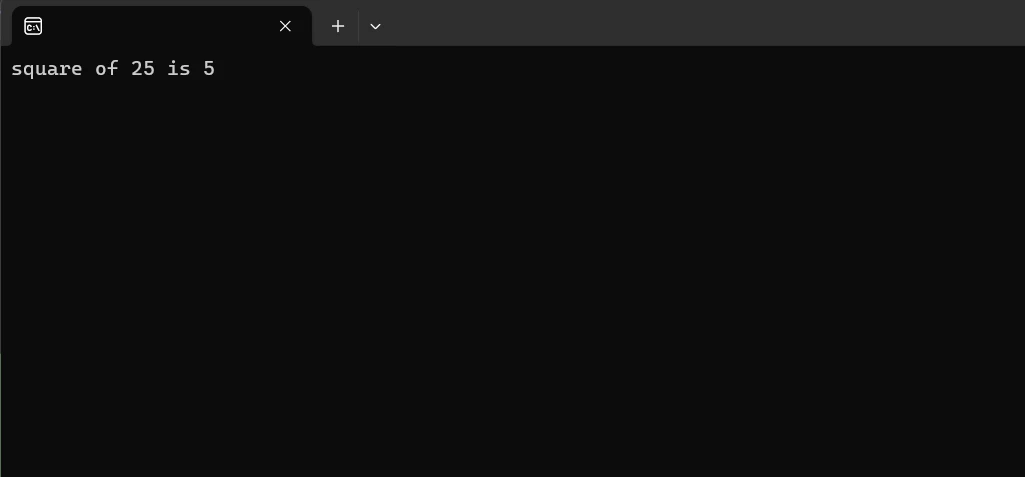
int x = 25;
Console.WriteLine($"square of {x} is {Math.Sqrt(x)}"); // Interpolated string output
```
Ausgabe:
## Zeicheninterpolationsfunktion mit IronPDF
Ein Highlight von IronPDF ist seine [HTML-zu-PDF-Konvertierungsfähigkeit](/tutorials/html-to-pdf/), wobei alle Layouts und Stile erhalten bleiben. Es konvertiert Webinhalt in PDFs, perfekt für Berichte, Rechnungen und Dokumentationen. Sie können HTML-Dateien, URLs und HTML-Strings problemlos in PDFs konvertieren.
```csharp
using IronPdf;
class Program
{
static void Main(string[] args)
{
var renderer = new ChromePdfRenderer();
// 1. Convert HTML String to PDF
var htmlContent = "<h1>Hello, IronPDF!</h1><p>This is a PDF from an HTML string.</p>";
var pdfFromHtmlString = renderer.RenderHtmlAsPdf(htmlContent);
pdfFromHtmlString.SaveAs("HTMLStringToPDF.pdf");
// 2. Convert HTML File to PDF
var htmlFilePath = "path_to_your_html_file.html"; // Specify the path to your HTML file
var pdfFromHtmlFile = renderer.RenderHtmlFileAsPdf(htmlFilePath);
pdfFromHtmlFile.SaveAs("HTMLFileToPDF.pdf");
// 3. Convert URL to PDF
var url = "http://ironpdf.com"; // Specify the URL
var pdfFromUrl = renderer.RenderUrlAsPdf(url);
pdfFromUrl.SaveAs("URLToPDF.pdf");
}
}
```
### IronPDF installieren
Holen Sie sich die [IronPDF-Bibliothek für eine nahtlose PDF-Erstellung](/), da sie für die nächste Lösung erforderlich ist. Um dies zu tun, geben Sie den folgenden Code in den Paketmanager ein:
```shell
:ProductInstall
```
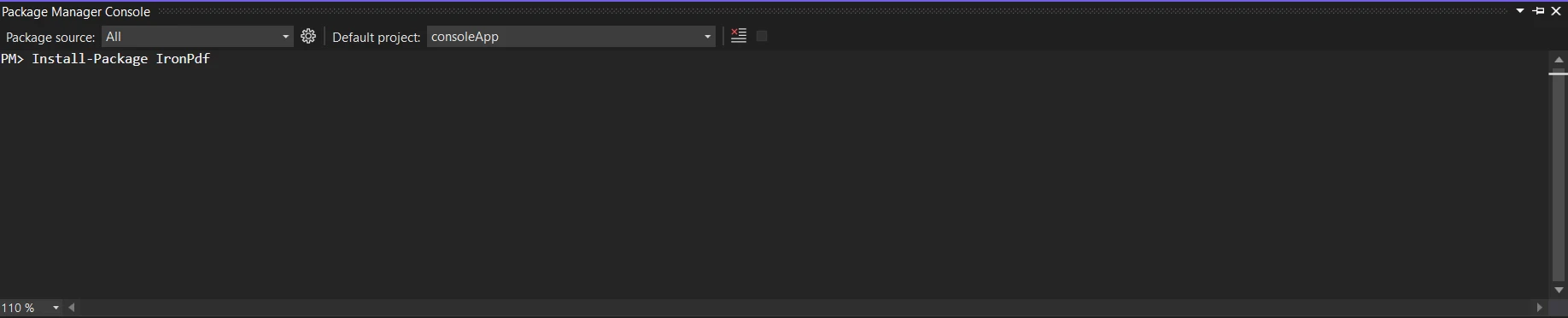
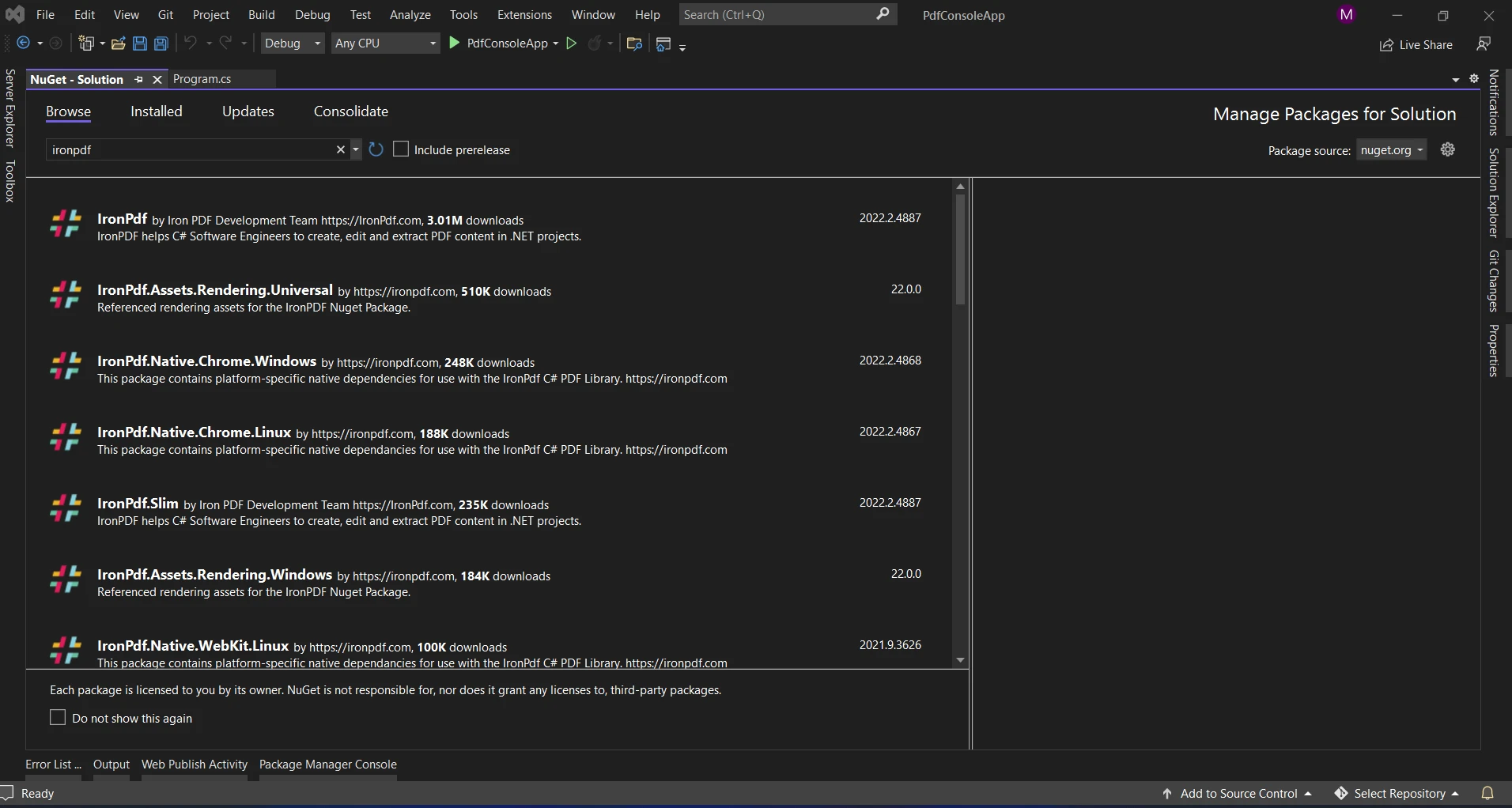
Alternativ können Sie den NuGet-Paket-Manager verwenden, um nach dem Paket "IronPDF" zu suchen. Wir können das notwendige Paket aus dieser Liste aller mit IronPDF verbundenen NuGet-Pakete auswählen und herunterladen.
### String Interpolation mit IronPDF
Der Beispielcode zeigt, wie wir mit der Stringinterpolationsmethode und dem interpolierten Ausdruck ein PDF erstellen können. Für einen einzelnen Interpolationsausdruck können Ausrichtungsspezifizierer und Formatstrings kombiniert werden.
```csharp
using IronPdf;
namespace ConsoleApp1
{
internal class Program
{
static void Main(string [] args)
{
int x = 25;
// Define the interpolated string
var outputstr = $@"square of <b>{x}</b> is <b>{Math.Sqrt(x)}</b>";
// Create a PDF using IronPDF
var pdfcreate = ChromePdfRenderer.StaticRenderHtmlAsPdf(outputstr);
// Save the PDF as a file
pdfcreate.SaveAs("demo.pdf");
}
}
}
```
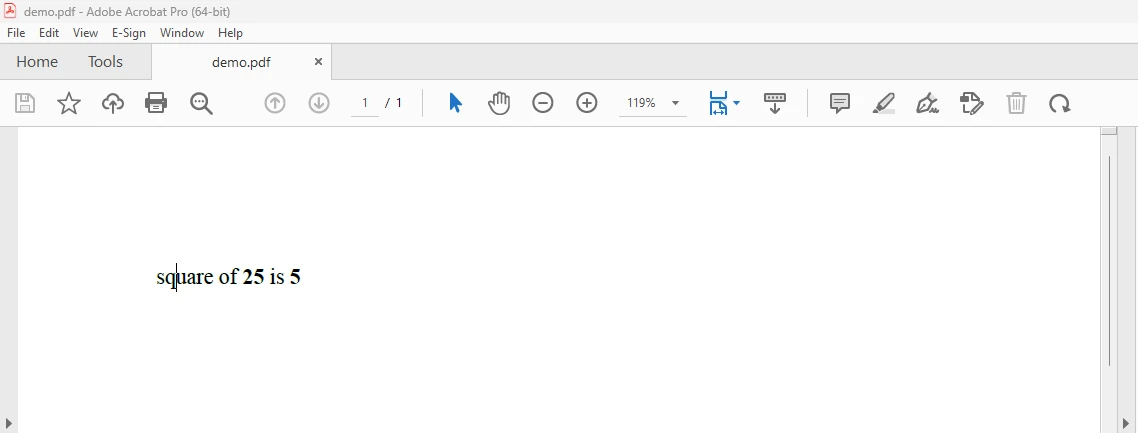
Im obigen Code hilft uns die gegebene Stringinterpolation dabei, die Zeichenfolgenrepräsentation in den gewünschten Ausgabestringnamen zu konvertieren. Wir verwenden auch mehrere Zeichenfolgen, um in eine einzige Zeichenfolge zu interpolieren. Und mit der Hilfe von IronPDF erstellen wir das PDF für die formatierten Zeichenfolgen. Ebenso können wir jede Anzahl von PDF-Zeichenfolgenrepräsentationen in ein PDF mit der Hilfe von IronPDF erstellen. Wir können auch Strings mit der `string.Format` Methode formatieren.
**Ergebnis:**
Um mehr über IronPDF zu erfahren, lesen Sie die [IronPDF-Dokumentation](/docs/).
## Abschluss
Zusammengefasst ist die Stringinterpolation in C# eine starke und effektive Funktion, die die Erstellung von Zeichenfolgen erleichtert, indem sie es ermöglicht, Ausdrücke direkt in sie einzubetten. Im Vergleich zu herkömmlichen Zeichenfolgenverkettungs- oder Formatierungstechniken bietet sie eine besser lesbare und verständlichere Syntax mit öffnenden und schließenden Klammern.
IronPDF bietet eine dauerhafte Lizenz, Upgrade-Optionen, ein Jahr Software-Wartung und eine 30-tägige Geld-zurück-Garantie im `$liteLicense` Lite-Paket an. Benutzer können das Produkt in praktischen Anwendungseinstellungen dreißig Tage lang während des wassergekennzeichneten Testzeitraums evaluieren. Bitte besuchen Sie die bereitgestellte [IronPDF-Preis- und Lizenzierungsseite](licensing), um mehr über die Kosten, Lizenzierung und Testversion von IronPDF zu erfahren. Um mehr über die verschiedenen [Iron-Softwareprodukte und -bibliotheken](https://ironsoftware.com/) zu erfahren, besuchen Sie deren Website.
Programmierer können Zeichenfolgen mithilfe der Stringinterpolation erstellen, bei der Ausdrücke oder Variablen sofort ausgewertet und in das konstante Zeichenfolgenobjektliteral eingefügt werden. Wortwörtliche Zeichenfolgen, die Platzhalter enthalten, die durch die Werte angegebenen Ausdrücke oder Variablen ersetzt werden, können mit interpolierten Zeichenfolgen erstellt werden.
Im Vergleich zu konventionelleren Techniken wie der Zeichenfolgenverkettung oder der Verwendung von Formatzeichenspezifizierern erleichtert die Darstellung interpolierter Zeichenfolgen das Kombinieren von Text mit dynamischen Daten in einer Vielzahl von Programmiersprachen, die diese Funktion unterstützen, was den Code besser lesbar und prägnanter macht. In diesem Artikel werden wir die Stringinterpolationsfunktion in C# kennenlernen.
Die folgenden sind die resultierenden Funktionen der Stringinterpolation:
Bessere Lesbarkeit: Durch die Möglichkeit, Werte direkt in Zeichenfolgen zu setzen, ohne sie umwandeln oder verketten zu müssen, wird die Lesbarkeit des Codes verbessert. Typischerweise umschließen spezielle Symbole oder Zeichen (wie {}, $(), {{}} usw.) die Platzhalter für die String-Interpolation.
Auswertung von Ausdrücken: Zur Laufzeit werden die in den Platzhaltern enthaltenen Variablen oder Ausdrücke ausgewertet und ihre Ergebnisse sofort in die rohe Zeichenfolge eingefügt.
Bessere Lesbarkeit: Entwicklern wird ermöglicht, Werte direkt in Zeichenfolgen zu setzen, ohne sie umwandeln zu müssen.
Wie man String-Interpolation verwendet
Erstellen Sie ein neues C# Projekt.
Stellen Sie sicher, dass die erforderliche C#-Version installiert ist.
Erstellen Sie eine Stringinterpolation mit den Symbolen oder Zeichen.
Verwenden Sie die interpolierte Zeichenfolge nach Bedarf.
Führen Sie den Code aus.
String Interpolation in C#
Die Stringinterpolation in C# erlaubt es Entwicklern, Ausdrücke oder Variablen direkt in Zeichenfolgenliteralen einzubetten. Sie vereinfacht den Prozess des Aufbaus von mehrzeiligen Zeichenfolgen, indem sie eine prägnante und lesbare Syntax bietet. Wenn wir die String-Interpolation direkt verwenden, wird der Compiler die string.Format Methode an seiner Stelle platzieren.
Komponenten der Struktur der wortwörtlichen Stringinterpolation:
Das $ Zeichen zeigt an, dass das String-Literal interpoliert wird und vor ihm steht. Es unterscheidet gewöhnliche Zeichenfolgenliterale von interpolierten Zeichenfolgen.
String-Literal mit Platzhaltern: Geschweifte Klammern {} umschließen Platzhalter für Ausdrücke oder Variablen innerhalb des String-Literals, das für die Interpolation mit $ vorgesehen ist. Diese Platzhalter zeigen die Orte an, an denen die Werte der Ausdrücke oder Variablen eingegeben werden.
Ausdrücke oder Variablen innerhalb von Platzhaltern: Im endgültig interpolierten String werden Platzhalter durch die Werte der Ausdrücke oder Variablen ersetzt, die in geschweiften Klammern eingeschlossen sind ({}).
Finale interpolierte Zeichenfolge: Dies ist die Zeichenfolge, die nach der Interpolation verbleibt, bei der Platzhalter durch die ausgewerteten Werte von Variablen oder Ausdrücken ersetzt wurden.
Structure Of Interpolation C#
Fügen Sie das $ Zeichen an den Anfang eines String-Literals hinzu, um anzuzeigen, dass es sich um einen interpolierten String handelt. Zwischen dem $ und dem ", das ein String-Literal startet, darf kein Leerzeichen erscheinen.
If True Then'INSTANT VB TODO TASK: The following line uses invalid syntax:' <interpolationExpression>[,<alignment>][:<formatString>]} 'constant expression
If True Then
'INSTANT VB TODO TASK: The following line uses invalid syntax:
'	<interpolationExpression>[,<alignment>][:<formatString>]} 'constant expression
Zeichenfolgen-Interpolation mit Verbatim- und Rohzeichenfolgen
Verwenden Sie mehrere $ Zeichen, um ein interpoliertes Roh-String-Literal zu beginnen, um { und } Zeichen im zurückgegebenen String zu integrieren. Jede Sequenz von { oder } Zeichen, die kleiner ist als die Gesamtzahl der $ Zeichen, wird in den Ausgabestring eingefügt, wenn Sie das tun. Um einen beliebigen Interpolationsausdruck in diesem String zu kapseln, muss die Anzahl der verwendeten Klammern der Anzahl der $ Zeichen entsprechen. Wie das folgende Beispiel unten zeigt:
int x = 25;Console.WriteLine($"square of {x} is {Math.Sqrt(x)}"); // Interpolated string output
int x = 25;
Console.WriteLine($"square of {x} is {Math.Sqrt(x)}"); // Interpolated string output
Dim x AsInteger = 25Console.WriteLine($"square of {x} is {Math.Sqrt(x)}") ' Interpolated string output
Dim x As Integer = 25
Console.WriteLine($"square of {x} is {Math.Sqrt(x)}") ' Interpolated string output
Ausgabe:
Zeicheninterpolationsfunktion mit IronPDF
Ein Highlight von IronPDF ist seine HTML-zu-PDF-Konvertierungsfähigkeit, wobei alle Layouts und Stile erhalten bleiben. Es konvertiert Webinhalt in PDFs, perfekt für Berichte, Rechnungen und Dokumentationen. Sie können HTML-Dateien, URLs und HTML-Strings problemlos in PDFs konvertieren.
using IronPdf;class Program{ static voidMain(string[] args) { var renderer = new ChromePdfRenderer(); // 1. Convert HTML String to PDF var htmlContent = "<h1>Hello, IronPDF!</h1><p>This is a PDF from an HTML string.</p>"; var pdfFromHtmlString = renderer.RenderHtmlAsPdf(htmlContent); pdfFromHtmlString.SaveAs("HTMLStringToPDF.pdf"); // 2. Convert HTML File to PDF var htmlFilePath = "path_to_your_html_file.html"; // Specify the path to your HTML file var pdfFromHtmlFile = renderer.RenderHtmlFileAsPdf(htmlFilePath); pdfFromHtmlFile.SaveAs("HTMLFileToPDF.pdf"); // 3. Convert URL to PDF var url = "http://ironpdf.com"; // Specify the URL var pdfFromUrl = renderer.RenderUrlAsPdf(url); pdfFromUrl.SaveAs("URLToPDF.pdf"); }}
using IronPdf;

class Program
{
    static void Main(string[] args)
    {
        var renderer = new ChromePdfRenderer();

        // 1. Convert HTML String to PDF
        var htmlContent = "<h1>Hello, IronPDF!</h1><p>This is a PDF from an HTML string.</p>";
        var pdfFromHtmlString = renderer.RenderHtmlAsPdf(htmlContent);
        pdfFromHtmlString.SaveAs("HTMLStringToPDF.pdf");

        // 2. Convert HTML File to PDF
        var htmlFilePath = "path_to_your_html_file.html"; // Specify the path to your HTML file
        var pdfFromHtmlFile = renderer.RenderHtmlFileAsPdf(htmlFilePath);
        pdfFromHtmlFile.SaveAs("HTMLFileToPDF.pdf");

        // 3. Convert URL to PDF
        var url = "http://ironpdf.com"; // Specify the URL
        var pdfFromUrl = renderer.RenderUrlAsPdf(url);
        pdfFromUrl.SaveAs("URLToPDF.pdf");
    }
}
ImportsIronPdfFriend Class ProgramShared Sub Main(ByVal args() AsString) Dim renderer = New ChromePdfRenderer() ' 1. Convert HTML String to PDF Dim htmlContent = "<h1>Hello, IronPDF!</h1><p>This is a PDF from an HTML string.</p>" Dim pdfFromHtmlString = renderer.RenderHtmlAsPdf(htmlContent) pdfFromHtmlString.SaveAs("HTMLStringToPDF.pdf") ' 2. Convert HTML File to PDF Dim htmlFilePath = "path_to_your_html_file.html" ' Specify the path to your HTML file Dim pdfFromHtmlFile = renderer.RenderHtmlFileAsPdf(htmlFilePath) pdfFromHtmlFile.SaveAs("HTMLFileToPDF.pdf") ' 3. Convert URL to PDF Dim url = "http://ironpdf.com" ' Specify the URL Dim pdfFromUrl = renderer.RenderUrlAsPdf(url) pdfFromUrl.SaveAs("URLToPDF.pdf") End SubEnd Class
Imports IronPdf

Friend Class Program
	Shared Sub Main(ByVal args() As String)
		Dim renderer = New ChromePdfRenderer()

		' 1. Convert HTML String to PDF
		Dim htmlContent = "<h1>Hello, IronPDF!</h1><p>This is a PDF from an HTML string.</p>"
		Dim pdfFromHtmlString = renderer.RenderHtmlAsPdf(htmlContent)
		pdfFromHtmlString.SaveAs("HTMLStringToPDF.pdf")

		' 2. Convert HTML File to PDF
		Dim htmlFilePath = "path_to_your_html_file.html" ' Specify the path to your HTML file
		Dim pdfFromHtmlFile = renderer.RenderHtmlFileAsPdf(htmlFilePath)
		pdfFromHtmlFile.SaveAs("HTMLFileToPDF.pdf")

		' 3. Convert URL to PDF
		Dim url = "http://ironpdf.com" ' Specify the URL
		Dim pdfFromUrl = renderer.RenderUrlAsPdf(url)
		pdfFromUrl.SaveAs("URLToPDF.pdf")
	End Sub
End Class
Alternativ können Sie den NuGet-Paket-Manager verwenden, um nach dem Paket "IronPDF" zu suchen. Wir können das notwendige Paket aus dieser Liste aller mit IronPDF verbundenen NuGet-Pakete auswählen und herunterladen.
String Interpolation mit IronPDF
Der Beispielcode zeigt, wie wir mit der Stringinterpolationsmethode und dem interpolierten Ausdruck ein PDF erstellen können. Für einen einzelnen Interpolationsausdruck können Ausrichtungsspezifizierer und Formatstrings kombiniert werden.
using IronPdf;namespace ConsoleApp1{ internal class Program { static voidMain(string [] args) { int x = 25; // Define the interpolated string var outputstr = $@"square of <b>{x}</b> is <b>{Math.Sqrt(x)}</b>"; // Create a PDF using IronPDF var pdfcreate = ChromePdfRenderer.StaticRenderHtmlAsPdf(outputstr); // Save the PDF as a file pdfcreate.SaveAs("demo.pdf"); } }}
using IronPdf;

namespace ConsoleApp1
{
    internal class Program
    {
        static void Main(string [] args)
        {
            int x = 25;
            // Define the interpolated string
            var outputstr = $@"square of <b>{x}</b> is <b>{Math.Sqrt(x)}</b>";
            // Create a PDF using IronPDF
            var pdfcreate = ChromePdfRenderer.StaticRenderHtmlAsPdf(outputstr);
            // Save the PDF as a file
            pdfcreate.SaveAs("demo.pdf");
        }
    }
}
ImportsIronPdfNamespaceConsoleApp1Friend Class ProgramShared Sub Main(ByVal args() AsString) Dim x AsInteger = 25 ' Define the interpolated string Dim outputstr = $"square of <b>{x}</b> is <b>{Math.Sqrt(x)}</b>" ' Create a PDF using IronPDF Dim pdfcreate = ChromePdfRenderer.StaticRenderHtmlAsPdf(outputstr) ' Save the PDF as a file pdfcreate.SaveAs("demo.pdf") End Sub End ClassEndNamespace
Imports IronPdf

Namespace ConsoleApp1
	Friend Class Program
		Shared Sub Main(ByVal args() As String)
			Dim x As Integer = 25
			' Define the interpolated string
			Dim outputstr = $"square of <b>{x}</b> is <b>{Math.Sqrt(x)}</b>"
			' Create a PDF using IronPDF
			Dim pdfcreate = ChromePdfRenderer.StaticRenderHtmlAsPdf(outputstr)
			' Save the PDF as a file
			pdfcreate.SaveAs("demo.pdf")
		End Sub
	End Class
End Namespace
Im obigen Code hilft uns die gegebene Stringinterpolation dabei, die Zeichenfolgenrepräsentation in den gewünschten Ausgabestringnamen zu konvertieren. Wir verwenden auch mehrere Zeichenfolgen, um in eine einzige Zeichenfolge zu interpolieren. Und mit der Hilfe von IronPDF erstellen wir das PDF für die formatierten Zeichenfolgen. Ebenso können wir jede Anzahl von PDF-Zeichenfolgenrepräsentationen in ein PDF mit der Hilfe von IronPDF erstellen. Wir können auch Strings mit der string.Format Methode formatieren.
Zusammengefasst ist die Stringinterpolation in C# eine starke und effektive Funktion, die die Erstellung von Zeichenfolgen erleichtert, indem sie es ermöglicht, Ausdrücke direkt in sie einzubetten. Im Vergleich zu herkömmlichen Zeichenfolgenverkettungs- oder Formatierungstechniken bietet sie eine besser lesbare und verständlichere Syntax mit öffnenden und schließenden Klammern.
IronPDF bietet eine dauerhafte Lizenz, Upgrade-Optionen, ein Jahr Software-Wartung und eine 30-tägige Geld-zurück-Garantie im $999 Lite-Paket an. Benutzer können das Produkt in praktischen Anwendungseinstellungen dreißig Tage lang während des wassergekennzeichneten Testzeitraums evaluieren. Bitte besuchen Sie die bereitgestellte IronPDF-Preis- und Lizenzierungsseite, um mehr über die Kosten, Lizenzierung und Testversion von IronPDF zu erfahren. Um mehr über die verschiedenen Iron-Softwareprodukte und -bibliotheken zu erfahren, besuchen Sie deren Website.
Jacob Mellor ist Chief Technology Officer bei Iron Software und ein visionärer Ingenieur, der Pionierarbeit in der C# PDF-Technologie leistet. Als der ursprüngliche Entwickler hinter der Kern-Codebasis von Iron Software hat er die Produktarchitektur des Unternehmens seit seiner Gründung geprägt und es zusammen mit CEO Cameron Rimington in ein Unternehmen mit mehr als 50 Mitarbeitern verwandelt, das die NASA, Tesla und globale Regierungsbehörden beliefert.