using IronPdf;

// Disable local disk access or cross-origin requests
Installation.EnableWebSecurity = true;

// Instantiate Renderer
var renderer = new ChromePdfRenderer();

// Create a PDF from a HTML string using C#
var pdf = renderer.RenderHtmlAsPdf("<h1>Hello World</h1>");

// Export to a file or Stream
pdf.SaveAs("output.pdf");

// Advanced Example with HTML Assets
// Load external html assets: Images, CSS and JavaScript.
// An optional BasePath 'C:\site\assets\' is set as the file location to load assets from
var myAdvancedPdf = renderer.RenderHtmlAsPdf("<img src='icons/iron.png'>", @"C:\site\assets\");
myAdvancedPdf.SaveAs("html-with-assets.pdf");
using IronPdf;// Disable local disk access or cross-origin requestsInstallation.EnableWebSecurity = true;// Instantiate Renderervar renderer = new ChromePdfRenderer();// Create a PDF from a HTML string using C#var pdf = renderer.RenderHtmlAsPdf("<h1>Hello World</h1>");// Export to a file or Streampdf.SaveAs("output.pdf");// Advanced Example with HTML Assets// Load external html assets: Images, CSS and JavaScript.// An optional BasePath 'C:\site\assets\' is set as the file location to load assets fromvar myAdvancedPdf = renderer.RenderHtmlAsPdf("<img src='icons/iron.png'>", @"C:\site\assets\");myAdvancedPdf.SaveAs("html-with-assets.pdf");
PM >Install-Package IronPdf
Install-Package IronPdf
ENTWICKLER-UPDATES
C# Struct vs Class (Funktionsweise für Entwickler)
In C# dienen sowohl Strukturen als auch Klassen als grundlegende Bausteine zum Organisieren und Speichern von Daten, weisen jedoch unterschiedliche Eigenschaften auf, die sie für verschiedene Szenarien geeignet machen. Das Verständnis der Unterschiede zwischen [**C#-Strukturen und Klassen**](https://learn.microsoft.com/en-us/dotnet/standard/design-guidelines/choosing-between-class-and-struct) ist entscheidend, um fundierte Entscheidungen bei der Gestaltung Ihrer C#-Anwendungen zu treffen.
In diesem Artikel werden wir die wesentlichen Unterschiede zwischen Strukturen und Klassen untersuchen und ihre Anwendungsfälle, Speicherverwaltung und Leistungsauswirkungen diskutieren. Außerdem werden wir besprechen, wie man Strukturen und Klassen mit [**IronPDF für C#**](/) zur Erstellung von PDF-Dateien verwendet.
## 1. Überblick über Strukturen und Klassen
### 1.1. Klassen (Referenztypen)
**Referenztypen:** Eine Klasse in C# ist ein Referenztyp, der sich im Heap befindet, was bedeutet, dass beim Erstellen einer Instanz einer Klasse ein Verweis auf das Objekt im Speicher gespeichert wird.
**Heap-Speicherzuweisung:** Klasseninstanzen werden im Speicher des Heaps zugewiesen, was Flexibilität in der Größe bietet und es Objekten ermöglicht, zwischen verschiedenen Teilen des Codes geteilt zu werden.
**Standardkonstruktor:** Klassen können einen Standardkonstruktor haben, der automatisch bereitgestellt wird, wenn keiner explizit definiert ist.
**Vererbung:** Klassen unterstützen die Vererbung, sodass abgeleitete Klassen mit gemeinsamen Merkmalen erstellt werden können.
```csharp
using System;

// Define a class
public class MyClass
{
    // Fields (data members)
    public int MyField;

    // Constructor
    public MyClass(int value)
    {
        MyField = value;
    }

    // Method to display the value
    public void Display()
    {
        Console.WriteLine($"Value in MyClass: {MyField}");
    }
}

class Program
{
    static void Main()
    {
        // Create an instance of the class
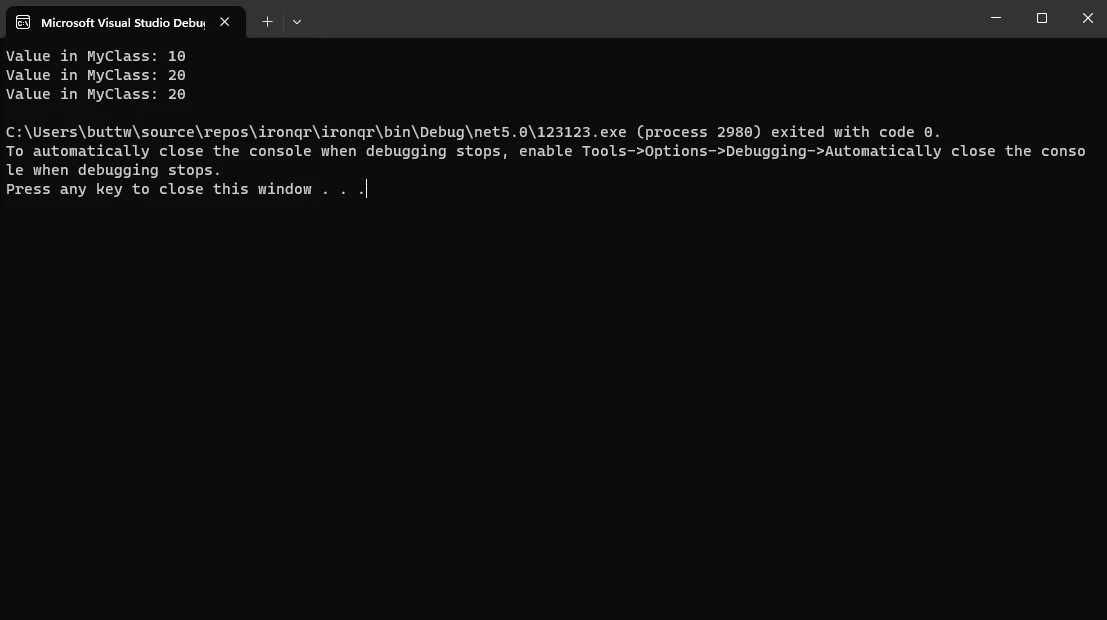
        MyClass myClassInstance = new MyClass(10);

        // Access field and call method
        myClassInstance.Display();

        // Classes are reference types, so myClassInstance refers to the same object in memory
        MyClass anotherInstance = myClassInstance;
        anotherInstance.MyField = 20;

        // Both instances refer to the same object, so the change is reflected in both
        myClassInstance.Display();
        anotherInstance.Display();
    }
}
```
### 1.2. Strukturen (Werttypen)
**Werttypen:** Structs sind Werttypen, was bedeutet, dass die eigentlichen Daten dort gespeichert werden, wo die Variable deklariert wird, anstatt wie primitive Typen an einem separaten Speicherort. Das bedeutet auch, dass der Struct nicht mit einem Nullwert als sein Werttyp zugewiesen werden kann, ohne ihn mit dem `Nullable<>`-Tag zu einem Nullable-Typ zu machen.
**Stack-Speicherzuweisung:** Strukturinstanzen werden im Stack Speicher zugewiesen, was zu schnellerer Zuweisung und Freigabe führt, jedoch mit Einschränkungen bei Größe und Umfang.
**Kein Standardkonstruktor:** Strukturen haben keinen Standardkonstruktor, es sei denn, einer wird explizit definiert. Jedes Feld muss während der Instanziierung initialisiert werden.
**Keine Vererbung:** Strukturen unterstützen keine Vererbung. Sie werden hauptsächlich für leichtgewichtige Datenstrukturen verwendet.
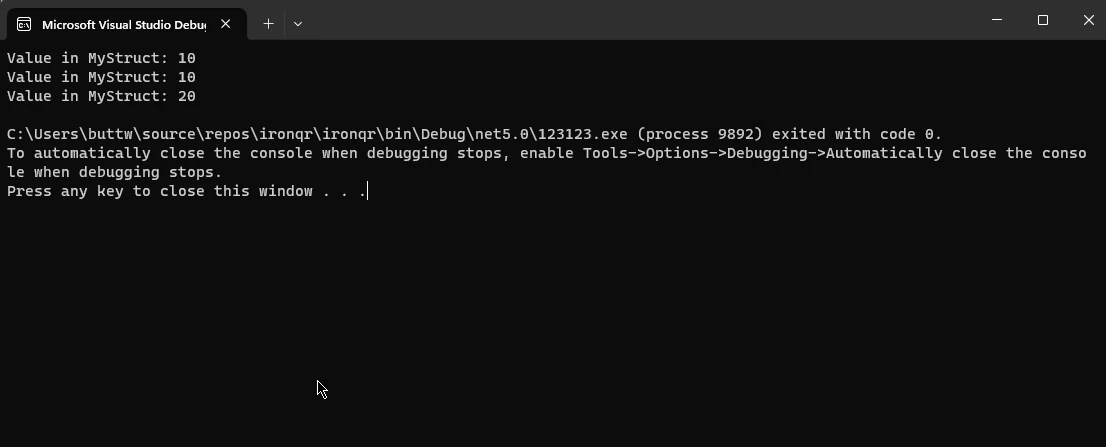
```csharp
using System;
// Define a struct
public struct MyStruct
{
// Fields (data members)
public int MyField;
// Constructor
public MyStruct(int value)
{
MyField = value;
}
// Method to display the value
public void Display()
{
Console.WriteLine($"Value in MyStruct: {MyField}");
}
}
class Program
{
static void Main()
{
// Create an instance of the struct
MyStruct myStructInstance = new MyStruct(10);
// Access field and call method
myStructInstance.Display();
// Structs are value types, so myStructInstance is a copy
MyStruct anotherInstance = myStructInstance;
anotherInstance.MyField = 20;
// Changes to anotherInstance do not affect myStructInstance
myStructInstance.Display();
anotherInstance.Display();
}
}
```
## 2: Anwendungsfälle und Richtlinien
### 2.1. Wann man Klassen verwenden sollte
**Komplexer Zustand und Verhalten:** Verwenden Sie Klassen, wenn Sie komplexe Datenstrukturen mit Zustand und Verhalten modellieren müssen. Klassen eignen sich zur Darstellung komplexer Objekte mit mehreren Eigenschaften und Methoden.
**Referenzsemantik:** Wenn Sie Instanzen von Objekten teilen möchten und möchten, dass Änderungen in verschiedenen Teilen Ihres Codes widergespiegelt werden, sind Klassen die geeignete Wahl.
### 2.2. Wann man Strukturen verwenden sollte
**Einfache Datenstrukturen:** Strukturen sind ideal für einfachere Datenstrukturen, die leichtgewichtige Entitäten wie kleine Datenstrukturen darstellen, wie Punkte, Rechtecke, Schlüssel-Wert-Paare oder wenn die Struktur logisch einen einzigen Wert repräsentiert, ähnlich wie primitive Typen.
**Wertesemantik:** Wenn Sie Wertesemantik bevorzugen und den Overhead der Heap-Zuweisung vermeiden möchten, sind Strukturen eine gute Wahl.
**Leistungsüberlegungen:** In Szenarien, in denen die Leistung entscheidend ist, insbesondere bei kleinen, häufig verwendeten Objekten, können Strukturen effizienter sein aufgrund der Stapelspeicherzuweisung.
## 3 Unterschiede in der Speicherzuweisung
### 3.1. Klassen
**Referenzzählung:** Der Speicher für Instanzen von Klassen wird durch Referenzzählung des Garbage Collectors verwaltet. Objekte sind für die Garbage Collection geeignet, wenn keine Verweise mehr auf sie existieren.
**Potenzial für Speicherlecks:** Unzureichende Handhabung von Verweisen kann zu Speicherlecks führen, wenn Objekte nicht ordnungsgemäß entsorgt werden, wenn sie nicht mehr benötigt werden.
### 3.2. Strukturen
**Keine Garbage Collection:** Strukturen verlassen sich nicht auf die Garbage Collection, da sie Wertetypen sind und anders verwaltet werden. Sie werden automatisch freigegeben, wenn sie aus dem Gültigkeitsbereich herausfallen.
**Begrenzter Speicher-Overhead:** Strukturen haben im Vergleich zu Klassen einen geringeren Speicher-Overhead, was sie effizient macht für Szenarien, in denen der Speicherverbrauch ein Thema ist.
## 4. leistungsbezogene Überlegungen
### Klassen
**Indirekter Zugriff:** Da auf Instanzen von Klassen über Referenzen zugegriffen wird, gibt es eine zusätzliche Ebene der Indirektion, die einen geringen Leistungs-Overhead verursachen kann.
**Heap-Speicherzuweisung:** Die dynamische Zuweisung von Speicher im Heap kann zu längeren Erstellungs- und Zerstörungszeiten von Objekten führen.
### Strukturen
**Direkter Zugriff:** Auf Strukturen wird direkt zugegriffen, wodurch die Notwendigkeit für eine zusätzliche Ebene der Indirektion entfällt. Dies kann zu einer besseren Leistung bei kleinen, häufig verwendeten Objekten führen.
**Stack-Speicherzuweisung:** Die Stapelspeicherzuweisung bietet schnellere Erstellung und Zerstörung von Strukturinstanzen.
## 5. Einführung in IronPDF
[**IronPDF-Übersicht: Robuste C#-Bibliothek für die PDF-Manipulation**](https://ironpdf.com) ist für nahtlose PDF-Erzeugung, -Manipulation und -Rendering innerhalb von .NET-Anwendungen konzipiert. Mit IronPDF können Entwickler mühelos PDF-Dokumente erstellen, bearbeiten und interagieren, was es zu einem unverzichtbaren Werkzeug für Aufgaben macht, die vom dynamischen Erzeugen von PDFs aus HTML-Inhalten bis hin zum Extrahieren von Daten aus vorhandenen Dokumenten reichen. Diese vielseitige Bibliothek vereinfacht PDF-bezogene Funktionen und bietet eine umfassende Reihe von Funktionen für Entwickler, die an Webanwendungen, Desktop-Software oder jedem .NET-Projekt arbeiten, das ein effizientes PDF-Handling erfordert.
### 5.1. Installieren von IronPDF
Bevor Sie in die Codebeispiele eintauchen, müssen Sie IronPDF installieren. Sie können dies mit der NuGet-Paket-Manager-Konsole tun oder indem Sie einen Verweis auf die IronPDF-Bibliothek in Ihr Projekt hinzufügen. Die folgenden Schritte skizzieren den Installationsprozess:
1. **NuGet-Paket-Manager-Konsole:**
```shell
:ProductInstall
```
2. **Paket-Manager-UI:** Suchen Sie nach "IronPDF" in der NuGet-Paket-Manager-UI und installieren Sie die neueste Version.
Sobald IronPDF installiert ist, sind Sie bereit, dessen Fähigkeiten für den Umgang mit PDF-Dateien in Ihren C#-Anwendungen zu nutzen.
## 5.2. Verwendung von Struct und Class mit IronPDF
```csharp
using IronPdf;
using System;
// Sample class representing a person with Name and Age properties
class Person
{
public string Name { get; set; }
public int Age { get; set; }
}
// Sample struct representing a point in a 2D coordinate system with X and Y properties
struct Point
{
public int X { get; set; }
public int Y { get; set; }
}
class Program
{
static void Main()
{
// Creating instances of the class and struct
Person person = new Person { Name = "John Doe", Age = 30 };
Point point = new Point { X = 10, Y = 20 };
// Create a new PDF document using IronPDF
var renderer = new ChromePdfRenderer();
// Construct HTML content using information from class and struct
string content = $@"
<!DOCTYPE html>
<html>
<body>
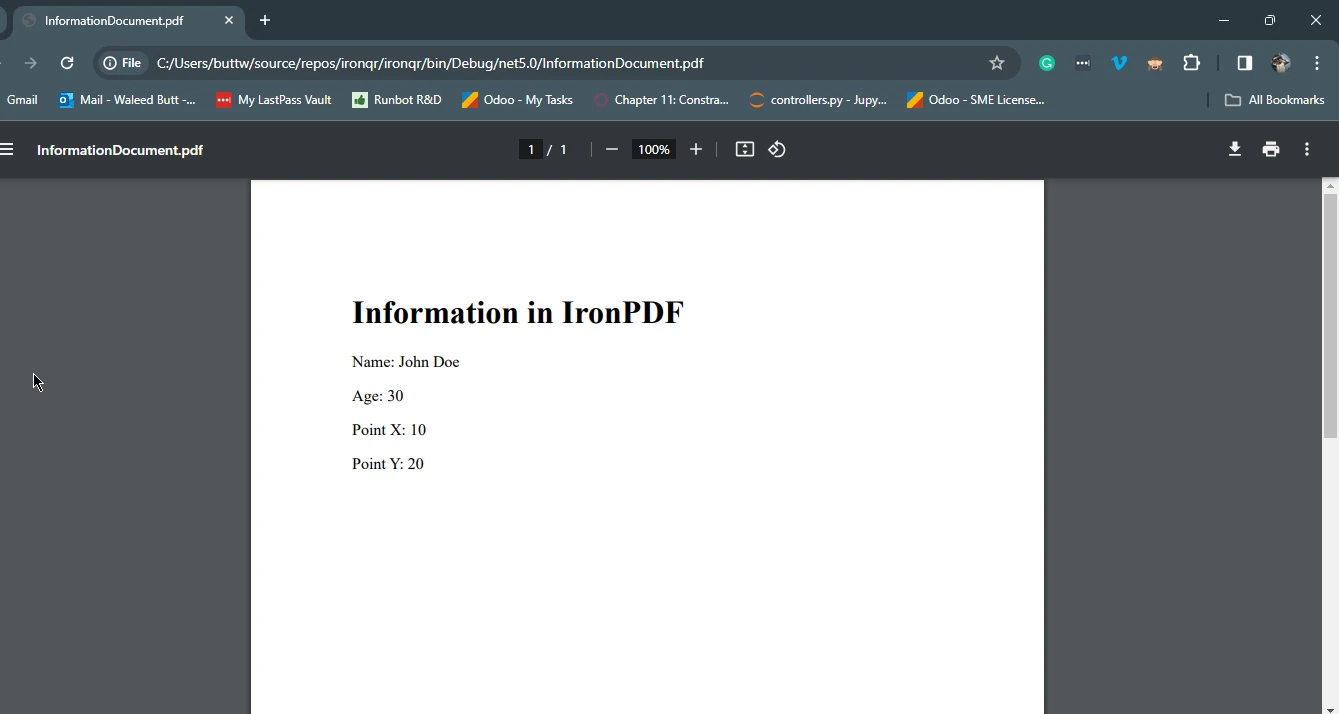
<h1>Information in IronPDF</h1>
<p>Name: {person.Name}</p>
<p>Age: {person.Age}</p>
<p>Point X: {point.X}</p>
<p>Point Y: {point.Y}</p>
</body>
</html>";
// Render HTML content to PDF
var pdf = renderer.RenderHtmlAsPdf(content);
// Save the PDF to a file
pdf.SaveAs("InformationDocument.pdf");
}
}
```
* **Person** ist eine Beispielklasse, die eine Person mit den Eigenschaften **Name** und **Alter** darstellt.
* **Point** ist eine Beispielstruktur, die einen Punkt in einem 2D-Koordinatensystem mit den Eigenschaften **X** und **Y** darstellt.
* Instanzen der **Person**-Klasse und der **Point**-Struktur werden erstellt.
* Der HTML-Inhalt wird dann in das PDF-Dokument gerendert, das als "InformationDocument.pdf" gespeichert wird.
### 5.2.1. Ausgabe der PDF-Datei
## 6. Fazit
Zusammenfassend hängt die Entscheidung zwischen der Verwendung von C#-Strukturen und Klassen von den spezifischen Anforderungen und Merkmalen Ihrer Anwendung ab. Klassen, die Referenztypen sind, eignen sich zur Modellierung komplexer Entitäten mit Zustand und Verhalten, unterstützen die Vererbung und erleichtern gemeinschaftlich genutzte Instanzen. Andererseits sind Strukturen, als Wertetypen, ideal für leichtgewichtige Datenstrukturen mit Wertesemantik und bieten Leistungsverbesserungen hinsichtlich Stapelspeicherzuweisung und direktem Zugriff.
IronPDF bietet eine [**Kostenlose Testlizenz zur Bewertung**](trial-license) für Benutzer, die eine gute Gelegenheit ist, die Funktionen und die Funktionalität von IronPDF kennenzulernen. Um mehr über IronPDF zu erfahren, besuchen Sie die [**Umfassende IronPDF-Dokumentation**](/docs/) und ein detailliertes Tutorial zur Erstellung von PDF-Dateien mit IronPDF ist unter [**IronPDF PDF-Erstellungstutorial**](/tutorials/html-to-pdf/) verfügbar.
In C# dienen sowohl Strukturen als auch Klassen als grundlegende Bausteine zum Organisieren und Speichern von Daten, weisen jedoch unterschiedliche Eigenschaften auf, die sie für verschiedene Szenarien geeignet machen. Das Verständnis der Unterschiede zwischen C#-Strukturen und Klassen ist entscheidend, um fundierte Entscheidungen bei der Gestaltung Ihrer C#-Anwendungen zu treffen.
In diesem Artikel werden wir die wesentlichen Unterschiede zwischen Strukturen und Klassen untersuchen und ihre Anwendungsfälle, Speicherverwaltung und Leistungsauswirkungen diskutieren. Außerdem werden wir besprechen, wie man Strukturen und Klassen mit IronPDF für C# zur Erstellung von PDF-Dateien verwendet.
1. Überblick über Strukturen und Klassen
1.1. Klassen (Referenztypen)
Referenztypen: Eine Klasse in C# ist ein Referenztyp, der sich im Heap befindet, was bedeutet, dass beim Erstellen einer Instanz einer Klasse ein Verweis auf das Objekt im Speicher gespeichert wird.
Heap-Speicherzuweisung: Klasseninstanzen werden im Speicher des Heaps zugewiesen, was Flexibilität in der Größe bietet und es Objekten ermöglicht, zwischen verschiedenen Teilen des Codes geteilt zu werden.
Standardkonstruktor: Klassen können einen Standardkonstruktor haben, der automatisch bereitgestellt wird, wenn keiner explizit definiert ist.
Vererbung: Klassen unterstützen die Vererbung, sodass abgeleitete Klassen mit gemeinsamen Merkmalen erstellt werden können.
using System;// Define a classpublic class MyClass{ // Fields (data members) public intMyField; // Constructor publicMyClass(int value) {MyField = value; } // Method to display the value public voidDisplay() {Console.WriteLine($"Value in MyClass: {MyField}"); }}class Program{ static voidMain() { // Create an instance of the class MyClass myClassInstance = new MyClass(10); // Access field and call method myClassInstance.Display(); // Classes are reference types, so myClassInstance refers to the same object in memory MyClass anotherInstance = myClassInstance; anotherInstance.MyField = 20; // Both instances refer to the same object, so the change is reflected in both myClassInstance.Display(); anotherInstance.Display(); }}
using System;

// Define a class
public class MyClass
{
    // Fields (data members)
    public int MyField;

    // Constructor
    public MyClass(int value)
    {
        MyField = value;
    }

    // Method to display the value
    public void Display()
    {
        Console.WriteLine($"Value in MyClass: {MyField}");
    }
}

class Program
{
    static void Main()
    {
        // Create an instance of the class
        MyClass myClassInstance = new MyClass(10);

        // Access field and call method
        myClassInstance.Display();

        // Classes are reference types, so myClassInstance refers to the same object in memory
        MyClass anotherInstance = myClassInstance;
        anotherInstance.MyField = 20;

        // Both instances refer to the same object, so the change is reflected in both
        myClassInstance.Display();
        anotherInstance.Display();
    }
}
ImportsSystem' Define a classPublic Class [MyClass] ' Fields (data members) PublicMyFieldAsInteger ' Constructor Public Sub New(ByVal value AsInteger)MyField = value End Sub ' Method to display the value Public Sub Display()Console.WriteLine($"Value in MyClass: {MyField}") End SubEnd ClassFriend Class ProgramShared Sub Main() ' Create an instance of the class Dim myClassInstance As [MyClass] = New [MyClass](10) ' Access field and call method myClassInstance.Display() ' Classes are reference types, so myClassInstance refers to the same object in memory Dim anotherInstance As [MyClass] = myClassInstance anotherInstance.MyField = 20 ' Both instances refer to the same object, so the change is reflected in both myClassInstance.Display() anotherInstance.Display() End SubEnd Class
Imports System

' Define a class
Public Class [MyClass]
	' Fields (data members)
	Public MyField As Integer

	' Constructor
	Public Sub New(ByVal value As Integer)
		MyField = value
	End Sub

	' Method to display the value
	Public Sub Display()
		Console.WriteLine($"Value in MyClass: {MyField}")
	End Sub
End Class

Friend Class Program
	Shared Sub Main()
		' Create an instance of the class
		Dim myClassInstance As [MyClass] = New [MyClass](10)

		' Access field and call method
		myClassInstance.Display()

		' Classes are reference types, so myClassInstance refers to the same object in memory
		Dim anotherInstance As [MyClass] = myClassInstance
		anotherInstance.MyField = 20

		' Both instances refer to the same object, so the change is reflected in both
		myClassInstance.Display()
		anotherInstance.Display()
	End Sub
End Class
1.2. Strukturen (Werttypen)
Werttypen: Structs sind Werttypen, was bedeutet, dass die eigentlichen Daten dort gespeichert werden, wo die Variable deklariert wird, anstatt wie primitive Typen an einem separaten Speicherort. Das bedeutet auch, dass der Struct nicht mit einem Nullwert als sein Werttyp zugewiesen werden kann, ohne ihn mit dem Nullable<>-Tag zu einem Nullable-Typ zu machen.
Stack-Speicherzuweisung: Strukturinstanzen werden im Stack Speicher zugewiesen, was zu schnellerer Zuweisung und Freigabe führt, jedoch mit Einschränkungen bei Größe und Umfang.
Kein Standardkonstruktor: Strukturen haben keinen Standardkonstruktor, es sei denn, einer wird explizit definiert. Jedes Feld muss während der Instanziierung initialisiert werden.
Keine Vererbung: Strukturen unterstützen keine Vererbung. Sie werden hauptsächlich für leichtgewichtige Datenstrukturen verwendet.
using System;// Define a structpublic struct MyStruct{ // Fields (data members) public intMyField; // Constructor publicMyStruct(int value) {MyField = value; } // Method to display the value public voidDisplay() {Console.WriteLine($"Value in MyStruct: {MyField}"); }}class Program{ static voidMain() { // Create an instance of the struct MyStruct myStructInstance = new MyStruct(10); // Access field and call method myStructInstance.Display(); // Structs are value types, so myStructInstance is a copy MyStruct anotherInstance = myStructInstance; anotherInstance.MyField = 20; // Changes to anotherInstance do not affect myStructInstance myStructInstance.Display(); anotherInstance.Display(); }}
using System;

// Define a struct
public struct MyStruct
{
    // Fields (data members)
    public int MyField;

    // Constructor
    public MyStruct(int value)
    {
        MyField = value;
    }

    // Method to display the value
    public void Display()
    {
        Console.WriteLine($"Value in MyStruct: {MyField}");
    }
}

class Program
{
    static void Main()
    {
        // Create an instance of the struct
        MyStruct myStructInstance = new MyStruct(10);

        // Access field and call method
        myStructInstance.Display();

        // Structs are value types, so myStructInstance is a copy
        MyStruct anotherInstance = myStructInstance;
        anotherInstance.MyField = 20;

        // Changes to anotherInstance do not affect myStructInstance
        myStructInstance.Display();
        anotherInstance.Display();
    }
}
ImportsSystem' Define a structPublicStructureMyStruct ' Fields (data members) PublicMyFieldAsInteger ' Constructor Public Sub New(ByVal value AsInteger)MyField = value End Sub ' Method to display the value Public Sub Display()Console.WriteLine($"Value in MyStruct: {MyField}") End SubEndStructureFriend Class ProgramShared Sub Main() ' Create an instance of the struct Dim myStructInstance As New MyStruct(10) ' Access field and call method myStructInstance.Display() ' Structs are value types, so myStructInstance is a copy Dim anotherInstance AsMyStruct = myStructInstance anotherInstance.MyField = 20 ' Changes to anotherInstance do not affect myStructInstance myStructInstance.Display() anotherInstance.Display() End SubEnd Class
Imports System

' Define a struct
Public Structure MyStruct
	' Fields (data members)
	Public MyField As Integer

	' Constructor
	Public Sub New(ByVal value As Integer)
		MyField = value
	End Sub

	' Method to display the value
	Public Sub Display()
		Console.WriteLine($"Value in MyStruct: {MyField}")
	End Sub
End Structure

Friend Class Program
	Shared Sub Main()
		' Create an instance of the struct
		Dim myStructInstance As New MyStruct(10)

		' Access field and call method
		myStructInstance.Display()

		' Structs are value types, so myStructInstance is a copy
		Dim anotherInstance As MyStruct = myStructInstance
		anotherInstance.MyField = 20

		' Changes to anotherInstance do not affect myStructInstance
		myStructInstance.Display()
		anotherInstance.Display()
	End Sub
End Class
2: Anwendungsfälle und Richtlinien
2.1. Wann man Klassen verwenden sollte
Komplexer Zustand und Verhalten: Verwenden Sie Klassen, wenn Sie komplexe Datenstrukturen mit Zustand und Verhalten modellieren müssen. Klassen eignen sich zur Darstellung komplexer Objekte mit mehreren Eigenschaften und Methoden.
Referenzsemantik: Wenn Sie Instanzen von Objekten teilen möchten und möchten, dass Änderungen in verschiedenen Teilen Ihres Codes widergespiegelt werden, sind Klassen die geeignete Wahl.
2.2. Wann man Strukturen verwenden sollte
Einfache Datenstrukturen: Strukturen sind ideal für einfachere Datenstrukturen, die leichtgewichtige Entitäten wie kleine Datenstrukturen darstellen, wie Punkte, Rechtecke, Schlüssel-Wert-Paare oder wenn die Struktur logisch einen einzigen Wert repräsentiert, ähnlich wie primitive Typen.
Wertesemantik: Wenn Sie Wertesemantik bevorzugen und den Overhead der Heap-Zuweisung vermeiden möchten, sind Strukturen eine gute Wahl.
Leistungsüberlegungen: In Szenarien, in denen die Leistung entscheidend ist, insbesondere bei kleinen, häufig verwendeten Objekten, können Strukturen effizienter sein aufgrund der Stapelspeicherzuweisung.
3 Unterschiede in der Speicherzuweisung
3.1. Klassen
Referenzzählung: Der Speicher für Instanzen von Klassen wird durch Referenzzählung des Garbage Collectors verwaltet. Objekte sind für die Garbage Collection geeignet, wenn keine Verweise mehr auf sie existieren.
Potenzial für Speicherlecks: Unzureichende Handhabung von Verweisen kann zu Speicherlecks führen, wenn Objekte nicht ordnungsgemäß entsorgt werden, wenn sie nicht mehr benötigt werden.
3.2. Strukturen
Keine Garbage Collection: Strukturen verlassen sich nicht auf die Garbage Collection, da sie Wertetypen sind und anders verwaltet werden. Sie werden automatisch freigegeben, wenn sie aus dem Gültigkeitsbereich herausfallen.
Begrenzter Speicher-Overhead: Strukturen haben im Vergleich zu Klassen einen geringeren Speicher-Overhead, was sie effizient macht für Szenarien, in denen der Speicherverbrauch ein Thema ist.
4. leistungsbezogene Überlegungen
Klassen
Indirekter Zugriff: Da auf Instanzen von Klassen über Referenzen zugegriffen wird, gibt es eine zusätzliche Ebene der Indirektion, die einen geringen Leistungs-Overhead verursachen kann.
Heap-Speicherzuweisung: Die dynamische Zuweisung von Speicher im Heap kann zu längeren Erstellungs- und Zerstörungszeiten von Objekten führen.
Strukturen
Direkter Zugriff: Auf Strukturen wird direkt zugegriffen, wodurch die Notwendigkeit für eine zusätzliche Ebene der Indirektion entfällt. Dies kann zu einer besseren Leistung bei kleinen, häufig verwendeten Objekten führen.
Stack-Speicherzuweisung: Die Stapelspeicherzuweisung bietet schnellere Erstellung und Zerstörung von Strukturinstanzen.
5. Einführung in IronPDF
IronPDF-Übersicht: Robuste C#-Bibliothek für die PDF-Manipulation ist für nahtlose PDF-Erzeugung, -Manipulation und -Rendering innerhalb von .NET-Anwendungen konzipiert. Mit IronPDF können Entwickler mühelos PDF-Dokumente erstellen, bearbeiten und interagieren, was es zu einem unverzichtbaren Werkzeug für Aufgaben macht, die vom dynamischen Erzeugen von PDFs aus HTML-Inhalten bis hin zum Extrahieren von Daten aus vorhandenen Dokumenten reichen. Diese vielseitige Bibliothek vereinfacht PDF-bezogene Funktionen und bietet eine umfassende Reihe von Funktionen für Entwickler, die an Webanwendungen, Desktop-Software oder jedem .NET-Projekt arbeiten, das ein effizientes PDF-Handling erfordert.
5.1. Installieren von IronPDF
Bevor Sie in die Codebeispiele eintauchen, müssen Sie IronPDF installieren. Sie können dies mit der NuGet-Paket-Manager-Konsole tun oder indem Sie einen Verweis auf die IronPDF-Bibliothek in Ihr Projekt hinzufügen. Die folgenden Schritte skizzieren den Installationsprozess:
NuGet-Paket-Manager-Konsole:
PM > Install-Package IronPdf
Install-Package IronPdf
Paket-Manager-UI: Suchen Sie nach "IronPDF" in der NuGet-Paket-Manager-UI und installieren Sie die neueste Version.
Sobald IronPDF installiert ist, sind Sie bereit, dessen Fähigkeiten für den Umgang mit PDF-Dateien in Ihren C#-Anwendungen zu nutzen.
5.2. Verwendung von Struct und Class mit IronPDF
using IronPdf;using System;// Sample class representing a person with Name and Age propertiesclass Person{ public stringName { get; set; } public intAge { get; set; }}// Sample struct representing a point in a 2D coordinate system with X and Y propertiesstruct Point{ public intX { get; set; } public intY { get; set; }}class Program{ static voidMain() { // Creating instances of the class and struct Person person = new Person { Name = "John Doe", Age = 30 }; Point point = new Point { X = 10, Y = 20 }; // Create a new PDF document using IronPDF var renderer = new ChromePdfRenderer(); // Construct HTML content using information from class and struct string content = $@" <!DOCTYPE html> <html> <body> <h1>Information in IronPDF</h1> <p>Name: {person.Name}</p> <p>Age: {person.Age}</p> <p>Point X: {point.X}</p> <p>Point Y: {point.Y}</p> </body> </html>"; // Render HTML content to PDF var pdf = renderer.RenderHtmlAsPdf(content); // Save the PDF to a file pdf.SaveAs("InformationDocument.pdf"); }}
using IronPdf;
using System;

// Sample class representing a person with Name and Age properties
class Person
{
    public string Name { get; set; }
    public int Age { get; set; }
}

// Sample struct representing a point in a 2D coordinate system with X and Y properties
struct Point
{
    public int X { get; set; }
    public int Y { get; set; }
}

class Program
{
    static void Main()
    {
        // Creating instances of the class and struct
        Person person = new Person { Name = "John Doe", Age = 30 };
        Point point = new Point { X = 10, Y = 20 };

        // Create a new PDF document using IronPDF
        var renderer = new ChromePdfRenderer();

        // Construct HTML content using information from class and struct
        string content = $@"
            <!DOCTYPE html>
            <html>
            <body>
                <h1>Information in IronPDF</h1>
                <p>Name: {person.Name}</p>
                <p>Age: {person.Age}</p>
                <p>Point X: {point.X}</p>
                <p>Point Y: {point.Y}</p>
            </body>
            </html>";

        // Render HTML content to PDF
        var pdf = renderer.RenderHtmlAsPdf(content);

        // Save the PDF to a file
        pdf.SaveAs("InformationDocument.pdf");
    }
}
ImportsIronPdfImportsSystem' Sample class representing a person with Name and Age propertiesFriend Class Person Public Property Name() AsString Public Property Age() AsIntegerEnd Class' Sample struct representing a point in a 2D coordinate system with X and Y propertiesFriendStructurePoint Public Property X() AsInteger Public Property Y() AsIntegerEndStructureFriend Class ProgramShared Sub Main() ' Creating instances of the class and struct Dim person As New PersonWith { .Name = "John Doe", .Age = 30 } Dim point As New PointWith { .X = 10, .Y = 20 } ' Create a new PDF document using IronPDF Dim renderer = New ChromePdfRenderer() ' Construct HTML content using information from class and struct Dim content AsString = $" <!DOCTYPE html> <html> <body> <h1>Information in IronPDF</h1> <p>Name: {person.Name}</p> <p>Age: {person.Age}</p> <p>Point X: {point.X}</p> <p>Point Y: {point.Y}</p> </body> </html>" ' Render HTML content to PDF Dim pdf = renderer.RenderHtmlAsPdf(content) ' Save the PDF to a file pdf.SaveAs("InformationDocument.pdf") End SubEnd Class
Imports IronPdf
Imports System

' Sample class representing a person with Name and Age properties
Friend Class Person
	Public Property Name() As String
	Public Property Age() As Integer
End Class

' Sample struct representing a point in a 2D coordinate system with X and Y properties
Friend Structure Point
	Public Property X() As Integer
	Public Property Y() As Integer
End Structure

Friend Class Program
	Shared Sub Main()
		' Creating instances of the class and struct
		Dim person As New Person With {
			.Name = "John Doe",
			.Age = 30
		}
		Dim point As New Point With {
			.X = 10,
			.Y = 20
		}

		' Create a new PDF document using IronPDF
		Dim renderer = New ChromePdfRenderer()

		' Construct HTML content using information from class and struct
		Dim content As String = $"
            <!DOCTYPE html>
            <html>
            <body>
                <h1>Information in IronPDF</h1>
                <p>Name: {person.Name}</p>
                <p>Age: {person.Age}</p>
                <p>Point X: {point.X}</p>
                <p>Point Y: {point.Y}</p>
            </body>
            </html>"

		' Render HTML content to PDF
		Dim pdf = renderer.RenderHtmlAsPdf(content)

		' Save the PDF to a file
		pdf.SaveAs("InformationDocument.pdf")
	End Sub
End Class
Person ist eine Beispielklasse, die eine Person mit den Eigenschaften Name und Alter darstellt.
Point ist eine Beispielstruktur, die einen Punkt in einem 2D-Koordinatensystem mit den Eigenschaften X und Y darstellt.
Instanzen der Person-Klasse und der Point-Struktur werden erstellt.
Der HTML-Inhalt wird dann in das PDF-Dokument gerendert, das als "InformationDocument.pdf" gespeichert wird.
5.2.1. Ausgabe der PDF-Datei
6. Fazit
Zusammenfassend hängt die Entscheidung zwischen der Verwendung von C#-Strukturen und Klassen von den spezifischen Anforderungen und Merkmalen Ihrer Anwendung ab. Klassen, die Referenztypen sind, eignen sich zur Modellierung komplexer Entitäten mit Zustand und Verhalten, unterstützen die Vererbung und erleichtern gemeinschaftlich genutzte Instanzen. Andererseits sind Strukturen, als Wertetypen, ideal für leichtgewichtige Datenstrukturen mit Wertesemantik und bieten Leistungsverbesserungen hinsichtlich Stapelspeicherzuweisung und direktem Zugriff.
Jacob Mellor ist Chief Technology Officer bei Iron Software und ein visionärer Ingenieur, der Pionierarbeit in der C# PDF-Technologie leistet. Als der ursprüngliche Entwickler hinter der Kern-Codebasis von Iron Software hat er die Produktarchitektur des Unternehmens seit seiner Gründung geprägt und es zusammen mit CEO Cameron Rimington in ein Unternehmen mit mehr als 50 Mitarbeitern verwandelt, das die NASA, Tesla und globale Regierungsbehörden beliefert.