In C#, virtuelle Methoden können in abgeleiteten Klassen überschrieben werden, während abstrakte Methoden in abgeleiteten Klassen überschrieben werden müssen. Dies ermöglicht flexibles Verhalten und unterstützt Polymorphie in der objektorientierten Programmierung. Diese beiden Konzepte erlauben Flexibilität und Wiederverwendbarkeit in der objektorientierten Programmierung. Dieser Artikel erklärt die Besonderheiten von abstrakten und virtuellen Methoden, bietet klare Beispiele und konzentriert sich auf deren praktische Anwendungen im Coding. Wir werden später im Artikel auch die Fähigkeiten und Anwendungsfälle von IronPDF erkunden.
Abstrakte Klasse und Methoden
Eine abstrakte Klasse ist eine spezielle Art von Klasse, die nicht direkt instanziiert werden kann. Stattdessen dient sie als Vorlage für andere Klassen. Eine abstrakte Klasse kann abstrakte Methoden enthalten, die in der abstrakten Klasse deklariert, aber in konkreten abgeleiteten Klassen implementiert werden müssen.
public abstract class Vehicle
{
    // Abstract method to be implemented in non-abstract child class
    public abstract void DisplayInfo();
}
public abstract class Vehicle
{
    // Abstract method to be implemented in non-abstract child class
    public abstract void DisplayInfo();
}
Public MustInherit Class Vehicle
' Abstract method to be implemented in non-abstract child class
Public MustOverride Sub DisplayInfo()
End Class
Public MustInherit Class Vehicle
	' Abstract method to be implemented in non-abstract child class
	Public MustOverride Sub DisplayInfo()
End Class
In diesem Beispiel ist die Vehicle-Klasse abstrakt, und DisplayInfo ist eine abstrakte Methode. Die DisplayInfo-Methode hat in der Vehicle-Klasse keine Implementierung. Sie zwingt die abgeleitete Klasse, ihre eigene Definition dieser Methode bereitzustellen.
Virtuelle Methoden
Virtuelle Methoden sind Methoden in einer Basisklasse, die eine Standardimplementierung haben, aber in abgeleiteten Klassen überschrieben werden können. Das virtual-Schlüsselwort wird verwendet, um eine Methode als virtuell zu deklarieren. Abgeleitete Klassen verwenden das override-Schlüsselwort, um eine spezifische Implementierung der Methode bereitzustellen, was hilft zu verstehen, wie eine Kindsklasse die virtuelle Methode ihrer Eltern überschreiben kann.
// Non-abstract class
public class Animal
{
    // Virtual method with a default implementation
    public virtual void Speak()
    {
        Console.WriteLine("Some generic animal sound");
    }
}
// Non-abstract class
public class Animal
{
    // Virtual method with a default implementation
    public virtual void Speak()
    {
        Console.WriteLine("Some generic animal sound");
    }
}
' Non-abstract class
Public Class Animal
' Virtual method with a default implementation
Public Overridable Sub Speak()
Console.WriteLine("Some generic animal sound")
End Sub
End Class
' Non-abstract class
Public Class Animal
	' Virtual method with a default implementation
	Public Overridable Sub Speak()
		Console.WriteLine("Some generic animal sound")
	End Sub
End Class
Hier hat die Animal-Klasse eine virtuelle Methode Speak mit einer Standardimplementierung. Abgeleitete Klassen können die Methode überschreiben, um einen spezifischen Tierlaut mit dem override-Schlüsselwort bereitzustellen.
Kombinieren von virtuellen und abstrakten Methoden
Eine Klasse kann sowohl abstrakte als auch virtuelle Methoden haben. Abstrakte Methoden haben keine Implementierung und müssen in abgeleiteten Klassen überschrieben werden, während virtuelle Methoden eine Standardimplementierung haben, die abgeleitete Klassen optional überschreiben können.
Betrachten Sie ein Szenario, in dem Sie ein System aufbauen, das verschiedene Arten von Fahrzeugen modelliert, von denen jedes seine eigene Art hat, Informationen anzuzeigen. Hier ist, wie Sie abstrakte und virtuelle Methoden verwenden können:
public abstract class Vehicle
{
    // Abstract method
    public abstract void DisplayInfo();

    // Virtual method
    public virtual void StartEngine()
    {
        Console.WriteLine("Engine started with default configuration.");
    }
}
public abstract class Vehicle
{
    // Abstract method
    public abstract void DisplayInfo();

    // Virtual method
    public virtual void StartEngine()
    {
        Console.WriteLine("Engine started with default configuration.");
    }
}
Public MustInherit Class Vehicle
' Abstract method
Public MustOverride Sub DisplayInfo()
' Virtual method
Public Overridable Sub StartEngine()
Console.WriteLine("Engine started with default configuration.")
End Sub
End Class
Public MustInherit Class Vehicle
	' Abstract method
	Public MustOverride Sub DisplayInfo()

	' Virtual method
	Public Overridable Sub StartEngine()
		Console.WriteLine("Engine started with default configuration.")
	End Sub
End Class
In dieser Vehicle-Klasse ist DisplayInfo eine abstrakte Methode, die alle abgeleiteten Klassen zwingt, ihre eigene Methode zur Anzeige von Informationen zu implementieren. StartEngine hingegen bietet eine Standardmethode zum Starten des Motors, die von einer abgeleiteten Klasse bei Bedarf überschrieben werden kann.
Beispiel mit abgeleiteten Klassen
Nun lassen Sie uns eine Car Klasse definieren, eine nicht-abstrakte untergeordnete Klasse, die von Vehicle erbt und die abstrakte Methode implementiert, während optional die virtuelle Methode überschrieben wird:
public class Car : Vehicle
{
    // Override the abstract method
    public override void DisplayInfo()
    {
        Console.WriteLine("This is a car.");
    }

    // Override the virtual method
    public override void StartEngine()
    {
        Console.WriteLine("Car engine started with custom settings.");
    }
}
public class Car : Vehicle
{
    // Override the abstract method
    public override void DisplayInfo()
    {
        Console.WriteLine("This is a car.");
    }

    // Override the virtual method
    public override void StartEngine()
    {
        Console.WriteLine("Car engine started with custom settings.");
    }
}
Public Class Car
Inherits Vehicle
' Override the abstract method
Public Overrides Sub DisplayInfo()
Console.WriteLine("This is a car.")
End Sub
' Override the virtual method
Public Overrides Sub StartEngine()
Console.WriteLine("Car engine started with custom settings.")
End Sub
End Class
Public Class Car
	Inherits Vehicle

	' Override the abstract method
	Public Overrides Sub DisplayInfo()
		Console.WriteLine("This is a car.")
	End Sub

	' Override the virtual method
	Public Overrides Sub StartEngine()
		Console.WriteLine("Car engine started with custom settings.")
	End Sub
End Class
Hier bietet die Car-Klasse spezifische Implementierungen sowohl für die abstrakte Methode DisplayInfo als auch für die virtuelle Methode StartEngine.
Unterschied und Verwendung
- Verwenden Sie abstrakte Methoden, wenn alle abgeleiteten Klassen ihre eigene Implementierung einer Methode bereitstellen müssen.
- Virtuelle Methoden verwenden, wenn abgeleitete Klassen eine Standardimplementierung überschreiben sollen.
Abstrakte und virtuelle Methoden sind leistungsstarke Funktionen in C#, die es Ihnen ermöglichen, wartbareren und wiederverwendbareren Code zu schreiben. Indem Sie Methoden in einer Basisklasse als abstrakt oder virtuell definieren, können Sie festlegen, welche Methoden in abgeleiteten Klassen überschrieben werden müssen und welche optional überschrieben werden können, um das Standardverhalten zu ändern oder zu erweitern.
Virtuelle Methoden außer Kraft setzen
Das Überschreiben von virtuellen Methoden in abgeleiteten Klassen ermöglicht benutzerdefiniertes Verhalten und behält die Möglichkeit bei, die Basisklassenimplementierung aufzurufen. Dies wird mit dem base-Schlüsselwort erreicht.
Beispiel für das Überschreiben und Aufrufen der Basisimplementierung
public class ElectricCar : Car
{
    // Override the StartEngine method
    public override void StartEngine()
    {
        base.StartEngine(); // Call the base class implementation
        Console.WriteLine("Electric car engine started with energy-saving mode.");
    }
}
public class ElectricCar : Car
{
    // Override the StartEngine method
    public override void StartEngine()
    {
        base.StartEngine(); // Call the base class implementation
        Console.WriteLine("Electric car engine started with energy-saving mode.");
    }
}
Public Class ElectricCar
Inherits Car
' Override the StartEngine method
Public Overrides Sub StartEngine()
MyBase.StartEngine() ' Call the base class implementation
Console.WriteLine("Electric car engine started with energy-saving mode.")
End Sub
End Class
Public Class ElectricCar
	Inherits Car

	' Override the StartEngine method
	Public Overrides Sub StartEngine()
		MyBase.StartEngine() ' Call the base class implementation
		Console.WriteLine("Electric car engine started with energy-saving mode.")
	End Sub
End Class
In diesem Beispiel überschreibt ElectricCar, das eine untergeordnete Klasse von Car ist, die von seiner Elternklasse geerbte StartEngine Methode. Die Basisklassenimplementierung wird aufgerufen und zusätzlich wird ein spezifisches Verhalten für Elektroautos hinzugefügt.
Implementierung von abstrakten und nicht-abstrakten Klassen
Es ist wesentlich, die praktischen Unterschiede und Anwendungen von abstrakten und nicht-abstrakten Klassen in der Softwareentwicklung zu verstehen. Abstrakte Klassen dienen als Vorlage für andere Klassen, während nicht-abstrakte Klassen verwendet werden, um Objekte zu instanziieren. Die Wahl zwischen der Verwendung einer abstrakten Klasse und einer nicht-abstrakten Klasse hängt davon ab, ob Sie eine Basisklasse erstellen müssen, die nicht eigenständig instanziiert werden soll.
IronPDF: C# PDF-Bibliothek
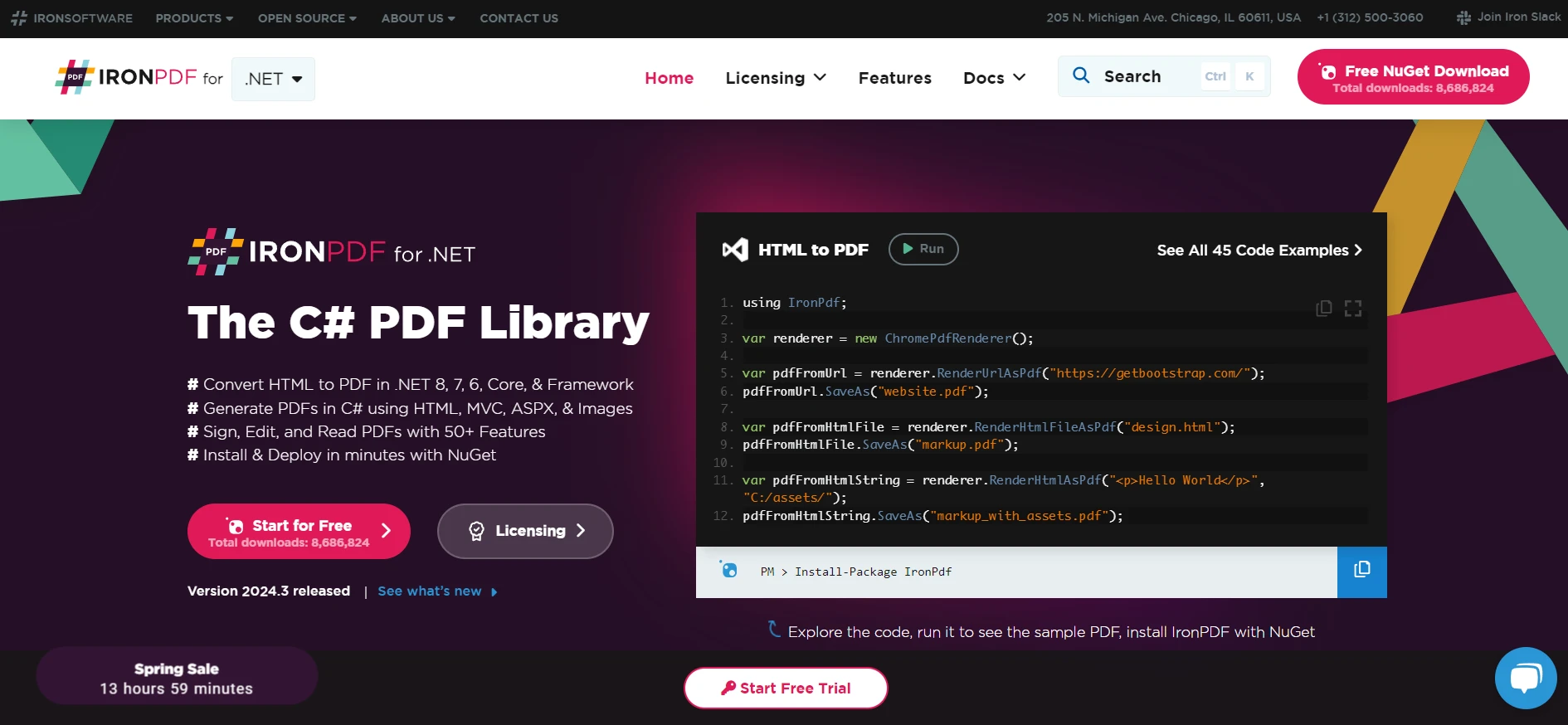
IronPDF ist eine umfassende PDF-Bibliothek, die für das Erstellen, Bearbeiten und Lesen von PDF-Dokumenten direkt innerhalb von .NET-Anwendungen konzipiert wurde. Dieses Tool zeichnet sich durch die Fähigkeit aus, PDFs direkt aus HTML-Strings, Dateien und URLs zu erstellen. Entwickler können in C#-Projekten programmatisch PDF-Inhalte erstellen, ändern und extrahieren. Lassen Sie uns ein Beispiel für IronPDF im Kontext unseres Artikels erkunden.
Die Hauptfunktion von IronPDF ist die Umwandlung von HTML in PDF, wobei Layouts und Stile beibehalten werden. Dieses Tool eignet sich hervorragend zum Erstellen von PDFs aus Webinhalten für Berichte, Rechnungen und Dokumentationen. Es unterstützt die Umwandlung von HTML-Dateien, URLs und HTML-Strings in PDF-Dateien.
using IronPdf;

class Program
{
    static void Main(string[] args)
    {
        var renderer = new ChromePdfRenderer();

        // Convert HTML String to PDF
        var htmlContent = "<h1>Hello, IronPDF!</h1><p>This is a PDF from an HTML string.</p>";
        var pdfFromHtmlString = renderer.RenderHtmlAsPdf(htmlContent);
        pdfFromHtmlString.SaveAs("HTMLStringToPDF.pdf");

        // Convert HTML File to PDF
        var htmlFilePath = "path_to_your_html_file.html"; // Specify the path to your HTML file
        var pdfFromHtmlFile = renderer.RenderHtmlFileAsPdf(htmlFilePath);
        pdfFromHtmlFile.SaveAs("HTMLFileToPDF.pdf");

        // Convert URL to PDF
        var url = "http://ironpdf.com"; // Specify the URL
        var pdfFromUrl = renderer.RenderUrlAsPdf(url);
        pdfFromUrl.SaveAs("URLToPDF.pdf");
    }
}
using IronPdf;

class Program
{
    static void Main(string[] args)
    {
        var renderer = new ChromePdfRenderer();

        // Convert HTML String to PDF
        var htmlContent = "<h1>Hello, IronPDF!</h1><p>This is a PDF from an HTML string.</p>";
        var pdfFromHtmlString = renderer.RenderHtmlAsPdf(htmlContent);
        pdfFromHtmlString.SaveAs("HTMLStringToPDF.pdf");

        // Convert HTML File to PDF
        var htmlFilePath = "path_to_your_html_file.html"; // Specify the path to your HTML file
        var pdfFromHtmlFile = renderer.RenderHtmlFileAsPdf(htmlFilePath);
        pdfFromHtmlFile.SaveAs("HTMLFileToPDF.pdf");

        // Convert URL to PDF
        var url = "http://ironpdf.com"; // Specify the URL
        var pdfFromUrl = renderer.RenderUrlAsPdf(url);
        pdfFromUrl.SaveAs("URLToPDF.pdf");
    }
}
Imports IronPdf
Module Program
Sub Main(args As String())
Dim renderer = New ChromePdfRenderer()
' Convert HTML String to PDF
Dim htmlContent = "<h1>Hello, IronPDF!</h1><p>This is a PDF from an HTML string.</p>"
Dim pdfFromHtmlString = renderer.RenderHtmlAsPdf(htmlContent)
pdfFromHtmlString.SaveAs("HTMLStringToPDF.pdf")
' Convert HTML File to PDF
Dim htmlFilePath = "path_to_your_html_file.html" ' Specify the path to your HTML file
Dim pdfFromHtmlFile = renderer.RenderHtmlFileAsPdf(htmlFilePath)
pdfFromHtmlFile.SaveAs("HTMLFileToPDF.pdf")
' Convert URL to PDF
Dim url = "http://ironpdf.com" ' Specify the URL
Dim pdfFromUrl = renderer.RenderUrlAsPdf(url)
pdfFromUrl.SaveAs("URLToPDF.pdf")
End Sub
End Module
Imports IronPdf

Module Program
    Sub Main(args As String())
        Dim renderer = New ChromePdfRenderer()

        ' Convert HTML String to PDF
        Dim htmlContent = "<h1>Hello, IronPDF!</h1><p>This is a PDF from an HTML string.</p>"
        Dim pdfFromHtmlString = renderer.RenderHtmlAsPdf(htmlContent)
        pdfFromHtmlString.SaveAs("HTMLStringToPDF.pdf")

        ' Convert HTML File to PDF
        Dim htmlFilePath = "path_to_your_html_file.html" ' Specify the path to your HTML file
        Dim pdfFromHtmlFile = renderer.RenderHtmlFileAsPdf(htmlFilePath)
        pdfFromHtmlFile.SaveAs("HTMLFileToPDF.pdf")

        ' Convert URL to PDF
        Dim url = "http://ironpdf.com" ' Specify the URL
        Dim pdfFromUrl = renderer.RenderUrlAsPdf(url)
        pdfFromUrl.SaveAs("URLToPDF.pdf")
    End Sub
End Module
Codebeispiel
Hier ist ein einfaches tatsächliches Codebeispiel, um die Verwendung von virtual und abstract Schlüsselwörtern im Kontext der Erweiterung von IronPDF-Funktionalitäten zu veranschaulichen:
public abstract class PdfReportGenerator
{
    // Use abstract method to force derived classes to implement their custom PDF generation logic
    public abstract void GenerateReport(string filePath);

    // A virtual function allows derived classes to override the default implementation of PDF setup
    public virtual void SetupPdfGenerator()
    {
        // Default PDF setup logic that can be overridden by derived classes
        IronPdf.Installation.TempFolderPath = @"F:\TempPdfFiles";
    }
}

public class MonthlyReportGenerator : PdfReportGenerator
{
    // Override abstract method to provide specific implementation
    public override void GenerateReport(string filePath)
    {
        var pdf = new ChromePdfRenderer();
        pdf.RenderHtmlAsPdf("<h1>Monthly Report</h1> <p>Add Your report content here....</p>").SaveAs(filePath);
    }

    // Optionally override the virtual method to customize the setup
    public override void SetupPdfGenerator()
    {
        base.SetupPdfGenerator();
        // Additional setup logic specific to monthly reports
        IronPdf.Installation.TempFolderPath = @"F:\MonthlyReports";
    }
}

class Program
{
    static void Main(string[] args)
    {
        License.LicenseKey = "License-Key";
        PdfReportGenerator reportGenerator = new MonthlyReportGenerator();
        reportGenerator.SetupPdfGenerator();
        reportGenerator.GenerateReport(@"F:\MonthlyReports\MonthlyReport.pdf");
        Console.WriteLine("Report generated successfully.");
    }
}
public abstract class PdfReportGenerator
{
    // Use abstract method to force derived classes to implement their custom PDF generation logic
    public abstract void GenerateReport(string filePath);

    // A virtual function allows derived classes to override the default implementation of PDF setup
    public virtual void SetupPdfGenerator()
    {
        // Default PDF setup logic that can be overridden by derived classes
        IronPdf.Installation.TempFolderPath = @"F:\TempPdfFiles";
    }
}

public class MonthlyReportGenerator : PdfReportGenerator
{
    // Override abstract method to provide specific implementation
    public override void GenerateReport(string filePath)
    {
        var pdf = new ChromePdfRenderer();
        pdf.RenderHtmlAsPdf("<h1>Monthly Report</h1> <p>Add Your report content here....</p>").SaveAs(filePath);
    }

    // Optionally override the virtual method to customize the setup
    public override void SetupPdfGenerator()
    {
        base.SetupPdfGenerator();
        // Additional setup logic specific to monthly reports
        IronPdf.Installation.TempFolderPath = @"F:\MonthlyReports";
    }
}

class Program
{
    static void Main(string[] args)
    {
        License.LicenseKey = "License-Key";
        PdfReportGenerator reportGenerator = new MonthlyReportGenerator();
        reportGenerator.SetupPdfGenerator();
        reportGenerator.GenerateReport(@"F:\MonthlyReports\MonthlyReport.pdf");
        Console.WriteLine("Report generated successfully.");
    }
}
Public MustInherit Class PdfReportGenerator
' Use abstract method to force derived classes to implement their custom PDF generation logic
Public MustOverride Sub GenerateReport(ByVal filePath As String)
' A virtual function allows derived classes to override the default implementation of PDF setup
Public Overridable Sub SetupPdfGenerator()
' Default PDF setup logic that can be overridden by derived classes
IronPdf.Installation.TempFolderPath = "F:\TempPdfFiles"
End Sub
End Class
Public Class MonthlyReportGenerator
Inherits PdfReportGenerator
' Override abstract method to provide specific implementation
Public Overrides Sub GenerateReport(ByVal filePath As String)
Dim pdf = New ChromePdfRenderer()
pdf.RenderHtmlAsPdf("<h1>Monthly Report</h1> <p>Add Your report content here....</p>").SaveAs(filePath)
End Sub
' Optionally override the virtual method to customize the setup
Public Overrides Sub SetupPdfGenerator()
MyBase.SetupPdfGenerator()
' Additional setup logic specific to monthly reports
IronPdf.Installation.TempFolderPath = "F:\MonthlyReports"
End Sub
End Class
Friend Class Program
Shared Sub Main(ByVal args() As String)
License.LicenseKey = "License-Key"
Dim reportGenerator As PdfReportGenerator = New MonthlyReportGenerator()
reportGenerator.SetupPdfGenerator()
reportGenerator.GenerateReport("F:\MonthlyReports\MonthlyReport.pdf")
Console.WriteLine("Report generated successfully.")
End Sub
End Class
Public MustInherit Class PdfReportGenerator
	' Use abstract method to force derived classes to implement their custom PDF generation logic
	Public MustOverride Sub GenerateReport(ByVal filePath As String)

	' A virtual function allows derived classes to override the default implementation of PDF setup
	Public Overridable Sub SetupPdfGenerator()
		' Default PDF setup logic that can be overridden by derived classes
		IronPdf.Installation.TempFolderPath = "F:\TempPdfFiles"
	End Sub
End Class

Public Class MonthlyReportGenerator
	Inherits PdfReportGenerator

	' Override abstract method to provide specific implementation
	Public Overrides Sub GenerateReport(ByVal filePath As String)
		Dim pdf = New ChromePdfRenderer()
		pdf.RenderHtmlAsPdf("<h1>Monthly Report</h1> <p>Add Your report content here....</p>").SaveAs(filePath)
	End Sub

	' Optionally override the virtual method to customize the setup
	Public Overrides Sub SetupPdfGenerator()
		MyBase.SetupPdfGenerator()
		' Additional setup logic specific to monthly reports
		IronPdf.Installation.TempFolderPath = "F:\MonthlyReports"
	End Sub
End Class

Friend Class Program
	Shared Sub Main(ByVal args() As String)
		License.LicenseKey = "License-Key"
		Dim reportGenerator As PdfReportGenerator = New MonthlyReportGenerator()
		reportGenerator.SetupPdfGenerator()
		reportGenerator.GenerateReport("F:\MonthlyReports\MonthlyReport.pdf")
		Console.WriteLine("Report generated successfully.")
	End Sub
End Class
In diesem benutzerdefinierten Implementierungsbeispiel ist PdfReportGenerator eine abstrakte Klasse, die einen Vertrag für die Erstellung von PDF-Berichten mit einer Methode zur Erstellung des Berichts und einer virtuellen Methode zur Einrichtung definiert, die optional überschrieben werden kann. MonthlyReportGenerator ist eine konkrete Implementierung, die die Einzelheiten zur Erstellung eines Monatsberichts bereitstellt und die Einrichtung durch Überschreiben der virtuellen Methode anpasst.

Abschluss
Das Verstehen und der effektive Einsatz von virtuellen und abstrakten Methoden kann Ihre C#-Programmierung erheblich verbessern. Denken Sie daran, dass abstrakte Methoden eine Implementierung durch eine abgeleitete Klasse erfordern, während virtuelle Methoden eine optionale Überschreibung einer Standardimplementierung zulassen. Die IronPDF-Bibliothek bietet eine kostenlose Testversion und Lizenzierungsoptionen, mit Lizenzen ab $999, und stellt eine umfassende Lösung für Ihre PDF-Anforderungen dar.