Das JUnit-Framework ist ein weit verbreitetes Unit-Test-Framework for Java-Anwendungen. Es bietet eine einfache, elegante Möglichkeit, wiederholbare Tests zu schreiben und auszuführen. Mit JUnit Java können Entwickler sicherstellen, dass ihr Code wie erwartet funktioniert, indem sie Unit-Tests schreiben, die verschiedene Aspekte ihrer Software überprüfen. Darüber hinaus können Entwickler auch Testklassen schreiben, um Testfälle zu organisieren und Testrunner zu nutzen, um Tests auszuführen und Feedback zu erhalten. Unit-Test-Frameworks helfen nicht nur dabei, Fehler zu identifizieren, sondern fördern auch ein besseres Design und Wartbarkeit.
In diesem Artikel werden wir die Ausführung von JUnit Java-Tests besprechen und verschiedene Techniken dazu betrachten. Wir werden auch einen Testfall für die PDF-Erstellung mit IronPDF for Java schreiben.
Geschichte und Entwicklung von JUnit
Das JUnit-Testframework wurde von Kent Beck und Erich Gamma geschaffen, zwei der führenden Persönlichkeiten in der Software-Entwicklergemeinschaft. Seit seiner Einführung in den späten 1990er Jahren hat JUnit mehrere Iterationen durchlaufen, die jeweils mehr Funktionalität hinzugefügt und die Benutzerfreundlichkeit verbessert haben. Die aktuelle stabile Version, JUnit 5, auch bekannt als JUnit Jupiter, bietet mehrere Verbesserungen gegenüber ihren Vorgängern und macht es robuster und flexibler.
Schlüsselmerkmale von JUnit
-
Annotationen: JUnit verwendet Annotationen, um Tests zu definieren und zu konfigurieren. Gängige Annotationen sind:
@Test: Markiert eine Methode als Testmethode.@BeforeEach: Läuft vor jedem Test.@AfterEach: Läuft nach jedem Test.@BeforeAll: Läuft einmal vor allen Tests.@AfterAll: Läuft einmal nach allen Tests.
-
Assertions: Assertions werden verwendet, um zu überprüfen, ob die Testergebnisse mit den erwarteten Ergebnissen übereinstimmen. Einige gängige Assertions sind:
assertEquals(expected, actual): Überprüft, ob zwei Werte gleich sind.assertTrue(condition): Überprüft, ob eine Bedingung wahr ist.assertFalse(condition): Überprüft, ob eine Bedingung falsch ist.assertNull(object): Überprüft, ob ein Objekt null ist.assertNotNull(object): Überprüft, ob ein Objekt nicht null ist.
-
Parametrisierte Tests: JUnit unterstützt parametrisierte Tests, wodurch derselbe Test mit verschiedenen Parametern ausgeführt werden kann und somit die Tests effizienter durchgeführt werden.
-
Test-Suites: Tests können zu Test-Suites zusammengefasst werden, um mehrere Tests gleichzeitig auszuführen.
-
Ausnahmeprüfung: JUnit kann testen, ob eine Methode die erwarteten Ausnahmen auslöst.
-
Integration mit Build-Tools: JUnit lässt sich nahtlos in weit verbreitete Build-Tools wie Maven integrieren. Dadurch können Sie Tests und Testcode während des Build-Prozesses automatisch ausführen und Entwickler informieren, wenn ein Test während des Build-Prozesses fehlschlägt.

JUnit integriert sich nahtlos mit weit verbreiteten Build-Tools wie Maven. Dies ermöglicht Ihnen, Tests während des Build-Prozesses automatisch auszuführen.
Um JUnit mit Maven zu verwenden, fügen Sie folgende Abhängigkeit zu Ihrer pom.xml Datei hinzu:
<dependencies>
    <dependency>
        <groupId>org.junit.jupiter</groupId>
        <artifactId>junit-jupiter-api</artifactId>
        <version>5.8.1</version>
        <scope>test</scope>
    </dependency>
    <dependency>
        <groupId>org.junit.jupiter</groupId>
        <artifactId>junit-jupiter-engine</artifactId>
        <version>5.8.1</version>
        <scope>test</scope>
    </dependency>
</dependencies>
<dependencies>
    <dependency>
        <groupId>org.junit.jupiter</groupId>
        <artifactId>junit-jupiter-api</artifactId>
        <version>5.8.1</version>
        <scope>test</scope>
    </dependency>
    <dependency>
        <groupId>org.junit.jupiter</groupId>
        <artifactId>junit-jupiter-engine</artifactId>
        <version>5.8.1</version>
        <scope>test</scope>
    </dependency>
</dependencies>
XML
Schreiben Sie Ihren ersten JUnit-Test
Bevor wir uns in komplexere Beispiele stürzen, beginnen wir mit einem einfachen Unit-Test-Fall. Wir werden einen Test für eine einfache Taschenrechner-Klasse schreiben.
Berechnungsklasse
// Calculator.java
public class Calculator {
    // Method to add two integers
    public int add(int a, int b) {
        return a + b;
    }

    // Method to subtract one integer from another
    public int subtract(int a, int b) {
        return a - b;
    }
}
// Calculator.java
public class Calculator {
    // Method to add two integers
    public int add(int a, int b) {
        return a + b;
    }

    // Method to subtract one integer from another
    public int subtract(int a, int b) {
        return a - b;
    }
}
Java
Unit-Test-Klasse
// CalculatorTest.java
import org.junit.jupiter.api.Test;
import static org.junit.jupiter.api.Assertions.*;

public class CalculatorTest {
    // Test method for addition
    @Test
    public void testAdd() {
        Calculator calculator = new Calculator();
        assertEquals(5, calculator.add(2, 3)); // Asserts that the sum of 2 and 3 is 5
    }

    // Test method for subtraction
    @Test
    public void testSubtract() {
        Calculator calculator = new Calculator();
        assertEquals(1, calculator.subtract(3, 2)); // Asserts that 3 minus 2 is 1
    }
}
// CalculatorTest.java
import org.junit.jupiter.api.Test;
import static org.junit.jupiter.api.Assertions.*;

public class CalculatorTest {
    // Test method for addition
    @Test
    public void testAdd() {
        Calculator calculator = new Calculator();
        assertEquals(5, calculator.add(2, 3)); // Asserts that the sum of 2 and 3 is 5
    }

    // Test method for subtraction
    @Test
    public void testSubtract() {
        Calculator calculator = new Calculator();
        assertEquals(1, calculator.subtract(3, 2)); // Asserts that 3 minus 2 is 1
    }
}
Java
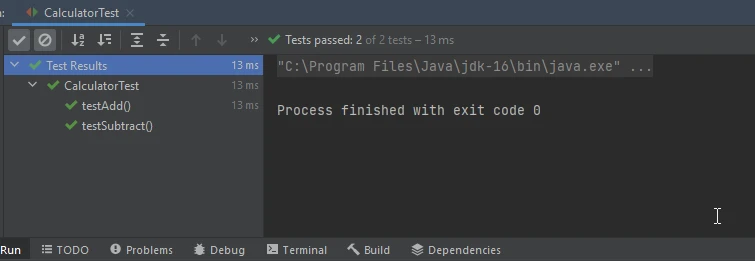
Das CalculatorTest Beispiel enthält zwei Testmethoden, eine zum Testen der Addition: testAdd und eine zum Testen der Subtraktion: testSubtract. Jede Methode erstellt eine Instanz der Calculator Klasse und nutzt Assertions, um die Korrektheit der add und subtract Methoden zu überprüfen.
Ausgabe
Erweiterte JUnit-Funktionen
Parametrisierte Tests
Parametrisierte Tests ermöglichen es Ihnen, denselben Test mit unterschiedlichen Parametersätzen auszuführen. Dies ist nützlich, um Methoden mit einer breiten Palette von Eingaben zu testen.
import org.junit.jupiter.params.ParameterizedTest;
import org.junit.jupiter.params.provider.CsvSource;
import static org.junit.jupiter.api.Assertions.*;

public class CalculatorParameterizedTest {
    @ParameterizedTest
    @CsvSource({
        "1, 1, 2",
        "2, 3, 5",
        "10, 20, 30"
    })
    public void testAdd(int a, int b, int expected) {
        Calculator calculator = new Calculator();
        assertEquals(expected, calculator.add(a, b)); // Asserts that the addition of a and b equals expected
    }
}
import org.junit.jupiter.params.ParameterizedTest;
import org.junit.jupiter.params.provider.CsvSource;
import static org.junit.jupiter.api.Assertions.*;

public class CalculatorParameterizedTest {
    @ParameterizedTest
    @CsvSource({
        "1, 1, 2",
        "2, 3, 5",
        "10, 20, 30"
    })
    public void testAdd(int a, int b, int expected) {
        Calculator calculator = new Calculator();
        assertEquals(expected, calculator.add(a, b)); // Asserts that the addition of a and b equals expected
    }
}
Java
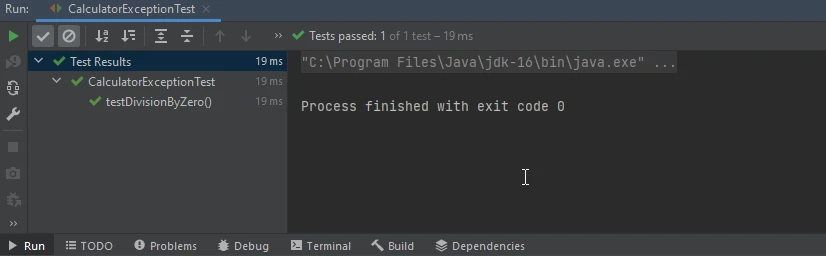
In diesem Beispiel läuft die testAdd Methode dreimal mit verschiedenen Eingabesätzen, wie durch die CsvSource angegeben.
Ausnahmeprüfung
Manchmal müssen Sie überprüfen, ob eine Methode eine erwartete Ausnahme wirft.
Fügen Sie die folgende Methode zu Ihrer Calculator-Klasse hinzu.
// Method to divide one integer by another, potentially throwing an exception if division by zero occurs
public float divide(int a, int b) {
    return a / b;
}
// Method to divide one integer by another, potentially throwing an exception if division by zero occurs
public float divide(int a, int b) {
    return a / b;
}
Java
Testklasse:
import org.junit.jupiter.api.Test;
import static org.junit.jupiter.api.Assertions.*;

class CalculatorExceptionTest {
    // Test method to verify division by zero throws ArithmeticException
    @Test
    public void testDivisionByZero() {
        Calculator calculator = new Calculator();
        assertThrows(ArithmeticException.class, () -> calculator.divide(1, 0)); // Asserts that dividing by zero throws an exception
    }
}
import org.junit.jupiter.api.Test;
import static org.junit.jupiter.api.Assertions.*;

class CalculatorExceptionTest {
    // Test method to verify division by zero throws ArithmeticException
    @Test
    public void testDivisionByZero() {
        Calculator calculator = new Calculator();
        assertThrows(ArithmeticException.class, () -> calculator.divide(1, 0)); // Asserts that dividing by zero throws an exception
    }
}
Java
Ausgabe
Integration von IronPDF mit JUnit in Java
IronPDF ist eine mächtige Bibliothek zur Erstellung von PDF-Dokumenten in Java-Anwendungen. Die Integration von IronPDF mit JUnit ermöglicht es Ihnen, die Testautomatisierung der PDF-Generierungs-Funktionalität sicherzustellen, dass Ihre Dokumente akkurat erstellt werden und die gewünschten Spezifikationen erfüllen.
Um IronPDF mit JUnit zu integrieren, müssen Sie zuerst die IronPDF-Bibliothek in Ihre Projektabhängigkeiten einfügen.
<dependencies>
    <!-- Adds IronPDF Java. Use the latest version in the version tag. -->
    <dependency>
        <groupId>com.ironsoftware</groupId>
        <artifactId>ironpdf</artifactId>
        <version>20xx.xx.xxxx</version>
    </dependency>
    <!-- Adds the slf4j logger which IronPDF Java uses. -->
    <dependency>
        <groupId>org.slf4j</groupId>
        <artifactId>slf4j-simple</artifactId>
        <version>2.0.3</version>
    </dependency>
</dependencies>
<dependencies>
    <!-- Adds IronPDF Java. Use the latest version in the version tag. -->
    <dependency>
        <groupId>com.ironsoftware</groupId>
        <artifactId>ironpdf</artifactId>
        <version>20xx.xx.xxxx</version>
    </dependency>
    <!-- Adds the slf4j logger which IronPDF Java uses. -->
    <dependency>
        <groupId>org.slf4j</groupId>
        <artifactId>slf4j-simple</artifactId>
        <version>2.0.3</version>
    </dependency>
</dependencies>
XML
Sobald dies erledigt ist, können Sie Testfälle schreiben, um die PDF-Generierungslogik mit den APIs von IronPDF zu validieren. Hier ist ein Beispiel, wie Sie JUnit verwenden können, um die PDF-Erstellung mit IronPDF zu testen:
import org.junit.jupiter.api.Test;
import static org.junit.jupiter.api.Assertions.*;

import com.ironsoftware.ironpdf.*;
import java.io.File;
import java.io.IOException;

class PdfGenerationTest {
    // Test method to verify PDF generation
    @Test
    public void testPdfGeneration() throws IOException {
        // Define HTML content
        String htmlContent = "<html><body><h1>Hello, IronPDF!</h1></body></html>";
        // Convert HTML to PDF
        PdfDocument pdfDocument = PdfDocument.renderHtmlAsPdf(htmlContent);
        // Save PDF to file
        pdfDocument.saveAs("output.pdf");
        // Assert PDF generation
        assertTrue(new File("output.pdf").exists()); // Asserts that the PDF file was created successfully
    }
}
import org.junit.jupiter.api.Test;
import static org.junit.jupiter.api.Assertions.*;

import com.ironsoftware.ironpdf.*;
import java.io.File;
import java.io.IOException;

class PdfGenerationTest {
    // Test method to verify PDF generation
    @Test
    public void testPdfGeneration() throws IOException {
        // Define HTML content
        String htmlContent = "<html><body><h1>Hello, IronPDF!</h1></body></html>";
        // Convert HTML to PDF
        PdfDocument pdfDocument = PdfDocument.renderHtmlAsPdf(htmlContent);
        // Save PDF to file
        pdfDocument.saveAs("output.pdf");
        // Assert PDF generation
        assertTrue(new File("output.pdf").exists()); // Asserts that the PDF file was created successfully
    }
}
Java
In diesem Beispiel erstellen wir einen Testfall testPdfGeneration(), der IronPDF verwendet, um HTML-Inhalt in ein PDF-Dokument zu konvertieren. Der Test überprüft dann, dass die PDF-Datei erfolgreich erzeugt wurde, indem ihre Existenz im Dateisystem überprüft wird.

Abschluss
JUnit ist ein vielseitiges Test-Framework for Java, das den Prozess des Schreibens und Ausführens automatisierter Tests vereinfacht. Indem man seine Funktionen wie parametrisierte Tests, Fehlerbehandlung und Annotationen nutzt, können Entwickler die Zuverlässigkeit und Robustheit ihres Codes sicherstellen.
Die Integration von IronPDF mit JUnit ermöglicht umfassende Tests der PDF-Generierungs-Funktion innerhalb von Java-Anwendungen, um sicherzustellen, dass die generierten Dokumente Qualitätsstandards erfüllen und den Spezifikationen entsprechen. Durch die Kombination der Stärken von JUnit und IronPDF können Entwickler den Testprozess rationalisieren und qualitativ hochwertige Software mit Vertrauen liefern.
Um mehr darüber zu erfahren, wie man einen HTML-String als PDF rendert, besuchen Sie den folgenden Link.