using IronPdf;

// Disable local disk access or cross-origin requests
Installation.EnableWebSecurity = true;

// Instantiate Renderer
var renderer = new ChromePdfRenderer();

// Create a PDF from a HTML string using C#
var pdf = renderer.RenderHtmlAsPdf("<h1>Hello World</h1>");

// Export to a file or Stream
pdf.SaveAs("output.pdf");

// Advanced Example with HTML Assets
// Load external html assets: Images, CSS and JavaScript.
// An optional BasePath 'C:\site\assets\' is set as the file location to load assets from
var myAdvancedPdf = renderer.RenderHtmlAsPdf("<img src='icons/iron.png'>", @"C:\site\assets\");
myAdvancedPdf.SaveAs("html-with-assets.pdf");
using IronPdf;// Disable local disk access or cross-origin requestsInstallation.EnableWebSecurity = true;// Instantiate Renderervar renderer = new ChromePdfRenderer();// Create a PDF from a HTML string using C#var pdf = renderer.RenderHtmlAsPdf("<h1>Hello World</h1>");// Export to a file or Streampdf.SaveAs("output.pdf");// Advanced Example with HTML Assets// Load external html assets: Images, CSS and JavaScript.// An optional BasePath 'C:\site\assets\' is set as the file location to load assets fromvar myAdvancedPdf = renderer.RenderHtmlAsPdf("<img src='icons/iron.png'>", @"C:\site\assets\");myAdvancedPdf.SaveAs("html-with-assets.pdf");
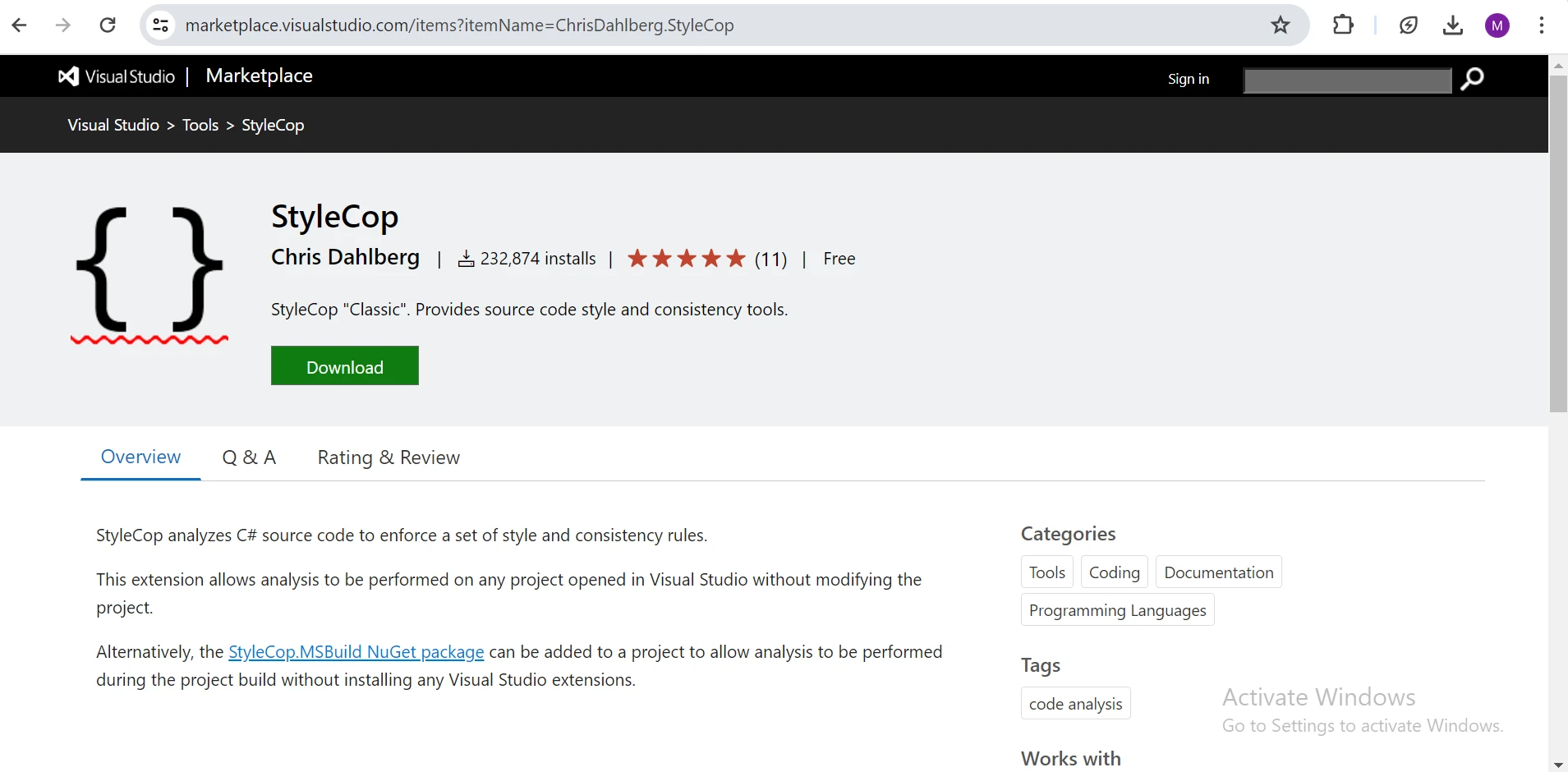
Wenn zwei Entwickler zusammenarbeiten, diskutieren sie unweigerlich über den Programmierstil. Jeder Entwickler hat eine einzigartige Art, Quellcode zu schreiben, wodurch Konsistenz wichtiger wird als die perfekte Stilwahl. Werkzeuge wie [StyleCop](https://marketplace.visualstudio.com/items?itemName=ChrisDahlberg.StyleCop) helfen dabei, Regelkonformität beim Programmierstil mithilfe einer Regelsatzdatei durchzusetzen, um Einheitlichkeit im Team oder Projekt sicherzustellen. Konsistenz verbessert die Lesbarkeit und erleichtert das Debuggen und die Wartung, was eine effizientere Entwicklungsumgebung schafft.
## Was ist **StyleCop?**
[StyleCop](https://www.nuget.org/packages/StyleCop.Analyzers/) ist ein Open-Source-Tool zur statischen Codeanalyse für C#, das den Code auf Einhaltung eines vordefinierten Satzes von Stil- und Konsistenzregeln oder Formatierungsregeln überprüft. Es integriert sich nahtlos in Visual Studio und kann in den Build-Prozess eingebunden werden, um Code-Konsistenz über Entwicklungsteams hinweg sicherzustellen. Um StyleCop zu konfigurieren, können Sie eine XML-Datei oder JSON-Datei verwenden, um die individuellen Regeln zu definieren, an die Ihr Projekt sich halten soll. Dieser XML-Dateikopf ermöglicht Ihnen, die Analyse zu individualisieren, indem Sie die spezifischen Regeln entsprechend den Anforderungen Ihres Projekts ändern. StyleCop unterstützt eine Vielzahl von Konfigurationen und ist daher ein flexibles Werkzeug zur Sicherung von Codequalität und -konsistenz.
## Hauptmerkmale von **StyleCop** C#
1. **Verbesserte Lesbarkeit:** StyleCop analysiert C#-Quellcode und sorgt für einheitliche Codierungsstandards, wodurch es Entwicklern leichter fällt, den Code anderer zu lesen und zu verstehen.
2. **Wartbarkeit:** Durch die Identifizierung von Verstößen gegen bewährte Verfahren und Codierungskonventionen stellt StyleCop sicher, dass Ihr Code leichter zu warten und weniger fehleranfällig ist.
3. **Automatisierung:** Durch die Aktivierung der automatisierten Prüfungen von StyleCop wird sichergestellt, dass die Stilregeln einheitlich angewendet werden, wodurch die Subjektivität und die Fehler manueller Überprüfungen vermieden werden.
### Einrichten von **StyleCop** in .NET-Projekten
Beginnen Sie, indem Sie Ihr Projekt in Visual Studio öffnen. Gehen Sie als nächstes zum Projektexplorer, klicken Sie mit der rechten Maustaste auf Ihr Projekt und wählen Sie "NuGet-Pakete verwalten". Suchen Sie im NuGet-Paket-Manager nach "[StyleCop.Analyzers](https://www.nuget.org/packages/StyleCop.Analyzers/)" und installieren Sie es.
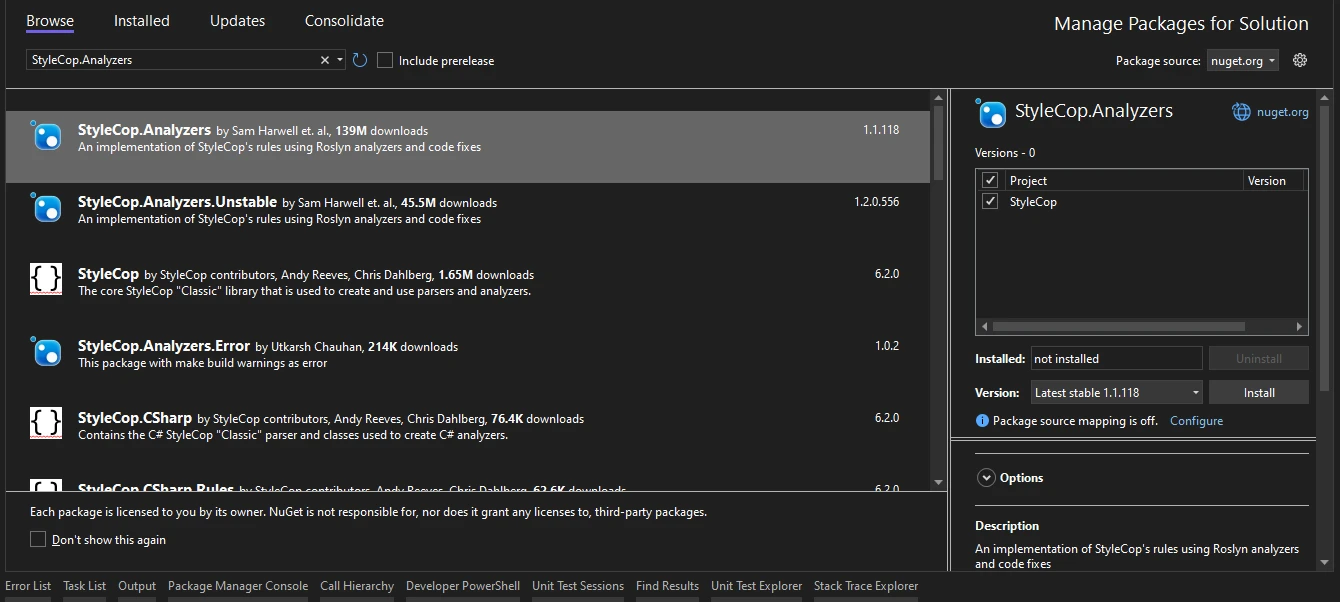
Alternativ, um StyleCop Analyzers über die NuGet-Paket-Manager-Konsole zu installieren, verwenden Sie den folgenden Befehl:
```shell
:InstallCmd Install-Package StyleCop.Analyzers
```
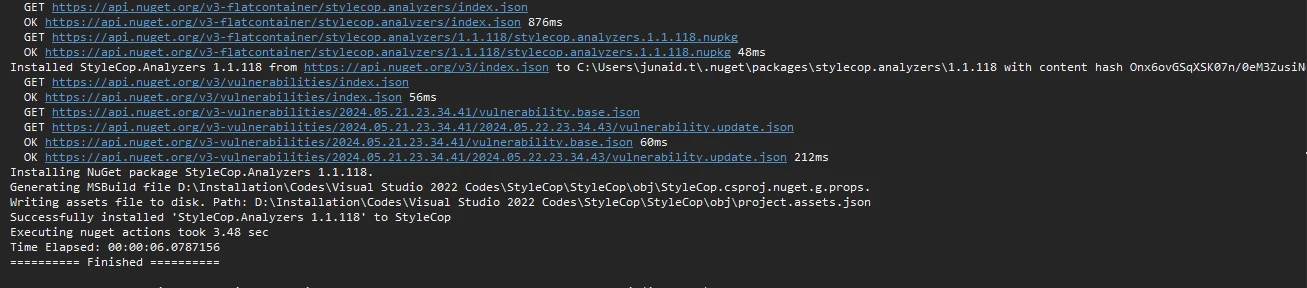
Der obige Befehl installiert StyleCop mit allen seinen Abhängigkeiten. StyleCop kann jetzt mit Namensdeklarationen verwendet werden.
### Einfaches Code-Beispiel
#### Beispiel 1: Erzwingen von Dokumentationskommentaren
Eine häufige Regel, die von StyleCop durchgesetzt wird, ist die Anforderung von Dokumentationskommentaren für öffentlich zugängliche Methoden und Klassen. Dies stellt sicher, dass Ihr Code gut dokumentiert und verständlich ist.
```csharp
// Source code without StyleCop
public class Calculator
{
    public int Add(int a, int b)
    {
        return a + b;
    }
}
```
Ohne die Verwendung von StyleCop fehlen im Code Dokumentationskommentare, was es anderen Entwicklern erschwert, den Zweck der Methode **Add** und der Parameter **a** und **b** zu verstehen. Dies kann zu Verwirrung und einer verringerten Wartbarkeit des Codes führen.
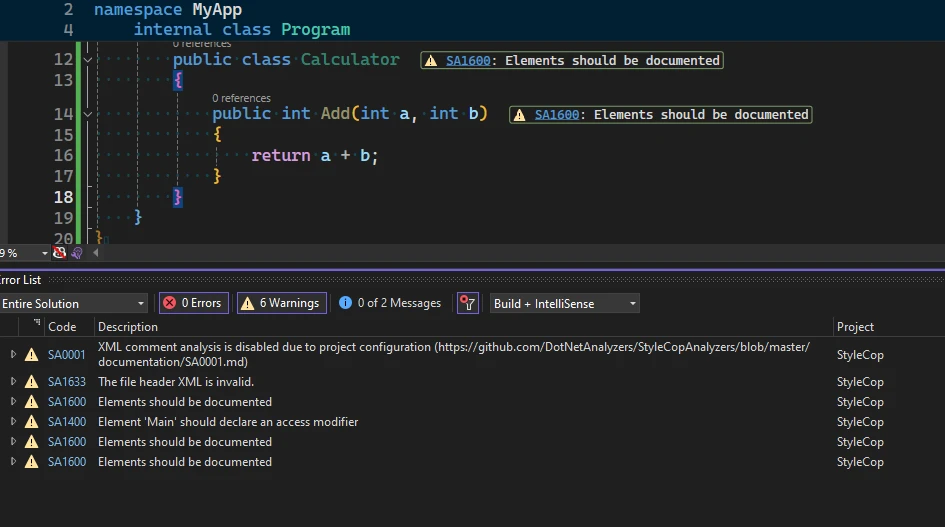
Wenn die Programmierkonventionen verletzt werden, gibt StyleCop Warnungen aus, wie im obigen Screenshot innerhalb von Visual Studio zu sehen ist.
#### Implementierung der StyleCop-Richtlinien
```csharp
// Code with StyleCop
/// <summary>
/// Provides methods for basic arithmetic operations.
/// </summary>
public class Calculator
{
/// <summary>
/// Adds two integers.
/// </summary>
/// <param name="a">The first integer.</param>
/// <param name="b">The second integer.</param>
/// <returns>The sum of the two integers.</returns>
public int Add(int a, int b)
{
return a + b;
}
}
```
Mit StyleCop werden Dokumentationskommentare zum Code hinzugefügt, um klare Informationen über die Funktionalität der **Calculator**-Klasse und ihrer **Add**-Methode bereitzustellen. Entwickler können leicht verstehen, was die Methode tut, welche Parameter sie akzeptiert und was sie zurückgibt, was die Lesbarkeit und Wartbarkeit des Codes verbessert.
#### Beispiel 2: Konsistente Benennungskonventionen
```csharp
public class rectangle
{
public double length;
public double Width;
public void calculate_area()
{
// Calculate area
}
public void GetPerimeter()
{
// Calculate perimeter
}
}
```
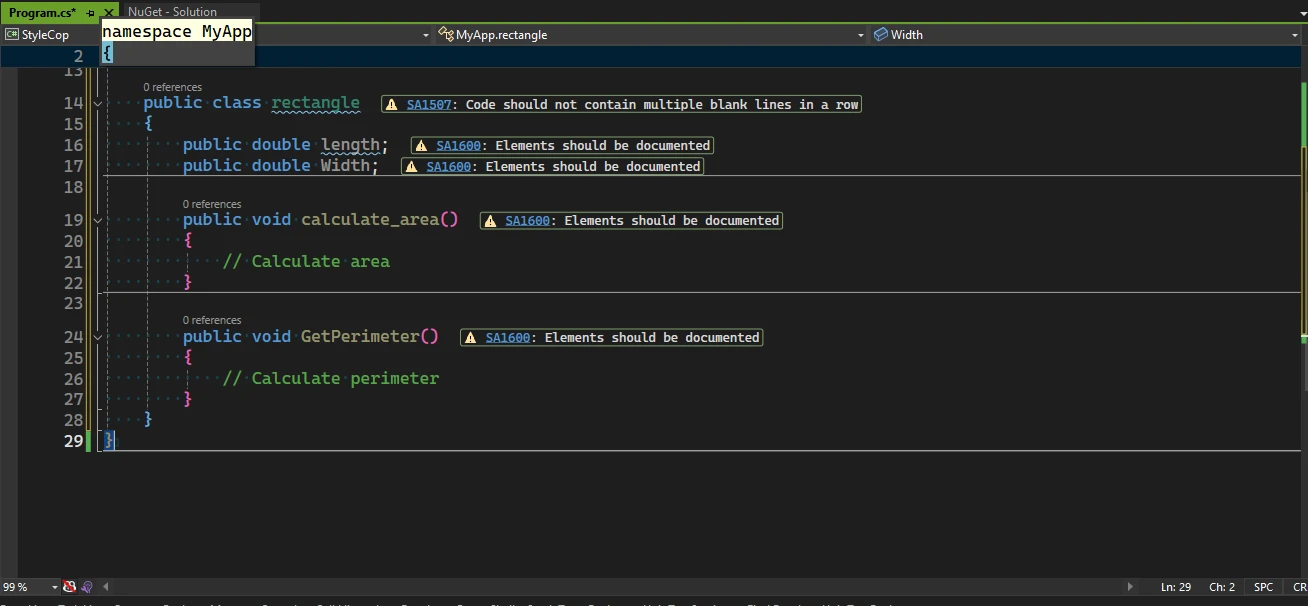
In diesem Quellcode verletzen der Klassenname (**rectangle**) und die Eigenschaftsnamen (**length**, **Width**) Stil- und Konsistenzregeln. Die Methodennamen (**calculate_area**, **GetPerimeter**) haben inkonsistente Schreibweisen, was zu Warnungen bei Namenskonventionen führt.
#### Screenshot des obigen Codes
## Integration von IronPDF mit StyleCop-Regeln
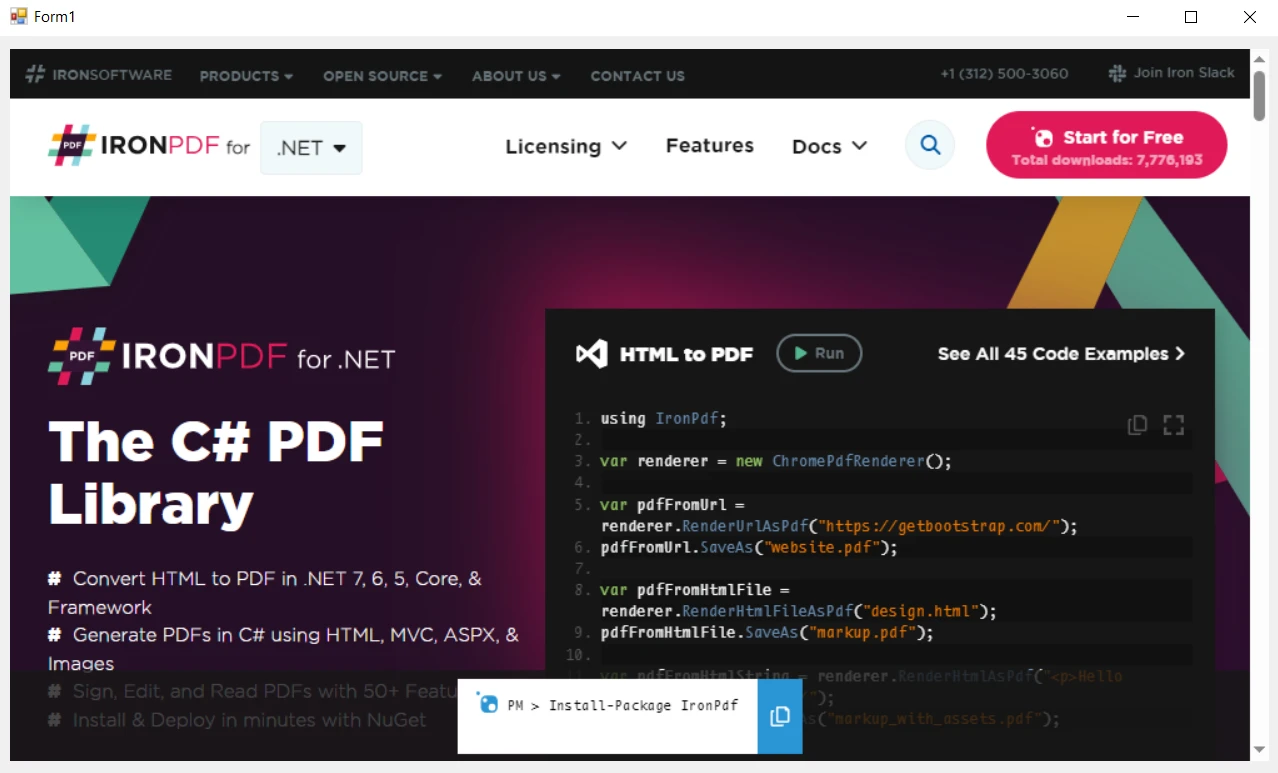
[Entdecken Sie die Möglichkeiten von IronPDF](https://ironpdf.com) ist eine führende C# PDF-Bibliothek, die es Entwicklern erleichtert, ohne großen Aufwand PDF-Dokumente zu erstellen, [PDF-Dokumente mit IronPDF zu bearbeiten](/examples/pdf-compression/) und [vorhandene PDFs zu manipulieren](/examples/image-to-pdf/) in ihren .NET-Projekten. Egal, ob Sie [HTML in PDF konvertieren](/examples/using-html-to-create-a-pdf/), dynamische PDF-Dateien generieren oder [Text und Bilder aus PDFs extrahieren](/examples/csharp-replace-text-in-pdf/) müssen, IronPDF bietet eine benutzerfreundliche API, die den Prozess vereinfacht. Es verwendet eine .NET Chromium-Engine, um HTML-Seiten in PDF-Dateien zu rendern, was es zu einem unverzichtbaren Werkzeug für Softwareentwickler macht, die mit C# arbeiten. Die Kompatibilität von IronPDF erstreckt sich über .NET Core (8, 7, 6, 5 und 3.1+), .NET Standard (2.0+) und .NET Framework (4.6.2+), und es unterstützt verschiedene Projekttypen, einschließlich Web (Blazor und WebForms), Desktop (WPF und MAUI) und Konsolenanwendungen. Wenn Ihre PDFs wie HTML aussehen sollen, bietet IronPDF Genauigkeit, Benutzerfreundlichkeit und Geschwindigkeit.
### Codebeispiel
#### Vor der Durchsetzung von StyleCop-Regeln
```csharp
using IronPdf;
namespace YourNamespace
{
public class PdfGenerator
{
public void generatePDF(string output)
{
// This code snippet does not adhere to StyleCop rules
var renderer = new ChromePdfRenderer();
PdfDocument pdf = renderer.RenderUrlAsPdf("<h1>Hello, World!</h1>");
pdf.SaveAs(output);
}
}
}
```
#### Beschreibung des Codes
Bevor StyleCop-Regeln durchgesetzt werden, weist der Code mehrere Verstöße auf: Der Methodenname `generatePDF` hält sich nicht an die PascalCase-Konvention, und der Parameter `output` fehlt es an Klarheit im Namen. Zusätzlich verringert implizite Typisierung mit `var` für die Variable `pdf` die Lesbarkeit. Das Weglassen des Namensraums bei der Instanziierung von `HtmlToPdf` kann zu Verwirrung führen, insbesondere in größeren Projekten.
#### Nach Durchsetzung der StyleCop-Regeln
```csharp
using IronPdf;
namespace YourNamespace
{
/// <summary>
/// Provides PDF generation functionalities.
/// </summary>
public class PdfGenerator
{
/// <summary>
/// Generates a PDF from a URL and saves it to the specified file path.
/// </summary>
/// <param name="outputFilePath">The file path where the PDF will be saved.</param>
public void GeneratePdf(string outputFilePath)
{
// This code snippet adheres to StyleCop rules
ChromePdfRenderer chromePdfRenderer = new ChromePdfRenderer();
PdfDocument pdfDocument = chromePdfRenderer.RenderUrlAsPdf("<h1>Hello, World!</h1>");
pdfDocument.SaveAs(outputFilePath);
}
}
}
```
#### Beschreibung des Codes
Nach Anwendung der StyleCop-Regeln entspricht die Methode `GeneratePdf` der PascalCase-Konvention und verbessert die Lesbarkeit. Der Parameter `outputFilePath` ist jetzt beschreibender und deutet seinen Zweck an. Die Verwendung expliziter Typisierung (`ChromePdfRenderer` und `PdfDocument`) erhöht die Klarheit.
### Abschluss
Die Integration von StyleCop in Ihre .NET-Projekte stellt sicher, dass einheitliche Programmierstandards eingehalten werden und optimiert mit einer anpassbaren Regelsatzdatei den Entwicklungsprozess. StyleCop kann über die Befehlszeile ausgeführt werden, um diese Standards direkt auf den Quellcode durchzusetzen und die Lesbarkeit und Wartbarkeit zu verbessern. Zusätzlich bieten Bibliotheken wie IronPDF robuste PDF-Generierungsfähigkeiten, ideal zum Erstellen dynamischer Dokumente. IronPDF bietet [eine kostenlose Testlizenz für Entwickler](trial-license) für diejenigen, die mit der Funktionalität zufrieden sind.
Wenn zwei Entwickler zusammenarbeiten, diskutieren sie unweigerlich über den Programmierstil. Jeder Entwickler hat eine einzigartige Art, Quellcode zu schreiben, wodurch Konsistenz wichtiger wird als die perfekte Stilwahl. Werkzeuge wie StyleCop helfen dabei, Regelkonformität beim Programmierstil mithilfe einer Regelsatzdatei durchzusetzen, um Einheitlichkeit im Team oder Projekt sicherzustellen. Konsistenz verbessert die Lesbarkeit und erleichtert das Debuggen und die Wartung, was eine effizientere Entwicklungsumgebung schafft.
Was ist StyleCop?
StyleCop ist ein Open-Source-Tool zur statischen Codeanalyse für C#, das den Code auf Einhaltung eines vordefinierten Satzes von Stil- und Konsistenzregeln oder Formatierungsregeln überprüft. Es integriert sich nahtlos in Visual Studio und kann in den Build-Prozess eingebunden werden, um Code-Konsistenz über Entwicklungsteams hinweg sicherzustellen. Um StyleCop zu konfigurieren, können Sie eine XML-Datei oder JSON-Datei verwenden, um die individuellen Regeln zu definieren, an die Ihr Projekt sich halten soll. Dieser XML-Dateikopf ermöglicht Ihnen, die Analyse zu individualisieren, indem Sie die spezifischen Regeln entsprechend den Anforderungen Ihres Projekts ändern. StyleCop unterstützt eine Vielzahl von Konfigurationen und ist daher ein flexibles Werkzeug zur Sicherung von Codequalität und -konsistenz.
Hauptmerkmale von StyleCop C#
Verbesserte Lesbarkeit: StyleCop analysiert C#-Quellcode und sorgt für einheitliche Codierungsstandards, wodurch es Entwicklern leichter fällt, den Code anderer zu lesen und zu verstehen.
Wartbarkeit: Durch die Identifizierung von Verstößen gegen bewährte Verfahren und Codierungskonventionen stellt StyleCop sicher, dass Ihr Code leichter zu warten und weniger fehleranfällig ist.
Automatisierung: Durch die Aktivierung der automatisierten Prüfungen von StyleCop wird sichergestellt, dass die Stilregeln einheitlich angewendet werden, wodurch die Subjektivität und die Fehler manueller Überprüfungen vermieden werden.
Einrichten von StyleCop in .NET-Projekten
Beginnen Sie, indem Sie Ihr Projekt in Visual Studio öffnen. Gehen Sie als nächstes zum Projektexplorer, klicken Sie mit der rechten Maustaste auf Ihr Projekt und wählen Sie "NuGet-Pakete verwalten". Suchen Sie im NuGet-Paket-Manager nach "StyleCop.Analyzers" und installieren Sie es.
Alternativ, um StyleCop Analyzers über die NuGet-Paket-Manager-Konsole zu installieren, verwenden Sie den folgenden Befehl:
PM > Install-Package StyleCop.Analyzers
Install-Package StyleCop.Analyzers
Der obige Befehl installiert StyleCop mit allen seinen Abhängigkeiten. StyleCop kann jetzt mit Namensdeklarationen verwendet werden.
Einfaches Code-Beispiel
Beispiel 1: Erzwingen von Dokumentationskommentaren
Eine häufige Regel, die von StyleCop durchgesetzt wird, ist die Anforderung von Dokumentationskommentaren für öffentlich zugängliche Methoden und Klassen. Dies stellt sicher, dass Ihr Code gut dokumentiert und verständlich ist.
// Source code without StyleCoppublic class Calculator{ public intAdd(int a, int b) { return a + b; }}
// Source code without StyleCop
public class Calculator
{
    public int Add(int a, int b)
    {
        return a + b;
    }
}
Public Class Calculator Public Function Add(a AsInteger, b AsInteger) AsInteger Return a + b End FunctionEnd Class
Public Class Calculator
    Public Function Add(a As Integer, b As Integer) As Integer
        Return a + b
    End Function
End Class
Ohne die Verwendung von StyleCop fehlen im Code Dokumentationskommentare, was es anderen Entwicklern erschwert, den Zweck der Methode Add und der Parameter a und b zu verstehen. Dies kann zu Verwirrung und einer verringerten Wartbarkeit des Codes führen.
Wenn die Programmierkonventionen verletzt werden, gibt StyleCop Warnungen aus, wie im obigen Screenshot innerhalb von Visual Studio zu sehen ist.
Implementierung der StyleCop-Richtlinien
// Code with StyleCop/// <summary>/// Provides methods for basic arithmetic operations./// </summary>public class Calculator{ /// <summary> /// Adds two integers. /// </summary> /// <param name="a">The first integer.</param> /// <param name="b">The second integer.</param> /// <returns>The sum of the two integers.</returns> public intAdd(int a, int b) { return a + b; }}
// Code with StyleCop
/// <summary>
/// Provides methods for basic arithmetic operations.
/// </summary>
public class Calculator
{
    /// <summary>
    /// Adds two integers.
    /// </summary>
    /// <param name="a">The first integer.</param>
    /// <param name="b">The second integer.</param>
    /// <returns>The sum of the two integers.</returns>
    public int Add(int a, int b)
    {
        return a + b;
    }
}
' Code with StyleCop''' <summary>''' Provides methods for basic arithmetic operations.''' </summary>Public Class Calculator ''' <summary> ''' Adds two integers. ''' </summary> ''' <param name="a">The first integer.</param> ''' <param name="b">The second integer.</param> ''' <returns>The sum of the two integers.</returns> Public Function Add(a AsInteger, b AsInteger) AsInteger Return a + b End FunctionEnd Class
' Code with StyleCop
''' <summary>
''' Provides methods for basic arithmetic operations.
''' </summary>
Public Class Calculator
    ''' <summary>
    ''' Adds two integers.
    ''' </summary>
    ''' <param name="a">The first integer.</param>
    ''' <param name="b">The second integer.</param>
    ''' <returns>The sum of the two integers.</returns>
    Public Function Add(a As Integer, b As Integer) As Integer
        Return a + b
    End Function
End Class
Mit StyleCop werden Dokumentationskommentare zum Code hinzugefügt, um klare Informationen über die Funktionalität der Calculator-Klasse und ihrer Add-Methode bereitzustellen. Entwickler können leicht verstehen, was die Methode tut, welche Parameter sie akzeptiert und was sie zurückgibt, was die Lesbarkeit und Wartbarkeit des Codes verbessert.
Beispiel 2: Konsistente Benennungskonventionen
public class rectangle{ public double length; public doubleWidth; public void calculate_area() { // Calculate area } public voidGetPerimeter() { // Calculate perimeter }}
public class rectangle
{
    public double length;
    public double Width;

    public void calculate_area()
    {
        // Calculate area
    }

    public void GetPerimeter()
    {
        // Calculate perimeter
    }
}
Public Class Rectangle PublicLengthAsDouble PublicWidthAsDouble Public Sub CalculateArea() ' Calculate area End Sub Public Sub GetPerimeter() ' Calculate perimeter End SubEnd Class
Public Class Rectangle
    Public Length As Double
    Public Width As Double

    Public Sub CalculateArea()
        ' Calculate area
    End Sub

    Public Sub GetPerimeter()
        ' Calculate perimeter
    End Sub
End Class
In diesem Quellcode verletzen der Klassenname (rectangle) und die Eigenschaftsnamen (length, Width) Stil- und Konsistenzregeln. Die Methodennamen (calculate_area, GetPerimeter) haben inkonsistente Schreibweisen, was zu Warnungen bei Namenskonventionen führt.
Screenshot des obigen Codes
Integration von IronPDF mit StyleCop-Regeln
Entdecken Sie die Möglichkeiten von IronPDF ist eine führende C# PDF-Bibliothek, die es Entwicklern erleichtert, ohne großen Aufwand PDF-Dokumente zu erstellen, PDF-Dokumente mit IronPDF zu bearbeiten und vorhandene PDFs zu manipulieren in ihren .NET-Projekten. Egal, ob Sie HTML in PDF konvertieren, dynamische PDF-Dateien generieren oder Text und Bilder aus PDFs extrahieren müssen, IronPDF bietet eine benutzerfreundliche API, die den Prozess vereinfacht. Es verwendet eine .NET Chromium-Engine, um HTML-Seiten in PDF-Dateien zu rendern, was es zu einem unverzichtbaren Werkzeug für Softwareentwickler macht, die mit C# arbeiten. Die Kompatibilität von IronPDF erstreckt sich über .NET Core (8, 7, 6, 5 und 3.1+), .NET Standard (2.0+) und .NET Framework (4.6.2+), und es unterstützt verschiedene Projekttypen, einschließlich Web (Blazor und WebForms), Desktop (WPF und MAUI) und Konsolenanwendungen. Wenn Ihre PDFs wie HTML aussehen sollen, bietet IronPDF Genauigkeit, Benutzerfreundlichkeit und Geschwindigkeit.
Codebeispiel
Vor der Durchsetzung von StyleCop-Regeln
using IronPdf;namespace YourNamespace{ public class PdfGenerator { public void generatePDF(string output) { // This code snippet does not adhere to StyleCop rules var renderer = new ChromePdfRenderer(); PdfDocument pdf = renderer.RenderUrlAsPdf("<h1>Hello, World!</h1>"); pdf.SaveAs(output); } }}
using IronPdf;

namespace YourNamespace
{
    public class PdfGenerator
    {
        public void generatePDF(string output)
        {
            // This code snippet does not adhere to StyleCop rules
            var renderer = new ChromePdfRenderer();
            PdfDocument pdf = renderer.RenderUrlAsPdf("<h1>Hello, World!</h1>");
            pdf.SaveAs(output);
        }
    }
}
ImportsIronPdfNamespaceYourNamespace Public Class PdfGenerator Public Sub generatePDF(ByVal output AsString) ' This code snippet does not adhere to StyleCop rules Dim renderer = New ChromePdfRenderer() Dim pdf AsPdfDocument = renderer.RenderUrlAsPdf("<h1>Hello, World!</h1>") pdf.SaveAs(output) End Sub End ClassEndNamespace
Imports IronPdf

Namespace YourNamespace
	Public Class PdfGenerator
		Public Sub generatePDF(ByVal output As String)
			' This code snippet does not adhere to StyleCop rules
			Dim renderer = New ChromePdfRenderer()
			Dim pdf As PdfDocument = renderer.RenderUrlAsPdf("<h1>Hello, World!</h1>")
			pdf.SaveAs(output)
		End Sub
	End Class
End Namespace
Beschreibung des Codes
Bevor StyleCop-Regeln durchgesetzt werden, weist der Code mehrere Verstöße auf: Der Methodenname generatePDF hält sich nicht an die PascalCase-Konvention, und der Parameter output fehlt es an Klarheit im Namen. Zusätzlich verringert implizite Typisierung mit var für die Variable pdf die Lesbarkeit. Das Weglassen des Namensraums bei der Instanziierung von HtmlToPdf kann zu Verwirrung führen, insbesondere in größeren Projekten.
Nach Durchsetzung der StyleCop-Regeln
using IronPdf;namespace YourNamespace{ /// <summary> /// Provides PDF generation functionalities. /// </summary> public class PdfGenerator { /// <summary> /// Generates a PDF from a URL and saves it to the specified file path. /// </summary> /// <param name="outputFilePath">The file path where the PDF will be saved.</param> public voidGeneratePdf(string outputFilePath) { // This code snippet adheres to StyleCop rules ChromePdfRenderer chromePdfRenderer = new ChromePdfRenderer(); PdfDocument pdfDocument = chromePdfRenderer.RenderUrlAsPdf("<h1>Hello, World!</h1>"); pdfDocument.SaveAs(outputFilePath); } }}
using IronPdf;

namespace YourNamespace
{
    /// <summary>
    /// Provides PDF generation functionalities.
    /// </summary>
    public class PdfGenerator
    {
        /// <summary>
        /// Generates a PDF from a URL and saves it to the specified file path.
        /// </summary>
        /// <param name="outputFilePath">The file path where the PDF will be saved.</param>
        public void GeneratePdf(string outputFilePath)
        {
            // This code snippet adheres to StyleCop rules
            ChromePdfRenderer chromePdfRenderer = new ChromePdfRenderer();
            PdfDocument pdfDocument = chromePdfRenderer.RenderUrlAsPdf("<h1>Hello, World!</h1>");
            pdfDocument.SaveAs(outputFilePath);
        }
    }
}
ImportsIronPdfNamespaceYourNamespace ''' <summary> ''' Provides PDF generation functionalities. ''' </summary> Public Class PdfGenerator ''' <summary> ''' Generates a PDF from a URL and saves it to the specified file path. ''' </summary> ''' <param name="outputFilePath">The file path where the PDF will be saved.</param> Public Sub GeneratePdf(ByVal outputFilePath AsString) ' This code snippet adheres to StyleCop rules Dim chromePdfRenderer As New ChromePdfRenderer() Dim pdfDocument AsPdfDocument = chromePdfRenderer.RenderUrlAsPdf("<h1>Hello, World!</h1>") pdfDocument.SaveAs(outputFilePath) End Sub End ClassEndNamespace
Imports IronPdf

Namespace YourNamespace
	''' <summary>
	''' Provides PDF generation functionalities.
	''' </summary>
	Public Class PdfGenerator
		''' <summary>
		''' Generates a PDF from a URL and saves it to the specified file path.
		''' </summary>
		''' <param name="outputFilePath">The file path where the PDF will be saved.</param>
		Public Sub GeneratePdf(ByVal outputFilePath As String)
			' This code snippet adheres to StyleCop rules
			Dim chromePdfRenderer As New ChromePdfRenderer()
			Dim pdfDocument As PdfDocument = chromePdfRenderer.RenderUrlAsPdf("<h1>Hello, World!</h1>")
			pdfDocument.SaveAs(outputFilePath)
		End Sub
	End Class
End Namespace
Beschreibung des Codes
Nach Anwendung der StyleCop-Regeln entspricht die Methode GeneratePdf der PascalCase-Konvention und verbessert die Lesbarkeit. Der Parameter outputFilePath ist jetzt beschreibender und deutet seinen Zweck an. Die Verwendung expliziter Typisierung (ChromePdfRenderer und PdfDocument) erhöht die Klarheit.
Abschluss
Die Integration von StyleCop in Ihre .NET-Projekte stellt sicher, dass einheitliche Programmierstandards eingehalten werden und optimiert mit einer anpassbaren Regelsatzdatei den Entwicklungsprozess. StyleCop kann über die Befehlszeile ausgeführt werden, um diese Standards direkt auf den Quellcode durchzusetzen und die Lesbarkeit und Wartbarkeit zu verbessern. Zusätzlich bieten Bibliotheken wie IronPDF robuste PDF-Generierungsfähigkeiten, ideal zum Erstellen dynamischer Dokumente. IronPDF bietet eine kostenlose Testlizenz für Entwickler für diejenigen, die mit der Funktionalität zufrieden sind.
Jacob Mellor ist Chief Technology Officer bei Iron Software und ein visionärer Ingenieur, der Pionierarbeit in der C# PDF-Technologie leistet. Als der ursprüngliche Entwickler hinter der Kern-Codebasis von Iron Software hat er die Produktarchitektur des Unternehmens seit seiner Gründung geprägt und es zusammen mit CEO Cameron Rimington in ein Unternehmen mit mehr als 50 Mitarbeitern verwandelt, das die NASA, Tesla und globale Regierungsbehörden beliefert.