In der robusten Umgebung der .NET-Entwicklung ist die nahtlose Handhabung von Dokumentenerstellungs- und -konvertierungsaufgaben für eine Vielzahl von Anwendungen unerlässlich. Ob es darum geht, dynamische Berichte zu erstellen, Rechnungen zu erstellen oder Dokumente zwischen Formaten zu konvertieren, die richtigen Werkzeuge zur Verfügung zu haben, kann Ihren Arbeitsablauf erheblich vereinfachen und die Produktivität verbessern.
In diesem Artikel werden wir erkunden, wie Xceed.Document.NET und IronPDF - zwei leistungsstarke Bibliotheken zur Dokumentenmanipulation in .NET - diese Prozesse vereinfachen und Entwicklern ermöglichen, vielseitige und effiziente Anwendungen zu erstellen.
Einführung in Xceed.Document.NET
Xceed.Document.NET, entwickelt von Xceed, ist eine umfassende .NET-Assembly, die die Erstellung, Bearbeitung und Formatierung von Word-Dokumenten (DOCX-Dateien) programmgesteuert erleichtert, ohne dass Microsoft Word oder Office InterOp installiert werden müssen. Entwickelt mit Einfachheit und Vielseitigkeit im Hinterkopf, bietet Xceed.Document.NET Entwicklern eine intuitive API für die nahtlose Integration von Dokumentenerstellungsmöglichkeiten in ihre .NET-Anwendungen.
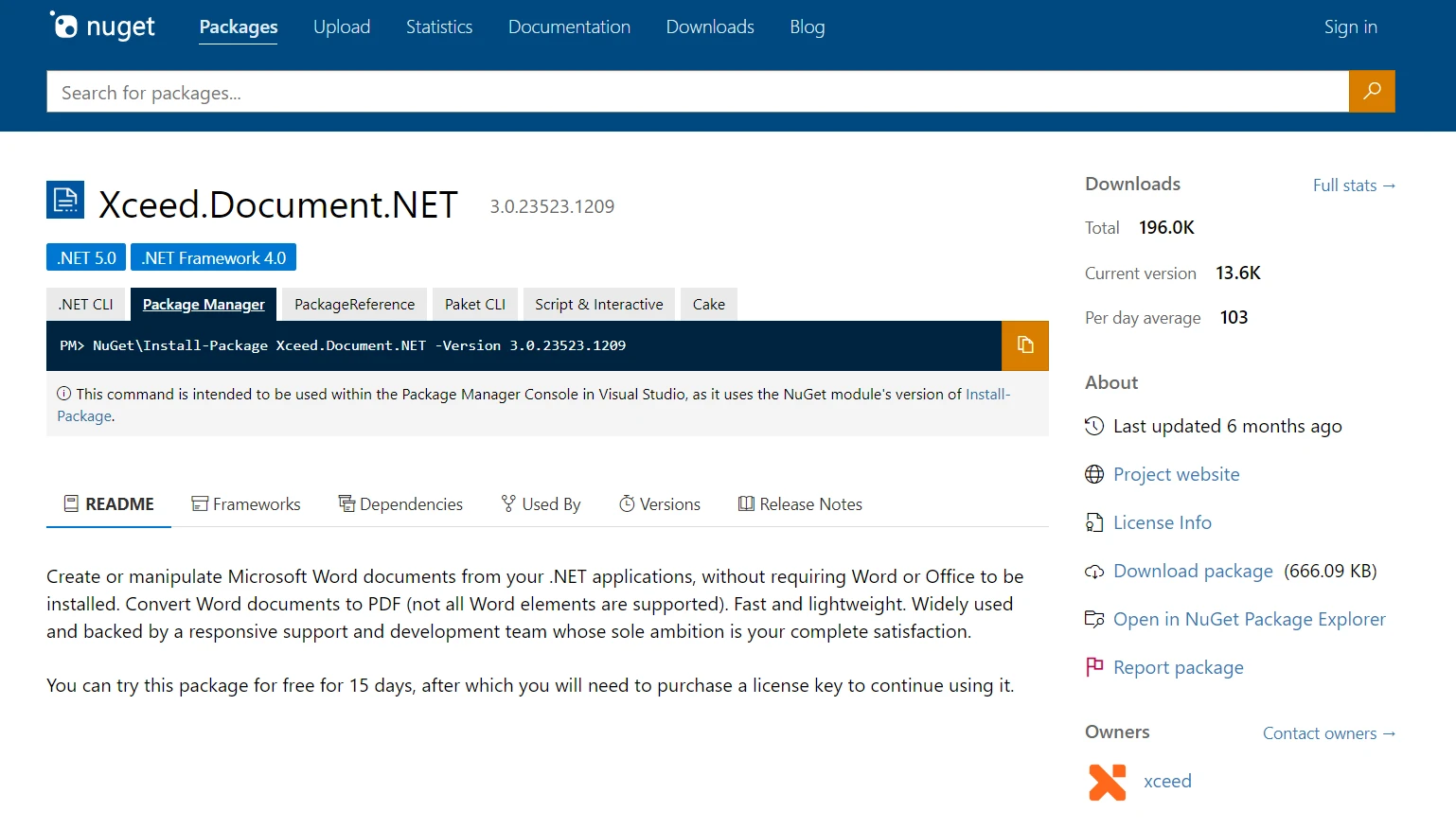
Mit der Leistungsfähigkeit von Xceed.Document.NET können Entwickler mühelos verschiedene Elemente von Word-Dokumenten manipulieren, darunter Absätze, Tabellen, Bilder und Stile, um reiche und anpassbare Dokumente zu erstellen, die auf ihre spezifischen Anforderungen zugeschnitten sind. Sie können auch die Dokumenteigenschaften festlegen, digital signieren und digitale Signaturen für die Integrität von MS Word-Dokumenten sicherstellen.
Xceed bietet verschiedene Bibliotheken an, die für unterschiedliche Dokumentformate maßgeschneidert sind, wie z.B. Textdokumente, verschiedene Textformate, .NET-Dokument zu PDF.
Funktionen von Xceed.Document.NET
- Leistungsstarke Dokumentenmanipulation: Xceed.Document .NET ermöglicht es Entwicklern, Word-Dokumente dank seines umfassenden Funktionsumfangs und seiner intuitiven API einfach zu erstellen, zu ändern und zu formatieren.
- Vielseitiges Content-Management: Mit Xceed.Document .NET können Entwickler verschiedene Dokumentelemente wie Absätze, Tabellen, Bilder und Stile bearbeiten, um dynamische und optisch ansprechende Dokumente zu erstellen.
- Umfangreiche Formatierungsoptionen: Xceed.Document .NET bietet umfangreiche Formatierungsoptionen, mit denen Entwickler das Erscheinungsbild ihrer Dokumente durch die Anwendung von Schriftarten, Farben, Ausrichtungen und mehr individuell gestalten können.
- Plattformübergreifende Kompatibilität: Xceed.Document .NET ist mit verschiedenen .NET Plattformen kompatibel, darunter Windows Forms, WPF, ASP.NET und .NET Core, und eignet sich daher für eine breite Palette von Anwendungen.
- Nahtlose Integration: Xceed.Document .NET lässt sich nahtlos in andere .NET Bibliotheken und -Frameworks integrieren, sodass Entwickler ihre dokumentenbezogenen Arbeitsabläufe problemlos optimieren können.
C#-Projekt in Visual Studio erstellen
-
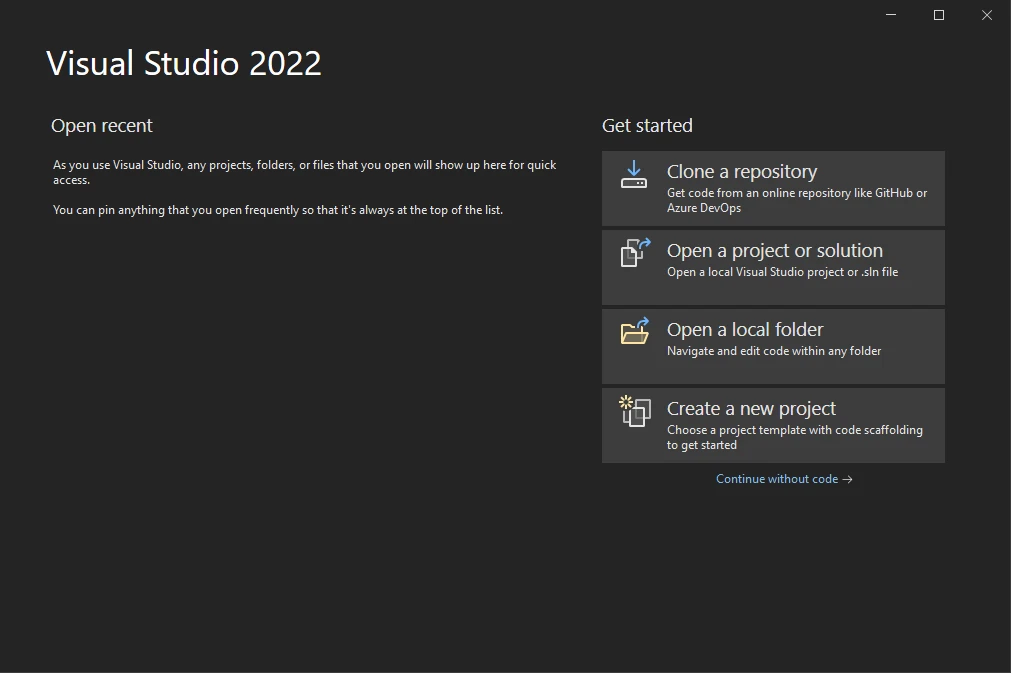
Öffnen Sie Visual Studio und erstellen Sie ein neues C#-Projekt.
-
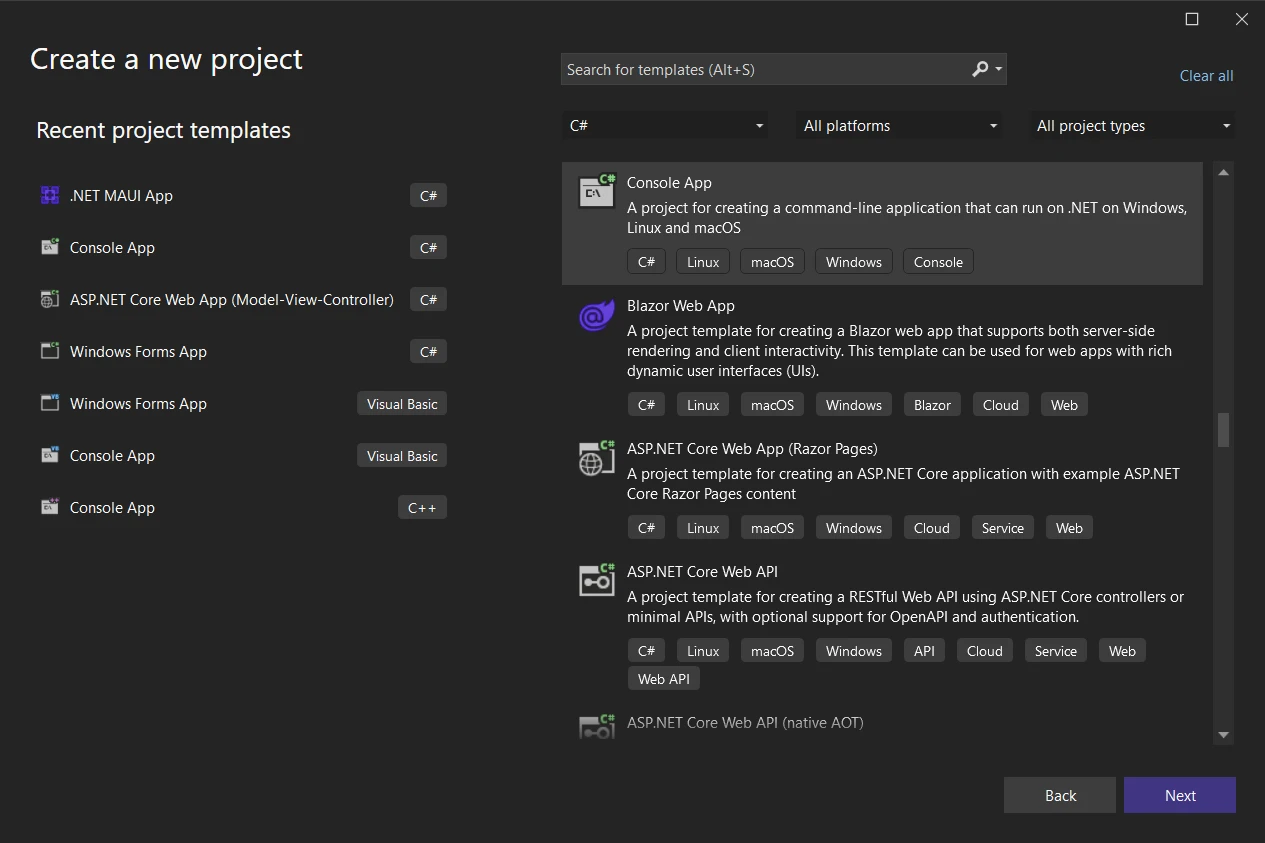
Wählen Sie die geeignete Projektvorlage basierend auf Ihren Anforderungen (z.B. Konsolenanwendung, Windows Forms-Anwendung).
-
Geben Sie den Projektnamen und den Speicherort an und klicken Sie dann auf "Weiter".
Tye nutzt Docker-Container als Bereitstellungseinheit for .NET-Anwendungen. 3. Navigieren Sie zur NuGet-Paket-Manager-Konsole.
- Wählen Sie aus den zusätzlichen Informationen das neueste .NET-Framework aus. Klicken Sie auf "Erstellen".
Installationsprozess
-
Öffnen Sie Visual Studio oder Ihre bevorzugte IDE.
-
Öffnen Sie Visual Studio oder Ihre bevorzugte IDE.
-
Navigieren Sie zur NuGet-Paket-Manager-Konsole.
-
Navigieren Sie zur NuGet-Paket-Manager-Konsole.
-
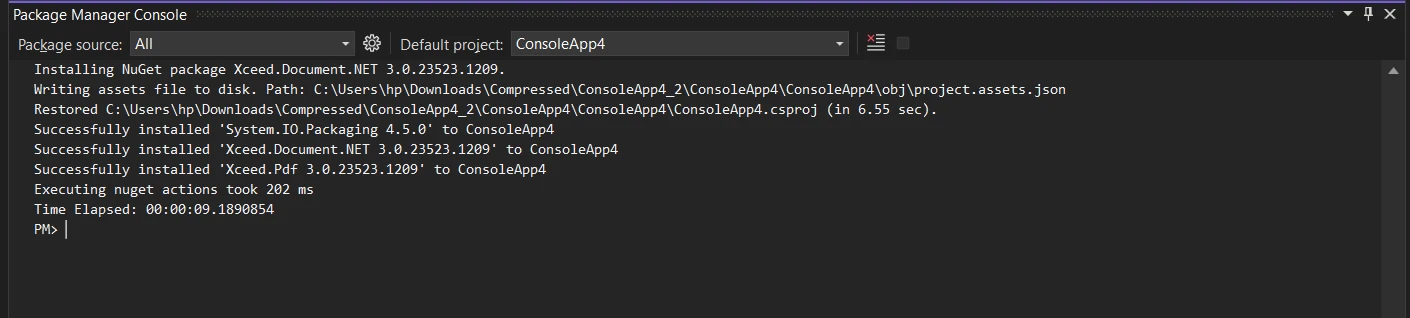
Führen Sie den folgenden Befehl aus, um das Xceed.Document.NET-Paket zu installieren:
Install-Package Xceed.Document.NET
Install-Package Xceed.Document.NET
PowerShell
-
Nach Abschluss der Installation können Sie Xceed.Document.NET in Ihrem Projekt verwenden.
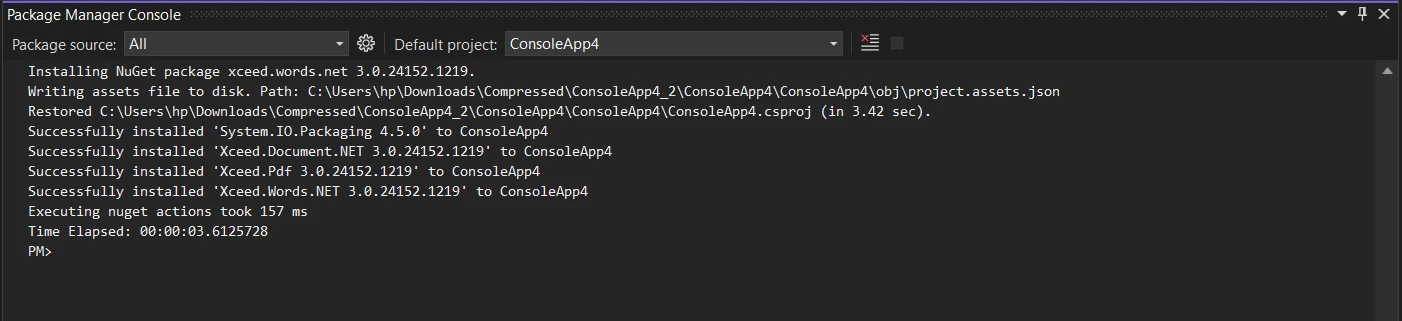
Hinweis: Xceed.Words.NET ist erforderlich, um DOCX-Dateien zu erstellen und Xceed.Document.NET zu verwenden, um Elemente zu integrieren.
Install-Package Xceed.Words.NET
Install-Package Xceed.Words.NET
PowerShell
Erstellen von DOCX-Dateien mit Xceed.Document.NET
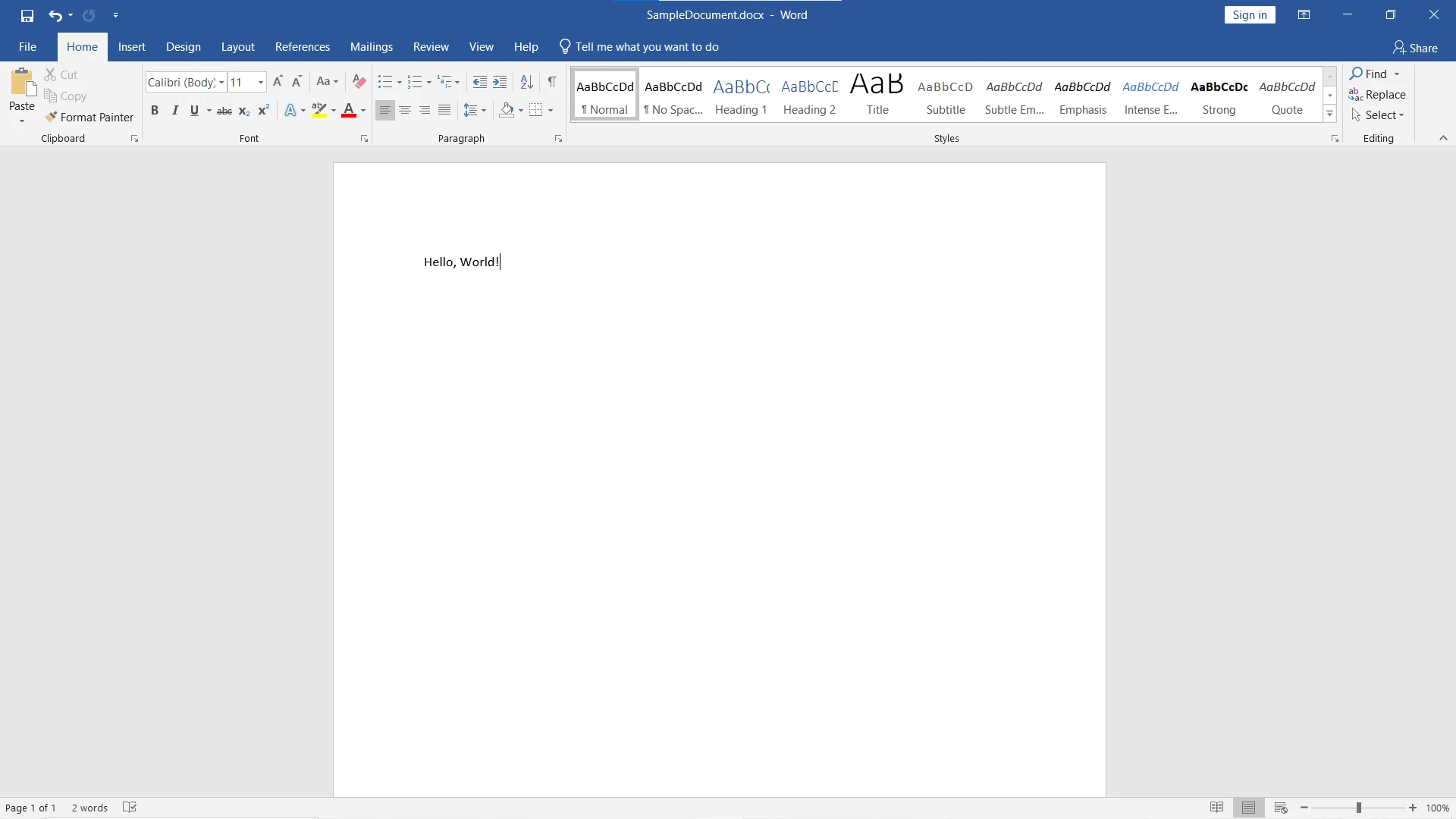
Die erstellte DOCX-Datei kann mit der Microsoft Office Word-Anwendung geöffnet werden.
using Xceed.Words.NET;
using System;

class Program
{
    static void Main(string[] args)
    {
        // Create a new document
        using (DocX document = DocX.Create("SampleDocument.docx"))
        {
            // Add a paragraph with text, styling it with font size, boldness and centered alignment
            document.InsertParagraph("Hello, World!")
                    .FontSize(12)     // Set the font size
                    .Bold()           // Make the text bold
                    .Alignment = Alignment.center; // Center align the text

            // Save the document
            document.Save();
            Console.WriteLine("Document created successfully!");
        }
    }
}
using Xceed.Words.NET;
using System;

class Program
{
    static void Main(string[] args)
    {
        // Create a new document
        using (DocX document = DocX.Create("SampleDocument.docx"))
        {
            // Add a paragraph with text, styling it with font size, boldness and centered alignment
            document.InsertParagraph("Hello, World!")
                    .FontSize(12)     // Set the font size
                    .Bold()           // Make the text bold
                    .Alignment = Alignment.center; // Center align the text

            // Save the document
            document.Save();
            Console.WriteLine("Document created successfully!");
        }
    }
}
Imports Xceed.Words.NET
Imports System
Friend Class Program
Shared Sub Main(ByVal args() As String)
' Create a new document
Using document As DocX = DocX.Create("SampleDocument.docx")
' Add a paragraph with text, styling it with font size, boldness and centered alignment
document.InsertParagraph("Hello, World!").FontSize(12).Bold().Alignment = Alignment.center ' Center align the text
' Save the document
document.Save()
Console.WriteLine("Document created successfully!")
End Using
End Sub
End Class
Imports Xceed.Words.NET
Imports System

Friend Class Program
	Shared Sub Main(ByVal args() As String)
		' Create a new document
		Using document As DocX = DocX.Create("SampleDocument.docx")
			' Add a paragraph with text, styling it with font size, boldness and centered alignment
			document.InsertParagraph("Hello, World!").FontSize(12).Bold().Alignment = Alignment.center ' Center align the text

			' Save the document
			document.Save()
			Console.WriteLine("Document created successfully!")
		End Using
	End Sub
End Class
Hier ist die Ausgabe des obigen Codes. Die erstellte DOCX-Datei kann mit der Microsoft Office Word-Anwendung geöffnet werden.
Integration von Xceed.Document.NET mit IronPDF
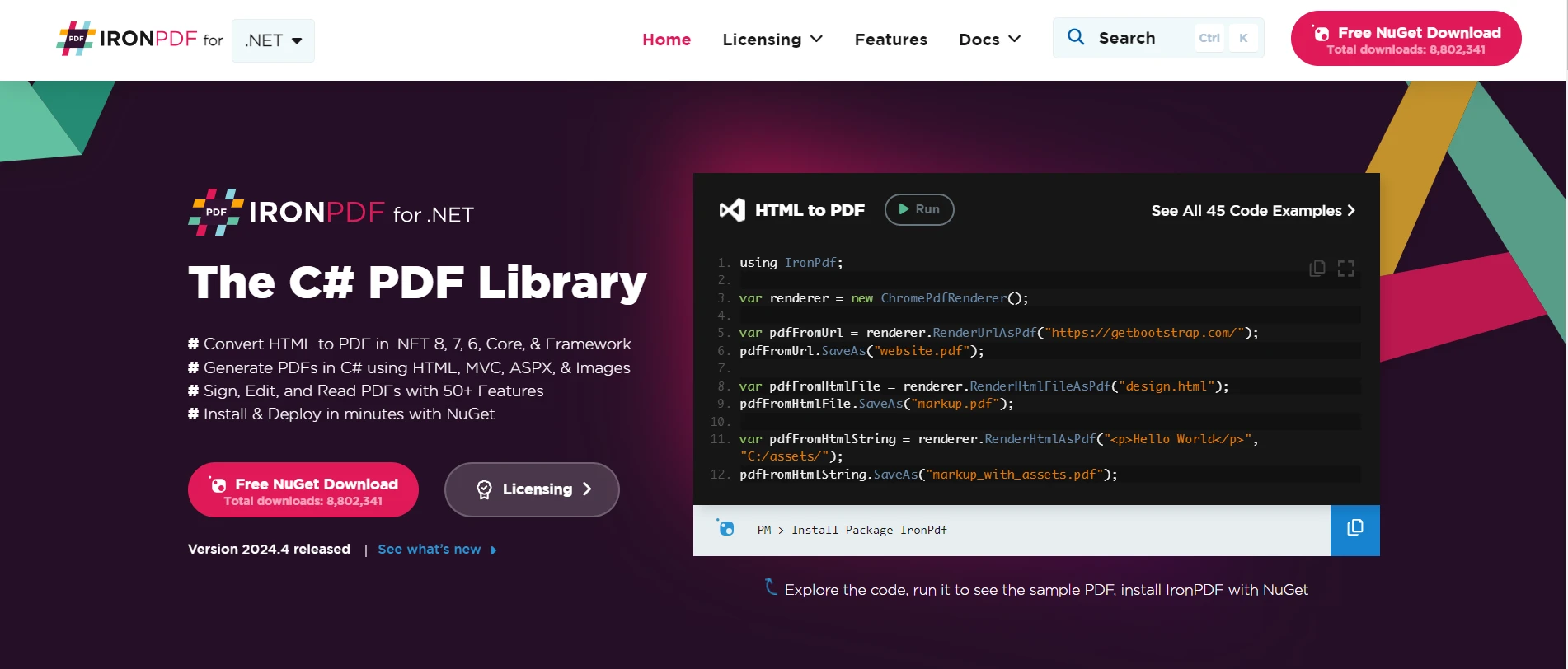
IronPDF ist eine robuste .NET-Bibliothek, die darauf ausgelegt ist, PDF-Generierungs-, Manipulations- und Rendering-Aufgaben in .NET-Anwendungen zu vereinfachen.
IronPDF
IronPDF ist eine robuste .NET-Bibliothek, die entwickelt wurde, um die PDF-Generierung, -Bearbeitung und -Wiedergabe in .NET-Anwendungen zu vereinfachen. IronPDF ist ein großartiges Werkzeug, um Webseiten, URLs und HTML als PDFs zu konvertieren, die dem Originalquelltext perfekt ähneln.
IronPDF ist ein großartiges Werkzeug zur Umwandlung von Webseiten, URLs und HTML in PDFs, die perfekt dem Original entsprechen. Wenn Sie ein PDF aus einer Webseite erstellen müssen, ist IronPDF die Lösung für Sie! Wenn Sie eine PDF aus einer Webseite erstellen müssen, ist IronPDF die Lösung für Sie!
using IronPdf;
using System;

class Program
{
    static void Main(string[] args)
    {
        var renderer = new ChromePdfRenderer();

        // 1. Convert HTML String to PDF
        var htmlContent = "<h1>Hello, IronPDF!</h1><p>This is a PDF from an HTML string.</p>";
        var pdfFromHtmlString = renderer.RenderHtmlAsPdf(htmlContent);
        pdfFromHtmlString.SaveAs("HTMLStringToPDF.pdf");
        Console.WriteLine("HTML string converted to PDF successfully.");

        // 2. Convert HTML File to PDF
        var htmlFilePath = "path_to_your_html_file.html"; // Specify the path to your HTML file
        var pdfFromHtmlFile = renderer.RenderHtmlFileAsPdf(htmlFilePath);
        pdfFromHtmlFile.SaveAs("HTMLFileToPDF.pdf");
        Console.WriteLine("HTML file converted to PDF successfully.");

        // 3. Convert URL to PDF
        var url = "http://ironpdf.com"; // Specify the URL
        var pdfFromUrl = renderer.RenderUrlAsPdf(url);
        pdfFromUrl.SaveAs("URLToPDF.pdf");
        Console.WriteLine("URL converted to PDF successfully.");
    }
}
using IronPdf;
using System;

class Program
{
    static void Main(string[] args)
    {
        var renderer = new ChromePdfRenderer();

        // 1. Convert HTML String to PDF
        var htmlContent = "<h1>Hello, IronPDF!</h1><p>This is a PDF from an HTML string.</p>";
        var pdfFromHtmlString = renderer.RenderHtmlAsPdf(htmlContent);
        pdfFromHtmlString.SaveAs("HTMLStringToPDF.pdf");
        Console.WriteLine("HTML string converted to PDF successfully.");

        // 2. Convert HTML File to PDF
        var htmlFilePath = "path_to_your_html_file.html"; // Specify the path to your HTML file
        var pdfFromHtmlFile = renderer.RenderHtmlFileAsPdf(htmlFilePath);
        pdfFromHtmlFile.SaveAs("HTMLFileToPDF.pdf");
        Console.WriteLine("HTML file converted to PDF successfully.");

        // 3. Convert URL to PDF
        var url = "http://ironpdf.com"; // Specify the URL
        var pdfFromUrl = renderer.RenderUrlAsPdf(url);
        pdfFromUrl.SaveAs("URLToPDF.pdf");
        Console.WriteLine("URL converted to PDF successfully.");
    }
}
Imports IronPdf
Imports System
Friend Class Program
Shared Sub Main(ByVal args() As String)
Dim renderer = New ChromePdfRenderer()
' 1. Convert HTML String to PDF
Dim htmlContent = "<h1>Hello, IronPDF!</h1><p>This is a PDF from an HTML string.</p>"
Dim pdfFromHtmlString = renderer.RenderHtmlAsPdf(htmlContent)
pdfFromHtmlString.SaveAs("HTMLStringToPDF.pdf")
Console.WriteLine("HTML string converted to PDF successfully.")
' 2. Convert HTML File to PDF
Dim htmlFilePath = "path_to_your_html_file.html" ' Specify the path to your HTML file
Dim pdfFromHtmlFile = renderer.RenderHtmlFileAsPdf(htmlFilePath)
pdfFromHtmlFile.SaveAs("HTMLFileToPDF.pdf")
Console.WriteLine("HTML file converted to PDF successfully.")
' 3. Convert URL to PDF
Dim url = "http://ironpdf.com" ' Specify the URL
Dim pdfFromUrl = renderer.RenderUrlAsPdf(url)
pdfFromUrl.SaveAs("URLToPDF.pdf")
Console.WriteLine("URL converted to PDF successfully.")
End Sub
End Class
Imports IronPdf
Imports System

Friend Class Program
	Shared Sub Main(ByVal args() As String)
		Dim renderer = New ChromePdfRenderer()

		' 1. Convert HTML String to PDF
		Dim htmlContent = "<h1>Hello, IronPDF!</h1><p>This is a PDF from an HTML string.</p>"
		Dim pdfFromHtmlString = renderer.RenderHtmlAsPdf(htmlContent)
		pdfFromHtmlString.SaveAs("HTMLStringToPDF.pdf")
		Console.WriteLine("HTML string converted to PDF successfully.")

		' 2. Convert HTML File to PDF
		Dim htmlFilePath = "path_to_your_html_file.html" ' Specify the path to your HTML file
		Dim pdfFromHtmlFile = renderer.RenderHtmlFileAsPdf(htmlFilePath)
		pdfFromHtmlFile.SaveAs("HTMLFileToPDF.pdf")
		Console.WriteLine("HTML file converted to PDF successfully.")

		' 3. Convert URL to PDF
		Dim url = "http://ironpdf.com" ' Specify the URL
		Dim pdfFromUrl = renderer.RenderUrlAsPdf(url)
		pdfFromUrl.SaveAs("URLToPDF.pdf")
		Console.WriteLine("URL converted to PDF successfully.")
	End Sub
End Class
Einige Top-Funktionen von IronPDF sind:
- PDF-Generierung: IronPDF ermöglicht es Entwicklern, PDF-Dokumente aus verschiedenen Quellen wie HTML, Bildern und XML-Daten zu erstellen. Dies ermöglicht die Erstellung von dynamischen und anpassbaren PDFs, die auf spezifische Anforderungen zugeschnitten sind.
- PDF-Manipulation: Mit IronPDF können Entwickler bestehende PDF-Dokumente bearbeiten, indem sie Seiten, Texte, Bilder, Anmerkungen und andere Elemente hinzufügen, ändern oder entfernen. Diese Flexibilität ermöglicht es Entwicklern, PDF-Dokumente gemäß ihren Bedürfnissen zu bearbeiten und anzupassen.
- PDF-Konvertierung: IronPDF ermöglicht die Konvertierung von HTML, Word-Dokumenten (DOCX), Bildern und anderen Dateiformaten in das PDF-Format. Dies bietet nahtlose Interoperabilität zwischen verschiedenen Dokumenttypen und vereinfacht den Umgang mit PDFs in .NET-Anwendungen.
- PDF-Rendering: IronPDF bietet hochwertige PDF-Rendering-Funktionen, die es Entwicklern ermöglichen, PDF-Dokumente innerhalb ihrer .NET Anwendungen mithilfe anpassbarer Viewer-Komponenten anzuzeigen. 5. Plattformübergreifende Kompatibilität: IronPDF bietet umfassende .NET-Unterstützung.
- Plattformübergreifende Kompatibilität: IronPDF bietet umfassende .NET Unterstützung. Es ist verfügbar für Windows, Linux und macOS. Es ist verfügbar für Windows, Linux und macOS. 6. Performance-Optimierung: IronPDF ist für Effizienz optimiert und unterstützt die schnelle PDF-Erstellung, auch bei großen Dokumenten.
- Leistungsoptimierung: IronPDF ist auf Leistung und Skalierbarkeit optimiert und gewährleistet so eine schnelle und effiziente PDF-Generierung und -Darstellung auch für große Dokumente. Dadurch können Entwickler reaktionsschnelle und leistungsstarke Anwendungen erstellen, die PDF-bezogene Aufgaben effektiv bearbeiten.
- Lizenzoptionen: IronPDF bietet flexible Lizenzoptionen, die den Bedürfnissen einzelner Entwickler, kleiner Teams und Anwendungen auf Unternehmensebene gerecht werden. Dies bietet kosteneffektive Lösungen für PDF-bezogene Aufgaben und ermöglicht Entwicklern, das Lizenzmodell auszuwählen, das am besten zu ihren Anforderungen passt.
Schritte zur Integration von Xceed.Document.NET mit IronPDF Library
Hier sind die Schritte zur Integration von Xceed.Document.NET mit IronPDF:
1. IronPDF installieren
-
Öffnen Sie Visual Studio oder Ihre bevorzugte IDE.
-
Navigieren Sie zur NuGet-Paket-Manager-Konsole.
-
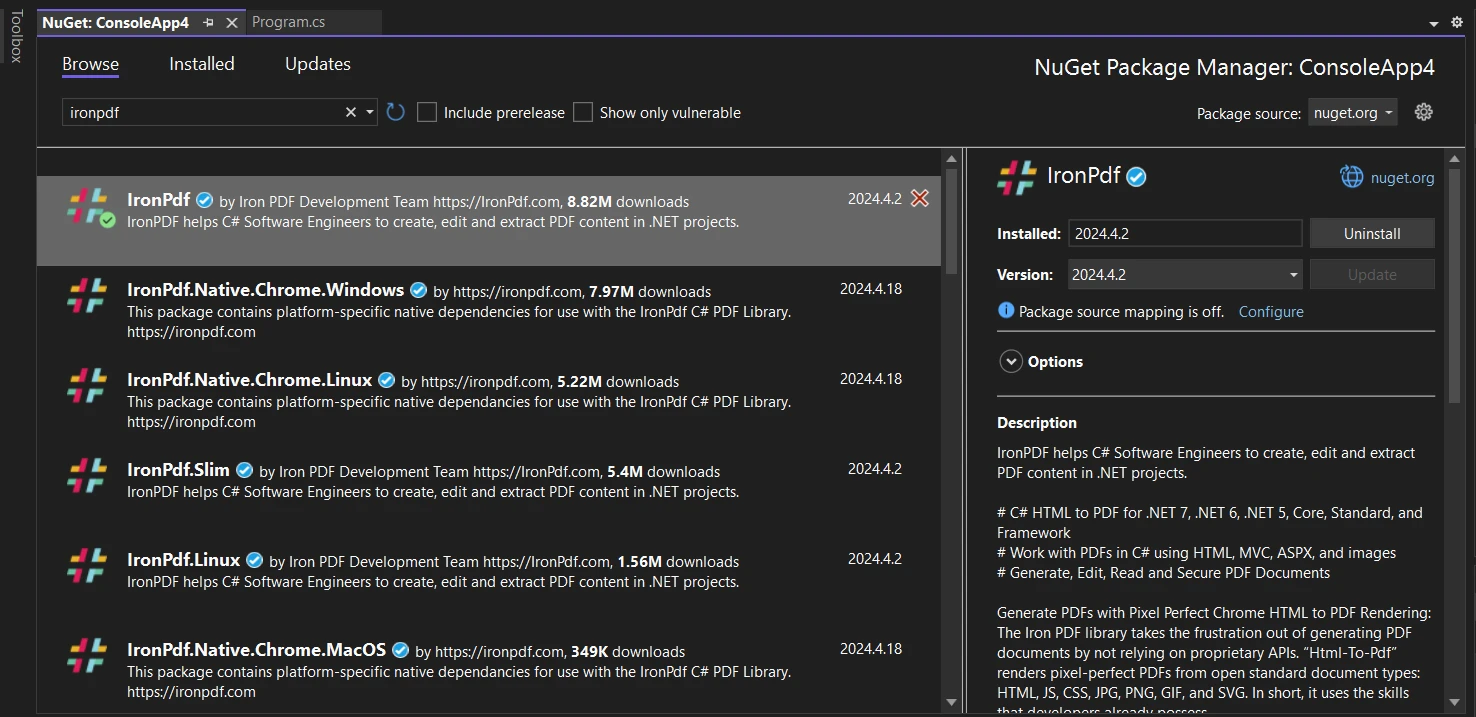
Wählen Sie IronPDF aus dem NuGet-Browser-Tab und klicken Sie auf Installieren.
Install-Package IronPdf
Install-Package IronPdf
PowerShell
-
Alternativ können Sie es vom NuGet-Pakete-Manager für Lösungen installieren.
-
Führen Sie den Befehl aus, um IronPDF zu installieren:
2. die Logik zur Konvertierung von DOCX in PDF mit IronPDF implementieren
- Instantiieren Sie die
DocxToPdfRenderer-Klasse von IronPDF.
- Instanziieren Sie die
DocxToPdfRenderer Klasse aus IronPDF.
- Verwenden Sie die
RenderDocxAsPdf Methode, um die mit Xceed.Document.NET generierte DOCX-Datei als PDF-Dokument zu rendern.
Hier ist ein Beispiel, um eine DOCX-Datei in PDF mit IronPDF zu konvertieren:
Hier ist ein Beispielcode, der zeigt, wie Sie eine DOCX-Datei in PDF mit IronPDF konvertieren:
using IronPdf;
using System;

class Program
{
    static void Main(string[] args)
    {
        // Instantiate the DOCX to PDF renderer
        DocxToPdfRenderer renderer = new DocxToPdfRenderer();

        // Render from a DOCX file to produce a PDF document
        PdfDocument pdf = renderer.RenderDocxAsPdf("SampleDocument.docx");

        // Save the PDF document
        pdf.SaveAs("SampleDocument.pdf");
        Console.WriteLine("DOCX file converted to PDF successfully.");
    }
}
using IronPdf;
using System;

class Program
{
    static void Main(string[] args)
    {
        // Instantiate the DOCX to PDF renderer
        DocxToPdfRenderer renderer = new DocxToPdfRenderer();

        // Render from a DOCX file to produce a PDF document
        PdfDocument pdf = renderer.RenderDocxAsPdf("SampleDocument.docx");

        // Save the PDF document
        pdf.SaveAs("SampleDocument.pdf");
        Console.WriteLine("DOCX file converted to PDF successfully.");
    }
}
Imports IronPdf
Imports System
Module Program
Sub Main(args As String())
' Instantiate the DOCX to PDF renderer
Dim renderer As New DocxToPdfRenderer()
' Render from a DOCX file to produce a PDF document
Dim pdf As PdfDocument = renderer.RenderDocxAsPdf("SampleDocument.docx")
' Save the PDF document
pdf.SaveAs("SampleDocument.pdf")
Console.WriteLine("DOCX file converted to PDF successfully.")
End Sub
End Module
Imports IronPdf
Imports System

Module Program
    Sub Main(args As String())
        ' Instantiate the DOCX to PDF renderer
        Dim renderer As New DocxToPdfRenderer()

        ' Render from a DOCX file to produce a PDF document
        Dim pdf As PdfDocument = renderer.RenderDocxAsPdf("SampleDocument.docx")

        ' Save the PDF document
        pdf.SaveAs("SampleDocument.pdf")
        Console.WriteLine("DOCX file converted to PDF successfully.")
    End Sub
End Module
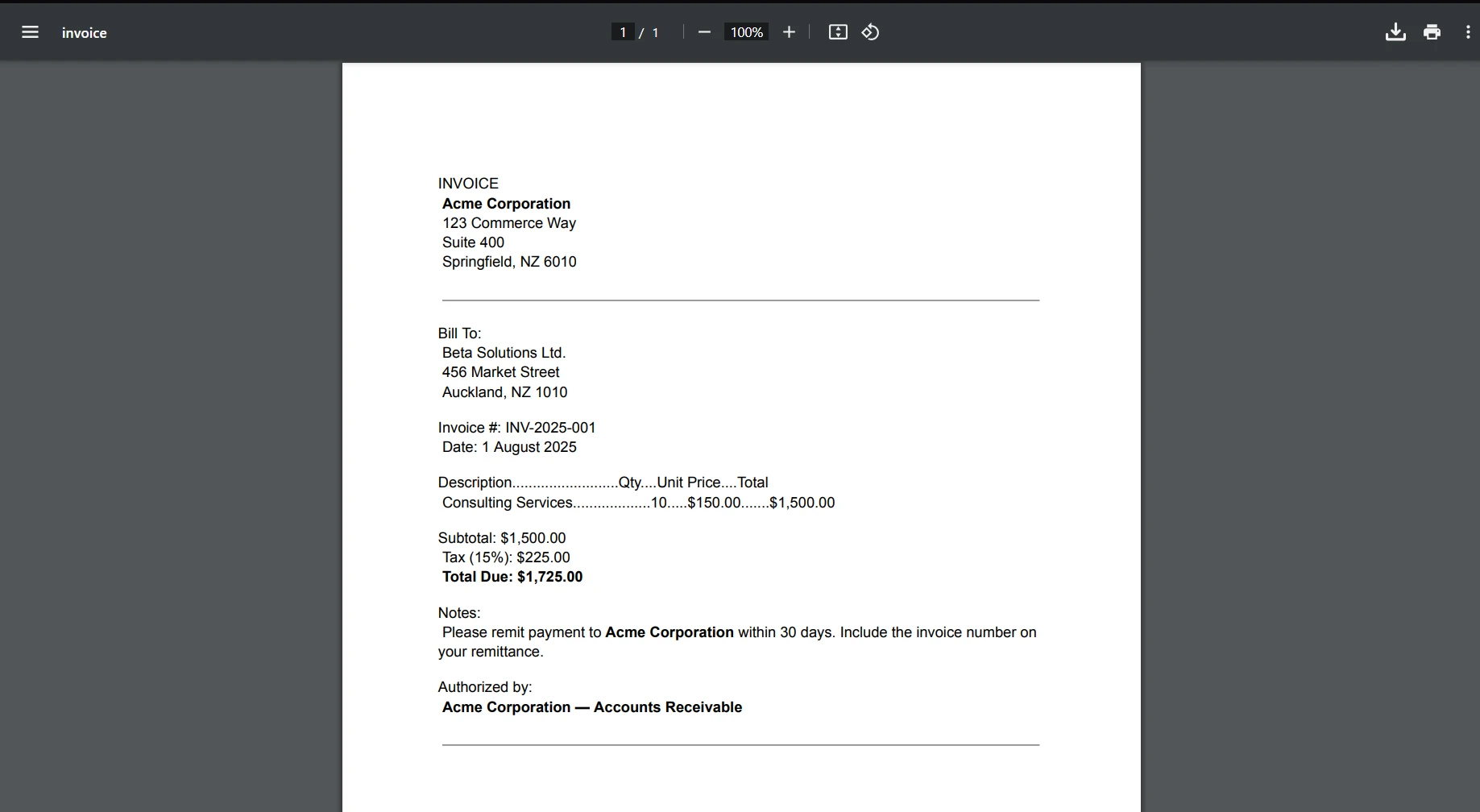
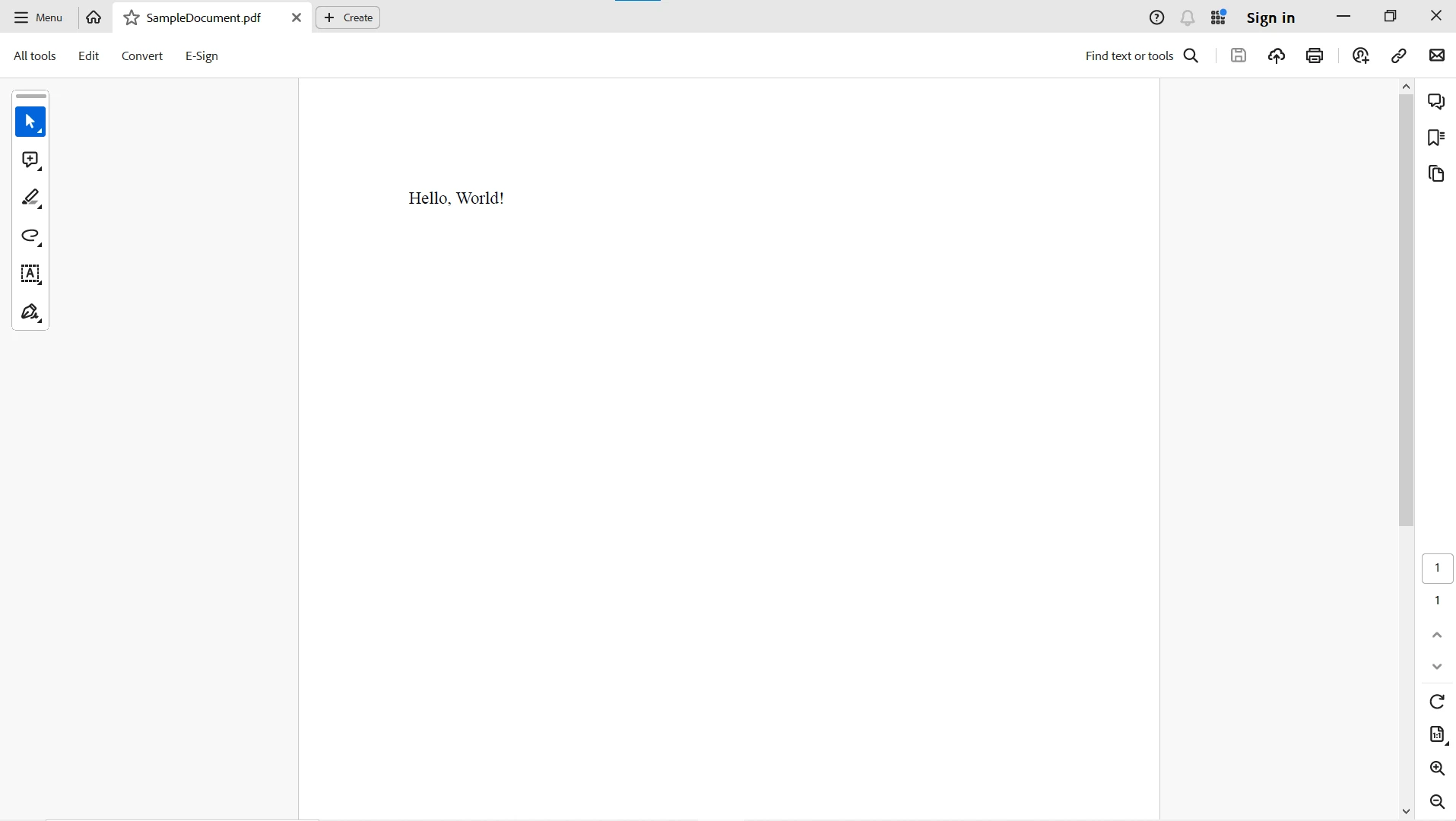
Ausgabe: DOCX zu PDF-Konvertierung
Output: Umwandlung von DOCX in PDF
Besuchen Sie die IronPDF-Dokumentation für weitere Informationen über IronPDF und seine Funktionen. Erkunden Sie das fertige HTML zu PDF Beispiel und beginnen Sie mit der PDF-Manipulation in Ihren .NET Framework-Console- oder Webanwendungen.
Abschluss
Zusammenfassend bieten Xceed.Document.NET und IronPDF leistungsstarke Lösungen für die Dokumentenerstellung und -konvertierung in .NET-Anwendungen. Durch die Nutzung der Fähigkeiten von Xceed.Document.NET können Entwickler dynamische und optisch ansprechende Word-Dokumente mühelos erstellen. Durch die nahtlose Integration mit IronPDF können Entwickler diese Word-Dokumente problemlos in PDF-Format konvertieren, was die Vielseitigkeit und Zugänglichkeit ihrer Anwendungen verbessert. Egal, ob Sie Berichte erstellen, Rechnungen generieren oder Dokumente zwischen Formaten konvertieren, Xceed.Document.NET und IronPDF ermöglichen Entwicklern, dokumentenbezogene Arbeitsabläufe zu optimieren und außergewöhnliche Ergebnisse in ihren .NET-Anwendungen zu liefern.
IronPDF von Iron Software bietet eine kostenlose Testversion und ist für die Bereitstellung in kommerziellen Projekten erforderlich. Laden Sie die Bibliothek von der IronPDF Download-Seite herunter und probieren Sie sie aus.