import {PdfDocument} from "@ironsoftware/ironpdf";

(async () => {
    // Create a PDF from an HTML string
    const pdf = await PdfDocument.fromHtml("<h1>Hello World</h1>");

    // Export the PDF to a file
    await pdf.saveAs("output.pdf");

    // Advanced Example with HTML Assets
    // Load external HTML assets: Images, CSS, and JavaScript.
    const htmlContentWithAssets = "<img src='icons/iron.png'>";
    const advancedPdf = await PdfDocument.fromHtml(htmlContentWithAssets);

    // Save the PDF with loaded assets
    await advancedPdf.saveAs("html-with-assets.pdf");
})();
import {PdfDocument} from "@ironsoftware/ironpdf";(async () => { // Create a PDF from an HTML string const pdf = awaitPdfDocument.fromHtml("<h1>Hello World</h1>"); // Export the PDF to a file await pdf.saveAs("output.pdf"); // Advanced Example with HTML Assets // Load external HTML assets: Images, CSS, and JavaScript. const htmlContentWithAssets = "<img src='icons/iron.png'>"; const advancedPdf = awaitPdfDocument.fromHtml(htmlContentWithAssets); // Save the PDF with loaded assets await advancedPdf.saveAs("html-with-assets.pdf");})();
In der modernen Webentwicklung ist es entscheidend, den Benutzern zeitnahes Feedback zu geben, um ein nahtloses Benutzererlebnis zu gewährleisten. Toast-Benachrichtigungen sind eine effektive Möglichkeit, Nachrichten zu übermitteln, ohne den Arbeitsablauf des Benutzers zu unterbrechen. Das [**React-toastify**](https://www.npmjs.com/package/react-toastify) Paket ist eine beliebte Wahl zur Implementierung von Toast-Benachrichtigungen in React-Anwendungen aufgrund seiner Einfachheit und Flexibilität. Wir werden uns auch das [**IronPDF**](/nodejs/) NPM-Paket ansehen, um PDF-Dokumente zu erstellen, zu bearbeiten und zu verwalten. Dieser Artikel führt Sie durch den Prozess der Integration von [**React-toastify**](https://www.npmjs.com/package/react-toastify) und [**IronPDF**](/nodejs/) in Ihr React-Projekt.
## Was ist Toastify?
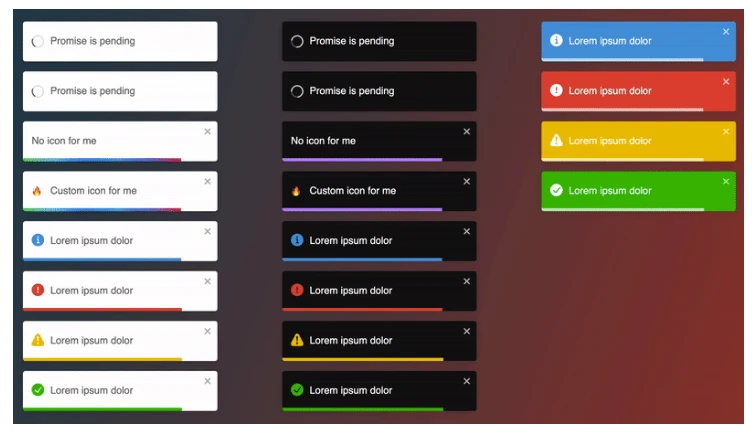
[**React-toastify**](https://www.npmjs.com/package/react-toastify) ist ein NPM-Paket, das es ermöglicht, anpassbare Toast-Benachrichtigungen mit minimalem Setup in Ihre React-Anwendungen einzufügen. Es bietet eine Vielzahl von Funktionen, einschließlich verschiedener Benachrichtigungstypen, automatisches Schließen, benutzerdefinierte Gestaltung und mehr.
## Installation
Um mit [react-toastify](https://github.com/fkhadra/react-toastify) zu beginnen, müssen Sie das Paket über NPM oder Yarn installieren. Führen Sie den folgenden Befehl im Stammverzeichnis Ihres Projekts aus:
```shell
npm install react-toastify
```
or
```shell
yarn add react-toastify
```
## Grundlegende Nutzung
Nach der Installation des Pakets können Sie beginnen, react-toastify in Ihrer React-Anwendung zu verwenden. Hier ist ein einfaches Codebeispiel, um zu demonstrieren, wie react-toastify integriert und verwendet wird.
### 1. Toastify-Komponenten importieren
Zuerst müssen Sie die notwendigen Komponenten aus react-toastify importieren:
```javascript
import React from 'react';
import { ToastContainer, toast } from 'react-toastify';
import 'react-toastify/dist/ReactToastify.css';
```
### 2. Toastify konfigurieren
Fügen Sie als Nächstes die ToastContainer-Komponente zu Ihrer Anwendung hinzu.
```javascript
function App() {
return (
<div>
<ToastContainer />
</div>
);
}
```
### 3. Toast-Benachrichtigungen auslösen
Sie können eine Toast-Benachrichtigung mit der toast-Funktion auslösen. Hier ist ein Codebeispiel, wie man eine Erfolgsmeldung anzeigt:
```javascript
function notify() {
toast.success("Success! This is a success message.", {
position: toast.POSITION.TOP_RIGHT
});
}
function App() {
return (
<div>
<button onClick={notify}>Show Toast</button>
<ToastContainer />
</div>
);
}
```
## Erweiterte Funktionen
### **OnOpen** und **OnClose** Hooks
React-toastify bietet verschiedene erweiterte Funktionen, die es Ihnen ermöglichen, das Verhalten und das Erscheinungsbild Ihrer Toasts mit **onOpen** und **onClose** Hooks anzupassen.
```javascript
import React from 'react';
import { ToastContainer, toast } from 'react-toastify';
import 'react-toastify/dist/ReactToastify.css';
function App() {
const notify = () => {
toast("Hello there", {
onOpen: () => window.alert('Called when I open'),
onClose: () => window.alert('Called when I close')
});
};
return (
<div>
<button onClick={notify}>Notify</button>
<ToastContainer />
</div>
);
}
export default App;
```
In diesem Beispiel:
* Wenn der Toast geöffnet wird, wird der **onOpen** Hook ausgelöst und wir zeigen eine Benachrichtigung an.
* Wenn der Toast geschlossen wird, wird der **onClose** Hook ausgelöst und eine weitere Benachrichtigung wird angezeigt.
### Benutzerdefinierte Positionen
Sie können Toasts an verschiedenen Positionen auf dem Bildschirm anzeigen, indem Sie die Positionsoption verwenden:
```javascript
toast.info("Information message", {
position: "top-right"
});
```
### Automatische Schließdauer
Sie können die Dauer festlegen, für die ein Toast angezeigt wird, indem Sie die **autoClose** Option verwenden:
```javascript
toast.warn("Warning message", {
autoClose: 5000 // Auto close after 5 seconds
});
```
### Benutzerdefinierte Gestaltung
Benutzerdefinierte Gestaltung kann auf Toasts angewendet werden, indem die **className** und Stiloptionen verwendet werden:
```javascript
toast.error("Error message", {
className: 'custom-toast',
style: { background: 'red', color: 'white' }
});
```
### Toasts schließen
Toasts können programmatisch mit der Methode toast.dismiss geschlossen werden:
```javascript
const toastId = toast("This toast can be dismissed");
function dismissToast() {
toast.dismiss(toastId);
}
```
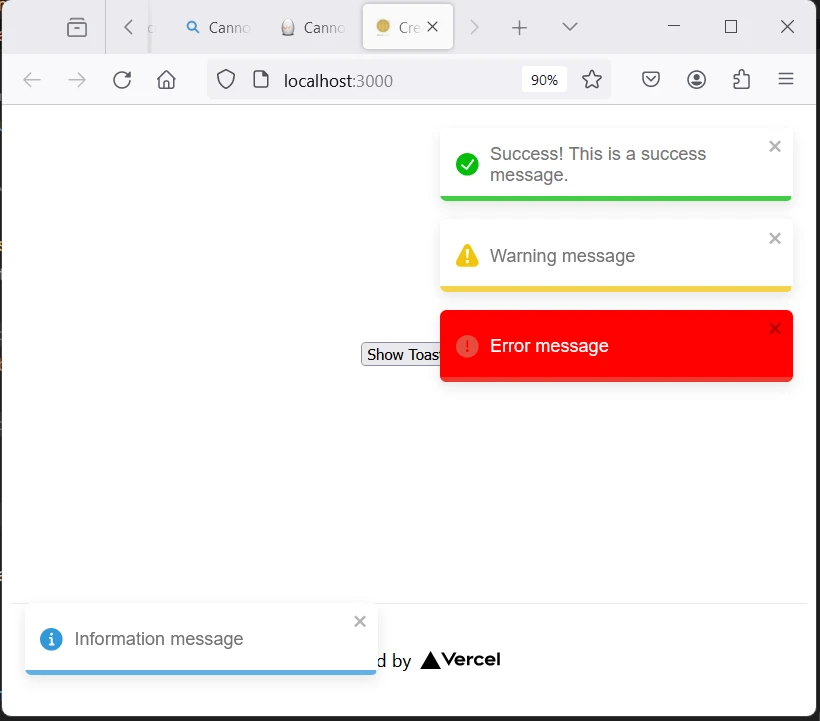
Hier ist ein vollständiges Beispiel, das die Verwendung verschiedener React-toastify-Funktionen demonstriert:
```javascript
import React from 'react';
import { ToastContainer, toast } from 'react-toastify';
import 'react-toastify/dist/ReactToastify.css';
function App() {
const notify = () => {
toast.success("Success! This is a success message.", {
position: "top-right"
});
toast.info("Information message", {
position: "bottom-left"
});
toast.warn("Warning message", {
autoClose: 5000
});
toast.error("Error message", {
className: 'custom-toast',
style: { background: 'red', color: 'white' }
});
};
return (
<div>
<button onClick={notify}>Show Toasts</button>
<ToastContainer />
</div>
);
}
export default App;
```
#### AUSGABE
## Einführung in IronPDF
[**IronPDF**](/nodejs/) ist eine leistungsstarke C# PDF-Bibliothek, die es Entwicklern ermöglicht, PDFs in ihren .NET-Projekten zu erstellen und zu bearbeiten. Egal, ob Sie PDFs aus HTML erstellen, vorhandene PDFs bearbeiten oder Webseiten ins PDF-Format konvertieren müssen, **IronPDF** bietet Ihnen umfassende Unterstützung.
Hier sind einige wichtige Funktionen und Anwendungsfälle:
### 1. HTML-zu-PDF-Konvertierung
IronPDF kann HTML-Seiten, sei es von einer URL, einer HTML-Datei oder einem HTML-String, in PDF umwandeln. Sie können auch lokale HTML-Dateien oder HTML-Strings in PDFs konvertieren.
### **2. Plattformübergreifende Unterstützung**
IronPDF funktioniert nahtlos auf verschiedenen Plattformen, einschließlich:
* .NET Core (8, 7, 6, 5 und 3.1+)
* .NET Standard (2.0+)
* .NET Framework (4.6.2+)
* Web (Blazor & WebForms)
* Desktop (WPF & MAUI)
* Konsole (App & Bibliothek)
* Windows-, Linux- und macOS-Umgebungen.
### **3. Bearbeiten und Manipulieren von PDFs**
IronPDF ermöglicht es Ihnen:
* [Eigenschaften und Sicherheit](/nodejs/examples/security-and-metadata/) (Passwörter, Berechtigungen) festzulegen.
* [Digitale Signaturen](/nodejs/examples/digitally-sign-a-pdf/) hinzuzufügen.
* PDF-Dateien zu komprimieren.
* Metadaten und Versionsverlauf zu bearbeiten.
* Seiten hinzuzufügen, zu kopieren und [zu löschen](/nodejs/examples/remove-page-from-pdf/).
### **4. Anpassung und Formatierung**
Sie können Seitentemplates, Kopf- und Fußzeilen, Seitenzahlen und benutzerdefinierte Ränder anwenden. IronPDF unterstützt UTF-8-Zeichenkodierung, Basis-URLs, Asset-Kodierung und mehr.
### **5. Einhaltung von Standards**
IronPDF hält sich an verschiedene PDF-Standards, einschließlich PDF-Versionen (1.2 - 1.7), PDF/UA (PDF/UA-1) und PDF/A (PDF/A-3b).
## PDF-Dokument mit IronPDF und Toastify NPM-Paket erstellen
**Abhängigkeiten installieren:** Erstellen Sie zunächst ein neues Next.js-Projekt (falls Sie dies noch nicht getan haben) mit dem folgenden Befehl. Bitte beachten Sie die [Einrichtungsseite](https://nextjs.org/learn-pages-router/basics/create-nextjs-app/setup).
```shell
npx create-next-app@latest my-pdf-app --use-npm --example "https://github.com/vercel/next-learn/tree/main/basics/learn-starter"
```
Navigieren Sie als Nächstes in Ihr Projektverzeichnis:
```shell
cd my-pdf-app
```
Installieren Sie die erforderlichen Pakete:
```shell
:InstallCmd npm install @ironsoftware/ironpdf, react-toastify
```
**PDF erstellen:** Jetzt erstellen wir ein einfaches Beispiel für die Generierung einer PDF-Datei mit [**IronPDF**](/nodejs/) . Fügen Sie den folgenden Code in Ihre Next.js-Komponente (z.B. pages/index.tsx) ein:
```javascript
import Head from 'next/head';
import styles from '../styles/Home.module.css';
import { ToastContainer, toast } from 'react-toastify';
import 'react-toastify/dist/ReactToastify.css';
import { useState } from "react";
export default function Home() {
const [textInput, setTextInput] = useState('');
// Function to show toast notifications
const notify = () => {
toast.success("Success! This is a success message.", {
position: "top-right"
});
toast.info("Information message", {
position: "bottom-left"
});
toast.warn("Warning message", {
autoClose: 5000
});
toast.error("Error message", {
className: 'custom-toast',
style: { background: 'red', color: 'white' }
});
};
// Function to generate a PDF
const generatePdf = async () => {
try {
const response = await fetch('/api/pdf?url=' + textInput);
const blob = await response.blob();
const url = window.URL.createObjectURL(new Blob([blob]));
const link = document.createElement('a');
link.href = url;
link.setAttribute('download', 'example.pdf');
document.body.appendChild(link);
link.click();
link.parentNode.removeChild(link);
} catch (error) {
console.error('Error generating PDF:', error);
}
};
// Handler for input change
const handleChange = (event) => {
setTextInput(event.target.value);
}
return (
<div className={styles.container}>
<Head>
<title>Demo Toaster and Generate PDF From IronPDF</title>
<link rel="icon" href="/favicon.ico"/>
</Head>
<main>
<h1>Demo Toaster and Generate PDF From IronPDF</h1>
<button style={{margin: 20, padding: 5}} onClick={notify}>Show Toasts</button>
<p>
<span>Enter Url To Convert to PDF:</span>{" "}
<input type="text" value={textInput} onChange={handleChange} />
</p>
<button style={{margin: 20, padding: 5}} onClick={generatePdf}>Generate PDF</button>
<ToastContainer />
</main>
<style jsx>{`
main {
padding: 5rem 0;
flex: 1;
display: flex;
flex-direction: column;
justify-content: center;
align-items: center;
}
footer {
width: 100%;
height: 100px;
border-top: 1px solid #eaeaea;
display: flex;
justify-content: center;
align-items: center;
}
footer img {
margin-left: 0.5rem;
}
footer a {
display: flex;
justify-content: center;
align-items: center;
text-decoration: none;
color: inherit;
}
code {
background: #fafafa;
border-radius: 5px;
padding: 0.75rem;
font-size: 1.1rem;
font-family: Menlo,
Monaco,
Lucida Console,
Liberation Mono,
DejaVu Sans Mono,
Bitstream Vera Sans Mono,
Courier New,
monospace;
}
`}</style>
<style jsx global>{`
html,
body {
padding: 0;
margin: 0;
font-family: -apple-system,
BlinkMacSystemFont,
Segoe UI,
Roboto,
Oxygen,
Ubuntu,
Cantarell,
Fira Sans,
Droid Sans,
Helvetica Neue,
sans-serif;
}
* {
box-sizing: border-box;
}
`}</style>
</div>
);
}
```
Da **IronPDF** nur auf Node.js läuft, fügen Sie als Nächstes eine API für die App hinzu, bei der PDF mit Node.js generiert wird.
Erstellen Sie eine Datei `pdf.js` im Ordner `pages/api` und fügen Sie den folgenden Code hinzu:
```javascript
// pages/api/pdf.js
import { IronPdfGlobalConfig, PdfDocument } from "@ironsoftware/ironpdf";
// Apply your IronPDF license key
IronPdfGlobalConfig.getConfig().licenseKey = "Add Your Key Here";
export default async function handler(req, res) {
try {
const url = req.query.url;
const pdf = await PdfDocument.fromUrl(url);
const data = await pdf.saveAsBuffer();
console.log('data PDF:', data);
res.setHeader('Content-Type', 'application/pdf');
res.setHeader('Content-Disposition', 'attachment; filename=awesomeIron.pdf');
res.send(data);
} catch (error) {
console.error('Error generating PDF:', error);
res.status(500).end();
}
}
```
**Hinweis:** Fügen Sie im obigen Code Ihren eigenen Lizenzschlüssel hinzu.
**App ausführen:** Starten Sie Ihre Next.js-App:
```shell
npm run dev
```
or
```shell
yarn dev
```
#### AUSGABE
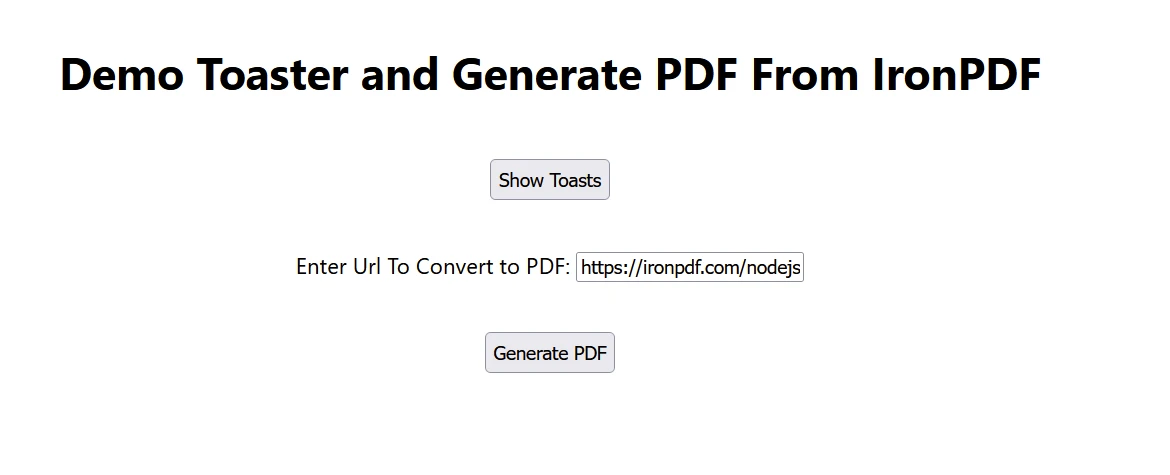
Öffnen Sie Ihren Browser und navigieren Sie zu http://localhost:3000, um die untenstehende Website zu sehen:
Klicken Sie auf "Toasts anzeigen", um Toast-Nachrichten zu sehen.
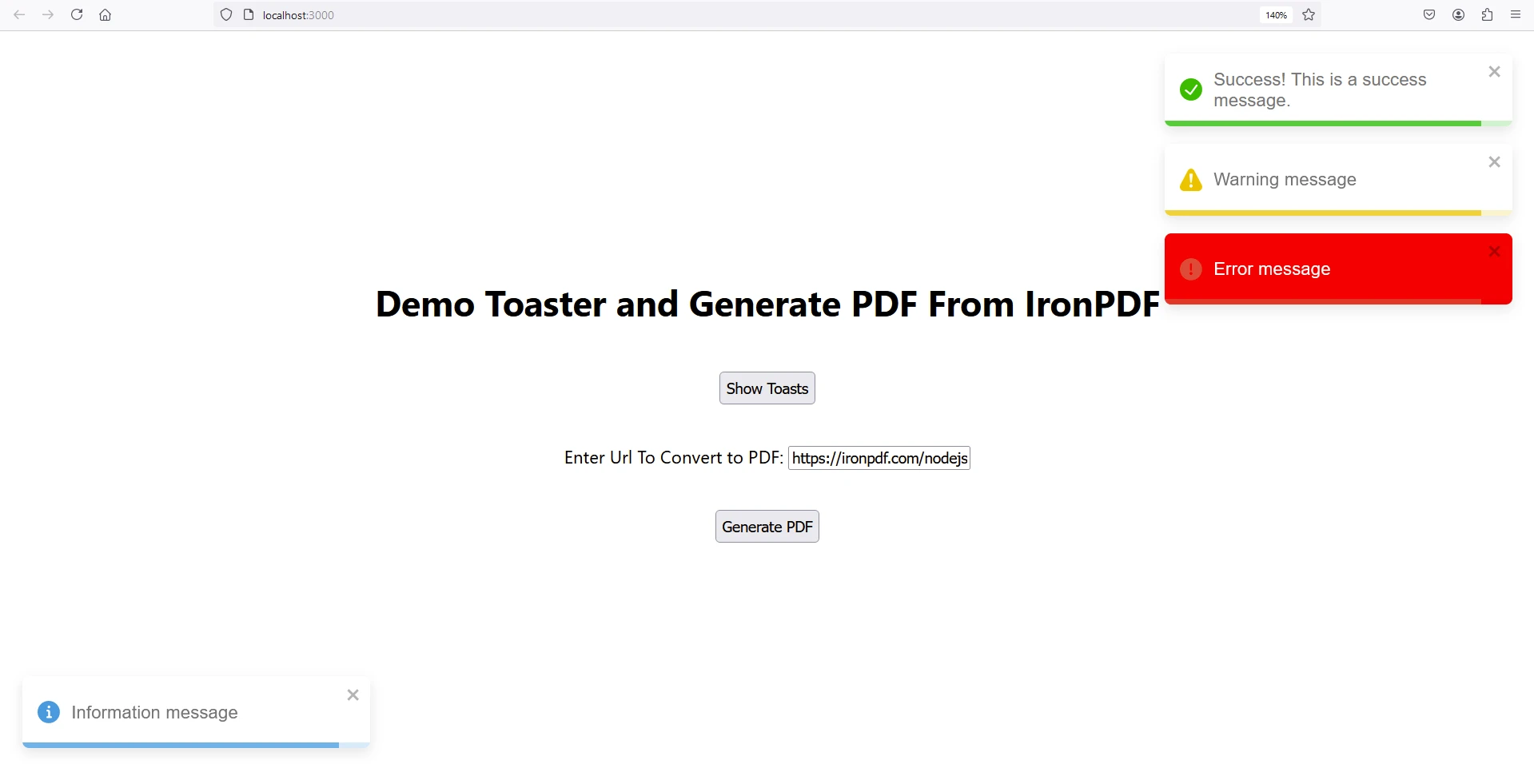 Darüber hinaus können Sie das Textfeld verwenden, um die URL der Webseite einzugeben, die Sie in ein PDF-Dokument konvertieren möchten, und auf die Schaltfläche "PDF erstellen" klicken. Dadurch wird die angegebene Webseite mit IronPDF in ein PDF konvertiert.
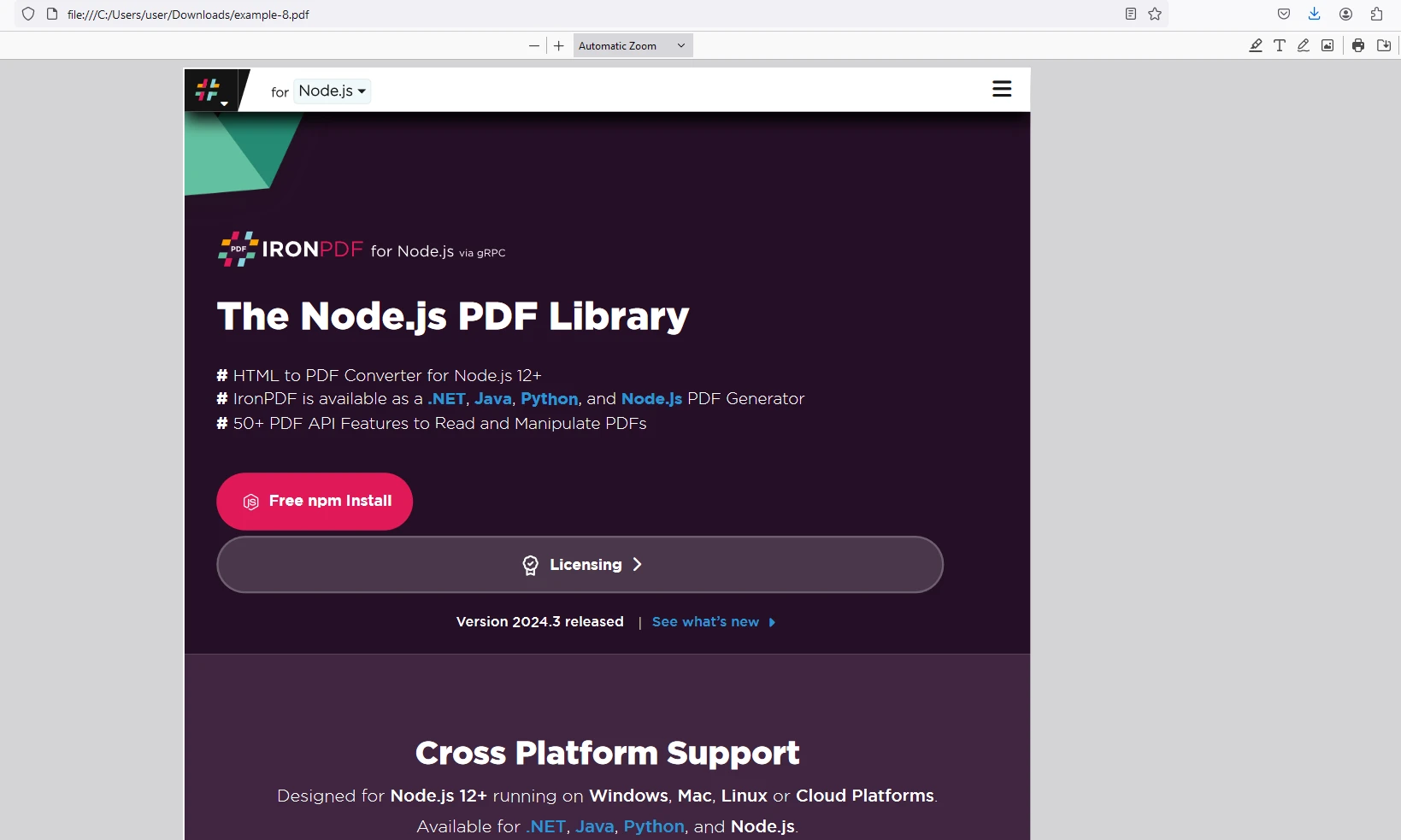
Geben Sie nun eine Website-URL ein, um ein PDF zu erstellen, und klicken Sie auf "PDF erstellen". Eine Datei mit dem Namen `awesomeIron.pdf` wird heruntergeladen.
## IronPDF-Lizenz
Für Informationen über die **IronPDF**-Lizenz besuchen Sie bitte die [IronPDF-Lizenzseite](licensing).
Platzieren Sie den Lizenzschlüssel in der App wie unten gezeigt:
```javascript
import { IronPdfGlobalConfig, PdfDocument } from "@ironsoftware/ironpdf";
// Apply your IronPDF license key
IronPdfGlobalConfig.getConfig().licenseKey = "Add Your Key Here";
```
## Abschluss
[**React-toastify**](https://www.npmjs.com/package/react-toastify) ist eine leistungsstarke und benutzerfreundliche Bibliothek, um Toast-Benachrichtigungen in Ihre React-Anwendungen einzufügen. Mit seinem breiten Funktionsumfang und den Anpassungsmöglichkeiten können Sie das Benutzererlebnis verbessern, indem Sie in super einfacher und unaufdringlicher Weise Echtzeit-Feedback bereitstellen. Auf der anderen Seite ist [**IronPDF**](/nodejs/) bei weitem die vielseitigste Unternehmensbibliothek mit Unterstützung zum Erstellen, Bearbeiten und Verwalten von PDF-Dokumenten. Indem Sie die in diesem Artikel beschriebenen Schritte befolgen, können Sie [**React-toastify**](https://www.npmjs.com/package/react-toastify) und [**IronPDF**](/nodejs/) schnell in Ihr Projekt integrieren und ihre Fähigkeiten nutzen.
Für weitere Informationen zum Einstieg in IronPDF konsultieren Sie bitte die [**Dokumentation**](/nodejs/docs/)-Seite und die [**Codebeispiele**](/nodejs/examples/using-html-to-create-a-pdf/).
In der modernen Webentwicklung ist es entscheidend, den Benutzern zeitnahes Feedback zu geben, um ein nahtloses Benutzererlebnis zu gewährleisten. Toast-Benachrichtigungen sind eine effektive Möglichkeit, Nachrichten zu übermitteln, ohne den Arbeitsablauf des Benutzers zu unterbrechen. Das React-toastify Paket ist eine beliebte Wahl zur Implementierung von Toast-Benachrichtigungen in React-Anwendungen aufgrund seiner Einfachheit und Flexibilität. Wir werden uns auch das IronPDF NPM-Paket ansehen, um PDF-Dokumente zu erstellen, zu bearbeiten und zu verwalten. Dieser Artikel führt Sie durch den Prozess der Integration von React-toastify und IronPDF in Ihr React-Projekt.
Was ist Toastify?
React-toastify ist ein NPM-Paket, das es ermöglicht, anpassbare Toast-Benachrichtigungen mit minimalem Setup in Ihre React-Anwendungen einzufügen. Es bietet eine Vielzahl von Funktionen, einschließlich verschiedener Benachrichtigungstypen, automatisches Schließen, benutzerdefinierte Gestaltung und mehr.
Installation
Um mit react-toastify zu beginnen, müssen Sie das Paket über NPM oder Yarn installieren. Führen Sie den folgenden Befehl im Stammverzeichnis Ihres Projekts aus:
npm install react-toastify
npm install react-toastify
SHELL
or
yarn add react-toastify
yarn add react-toastify
SHELL
Grundlegende Nutzung
Nach der Installation des Pakets können Sie beginnen, react-toastify in Ihrer React-Anwendung zu verwenden. Hier ist ein einfaches Codebeispiel, um zu demonstrieren, wie react-toastify integriert und verwendet wird.
1. Toastify-Komponenten importieren
Zuerst müssen Sie die notwendigen Komponenten aus react-toastify importieren:
importReactfrom 'react';import { ToastContainer, toast } from 'react-toastify';import 'react-toastify/dist/ReactToastify.css';
import React from 'react';
import { ToastContainer, toast } from 'react-toastify';
import 'react-toastify/dist/ReactToastify.css';
JavaScript
2. Toastify konfigurieren
Fügen Sie als Nächstes die ToastContainer-Komponente zu Ihrer Anwendung hinzu.
Sie können eine Toast-Benachrichtigung mit der toast-Funktion auslösen. Hier ist ein Codebeispiel, wie man eine Erfolgsmeldung anzeigt:
function notify() { toast.success("Success! This is a success message.", { position: toast.POSITION.TOP_RIGHT });}functionApp() { return ( <div> <button onClick={notify}>ShowToast</button> <ToastContainer /> </div> );}
function notify() {
  toast.success("Success! This is a success message.", {
    position: toast.POSITION.TOP_RIGHT
  });
}

function App() {
  return (
    <div>
      <button onClick={notify}>Show Toast</button>
      <ToastContainer />
    </div>
  );
}
JavaScript
Erweiterte Funktionen
OnOpen und OnClose Hooks
React-toastify bietet verschiedene erweiterte Funktionen, die es Ihnen ermöglichen, das Verhalten und das Erscheinungsbild Ihrer Toasts mit onOpen und onClose Hooks anzupassen.
importReactfrom 'react';import { ToastContainer, toast } from 'react-toastify';import 'react-toastify/dist/ReactToastify.css';functionApp() { const notify = () => { toast("Hello there", { onOpen: () => window.alert('Called when I open'), onClose: () => window.alert('Called when I close') }); }; return ( <div> <button onClick={notify}>Notify</button> <ToastContainer /> </div> );}export defaultApp;
import React from 'react';
import { ToastContainer, toast } from 'react-toastify';
import 'react-toastify/dist/ReactToastify.css';

function App() {
  const notify = () => {
    toast("Hello there", {
      onOpen: () => window.alert('Called when I open'),
      onClose: () => window.alert('Called when I close')
    });
  };

  return (
    <div>
      <button onClick={notify}>Notify</button>
      <ToastContainer />
    </div>
  );
}

export default App;
JavaScript
In diesem Beispiel:
Wenn der Toast geöffnet wird, wird der onOpen Hook ausgelöst und wir zeigen eine Benachrichtigung an.
Wenn der Toast geschlossen wird, wird der onClose Hook ausgelöst und eine weitere Benachrichtigung wird angezeigt.
Benutzerdefinierte Positionen
Sie können Toasts an verschiedenen Positionen auf dem Bildschirm anzeigen, indem Sie die Positionsoption verwenden:
IronPDF ist eine leistungsstarke C# PDF-Bibliothek, die es Entwicklern ermöglicht, PDFs in ihren .NET-Projekten zu erstellen und zu bearbeiten. Egal, ob Sie PDFs aus HTML erstellen, vorhandene PDFs bearbeiten oder Webseiten ins PDF-Format konvertieren müssen, IronPDF bietet Ihnen umfassende Unterstützung.
Hier sind einige wichtige Funktionen und Anwendungsfälle:
1. HTML-zu-PDF-Konvertierung
IronPDF kann HTML-Seiten, sei es von einer URL, einer HTML-Datei oder einem HTML-String, in PDF umwandeln. Sie können auch lokale HTML-Dateien oder HTML-Strings in PDFs konvertieren.
2. Plattformübergreifende Unterstützung
IronPDF funktioniert nahtlos auf verschiedenen Plattformen, einschließlich:
Sie können Seitentemplates, Kopf- und Fußzeilen, Seitenzahlen und benutzerdefinierte Ränder anwenden. IronPDF unterstützt UTF-8-Zeichenkodierung, Basis-URLs, Asset-Kodierung und mehr.
5. Einhaltung von Standards
IronPDF hält sich an verschiedene PDF-Standards, einschließlich PDF-Versionen (1.2 - 1.7), PDF/UA (PDF/UA-1) und PDF/A (PDF/A-3b).
PDF-Dokument mit IronPDF und Toastify NPM-Paket erstellen
Abhängigkeiten installieren: Erstellen Sie zunächst ein neues Next.js-Projekt (falls Sie dies noch nicht getan haben) mit dem folgenden Befehl. Bitte beachten Sie die Einrichtungsseite.
PDF erstellen: Jetzt erstellen wir ein einfaches Beispiel für die Generierung einer PDF-Datei mit IronPDF . Fügen Sie den folgenden Code in Ihre Next.js-Komponente (z.B. pages/index.tsx) ein:
Hinweis: Fügen Sie im obigen Code Ihren eigenen Lizenzschlüssel hinzu.
App ausführen: Starten Sie Ihre Next.js-App:
npm run dev
npm run dev
SHELL
or
yarn dev
yarn dev
SHELL
AUSGABE
Öffnen Sie Ihren Browser und navigieren Sie zu http://localhost:3000, um die untenstehende Website zu sehen:
Klicken Sie auf "Toasts anzeigen", um Toast-Nachrichten zu sehen.
Darüber hinaus können Sie das Textfeld verwenden, um die URL der Webseite einzugeben, die Sie in ein PDF-Dokument konvertieren möchten, und auf die Schaltfläche "PDF erstellen" klicken. Dadurch wird die angegebene Webseite mit IronPDF in ein PDF konvertiert.
Geben Sie nun eine Website-URL ein, um ein PDF zu erstellen, und klicken Sie auf "PDF erstellen". Eine Datei mit dem Namen awesomeIron.pdf wird heruntergeladen.
IronPDF-Lizenz
Für Informationen über die IronPDF-Lizenz besuchen Sie bitte die IronPDF-Lizenzseite.
Platzieren Sie den Lizenzschlüssel in der App wie unten gezeigt:
import { IronPdfGlobalConfig, PdfDocument } from "@ironsoftware/ironpdf";// Apply your IronPDF license keyIronPdfGlobalConfig.getConfig().licenseKey = "Add Your Key Here";
import { IronPdfGlobalConfig, PdfDocument } from "@ironsoftware/ironpdf";
// Apply your IronPDF license key
IronPdfGlobalConfig.getConfig().licenseKey = "Add Your Key Here";
JavaScript
Abschluss
React-toastify ist eine leistungsstarke und benutzerfreundliche Bibliothek, um Toast-Benachrichtigungen in Ihre React-Anwendungen einzufügen. Mit seinem breiten Funktionsumfang und den Anpassungsmöglichkeiten können Sie das Benutzererlebnis verbessern, indem Sie in super einfacher und unaufdringlicher Weise Echtzeit-Feedback bereitstellen. Auf der anderen Seite ist IronPDF bei weitem die vielseitigste Unternehmensbibliothek mit Unterstützung zum Erstellen, Bearbeiten und Verwalten von PDF-Dokumenten. Indem Sie die in diesem Artikel beschriebenen Schritte befolgen, können Sie React-toastify und IronPDF schnell in Ihr Projekt integrieren und ihre Fähigkeiten nutzen.
Für weitere Informationen zum Einstieg in IronPDF konsultieren Sie bitte die Dokumentation-Seite und die Codebeispiele.
Curtis Chau hat einen Bachelor-Abschluss in Informatik von der Carleton University und ist spezialisiert auf Frontend-Entwicklung mit Expertise in Node.js, TypeScript, JavaScript und React. Leidenschaftlich widmet er sich der Erstellung intuitiver und ästhetisch ansprechender Benutzerschnittstellen und arbeitet gerne mit modernen Frameworks sowie der Erstellung gut strukturierter, optisch ansprechender Handbücher.








 Darüber hinaus können Sie das Textfeld verwenden, um die URL der Webseite einzugeben, die Sie in ein PDF-Dokument konvertieren möchten, und auf die Schaltfläche "PDF erstellen" klicken. Dadurch wird die angegebene Webseite mit IronPDF in ein PDF konvertiert.