using IronPdf;

// Disable local disk access or cross-origin requests
Installation.EnableWebSecurity = true;

// Instantiate Renderer
var renderer = new ChromePdfRenderer();

// Create a PDF from a HTML string using C#
var pdf = renderer.RenderHtmlAsPdf("<h1>Hello World</h1>");

// Export to a file or Stream
pdf.SaveAs("output.pdf");

// Advanced Example with HTML Assets
// Load external html assets: Images, CSS and JavaScript.
// An optional BasePath 'C:\site\assets\' is set as the file location to load assets from
var myAdvancedPdf = renderer.RenderHtmlAsPdf("<img src='icons/iron.png'>", @"C:\site\assets\");
myAdvancedPdf.SaveAs("html-with-assets.pdf");
using IronPdf;// Disable local disk access or cross-origin requestsInstallation.EnableWebSecurity = true;// Instantiate Renderervar renderer = new ChromePdfRenderer();// Create a PDF from a HTML string using C#var pdf = renderer.RenderHtmlAsPdf("<h1>Hello World</h1>");// Export to a file or Streampdf.SaveAs("output.pdf");// Advanced Example with HTML Assets// Load external html assets: Images, CSS and JavaScript.// An optional BasePath 'C:\site\assets\' is set as the file location to load assets fromvar myAdvancedPdf = renderer.RenderHtmlAsPdf("<img src='icons/iron.png'>", @"C:\site\assets\");myAdvancedPdf.SaveAs("html-with-assets.pdf");
PM >Install-Package IronPdf
Install-Package IronPdf
ACTUALIZACIONES PARA DESARROLLADORES
AutoFixture C# (Cómo Funciona para Desarrolladores)
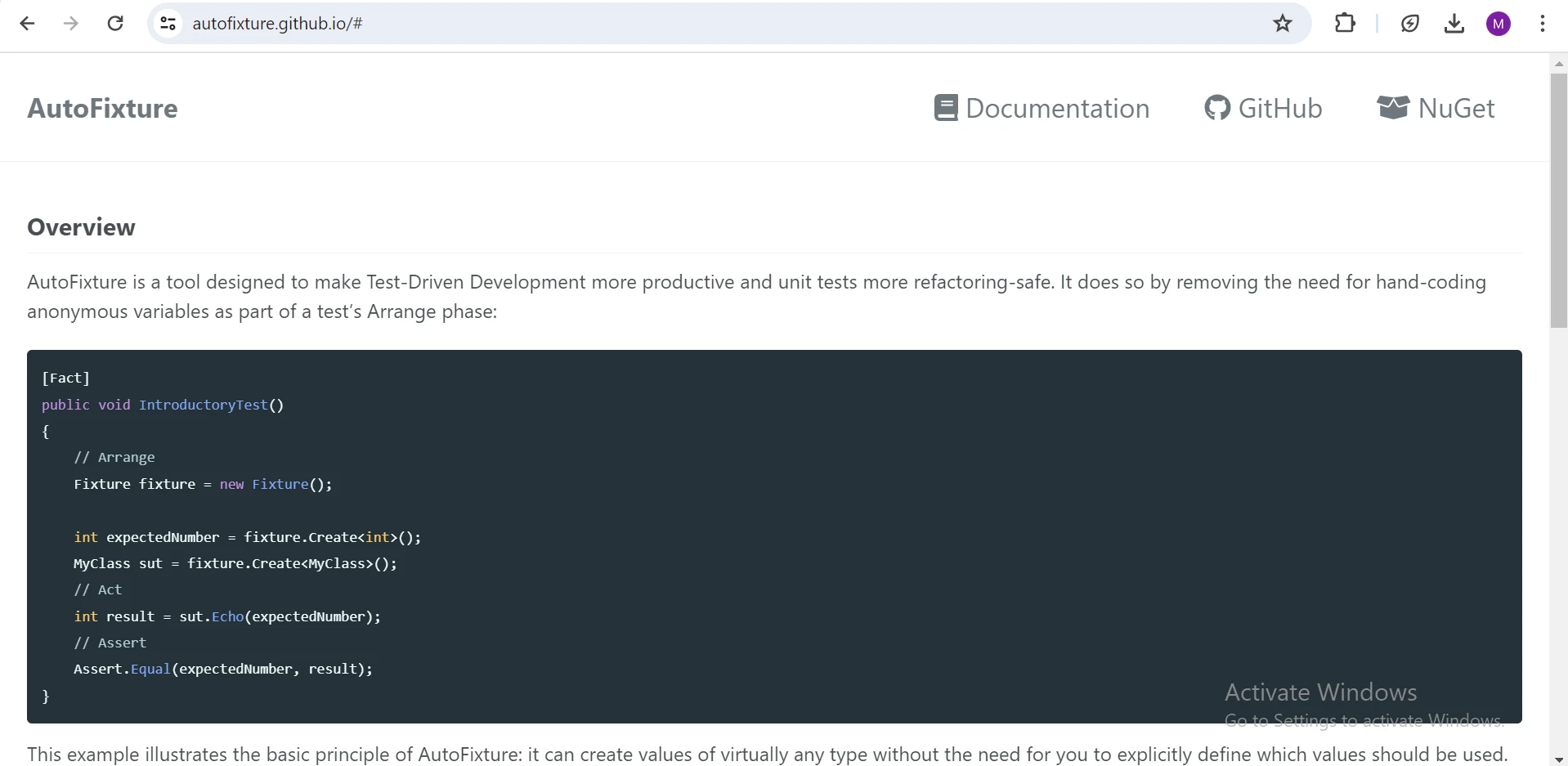
[AutoFixture](https://github.com/AutoFixture/AutoFixture) es una biblioteca de código abierto para [.NET](https://dotnet.microsoft.com/en-us/learn/dotnet/what-is-dotnet) enfocada en minimizar la fase de 'Arrange' en la escritura de pruebas unitarias, mejorando así la gestión de pruebas. Su objetivo principal es permitir que los desarrolladores se concentren en lo que están probando, en lugar del proceso de configuración, permitiéndole crear gráficos de objetos con datos de prueba. Este artículo explora cómo AutoFixture se puede utilizar para facilitar el desarrollo guiado por pruebas mediante la generación eficiente de datos de prueba.
AutoFixture es una poderosa biblioteca en C# diseñada para optimizar el proceso de creación de datos de prueba para pruebas unitarias. Ayuda a los desarrolladores a evitar escribir código de configuración repetitivo generando automáticamente datos para los casos de prueba. En las pruebas unitarias, AutoFixture proporciona un enfoque optimizado para generar datos de prueba, asegurando que cada prueba unitaria se ejecute con entradas variadas y realistas. AutoFixture hace que las pruebas en C# sean más eficientes al generar automáticamente datos de prueba, reduciendo la necesidad de configuración manual.
### Instalación y configuración de AutoFixture
AutoFixture está disponible como un paquete NuGet y se puede instalar usando la Consola del Administrador de Paquetes NuGet o el complemento de .NET en la interfaz de usuario del Administrador de Paquetes NuGet de Visual Studio.
```shell
:InstallCmd Install-Package AutoFixture
```
NuGet descargará e instalará la última versión de AutoFixture y sus dependencias en su proyecto.
#### Ejemplo de creación de datos de prueba para una clase
Supongamos que tenemos una clase de empleado simple con propiedades como `FirstName`, `LastName` y `Age`. En lugar de crear manualmente instancias de esta clase en nuestras pruebas unitarias, podemos utilizar AutoFixture para generar datos aleatorios para nosotros.
```csharp
public class Employee
{
    public string FirstName { get; set; }
    public string LastName { get; set; }
    public int Age { get; set; }

    public Employee(string firstName, string lastName, int age)
    {
        FirstName = firstName;
        LastName = lastName;
        Age = age;
    }

    public string GetFullName() => $"{FirstName} {LastName}";
}
```
#### Descripción del código
La clase `Employee` encapsula detalles esenciales de un empleado, incluidos su nombre, apellido y edad, representados por las propiedades `FirstName`, `LastName` y `Age` respectivamente. Su constructor facilita la creación de un objeto empleado aceptando estos detalles como parámetros y asignándolos a las propiedades correspondientes. Además, el método `GetFullName` concatena el nombre y el apellido del empleado, devolviendo el nombre completo como una cadena.
### Cómo configurar el código para nuestro escenario de prueba
A continuación, crearemos una clase de prueba para probar la clase `Employee`:
```csharp
using AutoFixture;
public class EmployeeTests
{
private readonly IFixture _fixture;
public EmployeeTests()
{
// Using AutoFixture's Fixture to create test data
_fixture = new Fixture();
}
}
```
#### Descripción del código
Este fragmento de código incorpora AutoFixture en la prueba unitaria para la clase `Employee`. Al importar el espacio de nombres `AutoFixture`, los desarrolladores acceden a la funcionalidad de generación de datos. El campo `_fixture`, inicializado con una nueva instancia de `Fixture`, agiliza la creación de datos de prueba. Este conjunto mejora la eficiencia y la fiabilidad de las pruebas para una cobertura integral de la clase `Employee`.
#### Ejemplo 1: Validación de valores de objetos de casos de prueba de empleados
```csharp
[Fact]
public void Employee_ShouldHaveValidValues()
{
// Arrange
var firstName = _fixture.Create<string>();
var lastName = _fixture.Create<string>();
var age = _fixture.Create<int>();
// Act
var employee = new Employee(firstName, lastName, age);
// Assert
Assert.Equal(firstName, employee.FirstName);
Assert.Equal(lastName, employee.LastName);
Assert.Equal(age, employee.Age);
}
```
#### Descripción del código
El método de prueba `Employee_ShouldHaveValidValues` valida que la clase `Employee` inicialice correctamente sus propiedades con los valores proporcionados. Usando un dispositivo de prueba para generar datos aleatorios para `FirstName`, `LastName` y `Age`, la prueba crea una instancia de `Employee`. Luego afirma que las propiedades `FirstName`, `LastName` y `Age` del objeto `Employee` coinciden con los valores generados, asegurándose de que el constructor establezca estas propiedades con precisión.
#### Ejemplo 2: Validación de empleado cuando se invoca al constructor
```csharp
[Fact]
public void CreateEmployee_ValidData_ReturnsEmployeeObject()
{
// Arrange
var employee = _fixture.Create<Employee>();
// Act
// Assert
Assert.NotNull(employee);
Assert.False(string.IsNullOrEmpty(employee.FirstName));
Assert.NotNull(employee.LastName);
Assert.True(employee.Age > 0);
}
```
#### Descripción del código
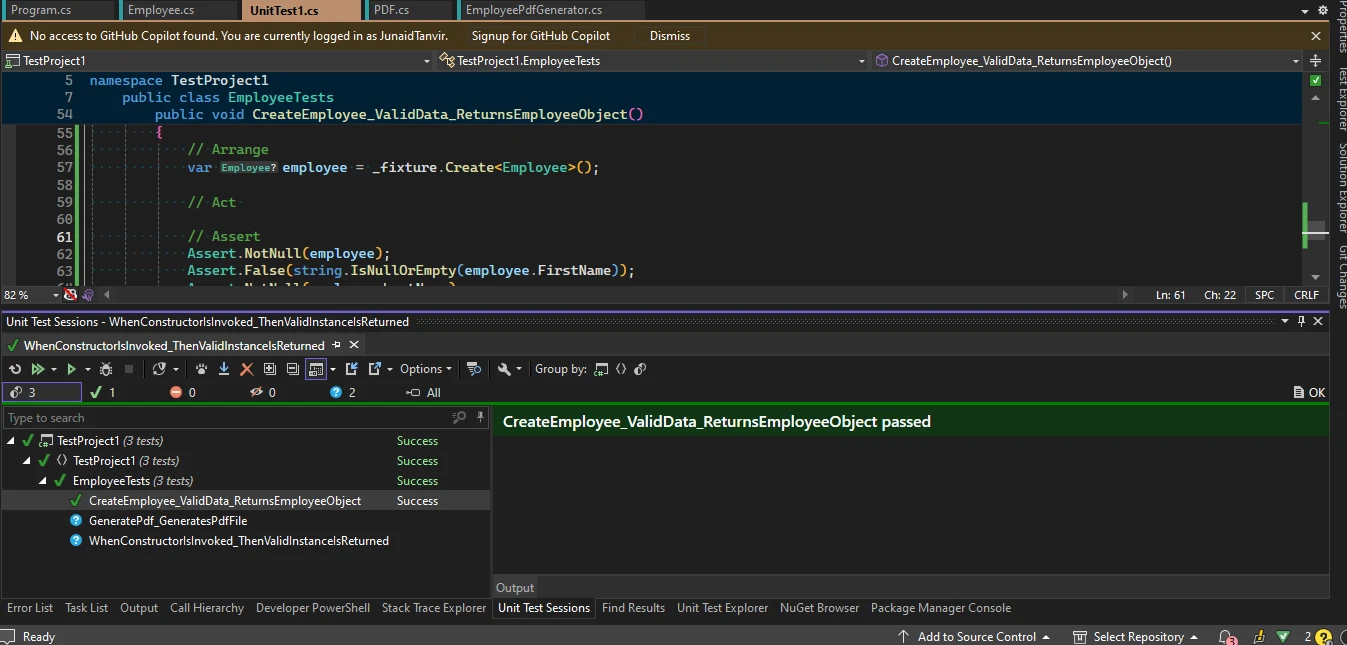
Este método de prueba incluye afirmaciones de prueba que validan si las propiedades de un objeto `Employee` coinciden con valores generados aleatoriamente. Verifica si las propiedades del tipo `string` `FirstName` y `LastName`, y `int` `Age` están correctamente establecidas y son válidas. Cualquier aserción fallida señala una discordancia entre los valores esperados y los valores aleatorios generados para los detalles del empleado.
# Presentación de IronPDF
[IronPDF C# PDF Library](/) es una robusta biblioteca de PDF en C# desarrollada por Iron Software que facilita la [lectura de texto PDF](/examples/reading-pdf-text/) y la [creación de documentos PDF usando HTML](/examples/using-html-to-create-a-pdf/). Esta herramienta versátil permite la conversión de documentos fáciles de formatear, completos con información de estilo, en PDFs de alta calidad. Con IronPDF, [generar PDFs a partir de texto HTML](/blog/using-ironpdf/5-steps-to-generate-a-pdf-file-in-c-sharp/) es un proceso sencillo, permitiendo a los usuarios extraer contenido HTML de URLs y transformarlo en archivos PDF bien estructurados. Esta capacidad convierte a IronPDF en una herramienta esencial para los desarrolladores que buscan automatizar y optimizar la creación de documentos PDF profesionales directamente desde contenido web.
### Instalación de IronPDF
Abra la consola del Administrador de Paquetes NuGet, y ejecute el siguiente comando:
```shell
:ProductInstall
```
#### Ejemplo de código usando las características de AutoFixture con IronPDF
A continuación se presenta un ejemplo que demuestra el uso de AutoFixture junto a IronPDF para generar un PDF de datos de empleados:
```csharp
using DemoAutofixture;
using IronPdf;
using System;
using System.Collections.Generic;
using System.Linq;
using System.Text;
public class EmployeePdfGenerator
{
private readonly Fixture _fixture;
public EmployeePdfGenerator()
{
_fixture = new Fixture();
}
public List<Employee> GenerateEmployees(int count)
{
return _fixture.CreateMany<Employee>(count).ToList();
}
public void GeneratePdf(List<Employee> employees, string filePath)
{
IronPdf.License.LicenseKey = "Your-License-Key-Here";
var renderer = new ChromePdfRenderer();
string htmlContent = GenerateHtml(employees);
try
{
renderer.RenderHtmlAsPdf(htmlContent).SaveAs(filePath);
Console.WriteLine("PDF Created Successfully!");
}
catch (Exception ex)
{
Console.WriteLine($"Error generating PDF: {ex.Message}");
}
}
private string GenerateHtml(List<Employee> employees)
{
StringBuilder htmlBuilder = new StringBuilder();
htmlBuilder.Append("<!DOCTYPE html><html><head><title>Employee List</title></head><body><h1>Employee List</h1><ul>");
foreach (var employee in employees)
{
htmlBuilder.Append($"<li>{employee.GetFullName()} - Age: {employee.Age}</li>");
}
htmlBuilder.Append("</ul></body></html>");
return htmlBuilder.ToString();
}
}
```
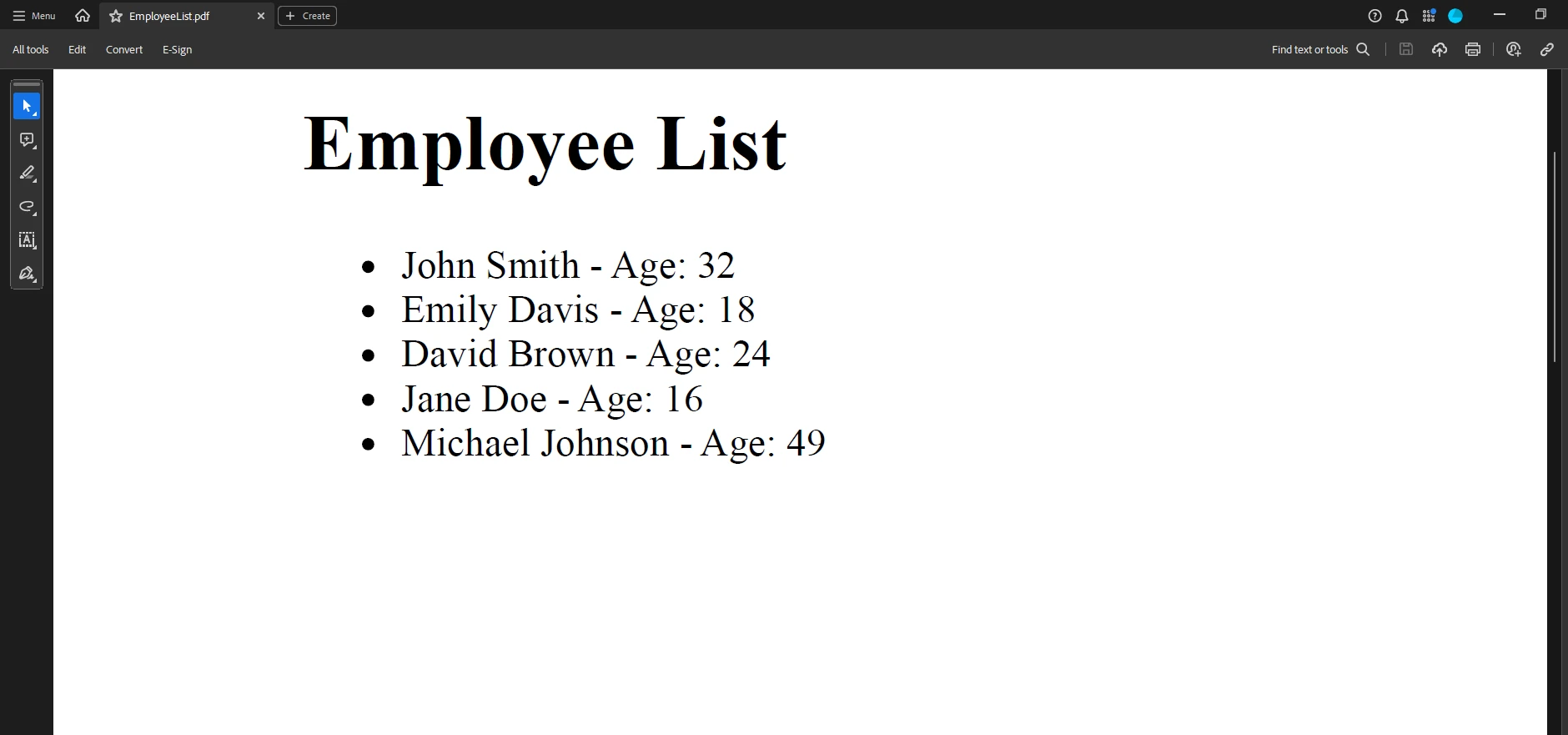
Para usar esta clase, instancias `EmployeePdfGenerator`, generas una lista de empleados y luego llamas a `GeneratePdf`:
```csharp
List<Employee> employees = new()
{
new Employee("John", "Smith", 32),
new Employee("Emily", "Davis", 18),
new Employee("David", "Brown", 24),
new Employee("Jane", "Doe", 16),
new Employee("Michael", "Johnson", 49),
};
EmployeePdfGenerator pdfGenerator = new();
pdfGenerator.GeneratePdf(employees, "EmployeeList.pdf");
```
#### Descripción del código
El código proporcionado en C# utiliza la biblioteca IronPDF para generar un documento PDF que lista empleados y sus edades. Define una clase `EmployeePdfGenerator` que incluye el método `GeneratePdf`, el cual toma una lista de objetos `Employee` y una ruta de archivo. Internamente, construye contenido HTML a través del método `GenerateHtml`, luego usa la clase `HtmlToPdf` de IronPDF para renderizar este HTML como un PDF, guardado en la ruta de archivo especificada. Las mejoras incluyen el uso de `StringBuilder` para la generación de HTML y la adición de manejo básico de errores para la generación de PDF y el guardado de archivos.
#### Escribir un método de prueba
En la configuración a continuación, se utiliza AutoFixture para crear instancias de la clase `Employee`, habilitando la generación de datos aleatorios para las pruebas. Se emplea IronPDF para convertir sin problemas el contenido HTML, incluyendo información del empleado, en formato PDF. La clase `EmployeePdfGenerator` orquesta estos procesos, gestionando tanto la generación de datos como la conversión a PDF de manera eficiente. Mientras tanto, la clase de prueba `EmployeePdfGeneratorTests` de XUnit asegura el funcionamiento adecuado de la generación de PDF a través de pruebas rigurosas. Este enfoque integrado simplifica la generación y documentación de datos de empleados, asegurando robustez y fiabilidad en el proceso de generación de PDFs.
```csharp
using System.IO;
using Xunit;
public class EmployeePdfGeneratorTests
{
[Fact]
public void GeneratePdf_GeneratesPdfFile()
{
// Arrange
var generator = new EmployeePdfGenerator();
var employees = generator.GenerateEmployees(5);
string filePath = "EmployeeList.pdf";
// Act
generator.GeneratePdf(employees, filePath);
// Assert
Assert.True(File.Exists(filePath));
}
}
```
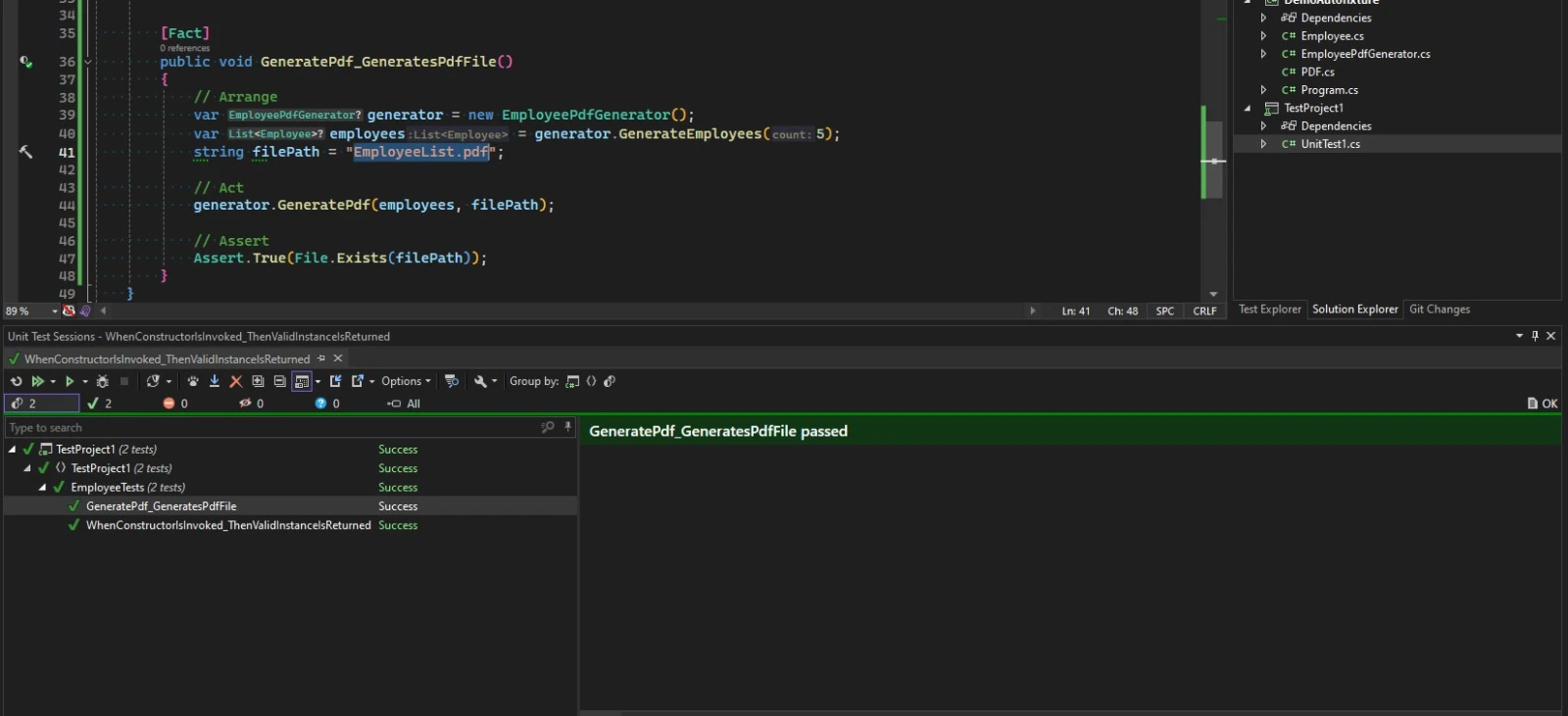
Aquí, la clase `EmployeePdfGeneratorTests` contiene un caso de prueba que valida la creación de un archivo PDF en la ruta de archivo especificada, asegurando que el método `GeneratePdf` funcione correctamente.
## Conclusión
AutoFixture simplifica la fase de 'Arrange' en la escritura de pruebas unitarias en .NET, ofreciendo a los desarrolladores un medio para centrarse en los casos de prueba en lugar de en las complejidades de la configuración. Optimiza el proceso de prueba unitaria, asegurando entradas variadas y realistas mediante la generación automática de datos de prueba. En conjunto con [Información de Licencias de IronPDF](/licensing/), proporciona una combinación poderosa para uso y soporte continuado.
AutoFixture es una biblioteca de código abierto para .NET enfocada en minimizar la fase de 'Arrange' en la escritura de pruebas unitarias, mejorando así la gestión de pruebas. Su objetivo principal es permitir que los desarrolladores se concentren en lo que están probando, en lugar del proceso de configuración, permitiéndole crear gráficos de objetos con datos de prueba. Este artículo explora cómo AutoFixture se puede utilizar para facilitar el desarrollo guiado por pruebas mediante la generación eficiente de datos de prueba.
AutoFixture es una poderosa biblioteca en C# diseñada para optimizar el proceso de creación de datos de prueba para pruebas unitarias. Ayuda a los desarrolladores a evitar escribir código de configuración repetitivo generando automáticamente datos para los casos de prueba. En las pruebas unitarias, AutoFixture proporciona un enfoque optimizado para generar datos de prueba, asegurando que cada prueba unitaria se ejecute con entradas variadas y realistas. AutoFixture hace que las pruebas en C# sean más eficientes al generar automáticamente datos de prueba, reduciendo la necesidad de configuración manual.
Instalación y configuración de AutoFixture
AutoFixture está disponible como un paquete NuGet y se puede instalar usando la Consola del Administrador de Paquetes NuGet o el complemento de .NET en la interfaz de usuario del Administrador de Paquetes NuGet de Visual Studio.
PM > Install-Package AutoFixture
Install-Package AutoFixture
NuGet descargará e instalará la última versión de AutoFixture y sus dependencias en su proyecto.
Ejemplo de creación de datos de prueba para una clase
Supongamos que tenemos una clase de empleado simple con propiedades como FirstName, LastName y Age. En lugar de crear manualmente instancias de esta clase en nuestras pruebas unitarias, podemos utilizar AutoFixture para generar datos aleatorios para nosotros.
public class Employee{ public stringFirstName { get; set; } public stringLastName { get; set; } public intAge { get; set; } publicEmployee(string firstName, string lastName, int age) {FirstName = firstName;LastName = lastName;Age = age; } public stringGetFullName() => $"{FirstName} {LastName}";}
public class Employee
{
    public string FirstName { get; set; }
    public string LastName { get; set; }
    public int Age { get; set; }

    public Employee(string firstName, string lastName, int age)
    {
        FirstName = firstName;
        LastName = lastName;
        Age = age;
    }

    public string GetFullName() => $"{FirstName} {LastName}";
}
Public Class Employee Public Property FirstName() AsString Public Property LastName() AsString Public Property Age() AsInteger Public Sub New(ByVal firstName AsString, ByVal lastName AsString, ByVal age AsInteger)Me.FirstName = firstNameMe.LastName = lastNameMe.Age = age End Sub Public Function GetFullName() AsString Return $"{FirstName} {LastName}" End FunctionEnd Class
Public Class Employee
	Public Property FirstName() As String
	Public Property LastName() As String
	Public Property Age() As Integer

	Public Sub New(ByVal firstName As String, ByVal lastName As String, ByVal age As Integer)
		Me.FirstName = firstName
		Me.LastName = lastName
		Me.Age = age
	End Sub

	Public Function GetFullName() As String
		Return $"{FirstName} {LastName}"
	End Function
End Class
Descripción del código
La clase Employee encapsula detalles esenciales de un empleado, incluidos su nombre, apellido y edad, representados por las propiedades FirstName, LastName y Age respectivamente. Su constructor facilita la creación de un objeto empleado aceptando estos detalles como parámetros y asignándolos a las propiedades correspondientes. Además, el método GetFullName concatena el nombre y el apellido del empleado, devolviendo el nombre completo como una cadena.
Cómo configurar el código para nuestro escenario de prueba
A continuación, crearemos una clase de prueba para probar la clase Employee:
using AutoFixture;public class EmployeeTests{ private readonly IFixture _fixture; publicEmployeeTests() { // Using AutoFixture's Fixture to create test data _fixture = new Fixture(); }}
using AutoFixture;

public class EmployeeTests
{
    private readonly IFixture _fixture;

    public EmployeeTests()
    {
        // Using AutoFixture's Fixture to create test data
        _fixture = new Fixture();
    }
}
ImportsAutoFixturePublic Class EmployeeTests PrivateReadOnly _fixture AsIFixture Public Sub New() ' Using AutoFixture's Fixture to create test data _fixture = New Fixture() End SubEnd Class
Imports AutoFixture

Public Class EmployeeTests
	Private ReadOnly _fixture As IFixture

	Public Sub New()
		' Using AutoFixture's Fixture to create test data
		_fixture = New Fixture()
	End Sub
End Class
Descripción del código
Este fragmento de código incorpora AutoFixture en la prueba unitaria para la clase Employee. Al importar el espacio de nombres AutoFixture, los desarrolladores acceden a la funcionalidad de generación de datos. El campo _fixture, inicializado con una nueva instancia de Fixture, agiliza la creación de datos de prueba. Este conjunto mejora la eficiencia y la fiabilidad de las pruebas para una cobertura integral de la clase Employee.
Ejemplo 1: Validación de valores de objetos de casos de prueba de empleados
[Fact]public voidEmployee_ShouldHaveValidValues(){ // Arrange var firstName = _fixture.Create<string>(); var lastName = _fixture.Create<string>(); var age = _fixture.Create<int>(); // Act var employee = new Employee(firstName, lastName, age); // AssertAssert.Equal(firstName, employee.FirstName);Assert.Equal(lastName, employee.LastName);Assert.Equal(age, employee.Age);}
[Fact]
public void Employee_ShouldHaveValidValues()
{
    // Arrange
    var firstName = _fixture.Create<string>();
    var lastName = _fixture.Create<string>();
    var age = _fixture.Create<int>();

    // Act
    var employee = new Employee(firstName, lastName, age);

    // Assert
    Assert.Equal(firstName, employee.FirstName);
    Assert.Equal(lastName, employee.LastName);
    Assert.Equal(age, employee.Age);
}
<Fact>Public Sub Employee_ShouldHaveValidValues() ' Arrange Dim firstName = _fixture.Create(OfString)() Dim lastName = _fixture.Create(OfString)() Dim age = _fixture.Create(OfInteger)() ' Act Dim employee As New Employee(firstName, lastName, age) ' AssertAssert.Equal(firstName, employee.FirstName)Assert.Equal(lastName, employee.LastName)Assert.Equal(age, employee.Age)End Sub
<Fact>
Public Sub Employee_ShouldHaveValidValues()
	' Arrange
	Dim firstName = _fixture.Create(Of String)()
	Dim lastName = _fixture.Create(Of String)()
	Dim age = _fixture.Create(Of Integer)()

	' Act
	Dim employee As New Employee(firstName, lastName, age)

	' Assert
	Assert.Equal(firstName, employee.FirstName)
	Assert.Equal(lastName, employee.LastName)
	Assert.Equal(age, employee.Age)
End Sub
Descripción del código
El método de prueba Employee_ShouldHaveValidValues valida que la clase Employee inicialice correctamente sus propiedades con los valores proporcionados. Usando un dispositivo de prueba para generar datos aleatorios para FirstName, LastName y Age, la prueba crea una instancia de Employee. Luego afirma que las propiedades FirstName, LastName y Age del objeto Employee coinciden con los valores generados, asegurándose de que el constructor establezca estas propiedades con precisión.
Ejemplo 2: Validación de empleado cuando se invoca al constructor
<Fact>Public Sub CreateEmployee_ValidData_ReturnsEmployeeObject() ' Arrange Dim employee = _fixture.Create(OfEmployee)() ' Act ' AssertAssert.NotNull(employee)Assert.False(String.IsNullOrEmpty(employee.FirstName))Assert.NotNull(employee.LastName)Assert.True(employee.Age > 0)End Sub
<Fact>
Public Sub CreateEmployee_ValidData_ReturnsEmployeeObject()
	' Arrange
	Dim employee = _fixture.Create(Of Employee)()

	' Act
	' Assert
	Assert.NotNull(employee)
	Assert.False(String.IsNullOrEmpty(employee.FirstName))
	Assert.NotNull(employee.LastName)
	Assert.True(employee.Age > 0)
End Sub
Descripción del código
Este método de prueba incluye afirmaciones de prueba que validan si las propiedades de un objeto Employee coinciden con valores generados aleatoriamente. Verifica si las propiedades del tipo stringFirstName y LastName, y intAge están correctamente establecidas y son válidas. Cualquier aserción fallida señala una discordancia entre los valores esperados y los valores aleatorios generados para los detalles del empleado.
Presentación de IronPDF
IronPDF C# PDF Library es una robusta biblioteca de PDF en C# desarrollada por Iron Software que facilita la lectura de texto PDF y la creación de documentos PDF usando HTML. Esta herramienta versátil permite la conversión de documentos fáciles de formatear, completos con información de estilo, en PDFs de alta calidad. Con IronPDF, generar PDFs a partir de texto HTML es un proceso sencillo, permitiendo a los usuarios extraer contenido HTML de URLs y transformarlo en archivos PDF bien estructurados. Esta capacidad convierte a IronPDF en una herramienta esencial para los desarrolladores que buscan automatizar y optimizar la creación de documentos PDF profesionales directamente desde contenido web.
Instalación de IronPDF
Abra la consola del Administrador de Paquetes NuGet, y ejecute el siguiente comando:
PM > Install-Package IronPdf
Install-Package IronPdf
Ejemplo de código usando las características de AutoFixture con IronPDF
A continuación se presenta un ejemplo que demuestra el uso de AutoFixture junto a IronPDF para generar un PDF de datos de empleados:
using DemoAutofixture;using IronPdf;using System;using System.Collections.Generic;using System.Linq;using System.Text;public class EmployeePdfGenerator{ private readonly Fixture _fixture; publicEmployeePdfGenerator() { _fixture = new Fixture(); } public List<Employee> GenerateEmployees(int count) { return _fixture.CreateMany<Employee>(count).ToList(); } public voidGeneratePdf(List<Employee> employees, string filePath) {IronPdf.License.LicenseKey = "Your-License-Key-Here"; var renderer = new ChromePdfRenderer(); string htmlContent = GenerateHtml(employees); try { renderer.RenderHtmlAsPdf(htmlContent).SaveAs(filePath);Console.WriteLine("PDF Created Successfully!"); } catch (Exception ex) {Console.WriteLine($"Error generating PDF: {ex.Message}"); } } private stringGenerateHtml(List<Employee> employees) { StringBuilder htmlBuilder = new StringBuilder(); htmlBuilder.Append("<!DOCTYPE html><html><head><title>Employee List</title></head><body><h1>Employee List</h1><ul>"); foreach (var employee in employees) { htmlBuilder.Append($"<li>{employee.GetFullName()} - Age: {employee.Age}</li>"); } htmlBuilder.Append("</ul></body></html>"); return htmlBuilder.ToString(); }}
using DemoAutofixture;
using IronPdf;
using System;
using System.Collections.Generic;
using System.Linq;
using System.Text;

public class EmployeePdfGenerator
{
    private readonly Fixture _fixture;

    public EmployeePdfGenerator()
    {
        _fixture = new Fixture();
    }

    public List<Employee> GenerateEmployees(int count)
    {
        return _fixture.CreateMany<Employee>(count).ToList();
    }

    public void GeneratePdf(List<Employee> employees, string filePath)
    {
        IronPdf.License.LicenseKey = "Your-License-Key-Here";
        var renderer = new ChromePdfRenderer();
        string htmlContent = GenerateHtml(employees);

        try
        {
            renderer.RenderHtmlAsPdf(htmlContent).SaveAs(filePath);
            Console.WriteLine("PDF Created Successfully!");
        }
        catch (Exception ex)
        {
            Console.WriteLine($"Error generating PDF: {ex.Message}");
        }
    }

    private string GenerateHtml(List<Employee> employees)
    {
        StringBuilder htmlBuilder = new StringBuilder();
        htmlBuilder.Append("<!DOCTYPE html><html><head><title>Employee List</title></head><body><h1>Employee List</h1><ul>");

        foreach (var employee in employees)
        {
            htmlBuilder.Append($"<li>{employee.GetFullName()} - Age: {employee.Age}</li>");
        }

        htmlBuilder.Append("</ul></body></html>");
        return htmlBuilder.ToString();
    }
}
ImportsDemoAutofixtureImportsIronPdfImportsSystemImportsSystem.Collections.GenericImportsSystem.LinqImportsSystem.TextPublic Class EmployeePdfGenerator PrivateReadOnly _fixture AsFixture Public Sub New() _fixture = New Fixture() End Sub Public Function GenerateEmployees(ByVal count AsInteger) AsList(OfEmployee) Return _fixture.CreateMany(OfEmployee)(count).ToList() End Function Public Sub GeneratePdf(ByVal employees AsList(OfEmployee), ByVal filePath AsString)IronPdf.License.LicenseKey = "Your-License-Key-Here" Dim renderer = New ChromePdfRenderer() Dim htmlContent AsString = GenerateHtml(employees)Try renderer.RenderHtmlAsPdf(htmlContent).SaveAs(filePath)Console.WriteLine("PDF Created Successfully!")Catch ex AsExceptionConsole.WriteLine($"Error generating PDF: {ex.Message}")EndTry End Sub Private Function GenerateHtml(ByVal employees AsList(OfEmployee)) AsString Dim htmlBuilder As New StringBuilder() htmlBuilder.Append("<!DOCTYPE html><html><head><title>Employee List</title></head><body><h1>Employee List</h1><ul>") For Each employee In employees htmlBuilder.Append($"<li>{employee.GetFullName()} - Age: {employee.Age}</li>") Next employee htmlBuilder.Append("</ul></body></html>") Return htmlBuilder.ToString() End FunctionEnd Class
Imports DemoAutofixture
Imports IronPdf
Imports System
Imports System.Collections.Generic
Imports System.Linq
Imports System.Text

Public Class EmployeePdfGenerator
	Private ReadOnly _fixture As Fixture

	Public Sub New()
		_fixture = New Fixture()
	End Sub

	Public Function GenerateEmployees(ByVal count As Integer) As List(Of Employee)
		Return _fixture.CreateMany(Of Employee)(count).ToList()
	End Function

	Public Sub GeneratePdf(ByVal employees As List(Of Employee), ByVal filePath As String)
		IronPdf.License.LicenseKey = "Your-License-Key-Here"
		Dim renderer = New ChromePdfRenderer()
		Dim htmlContent As String = GenerateHtml(employees)

		Try
			renderer.RenderHtmlAsPdf(htmlContent).SaveAs(filePath)
			Console.WriteLine("PDF Created Successfully!")
		Catch ex As Exception
			Console.WriteLine($"Error generating PDF: {ex.Message}")
		End Try
	End Sub

	Private Function GenerateHtml(ByVal employees As List(Of Employee)) As String
		Dim htmlBuilder As New StringBuilder()
		htmlBuilder.Append("<!DOCTYPE html><html><head><title>Employee List</title></head><body><h1>Employee List</h1><ul>")

		For Each employee In employees
			htmlBuilder.Append($"<li>{employee.GetFullName()} - Age: {employee.Age}</li>")
		Next employee

		htmlBuilder.Append("</ul></body></html>")
		Return htmlBuilder.ToString()
	End Function
End Class
Para usar esta clase, instancias EmployeePdfGenerator, generas una lista de empleados y luego llamas a GeneratePdf:
List<Employee> employees = new(){ new Employee("John", "Smith", 32), new Employee("Emily", "Davis", 18), new Employee("David", "Brown", 24), new Employee("Jane", "Doe", 16), new Employee("Michael", "Johnson", 49),};EmployeePdfGenerator pdfGenerator = new();pdfGenerator.GeneratePdf(employees, "EmployeeList.pdf");
List<Employee> employees = new()
{
    new Employee("John", "Smith", 32),
    new Employee("Emily", "Davis", 18),
    new Employee("David", "Brown", 24),
    new Employee("Jane", "Doe", 16),
    new Employee("Michael", "Johnson", 49),
};

EmployeePdfGenerator pdfGenerator = new();
pdfGenerator.GeneratePdf(employees, "EmployeeList.pdf");
Dim employees As New List(OfEmployee)() From { New Employee("John", "Smith", 32), New Employee("Emily", "Davis", 18), New Employee("David", "Brown", 24), New Employee("Jane", "Doe", 16), New Employee("Michael", "Johnson", 49)}Dim pdfGenerator As New EmployeePdfGenerator()pdfGenerator.GeneratePdf(employees, "EmployeeList.pdf")
Dim employees As New List(Of Employee)() From {
	New Employee("John", "Smith", 32),
	New Employee("Emily", "Davis", 18),
	New Employee("David", "Brown", 24),
	New Employee("Jane", "Doe", 16),
	New Employee("Michael", "Johnson", 49)
}

Dim pdfGenerator As New EmployeePdfGenerator()
pdfGenerator.GeneratePdf(employees, "EmployeeList.pdf")
Descripción del código
El código proporcionado en C# utiliza la biblioteca IronPDF para generar un documento PDF que lista empleados y sus edades. Define una clase EmployeePdfGenerator que incluye el método GeneratePdf, el cual toma una lista de objetos Employee y una ruta de archivo. Internamente, construye contenido HTML a través del método GenerateHtml, luego usa la clase HtmlToPdf de IronPDF para renderizar este HTML como un PDF, guardado en la ruta de archivo especificada. Las mejoras incluyen el uso de StringBuilder para la generación de HTML y la adición de manejo básico de errores para la generación de PDF y el guardado de archivos.
Escribir un método de prueba
En la configuración a continuación, se utiliza AutoFixture para crear instancias de la clase Employee, habilitando la generación de datos aleatorios para las pruebas. Se emplea IronPDF para convertir sin problemas el contenido HTML, incluyendo información del empleado, en formato PDF. La clase EmployeePdfGenerator orquesta estos procesos, gestionando tanto la generación de datos como la conversión a PDF de manera eficiente. Mientras tanto, la clase de prueba EmployeePdfGeneratorTests de XUnit asegura el funcionamiento adecuado de la generación de PDF a través de pruebas rigurosas. Este enfoque integrado simplifica la generación y documentación de datos de empleados, asegurando robustez y fiabilidad en el proceso de generación de PDFs.
using System.IO;using Xunit;public class EmployeePdfGeneratorTests{ [Fact] public voidGeneratePdf_GeneratesPdfFile() { // Arrange var generator = new EmployeePdfGenerator(); var employees = generator.GenerateEmployees(5); string filePath = "EmployeeList.pdf"; // Act generator.GeneratePdf(employees, filePath); // AssertAssert.True(File.Exists(filePath)); }}
using System.IO;
using Xunit;

public class EmployeePdfGeneratorTests
{
    [Fact]
    public void GeneratePdf_GeneratesPdfFile()
    {
        // Arrange
        var generator = new EmployeePdfGenerator();
        var employees = generator.GenerateEmployees(5);
        string filePath = "EmployeeList.pdf";

        // Act
        generator.GeneratePdf(employees, filePath);

        // Assert
        Assert.True(File.Exists(filePath));
    }
}
ImportsSystem.IOImportsXunitPublic Class EmployeePdfGeneratorTests <Fact> Public Sub GeneratePdf_GeneratesPdfFile() ' Arrange Dim generator = New EmployeePdfGenerator() Dim employees = generator.GenerateEmployees(5) Dim filePath AsString = "EmployeeList.pdf" ' Act generator.GeneratePdf(employees, filePath) ' AssertAssert.True(File.Exists(filePath)) End SubEnd Class
Imports System.IO
Imports Xunit

Public Class EmployeePdfGeneratorTests
	<Fact>
	Public Sub GeneratePdf_GeneratesPdfFile()
		' Arrange
		Dim generator = New EmployeePdfGenerator()
		Dim employees = generator.GenerateEmployees(5)
		Dim filePath As String = "EmployeeList.pdf"

		' Act
		generator.GeneratePdf(employees, filePath)

		' Assert
		Assert.True(File.Exists(filePath))
	End Sub
End Class
Aquí, la clase EmployeePdfGeneratorTests contiene un caso de prueba que valida la creación de un archivo PDF en la ruta de archivo especificada, asegurando que el método GeneratePdf funcione correctamente.
Conclusión
AutoFixture simplifica la fase de 'Arrange' en la escritura de pruebas unitarias en .NET, ofreciendo a los desarrolladores un medio para centrarse en los casos de prueba en lugar de en las complejidades de la configuración. Optimiza el proceso de prueba unitaria, asegurando entradas variadas y realistas mediante la generación automática de datos de prueba. En conjunto con Información de Licencias de IronPDF, proporciona una combinación poderosa para uso y soporte continuado.
Jacob Mellor es Director de Tecnología de Iron Software y un ingeniero visionario pionero en la tecnología C# PDF. Como desarrollador original de la base de código principal de Iron Software, ha dado forma a la arquitectura de productos de la empresa desde su creación, transformándola, junto con el director ejecutivo Cameron Rimington, en una empresa de más de 50 personas que presta servicios a la NASA, Tesla y organismos gubernamentales de todo el mundo.