Desestructuradores en C# son métodos que te ayudan a descomponer un objeto en múltiples valores. Esto es muy diferente de los destructores, que se usan para liberar recursos antes de que un objeto sea recolectado como basura. Un desestructurador te permite extraer valores de un objeto con facilidad. Comprender los desestructuradores es muy útil para los desarrolladores que trabajan con estructuras de datos complejas y necesitan acceder a partes de un objeto rápida y limpiamente. Exploraremos qué es un desestructurador y su uso con la biblioteca IronPDF.
¿Qué es un deconstructor?
Un desestructurador en C# se define dentro de una clase y trata específicamente con la descomposición del objeto en partes. Define un deconstructor usando el método public void Deconstruct. Este método utiliza parámetros para devolver los componentes del objeto. Cada parámetro corresponde a una pieza de datos dentro del objeto. Es crucial distinguir esto de los destructores, que usualmente se definen usando protected override void Finalize.
Ejemplo de deconstructor básico
Considere una clase sencilla Person. Esta clase puede tener un desestructurador que divide el objeto en nombre y edad. Aquí tienes cómo puedes definirlo:
public class Person
{
    public string Name { get; set; }
    public int Age { get; set; }

    // Deconstructor method to split Person object into its properties
    public void Deconstruct(out string name, out int age)
    {
        name = this.Name;
        age = this.Age;
    }
}
public class Person
{
    public string Name { get; set; }
    public int Age { get; set; }

    // Deconstructor method to split Person object into its properties
    public void Deconstruct(out string name, out int age)
    {
        name = this.Name;
        age = this.Age;
    }
}
Public Class Person
Public Property Name() As String
Public Property Age() As Integer
' Deconstructor method to split Person object into its properties
Public Sub Deconstruct(<System.Runtime.InteropServices.Out()> ByRef name As String, <System.Runtime.InteropServices.Out()> ByRef age As Integer)
name = Me.Name
age = Me.Age
End Sub
End Class
Public Class Person
	Public Property Name() As String
	Public Property Age() As Integer

	' Deconstructor method to split Person object into its properties
	Public Sub Deconstruct(<System.Runtime.InteropServices.Out()> ByRef name As String, <System.Runtime.InteropServices.Out()> ByRef age As Integer)
		name = Me.Name
		age = Me.Age
	End Sub
End Class
En el ejemplo anterior, la clase Person tiene un método Deconstruct que muestra las propiedades Name y Age. Esto es particularmente útil cuando deseas asignar estos valores a variables rápidamente.
Uso de deconstructores en código
Aplicación práctica
Para usar un desestructurador, típicamente empleas la sintaxis de desestructuración de tuplas. Aquí se explica cómo puede usar el deconstructor para la clase Person:
public static void Main()
{
    // Create a new Person instance
    Person person = new Person { Name = "Iron Developer", Age = 30 };

    // Use the deconstructor to assign values to the tuple elements
    (string name, int age) = person;

    // Output the extracted values
    Console.WriteLine($"Name: {name}, Age: {age}");
}
public static void Main()
{
    // Create a new Person instance
    Person person = new Person { Name = "Iron Developer", Age = 30 };

    // Use the deconstructor to assign values to the tuple elements
    (string name, int age) = person;

    // Output the extracted values
    Console.WriteLine($"Name: {name}, Age: {age}");
}
Public Shared Sub Main()
' Create a new Person instance
Dim person As New Person With {
.Name = "Iron Developer",
.Age = 30
}
' Use the deconstructor to assign values to the tuple elements
'INSTANT VB TODO TASK: VB has no equivalent to C# deconstruction declarations:
(String name, Integer age) = person
' Output the extracted values
Console.WriteLine($"Name: {name}, Age: {age}")
End Sub
Public Shared Sub Main()
	' Create a new Person instance
	Dim person As New Person With {
		.Name = "Iron Developer",
		.Age = 30
	}

	' Use the deconstructor to assign values to the tuple elements
'INSTANT VB TODO TASK: VB has no equivalent to C# deconstruction declarations:
	(String name, Integer age) = person

	' Output the extracted values
	Console.WriteLine($"Name: {name}, Age: {age}")
End Sub
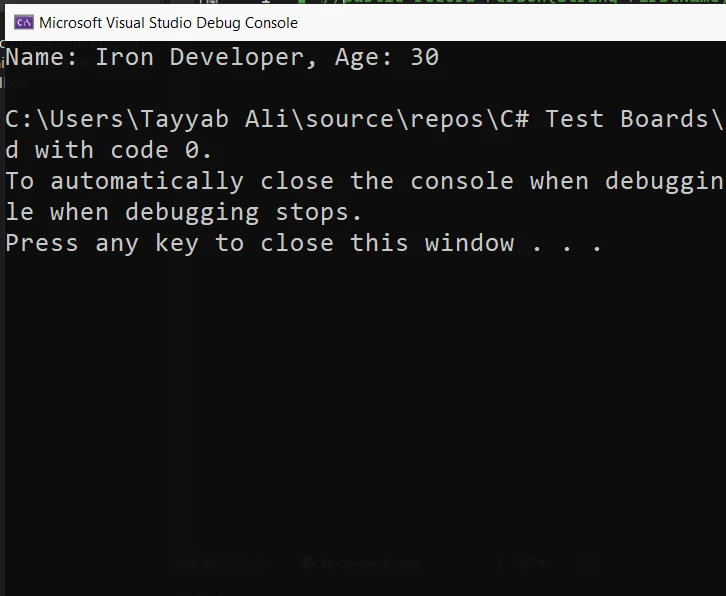
El método public static void Main en este caso crea un nuevo Person, luego usa el deconstructor para extraer Name y Age. Este método se llama implícitamente cuando el programa se ejecuta, simplificando la extracción de datos de los objetos.
Deconstrucción de tuplas
La desestructuración de tuplas es una forma conveniente de extraer valores de una tupla y asignarlos a variables individuales. Esta característica te permite dividir una tupla en sus partes constituyentes en una sola declaración, haciendo tu código más limpio y legible.
Ejemplo
Aquí tienes cómo puedes desestructurar una tupla en C#:
using System;

public class Program
{
    public static void Main()
    {
        // Create an instance of the Book class
        var book = new Book
        {
            Title = "C# Programming",
            Author = "Jon Skeet",
            Pages = 300
        };

        // Deconstruct the book object to get properties directly
        var (title, author, pages) = DeconstructBook(book);

        // Output the deconstructed properties
        Console.WriteLine($"Title: {title}, Author: {author}, Pages: {pages}");
    }

    // Deconstructor method for a Book class
    private static (string title, string author, int pages) DeconstructBook(Book book)
    {
        return (book.Title, book.Author, book.Pages);
    }
}

public class Book
{
    public string Title { get; set; }
    public string Author { get; set; }
    public int Pages { get; set; }
}
using System;

public class Program
{
    public static void Main()
    {
        // Create an instance of the Book class
        var book = new Book
        {
            Title = "C# Programming",
            Author = "Jon Skeet",
            Pages = 300
        };

        // Deconstruct the book object to get properties directly
        var (title, author, pages) = DeconstructBook(book);

        // Output the deconstructed properties
        Console.WriteLine($"Title: {title}, Author: {author}, Pages: {pages}");
    }

    // Deconstructor method for a Book class
    private static (string title, string author, int pages) DeconstructBook(Book book)
    {
        return (book.Title, book.Author, book.Pages);
    }
}

public class Book
{
    public string Title { get; set; }
    public string Author { get; set; }
    public int Pages { get; set; }
}
Imports System
Public Class Program
Public Shared Sub Main()
' Create an instance of the Book class
Dim book As New Book With {
.Title = "C# Programming",
.Author = "Jon Skeet",
.Pages = 300
}
' Deconstruct the book object to get properties directly
'INSTANT VB TODO TASK: VB has no equivalent to C# deconstruction declarations:
var(title, author, pages) = DeconstructBook(book)
' Output the deconstructed properties
Console.WriteLine($"Title: {title}, Author: {author}, Pages: {pages}")
End Sub
' Deconstructor method for a Book class
Private Shared Function DeconstructBook(ByVal book As Book) As (title As String, author As String, pages As Integer)
Return (book.Title, book.Author, book.Pages)
End Function
End Class
Public Class Book
Public Property Title() As String
Public Property Author() As String
Public Property Pages() As Integer
End Class
Imports System

Public Class Program
	Public Shared Sub Main()
		' Create an instance of the Book class
		Dim book As New Book With {
			.Title = "C# Programming",
			.Author = "Jon Skeet",
			.Pages = 300
		}

		' Deconstruct the book object to get properties directly
'INSTANT VB TODO TASK: VB has no equivalent to C# deconstruction declarations:
		var(title, author, pages) = DeconstructBook(book)

		' Output the deconstructed properties
		Console.WriteLine($"Title: {title}, Author: {author}, Pages: {pages}")
	End Sub

	' Deconstructor method for a Book class
	Private Shared Function DeconstructBook(ByVal book As Book) As (title As String, author As String, pages As Integer)
		Return (book.Title, book.Author, book.Pages)
	End Function
End Class

Public Class Book
	Public Property Title() As String
	Public Property Author() As String
	Public Property Pages() As Integer
End Class
En este ejemplo, la clase Book contiene tres propiedades: Title, Author y Pages. El método DeconstructBook() toma una instancia de la clase Book y devuelve una tupla que contiene los valores de estas propiedades. La declaración de deconstrucción en el método Main() luego asigna estos valores a las variables title, author y pages, respectivamente. De esta manera, puedes acceder fácilmente a los valores individuales sin necesidad de referenciar directamente el objeto Book.
Buceo en la mecánica de Deconstructor
Características principales y comportamiento
Los desestructuradores proporcionan una forma de extraer explícitamente información de un objeto. Deben ser llamados explícitamente para recuperar datos. Esto asegura que la información pueda ser accedida directa e inmediatamente. Los desestructuradores simplifican el proceso de descomponer un objeto en sus partes. Son especialmente útiles para la coincidencia de patrones y la extracción de valores.
Herencia y deconstructores
Si una clase base tiene un desestructurador, puede ser extendido o sobrescrito en una clase derivada. Esto sigue la cadena de herencia, permitiendo aplicar métodos de extensión que pueden personalizar aún más el proceso de desestructuración. Esto es particularmente útil cuando la clase derivada incluye propiedades adicionales que deben ser extraídas junto con las heredadas de la clase base.
IronPDF con Deconstructores
IronPDF es una biblioteca .NET que facilita la creación, edición y gestión de archivos PDF usando C#. IronPDF utiliza un motor de renderizado de Chrome para esta conversión. Asegura que los PDFs se vean precisos y nítidos. Permite a los desarrolladores centrarse en diseñar su contenido en HTML sin preocuparse por los detalles complejos de generación de PDF. IronPDF admite convertir HTML directamente a PDFs. También puede convertir formularios web, URLs e imágenes en documentos PDF. Para editar, puedes agregar texto, imágenes, encabezados y pies de página a tus PDFs. También te permite asegurar tus PDFs con contraseñas y firmas digitales.
Ejemplo de código
El siguiente código muestra cómo podrías usar IronPDF en C# para generar un PDF desde contenido HTML, y luego usar un desestructurador para manejar el documento PDF resultante para operaciones adicionales como la lectura de propiedades sin necesidad de múltiples llamadas a métodos o variables temporales. Este es un patrón de uso básico que enfatiza los aspectos de generación y desestructuración:
using IronPdf;

public class PdfGenerator
{
    public static void Main()
    {
        // Set your License Key
        License.LicenseKey = "License-Key";

        // Create an instance of the PDF renderer
        var renderer = new ChromePdfRenderer();

        // Generate a PDF from HTML content
        var pdfDocument = renderer.RenderHtmlAsPdf("<h1>Hello, IronPDF!</h1>");

        // Deconstruct the PDF document to get properties directly
        var (pageCount, author) = DeconstructPdf(pdfDocument);

        // Output the deconstructed properties
        Console.WriteLine($"Page Count: {pageCount}, Author: {author}");
    }

    // Deconstructor method for a PdfDocument
    private static (int pageCount, string author) DeconstructPdf(PdfDocument document)
    {
        return (document.PageCount, document.MetaData.Author);
    }
}
using IronPdf;

public class PdfGenerator
{
    public static void Main()
    {
        // Set your License Key
        License.LicenseKey = "License-Key";

        // Create an instance of the PDF renderer
        var renderer = new ChromePdfRenderer();

        // Generate a PDF from HTML content
        var pdfDocument = renderer.RenderHtmlAsPdf("<h1>Hello, IronPDF!</h1>");

        // Deconstruct the PDF document to get properties directly
        var (pageCount, author) = DeconstructPdf(pdfDocument);

        // Output the deconstructed properties
        Console.WriteLine($"Page Count: {pageCount}, Author: {author}");
    }

    // Deconstructor method for a PdfDocument
    private static (int pageCount, string author) DeconstructPdf(PdfDocument document)
    {
        return (document.PageCount, document.MetaData.Author);
    }
}
Imports IronPdf
Public Class PdfGenerator
Public Shared Sub Main()
' Set your License Key
License.LicenseKey = "License-Key"
' Create an instance of the PDF renderer
Dim renderer = New ChromePdfRenderer()
' Generate a PDF from HTML content
Dim pdfDocument = renderer.RenderHtmlAsPdf("<h1>Hello, IronPDF!</h1>")
' Deconstruct the PDF document to get properties directly
'INSTANT VB TODO TASK: VB has no equivalent to C# deconstruction declarations:
var(pageCount, author) = DeconstructPdf(pdfDocument)
' Output the deconstructed properties
Console.WriteLine($"Page Count: {pageCount}, Author: {author}")
End Sub
' Deconstructor method for a PdfDocument
Private Shared Function DeconstructPdf(ByVal document As PdfDocument) As (pageCount As Integer, author As String)
Return (document.PageCount, document.MetaData.Author)
End Function
End Class
Imports IronPdf

Public Class PdfGenerator
	Public Shared Sub Main()
		' Set your License Key
		License.LicenseKey = "License-Key"

		' Create an instance of the PDF renderer
		Dim renderer = New ChromePdfRenderer()

		' Generate a PDF from HTML content
		Dim pdfDocument = renderer.RenderHtmlAsPdf("<h1>Hello, IronPDF!</h1>")

		' Deconstruct the PDF document to get properties directly
'INSTANT VB TODO TASK: VB has no equivalent to C# deconstruction declarations:
		var(pageCount, author) = DeconstructPdf(pdfDocument)

		' Output the deconstructed properties
		Console.WriteLine($"Page Count: {pageCount}, Author: {author}")
	End Sub

	' Deconstructor method for a PdfDocument
	Private Shared Function DeconstructPdf(ByVal document As PdfDocument) As (pageCount As Integer, author As String)
		Return (document.PageCount, document.MetaData.Author)
	End Function
End Class
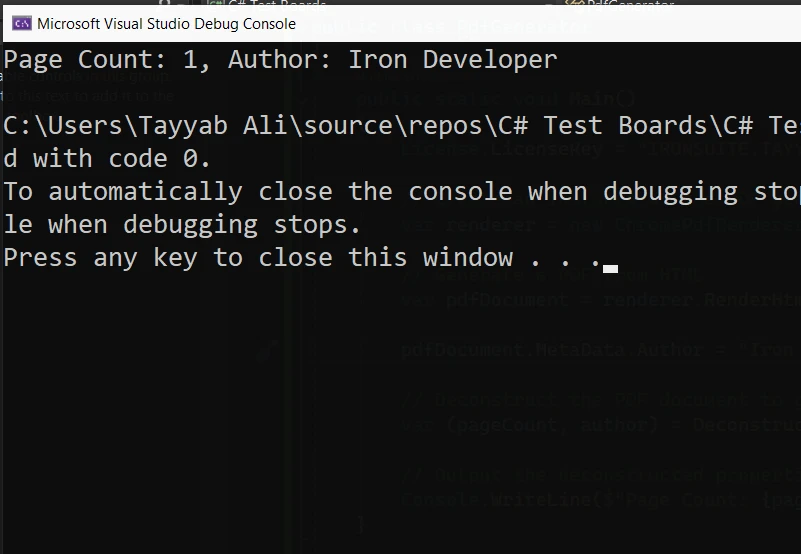
Este ejemplo en C# abstrae el proceso de obtener propiedades de un documento PDF, ilustrando cómo puedes usar un desestructurador en situaciones prácticas para simplificar la estructura de tu código y mejorar su legibilidad. Recuerda, IronPDF no admite inherentemente desestructuradores; esto es solo una implementación personalizada para fines demostrativos.
Conclusión
En resumen, los desestructuradores en C# son herramientas poderosas que permiten a los desarrolladores manejar y manipular datos dentro de objetos de manera eficiente. Al comprender cómo implementar y usar desestructuradores, puedes manejar datos complejos de manera más efectiva, asegurando que todos los componentes de un objeto sean accesibles cuando se necesitan. Ya sea que estés tratando con objetos simples o complejos, dominar los desestructuradores mejorará en gran medida tu efectividad en la codificación y precisión en el manejo de estructuras de datos.
Explore las opciones de precios y licencias de IronPDF comenzando en $999.