using IronPdf;

// Disable local disk access or cross-origin requests
Installation.EnableWebSecurity = true;

// Instantiate Renderer
var renderer = new ChromePdfRenderer();

// Create a PDF from a HTML string using C#
var pdf = renderer.RenderHtmlAsPdf("<h1>Hello World</h1>");

// Export to a file or Stream
pdf.SaveAs("output.pdf");

// Advanced Example with HTML Assets
// Load external html assets: Images, CSS and JavaScript.
// An optional BasePath 'C:\site\assets\' is set as the file location to load assets from
var myAdvancedPdf = renderer.RenderHtmlAsPdf("<img src='icons/iron.png'>", @"C:\site\assets\");
myAdvancedPdf.SaveAs("html-with-assets.pdf");
using IronPdf;// Disable local disk access or cross-origin requestsInstallation.EnableWebSecurity = true;// Instantiate Renderervar renderer = new ChromePdfRenderer();// Create a PDF from a HTML string using C#var pdf = renderer.RenderHtmlAsPdf("<h1>Hello World</h1>");// Export to a file or Streampdf.SaveAs("output.pdf");// Advanced Example with HTML Assets// Load external html assets: Images, CSS and JavaScript.// An optional BasePath 'C:\site\assets\' is set as the file location to load assets fromvar myAdvancedPdf = renderer.RenderHtmlAsPdf("<img src='icons/iron.png'>", @"C:\site\assets\");myAdvancedPdf.SaveAs("html-with-assets.pdf");
El registro es una parte integral del desarrollo de software, proporcionando a los desarrolladores información valiosa sobre el comportamiento de la aplicación y ayudando en la depuración, el monitoreo y la resolución de problemas. En el ámbito de C# y SQL Server, los mecanismos efectivos de API de registro estructurado son cruciales para garantizar la robustez y confiabilidad de la aplicación. Esta guía comprensiva explorará la importancia de los proveedores de registro, varios marcos de registro disponibles en C#, las mejores prácticas para la implementación de marcos de registro y técnicas avanzadas para ayudarte a dominar el registro en tus [Aplicaciones de Registro C#](https://learn.microsoft.com/en-us/dotnet/core/extensions/logging?tabs=command-line). También discutiremos cómo crear informes de mensajes de registro en PDF utilizando [IronPDF para la Generación de PDF](/).
## 1. Por qué es importante el registro
Antes de profundizar en los detalles técnicos, entendamos por qué el registro es indispensable en el desarrollo de software:
1. **Depuración:** el registro ayuda a los desarrolladores a identificar y diagnosticar problemas a lo largo del ciclo de vida del desarrollo. Mensajes de archivos de registro detallados proporcionan información valiosa sobre el flujo de ejecución, los valores de las variables y posibles errores, facilitando una depuración eficiente.
2. **Monitoreo:** En entornos de producción, el registro funciona como una herramienta de monitoreo, permitiendo a los equipos de operaciones rastrear el comportamiento de las aplicaciones, detectar anomalías y solucionar problemas de manera proactiva. Los registros de monitoreo ayudan a identificar cuellos de botella de rendimiento, brechas de seguridad y eventos críticos.
3. **Auditoría y cumplimiento:** el registro suele ser un requisito regulatorio en diversas industrias, como las finanzas y la atención médica. Registros comprehensivos con un nivel de registro mínimo aseguran responsabilidad, facilitan auditorías y demuestran cumplimiento con las regulaciones de protección de datos.
4. **Optimización del rendimiento:** el análisis de registros permite a los desarrolladores identificar áreas para optimizar el rendimiento, como consultas de base de datos ineficientes o llamadas de servicios externos lentas. Optimizar estos aspectos mejora el rendimiento y la escalabilidad de la aplicación.
## 2. Logging Frameworks in C#
C# ofrece varios marcos de registro, cada uno con sus características y capacidades. Exploremos algunos proveedores de registro populares junto con ejemplos de código:
### 2.1. NLog
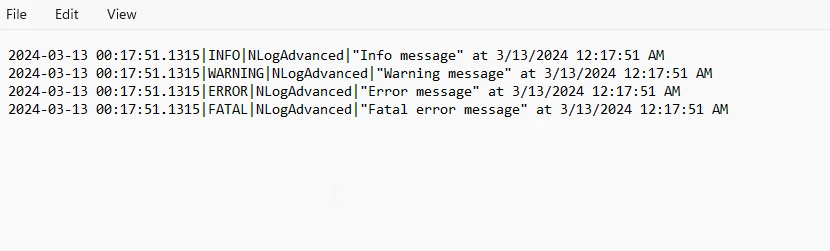
NLog es una biblioteca de registro de alto rendimiento con opciones extensas de archivo de configuración. Aquí tienes un ejemplo sencillo de cómo usar NLog en una aplicación C# para escribir mensajes de registro:
```csharp
// Install-Package NLog
using NLog;

public class Program
{
    // Initialize a logger instance from NLog
    private static readonly Logger logger = LogManager.GetCurrentClassLogger();

    static void Main(string[] args)
    {
        // Log various levels of messages
        logger.Info("Info message");
        logger.Warn("Warning message");
        logger.Error("Error message");
        logger.Fatal("Fatal error message");
    }
}
```
### 2.2. Serilog
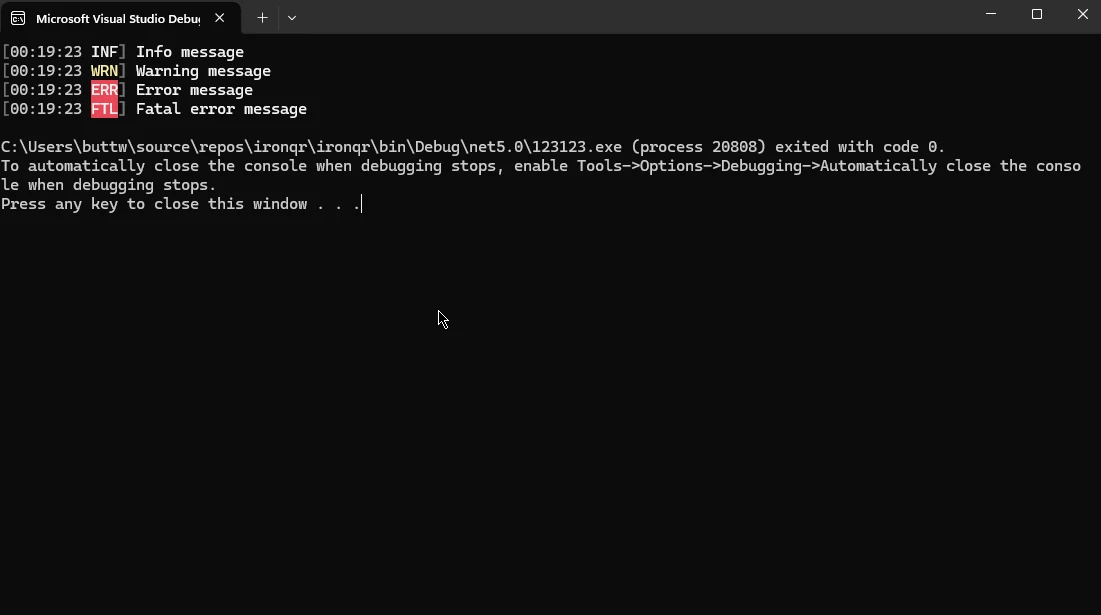
Serilog se centra en la API de registro estructurado y la integración sin problemas con infraestructuras de registro modernas. Así es como puedes usar Serilog en una aplicación C#:
```csharp
// Install-Package Serilog
// Install-Package Serilog.Sinks.Console
using Serilog;
public class Program
{
static void Main(string[] args)
{
// Configure Serilog to write log messages to the console
Log.Logger = new LoggerConfiguration()
.WriteTo.Console()
.CreateLogger();
// Log messages at various levels
Log.Debug("Debug message");
Log.Information("Info message");
Log.Warning("Warning message");
Log.Error("Error message");
Log.Fatal("Fatal error message");
}
}
```
### 2.3. Registro de extensiones de Microsoft
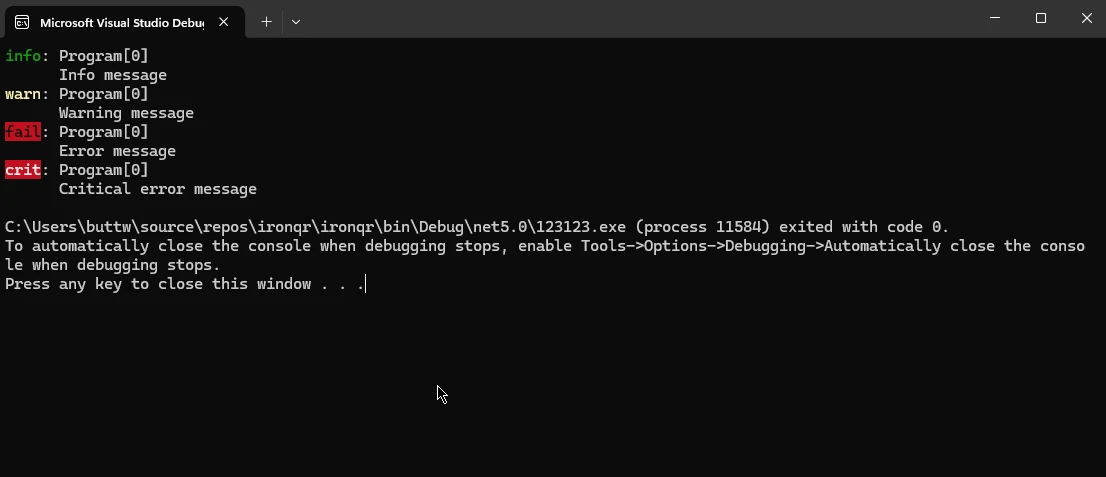
Microsoft.Extensions.Logging es una abstracción ligera de registro incluida en el ecosistema de .NET Core. Aquí tienes un ejemplo básico de cómo usarlo:
```csharp
// Install-Package Microsoft.Extensions.Logging
using Microsoft.Extensions.Logging;
public class Program
{
static void Main(string[] args)
{
// Create a logger factory with console output
ILoggerFactory loggerFactory = LoggerFactory.Create(builder =>
{
builder.AddConsole(); // Add console logger
});
// Create a logger from the factory
ILogger logger = loggerFactory.CreateLogger<Program>();
// Log messages at various levels
logger.LogDebug("Debug message");
logger.LogInformation("Info message");
logger.LogWarning("Warning message");
logger.LogError("Error message");
logger.LogCritical("Critical error message");
}
}
```
## 3. Best Practices for Logging in C#
Para garantizar un registro efectivo en tus aplicaciones C#, considera las siguientes mejores prácticas:
1. **Utilice mensajes de registro descriptivos:** escriba mensajes de registro que proporcionen un contexto significativo sobre los eventos que se registran. Incluye información relevante como marcas de tiempo, códigos de error, identificaciones de usuario y detalles de operación para ayudar en la resolución de problemas.
2. **Elija niveles de registro adecuados:** utilice diferentes niveles de registro (por ejemplo, DEBUG, INFO, WARN, ERROR, FATAL) según la gravedad de los eventos registrados. Reserva los niveles de registro más bajos (por ejemplo, DEBUG) para información detallada de depuración y niveles más altos (por ejemplo, ERROR, FATAL) para errores críticos que requieren atención inmediata.
3. **Implementar la rotación de registros:** evite que los archivos de registro crezcan indefinidamente implementando mecanismos de rotación de registros. Configura tamaños máximos de archivo o rotación basada en el tiempo para archivar registros antiguos y mantener tamaños manejables de registros.
4. **Proteja la información confidencial:** evite registrar información confidencial, como contraseñas, claves API e información de identificación personal (PII). Implementa técnicas adecuadas de redacción u ofuscación para proteger datos sensibles en los registros.
5. **Centralice la gestión de registros:** considere usar soluciones de registro centralizadas como Elasticsearch, Splunk o Azure Application Insights para agregar y analizar registros de múltiples fuentes. El registro centralizado facilita la búsqueda, el análisis y la visualización de los registros, mejorando las capacidades de resolución de problemas.
6. **Habilite el registro estructurado:** adopte formatos de registro estructurado como JSON o pares clave-valor para representar eventos de registro en un formato legible por máquina. Los registros estructurados permiten un análisis, filtrado y análisis más fácil en comparación con los registros de texto sin formato.
7. **Supervisar el estado de los registros:** supervisar el estado y la disponibilidad de la infraestructura de registro para garantizar la recopilación y el análisis ininterrumpidos de registros. Implementa alertas para problemas críticos de registro como agotamiento del espacio de disco, problemas de conectividad de red o tiempo de inactividad del servicio.
## 4. Técnicas avanzadas de registro
Más allá de los conceptos básicos, varias técnicas avanzadas de registro pueden mejorar aún más tus capacidades de registro en C#:
1. **Registro contextual:** enriquezca los eventos de registro con información contextual, como encabezados de solicitud HTTP, ID de sesión o ID de correlación, para rastrear el flujo de ejecución en sistemas distribuidos.
2. **Registro asincrónico:** mejore el rendimiento de la aplicación al descargar las operaciones de registro en subprocesos en segundo plano o tareas asincrónicas. El registro asíncrono evita bloquear el hilo de ejecución principal y minimiza el impacto en la capacidad de respuesta de la aplicación.
3. **Registro y manejo de excepciones:** implemente un registro de excepciones estructurado para capturar información detallada sobre las excepciones, incluidos los seguimientos de pila, las excepciones internas y el contexto de la excepción. Maneja las excepciones de manera ordenada y regístralas en niveles de registro apropiados para ayudar en la resolución de problemas y la recuperación de errores.
4. **Registro de rendimiento:** instrumente rutas de código críticas con registro de rendimiento para medir y analizar métricas de rendimiento de la aplicación, como tiempos de respuesta, rendimiento y utilización de recursos. Los registros de rendimiento ayudan a identificar cuellos de botella de rendimiento y optimizar la eficiencia de la aplicación.
5. **Correlación y agregación de registros:** correlacione eventos de registro relacionados entre componentes distribuidos o microservicios incluyendo identificadores únicos o ID de seguimiento en los mensajes de registro. Agrega registros correlacionados para tener una visión holística del comportamiento del sistema distribuido y solución de problemas.
## 5. IronPDF: Mejor Biblioteca C# para Crear Informes de Log
IronPDF es una biblioteca integral de C# que permite a los desarrolladores crear, editar y manipular documentos PDF de manera fluida dentro de sus aplicaciones .NET. Ya sea que necesites generar informes en PDF, convertir HTML a PDF o extraer texto de archivos PDF, IronPDF proporciona un conjunto rico de características para cumplir con tus requisitos. Con su API intuitiva y funcionalidad robusta, IronPDF simplifica las tareas de generación y manipulación de PDF, permitiendo a los desarrolladores mejorar sus aplicaciones con capacidades de documentos PDF de alta calidad.
## 5.1. Creación de informes de registro con IronPDF
Generar informes en PDF a partir de datos de registro es un requisito común en muchas aplicaciones, proporcionando a las partes interesadas información valiosa sobre el comportamiento y el rendimiento de la aplicación. En este ejemplo, demostraremos cómo crear un informe de registro usando IronPDF, incluyendo entradas de registro y metadatos relevantes.
### Paso 1: Instalar el paquete IronPDF
Primero, asegúrate de tener instalado el paquete IronPDF en tu proyecto. Puedes instalarlo a través del Administrador de Paquetes NuGet o la Consola de Paquetes NuGet:
```shell
:ProductInstall
```
### Paso 2: Crear datos de registro
Para fines de demostración, crearemos algunos datos de registro de ejemplo en nuestra aplicación. Puedes usar tu marco de registro preferido o simplemente registrar entradas manualmente:
```csharp
using System;
using System.Collections.Generic;
public class LogEntry
{
public DateTime Timestamp { get; set; }
public string Message { get; set; }
public LogLevel Level { get; set; }
}
public enum LogLevel
{
Info,
Warning,
Error
}
public class LogService
{
public List<LogEntry> GetLogEntries()
{
// Sample log entries
var logEntries = new List<LogEntry>
{
new LogEntry { Timestamp = DateTime.Now, Message = "Application started.", Level = LogLevel.Info },
new LogEntry { Timestamp = DateTime.Now, Message = "Warning: Disk space low.", Level = LogLevel.Warning },
new LogEntry { Timestamp = DateTime.Now, Message = "Error: Database connection failed.", Level = LogLevel.Error }
};
return logEntries;
}
}
```
### Paso 3: Generar informe en PDF
Ahora, usemos IronPDF para generar un informe en PDF a partir de los datos de registro.
```csharp
using IronPdf;
using System.Collections.Generic;
public class PdfReportGenerator
{
public void GenerateLogReport(List<LogEntry> logEntries)
{
var renderer = new ChromePdfRenderer();
var htmlContent = "<h1>Log Report</h1><hr/><ul>";
// Format log entries into an HTML list
foreach (var entry in logEntries)
{
htmlContent += $"<li><strong>{entry.Timestamp}</strong> - [{entry.Level}] {entry.Message}</li>";
}
htmlContent += "</ul>";
// Render the HTML content to a PDF
var pdf = renderer.RenderHtmlAsPdf(htmlContent);
// Save the PDF to a file
var outputPath = "LogReport.pdf";
pdf.SaveAs(outputPath);
}
}
```
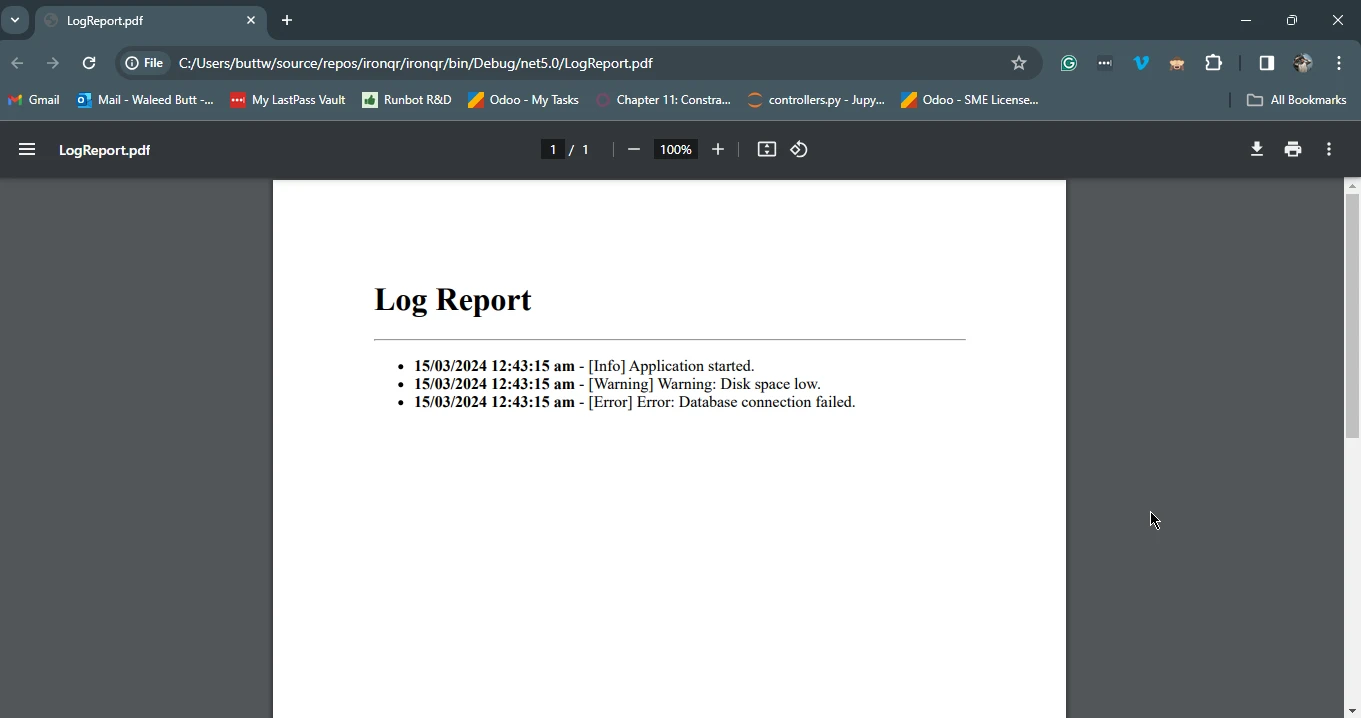
### Paso 4: Generar y ver el informe de registro
Finalmente, crearemos una instancia de **LogService** para obtener datos de registro y generar el informe en PDF.
```csharp
class Program
{
static void Main(string[] args)
{
var logService = new LogService();
var logEntries = logService.GetLogEntries();
var pdfGenerator = new PdfReportGenerator();
pdfGenerator.GenerateLogReport(logEntries);
}
}
```
Este código obtiene datos de registro de ejemplo usando **LogService**, genera una representación HTML del informe de registro, lo convierte a PDF usando ChromePdfRenderer de IronPDF, guarda el PDF en un archivo y lo abre para su visualización.
## 6. Conclusión
El registro es un componente crítico del desarrollo de software moderno, ofreciendo a los desarrolladores información invaluable sobre el comportamiento y rendimiento de la aplicación. Ya sea depurando código durante el desarrollo o monitoreando la salud de la aplicación en entornos de producción, el registro proporciona visibilidad esencial en las operaciones del sistema. Con una plétora de marcos de registro disponibles en C#, los desarrolladores tienen la flexibilidad de elegir la herramienta más adecuada para sus necesidades, ya sea NLog por su rendimiento, Serilog por sus capacidades de registro estructurado o Microsoft.Extensions.Logging por su abstracción ligera.
[IronPDF C# PDF Library](/docs/) se destaca como una herramienta poderosa para generar informes de registro en PDF de manera fluida dentro de aplicaciones C#. Su API intuitiva simplifica el proceso de transformar datos de registro en documentos PDF atractivos y procesables. Al integrar IronPDF en sus aplicaciones, los desarrolladores pueden mejorar sus capacidades de registro y proporcionar a las partes interesadas información comprensiva sobre el comportamiento de la aplicación. Desde la creación de registros de auditoría detallados hasta la generación de informes de rendimiento, IronPDF empodera a los desarrolladores para aprovechar el máximo potencial de la generación de documentos PDF en sus aplicaciones C#, enriqueciendo aún más la experiencia de desarrollo y mantenimiento.
Para obtener más información sobre IronPDF y sus características, visita la [Documentación de Licencias de IronPDF](/licensing/) oficial y explora cómo puede ser convertido a producción.
El registro es una parte integral del desarrollo de software, proporcionando a los desarrolladores información valiosa sobre el comportamiento de la aplicación y ayudando en la depuración, el monitoreo y la resolución de problemas. En el ámbito de C# y SQL Server, los mecanismos efectivos de API de registro estructurado son cruciales para garantizar la robustez y confiabilidad de la aplicación. Esta guía comprensiva explorará la importancia de los proveedores de registro, varios marcos de registro disponibles en C#, las mejores prácticas para la implementación de marcos de registro y técnicas avanzadas para ayudarte a dominar el registro en tus Aplicaciones de Registro C#. También discutiremos cómo crear informes de mensajes de registro en PDF utilizando IronPDF para la Generación de PDF.
1. Por qué es importante el registro
Antes de profundizar en los detalles técnicos, entendamos por qué el registro es indispensable en el desarrollo de software:
Depuración: el registro ayuda a los desarrolladores a identificar y diagnosticar problemas a lo largo del ciclo de vida del desarrollo. Mensajes de archivos de registro detallados proporcionan información valiosa sobre el flujo de ejecución, los valores de las variables y posibles errores, facilitando una depuración eficiente.
Monitoreo: En entornos de producción, el registro funciona como una herramienta de monitoreo, permitiendo a los equipos de operaciones rastrear el comportamiento de las aplicaciones, detectar anomalías y solucionar problemas de manera proactiva. Los registros de monitoreo ayudan a identificar cuellos de botella de rendimiento, brechas de seguridad y eventos críticos.
Auditoría y cumplimiento: el registro suele ser un requisito regulatorio en diversas industrias, como las finanzas y la atención médica. Registros comprehensivos con un nivel de registro mínimo aseguran responsabilidad, facilitan auditorías y demuestran cumplimiento con las regulaciones de protección de datos.
Optimización del rendimiento: el análisis de registros permite a los desarrolladores identificar áreas para optimizar el rendimiento, como consultas de base de datos ineficientes o llamadas de servicios externos lentas. Optimizar estos aspectos mejora el rendimiento y la escalabilidad de la aplicación.
2. Logging Frameworks in C#
C# ofrece varios marcos de registro, cada uno con sus características y capacidades. Exploremos algunos proveedores de registro populares junto con ejemplos de código:
2.1. NLog
NLog es una biblioteca de registro de alto rendimiento con opciones extensas de archivo de configuración. Aquí tienes un ejemplo sencillo de cómo usar NLog en una aplicación C# para escribir mensajes de registro:
// Install-Package NLogusing NLog;public class Program{ // Initialize a logger instance from NLog private static readonly Logger logger = LogManager.GetCurrentClassLogger(); static voidMain(string[] args) { // Log various levels of messages logger.Info("Info message"); logger.Warn("Warning message"); logger.Error("Error message"); logger.Fatal("Fatal error message"); }}
// Install-Package NLog
using NLog;

public class Program
{
    // Initialize a logger instance from NLog
    private static readonly Logger logger = LogManager.GetCurrentClassLogger();

    static void Main(string[] args)
    {
        // Log various levels of messages
        logger.Info("Info message");
        logger.Warn("Warning message");
        logger.Error("Error message");
        logger.Fatal("Fatal error message");
    }
}
' Install-Package NLogImportsNLogPublic Class Program ' Initialize a logger instance from NLog PrivateSharedReadOnly logger AsLogger = LogManager.GetCurrentClassLogger()Shared Sub Main(ByVal args() AsString) ' Log various levels of messages logger.Info("Info message") logger.Warn("Warning message") logger.Error("Error message") logger.Fatal("Fatal error message") End SubEnd Class
' Install-Package NLog
Imports NLog

Public Class Program
	' Initialize a logger instance from NLog
	Private Shared ReadOnly logger As Logger = LogManager.GetCurrentClassLogger()

	Shared Sub Main(ByVal args() As String)
		' Log various levels of messages
		logger.Info("Info message")
		logger.Warn("Warning message")
		logger.Error("Error message")
		logger.Fatal("Fatal error message")
	End Sub
End Class
2.2. Serilog
Serilog se centra en la API de registro estructurado y la integración sin problemas con infraestructuras de registro modernas. Así es como puedes usar Serilog en una aplicación C#:
// Install-Package Serilog// Install-Package Serilog.Sinks.Consoleusing Serilog;public class Program{ static voidMain(string[] args) { // Configure Serilog to write log messages to the consoleLog.Logger = new LoggerConfiguration() .WriteTo.Console() .CreateLogger(); // Log messages at various levelsLog.Debug("Debug message");Log.Information("Info message");Log.Warning("Warning message");Log.Error("Error message");Log.Fatal("Fatal error message"); }}
// Install-Package Serilog
// Install-Package Serilog.Sinks.Console
using Serilog;

public class Program
{
    static void Main(string[] args)
    {
        // Configure Serilog to write log messages to the console
        Log.Logger = new LoggerConfiguration()
            .WriteTo.Console()
            .CreateLogger();

        // Log messages at various levels
        Log.Debug("Debug message");
        Log.Information("Info message");
        Log.Warning("Warning message");
        Log.Error("Error message");
        Log.Fatal("Fatal error message");
    }
}
' Install-Package Serilog' Install-Package Serilog.Sinks.ConsoleImportsSerilogPublic Class ProgramShared Sub Main(ByVal args() AsString) ' Configure Serilog to write log messages to the consoleLog.Logger = (New LoggerConfiguration()).WriteTo.Console().CreateLogger() ' Log messages at various levelsLog.Debug("Debug message")Log.Information("Info message")Log.Warning("Warning message")Log.Error("Error message")Log.Fatal("Fatal error message") End SubEnd Class
' Install-Package Serilog
' Install-Package Serilog.Sinks.Console
Imports Serilog

Public Class Program
	Shared Sub Main(ByVal args() As String)
		' Configure Serilog to write log messages to the console
		Log.Logger = (New LoggerConfiguration()).WriteTo.Console().CreateLogger()

		' Log messages at various levels
		Log.Debug("Debug message")
		Log.Information("Info message")
		Log.Warning("Warning message")
		Log.Error("Error message")
		Log.Fatal("Fatal error message")
	End Sub
End Class
2.3. Registro de extensiones de Microsoft
Microsoft.Extensions.Logging es una abstracción ligera de registro incluida en el ecosistema de .NET Core. Aquí tienes un ejemplo básico de cómo usarlo:
// Install-Package Microsoft.Extensions.Loggingusing Microsoft.Extensions.Logging;public class Program{ static voidMain(string[] args) { // Create a logger factory with console output ILoggerFactory loggerFactory = LoggerFactory.Create(builder => { builder.AddConsole(); // Add console logger }); // Create a logger from the factory ILogger logger = loggerFactory.CreateLogger<Program>(); // Log messages at various levels logger.LogDebug("Debug message"); logger.LogInformation("Info message"); logger.LogWarning("Warning message"); logger.LogError("Error message"); logger.LogCritical("Critical error message"); }}
// Install-Package Microsoft.Extensions.Logging
using Microsoft.Extensions.Logging;

public class Program
{
    static void Main(string[] args)
    {
        // Create a logger factory with console output
        ILoggerFactory loggerFactory = LoggerFactory.Create(builder =>
        {
            builder.AddConsole(); // Add console logger
        });

        // Create a logger from the factory
        ILogger logger = loggerFactory.CreateLogger<Program>();

        // Log messages at various levels
        logger.LogDebug("Debug message");
        logger.LogInformation("Info message");
        logger.LogWarning("Warning message");
        logger.LogError("Error message");
        logger.LogCritical("Critical error message");
    }
}
' Install-Package Microsoft.Extensions.LoggingImportsMicrosoft.Extensions.LoggingPublic Class ProgramShared Sub Main(ByVal args() AsString) ' Create a logger factory with console output Dim loggerFactory AsILoggerFactory = LoggerFactory.Create(Sub(builder) builder.AddConsole() ' Add console logger End Sub) ' Create a logger from the factory Dim logger AsILogger = loggerFactory.CreateLogger(OfProgram)() ' Log messages at various levels logger.LogDebug("Debug message") logger.LogInformation("Info message") logger.LogWarning("Warning message") logger.LogError("Error message") logger.LogCritical("Critical error message") End SubEnd Class
' Install-Package Microsoft.Extensions.Logging
Imports Microsoft.Extensions.Logging

Public Class Program
	Shared Sub Main(ByVal args() As String)
		' Create a logger factory with console output
		Dim loggerFactory As ILoggerFactory = LoggerFactory.Create(Sub(builder)
			builder.AddConsole() ' Add console logger
		End Sub)

		' Create a logger from the factory
		Dim logger As ILogger = loggerFactory.CreateLogger(Of Program)()

		' Log messages at various levels
		logger.LogDebug("Debug message")
		logger.LogInformation("Info message")
		logger.LogWarning("Warning message")
		logger.LogError("Error message")
		logger.LogCritical("Critical error message")
	End Sub
End Class
3. Best Practices for Logging in C#
Para garantizar un registro efectivo en tus aplicaciones C#, considera las siguientes mejores prácticas:
Utilice mensajes de registro descriptivos: escriba mensajes de registro que proporcionen un contexto significativo sobre los eventos que se registran. Incluye información relevante como marcas de tiempo, códigos de error, identificaciones de usuario y detalles de operación para ayudar en la resolución de problemas.
Elija niveles de registro adecuados: utilice diferentes niveles de registro (por ejemplo, DEBUG, INFO, WARN, ERROR, FATAL) según la gravedad de los eventos registrados. Reserva los niveles de registro más bajos (por ejemplo, DEBUG) para información detallada de depuración y niveles más altos (por ejemplo, ERROR, FATAL) para errores críticos que requieren atención inmediata.
Implementar la rotación de registros: evite que los archivos de registro crezcan indefinidamente implementando mecanismos de rotación de registros. Configura tamaños máximos de archivo o rotación basada en el tiempo para archivar registros antiguos y mantener tamaños manejables de registros.
Proteja la información confidencial: evite registrar información confidencial, como contraseñas, claves API e información de identificación personal (PII). Implementa técnicas adecuadas de redacción u ofuscación para proteger datos sensibles en los registros.
Centralice la gestión de registros: considere usar soluciones de registro centralizadas como Elasticsearch, Splunk o Azure Application Insights para agregar y analizar registros de múltiples fuentes. El registro centralizado facilita la búsqueda, el análisis y la visualización de los registros, mejorando las capacidades de resolución de problemas.
Habilite el registro estructurado: adopte formatos de registro estructurado como JSON o pares clave-valor para representar eventos de registro en un formato legible por máquina. Los registros estructurados permiten un análisis, filtrado y análisis más fácil en comparación con los registros de texto sin formato.
Supervisar el estado de los registros: supervisar el estado y la disponibilidad de la infraestructura de registro para garantizar la recopilación y el análisis ininterrumpidos de registros. Implementa alertas para problemas críticos de registro como agotamiento del espacio de disco, problemas de conectividad de red o tiempo de inactividad del servicio.
4. Técnicas avanzadas de registro
Más allá de los conceptos básicos, varias técnicas avanzadas de registro pueden mejorar aún más tus capacidades de registro en C#:
Registro contextual: enriquezca los eventos de registro con información contextual, como encabezados de solicitud HTTP, ID de sesión o ID de correlación, para rastrear el flujo de ejecución en sistemas distribuidos.
Registro asincrónico: mejore el rendimiento de la aplicación al descargar las operaciones de registro en subprocesos en segundo plano o tareas asincrónicas. El registro asíncrono evita bloquear el hilo de ejecución principal y minimiza el impacto en la capacidad de respuesta de la aplicación.
Registro y manejo de excepciones: implemente un registro de excepciones estructurado para capturar información detallada sobre las excepciones, incluidos los seguimientos de pila, las excepciones internas y el contexto de la excepción. Maneja las excepciones de manera ordenada y regístralas en niveles de registro apropiados para ayudar en la resolución de problemas y la recuperación de errores.
Registro de rendimiento: instrumente rutas de código críticas con registro de rendimiento para medir y analizar métricas de rendimiento de la aplicación, como tiempos de respuesta, rendimiento y utilización de recursos. Los registros de rendimiento ayudan a identificar cuellos de botella de rendimiento y optimizar la eficiencia de la aplicación.
Correlación y agregación de registros: correlacione eventos de registro relacionados entre componentes distribuidos o microservicios incluyendo identificadores únicos o ID de seguimiento en los mensajes de registro. Agrega registros correlacionados para tener una visión holística del comportamiento del sistema distribuido y solución de problemas.
5. IronPDF: Mejor Biblioteca C# para Crear Informes de Log
IronPDF es una biblioteca integral de C# que permite a los desarrolladores crear, editar y manipular documentos PDF de manera fluida dentro de sus aplicaciones .NET. Ya sea que necesites generar informes en PDF, convertir HTML a PDF o extraer texto de archivos PDF, IronPDF proporciona un conjunto rico de características para cumplir con tus requisitos. Con su API intuitiva y funcionalidad robusta, IronPDF simplifica las tareas de generación y manipulación de PDF, permitiendo a los desarrolladores mejorar sus aplicaciones con capacidades de documentos PDF de alta calidad.
5.1. Creación de informes de registro con IronPDF
Generar informes en PDF a partir de datos de registro es un requisito común en muchas aplicaciones, proporcionando a las partes interesadas información valiosa sobre el comportamiento y el rendimiento de la aplicación. En este ejemplo, demostraremos cómo crear un informe de registro usando IronPDF, incluyendo entradas de registro y metadatos relevantes.
Paso 1: Instalar el paquete IronPDF
Primero, asegúrate de tener instalado el paquete IronPDF en tu proyecto. Puedes instalarlo a través del Administrador de Paquetes NuGet o la Consola de Paquetes NuGet:
PM > Install-Package IronPdf
Install-Package IronPdf
Paso 2: Crear datos de registro
Para fines de demostración, crearemos algunos datos de registro de ejemplo en nuestra aplicación. Puedes usar tu marco de registro preferido o simplemente registrar entradas manualmente:
using System;using System.Collections.Generic;public class LogEntry{ public DateTimeTimestamp { get; set; } public stringMessage { get; set; } public LogLevelLevel { get; set; }}public enum LogLevel{Info,Warning,Error}public class LogService{ public List<LogEntry> GetLogEntries() { // Sample log entries var logEntries = new List<LogEntry> { new LogEntry { Timestamp = DateTime.Now, Message = "Application started.", Level = LogLevel.Info }, new LogEntry { Timestamp = DateTime.Now, Message = "Warning: Disk space low.", Level = LogLevel.Warning }, new LogEntry { Timestamp = DateTime.Now, Message = "Error: Database connection failed.", Level = LogLevel.Error } }; return logEntries; }}
using System;
using System.Collections.Generic;

public class LogEntry
{
    public DateTime Timestamp { get; set; }
    public string Message { get; set; }
    public LogLevel Level { get; set; }
}

public enum LogLevel
{
    Info,
    Warning,
    Error
}

public class LogService
{
    public List<LogEntry> GetLogEntries()
    {
        // Sample log entries
        var logEntries = new List<LogEntry>
        {
            new LogEntry { Timestamp = DateTime.Now, Message = "Application started.", Level = LogLevel.Info },
            new LogEntry { Timestamp = DateTime.Now, Message = "Warning: Disk space low.", Level = LogLevel.Warning },
            new LogEntry { Timestamp = DateTime.Now, Message = "Error: Database connection failed.", Level = LogLevel.Error }
        };
        return logEntries;
    }
}
ImportsSystemImportsSystem.Collections.GenericPublic Class LogEntry Public Property Timestamp() AsDateTime Public Property Message() AsString Public Property Level() AsLogLevelEnd ClassPublicEnumLogLevelInfoWarning [Error]EndEnumPublic Class LogService Public Function GetLogEntries() AsList(OfLogEntry) ' Sample log entries Dim logEntries = New List(OfLogEntry) From { New LogEntryWith { .Timestamp = DateTime.Now, .Message = "Application started.", .Level = LogLevel.Info }, New LogEntryWith { .Timestamp = DateTime.Now, .Message = "Warning: Disk space low.", .Level = LogLevel.Warning }, New LogEntryWith { .Timestamp = DateTime.Now, .Message = "Error: Database connection failed.", .Level = LogLevel.Error } } Return logEntries End FunctionEnd Class
Imports System
Imports System.Collections.Generic

Public Class LogEntry
	Public Property Timestamp() As DateTime
	Public Property Message() As String
	Public Property Level() As LogLevel
End Class

Public Enum LogLevel
	Info
	Warning
	[Error]
End Enum

Public Class LogService
	Public Function GetLogEntries() As List(Of LogEntry)
		' Sample log entries
		Dim logEntries = New List(Of LogEntry) From {
			New LogEntry With {
				.Timestamp = DateTime.Now,
				.Message = "Application started.",
				.Level = LogLevel.Info
			},
			New LogEntry With {
				.Timestamp = DateTime.Now,
				.Message = "Warning: Disk space low.",
				.Level = LogLevel.Warning
			},
			New LogEntry With {
				.Timestamp = DateTime.Now,
				.Message = "Error: Database connection failed.",
				.Level = LogLevel.Error
			}
		}
		Return logEntries
	End Function
End Class
Paso 3: Generar informe en PDF
Ahora, usemos IronPDF para generar un informe en PDF a partir de los datos de registro.
using IronPdf;using System.Collections.Generic;public class PdfReportGenerator{ public voidGenerateLogReport(List<LogEntry> logEntries) { var renderer = new ChromePdfRenderer(); var htmlContent = "<h1>Log Report</h1><hr/><ul>"; // Format log entries into an HTML list foreach (var entry in logEntries) { htmlContent += $"<li><strong>{entry.Timestamp}</strong> - [{entry.Level}] {entry.Message}</li>"; } htmlContent += "</ul>"; // Render the HTML content to a PDF var pdf = renderer.RenderHtmlAsPdf(htmlContent); // Save the PDF to a file var outputPath = "LogReport.pdf"; pdf.SaveAs(outputPath); }}
using IronPdf;
using System.Collections.Generic;

public class PdfReportGenerator
{
    public void GenerateLogReport(List<LogEntry> logEntries)
    {
        var renderer = new ChromePdfRenderer();
        var htmlContent = "<h1>Log Report</h1><hr/><ul>";

        // Format log entries into an HTML list
        foreach (var entry in logEntries)
        {
            htmlContent += $"<li><strong>{entry.Timestamp}</strong> - [{entry.Level}] {entry.Message}</li>";
        }
        htmlContent += "</ul>";

        // Render the HTML content to a PDF
        var pdf = renderer.RenderHtmlAsPdf(htmlContent);

        // Save the PDF to a file
        var outputPath = "LogReport.pdf";
        pdf.SaveAs(outputPath);
    }
}
ImportsIronPdfImportsSystem.Collections.GenericPublic Class PdfReportGenerator Public Sub GenerateLogReport(ByVal logEntries AsList(OfLogEntry)) Dim renderer = New ChromePdfRenderer() Dim htmlContent = "<h1>Log Report</h1><hr/><ul>" ' Format log entries into an HTML list For Each entry In logEntries htmlContent &= $"<li><strong>{entry.Timestamp}</strong> - [{entry.Level}] {entry.Message}</li>" Next entry htmlContent &= "</ul>" ' Render the HTML content to a PDF Dim pdf = renderer.RenderHtmlAsPdf(htmlContent) ' Save the PDF to a file Dim outputPath = "LogReport.pdf" pdf.SaveAs(outputPath) End SubEnd Class
Imports IronPdf
Imports System.Collections.Generic

Public Class PdfReportGenerator
	Public Sub GenerateLogReport(ByVal logEntries As List(Of LogEntry))
		Dim renderer = New ChromePdfRenderer()
		Dim htmlContent = "<h1>Log Report</h1><hr/><ul>"

		' Format log entries into an HTML list
		For Each entry In logEntries
			htmlContent &= $"<li><strong>{entry.Timestamp}</strong> - [{entry.Level}] {entry.Message}</li>"
		Next entry
		htmlContent &= "</ul>"

		' Render the HTML content to a PDF
		Dim pdf = renderer.RenderHtmlAsPdf(htmlContent)

		' Save the PDF to a file
		Dim outputPath = "LogReport.pdf"
		pdf.SaveAs(outputPath)
	End Sub
End Class
Paso 4: Generar y ver el informe de registro
Finalmente, crearemos una instancia de LogService para obtener datos de registro y generar el informe en PDF.
class Program{ static voidMain(string[] args) { var logService = new LogService(); var logEntries = logService.GetLogEntries(); var pdfGenerator = new PdfReportGenerator(); pdfGenerator.GenerateLogReport(logEntries); }}
class Program
{
    static void Main(string[] args)
    {
        var logService = new LogService();
        var logEntries = logService.GetLogEntries();
        var pdfGenerator = new PdfReportGenerator();
        pdfGenerator.GenerateLogReport(logEntries);
    }
}
Friend Class ProgramShared Sub Main(ByVal args() AsString) Dim logService As New LogService() Dim logEntries = logService.GetLogEntries() Dim pdfGenerator = New PdfReportGenerator() pdfGenerator.GenerateLogReport(logEntries) End SubEnd Class
Friend Class Program
	Shared Sub Main(ByVal args() As String)
		Dim logService As New LogService()
		Dim logEntries = logService.GetLogEntries()
		Dim pdfGenerator = New PdfReportGenerator()
		pdfGenerator.GenerateLogReport(logEntries)
	End Sub
End Class
Este código obtiene datos de registro de ejemplo usando LogService, genera una representación HTML del informe de registro, lo convierte a PDF usando ChromePdfRenderer de IronPDF, guarda el PDF en un archivo y lo abre para su visualización.
6. Conclusión
El registro es un componente crítico del desarrollo de software moderno, ofreciendo a los desarrolladores información invaluable sobre el comportamiento y rendimiento de la aplicación. Ya sea depurando código durante el desarrollo o monitoreando la salud de la aplicación en entornos de producción, el registro proporciona visibilidad esencial en las operaciones del sistema. Con una plétora de marcos de registro disponibles en C#, los desarrolladores tienen la flexibilidad de elegir la herramienta más adecuada para sus necesidades, ya sea NLog por su rendimiento, Serilog por sus capacidades de registro estructurado o Microsoft.Extensions.Logging por su abstracción ligera.
IronPDF C# PDF Library se destaca como una herramienta poderosa para generar informes de registro en PDF de manera fluida dentro de aplicaciones C#. Su API intuitiva simplifica el proceso de transformar datos de registro en documentos PDF atractivos y procesables. Al integrar IronPDF en sus aplicaciones, los desarrolladores pueden mejorar sus capacidades de registro y proporcionar a las partes interesadas información comprensiva sobre el comportamiento de la aplicación. Desde la creación de registros de auditoría detallados hasta la generación de informes de rendimiento, IronPDF empodera a los desarrolladores para aprovechar el máximo potencial de la generación de documentos PDF en sus aplicaciones C#, enriqueciendo aún más la experiencia de desarrollo y mantenimiento.
Para obtener más información sobre IronPDF y sus características, visita la Documentación de Licencias de IronPDF oficial y explora cómo puede ser convertido a producción.
Jacob Mellor es Director de Tecnología de Iron Software y un ingeniero visionario pionero en la tecnología C# PDF. Como desarrollador original de la base de código principal de Iron Software, ha dado forma a la arquitectura de productos de la empresa desde su creación, transformándola, junto con el director ejecutivo Cameron Rimington, en una empresa de más de 50 personas que presta servicios a la NASA, Tesla y organismos gubernamentales de todo el mundo.