En C#, la palabra clave ref es una característica poderosa que permite a los métodos modificar el valor del parámetro de las variables de tipo referencia pasadas. Comprender cómo usar ref puede mejorar tu habilidad para gestionar y manipular datos dentro de tus aplicaciones.
Este artículo te guiará a través de los conceptos básicos de la palabra clave ref, su aplicación y los matices de utilizarlo con diferentes tipos de datos. También aprenderemos sobre la biblioteca IronPDF for .NET, que es una biblioteca PDF.
Entender los parámetros de referencia
Un parámetro ref es un parámetro de método que actúa como una referencia a la variable pasada al método. A diferencia de los parámetros de valor estándar, donde solo se pasa una copia de la variable, los parámetros ref permiten que el método llamado modifique el valor de la variable original. Este comportamiento es crucial cuando se necesita que un método actualice el estado de las variables que se le pasan.
Considera el siguiente ejemplo para demostrar el uso básico de ref, centrando en cómo una variable de tipo referencia retiene su valor de parámetro en el mismo objeto a lo largo de las llamadas al método:
class Program
{
    static void Main()
    {
        int number = 100;
        ModifyNumber(ref number);
        Console.WriteLine(number); // Output: 200
    }

    // Method that modifies the original number through 'ref'
    static void ModifyNumber(ref int number)
    {
        number = 200; // Modifies the original value
    }
}
class Program
{
    static void Main()
    {
        int number = 100;
        ModifyNumber(ref number);
        Console.WriteLine(number); // Output: 200
    }

    // Method that modifies the original number through 'ref'
    static void ModifyNumber(ref int number)
    {
        number = 200; // Modifies the original value
    }
}
Friend Class Program
Shared Sub Main()
Dim number As Integer = 100
ModifyNumber(number)
Console.WriteLine(number) ' Output: 200
End Sub
' Method that modifies the original number through 'ref'
Private Shared Sub ModifyNumber(ByRef number As Integer)
number = 200 ' Modifies the original value
End Sub
End Class
Friend Class Program
	Shared Sub Main()
		Dim number As Integer = 100
		ModifyNumber(number)
		Console.WriteLine(number) ' Output: 200
	End Sub

	' Method that modifies the original number through 'ref'
	Private Shared Sub ModifyNumber(ByRef number As Integer)
		number = 200 ' Modifies the original value
	End Sub
End Class
En este ejemplo, el método Main declara un entero number y lo inicializa a 100. Luego llama a ModifyNumber, pasando number como un parámetro ref. Dentro de ModifyNumber, el valor de number se cambia a 200. Dado que number se pasa por referencia, el cambio se refleja en el valor original en el método Main, e imprime 200 en la consola.
Cómo funcionan los parámetros de referencia
Cuando declaras un parámetro de método con la palabra clave ref, estás diciendo al compilador que el parámetro referenciará la variable original en lugar de una copia. Esto se logra pasando la dirección de memoria de la variable, en lugar del valor real. Tanto el método llamado como el llamador acceden al mismo lugar de memoria, lo que significa que cualquier cambio realizado en el parámetro se hace directamente sobre la variable original.
La clave para entender ref es reconocer que se puede utilizar tanto con tipos de valor como con tipos de referencia. Los tipos de valor incluyen tipos de datos simples como enteros y estructuras, mientras que los tipos de referencia incluyen objetos y arreglos. Sin embargo, aunque las variables de tipo referencia inherentemente contienen direcciones de memoria, usar ref con tipos de referencia te permite modificar la referencia actual, no solo el contenido del objeto.
Diferencias entre ref y out
Mientras que las palabras clave ref y out permiten modificar las variables originales, hay distinciones importantes. Un parámetro out no requiere inicialización antes de ser pasado a un método. Por el contrario, un parámetro ref requiere que la variable sea inicializada antes de ser pasada. Además, un método que utiliza un parámetro out está obligado a asignar un valor antes de que el método regrese. Este requisito no se aplica a los parámetros ref.
Aquí tienes cómo podrías usar la palabra clave out:
class Program
{
    static void Main()
    {
        int result;
        CalculateResult(out result);
        Console.WriteLine(result); // Output: 100
    }

    // Method that calculates a result and assigns it via 'out'
    static void CalculateResult(out int calculation)
    {
        calculation = 20 * 5; // Must initialize the out parameter
    }
}
class Program
{
    static void Main()
    {
        int result;
        CalculateResult(out result);
        Console.WriteLine(result); // Output: 100
    }

    // Method that calculates a result and assigns it via 'out'
    static void CalculateResult(out int calculation)
    {
        calculation = 20 * 5; // Must initialize the out parameter
    }
}
Friend Class Program
Shared Sub Main()
Dim result As Integer = Nothing
CalculateResult(result)
Console.WriteLine(result) ' Output: 100
End Sub
' Method that calculates a result and assigns it via 'out'
Private Shared Sub CalculateResult(ByRef calculation As Integer)
calculation = 20 * 5 ' Must initialize the out parameter
End Sub
End Class
Friend Class Program
	Shared Sub Main()
		Dim result As Integer = Nothing
		CalculateResult(result)
		Console.WriteLine(result) ' Output: 100
	End Sub

	' Method that calculates a result and assigns it via 'out'
	Private Shared Sub CalculateResult(ByRef calculation As Integer)
		calculation = 20 * 5 ' Must initialize the out parameter
	End Sub
End Class
En este caso, CalculateResult inicializa el calculation dentro del método, y Main refleja el resultado.
Uso práctico de ref en la sobrecarga de métodos
ref también se puede usar en la sobrecarga de métodos, donde la firma del método se altera por la palabra clave ref. Las firmas de métodos están compuestas por el nombre del método y sus tipos de parámetros, incluyendo si los parámetros se pasan por referencia (ref), por valor, o como un parámetro out.
Considera sobrecargar métodos basados en ref y parámetros de valor:
class Program
{
    static void Main()
    {
        int normalParameter = 10, refParameter = 10;
        IncrementValue(normalParameter);
        IncrementValue(ref refParameter);
        Console.WriteLine($"Normal: {normalParameter}, Ref: {refParameter}"); // Output: Normal: 10, Ref: 11
    }

    // Method that increments a copy of the integer
    static void IncrementValue(int number)
    {
        number++;
    }

    // Method that increments the original integer using 'ref'
    static void IncrementValue(ref int number)
    {
        number++;
    }
}
class Program
{
    static void Main()
    {
        int normalParameter = 10, refParameter = 10;
        IncrementValue(normalParameter);
        IncrementValue(ref refParameter);
        Console.WriteLine($"Normal: {normalParameter}, Ref: {refParameter}"); // Output: Normal: 10, Ref: 11
    }

    // Method that increments a copy of the integer
    static void IncrementValue(int number)
    {
        number++;
    }

    // Method that increments the original integer using 'ref'
    static void IncrementValue(ref int number)
    {
        number++;
    }
}
Friend Class Program
Shared Sub Main()
Dim normalParameter As Integer = 10, refParameter As Integer = 10
IncrementValue(normalParameter)
IncrementValue(refParameter)
Console.WriteLine($"Normal: {normalParameter}, Ref: {refParameter}") ' Output: Normal: 10, Ref: 11
End Sub
' Method that increments a copy of the integer
'INSTANT VB TODO TASK: VB does not allow method overloads which differ only in parameter ByVal/ByRef:
'ORIGINAL LINE: static void IncrementValue(int number)
Private Shared Sub IncrementValue(ByVal number As Integer)
number += 1
End Sub
' Method that increments the original integer using 'ref'
'INSTANT VB TODO TASK: VB does not allow method overloads which differ only in parameter ByVal/ByRef:
'ORIGINAL LINE: static void IncrementValue(ref int number)
Private Shared Sub IncrementValue(ByRef number As Integer)
number += 1
End Sub
End Class
Friend Class Program
	Shared Sub Main()
		Dim normalParameter As Integer = 10, refParameter As Integer = 10
		IncrementValue(normalParameter)
		IncrementValue(refParameter)
		Console.WriteLine($"Normal: {normalParameter}, Ref: {refParameter}") ' Output: Normal: 10, Ref: 11
	End Sub

	' Method that increments a copy of the integer
'INSTANT VB TODO TASK: VB does not allow method overloads which differ only in parameter ByVal/ByRef:
'ORIGINAL LINE: static void IncrementValue(int number)
	Private Shared Sub IncrementValue(ByVal number As Integer)
		number += 1
	End Sub

	' Method that increments the original integer using 'ref'
'INSTANT VB TODO TASK: VB does not allow method overloads which differ only in parameter ByVal/ByRef:
'ORIGINAL LINE: static void IncrementValue(ref int number)
	Private Shared Sub IncrementValue(ByRef number As Integer)
		number += 1
	End Sub
End Class
Aquí, IncrementValue está sobrecargado con una versión que toma un parámetro normal y otra que toma un parámetro ref. La versión ref incrementa la variable original, mientras que la versión normal solo cambia una copia.
Introducción a IronPDF
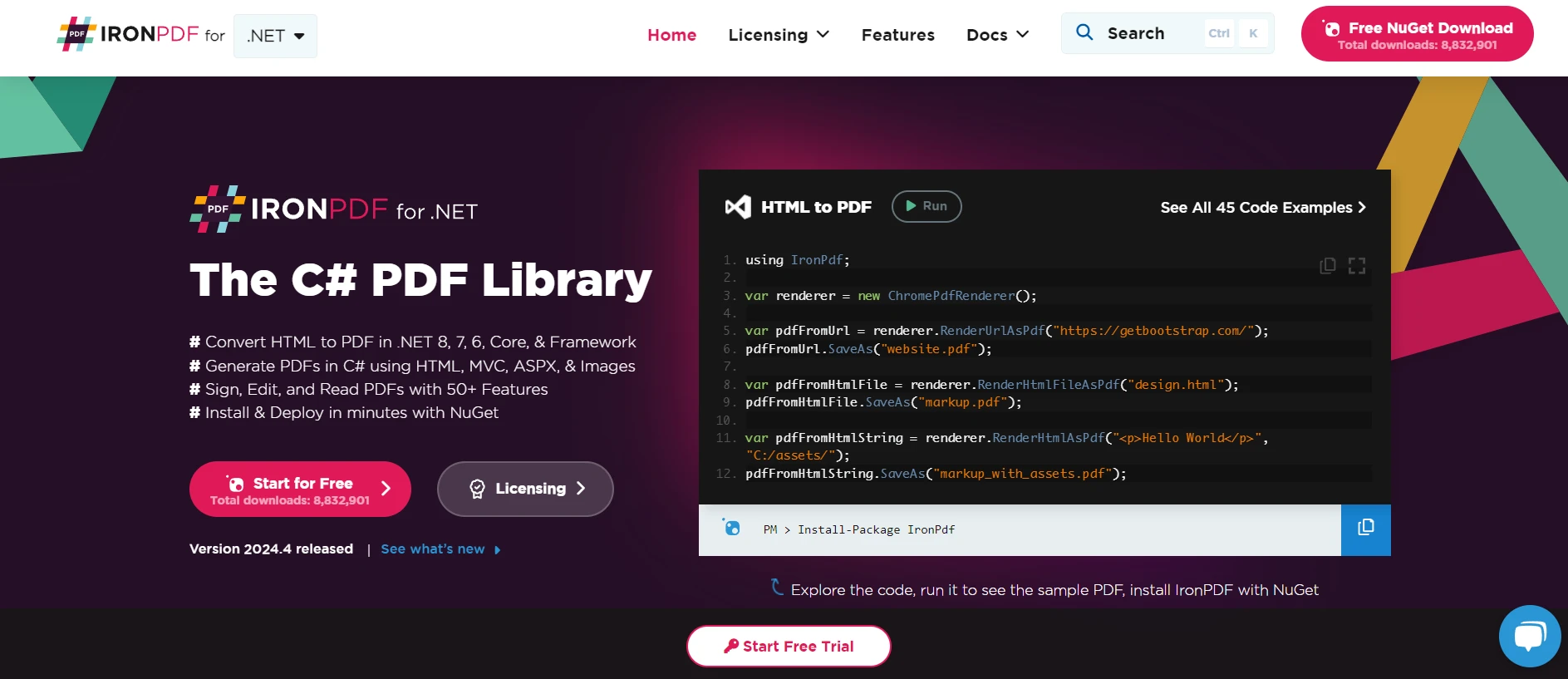
IronPDF para Soluciones PDF en .NET es una biblioteca .NET integral diseñada para trabajar con documentos PDF. Está construida principalmente en C# y se centra en simplificar la creación y manipulación de PDFs a partir de contenido HTML. Al emplear un Motor de Renderizado de Chrome, IronPDF proporciona documentos PDF de alta calidad, precisos al píxel, que capturan las particularidades de HTML, CSS, JavaScript y contenido de imagen.
Esta biblioteca es versátil, soportando una amplia gama de entornos .NET incluyendo .NET Framework, .NET Core, y .NET Standard, lo que la hace adecuada para diversas aplicaciones, desde sistemas de escritorio hasta sistemas basados en la web. IronPDF no solo soporta la creación de PDFs sino que también ofrece funcionalidades para editar, asegurar y convertir PDFs a otros formatos.
Esta capacidad se extiende a la extracción de texto e imágenes, el llenado de formularios e incluso la aplicación de firmas digitales, asegurando un manejo completo de documentos PDF dentro de aplicaciones .NET.
Integrando IronPDF con C# y la palabra clave ref
IronPDF puede integrarse con C# para aprovechar las robustas características del lenguaje, incluyendo el uso de la palabra clave ref para pasar parámetros por referencia. Esta integración permite una generación dinámica de PDFs donde el contenido puede depender de variables cuyos valores se determinan en tiempo de ejecución.
Para ilustrar la integración de IronPDF con C# usando la palabra clave ref, considera un escenario donde queremos generar un reporte PDF que incluya un valor calculado dinámicamente. Este valor será calculado dentro de un método que acepta un parámetro ref, permitiendo al método modificar este valor, que luego se refleja en el PDF generado.
Ejemplo de código: Generación de un PDF con contenido dinámico usando ref
El siguiente código C# muestra cómo utilizar IronPDF junto con la palabra clave ref para generar un documento PDF. El código calcula un valor, lo modifica mediante un método que acepta un parámetro ref, y luego usa IronPDF para generar un PDF que incluya este contenido dinámico.
using IronPdf;
using System;

class Program
{
    static void Main(string[] args)
    {
        // Set your IronPDF license key
        License.LicenseKey = "License-Key";

        // Initialize the value
        int totalSales = 150;

        // Modify the value within the method using 'ref'
        AddMonthlyBonus(ref totalSales);

        // Use IronPDF to generate a PDF report
        var Renderer = new ChromePdfRenderer();
        var PDF = Renderer.RenderHtmlAsPdf($"<h1>Monthly Sales Report</h1><p>Total Sales, including bonus: {totalSales}</p>");

        // Save the PDF to a file
        PDF.SaveAs("MonthlySalesReport.pdf");

        // Confirm the PDF has been generated
        Console.WriteLine("PDF generated successfully. Check your project directory.");
    }

    // Method that adds a monthly bonus to sales using 'ref'
    static void AddMonthlyBonus(ref int sales)
    {
        // Assume a bonus of 10% of the sales
        sales += (int)(sales * 0.1);
    }
}
using IronPdf;
using System;

class Program
{
    static void Main(string[] args)
    {
        // Set your IronPDF license key
        License.LicenseKey = "License-Key";

        // Initialize the value
        int totalSales = 150;

        // Modify the value within the method using 'ref'
        AddMonthlyBonus(ref totalSales);

        // Use IronPDF to generate a PDF report
        var Renderer = new ChromePdfRenderer();
        var PDF = Renderer.RenderHtmlAsPdf($"<h1>Monthly Sales Report</h1><p>Total Sales, including bonus: {totalSales}</p>");

        // Save the PDF to a file
        PDF.SaveAs("MonthlySalesReport.pdf");

        // Confirm the PDF has been generated
        Console.WriteLine("PDF generated successfully. Check your project directory.");
    }

    // Method that adds a monthly bonus to sales using 'ref'
    static void AddMonthlyBonus(ref int sales)
    {
        // Assume a bonus of 10% of the sales
        sales += (int)(sales * 0.1);
    }
}
Imports IronPdf
Imports System
Module Program
Sub Main(args As String())
' Set your IronPDF license key
License.LicenseKey = "License-Key"
' Initialize the value
Dim totalSales As Integer = 150
' Modify the value within the method using 'ByRef'
AddMonthlyBonus(totalSales)
' Use IronPDF to generate a PDF report
Dim Renderer = New ChromePdfRenderer()
Dim PDF = Renderer.RenderHtmlAsPdf($"<h1>Monthly Sales Report</h1><p>Total Sales, including bonus: {totalSales}</p>")
' Save the PDF to a file
PDF.SaveAs("MonthlySalesReport.pdf")
' Confirm the PDF has been generated
Console.WriteLine("PDF generated successfully. Check your project directory.")
End Sub
' Method that adds a monthly bonus to sales using 'ByRef'
Sub AddMonthlyBonus(ByRef sales As Integer)
' Assume a bonus of 10% of the sales
sales += CInt(sales * 0.1)
End Sub
End Module
Imports IronPdf
Imports System

Module Program
    Sub Main(args As String())
        ' Set your IronPDF license key
        License.LicenseKey = "License-Key"

        ' Initialize the value
        Dim totalSales As Integer = 150

        ' Modify the value within the method using 'ByRef'
        AddMonthlyBonus(totalSales)

        ' Use IronPDF to generate a PDF report
        Dim Renderer = New ChromePdfRenderer()
        Dim PDF = Renderer.RenderHtmlAsPdf($"<h1>Monthly Sales Report</h1><p>Total Sales, including bonus: {totalSales}</p>")

        ' Save the PDF to a file
        PDF.SaveAs("MonthlySalesReport.pdf")

        ' Confirm the PDF has been generated
        Console.WriteLine("PDF generated successfully. Check your project directory.")
    End Sub

    ' Method that adds a monthly bonus to sales using 'ByRef'
    Sub AddMonthlyBonus(ByRef sales As Integer)
        ' Assume a bonus of 10% of the sales
        sales += CInt(sales * 0.1)
    End Sub
End Module

En este ejemplo, totalSales comienza en 150. El método AddMonthlyBonus toma este valor por referencia usando la palabra clave ref, calcula un bono del 10%, y lo suma al valor original de ventas. IronPDF luego genera un documento PDF que contiene un fragmento HTML que informa las ventas totales, incluido el bono. El documento final se guarda localmente como "MonthlySalesReport.pdf".
Conclusión
Entender la palabra clave ref en C# proporciona una herramienta valiosa para gestionar cómo se pasan los datos entre métodos. Al permitir que los métodos modifiquen directamente los valores originales de los parámetros pasados a ellos, ref puede hacer que tus métodos sean más flexibles y poderosos.
A medida que ganes experiencia con ref, comprenderás mejor cuándo y cómo usarlo eficazmente para satisfacer tus necesidades de programación. IronPDF ofrece una prueba gratuita para comenzar con capacidades PDF y los precios comienzan desde $999.























