En programación, particularmente en entornos donde la concurrencia juega un papel importante, comprender cómo gestionar las operaciones de memoria de manera eficiente y segura es importante. Este tutorial tiene como objetivo desmitificar el concepto de la palabra clave volatile en C#, una característica importante para los desarrolladores que trabajan con múltiples hilos en sus aplicaciones.
Exploraremos la importancia del modificador volatile, su impacto en las operaciones de memoria y aplicaciones prácticas a través de ejemplos de código. También exploraremos la biblioteca IronPDF para la integración con C# trabajando con C# volatile.
Understanding the Volatile Keyword in C#
La palabra clave volatile en C# se utiliza principalmente para indicar que un campo podría ser modificado por múltiples hilos que se ejecutan simultáneamente. Cuando declara un campo con el modificador volatile, instruye al compilador y al procesador a tratar las lecturas y escrituras de ese campo de manera diferente.
La función clave de la palabra clave volatile es evitar que el compilador aplique cualquier optimización en tales campos que pueda asumir incorrectamente que pueden almacenar en caché el valor o reordenar operaciones que involucran el campo, como la operación de lectura volátil.
La necesidad de la palabra clave volatile surge de las complejas maneras en que los procesadores modernos mejoran el rendimiento. Los procesadores a menudo realizan optimizaciones como almacenar variables en registros para un acceso más rápido y reordenar instrucciones para una ejecución eficiente. Sin embargo, en escenarios multihilo, estas optimizaciones podrían llevar a inconsistencias cuando múltiples hilos acceden y modifican la misma ubicación de memoria sin la sincronización adecuada.
Ejemplo de código: Uso de Volatile
Considera un escenario simple donde una variable volatile y un objeto no volatile son accedidos por múltiples hilos. Aquí tienes un ejemplo básico:
using System;
using System.Threading;

public class Worker
{
    private volatile bool _shouldStop;

    // Method run by a separate thread to perform work until _shouldStop is set to true
    public void DoWork()
    {
        while (!_shouldStop)
        {
            Console.WriteLine("Worker thread is running...");
            Thread.Sleep(500); // Simulates work being done
        }
        Console.WriteLine("Worker thread has been stopped.");
    }

    // Method to request stopping the work by setting _shouldStop to true
    public void RequestStop()
    {
        _shouldStop = true;
    }

    // Main method to start the worker and stop it after some time
    static void Main()
    {
        Worker worker = new Worker();
        Thread newThread = new Thread(worker.DoWork);
        newThread.Start();
        Thread.Sleep(1000); // Allow the worker to run for a while
        worker.RequestStop();
        newThread.Join();   // Wait for the worker thread to finish
    }
}
using System;
using System.Threading;

public class Worker
{
    private volatile bool _shouldStop;

    // Method run by a separate thread to perform work until _shouldStop is set to true
    public void DoWork()
    {
        while (!_shouldStop)
        {
            Console.WriteLine("Worker thread is running...");
            Thread.Sleep(500); // Simulates work being done
        }
        Console.WriteLine("Worker thread has been stopped.");
    }

    // Method to request stopping the work by setting _shouldStop to true
    public void RequestStop()
    {
        _shouldStop = true;
    }

    // Main method to start the worker and stop it after some time
    static void Main()
    {
        Worker worker = new Worker();
        Thread newThread = new Thread(worker.DoWork);
        newThread.Start();
        Thread.Sleep(1000); // Allow the worker to run for a while
        worker.RequestStop();
        newThread.Join();   // Wait for the worker thread to finish
    }
}
Imports System
Imports System.Threading
Public Class Worker
Private _shouldStop As Boolean ' Volatile not needed in VB.NET as much as C#
' Method run by a separate thread to perform work until _shouldStop is set to true
Public Sub DoWork()
While Not _shouldStop
Console.WriteLine("Worker thread is running...")
Thread.Sleep(500) ' Simulates work being done
End While
Console.WriteLine("Worker thread has been stopped.")
End Sub
' Method to request stopping the work by setting _shouldStop to true
Public Sub RequestStop()
_shouldStop = True
End Sub
' Main method to start the worker and stop it after some time
Shared Sub Main()
Dim worker As New Worker()
Dim newThread As New Thread(AddressOf worker.DoWork)
newThread.Start()
Thread.Sleep(1000) ' Allow the worker to run for a while
worker.RequestStop()
newThread.Join() ' Wait for the worker thread to finish
End Sub
End Class
Imports System
Imports System.Threading

Public Class Worker
    Private _shouldStop As Boolean ' Volatile not needed in VB.NET as much as C#

    ' Method run by a separate thread to perform work until _shouldStop is set to true
    Public Sub DoWork()
        While Not _shouldStop
            Console.WriteLine("Worker thread is running...")
            Thread.Sleep(500) ' Simulates work being done
        End While
        Console.WriteLine("Worker thread has been stopped.")
    End Sub

    ' Method to request stopping the work by setting _shouldStop to true
    Public Sub RequestStop()
        _shouldStop = True
    End Sub

    ' Main method to start the worker and stop it after some time
    Shared Sub Main()
        Dim worker As New Worker()
        Dim newThread As New Thread(AddressOf worker.DoWork)
        newThread.Start()
        Thread.Sleep(1000) ' Allow the worker to run for a while
        worker.RequestStop()
        newThread.Join()   ' Wait for the worker thread to finish
    End Sub
End Class
En este ejemplo, _shouldStop es un campo marcado con el modificador volatile. El método DoWork se ejecuta en un hilo de trabajo y verifica continuamente el campo _shouldStop dentro de un bucle. El hilo principal duerme por un corto periodo y luego llama al método RequestStop para modificar _shouldStop. Marcar _shouldStop como volatile asegura que el valor más reciente siempre se lea desde la memoria principal, de modo que todos los hilos vean el valor actualizado de inmediato.
Cómo afecta volátil a las operaciones de memoria
El uso de la palabra clave volatile impacta las operaciones de memoria al introducir una barrera de memoria, afectando incluso a las variables locales que típicamente residen en pilas específicas de hilos. Una barrera de memoria impide ciertos tipos de reordenamiento de memoria a su alrededor, que son permitidos por el procesador o el compilador con fines de optimización. Específicamente, marcar un campo como volatile asegura que:
- Cada escritura a un campo volatile es seguida por una barrera de memoria.
- Cada lectura de un campo volatile es precedida por una barrera de memoria.
Estas barreras de memoria aseguran que las operaciones antes y después de la lectura o escritura se completen antes de avanzar. Esto es crucial en aplicaciones multihilo para mantener la consistencia y visibilidad de las variables.
Volátil vs. Bloqueo
Es importante diferenciar entre la palabra clave volatile y los constructos de sincronización como la palabra clave lock. Mientras que volatile asegura que el valor de una variable siempre se extraiga desde la memoria principal, no proporciona ningún mecanismo para asegurar que una secuencia de operaciones que involucran múltiples variables sea atómica. Para la atomicidad, son necesarios constructos de sincronización como lock.
Por ejemplo, considera una situación donde un hilo de trabajo necesita actualizar dos variables cuando se cumple una cierta condición. Simplemente marcar estas variables como volatile no evita que otro hilo vea un estado inconsistente donde una variable se actualiza, pero la otra no. En tales casos, se necesitaría un lock para asegurar que estas operaciones se realicen sin interrupción.
Introducción a IronPDF
IronPDF es una versátil biblioteca .NET diseñada para desarrolladores que buscan crear, manipular y producir archivos PDF directamente desde HTML, JavaScript, CSS e imágenes. Esta biblioteca utiliza un motor de renderizado de Chrome, asegurando que los PDF generados mantengan su fidelidad visual, reflejando exactamente lo que uno vería en un navegador.
IronPDF sobresale al eliminar la necesidad de APIs engorrosas de generación de PDF, ofreciendo un enfoque simplificado para la creación de PDFs que puede ser tan sencillo como convertir páginas web y código HTML en PDFs formateados profesionalmente.
IronPDF no solo crea PDFs sino que también proporciona funcionalidades para editar, asegurar e incluso extraer contenido de PDFs. Admite varias manipulaciones de PDF como agregar encabezados, pies de página y firmas digitales, gestionar formularios PDF y asegurar con protecciones de contraseña y permisos.
Está diseñado para ser eficiente y no depende de dependencias externas, simplificando la implementación en diferentes plataformas compatibles con .NET como Windows, macOS y Linux.
Usando IronPDF con C# Volatile
IronPDF y la palabra clave volatile en C# sirven para diferentes aspectos del desarrollo de software. Mientras que IronPDF se centra en la generación y manipulación de PDF, volatile en C# se utiliza para asegurar la corrección de programas que involucran múltiples hilos al prevenir tipos específicos de optimizaciones del compilador que podrían llevar a un comportamiento incorrecto en un contexto multihilo.
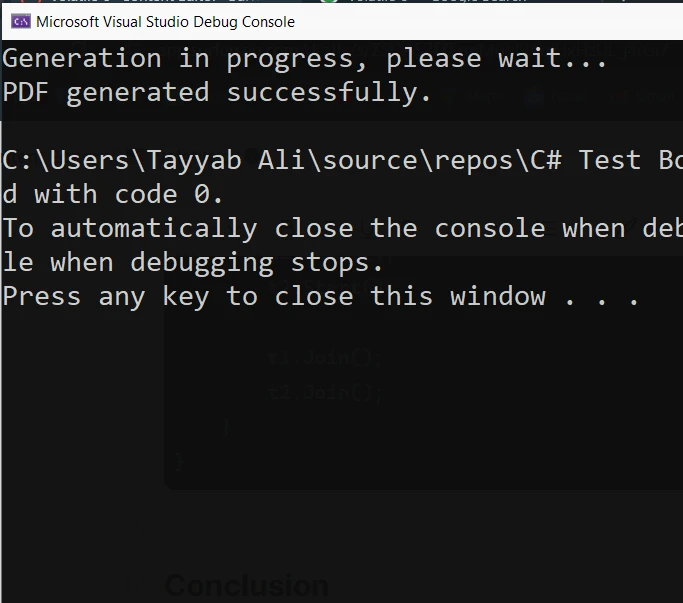
Integrar IronPDF con la palabra clave volatile de C# puede ser relevante en escenarios donde la generación o manipulación de PDF necesita ser controlada por múltiples hilos, tal vez en una aplicación web donde se generan informes PDF y se proporcionan sobre la marcha basados en solicitudes concurrentes de usuarios. Aquí, volatile podría ser utilizado para manejar banderas o señales entre hilos en relación con el estado del proceso de generación de PDF.
Ejemplo de código: Generación concurrente de PDF con IronPDF y Volatile
Aquí tienes un ejemplo que demuestra cómo podrías usar IronPDF en una aplicación multihilo de C# con una bandera volatile para gestionar el proceso de generación:
using IronPdf;
using System;
using System.Threading;

public class PDFGenerator
{
    private volatile bool _isProcessing;

    // Generates a PDF if no other generation is currently in progress
    public void GeneratePDF()
    {
        if (!_isProcessing)
        {
            _isProcessing = true;
            try
            {
                var renderer = new ChromePdfRenderer();
                var PDF = renderer.RenderHtmlAsPdf("<h1>Hello, World!</h1>");
                PDF.SaveAs("example.pdf");
                Console.WriteLine("PDF generated successfully.");
            }
            catch (Exception ex)
            {
                Console.WriteLine("Failed to generate PDF: " + ex.Message);
            }
            finally
            {
                _isProcessing = false;
            }
        }
        else
        {
            Console.WriteLine("Generation in progress, please wait...");
        }
    }

    // Main method to start concurrent PDF generation
    static void Main()
    {
        License.LicenseKey = "License-Key"; // Replace with your actual License Key
        PDFGenerator generator = new PDFGenerator();
        Thread t1 = new Thread(generator.GeneratePDF);
        Thread t2 = new Thread(generator.GeneratePDF);
        t1.Start();
        t2.Start();
        t1.Join(); // Wait for thread t1 to finish
        t2.Join(); // Wait for thread t2 to finish
    }
}
using IronPdf;
using System;
using System.Threading;

public class PDFGenerator
{
    private volatile bool _isProcessing;

    // Generates a PDF if no other generation is currently in progress
    public void GeneratePDF()
    {
        if (!_isProcessing)
        {
            _isProcessing = true;
            try
            {
                var renderer = new ChromePdfRenderer();
                var PDF = renderer.RenderHtmlAsPdf("<h1>Hello, World!</h1>");
                PDF.SaveAs("example.pdf");
                Console.WriteLine("PDF generated successfully.");
            }
            catch (Exception ex)
            {
                Console.WriteLine("Failed to generate PDF: " + ex.Message);
            }
            finally
            {
                _isProcessing = false;
            }
        }
        else
        {
            Console.WriteLine("Generation in progress, please wait...");
        }
    }

    // Main method to start concurrent PDF generation
    static void Main()
    {
        License.LicenseKey = "License-Key"; // Replace with your actual License Key
        PDFGenerator generator = new PDFGenerator();
        Thread t1 = new Thread(generator.GeneratePDF);
        Thread t2 = new Thread(generator.GeneratePDF);
        t1.Start();
        t2.Start();
        t1.Join(); // Wait for thread t1 to finish
        t2.Join(); // Wait for thread t2 to finish
    }
}
Imports IronPdf
Imports System
Imports System.Threading
Public Class PDFGenerator
Private _isProcessing As Boolean
' Generates a PDF if no other generation is currently in progress
Public Sub GeneratePDF()
If Not _isProcessing Then
_isProcessing = True
Try
Dim renderer = New ChromePdfRenderer()
Dim PDF = renderer.RenderHtmlAsPdf("<h1>Hello, World!</h1>")
PDF.SaveAs("example.pdf")
Console.WriteLine("PDF generated successfully.")
Catch ex As Exception
Console.WriteLine("Failed to generate PDF: " & ex.Message)
Finally
_isProcessing = False
End Try
Else
Console.WriteLine("Generation in progress, please wait...")
End If
End Sub
' Main method to start concurrent PDF generation
Shared Sub Main()
License.LicenseKey = "License-Key" ' Replace with your actual License Key
Dim generator As New PDFGenerator()
Dim t1 As New Thread(AddressOf generator.GeneratePDF)
Dim t2 As New Thread(AddressOf generator.GeneratePDF)
t1.Start()
t2.Start()
t1.Join() ' Wait for thread t1 to finish
t2.Join() ' Wait for thread t2 to finish
End Sub
End Class
Imports IronPdf
Imports System
Imports System.Threading

Public Class PDFGenerator
    Private _isProcessing As Boolean

    ' Generates a PDF if no other generation is currently in progress
    Public Sub GeneratePDF()
        If Not _isProcessing Then
            _isProcessing = True
            Try
                Dim renderer = New ChromePdfRenderer()
                Dim PDF = renderer.RenderHtmlAsPdf("<h1>Hello, World!</h1>")
                PDF.SaveAs("example.pdf")
                Console.WriteLine("PDF generated successfully.")
            Catch ex As Exception
                Console.WriteLine("Failed to generate PDF: " & ex.Message)
            Finally
                _isProcessing = False
            End Try
        Else
            Console.WriteLine("Generation in progress, please wait...")
        End If
    End Sub

    ' Main method to start concurrent PDF generation
    Shared Sub Main()
        License.LicenseKey = "License-Key" ' Replace with your actual License Key
        Dim generator As New PDFGenerator()
        Dim t1 As New Thread(AddressOf generator.GeneratePDF)
        Dim t2 As New Thread(AddressOf generator.GeneratePDF)
        t1.Start()
        t2.Start()
        t1.Join() ' Wait for thread t1 to finish
        t2.Join() ' Wait for thread t2 to finish
    End Sub
End Class
Conclusión
Entender la palabra clave volatile en C# es esencial para los desarrolladores que trabajan con múltiples hilos y que necesitan asegurar la consistencia y visibilidad de los datos. Al prevenir optimizaciones que podrían llevar a un comportamiento incorrecto en un entorno multihilo, el modificador volatile desempeña un papel crítico en la escritura de aplicaciones concurrentes fiables. Sin embargo, también es vital reconocer sus limitaciones y saber cuándo se requieren otras técnicas de sincronización para asegurar la atomicidad de operaciones complejas.
IronPDF ofrece una prueba de acceso con todas las funciones de la suite IronPDF a partir de $999, proporcionando acceso completo a su amplia suite de herramientas de manipulación de PDF.