La Google HTTP Client Library for Java es una biblioteca robusta diseñada para simplificar el proceso de hacer solicitudes HTTP y manejar respuestas en aplicaciones Java. Forma parte del Google App Engine y del cliente de la API de Google, como parte de las API de Google. Desarrollada y mantenida por Google, esta potente biblioteca Java admite una amplia gama de métodos HTTP y se integra a la perfección con modelos de datos JSON y XML, lo que la convierte en una excelente opción para los desarrolladores que buscan interactuar con servicios web. Además, exploraremos IronPDF for Java y demostraremos cómo integrarlo con la Google HTTP Client Library para generar documentos PDF a partir de datos de respuesta HTTP.
Características clave
- Solicitudes HTTP simplificadas: la biblioteca abstrae gran parte de la complejidad de crear y enviar solicitudes HTTP, lo que hace que sea más fácil para los desarrolladores trabajar con ella.
- Compatibilidad con varios métodos de autenticación: admite OAuth 2.0 y otros esquemas de autenticación, lo cual es esencial para interactuar con las API modernas.
- Análisis de JSON y XML: la biblioteca puede analizar automáticamente las respuestas JSON y XML en objetos Java, lo que reduce el código repetitivo.
- Solicitudes asincrónicas: admite solicitudes asincrónicas, lo que puede mejorar el rendimiento de la aplicación al descargar operaciones de red en subprocesos en segundo plano.
- Mecanismo de reintento integrado: la biblioteca incluye un mecanismo de reintento integrado para manejar errores de red transitorios, lo que puede ayudar a mejorar la solidez de las aplicaciones.
- Estabilidad y mantenimiento: La biblioteca ofrece características estables y no beta, asegurando un rendimiento confiable en entornos de producción.
Configuración de la biblioteca de clientes HTTP de Google for Java
Para usar Google HTTP Client Library for Java, debes agregar la biblioteca completa del cliente y las dependencias necesarias en tu proyecto. Si estás usando Maven, puedes agregar las siguientes dependencias a tu archivo pom.xml:
<dependencies>
    <dependency>
        <groupId>com.google.http-client</groupId>
        <artifactId>google-http-client</artifactId>
        <version>1.39.2</version>
    </dependency>
    <dependency>
        <groupId>com.google.http-client</groupId>
        <artifactId>google-http-client-jackson2</artifactId>
        <version>1.39.2</version>
    </dependency>
</dependencies>
<dependencies>
    <dependency>
        <groupId>com.google.http-client</groupId>
        <artifactId>google-http-client</artifactId>
        <version>1.39.2</version>
    </dependency>
    <dependency>
        <groupId>com.google.http-client</groupId>
        <artifactId>google-http-client-jackson2</artifactId>
        <version>1.39.2</version>
    </dependency>
</dependencies>
XML
Uso básico
Exploremos el uso básico de Google HTTP Client Library for Java a través de varios ejemplos.
1. Cómo realizar una solicitud GET sencilla
El siguiente código demuestra cómo realizar una solicitud GET simple usando Google HTTP Client Library:
import com.google.api.client.http.HttpRequest;
import com.google.api.client.http.HttpRequestFactory;
import com.google.api.client.http.HttpResponse;
import com.google.api.client.http.javanet.NetHttpTransport;
import com.google.api.client.http.GenericUrl;

public class HttpClientExample {
    public static void main(String[] args) {
        try {
            // Create a request factory using NetHttpTransport
            HttpRequestFactory requestFactory = new NetHttpTransport().createRequestFactory();
            // Define the URL for the GET request
            GenericUrl url = new GenericUrl("https://jsonplaceholder.typicode.com/posts/1");
            // Build the GET request
            HttpRequest request = requestFactory.buildGetRequest(url);
            // Execute the request and get the response
            HttpResponse response = request.execute();
            // Parse the response as a String and print it
            System.out.println(response.parseAsString());
        } catch (Exception e) {
            // Print the stack trace if an exception occurs
            e.printStackTrace();
        }
    }
}
import com.google.api.client.http.HttpRequest;
import com.google.api.client.http.HttpRequestFactory;
import com.google.api.client.http.HttpResponse;
import com.google.api.client.http.javanet.NetHttpTransport;
import com.google.api.client.http.GenericUrl;

public class HttpClientExample {
    public static void main(String[] args) {
        try {
            // Create a request factory using NetHttpTransport
            HttpRequestFactory requestFactory = new NetHttpTransport().createRequestFactory();
            // Define the URL for the GET request
            GenericUrl url = new GenericUrl("https://jsonplaceholder.typicode.com/posts/1");
            // Build the GET request
            HttpRequest request = requestFactory.buildGetRequest(url);
            // Execute the request and get the response
            HttpResponse response = request.execute();
            // Parse the response as a String and print it
            System.out.println(response.parseAsString());
        } catch (Exception e) {
            // Print the stack trace if an exception occurs
            e.printStackTrace();
        }
    }
}
Java
En este ejemplo, creamos un HttpRequestFactory y lo usamos para construir y ejecutar una solicitud GET a una API de marcador de posición. Usamos un bloque try-catch aquí para manejar excepciones que puedan ocurrir cuando la solicitud falle. Luego imprimimos la respuesta en la consola.

2. Realizar una solicitud POST con datos JSON
El siguiente código demuestra cómo realizar una solicitud POST con datos JSON:
import com.google.api.client.http.HttpRequest;
import com.google.api.client.http.HttpRequestFactory;
import com.google.api.client.http.HttpResponse;
import com.google.api.client.http.javanet.NetHttpTransport;
import com.google.api.client.http.GenericUrl;
import com.google.api.client.http.json.JsonHttpContent;
import com.google.api.client.json.JsonFactory;
import com.google.api.client.json.jackson2.JacksonFactory;
import java.util.HashMap;
import java.util.Map;

public class HttpClientExample {
    public static void main(String[] args) {
        try {
            // Create a request factory using NetHttpTransport
            HttpRequestFactory requestFactory = new NetHttpTransport().createRequestFactory();
            // Define the URL for the POST request
            GenericUrl url = new GenericUrl("https://jsonplaceholder.typicode.com/posts");
            // Create a map to hold JSON data
            Map<String, Object> jsonMap = new HashMap<>();
            jsonMap.put("title", "foo");
            jsonMap.put("body", "bar");
            jsonMap.put("userId", 1);
            // Create a JSON content using the map
            JsonFactory jsonFactory = new JacksonFactory();
            JsonHttpContent content = new JsonHttpContent(jsonFactory, jsonMap);
            // Build the POST request
            HttpRequest request = requestFactory.buildPostRequest(url, content);
            // Execute the request and get the response
            HttpResponse response = request.execute();
            // Parse the response as a String and print it
            System.out.println(response.parseAsString());
        } catch (Exception e) {
            // Print the stack trace if an exception occurs
            e.printStackTrace();
        }
    }
}
import com.google.api.client.http.HttpRequest;
import com.google.api.client.http.HttpRequestFactory;
import com.google.api.client.http.HttpResponse;
import com.google.api.client.http.javanet.NetHttpTransport;
import com.google.api.client.http.GenericUrl;
import com.google.api.client.http.json.JsonHttpContent;
import com.google.api.client.json.JsonFactory;
import com.google.api.client.json.jackson2.JacksonFactory;
import java.util.HashMap;
import java.util.Map;

public class HttpClientExample {
    public static void main(String[] args) {
        try {
            // Create a request factory using NetHttpTransport
            HttpRequestFactory requestFactory = new NetHttpTransport().createRequestFactory();
            // Define the URL for the POST request
            GenericUrl url = new GenericUrl("https://jsonplaceholder.typicode.com/posts");
            // Create a map to hold JSON data
            Map<String, Object> jsonMap = new HashMap<>();
            jsonMap.put("title", "foo");
            jsonMap.put("body", "bar");
            jsonMap.put("userId", 1);
            // Create a JSON content using the map
            JsonFactory jsonFactory = new JacksonFactory();
            JsonHttpContent content = new JsonHttpContent(jsonFactory, jsonMap);
            // Build the POST request
            HttpRequest request = requestFactory.buildPostRequest(url, content);
            // Execute the request and get the response
            HttpResponse response = request.execute();
            // Parse the response as a String and print it
            System.out.println(response.parseAsString());
        } catch (Exception e) {
            // Print the stack trace if an exception occurs
            e.printStackTrace();
        }
    }
}
Java
En este ejemplo, creamos un objeto JSON y usamos JsonHttpContent para enviarlo en una solicitud POST. La respuesta luego se imprime en la consola.

Introducción a IronPDF for Java
IronPDF es una poderosa biblioteca para desarrolladores Java que simplifica la creación, edición y gestión de documentos PDF. Proporciona una amplia gama de características, incluyendo la conversión de HTML a PDF, la manipulación de archivos PDF existentes y la extracción de texto e imágenes de PDFs.
Características principales de IronPDF
- Conversión de HTML a PDF: convierte contenido HTML a PDF con alta fidelidad.
- Manipulación de archivos PDF existentes: fusionar, dividir y modificar documentos PDF existentes.
- Extracción de texto e imágenes: extraiga texto e imágenes de documentos PDF para su posterior procesamiento.
- Marcas de agua y anotaciones: agregue marcas de agua, anotaciones y otras mejoras a los archivos PDF.
- Funciones de seguridad: agregue contraseñas y permisos para proteger documentos PDF.
Configuración de IronPDF for Java
Para usar IronPDF en tu proyecto Java, necesitas incluir la biblioteca IronPDF. Puedes descargar el archivo JAR desde el sitio web de IronPDF o usar una herramienta de construcción como Maven para incluirlo en tu proyecto. Para los usuarios que utilizan Maven, añade el siguiente código a tu pom.xml:
<!--Adds IronPDF Java. Use the latest version in the version tag.-->
<dependency>
    <groupId>com.ironsoftware</groupId>
    <artifactId>ironpdf</artifactId>
    <version>2023.12.1</version>
</dependency>
<!--Adds the slf4j logger which IronPDF Java uses.-->
<dependency>
    <groupId>org.slf4j</groupId>
    <artifactId>slf4j-simple</artifactId>
    <version>2.0.3</version>
</dependency>
<!--Adds IronPDF Java. Use the latest version in the version tag.-->
<dependency>
    <groupId>com.ironsoftware</groupId>
    <artifactId>ironpdf</artifactId>
    <version>2023.12.1</version>
</dependency>
<!--Adds the slf4j logger which IronPDF Java uses.-->
<dependency>
    <groupId>org.slf4j</groupId>
    <artifactId>slf4j-simple</artifactId>
    <version>2.0.3</version>
</dependency>
XML
Uso de la biblioteca de clientes HTTP de Google con IronPDF
En esta sección, demostraremos cómo usar Google HTTP Client Library para obtener contenido HTML de un servicio web y luego usar IronPDF para convertir ese contenido HTML en un documento PDF.
Ejemplo: Obtención de HTML y conversión a PDF
import com.google.api.client.http.HttpRequest;
import com.google.api.client.http.HttpRequestFactory;
import com.google.api.client.http.HttpResponse;
import com.google.api.client.http.javanet.NetHttpTransport;
import com.google.api.client.http.GenericUrl;
import com.ironsoftware.ironpdf.PdfDocument;

public class HtmlToPdfExample {
    public static void main(String[] args) {
        try {
            // Fetch HTML content using Google HTTP Client Library
            HttpRequestFactory requestFactory = new NetHttpTransport().createRequestFactory();
            GenericUrl url = new GenericUrl("https://jsonplaceholder.typicode.com/posts/1");
            HttpRequest request = requestFactory.buildGetRequest(url);
            HttpResponse response = request.execute();
            String htmlContent = response.parseAsString();

            // Convert HTML content to PDF using IronPDF
            PdfDocument pdf = PdfDocument.renderHtmlAsPdf(htmlContent);
            pdf.saveAs("output.pdf");

            System.out.println("PDF created successfully!");
        } catch (Exception e) {
            // Print the stack trace if an exception occurs
            e.printStackTrace();
        }
    }
}
import com.google.api.client.http.HttpRequest;
import com.google.api.client.http.HttpRequestFactory;
import com.google.api.client.http.HttpResponse;
import com.google.api.client.http.javanet.NetHttpTransport;
import com.google.api.client.http.GenericUrl;
import com.ironsoftware.ironpdf.PdfDocument;

public class HtmlToPdfExample {
    public static void main(String[] args) {
        try {
            // Fetch HTML content using Google HTTP Client Library
            HttpRequestFactory requestFactory = new NetHttpTransport().createRequestFactory();
            GenericUrl url = new GenericUrl("https://jsonplaceholder.typicode.com/posts/1");
            HttpRequest request = requestFactory.buildGetRequest(url);
            HttpResponse response = request.execute();
            String htmlContent = response.parseAsString();

            // Convert HTML content to PDF using IronPDF
            PdfDocument pdf = PdfDocument.renderHtmlAsPdf(htmlContent);
            pdf.saveAs("output.pdf");

            System.out.println("PDF created successfully!");
        } catch (Exception e) {
            // Print the stack trace if an exception occurs
            e.printStackTrace();
        }
    }
}
Java
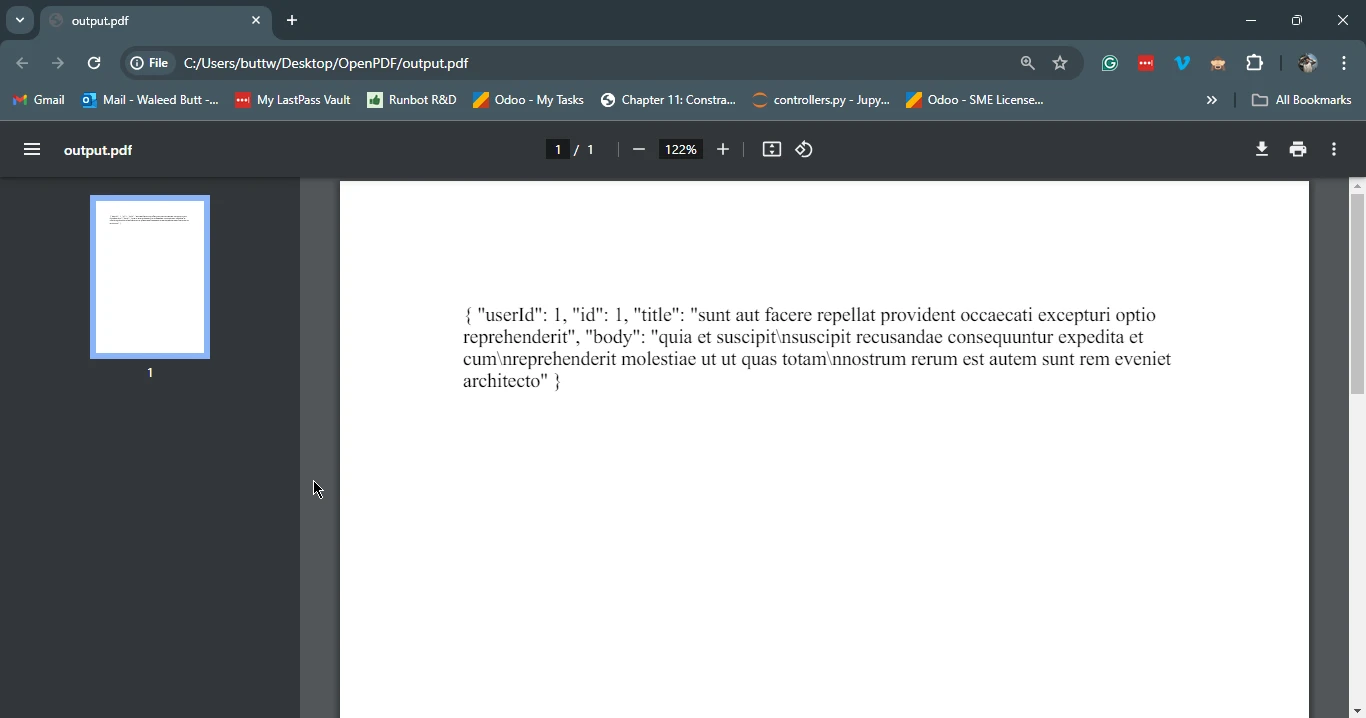
En este ejemplo, primero obtenemos contenido HTML de un API de marcador de posición usando Google HTTP Client Library. Luego usamos IronPDF para convertir el contenido HTML obtenido en un documento PDF y lo guardamos como output.pdf.
Conclusión
La Google HTTP Client Library for Java es una herramienta poderosa para interactuar con servicios web, ofreciendo solicitudes HTTP simplificadas, soporte para varios métodos de autenticación, integración sin problemas con el análisis JSON y XML, y compatibilidad para varios entornos Java. Combinada con IronPDF, los desarrolladores pueden fácilmente obtener contenido HTML de servicios web y convertirlo en documentos PDF, habilitando una biblioteca completa para varias aplicaciones, desde generar informes hasta crear contenido descargable para aplicaciones web. Al aprovechar estas dos bibliotecas, los desarrolladores Java pueden mejorar significativamente las capacidades de sus aplicaciones mientras reducen la complejidad del código.
Por favor, consulta el siguiente enlace.