Este artículo discutirá un SDK de PDF for Node.js y cómo usar este SDK para satisfacer todas tus necesidades de manipulación de PDF usando Node.js. El SDK de PDF que discutiremos hoy es IronPDF for Node.js, su introducción, detalles sobre cómo instalarlo y cómo usarlo para manipular archivos PDF.
1. IronPDF for Node.js
IronPDF es una biblioteca poderosa y versátil que capacita a los desarrolladores para trabajar con documentos PDF en aplicaciones Node.js con facilidad y eficiencia. Ya sea que necesites crear, editar o manipular archivos PDF, IronPDF proporciona un conjunto completo de herramientas y características para agilizar tu flujo de trabajo.
PDF (Formato de Documento Portátil) es un formato de archivo ampliamente utilizado para el intercambio de documentos debido a su compatibilidad y consistencia en varias plataformas. Con IronPDF for Node.js, puedes automatizar la generación de PDFs, extraer datos de PDFs existentes y realizar diversas tareas relacionadas con el acceso a documentos PDF de forma programada.
1.1 Características principales de IronPDF for Node.js
- Creación de PDF : IronPDF le permite generar documentos PDF desde cero. Puedes crear facturas, informes, certificados y otros tipos de documentos combinando texto, imágenes y otros contenidos en un diseño personalizable.
- Conversión de HTML a PDF : una de las características destacadas de IronPDF es la capacidad de convertir contenido HTML a PDF. Puedes tomar documentos HTML existentes o páginas web y transformarlas en archivos PDF.
- Edición de PDF : con IronPDF, puede editar archivos PDF existentes mediante programación. Puedes agregar o modificar texto, imágenes, hipervínculos y anotaciones.
- Manejo de formularios PDF: IronPDF admite trabajar con formularios PDF . Puedes rellenar campos de formulario de forma programada, extraer datos de formularios llenos, e incluso firmar documentos digitalmente.
- Fusión y división de PDF: puede fusionar varios documentos PDF en un solo archivo o dividir un PDF en varios archivos más pequeños usando IronPDF.
- Salida de alta calidad: IronPDF garantiza que los documentos PDF generados mantengan una alta calidad y fidelidad al contenido original. Puedes controlar aspectos como el tamaño de página, orientación, resolución y configuración de compresión.
- Compatibilidad entre plataformas: IronPDF es compatible con Node.js y se puede utilizar en varios sistemas operativos, lo que lo hace versátil y accesible para los desarrolladores que trabajan en diferentes plataformas.
- Amplia documentación: IronPDF viene con amplia documentación y ejemplos para ayudar a los desarrolladores a comenzar de forma rápida y eficiente. La API bien documentada y los ejemplos de código sencillos hacen que la integración en aplicaciones Node.js sea un proceso fluido.
- Licencias flexibles: IronPDF ofrece opciones de licencias flexibles, lo que permite a los desarrolladores elegir el plan que mejor se adapte a las necesidades de su proyecto, ya sea un proyecto personal, una startup o una aplicación de nivel empresarial.
2. Instalación de IronPDF for Node.js
Esta sección discutirá cómo puedes configurar el entorno e instalar IronPDF for Node.js.
Antes de comenzar, asegúrate de tener Node.js instalado en tu sistema.
-
Primero, abre el Símbolo del Sistema (CMD) y crea un nuevo proyecto Node.js usando los siguientes comandos.
mkdir IronPDF
mkdir IronPDF
SHELL
Esto creará un nuevo directorio en el que puedes configurar este proyecto de demostración.
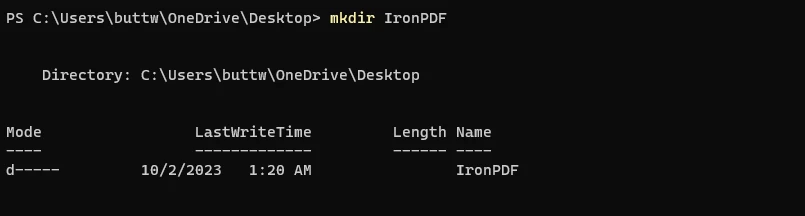 Crea una nueva carpeta
-
Navega al directorio recién creado.
-
Inicializa un nuevo proyecto Node.js dentro de este directorio.
Este comando creará un archivo package.json, que almacenará los metadatos y las dependencias relacionados con el proyecto, así como todas las variables de Entorno.
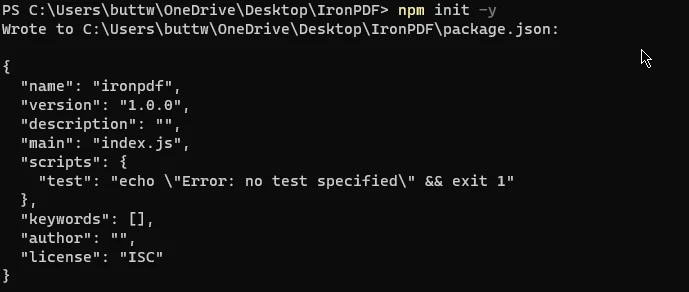 Inicia un archivo package.json
-
Una vez completada la configuración inicial, instalemos IronPDF usando el siguiente comando.
npm install @ironsoftware/ironpdf
npm install @ironsoftware/ironpdf
SHELL
-
Ahora abre el proyecto en Visual Studio Code y crea un archivo nuevo llamado "index.js".
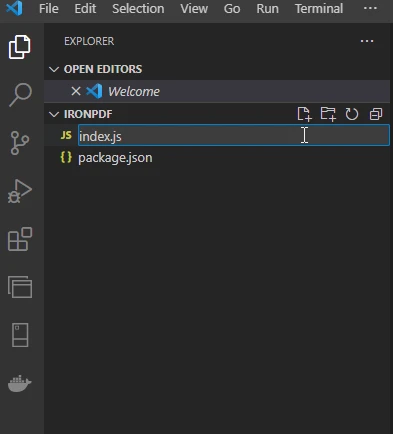 Crea un nuevo archivo index.js
-
Abre el archivo JSON estructurado package.json y añade los siguientes datos JSON para añadir compatibilidad con los módulos ES.
"type": "module",
"type": "module",
JSON
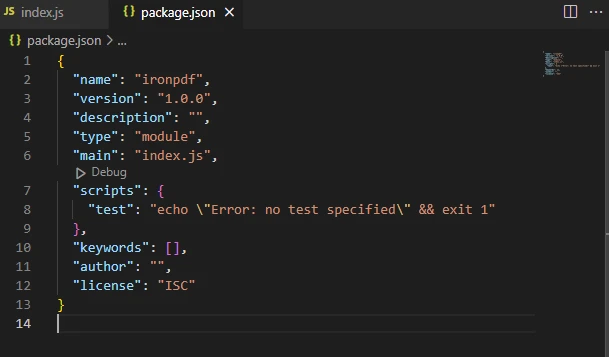 Imagen de muestra del archivo package.json
Así de sencillo, IronPDF está instalado y el entorno de demostración está listo para ejecutar el código de IronPDF, la generación de documentos y la ejecución de operaciones.
3. Creación de archivos PDF con Node.js PDF SDK
Usar IronPDF for Node.js SDK para crear archivos PDF y usar otros servicios de PDF es pan comido, y puedes crear un archivo PDF con solo unas pocas líneas de código. Hay dos maneras más comunes de crear archivos PDF:
- Archivo HTML a PDF
- URL a Documentos PDF
3.1. Archivo HTML a PDF
Esta sección verá cómo crear archivos PDF usando IronPDF for Node.js PDF SDK. Usando IronPDF, puedes convertir una cadena de HTML a un archivo PDF.
import { PdfDocument } from "@ironsoftware/ironpdf";

(async () => {
  // Create a PDF document from an HTML string
  const pdf = await PdfDocument.fromHtml("<h1 style='padding:100px'>This PDF is Created By Using IronPDF for Node.js PDF SDK</h1>");

  // Save the generated PDF to a file
  await pdf.saveAs("pdf-from-html.pdf");
})();
import { PdfDocument } from "@ironsoftware/ironpdf";

(async () => {
  // Create a PDF document from an HTML string
  const pdf = await PdfDocument.fromHtml("<h1 style='padding:100px'>This PDF is Created By Using IronPDF for Node.js PDF SDK</h1>");

  // Save the generated PDF to a file
  await pdf.saveAs("pdf-from-html.pdf");
})();
JavaScript
Este código demuestra el uso de la librería IronPDF en una aplicación Node.js para crear un documento PDF a partir de una cadena de HTML proporcionada. Importa la clase PdfDocument, genera un documento PDF a partir del contenido HTML utilizando el método fromHtml y, a continuación, guarda una copia del PDF resultante en un archivo denominado "pdf-from-html.pdf". El código utiliza una función async de invocación inmediata para garantizar un manejo asíncrono adecuado, lo que permite que las operaciones de creación y guardado del PDF se completen antes de finalizar la ejecución.
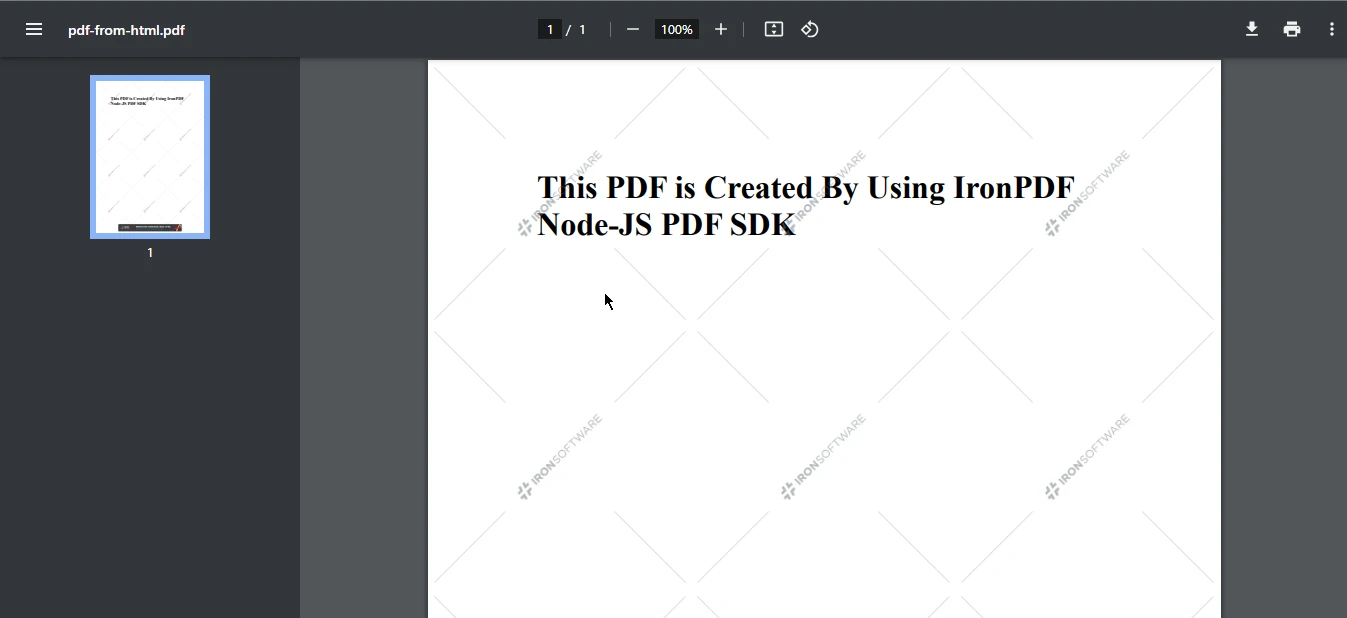 Archivo PDF de salida
3.2. URL a documentos PDF
El SDK de PDF for Node.js ofrece la capacidad de crear archivos PDF desde URLs. Este paquete da a los desarrolladores la capacidad de convertir páginas web en archivos PDF sobre la marcha.
import { PdfDocument } from "@ironsoftware/ironpdf";

(async () => {
  // Create a PDF document from a URL
  const pdf = await PdfDocument.fromUrl("https://www.google.com");

  // Save the generated PDF to a file
  await pdf.saveAs("pdf-from-url.pdf");
})();
import { PdfDocument } from "@ironsoftware/ironpdf";

(async () => {
  // Create a PDF document from a URL
  const pdf = await PdfDocument.fromUrl("https://www.google.com");

  // Save the generated PDF to a file
  await pdf.saveAs("pdf-from-url.pdf");
})();
JavaScript
Este código ilustra el uso de la librería IronPDF en una aplicación Node.js para convertir una página web, en este caso, la página de inicio de Google, en un documento PDF. Importa la clase PdfDocument, crea un documento PDF obteniendo contenido de la URL especificada mediante el método fromUrl y, a continuación, guarda el PDF resultante como "pdf-from-url.pdf" en el directorio de trabajo actual. El código emplea una función async de invocación inmediata para garantizar un manejo asíncrono adecuado, lo que permite que las operaciones de conversión y guardado del PDF se completen antes de que finalice la ejecución del código.
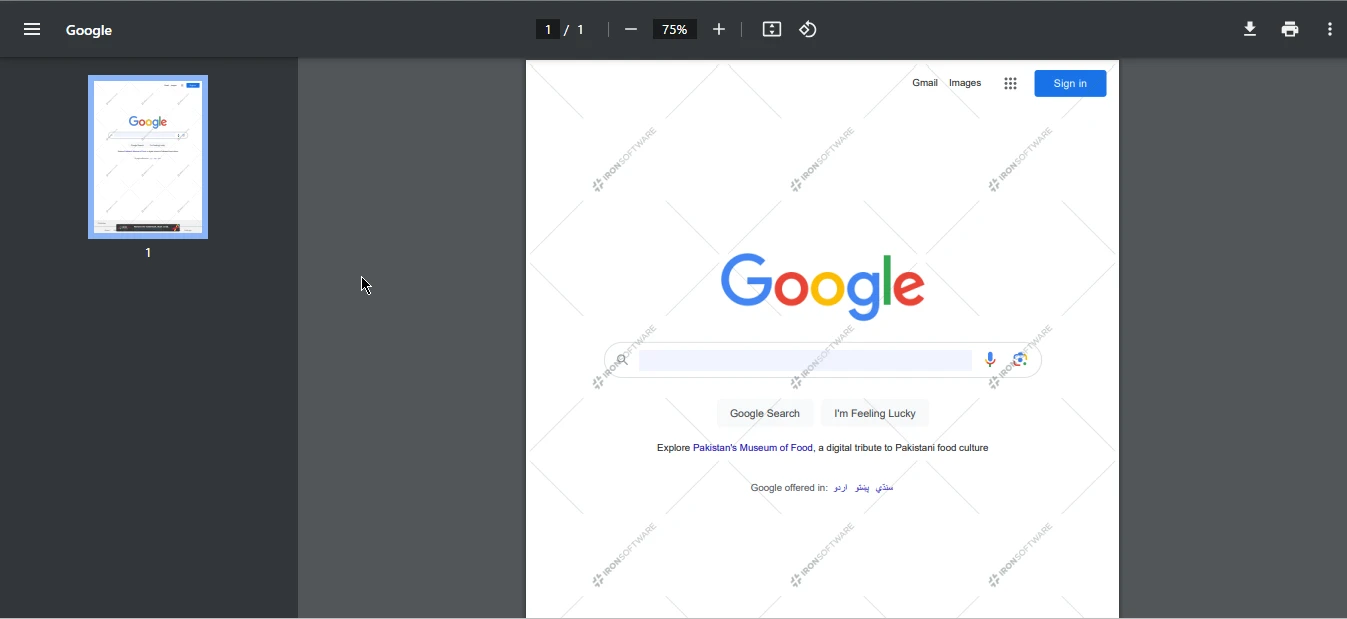 Archivo PDF de salida
4. Combinar archivos PDF
Esta sección demostrará cómo combinar los dos archivos PDF creados anteriormente y luego crear un nuevo archivo PDF con solo unas pocas líneas de código. Puedes combinar múltiples PDFs para crear "documentos dinámicos" para contratos y acuerdos, facturas, propuestas, informes, formularios, documentos de marketing de marca y más.
import { PdfDocument } from "@ironsoftware/ironpdf";

(async () => {
  // Load existing PDF files
  const pdf1 = await PdfDocument.fromFile("pdf-from-html.pdf");
  const pdf2 = await PdfDocument.fromFile("pdf-from-url.pdf");

  // Create an array of PDFs to be merged
  const arrayOfPDFs = [pdf1, pdf2];

  // Merge the PDFs into a single document
  const merge_pdf = await PdfDocument.mergePdf(arrayOfPDFs);

  // Save the merged PDF to a file
  await merge_pdf.saveAs("merged_PDF.pdf");
})();
import { PdfDocument } from "@ironsoftware/ironpdf";

(async () => {
  // Load existing PDF files
  const pdf1 = await PdfDocument.fromFile("pdf-from-html.pdf");
  const pdf2 = await PdfDocument.fromFile("pdf-from-url.pdf");

  // Create an array of PDFs to be merged
  const arrayOfPDFs = [pdf1, pdf2];

  // Merge the PDFs into a single document
  const merge_pdf = await PdfDocument.mergePdf(arrayOfPDFs);

  // Save the merged PDF to a file
  await merge_pdf.saveAs("merged_PDF.pdf");
})();
JavaScript
Este código utiliza la biblioteca IronPDF en una aplicación Node.js para fusionar dos documentos PDF, "pdf-from-html.pdf" y "pdf-from-url.pdf", en un único archivo PDF denominado "merged_PDF.pdf". Comienza creando dos instancias PdfDocument a partir de archivos PDF existentes y, a continuación, las agrupa en una matriz denominada arrayOfPDFs. Utilizando el método PdfDocument.mergePdf, el código combina los archivos PDF de la matriz en un documento unificado, que se almacena en la variable merge_pdf. Finalmente, el archivo fuente del PDF combinado se guarda en el directorio de trabajo actual con el nombre de archivo "merged_PDF.pdf". El código utiliza una función async de invocación inmediata para gestionar eficazmente las operaciones asíncronas, garantizando que las tareas de fusión y guardado se completen antes de que finalice la ejecución del código.
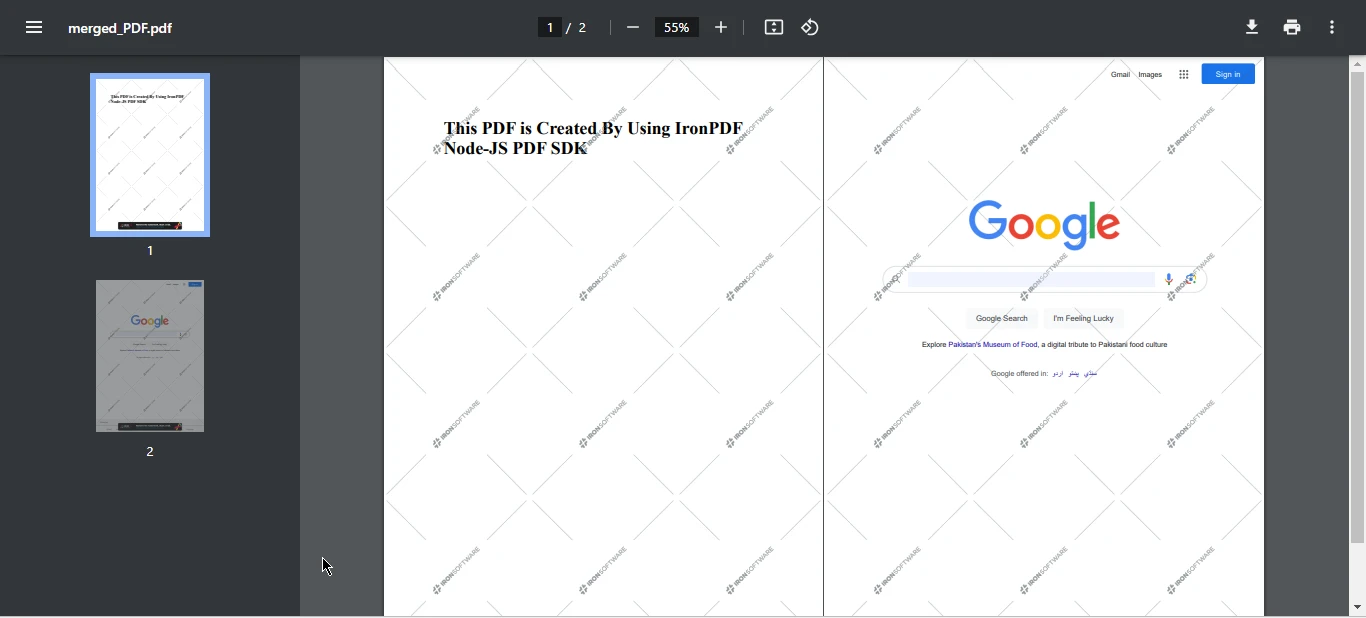 Archivo PDF de salida
5. Conclusión
En una era digital donde el intercambio de información es ubicuo, los documentos PDF han surgido como una piedra angular para compartir y preservar contenido en diversas plataformas y dispositivos. El SDK de PDF for Node.js, con su capacidad para aprovechar el poder de Node.js, se ha convertido en una herramienta pivotal en el ámbito de la gestión de documentos PDF, ofreciendo un enfoque versátil y eficiente para manejar archivos PDF. Este artículo se ha centrado en IronPDF for Node.js, delineando su introducción, instalación y uso práctico para la manipulación de PDF.
Con una gama de características a su disposición, que incluyen creación de PDF, conversión de HTML a PDF, edición de PDF, manejo de formularios y fusión de PDF, IronPDF capacita a los desarrolladores para trabajar sin problemas con PDFs en un entorno multiplataforma. El proceso de instalación es sencillo, y crear, editar o combinar archivos PDF es fácil mediante ejemplos de código simples pero poderosos. Este SDK de PDF for Node.js ha redefinido el panorama de la gestión de documentos PDF, convirtiéndose en una herramienta indispensable para los desarrolladores que buscan agilizar sus flujos de trabajo relacionados con PDFs.
Para saber más sobre IronPDF for Node.js, consulta la última versión desde el sitio web de NPM. Los usuarios pueden optar por una licencia de prueba gratuita para probar todas las características clave de la librería IronPDF for Node.js antes de decidir comprar una licencia comercial.