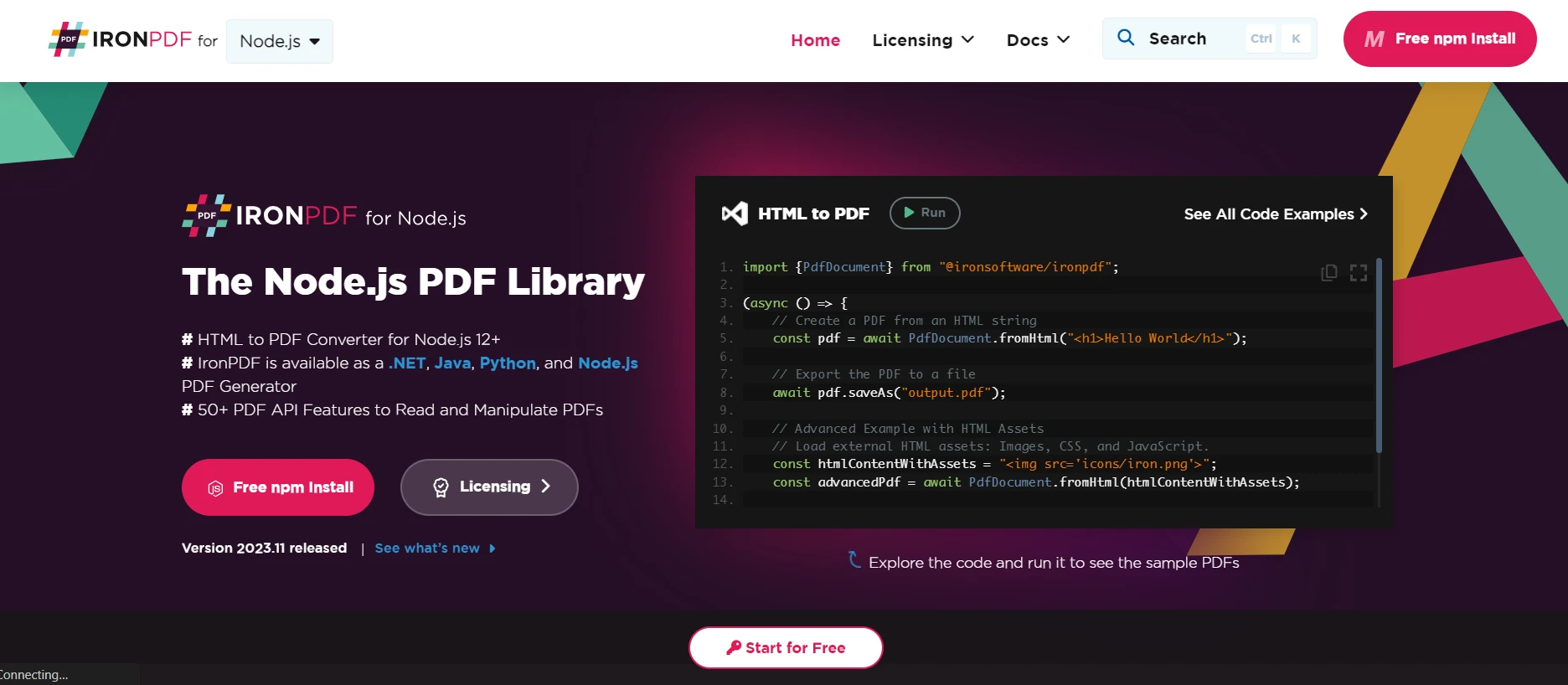
import {PdfDocument} from "@ironsoftware/ironpdf";

(async () => {
    // Create a PDF from an HTML string
    const pdf = await PdfDocument.fromHtml("<h1>Hello World</h1>");

    // Export the PDF to a file
    await pdf.saveAs("output.pdf");

    // Advanced Example with HTML Assets
    // Load external HTML assets: Images, CSS, and JavaScript.
    const htmlContentWithAssets = "<img src='icons/iron.png'>";
    const advancedPdf = await PdfDocument.fromHtml(htmlContentWithAssets);

    // Save the PDF with loaded assets
    await advancedPdf.saveAs("html-with-assets.pdf");
})();
import {PdfDocument} from "@ironsoftware/ironpdf";(async () => { // Create a PDF from an HTML string const pdf = awaitPdfDocument.fromHtml("<h1>Hello World</h1>"); // Export the PDF to a file await pdf.saveAs("output.pdf"); // Advanced Example with HTML Assets // Load external HTML assets: Images, CSS, and JavaScript. const htmlContentWithAssets = "<img src='icons/iron.png'>"; const advancedPdf = awaitPdfDocument.fromHtml(htmlContentWithAssets); // Save the PDF with loaded assets await advancedPdf.saveAs("html-with-assets.pdf");})();
Este artículo demostrará cómo analizar archivos PDF usando Node.js con la biblioteca de análisis PDF Node.js IronPDF.
## ¿Qué es Node?
El entorno de ejecución de JavaScript Node.js, multiplataforma y de código abierto, permite que el código JavaScript se ejecute fuera de un navegador web. Los programadores pueden crear aplicaciones de red que sean escalables, rápidas y efectivas al habilitar la ejecución del servidor JS o módulo JavaScript. Debido a que Node.js es un modelo de E/S no bloqueante y basado en eventos, es ideal para desarrollar aplicaciones en tiempo real que gestionan múltiples conexiones a la vez con elementos de formulario interactivos.
Node.js se utiliza con frecuencia para crear una amplia gama de aplicaciones, incluyendo servidores web, APIs, aplicaciones de transmisión de estructuras de datos, aplicaciones de chat en tiempo real, dispositivos de Internet de las Cosas (IoT), y más. Considerando todo, Node.js está creciendo en popularidad debido a su eficacia, velocidad y compatibilidad con JavaScript en tanto el front-end como el back-end, proporcionando un único lenguaje para el desarrollo full-stack. Consulta este [sitio web de explicación](https://en.wikipedia.org/wiki/Node.js) para páginas de documentación y aprender más sobre Node.js.
## Cómo analizar un documento PDF en Node.js
1. Para analizar archivos PDF para un flujo legible, descarga el paquete de Node.js.
2. Instala IronPDF para la biblioteca Node.js.
3. Crea un nuevo PDF o importa uno existente con los datos del documento analizado.
4. Para extraer cada línea de texto, utiliza el método [`extractText`](/nodejs/object-reference/api/classes/PdfDocument.html#extractText).
5. Ver el contenido del PDF analizado para la lectura cruda del PDF.
## IronPDF for Node.js
Hasta mi última actualización de conocimientos en enero de 2022, IronPDF era en gran medida una biblioteca .NET construida para trabajar dentro del .NET Framework, permitiendo a los desarrolladores trabajar con documentos PDF usando C# o VB.NET. Sin embargo, no había una versión nativa o directa de IronPDF creada solo para Node.js.
A medida que IronPDF se ha expandido para soportar e incluir enlaces para Node.js, esto probablemente significa que las herramientas para crear, editar y procesar documentos PDF en aplicaciones Node.js ya están disponibles en IronPDF for Node.js.
## Características de IronPDF
- [Generación de HTML a PDF](/nodejs/tutorials/html-to-pdf/): La capacidad de convertir contenido HTML en documentos PDF.
- La adición, alteración o eliminación de texto, formas, imágenes y otros elementos de archivos PDF se denomina [manipulación de texto e imagen](/csharp/pdf/how-to/javascript-to-pdf).
- [Combinación](/nodejs/examples/merge-pdfs/), extracción de páginas de archivos PDF, [división de archivos PDF](/nodejs/blog/using-ironpdf-for-nodejs/split-pdf-node-tutorial/), y [cifrado y descifrado](/nodejs/examples/encryption-and-decryption/) de los mismos son todos ejemplos de alteración de documentos PDF.
- [Manejo de formularios](/nodejs/examples/form-data/) abarca completar formularios, adquirir datos de formularios y utilizar formularios PDF a través de la programación.
- La seguridad de PDF es el uso de [firmas digitales](/nodejs/blog/using-ironpdf-for-nodejs/sign-pdf-node-js-tutorial/), cifrado y [protección por contraseña](/nodejs/examples/security-and-metadata/) para los documentos PDF.
- La recuperación y modificación de archivos PDF se conoce como manejo de metadatos de página.
Si IronPDF ha expandido su gama de productos para incluir una versión de Node.js, esto podría proporcionar una forma para que los desarrolladores que crean aplicaciones Node.js utilicen la funcionalidad de manipulación de PDF de IronPDF. Esto podría ser útil para los desarrolladores que prefieren trabajar con una biblioteca que ofrece características similares a las de IronPDF en el entorno .NET.
La documentación oficial, las notas de lanzamiento o las actualizaciones del equipo de IronPDF deben ser consultadas siempre para obtener la información más actualizada sobre las características, compatibilidad y soporte de IronPDF for Node.js. Ve aquí para aprender más sobre IronPDF y las nuevas características en cada lanzamiento. Para saber más sobre IronPDF, consulta esta [página de documentación oficial](/nodejs/).
## Requisitos del paquete
- Visual Studio Code como IDE
- Node.js
- Yarn o npm pueden ser usados para la gestión de paquetes, lo cual es necesario para las instalaciones de paquetes.
### Instalar el paquete IronPDF for Node.js
Lanza el Símbolo del sistema o Terminal: Abre el símbolo del sistema o terminal. Existen varias maneras de acceder dependiendo de tu sistema operativo:
- Windows: PowerShell o Símbolo del sistema
- Terminal en macOS
- Terminal en Linux
Para instalar un paquete, usa el nombre del paquete y el comando npm install. Por ejemplo, para instalar el paquete `@ironsoftware/ironpdf`, ejecuta el siguiente comando en la terminal:
```shell
:ProductInstall
```
Reemplaza `@ironsoftware/ironpdf` con el nombre del paquete que deseas instalar si es diferente.
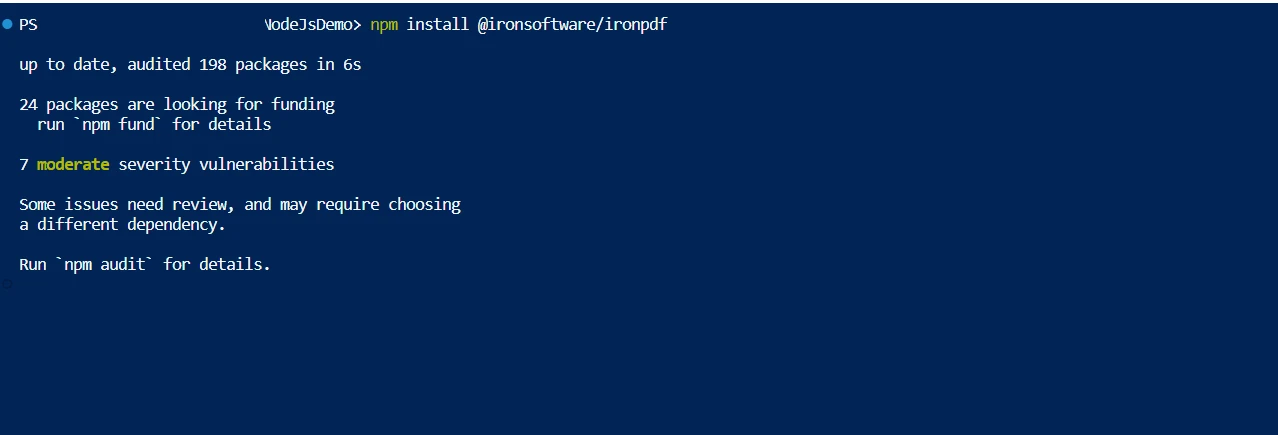
**Instalar IronPDF**
## Extraer datos de un archivo PDF
A partir de la experimentación, puedes ver que IronPDF ofrece muchas funciones para facilitar el manejo de PDF en Node.js. Está enfocado en generar, ver y modificar cualquier documento PDF en los formatos requeridos. Los archivos PDF son bastante simples de analizar.
```nodejs
const { PdfDocument } = require("@ironsoftware/ironpdf");

const pdfProcess = async () => {
  // Load the existing PDF document
  const pdf = await PdfDocument.fromFile("Demo.pdf");
  // Extract text data from the loaded PDF
  const data = await pdf.extractText();
  // Output the extracted text to the console
  console.log(data);
};

pdfProcess();
```
La importancia de la función [`fromFile`](/nodejs/object-reference/api/classes/PdfDocument.html#fromFile) se demuestra con el código anterior. El método `fromFile` lee documentos PDF y convierte el archivo PDF en objetos [`PdfDocument`](/nodejs/object-reference/api/classes/PdfDocument.html), cargando el archivo desde un sistema de archivos existente. Así, `PdfDocument` mantiene los metadatos del PDF. Los metadatos del archivo en el objeto PDF pueden ser utilizados como desee el usuario. Este objeto de datos del documento analizado son el texto y los gráficos contenidos dentro del objeto de página PDF. La función `extractText` se utiliza para extraer todo el texto del archivo PDF proporcionado. Después, el texto recuperado se almacena como una cadena y se prepara para procesamiento adicional como crear un formato JSON.
### Extracción de texto página por página
A continuación se ofrece el código para otro enfoque, que extrae explícitamente texto de cada página del archivo PDF.
```nodejs
const pdf = await PdfDocument.fromFile("Demo.pdf");
// Get the total number of pages in the PDF
const pageCount = await pdf.getPageCount();
// Loop through each page to extract text
for (let i = 0; i < pageCount; i++) {
const pageText = await pdf.extractText(i);
// Output the text of each page
console.log(pageText);
}
```
La lectura cruda del PDF ya en memoria se carga desde el directorio especificado en su totalidad por este código de muestra, que luego crea un objeto `PdfDocument` llamado `pdf`. Un documento PDF es una estructura de datos compuesta por varios tipos de objetos de datos fundamentales. Cada dato de página en el archivo PDF se recupera usando su número de página o índice de página en el objeto PDF para garantizar que se procese uno tras otro. Primero, usamos el método [`getPageCount`](/nodejs/object-reference/api/classes/PdfDocument.html#getPageCount) de su objeto PDF para encontrar el número total de páginas en el PDF suministrado.
El bucle `for` itera a través de cada página utilizando este recuento de páginas, invocando la función `extractText` para recuperar texto de cada página del PDF. El texto extraído puede mostrarse en la pantalla del usuario o guardarse en una variable de cadena. Esta técnica hace posible extraer texto de páginas PDF individuales de manera organizada. Estas técnicas demuestran cómo IronPDF, una biblioteca de Node.js creada específicamente para tareas PDF, puede extraer fácilmente y de manera exhaustiva texto de archivos PDF. Esta accesibilidad mejora la utilidad de los PDF en una variedad de contextos y tiene numerosas aplicaciones prácticas.
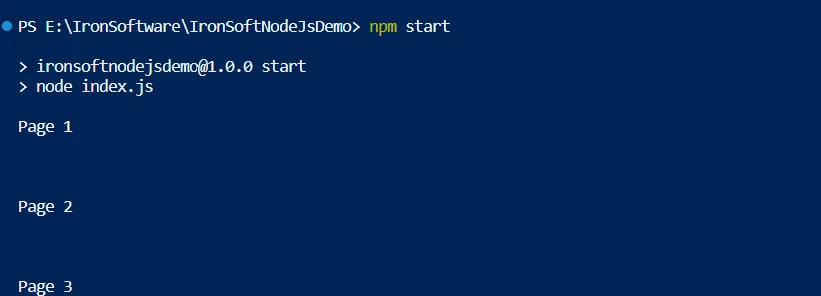
**Leer PDF página por página**
Ambos códigos anteriores logran el mismo resultado, pero la única diferencia está en la implementación del código basada en los requisitos del usuario. Para saber más sobre IronPDF, consulta estas [páginas de documentación detallada](/nodejs/docs/).
## Conclusión
La biblioteca IronPDF ofrece medidas de seguridad robustas para reducir riesgos y garantizar la seguridad de los datos. Es compatible con todos los navegadores populares y no está limitado a ninguno de ellos. Para satisfacer las diversas demandas de los desarrolladores, la biblioteca ofrece una amplia gama de opciones de licencia, incluyendo una licencia de desarrollador gratuita y licencias de desarrollo adicionales que pueden ser compradas.
Además de una licencia permanente, un año de mantenimiento de software y una garantía de devolución de dinero de treinta días, el paquete Lite `$liteLicense` incluye posibilidades de actualización. Los usuarios tienen la oportunidad de evaluar el producto en circunstancias de aplicación práctica durante el período de prueba con marcas de agua. Por favor, revisa la [página de licencias](licensing) proporcionada para más detalles sobre el coste, licencias, y versión de prueba de IronPDF. Para saber sobre otros productos ofrecidos por Iron Software, visita el [sitio web oficial](https://ironsoftware.com/).
**Precios de Iron Software**
Este artículo demostrará cómo analizar archivos PDF usando Node.js con la biblioteca de análisis PDF Node.js IronPDF.
¿Qué es Node?
El entorno de ejecución de JavaScript Node.js, multiplataforma y de código abierto, permite que el código JavaScript se ejecute fuera de un navegador web. Los programadores pueden crear aplicaciones de red que sean escalables, rápidas y efectivas al habilitar la ejecución del servidor JS o módulo JavaScript. Debido a que Node.js es un modelo de E/S no bloqueante y basado en eventos, es ideal para desarrollar aplicaciones en tiempo real que gestionan múltiples conexiones a la vez con elementos de formulario interactivos.
Node.js se utiliza con frecuencia para crear una amplia gama de aplicaciones, incluyendo servidores web, APIs, aplicaciones de transmisión de estructuras de datos, aplicaciones de chat en tiempo real, dispositivos de Internet de las Cosas (IoT), y más. Considerando todo, Node.js está creciendo en popularidad debido a su eficacia, velocidad y compatibilidad con JavaScript en tanto el front-end como el back-end, proporcionando un único lenguaje para el desarrollo full-stack. Consulta este sitio web de explicación para páginas de documentación y aprender más sobre Node.js.
Cómo analizar un documento PDF en Node.js
Para analizar archivos PDF para un flujo legible, descarga el paquete de Node.js.
Instala IronPDF para la biblioteca Node.js.
Crea un nuevo PDF o importa uno existente con los datos del documento analizado.
Para extraer cada línea de texto, utiliza el método extractText.
Ver el contenido del PDF analizado para la lectura cruda del PDF.
IronPDF for Node.js
Hasta mi última actualización de conocimientos en enero de 2022, IronPDF era en gran medida una biblioteca .NET construida para trabajar dentro del .NET Framework, permitiendo a los desarrolladores trabajar con documentos PDF usando C# o VB.NET. Sin embargo, no había una versión nativa o directa de IronPDF creada solo para Node.js.
A medida que IronPDF se ha expandido para soportar e incluir enlaces para Node.js, esto probablemente significa que las herramientas para crear, editar y procesar documentos PDF en aplicaciones Node.js ya están disponibles en IronPDF for Node.js.
La recuperación y modificación de archivos PDF se conoce como manejo de metadatos de página.
Si IronPDF ha expandido su gama de productos para incluir una versión de Node.js, esto podría proporcionar una forma para que los desarrolladores que crean aplicaciones Node.js utilicen la funcionalidad de manipulación de PDF de IronPDF. Esto podría ser útil para los desarrolladores que prefieren trabajar con una biblioteca que ofrece características similares a las de IronPDF en el entorno .NET.
La documentación oficial, las notas de lanzamiento o las actualizaciones del equipo de IronPDF deben ser consultadas siempre para obtener la información más actualizada sobre las características, compatibilidad y soporte de IronPDF for Node.js. Ve aquí para aprender más sobre IronPDF y las nuevas características en cada lanzamiento. Para saber más sobre IronPDF, consulta esta página de documentación oficial.
Requisitos del paquete
Visual Studio Code como IDE
Node.js
Yarn o npm pueden ser usados para la gestión de paquetes, lo cual es necesario para las instalaciones de paquetes.
Instalar el paquete IronPDF for Node.js
Lanza el Símbolo del sistema o Terminal: Abre el símbolo del sistema o terminal. Existen varias maneras de acceder dependiendo de tu sistema operativo:
Windows: PowerShell o Símbolo del sistema
Terminal en macOS
Terminal en Linux
Para instalar un paquete, usa el nombre del paquete y el comando npm install. Por ejemplo, para instalar el paquete @ironsoftware/ironpdf, ejecuta el siguiente comando en la terminal:
> npm i @ironsoftware/ironpdf
npm i @ironsoftware/ironpdf
Reemplaza @ironsoftware/ironpdf con el nombre del paquete que deseas instalar si es diferente.
Instalar IronPDF
Extraer datos de un archivo PDF
A partir de la experimentación, puedes ver que IronPDF ofrece muchas funciones para facilitar el manejo de PDF en Node.js. Está enfocado en generar, ver y modificar cualquier documento PDF en los formatos requeridos. Los archivos PDF son bastante simples de analizar.
const { PdfDocument } = require("@ironsoftware/ironpdf");const pdfProcess = async () => { // Load the existing PDF document const pdf = awaitPdfDocument.fromFile("Demo.pdf"); // Extract text data from the loaded PDF const data = await pdf.extractText(); // Output the extracted text to the console console.log(data);};pdfProcess();
const { PdfDocument } = require("@ironsoftware/ironpdf");

const pdfProcess = async () => {
  // Load the existing PDF document
  const pdf = await PdfDocument.fromFile("Demo.pdf");
  // Extract text data from the loaded PDF
  const data = await pdf.extractText();
  // Output the extracted text to the console
  console.log(data);
};

pdfProcess();
JavaScript
La importancia de la función fromFile se demuestra con el código anterior. El método fromFile lee documentos PDF y convierte el archivo PDF en objetos PdfDocument, cargando el archivo desde un sistema de archivos existente. Así, PdfDocument mantiene los metadatos del PDF. Los metadatos del archivo en el objeto PDF pueden ser utilizados como desee el usuario. Este objeto de datos del documento analizado son el texto y los gráficos contenidos dentro del objeto de página PDF. La función extractText se utiliza para extraer todo el texto del archivo PDF proporcionado. Después, el texto recuperado se almacena como una cadena y se prepara para procesamiento adicional como crear un formato JSON.
Extracción de texto página por página
A continuación se ofrece el código para otro enfoque, que extrae explícitamente texto de cada página del archivo PDF.
const pdf = awaitPdfDocument.fromFile("Demo.pdf");// Get the total number of pages in the PDFconst pageCount = await pdf.getPageCount();// Loop through each page to extract textfor (let i = 0; i < pageCount; i++) { const pageText = await pdf.extractText(i); // Output the text of each page console.log(pageText);}
const pdf = await PdfDocument.fromFile("Demo.pdf");
// Get the total number of pages in the PDF
const pageCount = await pdf.getPageCount();

// Loop through each page to extract text
for (let i = 0; i < pageCount; i++) {
  const pageText = await pdf.extractText(i);
  // Output the text of each page
  console.log(pageText);
}
JavaScript
La lectura cruda del PDF ya en memoria se carga desde el directorio especificado en su totalidad por este código de muestra, que luego crea un objeto PdfDocument llamado pdf. Un documento PDF es una estructura de datos compuesta por varios tipos de objetos de datos fundamentales. Cada dato de página en el archivo PDF se recupera usando su número de página o índice de página en el objeto PDF para garantizar que se procese uno tras otro. Primero, usamos el método getPageCount de su objeto PDF para encontrar el número total de páginas en el PDF suministrado.
El bucle for itera a través de cada página utilizando este recuento de páginas, invocando la función extractText para recuperar texto de cada página del PDF. El texto extraído puede mostrarse en la pantalla del usuario o guardarse en una variable de cadena. Esta técnica hace posible extraer texto de páginas PDF individuales de manera organizada. Estas técnicas demuestran cómo IronPDF, una biblioteca de Node.js creada específicamente para tareas PDF, puede extraer fácilmente y de manera exhaustiva texto de archivos PDF. Esta accesibilidad mejora la utilidad de los PDF en una variedad de contextos y tiene numerosas aplicaciones prácticas.
Leer PDF página por página
Ambos códigos anteriores logran el mismo resultado, pero la única diferencia está en la implementación del código basada en los requisitos del usuario. Para saber más sobre IronPDF, consulta estas páginas de documentación detallada.
Conclusión
La biblioteca IronPDF ofrece medidas de seguridad robustas para reducir riesgos y garantizar la seguridad de los datos. Es compatible con todos los navegadores populares y no está limitado a ninguno de ellos. Para satisfacer las diversas demandas de los desarrolladores, la biblioteca ofrece una amplia gama de opciones de licencia, incluyendo una licencia de desarrollador gratuita y licencias de desarrollo adicionales que pueden ser compradas.
Además de una licencia permanente, un año de mantenimiento de software y una garantía de devolución de dinero de treinta días, el paquete Lite $999 incluye posibilidades de actualización. Los usuarios tienen la oportunidad de evaluar el producto en circunstancias de aplicación práctica durante el período de prueba con marcas de agua. Por favor, revisa la página de licencias proporcionada para más detalles sobre el coste, licencias, y versión de prueba de IronPDF. Para saber sobre otros productos ofrecidos por Iron Software, visita el sitio web oficial.
Curtis Chau tiene una licenciatura en Ciencias de la Computación (Carleton University) y se especializa en el desarrollo front-end con experiencia en Node.js, TypeScript, JavaScript y React. Apasionado por crear interfaces de usuario intuitivas y estéticamente agradables, disfruta trabajando con frameworks modernos y creando manuales bien estructurados y visualmente atractivos.




 Instalar IronPDF
 Leer PDF página por página