Cómo Extraer Datos De Un PDF en Python

Un paquete robusto de Python llamado IronPDF puede usarse para extraer datos, imágenes, botones de radio, widgets de cuadro de lista (en lugar de widgets de casilla de verificación) y otra información de archivos PDF. Este artículo demostrará cómo usar esta biblioteca para agrupar formularios interactivos con datos y generar nuevos archivos y formularios PDF.
Cómo extraer datos de un PDF con Python
- Obtén el archivo PDF para extraer texto para el procesamiento de datos.
- Crea un proyecto en PyCharm.
- Configura las bibliotecas de Python necesarias para tu proyecto.
- Extrae información de páginas específicas en el documento PDF.
- Imprime el contenido del texto extraído del documento PDF.
2. IronPDF
La biblioteca IronPDF for Python mejora sin problemas la programación en Python facilitando el procesamiento eficiente de datos PDF y ofreciendo multitud de operaciones PDF. Sus capacidades de integración se extienden a varios marcos de trabajo, expandiendo las capacidades para desarrollar interfaces gráficas de usuario.
Python es un lenguaje de programación versátil que permite la creación rápida y sencilla de interfaces gráficas de usuario amigables, lo que lo hace una elección preferida por muchos desarrolladores. Su naturaleza dinámica lo distingue de otros lenguajes de programación. La introducción de la biblioteca IronPDF a Python resulta ser un proceso sencillo, permitiendo una gestión y procesamiento eficiente de datos PDF.
Para el desarrollo rápido y seguro de interfaces gráficas de usuario completamente funcionales, los desarrolladores pueden aprovechar una amplia gama de herramientas preinstaladas y populares bibliotecas de Python, incluidas PyQt, wxWidgets, Kivy y muchas otras.
Además, la biblioteca IronPDF integra sin problemas varias características de otros marcos, especialmente en el contexto de .NET Core, que extiende el soporte a Python y a varios otros lenguajes de programación. Se puede acceder a más información sobre Python IronPDF visitando el sitio web oficial.
La biblioteca IronPDF for Python simplifica el proceso de creación y gestión de sitios web, especialmente cuando se trata del desarrollo web basado en Python utilizando marcos como Django, Flask y Pyramid. Es una herramienta valiosa en la que estos populares sitios web y servicios en línea, como Reddit, Mozilla y Spotify, confían para mejorar su funcionalidad y características.
2.1 Características de IronPDF
HTML, HTML5, ASPX y Razor/MVC View son algunos de los formatos que pueden convertirse en formato PDF usando IronPDF. Además, IronPDF ofrece la conveniente capacidad de generar archivos PDF tanto desde imágenes como desde páginas HTML.
La caja de herramientas de IronPDF puede ayudar con varias tareas, incluidas la creación de PDFs interactivos, la facilitación de la completación y el envío de formularios interactivos, la eficiente fusión y división de archivos PDF, la extracción precisa de texto e imágenes, la búsqueda integral de texto dentro de archivos PDF, la transformación de PDFs en imágenes, y la flexibilidad para personalizar tamaños de fuente, bordes y colores de fondo. IronPDF también puede lograr conversiones de archivos PDF sin esfuerzo.
IronPDF va un paso más allá al extender su soporte para agentes de usuario, proxies, cookies, encabezados HTTP y variables de formulario, mejorando así la validación de formularios de inicio de sesión en HTML. Utiliza nombres de usuario y contraseñas para salvaguardar el acceso de usuario al texto seguro contenido dentro de los PDFs.
Se puede producir una impresión de archivo PDF desde muchas fuentes, como una cadena, flujo o URL, y es alcanzable con solo unas pocas líneas de código.
IronPDF puede producir documentos PDF aplanados convirtiendo elementos interactivos y asegurando que el contenido del documento permanezca inalterable y visible pero no editable.
3. Configuración e instalación
3.1 Instalación de Python y creación de un entorno virtual
Asegúrate de tener el lenguaje de programación Python instalado en tu computadora personal. Esto es importante porque las bibliotecas de Python suelen ser necesarias para varias tareas. Para lograr esto, visita el sitio web oficial de Python y descarga la última versión compatible con tu sistema operativo. Esto garantiza que tengas las herramientas adecuadas para trabajar de manera efectiva con bibliotecas de Python.
Después de instalar Python, establece un entorno virtual para aislar las bibliotecas necesarias para tu proyecto, ya que algunos proyectos pueden necesitar algunas bibliotecas necesarias de Python. El módulo venv, que le permite construir y mantener entornos virtuales, puede ayudar a que su proyecto de conversión tenga un lugar de trabajo ordenado y autónomo, especialmente cuando se trabaja con múltiples bibliotecas de Python.
3.2 Configuración de un nuevo proyecto en PyCharm
Tienes la flexibilidad de escribir código Python usando cualquier editor de texto o entorno de codificación, como Visual Studio Code, PyCharm, o Sublime Text. Sin embargo, este artículo usa PyCharm, un IDE para escribir código de Python, para crear un proyecto de Python.
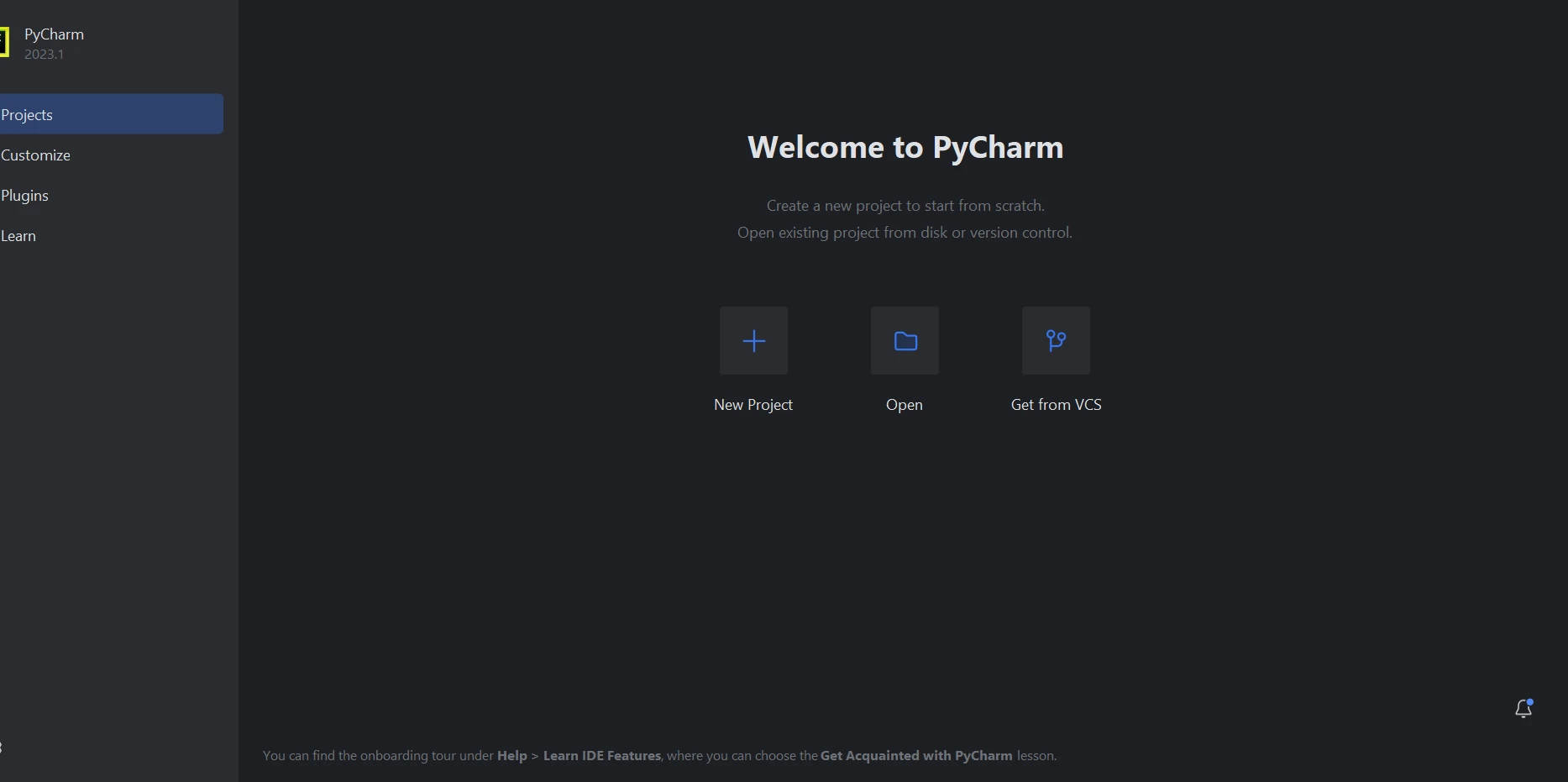
Una vez que el IDE PyCharm se inicia, selecciona Nuevo Proyecto.
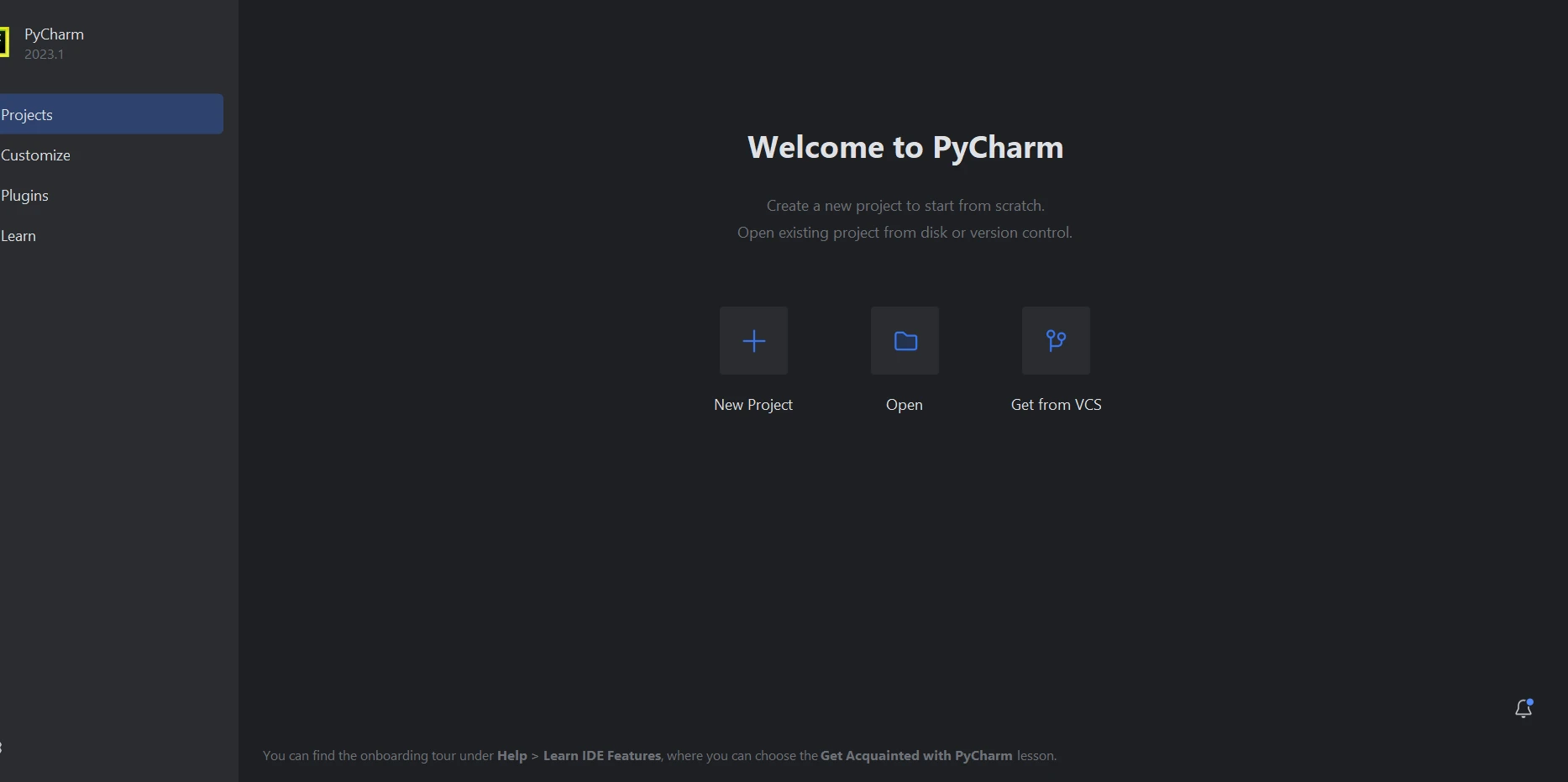 PyCharm IDE para crear un Nuevo Proyecto de Python
Después de seleccionar Nuevo Proyecto, verás una nueva ventana que te permite especificar el entorno y la ubicación del proyecto. La imagen siguiente podría proporcionar más claridad.
Después de configurar la ubicación del proyecto y los detalles del entorno y hacer clic en Crear ingresarás a la interfaz de PyCharm. Aquí encontrarás la estructura de tu proyecto y los archivos de código. Este es tu espacio de trabajo para gestionar y desarrollar tu proyecto. Python 3.9 es la versión utilizada en esta guía.
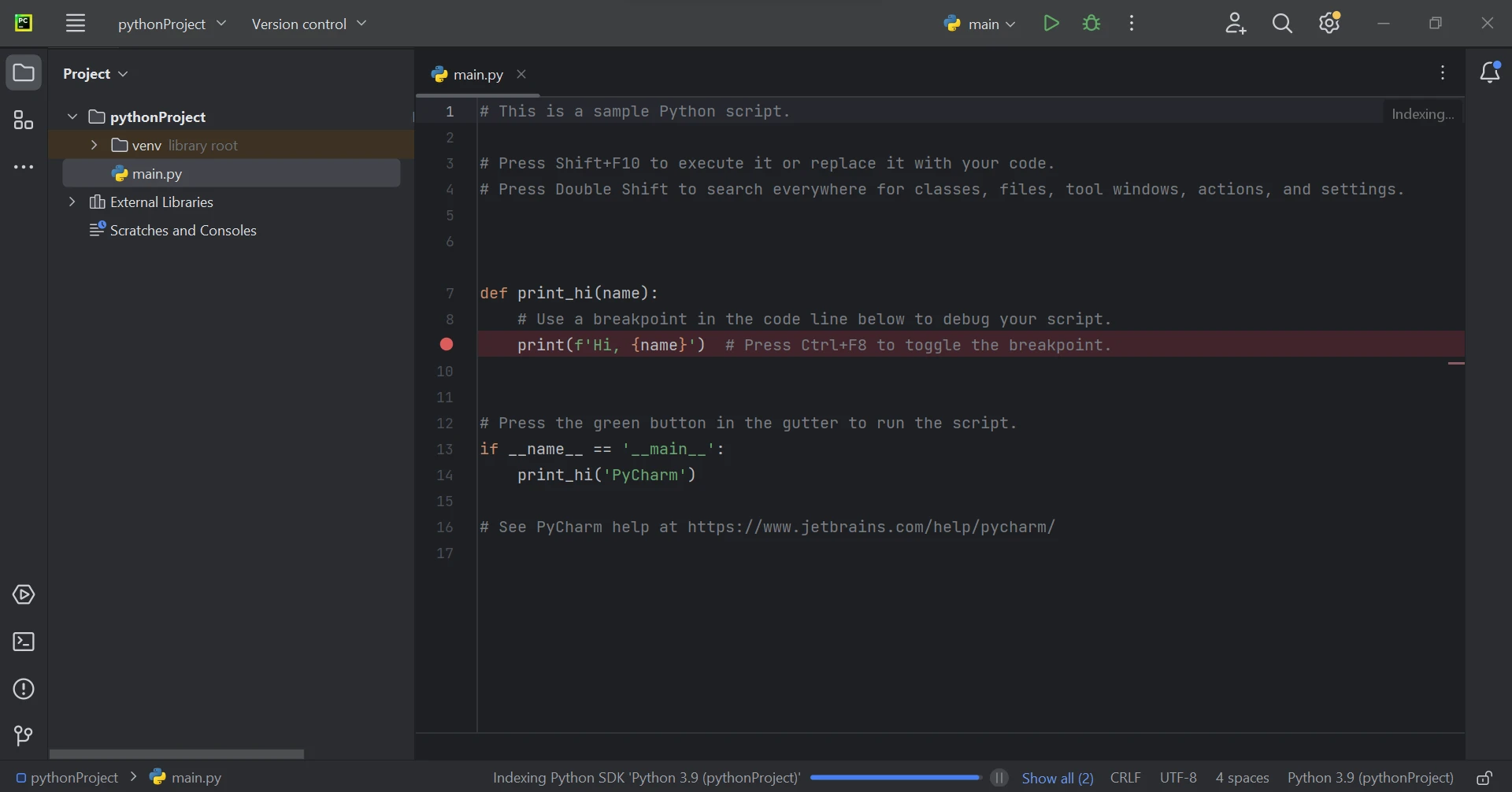 El archivo principal de Python
3.3 Requisitos de la biblioteca para IronPDF
La biblioteca de Python IronPDF comúnmente se integra con .NET 6.0. Por lo tanto, para utilizar IronPDF for Python de manera efectiva, tu computadora debe estar equipada con el runtime de .NET 6.0.
Para los usuarios de Linux y Mac, puede ser necesario instalar .NET antes de utilizar este módulo de Python. Para obtener orientación sobre cómo obtener el entorno de ejecución requerido, visita esta página de descarga de Microsoft.
3.4 Instalación de la librería IronPDF
Debes instalar el paquete "IronPDF" para trabajar con archivos PDF, incluidos la creación, edición y apertura de los mismos. Para hacer esto en PyCharm, abre la ventana del terminal e ingresa este comando:
pip install ironpdf
Consulte la captura de pantalla a continuación para la instalación del paquete ironpdf.
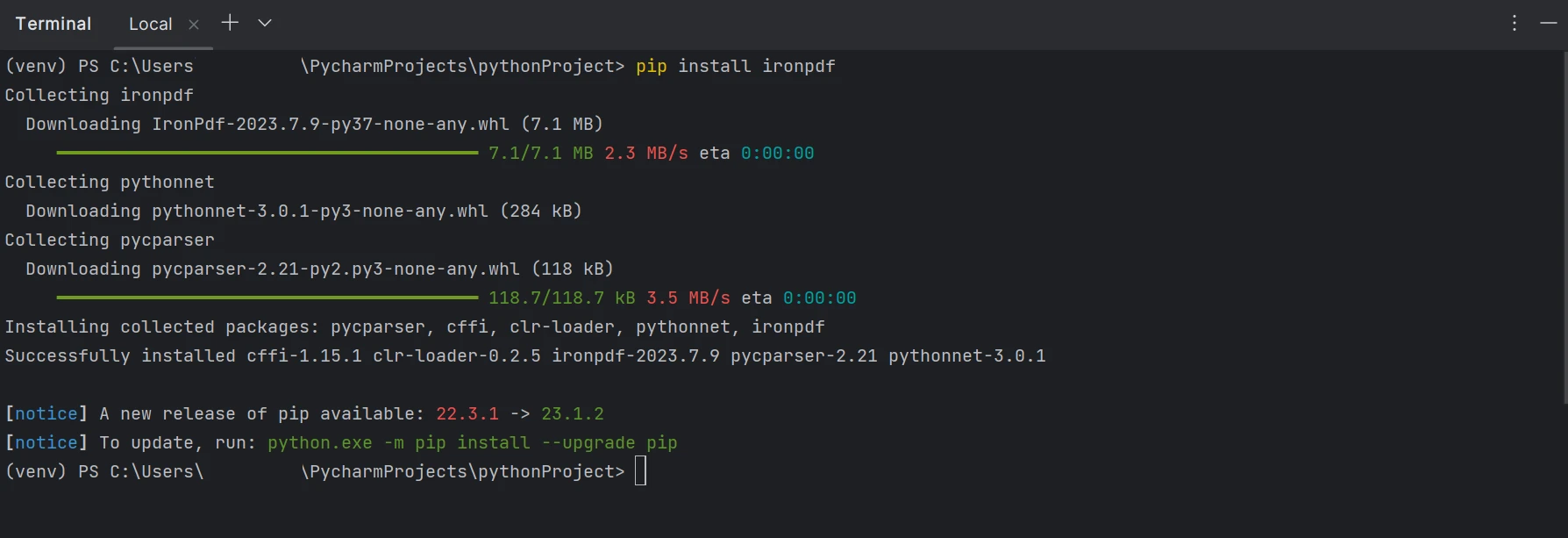 Instalación de IronPDF
4. Extraer texto de archivos PDF
La biblioteca IronPDF for Python transforma eficientemente las páginas PDF en objetos de página PDF, simplificando el proceso de extracción de contenido textual de archivos PDF.
4.1 Cómo extraer todos los datos de texto de un archivo PDF
En este ejemplo, se demuestra el proceso de extracción de texto de un PDF existente utilizando IronPDF. En este caso, se utiliza el documento PDF a continuación para esta demostración.
El primer método se centra en extraer todo el texto del archivo PDF. Escribe el siguiente código para realizar fácilmente la extracción completa de datos del PDF de entrada:
from ironpdf import *

# Load a PDF document from a file
pdf = PdfDocument.FromFile("sampleData.pdf")

# Extract all text from the PDF document
all_text = pdf.ExtractAllText()
from ironpdf import *
# Load a PDF document from a file
pdf = PdfDocument.FromFile("sampleData.pdf")
# Extract all text from the PDF document
all_text = pdf.ExtractAllText()Como se ilustra en el código anterior, el método FromFile juega un papel clave. Carga el archivo PDF desde una ubicación existente, para convertirlo en objetos PdfDocument. Con este objeto, se puede acceder tanto al contenido textual como a las imágenes presentes dentro de las páginas del PDF. Para extraer todo el texto del archivo PDF dado, se utiliza un método llamado ExtractAllText. El texto extraído se almacena luego en una cadena, listo para su posterior procesamiento.
4.2 Extracción de texto página por página
A continuación, se muestra el código para el segundo enfoque, que extrae explícitamente texto de cada página del archivo PDF.
from ironpdf import *

# Load a PDF document from a file
pdf = PdfDocument.FromFile("sampleData.pdf")

# Iterate over each page and extract text
for xpage in range(pdf.PageCount):
    # Extract text from the current page
    print(pdf.ExtractTextFromPage(xpage))
from ironpdf import *
# Load a PDF document from a file
pdf = PdfDocument.FromFile("sampleData.pdf")
# Iterate over each page and extract text
for xpage in range(pdf.PageCount):
# Extract text from the current page
print(pdf.ExtractTextFromPage(xpage))Este código de muestra carga inicialmente el archivo PDF completo y lo transforma en un objeto PdfDocument llamado pdf. Para garantizar que cada página específica del archivo PDF se procese secuencialmente, se accede a cada página utilizando su número de página o índice de página en el objeto pdf. Para hacer esto, primero se determina el número total de páginas presentes en el PDF de entrada utilizando el método PageCount de su objeto pdf.
Con este recuento de páginas, un bucle for itera a través de cada página, llamando a la función ExtractTextFromPage para extraer texto de cada página del documento PDF. El texto extraído puede almacenarse en una variable de cadena o mostrarse en la pantalla del usuario. Por lo tanto, este método permite la extracción organizada de texto de cada página PDF por separado. Estos métodos, de IronPDF, una biblioteca de Python diseñada para tareas PDF, destacan su capacidad para hacer la extracción de texto de archivos PDF fácil y exhaustiva. Esta accesibilidad tiene muchas aplicaciones prácticas y mejora la utilidad de los PDFs en diferentes áreas.
5. Conclusión
La biblioteca IronPDF incorpora fuertes medidas de seguridad para mitigar riesgos potenciales y garantizar la seguridad de los datos. Opera eficazmente en todos los navegadores ampliamente utilizados sin ninguna limitación específica. IronPDF permite a los desarrolladores generar y analizar documentos PDF de manera eficiente con pocas líneas de código Python. Para abordar las diversas demandas de los desarrolladores, la biblioteca IronPDF presenta una variedad de opciones de licencia, que abarcan una licencia de desarrollador gratuita y licencias de desarrollo adicionales disponibles para adquisición.
El paquete Lite cuesta $799 y le otorga una licencia permanente. También obtienes una garantía de devolución de dinero de 30 días, un año de mantenimiento de software y la oportunidad de obtener actualizaciones. Después de comprarlo, no hay cargos adicionales. Puedes usar esta licencia en producción, pruebas y desarrollo. IronPDF también ofrece licencias gratuitas con algunos límites de tiempo y de uso compartido. Puedes probarlo durante 30 días sin marca de agua. Para conocer el costo y cómo obtener la versión de prueba de IronPDF, visita la página de licencias de IronPDF.
Preguntas Frecuentes
¿Cómo puedo extraer datos de un archivo PDF usando Python?
Puedes usar IronPDF para extraer datos de archivos PDF en Python. Carga el PDF usando el método PdfDocument.FromFile() y utiliza el método ExtractAllText() o ExtractTextFromPage() para recuperar datos de texto.
¿Cuáles son los pasos para configurar IronPDF en un proyecto de Python?
Para configurar IronPDF en tu proyecto de Python, primero instala Python y configura un entorno virtual. Luego, usa el comando pip install ironpdf para instalar la biblioteca IronPDF. Asegúrate de que tu sistema tenga instalado el runtime de .NET 6.0.
¿Puedo convertir contenido HTML a PDF usando Python?
Sí, IronPDF te permite convertir contenido HTML a PDF en Python. Puedes usar los métodos RenderUrlAsPdf() o RenderHtmlAsPdf() para convertir páginas web o cadenas HTML en documentos PDF.
¿IronPDF soporta la creación y gestión de formularios PDF?
IronPDF soporta la creación y gestión de formularios PDF interactivos. Puedes utilizarlo para llenar formularios programáticamente y enviarlos, mejorando la interactividad de tus documentos PDF.
¿Cómo puede integrarse IronPDF con marcos de trabajo web en Python?
IronPDF puede integrarse con marcos de trabajo web populares de Python como Django y Flask. Esta integración te permite generar PDFs dinámicamente desde aplicaciones web, mejorando las capacidades de desarrollo web.
¿Qué características ofrece IronPDF para la manipulación de PDF en Python?
IronPDF ofrece características como extracción de texto e imágenes, división y fusión de PDFs, conversión de HTML e imágenes a PDF, y soporte para formularios interactivos. También permite personalizaciones y gestión de acceso seguro para PDFs.
¿Cuáles son las opciones de licencia disponibles para usar IronPDF?
IronPDF ofrece múltiples opciones de licencia, incluyendo una licencia gratuita para desarrolladores y varias licencias pagas para diferentes niveles de necesidades de desarrollo y despliegue.
¿Es posible extraer imágenes de un PDF usando IronPDF en Python?
Sí, puedes extraer imágenes de un PDF usando IronPDF accediendo a los datos de imagen dentro de las páginas PDF, lo que te permite guardarlas o manipularlas según sea necesario.
¿Cuáles son los requisitos del sistema para ejecutar IronPDF en un entorno Python?
Para ejecutar IronPDF en Python, necesitas tener instalado el runtime de .NET 6.0 en tu sistema. Este requisito es especialmente importante para usuarios de Linux y MacOS.
¿Cómo puedo asegurar el acceso seguro a los PDFs generados en Python?
IronPDF te permite implementar medidas de seguridad como protección con contraseña y encriptación para asegurar que tus PDFs sean accedidos de manera segura, resguardando información sensible.






 Comience gratis
 Comience gratis
 Reserve demostración en vivo gratis



 No se requiere tarjeta de crédito ni creación de cuenta