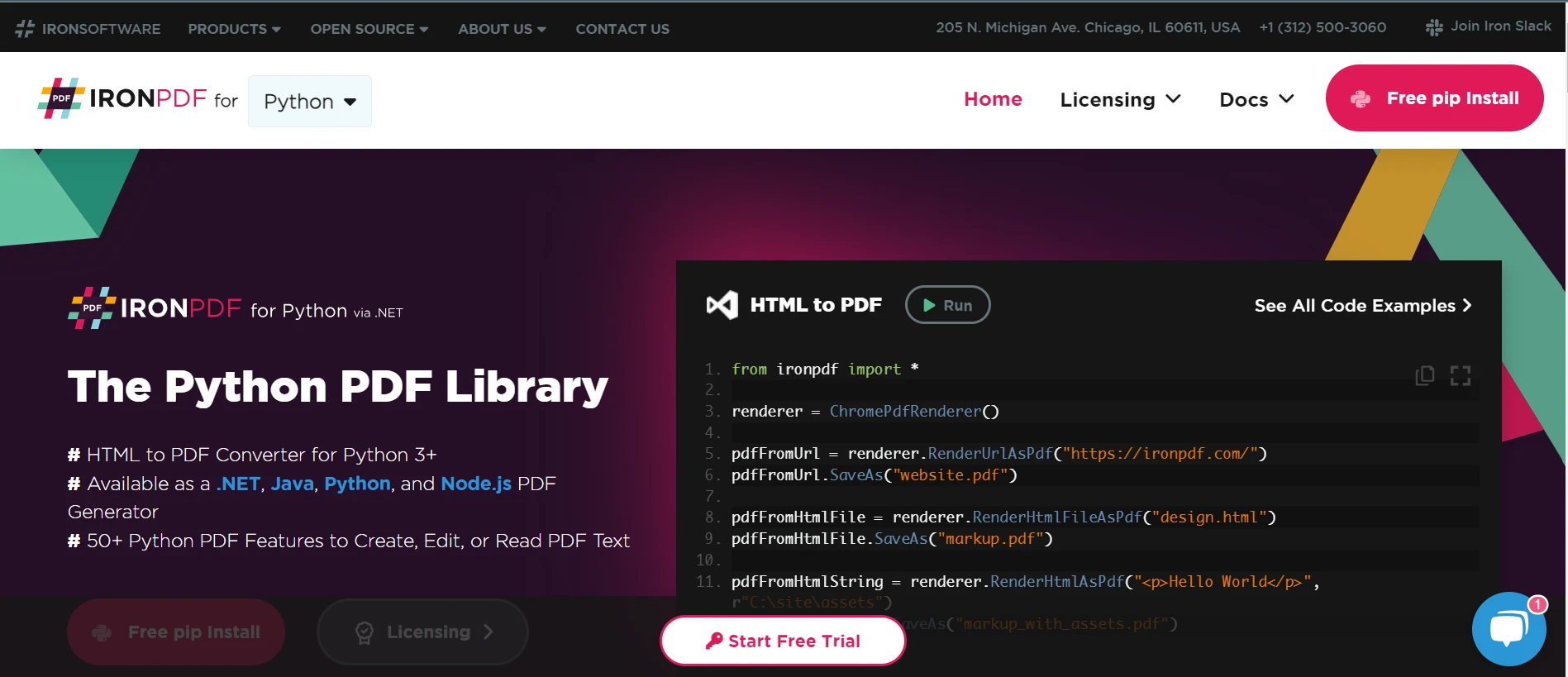
from ironpdf import *

# Instantiate Renderer
renderer = ChromePdfRenderer()

# Create a PDF from a HTML string using Python
pdf = renderer.RenderHtmlAsPdf("<h1>Hello World</h1>")

# Export to a file or Stream
pdf.SaveAs("output.pdf")

# Advanced Example with HTML Assets
# Load external html assets: Images, CSS and JavaScript.
# An optional BasePath 'C:\site\assets\' is set as the file location to load assets from
myAdvancedPdf = renderer.RenderHtmlAsPdf("<img src='icons/iron.png'>", r"C:\site\assets")
myAdvancedPdf.SaveAs("html-with-assets.pdf")
from ironpdf import *# Instantiate Rendererrenderer = ChromePdfRenderer()# Create a PDF from a HTML string using Pythonpdf = renderer.RenderHtmlAsPdf("<h1>Hello World</h1>")# Export to a file or Streampdf.SaveAs("output.pdf")# Advanced Example with HTML Assets# Load external html assets: Images, CSS and JavaScript.# An optional BasePath 'C:\site\assets\' is set as the file location to load assets frommyAdvancedPdf = renderer.RenderHtmlAsPdf("<img src='icons/iron.png'>", r"C:\site\assets")myAdvancedPdf.SaveAs("html-with-assets.pdf")
Este artículo utilizará [IronPDF for Python](/python/) para crear documentos PDF simples a partir de plantillas.
## IronPDF for Python
[IronPDF](/python/) es una potente biblioteca de Python que revoluciona la forma en que los desarrolladores interactúan con documentos PDF. Diseñado para simplificar la creación, edición y manipulación de archivos PDF, IronPDF permite a los programadores Python integrar sofisticadas funcionalidades PDF en sus aplicaciones sin esfuerzo. Ya sea generando PDFs desde cero, convirtiendo contenido HTML en PDFs de alta calidad, o [fusionando](/python/how-to/python-merge-pdf/), [dividiendo](/python/blog/using-ironpdf-for-python/split-pdf-python-tutorial/) y [editando PDFs existentes](/python/blog/using-ironpdf-for-python/python-pdf-editor-tutorial/), el conjunto integral de herramientas y APIs de IronPDF ofrece una solución intuitiva y eficiente. Con su interfaz fácil de usar y documentación extensa, IronPDF abre un mundo de posibilidades para los desarrolladores que buscan aprovechar todo el potencial de los PDFs en sus proyectos Python, convirtiéndolo en un activo invaluable en el ámbito de la gestión de documentos y la automatización.
## Requisitos previos
Generar un PDF a partir de una plantilla en Python requiere que se cumplan los siguientes requisitos previos:
1. Instalación de Python: Asegúrese de tener Python instalado en su sistema. La biblioteca IronPDF es compatible con versiones de Python 3.0 o superiores, así que asegúrese de tener una instalación de Python compatible.
2. SDK de .NET 6.0: El SDK de .NET 6.0 es un requisito previo para utilizar la biblioteca IronPDF en Python. IronPDF está construido sobre el marco .NET, que proporciona las capacidades subyacentes necesarias para la generación y manipulación de PDFs. Por lo tanto, el SDK de .NET 6.0 debe estar instalado para usar IronPDF en Python.
3. **Biblioteca IronPDF**: Para instalar la biblioteca IronPDF, utiliza `pip`, el gestor de paquetes de Python. Abra su interfaz de línea de comandos y ejecute el siguiente comando:
```shell
:ProductInstall
```
4. Entorno de Desarrollo Integrado (IDE): Aunque no es estrictamente necesario, el uso de un IDE puede mejorar significativamente su experiencia de desarrollo. Ofrece características como autocompletado de código, depuración, y un flujo de trabajo más eficiente. Un IDE popular para el desarrollo en Python es PyCharm. Puede descargar e instalar PyCharm desde el sitio web de JetBrains en [**https://www.jetbrains.com/pycharm/**](https://www.jetbrains.com/pycharm/).
## Creación de un nuevo proyecto Python
Aquí están los pasos para crear un nuevo Proyecto Python en PyCharm.
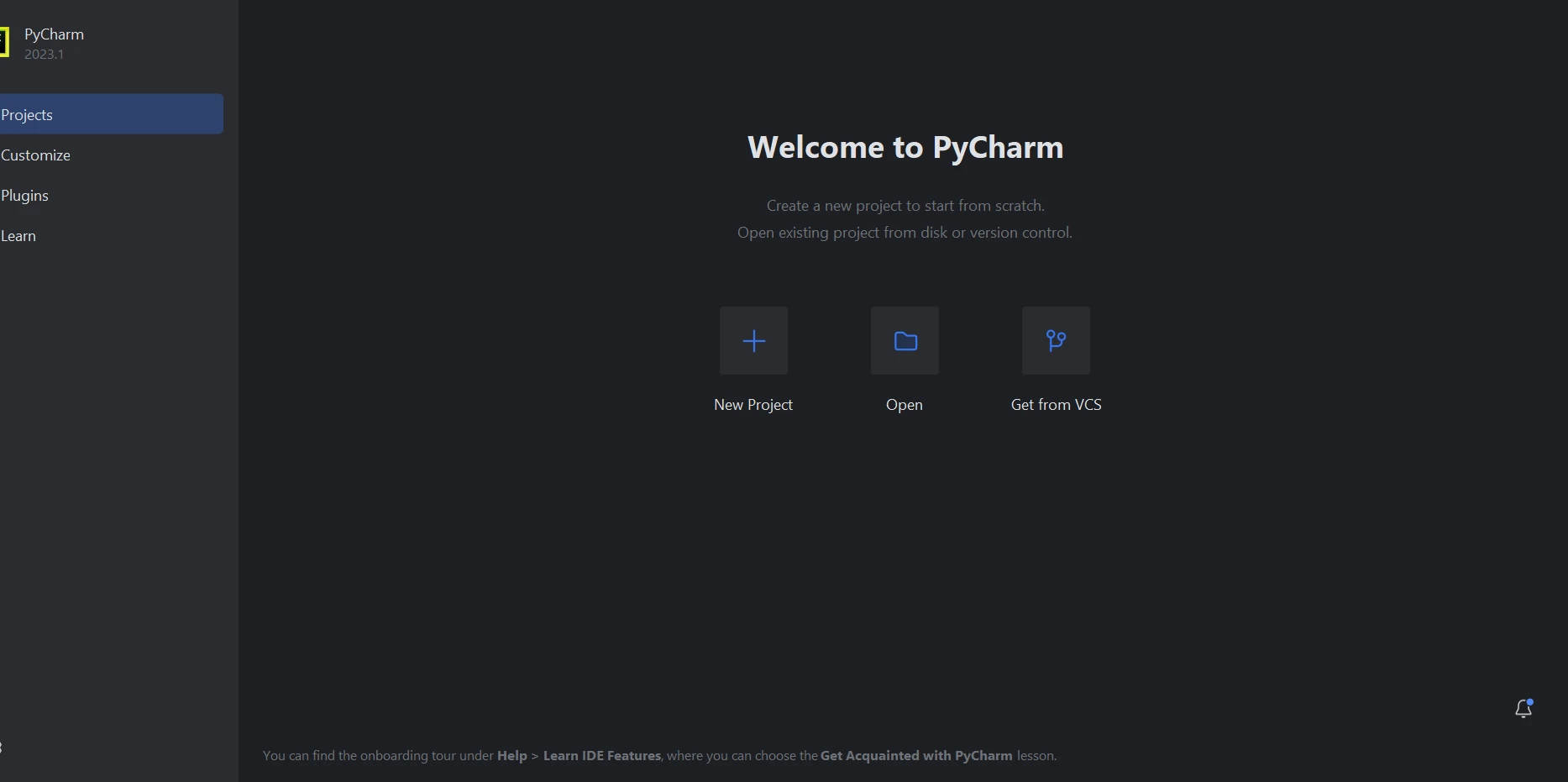
1. Para crear un nuevo proyecto de Python, abra PyCharm, vaya a "Archivo" en el menú superior y haga clic en "Nuevo Proyecto".
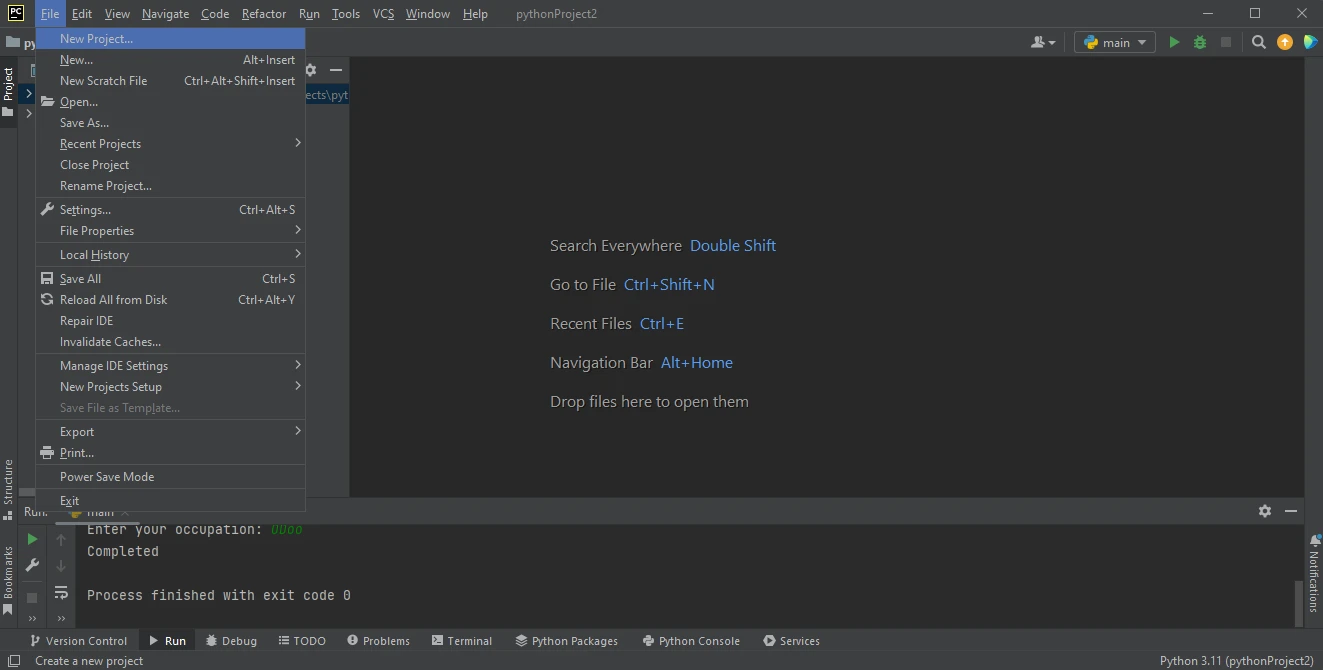
**PyCharm IDE**
2. Aparecerá una nueva ventana donde puede especificar el entorno y la ubicación del proyecto. Después de seleccionar el entorno, haga clic en el botón **Crear**.
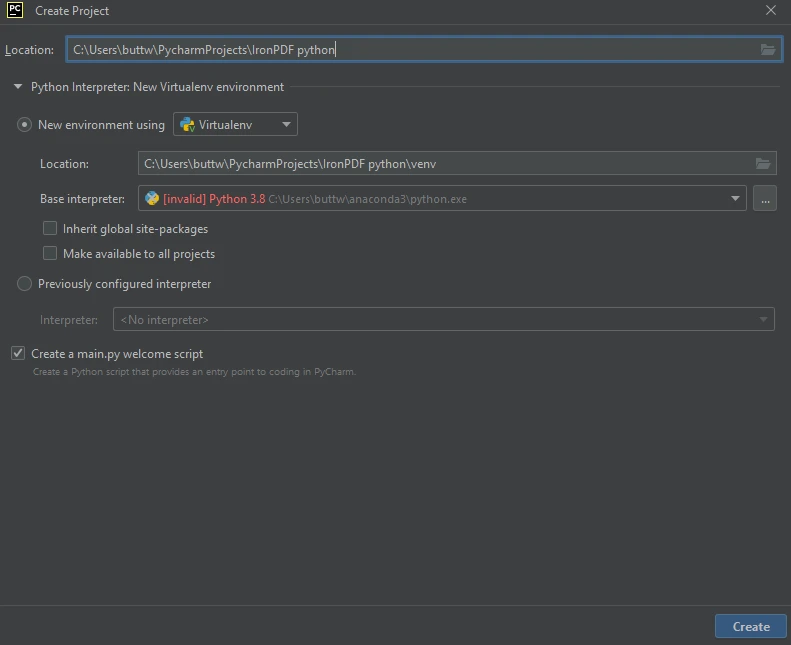
**Crear un nuevo proyecto Python en PyCharm**
3. Así de simple, este proyecto de demostración de Python se crea y está listo para usar.
## Instalación de IronPDF
Para instalar [IronPDF](/python/), simplemente abre la terminal y ejecuta el siguiente comando `pip install ironpdf` y presiona enter. La salida de la terminal debería verse así.
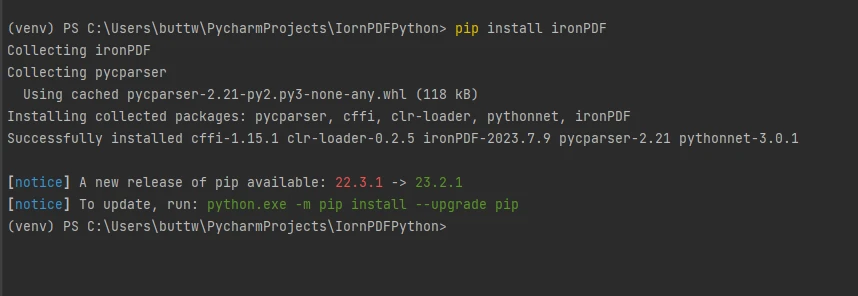
**Instalar el paquete IronPDF**
## Generar archivos PDF a partir de plantillas con IronPDF
Esta sección explicará cómo generar documentos PDF a partir de plantillas HTML utilizando datos de entrada desde la consola para crear archivos PDF.
Primero, importe algunas dependencias para crear archivos PDF.
```python
# Import the required classes from the libraries
from ironpdf import ChromePdfRenderer
from jinja2 import Template
```
Luego, declara `renderer` como un objeto `ChromePdfRenderer` y úsalo para renderizar plantillas HTML.
```python
# Create a renderer object to generate PDFs
renderer = ChromePdfRenderer()
```
Ahora, cree un documento de plantilla HTML para usos reutilizables al crear archivos PDF. Simplemente cree una nueva variable y llénela con contenido HTML que contenga marcadores de posición.
```python
# Define an HTML template with placeholders for dynamic data
html_template = """
<!DOCTYPE html>
<html>
<head>
<title>{{title}}</title>
</head>
<body>
<h1>{{title}}</h1>
<p>
Hello, {{name}}! This is a sample PDF generated from a template using IronPDF for Python.
</p>
<p>
Your age is {{age}} and your occupation is {{occupation}}.
</p>
</body>
</html>
"""
```
Con la plantilla de diseño lista, escriba un código que tomará la entrada del usuario y la almacenará en un diccionario.
```python
# Gather input from the user
title = input("Enter the title: ")
name = input("Enter your name: ")
age = input("Enter your age: ")
occupation = input("Enter your occupation: ")
# Store the input data into a dictionary for rendering the template
data = {
"title": title,
"name": name,
"age": age,
"occupation": occupation
}
```
Además, el siguiente código integrará los datos en el documento de plantilla y renderizará plantillas HTML usando el objeto `renderer` creado anteriormente. Finalmente, guarda el archivo PDF usando el método `SaveAs`.
```python
# Create a Template object with the HTML structure
template = Template(html_template)
# Render the template with the user-provided data
html_content = template.render(**data)
# Generate the PDF from the rendered HTML content
pdf = renderer.RenderHtmlAsPdf(html_content)
# Save the generated PDF to a file
pdf.SaveAs("output.pdf")
```
Con eso, el código para crear archivos PDF dinámicamente está completo. Ejecutemos el código para ver la salida.
### Ejemplo de salida 1
Después de ejecutar el código, solicitará las siguientes entradas del usuario.
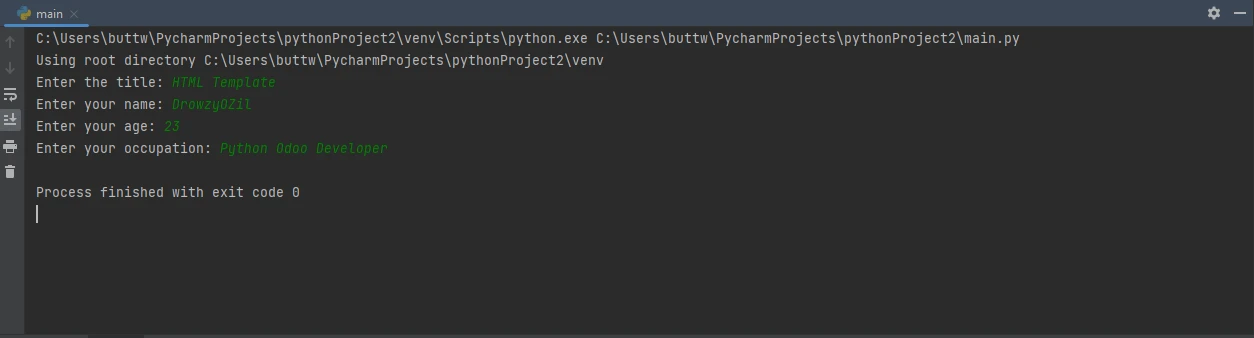
**La consola requiere entrada adicional del usuario**
Ingrese las entradas una por una y presione enter después de cada entrada. Una vez ingresadas las cuatro entradas, generará un archivo PDF.
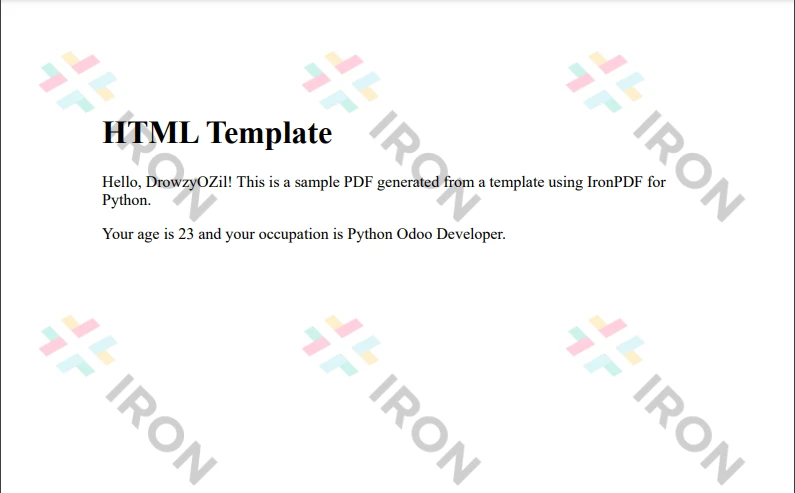
**El archivo PDF de salida**
### Ejemplo de salida 2
Ahora, vuelva a ejecutar el programa y pruebe diferentes entradas.
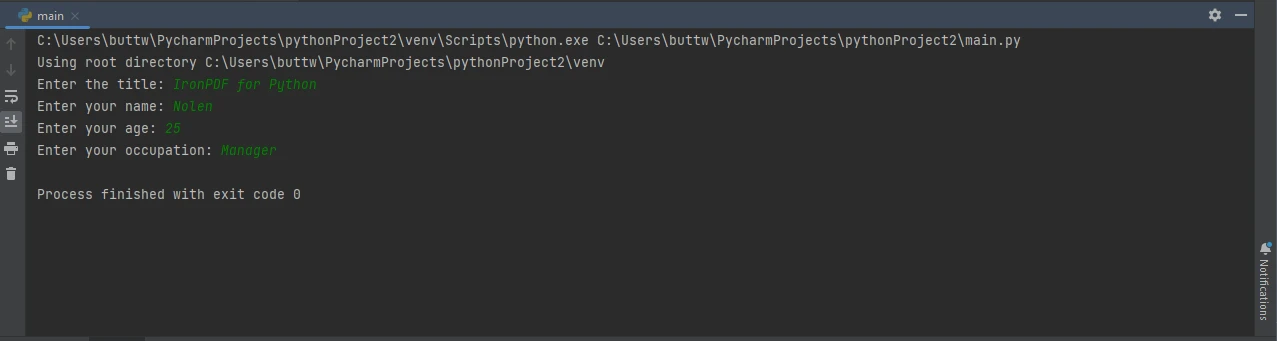
**La consola con una entrada diferente**
Como puede ver a continuación, el formato del archivo de salida es el mismo, pero se actualiza con las nuevas entradas.
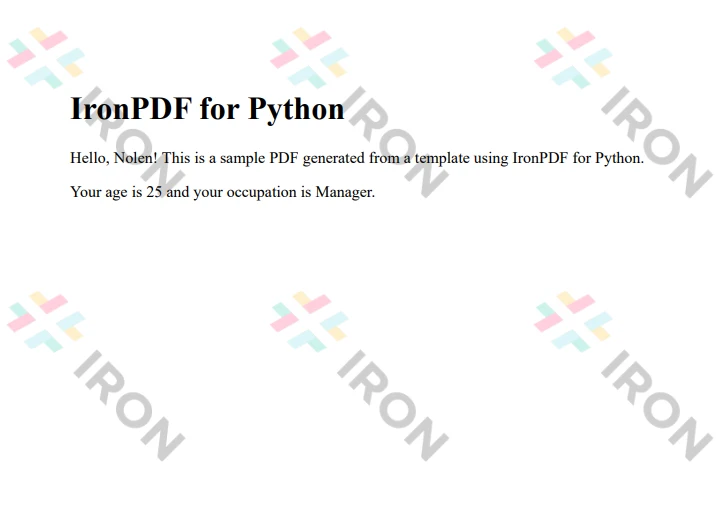
**El nuevo archivo PDF de salida**
Para obtener más información sobre cómo crear, modificar y leer PDF en Python usando IronPDF, visite la [página de documentación](/python/docs/).
## Conclusión
En el mundo de la programación y la automatización de documentos, la utilización de la biblioteca [IronPDF](/python/) en Python para renderizar documentos PDF a partir de plantillas ha revolucionado la gestión de documentos y la eficiencia del flujo de trabajo. Esta potente combinación permite a los desarrolladores crear fácilmente archivos PDF personalizados, como facturas, informes y certificados, mejorando la productividad y la experiencia del usuario. La integración impecable de las herramientas y APIs integrales de IronPDF dentro de los proyectos Python permite a los desarrolladores manejar tareas de generación, edición y manipulación de PDFs con facilidad, agilizando el proceso de desarrollo y asegurando salidas consistentes y pulidas. La versatilidad de Python, junto con las capacidades de IronPDF, convierte a este dúo dinámico en un activo indispensable para cualquier desarrollador que busque soluciones eficientes y automatizadas para documentos PDF. Además, es posible utilizar la misma técnica para crear PDFs a partir de archivos CSV editando su código Python en consecuencia.
Como puede notar, los archivos de salida están marcados con una marca de agua. Puede eliminarlos fácilmente comprando una [licencia](licensing). El paquete `Lite` viene con una licencia perpetua, una garantía de devolución de dinero de 30 días, un año de soporte de software y posibilidades de actualización. IronPDF también ofrece una [licencia de prueba gratuita](trial-license).
Este artículo utilizará IronPDF for Python para crear documentos PDF simples a partir de plantillas.
IronPDF for Python
IronPDF es una potente biblioteca de Python que revoluciona la forma en que los desarrolladores interactúan con documentos PDF. Diseñado para simplificar la creación, edición y manipulación de archivos PDF, IronPDF permite a los programadores Python integrar sofisticadas funcionalidades PDF en sus aplicaciones sin esfuerzo. Ya sea generando PDFs desde cero, convirtiendo contenido HTML en PDFs de alta calidad, o fusionando, dividiendo y editando PDFs existentes, el conjunto integral de herramientas y APIs de IronPDF ofrece una solución intuitiva y eficiente. Con su interfaz fácil de usar y documentación extensa, IronPDF abre un mundo de posibilidades para los desarrolladores que buscan aprovechar todo el potencial de los PDFs en sus proyectos Python, convirtiéndolo en un activo invaluable en el ámbito de la gestión de documentos y la automatización.
Requisitos previos
Generar un PDF a partir de una plantilla en Python requiere que se cumplan los siguientes requisitos previos:
Instalación de Python: Asegúrese de tener Python instalado en su sistema. La biblioteca IronPDF es compatible con versiones de Python 3.0 o superiores, así que asegúrese de tener una instalación de Python compatible.
SDK de .NET 6.0: El SDK de .NET 6.0 es un requisito previo para utilizar la biblioteca IronPDF en Python. IronPDF está construido sobre el marco .NET, que proporciona las capacidades subyacentes necesarias para la generación y manipulación de PDFs. Por lo tanto, el SDK de .NET 6.0 debe estar instalado para usar IronPDF en Python.
Biblioteca IronPDF: Para instalar la biblioteca IronPDF, utiliza pip, el gestor de paquetes de Python. Abra su interfaz de línea de comandos y ejecute el siguiente comando:
> pip install ironpdf
pip install ironpdf
Entorno de Desarrollo Integrado (IDE): Aunque no es estrictamente necesario, el uso de un IDE puede mejorar significativamente su experiencia de desarrollo. Ofrece características como autocompletado de código, depuración, y un flujo de trabajo más eficiente. Un IDE popular para el desarrollo en Python es PyCharm. Puede descargar e instalar PyCharm desde el sitio web de JetBrains en https://www.jetbrains.com/pycharm/.
Creación de un nuevo proyecto Python
Aquí están los pasos para crear un nuevo Proyecto Python en PyCharm.
Para crear un nuevo proyecto de Python, abra PyCharm, vaya a "Archivo" en el menú superior y haga clic en "Nuevo Proyecto".
PyCharm IDE
Aparecerá una nueva ventana donde puede especificar el entorno y la ubicación del proyecto. Después de seleccionar el entorno, haga clic en el botón Crear.
Crear un nuevo proyecto Python en PyCharm
Así de simple, este proyecto de demostración de Python se crea y está listo para usar.
Instalación de IronPDF
Para instalar IronPDF, simplemente abre la terminal y ejecuta el siguiente comando pip install ironpdf y presiona enter. La salida de la terminal debería verse así.
Instalar el paquete IronPDF
Generar archivos PDF a partir de plantillas con IronPDF
Esta sección explicará cómo generar documentos PDF a partir de plantillas HTML utilizando datos de entrada desde la consola para crear archivos PDF.
Primero, importe algunas dependencias para crear archivos PDF.
# Import the required classes from the librariesfrom ironpdf importChromePdfRendererfrom jinja2 importTemplate
# Import the required classes from the libraries
from ironpdf import ChromePdfRenderer
from jinja2 import Template
Python
Luego, declara renderer como un objeto ChromePdfRenderer y úsalo para renderizar plantillas HTML.
# Create a renderer object to generate PDFsrenderer = ChromePdfRenderer()
# Create a renderer object to generate PDFs
renderer = ChromePdfRenderer()
Python
Ahora, cree un documento de plantilla HTML para usos reutilizables al crear archivos PDF. Simplemente cree una nueva variable y llénela con contenido HTML que contenga marcadores de posición.
# Define an HTML template with placeholders for dynamic datahtml_template = """<!DOCTYPE html><html><head> <title>{{title}}</title></head><body> <h1>{{title}}</h1> <p> Hello, {{name}}! This is a sample PDF generated from a template using IronPDF for Python. </p> <p> Your age is {{age}} and your occupation is {{occupation}}. </p></body></html>"""
# Define an HTML template with placeholders for dynamic data
html_template = """
<!DOCTYPE html>
<html>
<head>
    <title>{{title}}</title>
</head>
<body>
    <h1>{{title}}</h1>
    <p>
        Hello, {{name}}! This is a sample PDF generated from a template using IronPDF for Python.
    </p>
    <p>
        Your age is {{age}} and your occupation is {{occupation}}.
    </p>
</body>
</html>
"""
Python
Con la plantilla de diseño lista, escriba un código que tomará la entrada del usuario y la almacenará en un diccionario.
# Gather input from the usertitle = input("Enter the title: ")name = input("Enter your name: ")age = input("Enter your age: ")occupation = input("Enter your occupation: ")# Store the input data into a dictionary for rendering the templatedata = { "title": title, "name": name, "age": age, "occupation": occupation}
# Gather input from the user
title = input("Enter the title: ")
name = input("Enter your name: ")
age = input("Enter your age: ")
occupation = input("Enter your occupation: ")

# Store the input data into a dictionary for rendering the template
data = {
    "title": title,
    "name": name,
    "age": age,
    "occupation": occupation
}
Python
Además, el siguiente código integrará los datos en el documento de plantilla y renderizará plantillas HTML usando el objeto renderer creado anteriormente. Finalmente, guarda el archivo PDF usando el método SaveAs.
# Create a Template object with the HTML structuretemplate = Template(html_template)# Render the template with the user-provided datahtml_content = template.render(**data)# Generate the PDF from the rendered HTML contentpdf = renderer.RenderHtmlAsPdf(html_content)# Save the generated PDF to a filepdf.SaveAs("output.pdf")
# Create a Template object with the HTML structure
template = Template(html_template)

# Render the template with the user-provided data
html_content = template.render(**data)

# Generate the PDF from the rendered HTML content
pdf = renderer.RenderHtmlAsPdf(html_content)

# Save the generated PDF to a file
pdf.SaveAs("output.pdf")
Python
Con eso, el código para crear archivos PDF dinámicamente está completo. Ejecutemos el código para ver la salida.
Ejemplo de salida 1
Después de ejecutar el código, solicitará las siguientes entradas del usuario.
La consola requiere entrada adicional del usuario
Ingrese las entradas una por una y presione enter después de cada entrada. Una vez ingresadas las cuatro entradas, generará un archivo PDF.
El archivo PDF de salida
Ejemplo de salida 2
Ahora, vuelva a ejecutar el programa y pruebe diferentes entradas.
La consola con una entrada diferente
Como puede ver a continuación, el formato del archivo de salida es el mismo, pero se actualiza con las nuevas entradas.
El nuevo archivo PDF de salida
Para obtener más información sobre cómo crear, modificar y leer PDF en Python usando IronPDF, visite la página de documentación.
Conclusión
En el mundo de la programación y la automatización de documentos, la utilización de la biblioteca IronPDF en Python para renderizar documentos PDF a partir de plantillas ha revolucionado la gestión de documentos y la eficiencia del flujo de trabajo. Esta potente combinación permite a los desarrolladores crear fácilmente archivos PDF personalizados, como facturas, informes y certificados, mejorando la productividad y la experiencia del usuario. La integración impecable de las herramientas y APIs integrales de IronPDF dentro de los proyectos Python permite a los desarrolladores manejar tareas de generación, edición y manipulación de PDFs con facilidad, agilizando el proceso de desarrollo y asegurando salidas consistentes y pulidas. La versatilidad de Python, junto con las capacidades de IronPDF, convierte a este dúo dinámico en un activo indispensable para cualquier desarrollador que busque soluciones eficientes y automatizadas para documentos PDF. Además, es posible utilizar la misma técnica para crear PDFs a partir de archivos CSV editando su código Python en consecuencia.
Como puede notar, los archivos de salida están marcados con una marca de agua. Puede eliminarlos fácilmente comprando una licencia. El paquete Lite viene con una licencia perpetua, una garantía de devolución de dinero de 30 días, un año de soporte de software y posibilidades de actualización. IronPDF también ofrece una licencia de prueba gratuita.
Curtis Chau tiene una licenciatura en Ciencias de la Computación (Carleton University) y se especializa en el desarrollo front-end con experiencia en Node.js, TypeScript, JavaScript y React. Apasionado por crear interfaces de usuario intuitivas y estéticamente agradables, disfruta trabajando con frameworks modernos y creando manuales bien estructurados y visualmente atractivos.




 PyCharm IDE
 Crear un nuevo proyecto Python en PyCharm
 Instalar el paquete IronPDF
 La consola requiere entrada adicional del usuario
 El archivo PDF de salida
 La consola con una entrada diferente
 El nuevo archivo PDF de salida