using IronPdf;

// Disable local disk access or cross-origin requests
Installation.EnableWebSecurity = true;

// Instantiate Renderer
var renderer = new ChromePdfRenderer();

// Create a PDF from a HTML string using C#
var pdf = renderer.RenderHtmlAsPdf("<h1>Hello World</h1>");

// Export to a file or Stream
pdf.SaveAs("output.pdf");

// Advanced Example with HTML Assets
// Load external html assets: Images, CSS and JavaScript.
// An optional BasePath 'C:\site\assets\' is set as the file location to load assets from
var myAdvancedPdf = renderer.RenderHtmlAsPdf("<img src='icons/iron.png'>", @"C:\site\assets\");
myAdvancedPdf.SaveAs("html-with-assets.pdf");
using IronPdf;// Disable local disk access or cross-origin requestsInstallation.EnableWebSecurity = true;// Instantiate Renderervar renderer = new ChromePdfRenderer();// Create a PDF from a HTML string using C#var pdf = renderer.RenderHtmlAsPdf("<h1>Hello World</h1>");// Export to a file or Streampdf.SaveAs("output.pdf");// Advanced Example with HTML Assets// Load external html assets: Images, CSS and JavaScript.// An optional BasePath 'C:\site\assets\' is set as the file location to load assets fromvar myAdvancedPdf = renderer.RenderHtmlAsPdf("<img src='icons/iron.png'>", @"C:\site\assets\");myAdvancedPdf.SaveAs("html-with-assets.pdf");
PM >Install-Package IronPdf
Install-Package IronPdf
MISES À JOUR POUR LES DÉVELOPPEURS
WebClient C# (Comment ça fonctionne pour les développeurs)
[WebClient](https://learn.microsoft.com/en-us/dotnet/api/system.net.webclient?view=net-8.0) est une classe puissante en C# conçue pour envoyer et recevoir des données sur le web. Il fait partie de l'espace de noms **System.Net** du .NET Framework et convient à diverses applications, du simple téléchargement de fichiers à l'envoi de données à un serveur web.
Ce tutoriel explique comment utiliser efficacement la classe WebClient, en se concentrant sur ses fonctionnalités de base et sur la manière de gérer des scénarios courants tels que le téléchargement de fichiers et l'affichage de données. Nous explorerons également la bibliothèque [IronPDF](https://ironpdf.com) dans le contexte de l'utilisation de WebClient avec elle.
## Utilisation de base de WebClient
### Création d'un nouveau WebClient
Pour commencer à utiliser WebClient, vous devez en créer une instance. Cette instance sert de passerelle pour effectuer des requêtes HTTP.
Voici une manière simple d'instancier un WebClient :
```csharp
// Create a new instance of WebClient
WebClient client = new WebClient();
```
Ce `new WebClient()` est une configuration de base. Il prépare votre application à interagir avec les serveurs HTTP. En créant cette instance, vous accédez à une variété de méthodes offertes par la classe WebClient pour le téléchargement et l'envoi de données.
### Configuration des propriétés du WebClient
Avant de commencer à faire des requêtes, vous pouvez personnaliser le comportement de votre instance de WebClient. Par exemple, vous pouvez définir un en-tête d'agent utilisateur pour indiquer au serveur le nom du client qui effectue la requête :
```csharp
// Adding user-agent to the HTTP headers
client.Headers["User-Agent"] = "Mozilla/5.0 (Windows NT 10.0; Win64; x64)";
```
La définition de l'en-tête user agent est importante car certains serveurs vérifient cet en-tête pour voir si la demande provient d'un navigateur ou d'un appareil reconnu. Cela peut avoir une incidence sur la manière dont les serveurs répondent à vos demandes.
## Téléchargement de données à l'aide de WebClient
### Téléchargement simple de fichiers
WebClient fournit une méthode simple pour télécharger des fichiers directement d'une URL vers un fichier local. Cette méthode est utile pour les applications qui doivent fonctionner avec des ressources externes, comme le téléchargement de fichiers de configuration ou de mises à jour.
```csharp
// Example of downloading a file from a URL
string address = "http://example.com/file.zip";
string localFile = "C:\\Downloads\\file.zip";
try
{
client.DownloadFile(address, localFile);
Console.WriteLine("Download complete.");
}
catch (Exception ex)
{
Console.WriteLine("Download failed: " + ex.Message);
}
```
Dans cet exemple, `DownloadFile` est utilisé pour récupérer un fichier d'un `string address` et l'enregistrer comme fichier local. Le processus est encapsulé dans un bloc try-catch pour gérer les erreurs potentielles, telles qu'une erreur interne du serveur ou des problèmes de connectivité.
### Gestion des données téléchargées en mémoire
Il peut arriver que vous souhaitiez traiter les données téléchargées directement en mémoire, sans les enregistrer sur un disque. Cela peut être fait en utilisant la méthode `DownloadData`, qui renvoie un tableau de bytes :
```csharp
// Example of downloading data into memory
string uriAddress = "http://example.com/data.json";
try
{
byte[] data = client.DownloadData(uriAddress);
string json = System.Text.Encoding.UTF8.GetString(data);
Console.WriteLine("Data received: " + json);
}
catch (Exception ex)
{
Console.WriteLine("Error receiving data: " + ex.Message);
}
```
Ici, les données de `uriAddress` sont téléchargées dans un tableau de bytes. Elle est ensuite convertie en chaîne de caractères si les données sont au format JSON. La gestion des données en mémoire est particulièrement utile lorsqu'il s'agit d'API qui renvoient des données au format JSON.
## Téléchargement de données à l'aide de WebClient
### Enregistrer des données sur un serveur
WebClient peut également être utilisé pour envoyer des données à un serveur. La méthode HTTP POST est couramment utilisée pour envoyer des données dans le corps de la requête.
```csharp
// Example of posting data to a server
string postAddress = "http://example.com/api/post";
// Prepare string data for POST request
string stringData = "name=John&age=30";
byte[] postData = System.Text.Encoding.ASCII.GetBytes(stringData);
try
{
byte[] response = client.UploadData(postAddress, "POST", postData);
// Log response headers and content
Console.WriteLine("Response received: " + System.Text.Encoding.ASCII.GetString(response));
}
catch (Exception ex)
{
Console.WriteLine("Post failed: " + ex.Message);
}
```
Cet extrait de code envoie `postData` au serveur. Les données sont d'abord encodées dans un tableau d'octets avant d'être envoyées. WebClient gère automatiquement l'en-tête de type de contenu pour les données de type byte array, mais si vous devez envoyer des données dans un format différent, tel que JSON, vous devrez peut-être définir manuellement l'en-tête de type de contenu.
## IronPDF avec WebClient
[IronPDF](https://ironpdf.com) est une bibliothèque .NET qui aide les développeurs à créer, modifier et gérer facilement des fichiers PDF. Elle utilise un moteur de rendu Chrome pour une [conversion HTML vers PDF](/examples/using-html-to-create-a-pdf/) précise. Cette bibliothèque permet de convertir du contenu web, HTML et des images en PDF et comprend des fonctionnalités telles que les signatures numériques et la gestion des formulaires.
Le logiciel fonctionne avec différentes versions de .NET et prend en charge plusieurs systèmes d'exploitation, ce qui le rend polyvalent pour différents environnements de développement. IronPDF propose une documentation complète et une assistance solide pour aider les développeurs à intégrer les fonctionnalités PDF en douceur.
IronPDF excelle dans la conversion [HTML en PDF](/tutorials/html-to-pdf/), garantissant une préservation précise des mises en page et styles originaux. Il est parfait pour créer des PDF à partir de contenus basés sur le Web tels que des rapports, des factures et de la documentation. Avec le support des fichiers HTML, des URLs et des chaînes HTML brutes, IronPDF produit facilement des documents PDF de haute qualité.
```csharp
using IronPdf;
class Program
{
static void Main(string[] args)
{
var renderer = new ChromePdfRenderer();
// 1. Convert HTML String to PDF
var htmlContent = "<h1>Hello, IronPDF!</h1><p>This is a PDF from an HTML string.</p>";
var pdfFromHtmlString = renderer.RenderHtmlAsPdf(htmlContent);
pdfFromHtmlString.SaveAs("HTMLStringToPDF.pdf");
// 2. Convert HTML File to PDF
var htmlFilePath = "path_to_your_html_file.html"; // Specify the path to your HTML file
var pdfFromHtmlFile = renderer.RenderHtmlFileAsPdf(htmlFilePath);
pdfFromHtmlFile.SaveAs("HTMLFileToPDF.pdf");
// 3. Convert URL to PDF
var url = "http://ironpdf.com"; // Specify the URL
var pdfFromUrl = renderer.RenderUrlAsPdf(url);
pdfFromUrl.SaveAs("URLToPDF.pdf");
}
}
```
### Exemple de Code
Voici un exemple basique d'utilisation de IronPDF avec C# pour convertir du contenu HTML en PDF en utilisant la classe `WebClient`. Cet exemple de code montre comment récupérer du HTML à partir d'une URL, puis utiliser IronPDF pour générer un fichier PDF à partir de ce HTML.
```csharp
using IronPdf;
using System.Net;
class Program
{
static void Main()
{
// Set your IronPDF license key
License.LicenseKey = "License-Key";
// Create a new WebClient instance to download HTML
using (WebClient client = new WebClient())
{
// Specify the URL of the HTML page
string url = "http://example.com";
string htmlString = client.DownloadString(url);
// Create a new HTML to PDF converter instance
var renderer = new ChromePdfRenderer();
// Convert HTML string to PDF
var pdf = renderer.RenderHtmlAsPdf(htmlString);
// Save the PDF to a file
pdf.SaveAs("output.pdf");
}
}
}
```
Veillez à ajouter la bibliothèque IronPDF à votre projet. Vous pouvez généralement effectuer cette opération via NuGet dans votre environnement de développement, à l'aide d'une commande telle que :
```shell
:ProductInstall
```
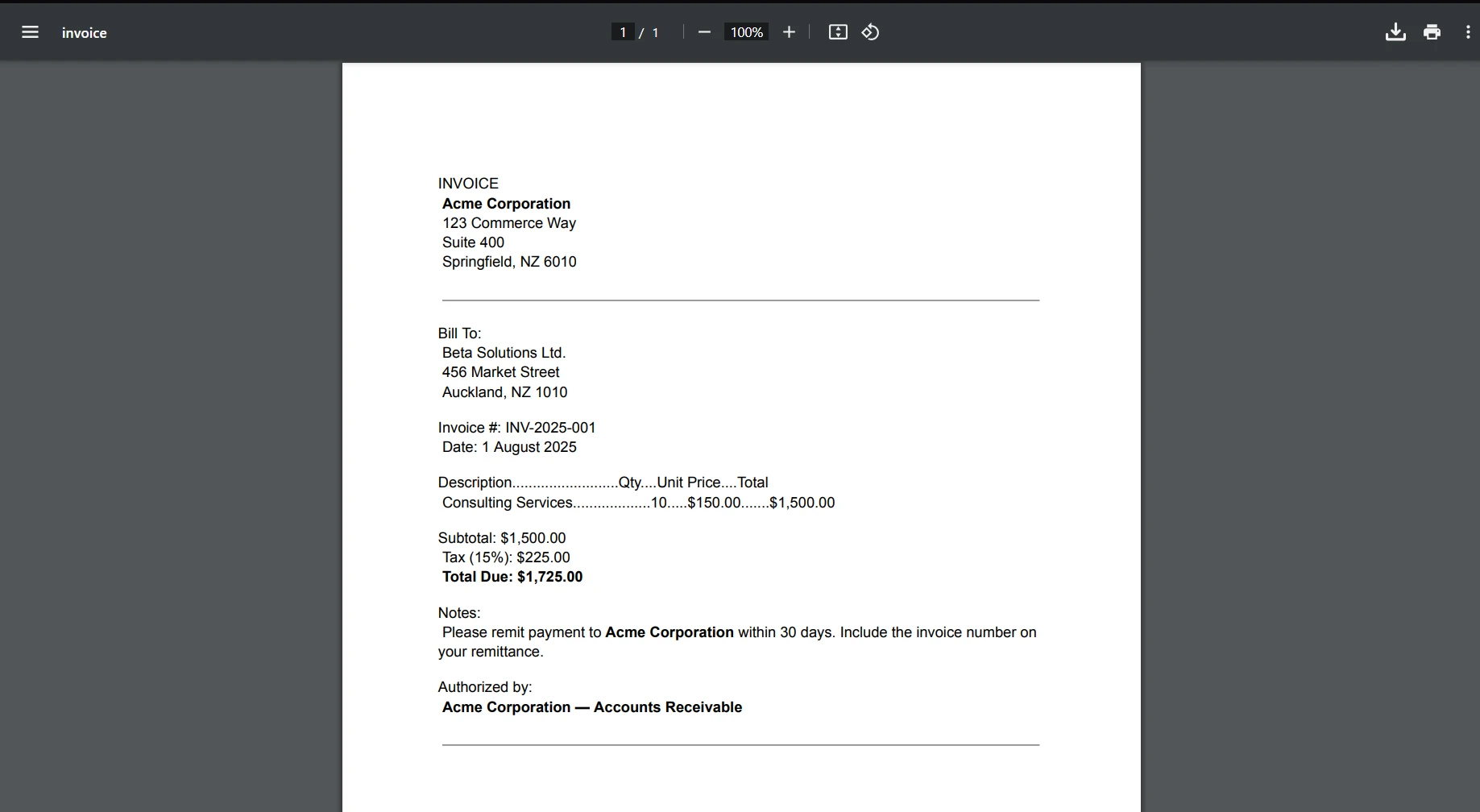
Voici le fichier PDF généré :

## Conclusion
WebClient est une classe polyvalente du .NET Framework idéale pour diverses opérations réseau, notamment le téléchargement et le chargement de fichiers. Ce tutoriel explique comment lancer un WebClient, personnaliser ses en-têtes, gérer les téléchargements de données et traiter efficacement les erreurs.
À mesure que vous vous familiariserez avec WebClient, vous pourrez explorer des fonctionnalités plus avancées et envisager de passer à des solutions plus robustes comme HttpClient pour des scénarios plus complexes. IronPDF permet aux développeurs d'explorer ses fonctionnalités avec [des options de licence et des détails sur les prix](/licensing/) avec des licences disponibles à partir de $liteLicense.
WebClient est une classe puissante en C# conçue pour envoyer et recevoir des données sur le web. Il fait partie de l'espace de noms System.Net du .NET Framework et convient à diverses applications, du simple téléchargement de fichiers à l'envoi de données à un serveur web.
Ce tutoriel explique comment utiliser efficacement la classe WebClient, en se concentrant sur ses fonctionnalités de base et sur la manière de gérer des scénarios courants tels que le téléchargement de fichiers et l'affichage de données. Nous explorerons également la bibliothèque IronPDF dans le contexte de l'utilisation de WebClient avec elle.
Utilisation de base de WebClient
Création d'un nouveau WebClient
Pour commencer à utiliser WebClient, vous devez en créer une instance. Cette instance sert de passerelle pour effectuer des requêtes HTTP.
Voici une manière simple d'instancier un WebClient :
// Create a new instance of WebClientWebClient client = new WebClient();
// Create a new instance of WebClient
WebClient client = new WebClient();
' Create a new instance of WebClientDim client As New WebClient()
' Create a new instance of WebClient
Dim client As New WebClient()
Ce new WebClient() est une configuration de base. Il prépare votre application à interagir avec les serveurs HTTP. En créant cette instance, vous accédez à une variété de méthodes offertes par la classe WebClient pour le téléchargement et l'envoi de données.
Configuration des propriétés du WebClient
Avant de commencer à faire des requêtes, vous pouvez personnaliser le comportement de votre instance de WebClient. Par exemple, vous pouvez définir un en-tête d'agent utilisateur pour indiquer au serveur le nom du client qui effectue la requête :
// Adding user-agent to the HTTP headersclient.Headers["User-Agent"] = "Mozilla/5.0 (Windows NT 10.0; Win64; x64)";
// Adding user-agent to the HTTP headers
client.Headers["User-Agent"] = "Mozilla/5.0 (Windows NT 10.0; Win64; x64)";
' Adding user-agent to the HTTP headersclient.Headers("User-Agent") = "Mozilla/5.0 (Windows NT 10.0; Win64; x64)"
' Adding user-agent to the HTTP headers
client.Headers("User-Agent") = "Mozilla/5.0 (Windows NT 10.0; Win64; x64)"
La définition de l'en-tête user agent est importante car certains serveurs vérifient cet en-tête pour voir si la demande provient d'un navigateur ou d'un appareil reconnu. Cela peut avoir une incidence sur la manière dont les serveurs répondent à vos demandes.
Téléchargement de données à l'aide de WebClient
Téléchargement simple de fichiers
WebClient fournit une méthode simple pour télécharger des fichiers directement d'une URL vers un fichier local. Cette méthode est utile pour les applications qui doivent fonctionner avec des ressources externes, comme le téléchargement de fichiers de configuration ou de mises à jour.
// Example of downloading a file from a URLstring address = "http://example.com/file.zip";string localFile = "C:\\Downloads\\file.zip";try{ client.DownloadFile(address, localFile);Console.WriteLine("Download complete.");}catch (Exception ex){Console.WriteLine("Download failed: " + ex.Message);}
// Example of downloading a file from a URL
string address = "http://example.com/file.zip";
string localFile = "C:\\Downloads\\file.zip";
try
{
    client.DownloadFile(address, localFile);
    Console.WriteLine("Download complete.");
}
catch (Exception ex)
{
    Console.WriteLine("Download failed: " + ex.Message);
}
' Example of downloading a file from a URLDim address AsString = "http://example.com/file.zip"Dim localFile AsString = "C:\Downloads\file.zip"Try client.DownloadFile(address, localFile)Console.WriteLine("Download complete.")Catch ex AsExceptionConsole.WriteLine("Download failed: " & ex.Message)EndTry
' Example of downloading a file from a URL
Dim address As String = "http://example.com/file.zip"
Dim localFile As String = "C:\Downloads\file.zip"
Try
	client.DownloadFile(address, localFile)
	Console.WriteLine("Download complete.")
Catch ex As Exception
	Console.WriteLine("Download failed: " & ex.Message)
End Try
Dans cet exemple, DownloadFile est utilisé pour récupérer un fichier d'un string address et l'enregistrer comme fichier local. Le processus est encapsulé dans un bloc try-catch pour gérer les erreurs potentielles, telles qu'une erreur interne du serveur ou des problèmes de connectivité.
Gestion des données téléchargées en mémoire
Il peut arriver que vous souhaitiez traiter les données téléchargées directement en mémoire, sans les enregistrer sur un disque. Cela peut être fait en utilisant la méthode DownloadData, qui renvoie un tableau de bytes :
// Example of downloading data into memorystring uriAddress = "http://example.com/data.json";try{ byte[] data = client.DownloadData(uriAddress); string json = System.Text.Encoding.UTF8.GetString(data);Console.WriteLine("Data received: " + json);}catch (Exception ex){Console.WriteLine("Error receiving data: " + ex.Message);}
// Example of downloading data into memory
string uriAddress = "http://example.com/data.json";
try
{
    byte[] data = client.DownloadData(uriAddress);
    string json = System.Text.Encoding.UTF8.GetString(data);
    Console.WriteLine("Data received: " + json);
}
catch (Exception ex)
{
    Console.WriteLine("Error receiving data: " + ex.Message);
}
' Example of downloading data into memoryDim uriAddress AsString = "http://example.com/data.json"Try Dim data() AsByte = client.DownloadData(uriAddress) Dim json AsString = System.Text.Encoding.UTF8.GetString(data)Console.WriteLine("Data received: " & json)Catch ex AsExceptionConsole.WriteLine("Error receiving data: " & ex.Message)EndTry
' Example of downloading data into memory
Dim uriAddress As String = "http://example.com/data.json"
Try
	Dim data() As Byte = client.DownloadData(uriAddress)
	Dim json As String = System.Text.Encoding.UTF8.GetString(data)
	Console.WriteLine("Data received: " & json)
Catch ex As Exception
	Console.WriteLine("Error receiving data: " & ex.Message)
End Try
Ici, les données de uriAddress sont téléchargées dans un tableau de bytes. Elle est ensuite convertie en chaîne de caractères si les données sont au format JSON. La gestion des données en mémoire est particulièrement utile lorsqu'il s'agit d'API qui renvoient des données au format JSON.
Téléchargement de données à l'aide de WebClient
Enregistrer des données sur un serveur
WebClient peut également être utilisé pour envoyer des données à un serveur. La méthode HTTP POST est couramment utilisée pour envoyer des données dans le corps de la requête.
// Example of posting data to a serverstring postAddress = "http://example.com/api/post";// Prepare string data for POST requeststring stringData = "name=John&age=30";byte[] postData = System.Text.Encoding.ASCII.GetBytes(stringData);try{ byte[] response = client.UploadData(postAddress, "POST", postData); // Log response headers and contentConsole.WriteLine("Response received: " + System.Text.Encoding.ASCII.GetString(response));}catch (Exception ex){Console.WriteLine("Post failed: " + ex.Message);}
// Example of posting data to a server
string postAddress = "http://example.com/api/post";
// Prepare string data for POST request
string stringData = "name=John&age=30";
byte[] postData = System.Text.Encoding.ASCII.GetBytes(stringData);
try
{
    byte[] response = client.UploadData(postAddress, "POST", postData);
    // Log response headers and content
    Console.WriteLine("Response received: " + System.Text.Encoding.ASCII.GetString(response));
}
catch (Exception ex)
{
    Console.WriteLine("Post failed: " + ex.Message);
}
' Example of posting data to a serverDim postAddress AsString = "http://example.com/api/post"' Prepare string data for POST requestDim stringData AsString = "name=John&age=30"Dim postData() AsByte = System.Text.Encoding.ASCII.GetBytes(stringData)Try Dim response() AsByte = client.UploadData(postAddress, "POST", postData) ' Log response headers and contentConsole.WriteLine("Response received: " & System.Text.Encoding.ASCII.GetString(response))Catch ex AsExceptionConsole.WriteLine("Post failed: " & ex.Message)EndTry
' Example of posting data to a server
Dim postAddress As String = "http://example.com/api/post"
' Prepare string data for POST request
Dim stringData As String = "name=John&age=30"
Dim postData() As Byte = System.Text.Encoding.ASCII.GetBytes(stringData)
Try
	Dim response() As Byte = client.UploadData(postAddress, "POST", postData)
	' Log response headers and content
	Console.WriteLine("Response received: " & System.Text.Encoding.ASCII.GetString(response))
Catch ex As Exception
	Console.WriteLine("Post failed: " & ex.Message)
End Try
Cet extrait de code envoie postData au serveur. Les données sont d'abord encodées dans un tableau d'octets avant d'être envoyées. WebClient gère automatiquement l'en-tête de type de contenu pour les données de type byte array, mais si vous devez envoyer des données dans un format différent, tel que JSON, vous devrez peut-être définir manuellement l'en-tête de type de contenu.
IronPDF avec WebClient
IronPDF est une bibliothèque .NET qui aide les développeurs à créer, modifier et gérer facilement des fichiers PDF. Elle utilise un moteur de rendu Chrome pour une conversion HTML vers PDF précise. Cette bibliothèque permet de convertir du contenu web, HTML et des images en PDF et comprend des fonctionnalités telles que les signatures numériques et la gestion des formulaires.
Le logiciel fonctionne avec différentes versions de .NET et prend en charge plusieurs systèmes d'exploitation, ce qui le rend polyvalent pour différents environnements de développement. IronPDF propose une documentation complète et une assistance solide pour aider les développeurs à intégrer les fonctionnalités PDF en douceur.
IronPDF excelle dans la conversion HTML en PDF, garantissant une préservation précise des mises en page et styles originaux. Il est parfait pour créer des PDF à partir de contenus basés sur le Web tels que des rapports, des factures et de la documentation. Avec le support des fichiers HTML, des URLs et des chaînes HTML brutes, IronPDF produit facilement des documents PDF de haute qualité.
using IronPdf;class Program{ static voidMain(string[] args) { var renderer = new ChromePdfRenderer(); // 1. Convert HTML String to PDF var htmlContent = "<h1>Hello, IronPDF!</h1><p>This is a PDF from an HTML string.</p>"; var pdfFromHtmlString = renderer.RenderHtmlAsPdf(htmlContent); pdfFromHtmlString.SaveAs("HTMLStringToPDF.pdf"); // 2. Convert HTML File to PDF var htmlFilePath = "path_to_your_html_file.html"; // Specify the path to your HTML file var pdfFromHtmlFile = renderer.RenderHtmlFileAsPdf(htmlFilePath); pdfFromHtmlFile.SaveAs("HTMLFileToPDF.pdf"); // 3. Convert URL to PDF var url = "http://ironpdf.com"; // Specify the URL var pdfFromUrl = renderer.RenderUrlAsPdf(url); pdfFromUrl.SaveAs("URLToPDF.pdf"); }}
using IronPdf;

class Program
{
    static void Main(string[] args)
    {
        var renderer = new ChromePdfRenderer();

        // 1. Convert HTML String to PDF
        var htmlContent = "<h1>Hello, IronPDF!</h1><p>This is a PDF from an HTML string.</p>";
        var pdfFromHtmlString = renderer.RenderHtmlAsPdf(htmlContent);
        pdfFromHtmlString.SaveAs("HTMLStringToPDF.pdf");

        // 2. Convert HTML File to PDF
        var htmlFilePath = "path_to_your_html_file.html"; // Specify the path to your HTML file
        var pdfFromHtmlFile = renderer.RenderHtmlFileAsPdf(htmlFilePath);
        pdfFromHtmlFile.SaveAs("HTMLFileToPDF.pdf");

        // 3. Convert URL to PDF
        var url = "http://ironpdf.com"; // Specify the URL
        var pdfFromUrl = renderer.RenderUrlAsPdf(url);
        pdfFromUrl.SaveAs("URLToPDF.pdf");
    }
}
ImportsIronPdfFriend Class ProgramShared Sub Main(ByVal args() AsString) Dim renderer = New ChromePdfRenderer() ' 1. Convert HTML String to PDF Dim htmlContent = "<h1>Hello, IronPDF!</h1><p>This is a PDF from an HTML string.</p>" Dim pdfFromHtmlString = renderer.RenderHtmlAsPdf(htmlContent) pdfFromHtmlString.SaveAs("HTMLStringToPDF.pdf") ' 2. Convert HTML File to PDF Dim htmlFilePath = "path_to_your_html_file.html" ' Specify the path to your HTML file Dim pdfFromHtmlFile = renderer.RenderHtmlFileAsPdf(htmlFilePath) pdfFromHtmlFile.SaveAs("HTMLFileToPDF.pdf") ' 3. Convert URL to PDF Dim url = "http://ironpdf.com" ' Specify the URL Dim pdfFromUrl = renderer.RenderUrlAsPdf(url) pdfFromUrl.SaveAs("URLToPDF.pdf") End SubEnd Class
Imports IronPdf

Friend Class Program
	Shared Sub Main(ByVal args() As String)
		Dim renderer = New ChromePdfRenderer()

		' 1. Convert HTML String to PDF
		Dim htmlContent = "<h1>Hello, IronPDF!</h1><p>This is a PDF from an HTML string.</p>"
		Dim pdfFromHtmlString = renderer.RenderHtmlAsPdf(htmlContent)
		pdfFromHtmlString.SaveAs("HTMLStringToPDF.pdf")

		' 2. Convert HTML File to PDF
		Dim htmlFilePath = "path_to_your_html_file.html" ' Specify the path to your HTML file
		Dim pdfFromHtmlFile = renderer.RenderHtmlFileAsPdf(htmlFilePath)
		pdfFromHtmlFile.SaveAs("HTMLFileToPDF.pdf")

		' 3. Convert URL to PDF
		Dim url = "http://ironpdf.com" ' Specify the URL
		Dim pdfFromUrl = renderer.RenderUrlAsPdf(url)
		pdfFromUrl.SaveAs("URLToPDF.pdf")
	End Sub
End Class
Exemple de Code
Voici un exemple basique d'utilisation de IronPDF avec C# pour convertir du contenu HTML en PDF en utilisant la classe WebClient. Cet exemple de code montre comment récupérer du HTML à partir d'une URL, puis utiliser IronPDF pour générer un fichier PDF à partir de ce HTML.
using IronPdf;using System.Net;class Program{ static voidMain() { // Set your IronPDF license keyLicense.LicenseKey = "License-Key"; // Create a new WebClient instance to download HTML using (WebClient client = new WebClient()) { // Specify the URL of the HTML page string url = "http://example.com"; string htmlString = client.DownloadString(url); // Create a new HTML to PDF converter instance var renderer = new ChromePdfRenderer(); // Convert HTML string to PDF var pdf = renderer.RenderHtmlAsPdf(htmlString); // Save the PDF to a file pdf.SaveAs("output.pdf"); } }}
using IronPdf;
using System.Net;

class Program
{
    static void Main()
    {
        // Set your IronPDF license key
        License.LicenseKey = "License-Key";
        // Create a new WebClient instance to download HTML
        using (WebClient client = new WebClient())
        {
            // Specify the URL of the HTML page
            string url = "http://example.com";
            string htmlString = client.DownloadString(url);
            // Create a new HTML to PDF converter instance
            var renderer = new ChromePdfRenderer();
            // Convert HTML string to PDF
            var pdf = renderer.RenderHtmlAsPdf(htmlString);
            // Save the PDF to a file
            pdf.SaveAs("output.pdf");
        }
    }
}
ImportsIronPdfImportsSystem.NetFriend Class ProgramShared Sub Main() ' Set your IronPDF license keyLicense.LicenseKey = "License-Key" ' Create a new WebClient instance to download HTMLUsing client As New WebClient() ' Specify the URL of the HTML page Dim url AsString = "http://example.com" Dim htmlString AsString = client.DownloadString(url) ' Create a new HTML to PDF converter instance Dim renderer = New ChromePdfRenderer() ' Convert HTML string to PDF Dim pdf = renderer.RenderHtmlAsPdf(htmlString) ' Save the PDF to a file pdf.SaveAs("output.pdf")EndUsing End SubEnd Class
Imports IronPdf
Imports System.Net

Friend Class Program
	Shared Sub Main()
		' Set your IronPDF license key
		License.LicenseKey = "License-Key"
		' Create a new WebClient instance to download HTML
		Using client As New WebClient()
			' Specify the URL of the HTML page
			Dim url As String = "http://example.com"
			Dim htmlString As String = client.DownloadString(url)
			' Create a new HTML to PDF converter instance
			Dim renderer = New ChromePdfRenderer()
			' Convert HTML string to PDF
			Dim pdf = renderer.RenderHtmlAsPdf(htmlString)
			' Save the PDF to a file
			pdf.SaveAs("output.pdf")
		End Using
	End Sub
End Class
Veillez à ajouter la bibliothèque IronPDF à votre projet. Vous pouvez généralement effectuer cette opération via NuGet dans votre environnement de développement, à l'aide d'une commande telle que :
PM > Install-Package IronPdf
Install-Package IronPdf
Voici le fichier PDF généré :
Conclusion
WebClient est une classe polyvalente du .NET Framework idéale pour diverses opérations réseau, notamment le téléchargement et le chargement de fichiers. Ce tutoriel explique comment lancer un WebClient, personnaliser ses en-têtes, gérer les téléchargements de données et traiter efficacement les erreurs.
À mesure que vous vous familiariserez avec WebClient, vous pourrez explorer des fonctionnalités plus avancées et envisager de passer à des solutions plus robustes comme HttpClient pour des scénarios plus complexes. IronPDF permet aux développeurs d'explorer ses fonctionnalités avec des options de licence et des détails sur les prix avec des licences disponibles à partir de $999.
Jacob Mellor est directeur de la technologie chez Iron Software et un ingénieur visionnaire pionnier de la technologie C# PDF. En tant que développeur à l'origine de la base de code centrale d'Iron Software, il a façonné l'architecture des produits de l'entreprise depuis sa création, la transformant aux côtés du PDG Cameron Rimington en une entreprise de plus de 50 personnes au service de la NASA, de Tesla et d'agences gouvernementales mondiales.