



更新日 2026年4月23日
Microsoft.Extensions.AIを使用した .NET での LLM 統合の簡素化
AI はソフトウェア開発を変革していますが、.NET への大規模言語モデル (LLM) の統合はこれまで複雑でした。IronPdf.AI を使用して AI 統合をさらに進め、OpenAI を活用した PDF 解析、データ抽出、およびコンテンツの要約を .NET アプリケーションにもたらします。
詳しく読む

Swashbuckleは、C# .NET CoreのNuGetパッケージで、RESTful Web APIのドキュメントを自動生成するのに役立ちます。このブログでは、Swashbuckle ASP.NET CoreとIronPDFインストール手順NuGetパッケージを探り、ASP.NET Core Web APIの最新の開発を可能にします。これらは、最小限のコードで達成できる多数の機能を提供します。
APIの文書ページは、Web APIプロジェクトから生成されたswagger.jsonファイルを使用するSwagger UIツールを使用して表示されます。 生成されたJSONドキュメントは、Open API標準に従います。 Swashbuckleは、Swashbuckle.AspNetCoreというNuGetパッケージとして利用可能で、インストールおよび設定すると、自動的にSwagger JSONを公開します。 Swagger UIツールは、APIに記述されたXMLコメントから生成されたSwagger JSONファイルを読み込みます。さらに、プロジェクト設定ファイルで有効にすることでXMLドキュメントファイルを作成できます。XMLコメントはXMLドキュメントファイルに変換され、Swagger JSONが生成されます。 その後、SwaggerミドルウェアはJSONを読み込み、Swagger JSONエンドポイントを公開します。
Web APIプロジェクトから始めましょう。
dotnet new webapi -n SwashbuckleDemo
cd SwashbuckleDemo
dotnet build
dotnet add package Swashbuckle.AspNetCore --version 6.5.0
dotnet buildここでは"SwashbuckleDemo"という名前のWeb APIプロジェクトを作成し、パッケージマネージャーコンソールを使用してSwashbuckleパッケージを.NET Core Web APIプロジェクトにインストールします。
SwaggerサービスをStartup.csファイルで構成します。
using System.Reflection;
using Microsoft.Extensions.DependencyInjection;
using Microsoft.AspNetCore.Builder;

public class Startup
{
    public void ConfigureServices(IServiceCollection services)
    {
        // Other service configurations...

        // Register the Swagger generator
        services.AddSwaggerGen(c =>
        {
            c.SwaggerDoc("v1", new OpenApiInfo { Title = "My API", Version = "v1" });

            // Optionally, include XML comments for additional information
            var xmlFile = $"{Assembly.GetExecutingAssembly().GetName().Name}.xml";
            var xmlPath = Path.Combine(AppContext.BaseDirectory, xmlFile);
            c.IncludeXmlComments(xmlPath);
        });
    }

    public void Configure(IApplicationBuilder app, IHostingEnvironment env)
    {
        // Other app configurations...

        // Enable middleware to serve generated Swagger as a JSON endpoint.
        app.UseSwagger();

        // Enable Swagger UI (HTML, JS, CSS, etc.), specifying the Swagger JSON endpoint.
        app.UseSwaggerUI(c =>
        {
            c.SwaggerEndpoint("/swagger/v1/swagger.json", "My API V1");
        });
    }
}Imports System.Reflection
Imports Microsoft.Extensions.DependencyInjection
Imports Microsoft.AspNetCore.Builder
Public Class Startup
Public Sub ConfigureServices(ByVal services As IServiceCollection)
' Other service configurations...
' Register the Swagger generator
services.AddSwaggerGen(Sub(c)
c.SwaggerDoc("v1", New OpenApiInfo With {
.Title = "My API",
.Version = "v1"
})
' Optionally, include XML comments for additional information
Dim xmlFile = $"{System.Reflection.Assembly.GetExecutingAssembly().GetName().Name}.xml"
Dim xmlPath = Path.Combine(AppContext.BaseDirectory, xmlFile)
c.IncludeXmlComments(xmlPath)
End Sub)
End Sub
Public Sub Configure(ByVal app As IApplicationBuilder, ByVal env As IHostingEnvironment)
' Other app configurations...
' Enable middleware to serve generated Swagger as a JSON endpoint.
app.UseSwagger()
' Enable Swagger UI (HTML, JS, CSS, etc.), specifying the Swagger JSON endpoint.
app.UseSwaggerUI(Sub(c)
c.SwaggerEndpoint("/swagger/v1/swagger.json", "My API V1")
End Sub)
End Sub
End ClassToDoリストAPIのためのコントローラーを追加します。
using Microsoft.AspNetCore.Http.HttpResults;
using Microsoft.AspNetCore.Builder;
using Microsoft.EntityFrameworkCore;
using Microsoft.AspNetCore.Mvc;
using System.Threading.Tasks;

// Example to define an entity class
public class Todo
{
    public int Id { get; set; }
    public string Name { get; set; }
    public bool IsComplete { get; set; }
}

// Example to define a DbContext class
public class TodoDb : DbContext
{
    public DbSet<Todo> Todos => Set<Todo>();
}

var builder = WebApplication.CreateBuilder(args);
var app = builder.Build();

app.MapGet("/", () => "SwashbuckleDemo!");

app.MapGet("/todoitems", async (TodoDb db) =>
    await db.Todos.ToListAsync());

app.MapGet("/todoitems/complete", async (TodoDb db) =>
    await db.Todos.Where(t => t.IsComplete).ToListAsync());

app.MapGet("/todoitems/{id}", async (int id, TodoDb db) =>
    await db.Todos.FindAsync(id) is Todo todo
        ? Results.Ok(todo)
        : Results.NotFound());

app.MapPost("/todoitems", async (Todo todo, TodoDb db) =>
{
    db.Todos.Add(todo);
    await db.SaveChangesAsync();
    return Results.Created($"/todoitems/{todo.Id}", todo);
});

app.MapPut("/todoitems/{id}", async (int id, Todo inputTodo, TodoDb db) =>
{
    var todo = await db.Todos.FindAsync(id);
    if (todo is null) return Results.NotFound();
    todo.Name = inputTodo.Name;
    todo.IsComplete = inputTodo.IsComplete;
    await db.SaveChangesAsync();
    return Results.NoContent();
});

app.MapDelete("/todoitems/{id}", async (int id, TodoDb db) =>
{
    if (await db.Todos.FindAsync(id) is Todo todo)
    {
        db.Todos.Remove(todo);
        await db.SaveChangesAsync();
        return Results.Ok(todo);
    }

    return Results.NotFound();
});

app.Run();Imports Microsoft.AspNetCore.Http.HttpResults
Imports Microsoft.AspNetCore.Builder
Imports Microsoft.EntityFrameworkCore
Imports Microsoft.AspNetCore.Mvc
Imports System.Threading.Tasks
' Example to define an entity class
Public Class Todo
Public Property Id() As Integer
Public Property Name() As String
Public Property IsComplete() As Boolean
End Class
' Example to define a DbContext class
Public Class TodoDb
Inherits DbContext
Public ReadOnly Property Todos() As DbSet(Of Todo)
Get
Return [Set](Of Todo)()
End Get
End Property
End Class
Private builder = WebApplication.CreateBuilder(args)
Private app = builder.Build()
app.MapGet("/", Function() "SwashbuckleDemo!")
app.MapGet("/todoitems", Async Function(db As TodoDb) Await db.Todos.ToListAsync())
app.MapGet("/todoitems/complete", Async Function(db As TodoDb) Await db.Todos.Where(Function(t) t.IsComplete).ToListAsync())
Dim tempVar As Boolean = TypeOf db.Todos.FindAsync(id) Is Todo
Dim todo As Todo = If(tempVar, CType(db.Todos.FindAsync(id), Todo), Nothing)
app.MapGet("/todoitems/{id}", Async Function(id As Integer, db As TodoDb)If(Await tempVar, Results.Ok(todo), Results.NotFound()))
app.MapPost("/todoitems", Async Function(todo As Todo, db As TodoDb)
db.Todos.Add(todo)
Await db.SaveChangesAsync()
Return Results.Created($"/todoitems/{todo.Id}", todo)
End Function)
app.MapPut("/todoitems/{id}", Async Function(id As Integer, inputTodo As Todo, db As TodoDb)
Dim todo = Await db.Todos.FindAsync(id)
If todo Is Nothing Then
Return Results.NotFound()
End If
todo.Name = inputTodo.Name
todo.IsComplete = inputTodo.IsComplete
Await db.SaveChangesAsync()
Return Results.NoContent()
End Function)
app.MapDelete("/todoitems/{id}", Async Function(id As Integer, db As TodoDb)
Dim tempVar2 As Boolean = TypeOf db.Todos.FindAsync(id) Is Todo
Dim todo As Todo = If(tempVar2, CType(db.Todos.FindAsync(id), Todo), Nothing)
If Await tempVar2 Then
db.Todos.Remove(todo)
Await db.SaveChangesAsync()
Return Results.Ok(todo)
End If
Return Results.NotFound()
End Function)
app.Run()次のようにコントローラーを追加することも可能です。
using Microsoft.AspNetCore.Mvc;
using Microsoft.Extensions.Logging;
using System.Collections.Generic;
using System;
using System.Linq;

namespace RestFullMinimalApi.Controllers
{
    [ApiController]
    [Route("[controller]")]
    public class WeatherForecastController : ControllerBase
    {
        private static readonly string[] Summaries = new[]
        {
            "Freezing", "Bracing", "Chilly", "Cool", "Mild", "Warm", "Balmy", "Hot", "Sweltering", "Scorching"
        };

        private readonly ILogger<WeatherForecastController> _logger;

        public WeatherForecastController(ILogger<WeatherForecastController> logger)
        {
            _logger = logger;
        }

        /// <summary>
        /// Retrieves WeatherForecast
        /// </summary>
        /// <remarks>Awesomeness!</remarks>
        /// <response code="200">Retrieved</response>
        /// <response code="404">Not found</response>
        /// <response code="500">Oops! Can't lookup your request right now</response>
        [HttpGet(Name = "GetWeatherForecast")]
        public IEnumerable<WeatherForecast> Get()
        {
            return Enumerable.Range(1, 5).Select(index => new WeatherForecast
            {
                Date = DateTime.Now.AddDays(index),
                TemperatureC = Random.Shared.Next(-20, 55),
                Summary = Summaries[Random.Shared.Next(Summaries.Length)]
            })
            .ToArray();
        }
    }

    public class WeatherForecast
    {
        public DateTime Date { get; set; }
        public int TemperatureC { get; set; }
        public string Summary { get; set; }
    }
}Imports Microsoft.AspNetCore.Mvc
Imports Microsoft.Extensions.Logging
Imports System.Collections.Generic
Imports System
Imports System.Linq
Namespace RestFullMinimalApi.Controllers
<ApiController>
<Route("[controller]")>
Public Class WeatherForecastController
Inherits ControllerBase
Private Shared ReadOnly Summaries() As String = { "Freezing", "Bracing", "Chilly", "Cool", "Mild", "Warm", "Balmy", "Hot", "Sweltering", "Scorching" }
Private ReadOnly _logger As ILogger(Of WeatherForecastController)
Public Sub New(ByVal logger As ILogger(Of WeatherForecastController))
_logger = logger
End Sub
''' <summary>
''' Retrieves WeatherForecast
''' </summary>
''' <remarks>Awesomeness!</remarks>
''' <response code="200">Retrieved</response>
''' <response code="404">Not found</response>
''' <response code="500">Oops! Can't lookup your request right now</response>
<HttpGet(Name := "GetWeatherForecast")>
Public Function [Get]() As IEnumerable(Of WeatherForecast)
Return Enumerable.Range(1, 5).Select(Function(index) New WeatherForecast With {
.Date = DateTime.Now.AddDays(index),
.TemperatureC = Random.Shared.Next(-20, 55),
.Summary = Summaries(Random.Shared.Next(Summaries.Length))
}).ToArray()
End Function
End Class
Public Class WeatherForecast
Public Property [Date]() As DateTime
Public Property TemperatureC() As Integer
Public Property Summary() As String
End Class
End Namespace上記のコードはGitHub - Swashbuckle Demoにあります。
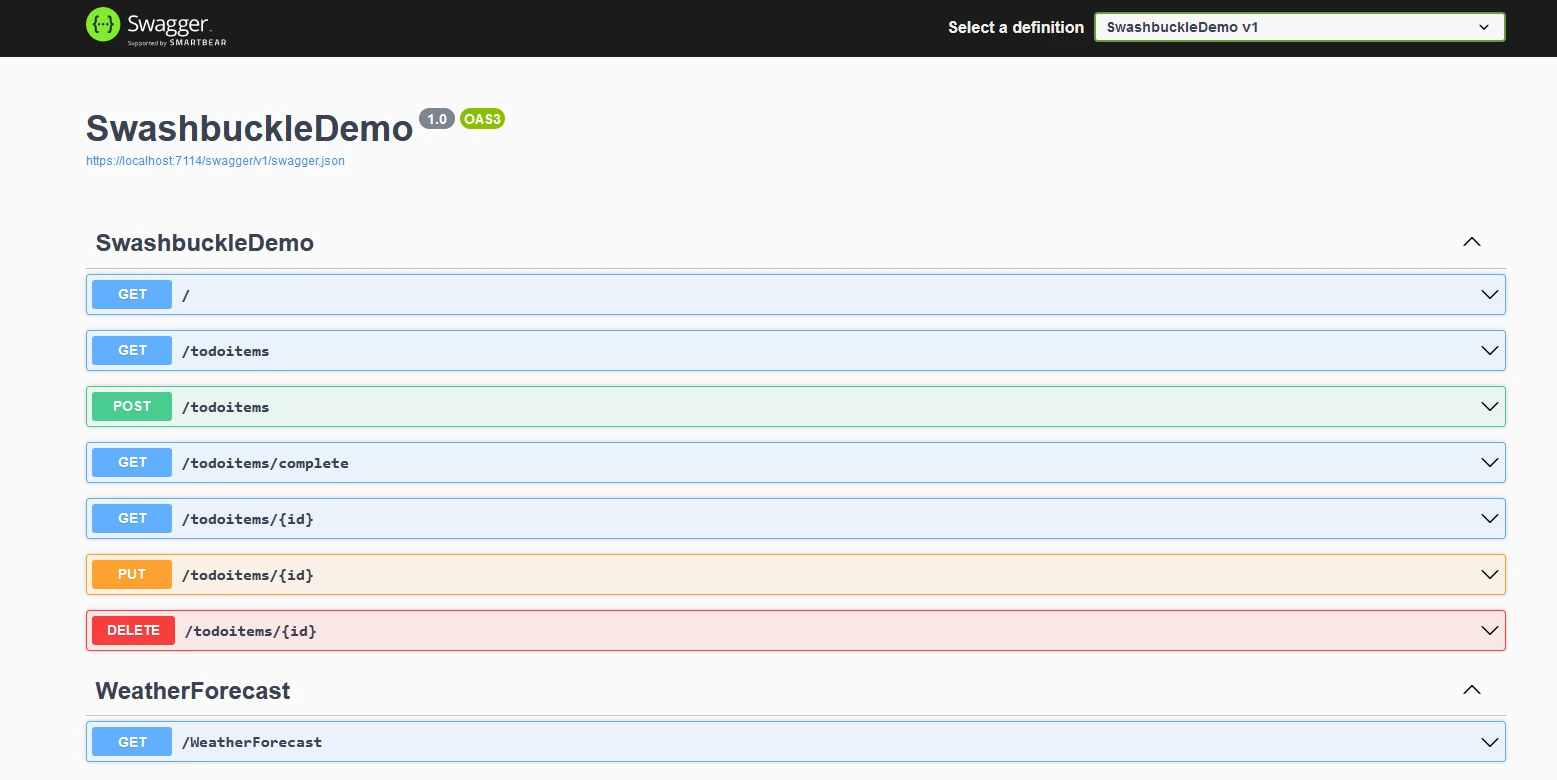
Swagger UIはWeb APIアプリケーションのベースURLから"/swagger/index.html"で利用可能です。 コードからすべてのREST APIをリスト表示します。 SwaggerジェネレーターはJSONファイルを読み込み、UIを生成します。
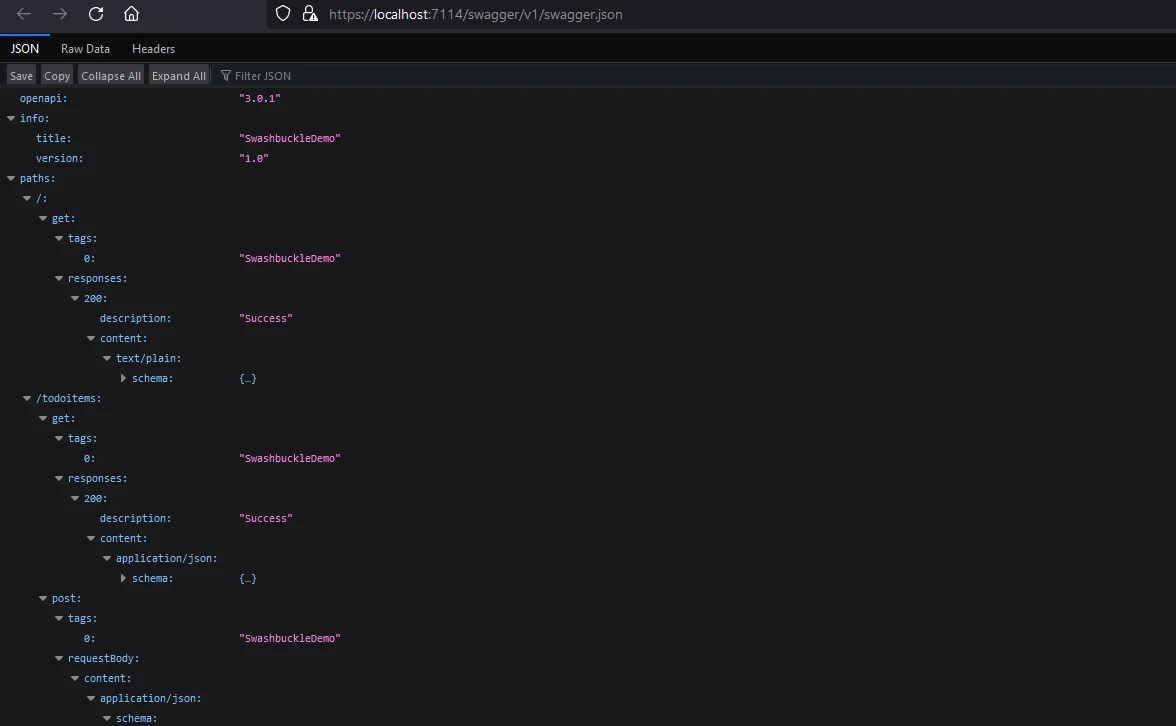
Swashbuckle.AspNetCoreは、APIの構造に関する情報(エンドポイント、リクエストおよびレスポンスタイプなどの詳細を含む)を含むSwagger JSONファイルを自動生成します。 このJSONファイルは、Swagger/OpenAPI標準をサポートする他のツールやサービスで使用可能です。
Swagger JSONファイルはWeb APIアプリケーションのベースURLから"/swagger/v1/swagger.json"で利用可能です。
開発者はXMLコメントや属性をASP.NET Coreコントローラー内で使用し、Swaggerドキュメントの為の追加情報を提供できます。 これには説明、例、および生成されたSwaggerドキュメントを強化する他のメタデータが含まれます。
[ApiController]
[Route("[controller]")]
public class WeatherForecastController : ControllerBase
{
    private static readonly string[] Summaries = new[]
    {
        "Freezing", "Bracing", "Chilly", "Cool", "Mild", "Warm", "Balmy", "Hot", "Sweltering", "Scorching"
    };

    private readonly ILogger<WeatherForecastController> _logger;

    public WeatherForecastController(ILogger<WeatherForecastController> logger)
    {
        _logger = logger;
    }

    /// <summary>
    /// Retrieves WeatherForecast
    /// </summary>
    /// <remarks>Awesomeness!</remarks>
    /// <response code="200">Retrieved</response>
    /// <response code="404">Not found</response>
    /// <response code="500">Oops! Can't lookup your request right now</response>
    [HttpGet(Name = "GetWeatherForecast")]
    public IEnumerable<WeatherForecast> Get()
    {
        return Enumerable.Range(1, 5).Select(index => new WeatherForecast
        {
            Date = DateTime.Now.AddDays(index),
            TemperatureC = Random.Shared.Next(-20, 55),
            Summary = Summaries[Random.Shared.Next(Summaries.Length)]
        })
        .ToArray();
    }
}<ApiController>
<Route("[controller]")>
Public Class WeatherForecastController
Inherits ControllerBase
Private Shared ReadOnly Summaries() As String = { "Freezing", "Bracing", "Chilly", "Cool", "Mild", "Warm", "Balmy", "Hot", "Sweltering", "Scorching" }
Private ReadOnly _logger As ILogger(Of WeatherForecastController)
Public Sub New(ByVal logger As ILogger(Of WeatherForecastController))
_logger = logger
End Sub
''' <summary>
''' Retrieves WeatherForecast
''' </summary>
''' <remarks>Awesomeness!</remarks>
''' <response code="200">Retrieved</response>
''' <response code="404">Not found</response>
''' <response code="500">Oops! Can't lookup your request right now</response>
<HttpGet(Name := "GetWeatherForecast")>
Public Function [Get]() As IEnumerable(Of WeatherForecast)
Return Enumerable.Range(1, 5).Select(Function(index) New WeatherForecast With {
.Date = DateTime.Now.AddDays(index),
.TemperatureC = Random.Shared.Next(-20, 55),
.Summary = Summaries(Random.Shared.Next(Summaries.Length))
}).ToArray()
End Function
End ClassSwashbuckle.AspNetCoreは、Swaggerドキュメントの生成方法をカスタマイズできるさまざまな設定オプションを提供します。 開発者はどのAPIをドキュメント化するかを制御し、命名規則を設定し、他の設定を調整できます。
Swashbuckle.AspNetCoreが提供する主要な設定オプションをいくつか紹介します。
c.SwaggerDoc("v1", new OpenApiInfo { Title = "My API", Version = "v1" });c.SwaggerDoc("v1", New OpenApiInfo With {
.Title = "My API",
.Version = "v1"
})この行はSwaggerドキュメントのバージョンを指定し、APIのタイトルやバージョンなどのメタデータを含みます。
c.IncludeXmlComments(xmlPath);c.IncludeXmlComments(xmlPath)このオプションを使用することで、コードからのXMLコメントがSwaggerドキュメントに追加情報として含まれるようにできます。 xmlPath変数は、XMLコメントファイルの位置を指す必要があります。
c.DescribeAllParametersInCamelCase();c.DescribeAllParametersInCamelCase()このオプションは、Swagger ジェネレーターがパラメータ名に camelCase を使用するように構成します。
c.OperationFilter<CustomOperationFilter>();c.OperationFilter(Of CustomOperationFilter)()特定の操作のためのSwaggerドキュメントを変更するためにカスタム操作フィルタを登録できます。 IOperationFilterを実装するクラスです。
c.SwaggerEndpoint("/swagger/v1/swagger.json", "My API V1");c.SwaggerEndpoint("/swagger/v1/swagger.json", "My API V1")この行はSwagger UIを設定してドキュメントを表示します。 最初のパラメータはSwagger JSONファイルのURLであり、2番目のパラメータはAPIバージョンのユーザーフレンドリーな名前です。
c.RoutePrefix = "swagger";c.RoutePrefix = "swagger"Swagger UIのルートプレフィックスを設定することもできます。 この例では、Swagger UIは/swaggerで利用可能になります。
c.DocExpansion(DocExpansion.None);c.DocExpansion(DocExpansion.None)このオプションはSwagger UIがAPIドキュメントをどう表示するかを制御します。 DocExpansion.Noneはデフォルトですべての操作を折りたたみます。
c.SerializeAsV2 = true;c.SerializeAsV2 = TrueこのオプションはSwagger文書をバージョン2.0形式(false)でシリアライズするかどうかを指定します。 Swagger 2.0を使用したい場合はtrueに設定します。
c.DisplayOperationId();c.DisplayOperationId()このオプションは操作IDをSwagger UIに表示させ、デバッグとAPI構造の理解に役立ちます。
c.OAuthClientId("swagger-ui");c.OAuthClientId("swagger-ui")APIがOAuth認証を使用する場合は、Swagger UIのOAuthクライアントIDを設定可能です。
これらは利用可能な設定オプションのほんの一例です。 Swashbuckle.AspNetCoreライブラリは非常にカスタマイズ性が高く、さまざまなオプションやフィルタを組み合わせて特定のニーズに合わせてSwaggerドキュメントを調整できます。 常に公式ドキュメントや開発環境でのIntelliSenseで利用可能なオプションに関する最新かつ包括的な情報を参照してください。
IronPDF製品概要は、Iron Software WebsiteのC# PDFライブラリで、PDFドキュメントの読み取りと生成に役立ちます。 スタイル情報付きのフォーマットドキュメントを簡単にPDFに変換できます。 IronPDFはHTMLコンテンツから簡単にPDFを生成できます。 URLからHTMLコンテンツをダウンロードし、PDFを生成します。
IronPDFは、HTMLを忠実に再現するWebページやURL、HTMLをPDFに変換する素晴らしいツールです。 レポートや請求書など、オンラインコンテンツのPDF生成に最適で、任意のウェブページのPDFバージョンを簡単に作成します。
using IronPdf;

class Program
{
    static void Main(string[] args)
    {
        var renderer = new ChromePdfRenderer();

        // 1. Convert HTML String to PDF
        var htmlContent = "<h1>Hello, IronPDF!</h1><p>This is a PDF from an HTML string.</p>";
        var pdfFromHtmlString = renderer.RenderHtmlAsPdf(htmlContent);
        pdfFromHtmlString.SaveAs("HTMLStringToPDF.pdf");

        // 2. Convert HTML File to PDF
        var htmlFilePath = "path_to_your_html_file.html"; // Specify the path to your HTML file
        var pdfFromHtmlFile = renderer.RenderHtmlFileAsPdf(htmlFilePath);
        pdfFromHtmlFile.SaveAs("HTMLFileToPDF.pdf");

        // 3. Convert URL to PDF
        var url = "http://ironpdf.com"; // Specify the URL
        var pdfFromUrl = renderer.RenderUrlAsPdf(url);
        pdfFromUrl.SaveAs("URLToPDF.pdf");
    }
}Imports IronPdf
Friend Class Program
Shared Sub Main(ByVal args() As String)
Dim renderer = New ChromePdfRenderer()
' 1. Convert HTML String to PDF
Dim htmlContent = "<h1>Hello, IronPDF!</h1><p>This is a PDF from an HTML string.</p>"
Dim pdfFromHtmlString = renderer.RenderHtmlAsPdf(htmlContent)
pdfFromHtmlString.SaveAs("HTMLStringToPDF.pdf")
' 2. Convert HTML File to PDF
Dim htmlFilePath = "path_to_your_html_file.html" ' Specify the path to your HTML file
Dim pdfFromHtmlFile = renderer.RenderHtmlFileAsPdf(htmlFilePath)
pdfFromHtmlFile.SaveAs("HTMLFileToPDF.pdf")
' 3. Convert URL to PDF
Dim url = "http://ironpdf.com" ' Specify the URL
Dim pdfFromUrl = renderer.RenderUrlAsPdf(url)
pdfFromUrl.SaveAs("URLToPDF.pdf")
End Sub
End ClassIronPDFをNuGet経由でインストールし、NuGetパッケージマネージャー詳細やVisual Studioインストールガイドのパッケージマネージャーコンソールで使います。
パッケージマネージャーコンソールで次のコマンドを入力します:
Visual Studioを使用する
![Swashbuckle ASP .NET Core (開発者向けのしくみ): 図3 - プロジェクトをVisual Studioで開く。 "ツール"メニューから"NuGetパッケージマネージャー"を選択し、"ソリューションのNuGetパッケージを管理"を選択します。 NuGet パッケージ マネージャー インターフェイスで、[参照] タブで"IronPDF"パッケージを検索します。 そして、IronPDFの最新バージョンを選択してインストールします。](/static-assets/pdf/blog/swashbuckle-asp-net-core/swashbuckle-asp-net-core-3.webp)
では、ウェブサイトコンテンツをPDFファイルとしてダウンロードする機能を追加するためにアプリケーションを修正しましょう。
using Microsoft.AspNetCore.Mvc;
using Microsoft.Extensions.Logging;
using IronPdf;
using System;
using System.Collections.Generic;
using System.IO;
using System.Linq;

namespace RestFullMinimalApi.Controllers
{
    [ApiController]
    [Route("[controller]")]
    public class WeatherForecastController : ControllerBase
    {
        private static readonly string[] Summaries = new[]
        {
            "Freezing", "Bracing", "Chilly", "Cool", "Mild", "Warm", "Balmy", "Hot", "Sweltering", "Scorching"
        };

        private readonly ILogger<WeatherForecastController> _logger;

        public WeatherForecastController(ILogger<WeatherForecastController> logger)
        {
            _logger = logger;
        }

        /// <summary>
        /// Retrieves WeatherForecast
        /// </summary>
        /// <remarks>Awesomeness!</remarks>
        /// <response code="200">Retrieved</response>
        /// <response code="404">Not found</response>
        /// <response code="500">Oops! Can't lookup your request right now</response>
        [HttpGet(Name = "GetWeatherForecast")]
        public IEnumerable<WeatherForecast> Get()
        {
            return Enumerable.Range(1, 5).Select(index => new WeatherForecast
            {
                Date = DateTime.Now.AddDays(index),
                TemperatureC = Random.Shared.Next(-20, 55),
                Summary = Summaries[Random.Shared.Next(Summaries.Length)]
            })
            .ToArray();
        }

        /// <summary>
        /// Retrieves WeatherForecast as Pdf
        /// </summary>
        /// <remarks>Awesomeness!</remarks>
        /// <response code="200">Retrieved</response>
        /// <response code="404">Not found</response>
        /// <response code="500">Oops! Can't lookup your request right now</response>
        [HttpGet("download", Name = "DownloadWeatherForecast")]
        public IActionResult GetWeatherPdf()
        {
            var results = Enumerable.Range(1, 5).Select(index => new WeatherForecast
            {
                Date = DateTime.Now.AddDays(index),
                TemperatureC = Random.Shared.Next(-20, 55),
                Summary = Summaries[Random.Shared.Next(Summaries.Length)]
            }).ToArray();

            var html = GetHtml(results);
            var renderer = new ChromePdfRenderer();
            var pdf = renderer.RenderHtmlAsPdf(html);
            var fileName = "WeatherReport.pdf";
            pdf.SaveAs(fileName);

            var stream = new FileStream(fileName, FileMode.Open);
            // Return the PDF file for download
            return new FileStreamResult(stream, "application/octet-stream") { FileDownloadName = fileName };
        }

        private static string GetHtml(WeatherForecast[] weatherForecasts)
        {
            string header = @"
<html>
<head><title>WeatherForecast</title></head>
<body>
<h1>WeatherForecast</h1>
";

            var footer = @"
</body>
</html>";

            var htmlContent = header;
            foreach (var weather in weatherForecasts)
            {
                htmlContent += $@"
    <h2>{weather.Date}</h2>
    <p>Summary: {weather.Summary}</p>
    <p>Temperature in Celsius: {weather.TemperatureC}</p>
    <p>Temperature in Fahrenheit: {weather.TemperatureF}</p>
";
            }
            htmlContent += footer;
            return htmlContent;
        }
    }

    public class WeatherForecast
    {
        public DateTime Date { get; set; }
        public int TemperatureC { get; set; }
        public string Summary { get; set; }

        public int TemperatureF => 32 + (int)(TemperatureC / 0.5556);
    }
}Imports Microsoft.AspNetCore.Mvc
Imports Microsoft.Extensions.Logging
Imports IronPdf
Imports System
Imports System.Collections.Generic
Imports System.IO
Imports System.Linq
Namespace RestFullMinimalApi.Controllers
<ApiController>
<Route("[controller]")>
Public Class WeatherForecastController
Inherits ControllerBase
Private Shared ReadOnly Summaries As String() = {"Freezing", "Bracing", "Chilly", "Cool", "Mild", "Warm", "Balmy", "Hot", "Sweltering", "Scorching"}
Private ReadOnly _logger As ILogger(Of WeatherForecastController)
Public Sub New(logger As ILogger(Of WeatherForecastController))
_logger = logger
End Sub
''' <summary>
''' Retrieves WeatherForecast
''' </summary>
''' <remarks>Awesomeness!</remarks>
''' <response code="200">Retrieved</response>
''' <response code="404">Not found</response>
''' <response code="500">Oops! Can't lookup your request right now</response>
<HttpGet(Name:="GetWeatherForecast")>
Public Function [Get]() As IEnumerable(Of WeatherForecast)
Return Enumerable.Range(1, 5).Select(Function(index) New WeatherForecast With {
.Date = DateTime.Now.AddDays(index),
.TemperatureC = Random.Shared.Next(-20, 55),
.Summary = Summaries(Random.Shared.Next(Summaries.Length))
}).ToArray()
End Function
''' <summary>
''' Retrieves WeatherForecast as Pdf
''' </summary>
''' <remarks>Awesomeness!</remarks>
''' <response code="200">Retrieved</response>
''' <response code="404">Not found</response>
''' <response code="500">Oops! Can't lookup your request right now</response>
<HttpGet("download", Name:="DownloadWeatherForecast")>
Public Function GetWeatherPdf() As IActionResult
Dim results = Enumerable.Range(1, 5).Select(Function(index) New WeatherForecast With {
.Date = DateTime.Now.AddDays(index),
.TemperatureC = Random.Shared.Next(-20, 55),
.Summary = Summaries(Random.Shared.Next(Summaries.Length))
}).ToArray()
Dim html = GetHtml(results)
Dim renderer = New ChromePdfRenderer()
Dim pdf = renderer.RenderHtmlAsPdf(html)
Dim fileName = "WeatherReport.pdf"
pdf.SaveAs(fileName)
Dim stream = New FileStream(fileName, FileMode.Open)
' Return the PDF file for download
Return New FileStreamResult(stream, "application/octet-stream") With {.FileDownloadName = fileName}
End Function
Private Shared Function GetHtml(weatherForecasts As WeatherForecast()) As String
Dim header As String = "
<html>
<head><title>WeatherForecast</title></head>
<body>
<h1>WeatherForecast</h1>
"
Dim footer As String = "
</body>
</html>"
Dim htmlContent As String = header
For Each weather In weatherForecasts
htmlContent += $"
<h2>{weather.Date}</h2>
<p>Summary: {weather.Summary}</p>
<p>Temperature in Celsius: {weather.TemperatureC}</p>
<p>Temperature in Fahrenheit: {weather.TemperatureF}</p>
"
Next
htmlContent += footer
Return htmlContent
End Function
End Class
Public Class WeatherForecast
Public Property [Date] As DateTime
Public Property TemperatureC As Integer
Public Property Summary As String
Public ReadOnly Property TemperatureF As Integer
Get
Return 32 + CInt(TemperatureC / 0.5556)
End Get
End Property
End Class
End Namespaceここでは、天気データを使用してHTML文字列を生成し、それを使用してPDFドキュメントを作成します。
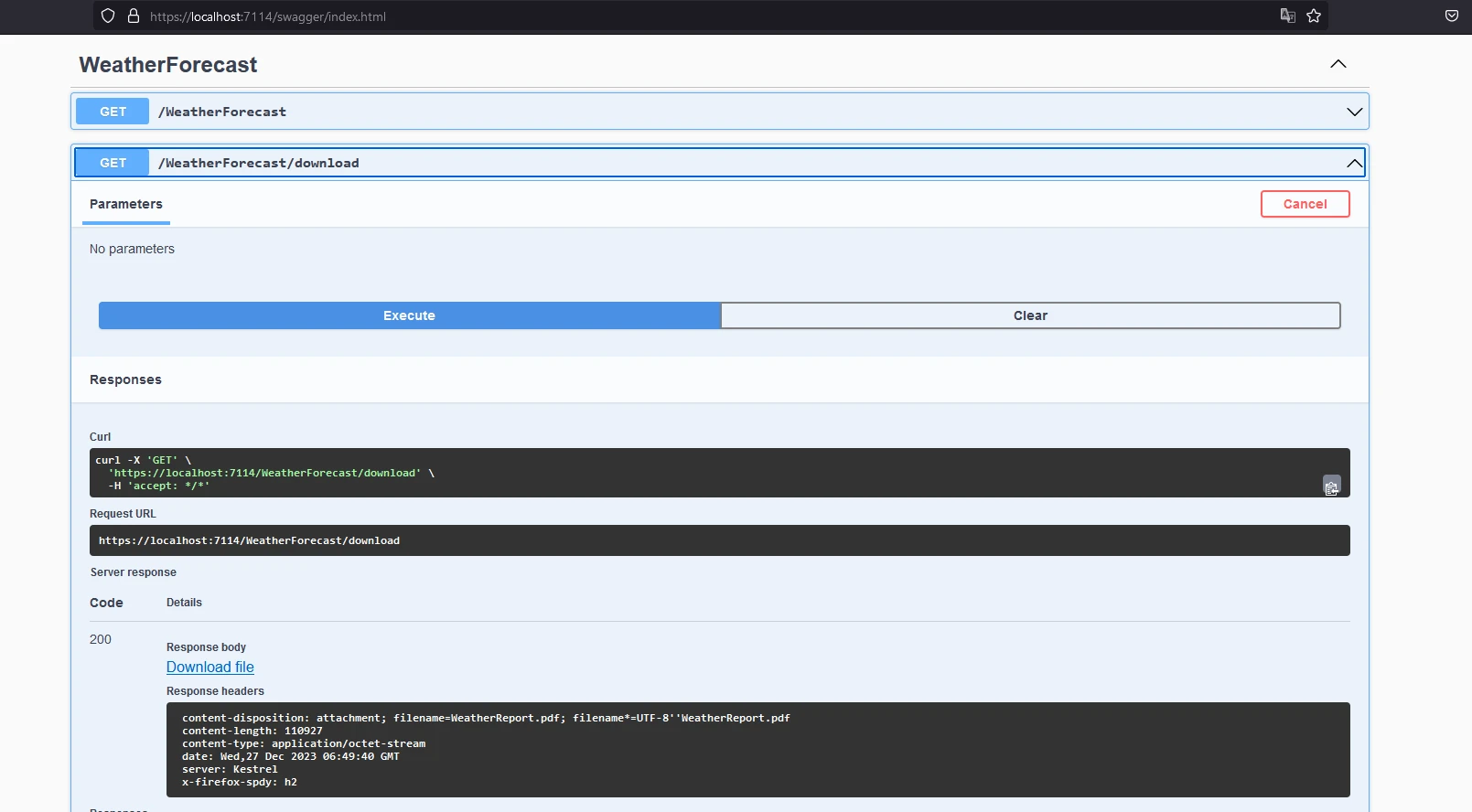
そしてPDFレポートは次のようになります。
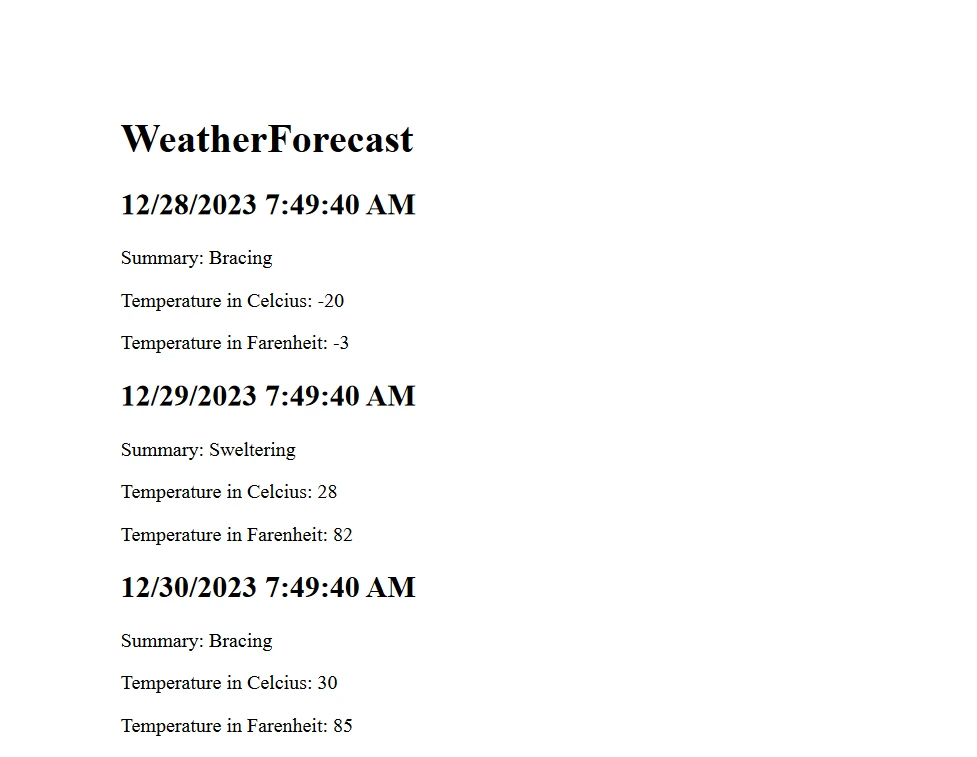
完全なコードはGitHub - Swashbuckle Demoソースコードにあります。
ドキュメントには、試用ライセンス用の小さな透かしがありますが、有効なライセンスで削除可能です。
上記のコードを機能させるには、ライセンスキーが必要です。 このキーをappsettings.jsonファイルに配置します。
{
    "IronPdf": {
        "LicenseKey": "your license key"
    }
}試用ライセンスは、IronPDFの試用登録に登録すると開発者向けに利用可能です。 試用ライセンスにはクレジットカードは不要です。 メールアドレスを登録して無料の試用版を取得してください。
SwashbuckleとIronPDFを理解することで、ASP.NET CoreアプリケーションにAPIドキュメントとPDF生成機能を効果的に統合できます。 IronPDFでは、はじめにのための包括的なドキュメントと、さまざまなPDF生成のためのコード例も提供しています。
また、Iron Softwareの関連ソフトウェア製品を探求することで、コーディングスキルを向上させ、現代のアプリケーション要件を満たすことができます。

ジェイコブ・メラーはIron Softwareの最高技術責任者(CTO)であり、C# PDFテクノロジーを開拓する先見的なエンジニアです。Iron Softwareのコアコードベースを支えるオリジナル開発者として、彼は創業以来、会社の製品アーキテクチャを形成し、CEOのCameron Rimingtonとともに、会社をNASA、Tesla、および世界的な政府機関にサービスを提供する50人以上の会社に変えました。1999年にロンドンで最初のソフトウェアビジネスを開業し、2005年に最初 for .NETコンポーネントを作成した後、Microsoftのエコシステム全体で複雑な問題を解決することを専門としました。

IronPDF はIRONSUITEの一部です
オフィス文書向けの.NET API製品10個

PDFがHTMLのように見える必要があるとき、迅速に。












