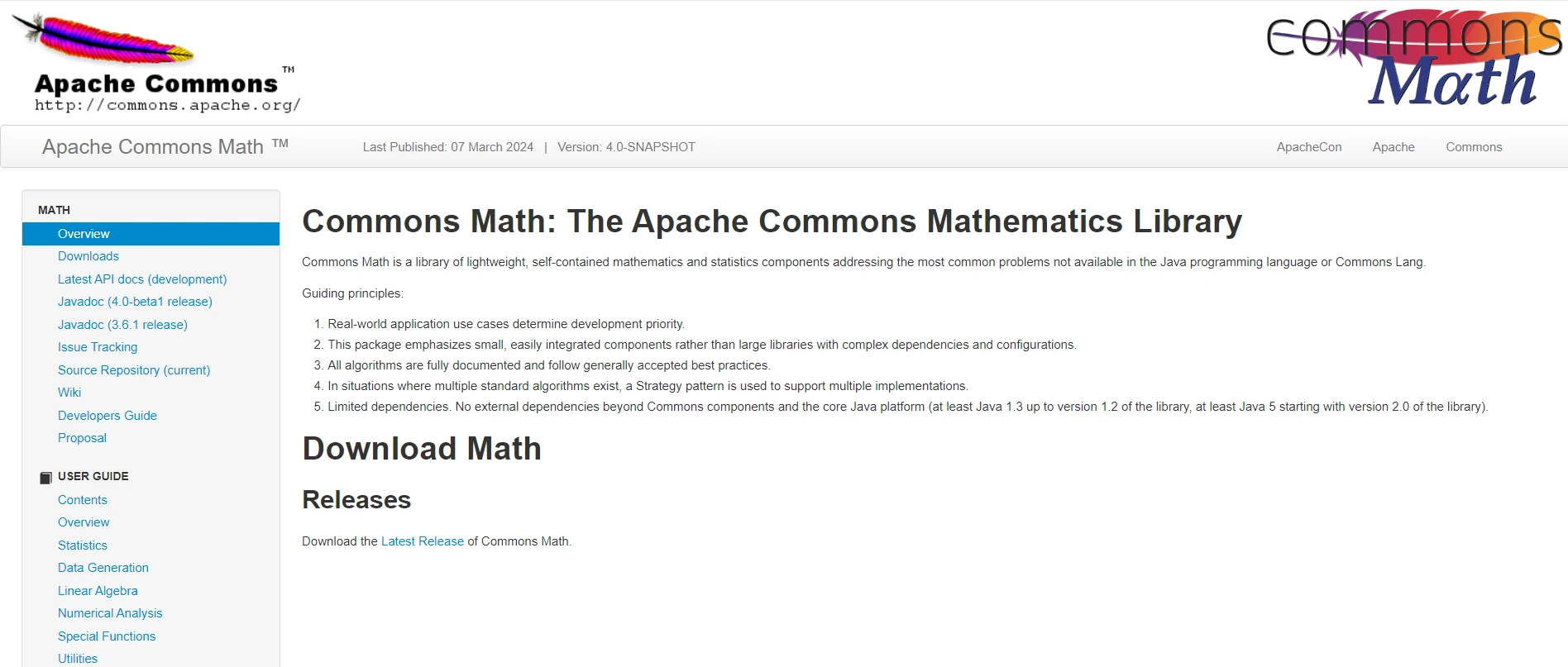
JAVA 도움말 Java 개발자를 위한 아파치 커먼즈 수학 커티스 차우 업데이트됨:1월 5, 2026 다운로드 IronPDF 메이븐 다운로드 JAR 다운로드 무료 체험 시작하기 LLM용 사본 LLM용 사본 LLM용 마크다운 형식으로 페이지를 복사하세요 ChatGPT에서 열기 ChatGPT에 이 페이지에 대해 문의하세요 제미니에서 열기 제미니에게 이 페이지에 대해 문의하세요 Grok에서 열기 Grok에게 이 페이지에 대해 문의하세요 혼란 속에서 열기 Perplexity에게 이 페이지에 대해 문의하세요 공유하다 페이스북에 공유하기 트위터에 공유하기 LinkedIn에 공유하기 URL 복사 이메일로 기사 보내기 In the realm of software development, mathematical computations often form the backbone of numerous applications, ranging from scientific simulations to financial modeling. However, implementing complex mathematical algorithms from scratch can be both time-consuming and error-prone. This is where the Apache Commons Math package comes into play, offering a comprehensive library of mathematical components and utilities for Java developers. In this article, we explore the Math and FastMath functions of Apache Commons Math, also exploring its features, capabilities, and how it simplifies mathematical analysis and computing tasks. What is Apache Commons Math? Apache Commons Math is an open-source Java library that provides a wide range of mathematical algorithms, custom methods, and utilities. Developed under the Apache Software Foundation, it aims to address common mathematical problems encountered in software development, offering ready-to-use implementations of various mathematical functions, algorithm transform methods, and statistical tools. Key Features Here are some key features of the Apache Commons Math library: 1. Numerical Analysis Apache Commons Math offers a plethora of numerical analysis tools, including root finding, optimization, interpolation, and integration. Developers can easily solve equations, find roots using mathematical formulas, optimize functions, and perform numerical integration using pre-built algorithms. 2. Linear Algebra Linear algebra forms the foundation of many mathematical computations. Apache Commons Math provides robust support for operations on matrices and vectors, including addition, multiplication, inversion, decomposition, and solving linear systems of equations. These functionalities are essential for applications such as machine learning, signal processing, and computer graphics. 3. Probability and Statistics Probability and statistics are vital for analyzing data and making informed decisions. Apache Commons Math offers a comprehensive set of statistical tools for calculating descriptive statistics, probability distributions, hypothesis testing, and regression analysis. Whether you're analyzing experimental data or building predictive models, these statistical functions come in handy. 4. Special Functions The library includes implementations of special mathematical functions, such as gamma functions, beta functions, Bessel functions, inverse trigonometric functions, and error functions. These functions are commonly used in scientific computing, physics, engineering, and other domains. With Apache Commons Math, developers can leverage these specialized functions without having to implement them from scratch. 5. Random Number Generation Generating random numbers is a fundamental requirement in many applications, including simulations, cryptography, and gaming. Apache Commons Math provides efficient algorithms for generating random numbers from various distributions, ensuring both speed and statistical accuracy. 6. Binary Space Partitioning (BSP) Binary space partitioning (BSP) is another area where Apache Commons Math shines. BSP is a technique used in computer graphics, collision detection, and spatial partitioning algorithms. Apache Commons Math offers utilities for creating and manipulating BSP trees, enabling developers to efficiently organize and search spatial data structures in multidimensional spaces. 7. Ordinary Differential Equations Integration With Apache Commons Math, developers can seamlessly integrate ordinary differential equations (ODEs) into their Java applications, enabling simulations of dynamic systems, modeling physical phenomena, and performing time-dependent calculations accurately. How to Use Apache Commons Math Library Using Apache Commons Math in your Java projects is straightforward. Simply include the library in your project's dependencies, and you're ready to leverage its functionalities. The library is well-documented, with extensive Javadoc and examples, making it easy for developers to understand and utilize its features. Here's a simple example demonstrating the usage of Apache Commons Math for solving a system of linear equations: import org.apache.commons.math3.linear.*; public class Main { public static void main(String[] args) { // Define the coefficient matrix and constant vector RealMatrix coefficients = MatrixUtils.createRealMatrix(new double[][] {{2, 3}, {4, 5}}); RealVector constants = new ArrayRealVector(new double[] {10, 20}); // Solve the linear system of equations DecompositionSolver solver = new LUDecomposition(coefficients).getSolver(); RealVector solution = solver.solve(constants); // Print the solution System.out.println("Solution: " + solution); } } import org.apache.commons.math3.linear.*; public class Main { public static void main(String[] args) { // Define the coefficient matrix and constant vector RealMatrix coefficients = MatrixUtils.createRealMatrix(new double[][] {{2, 3}, {4, 5}}); RealVector constants = new ArrayRealVector(new double[] {10, 20}); // Solve the linear system of equations DecompositionSolver solver = new LUDecomposition(coefficients).getSolver(); RealVector solution = solver.solve(constants); // Print the solution System.out.println("Solution: " + solution); } } JAVA Integrating Apache Commons Math with IronPDF Integrating Apache Commons Math with IronPDF involves leveraging the computational capabilities of Apache Commons Math to perform complex calculations and statistical analysis, and then using IronPDF to render the results of the analysis into a PDF document. IronPDF for Java IronPDF for Java is a powerful library designed to simplify PDF generation within Java applications. With IronPDF, developers can effortlessly create, manipulate, and render PDF documents programmatically, enabling the generation of dynamic reports, invoices, and documents with ease. The library offers a straightforward API for converting HTML content, including CSS styling and images, into PDF format, making it ideal for web applications and content management systems. Here's a step-by-step guide on how to integrate these libraries: Perform Mathematical Calculations: Use Apache Commons Math to perform the necessary mathematical calculations, such as solving equations, computing statistical measures, or generating charts. For example, you can use Apache Commons Math to calculate statistical measures like mean, median, and standard deviation for a dataset. Generate HTML Content: Once the calculations are performed, generate HTML content representing the results. IronPDF allows you to create PDF documents from HTML content, making it easy to include dynamic data, images, and formatting in your PDF reports. You can use libraries like Thymeleaf or FreeMarker to generate HTML templates dynamically. Convert HTML to PDF: Use IronPDF to convert the generated HTML content into a PDF document. IronPDF provides a simple API for converting HTML to PDF, allowing you to specify options such as page size, margins, and header/footer content. Save or Stream the PDF: Finally, save the generated PDF document to a file or stream it directly to the client browser, depending on your application's requirements. IronPDF supports saving PDF documents to disk or streaming them over HTTP, making it easy to integrate PDF generation into web applications. Example Integration Here's an example demonstrating how to integrate Apache Commons Math with IronPDF to generate a PDF report containing statistical analysis results: import org.apache.commons.math3.stat.descriptive.DescriptiveStatistics; import com.ironpdf.*; import java.io.File; import java.io.IOException; public class PDFReportGenerator { public static void main(String[] args) { // Perform statistical analysis using Apache Commons Math double[] data = {10, 20, 30, 40, 50}; DescriptiveStatistics stats = new DescriptiveStatistics(data); double mean = stats.getMean(); double stdDev = stats.getStandardDeviation(); // Generate HTML content with statistical analysis results String htmlContent = "<h1>Statistical Analysis Report</h1>" + "<p>Mean: " + mean + "</p>" + "<p>Standard Deviation: " + stdDev + "</p>"; // Convert HTML to PDF using IronPDF try { HtmlToPdfConverter converter = new HtmlToPdfConverter(); PdfDocument pdfDocument = converter.convertHtmlString(htmlContent); // Save the PDF document to disk pdfDocument.saveAs(new File("StatisticalAnalysisReport.pdf")); } catch (IOException e) { e.printStackTrace(); } } } import org.apache.commons.math3.stat.descriptive.DescriptiveStatistics; import com.ironpdf.*; import java.io.File; import java.io.IOException; public class PDFReportGenerator { public static void main(String[] args) { // Perform statistical analysis using Apache Commons Math double[] data = {10, 20, 30, 40, 50}; DescriptiveStatistics stats = new DescriptiveStatistics(data); double mean = stats.getMean(); double stdDev = stats.getStandardDeviation(); // Generate HTML content with statistical analysis results String htmlContent = "<h1>Statistical Analysis Report</h1>" + "<p>Mean: " + mean + "</p>" + "<p>Standard Deviation: " + stdDev + "</p>"; // Convert HTML to PDF using IronPDF try { HtmlToPdfConverter converter = new HtmlToPdfConverter(); PdfDocument pdfDocument = converter.convertHtmlString(htmlContent); // Save the PDF document to disk pdfDocument.saveAs(new File("StatisticalAnalysisReport.pdf")); } catch (IOException e) { e.printStackTrace(); } } } JAVA For more detailed information on IronPDF, please visit their documentation page. For ready-to-use resources and code examples, please visit this IronPDF Java code examples page. Conclusion Apache Commons Math is a versatile toolkit for mathematical computing in Java. Whether you're a scientist, engineer, data analyst, or software developer, this library provides invaluable support for implementing mathematical algorithms and solving complex problems efficiently. By integrating Apache Commons Math with IronPDF, developers can create dynamic PDF reports containing mathematical calculations, statistical analysis results, and charts with ease. Whether you're building financial applications, scientific simulations, statistical tests, or data analysis tools, the combined power of Apache Commons Math and IronPDF empowers you to create professional-quality PDF reports efficiently and effectively. Start using IronPDF today, which starts from $799 and comes with a money-back guarantee, making it a safe choice for managing your documents. Download IronPDF for Java now and enjoy smooth PDF integration! 커티스 차우 지금 바로 엔지니어링 팀과 채팅하세요 기술 문서 작성자 커티스 차우는 칼턴 대학교에서 컴퓨터 과학 학사 학위를 취득했으며, Node.js, TypeScript, JavaScript, React를 전문으로 하는 프론트엔드 개발자입니다. 직관적이고 미적으로 뛰어난 사용자 인터페이스를 만드는 데 열정을 가진 그는 최신 프레임워크를 활용하고, 잘 구성되고 시각적으로 매력적인 매뉴얼을 제작하는 것을 즐깁니다. 커티스는 개발 분야 외에도 사물 인터넷(IoT)에 깊은 관심을 가지고 있으며, 하드웨어와 소프트웨어를 통합하는 혁신적인 방법을 연구합니다. 여가 시간에는 게임을 즐기거나 디스코드 봇을 만들면서 기술에 대한 애정과 창의성을 결합합니다. 관련 기사 업데이트됨 10월 26, 2025 참조를 통한 Java 패스(개발자를 위한 작동 방식) Java 프로그래밍 언어에서 매개변수 전달은 항상 값으로 전달됩니다. 객체를 다룰 때 참조 변수는 값으로 전달됩니다 더 읽어보기 업데이트됨 10월 26, 2025 Java 스캐너(개발자를 위한 작동 방식) 이 문서에서는 Java Scanner 클래스의 작동 방식을 자세히 살펴보고 예제를 통해 그 사용법을 살펴봅니다 더 읽어보기 업데이트됨 8월 31, 2025 Java Printf(개발자를 위한 작동 방식) IronPDF와 Java의 printf 기능을 통합하면 정확한 텍스트 서식으로 PDF 출력을 향상시킬 수 있습니다 더 읽어보기 잭슨 자바(개발자를 위한 작동 방식)로그백: 개발자를 위한 Java...
업데이트됨 10월 26, 2025 참조를 통한 Java 패스(개발자를 위한 작동 방식) Java 프로그래밍 언어에서 매개변수 전달은 항상 값으로 전달됩니다. 객체를 다룰 때 참조 변수는 값으로 전달됩니다 더 읽어보기
업데이트됨 10월 26, 2025 Java 스캐너(개발자를 위한 작동 방식) 이 문서에서는 Java Scanner 클래스의 작동 방식을 자세히 살펴보고 예제를 통해 그 사용법을 살펴봅니다 더 읽어보기
업데이트됨 8월 31, 2025 Java Printf(개발자를 위한 작동 방식) IronPDF와 Java의 printf 기능을 통합하면 정확한 텍스트 서식으로 PDF 출력을 향상시킬 수 있습니다 더 읽어보기