C# Find (How It Works For Developers)

Welcome to our tutorial on C#'s handy Find function. You've just stumbled upon a powerful feature that can streamline your coding process. So, whether you're a seasoned coder or just starting out, this tutorial will walk you through all the elements to get you going.
The Basics of Find
At its core, Find is a function that allows you to locate the first element in a collection, array, or list that satisfies a specified predicate. What's a predicate, you ask? In programming, a predicate is a function that tests certain conditions defined for elements in a collection.
Now, let's dive into a public class example.
public class BikePart
{
    public string Id { get; set; } // Property to identify the bike part

    // Override the Equals method to specify how to compare two BikePart objects
    public override bool Equals(object obj)
    {
        if (obj == null || !(obj is BikePart))
            return false;

        return this.Id == ((BikePart)obj).Id;
    }

    // Override GetHashCode for hashing BikePart objects
    public override int GetHashCode()
    {
        return this.Id.GetHashCode();
    }

    // Override ToString to return a custom string representation of the object
    public override string ToString()
    {
        return "BikePart ID: " + this.Id;
    }
}
public class BikePart
{
public string Id { get; set; } // Property to identify the bike part
// Override the Equals method to specify how to compare two BikePart objects
public override bool Equals(object obj)
{
if (obj == null || !(obj is BikePart))
return false;
return this.Id == ((BikePart)obj).Id;
}
// Override GetHashCode for hashing BikePart objects
public override int GetHashCode()
{
return this.Id.GetHashCode();
}
// Override ToString to return a custom string representation of the object
public override string ToString()
{
return "BikePart ID: " + this.Id;
}
}Public Class BikePart
Public Property Id() As String ' - Property to identify the bike part
' Override the Equals method to specify how to compare two BikePart objects
Public Overrides Function Equals(ByVal obj As Object) As Boolean
If obj Is Nothing OrElse Not (TypeOf obj Is BikePart) Then
Return False
End If
Return Me.Id = DirectCast(obj, BikePart).Id
End Function
' Override GetHashCode for hashing BikePart objects
Public Overrides Function GetHashCode() As Integer
Return Me.Id.GetHashCode()
End Function
' Override ToString to return a custom string representation of the object
Public Overrides Function ToString() As String
Return "BikePart ID: " & Me.Id
End Function
End ClassIn this code, BikePart is our public class, and it contains a public string ID to identify each bike part. We have overridden the ToString method to print the ID of the bike part nicely, and we have also overridden the Equals and GetHashCode methods for comparison purposes.
Employing Find with Predicates
Now that we have our BikePart class, we can create a list of bike parts and use Find to locate specific parts based on their IDs. Let's consider the following example:
using System;
using System.Collections.Generic;

public static void Main()
{
    // Create a list of BikePart objects
    List<BikePart> bikeParts = new List<BikePart>
    {
        new BikePart { Id = "Chain Ring ID" },
        new BikePart { Id = "Crank Arm ID" },
        new BikePart { Id = "Regular Seat ID" },
        new BikePart { Id = "Banana Seat ID" },
    };

    // Define a predicate to find a BikePart with a specific ID
    Predicate<BikePart> findChainRingPredicate = (BikePart bp) => { return bp.Id == "Chain Ring ID"; };
    BikePart chainRingPart = bikeParts.Find(findChainRingPredicate);

    // Print the found BikePart's ID to the console
    Console.WriteLine(chainRingPart.ToString());
}
using System;
using System.Collections.Generic;
public static void Main()
{
// Create a list of BikePart objects
List<BikePart> bikeParts = new List<BikePart>
{
new BikePart { Id = "Chain Ring ID" },
new BikePart { Id = "Crank Arm ID" },
new BikePart { Id = "Regular Seat ID" },
new BikePart { Id = "Banana Seat ID" },
};
// Define a predicate to find a BikePart with a specific ID
Predicate<BikePart> findChainRingPredicate = (BikePart bp) => { return bp.Id == "Chain Ring ID"; };
BikePart chainRingPart = bikeParts.Find(findChainRingPredicate);
// Print the found BikePart's ID to the console
Console.WriteLine(chainRingPart.ToString());
}Imports System
Imports System.Collections.Generic
Public Shared Sub Main()
' Create a list of BikePart objects
Dim bikeParts As New List(Of BikePart) From {
New BikePart With {.Id = "Chain Ring ID"},
New BikePart With {.Id = "Crank Arm ID"},
New BikePart With {.Id = "Regular Seat ID"},
New BikePart With {.Id = "Banana Seat ID"}
}
' Define a predicate to find a BikePart with a specific ID
Dim findChainRingPredicate As Predicate(Of BikePart) = Function(bp As BikePart)
Return bp.Id = "Chain Ring ID"
End Function
Dim chainRingPart As BikePart = bikeParts.Find(findChainRingPredicate)
' Print the found BikePart's ID to the console
Console.WriteLine(chainRingPart.ToString())
End SubIn this code, we instantiate four BikePart objects with unique IDs. Next, we create a predicate findChainRingPredicate that checks if a bike part has the ID "Chain Ring ID". Finally, we call Find on our list of bike parts using the predicate we defined and print the found part's ID to the console.
Understanding the Predicate Parameter
You might be wondering about the Predicate match parameter in our Find method. This is where you define the conditions under which the Find method returns an element. In our case, we wanted the Find method to return the first element that matches the "Chain Ring ID".
If no element satisfies the conditions defined in your predicate, the Find method will return a default value. For instance, if you're working with an array of integers and your predicate doesn't find a match, the Find method will return '0', the default value for integers in C#.
The Linear Search Principle
It's essential to note that the Find function conducts a linear search across the entire array, list, or collection. This means it starts at the first element and inspects each following element in sequence until it locates the first occurrence of an element satisfying the predicate.
In some cases, you might want to locate the last element that satisfies the predicate instead of the first one. For this purpose, C# provides the FindLast function.
FindIndex and FindLastIndex
Just as Find helps you locate the first occurrence of an element that matches your specified predicate, C# also provides FindIndex and FindLastIndex methods to give you the indices of the first and last elements that match your conditions, respectively.
Let's try an example:
using System;
using System.Collections.Generic;

public static void Main()
{
    // Create a list of BikePart objects with an additional duplicate entry
    List<BikePart> bikeParts = new List<BikePart>
    {
        new BikePart { Id = "Chain Ring ID" },
        new BikePart { Id = "Crank Arm ID" },
        new BikePart { Id = "Regular Seat ID" },
        new BikePart { Id = "Banana Seat ID" },
        new BikePart { Id = "Chain Ring ID" }, // Added a second chain ring
    };

    // Define a predicate to find a BikePart with a specific ID
    Predicate<BikePart> findChainRingPredicate = (BikePart bp) => { return bp.Id == "Chain Ring ID"; };

    // Find the index of the first and last occurrence of the specified BikePart
    int firstChainRingIndex = bikeParts.FindIndex(findChainRingPredicate);
    int lastChainRingIndex = bikeParts.FindLastIndex(findChainRingPredicate);

    // Print the indices to the console
    Console.WriteLine($"First Chain Ring ID found at index: {firstChainRingIndex}");
    Console.WriteLine($"Last Chain Ring ID found at index: {lastChainRingIndex}");
}
using System;
using System.Collections.Generic;
public static void Main()
{
// Create a list of BikePart objects with an additional duplicate entry
List<BikePart> bikeParts = new List<BikePart>
{
new BikePart { Id = "Chain Ring ID" },
new BikePart { Id = "Crank Arm ID" },
new BikePart { Id = "Regular Seat ID" },
new BikePart { Id = "Banana Seat ID" },
new BikePart { Id = "Chain Ring ID" }, // Added a second chain ring
};
// Define a predicate to find a BikePart with a specific ID
Predicate<BikePart> findChainRingPredicate = (BikePart bp) => { return bp.Id == "Chain Ring ID"; };
// Find the index of the first and last occurrence of the specified BikePart
int firstChainRingIndex = bikeParts.FindIndex(findChainRingPredicate);
int lastChainRingIndex = bikeParts.FindLastIndex(findChainRingPredicate);
// Print the indices to the console
Console.WriteLine($"First Chain Ring ID found at index: {firstChainRingIndex}");
Console.WriteLine($"Last Chain Ring ID found at index: {lastChainRingIndex}");
}Imports System
Imports System.Collections.Generic
Public Shared Sub Main()
' Create a list of BikePart objects with an additional duplicate entry
Dim bikeParts As New List(Of BikePart) From {
New BikePart With {.Id = "Chain Ring ID"},
New BikePart With {.Id = "Crank Arm ID"},
New BikePart With {.Id = "Regular Seat ID"},
New BikePart With {.Id = "Banana Seat ID"},
New BikePart With {.Id = "Chain Ring ID"}
}
' Define a predicate to find a BikePart with a specific ID
Dim findChainRingPredicate As Predicate(Of BikePart) = Function(bp As BikePart)
Return bp.Id = "Chain Ring ID"
End Function
' Find the index of the first and last occurrence of the specified BikePart
Dim firstChainRingIndex As Integer = bikeParts.FindIndex(findChainRingPredicate)
Dim lastChainRingIndex As Integer = bikeParts.FindLastIndex(findChainRingPredicate)
' Print the indices to the console
Console.WriteLine($"First Chain Ring ID found at index: {firstChainRingIndex}")
Console.WriteLine($"Last Chain Ring ID found at index: {lastChainRingIndex}")
End SubThe Power of FindAll
The FindAll method, as the name suggests, retrieves all elements in the collection that satisfy the predicate. It is used when you need to filter elements based on certain conditions. The FindAll method returns a new List with all the matched elements.
Here's a code example:
using System;
using System.Collections.Generic;

public static void Main()
{
    // Create a list of BikePart objects with an additional duplicate entry
    List<BikePart> bikeParts = new List<BikePart>
    {
        new BikePart { Id = "Chain Ring ID" },
        new BikePart { Id = "Crank Arm ID" },
        new BikePart { Id = "Regular Seat ID" },
        new BikePart { Id = "Banana Seat ID" },
        new BikePart { Id = "Chain Ring ID" }, // Added a second chain ring
    };

    // Define a predicate to find all BikeParts with a specific ID
    Predicate<BikePart> findChainRingPredicate = (BikePart bp) => { return bp.Id == "Chain Ring ID"; };

    // Use FindAll to get all matching BikePart objects
    List<BikePart> chainRings = bikeParts.FindAll(findChainRingPredicate);

    // Print the count and details of each found BikePart
    Console.WriteLine($"Found {chainRings.Count} Chain Rings:");
    foreach (BikePart chainRing in chainRings)
    {
        Console.WriteLine(chainRing.ToString());
    }
}
using System;
using System.Collections.Generic;
public static void Main()
{
// Create a list of BikePart objects with an additional duplicate entry
List<BikePart> bikeParts = new List<BikePart>
{
new BikePart { Id = "Chain Ring ID" },
new BikePart { Id = "Crank Arm ID" },
new BikePart { Id = "Regular Seat ID" },
new BikePart { Id = "Banana Seat ID" },
new BikePart { Id = "Chain Ring ID" }, // Added a second chain ring
};
// Define a predicate to find all BikeParts with a specific ID
Predicate<BikePart> findChainRingPredicate = (BikePart bp) => { return bp.Id == "Chain Ring ID"; };
// Use FindAll to get all matching BikePart objects
List<BikePart> chainRings = bikeParts.FindAll(findChainRingPredicate);
// Print the count and details of each found BikePart
Console.WriteLine($"Found {chainRings.Count} Chain Rings:");
foreach (BikePart chainRing in chainRings)
{
Console.WriteLine(chainRing.ToString());
}
}Imports System
Imports System.Collections.Generic
Public Shared Sub Main()
' Create a list of BikePart objects with an additional duplicate entry
Dim bikeParts As New List(Of BikePart) From {
New BikePart With {.Id = "Chain Ring ID"},
New BikePart With {.Id = "Crank Arm ID"},
New BikePart With {.Id = "Regular Seat ID"},
New BikePart With {.Id = "Banana Seat ID"},
New BikePart With {.Id = "Chain Ring ID"}
}
' Define a predicate to find all BikeParts with a specific ID
Dim findChainRingPredicate As Predicate(Of BikePart) = Function(bp As BikePart)
Return bp.Id = "Chain Ring ID"
End Function
' Use FindAll to get all matching BikePart objects
Dim chainRings As List(Of BikePart) = bikeParts.FindAll(findChainRingPredicate)
' Print the count and details of each found BikePart
Console.WriteLine($"Found {chainRings.Count} Chain Rings:")
For Each chainRing As BikePart In chainRings
Console.WriteLine(chainRing.ToString())
Next chainRing
End SubBringing IronPDF into the Picture
A crucial area where our C# Find knowledge can be utilized is PDF content manipulation using IronPDF, a powerful C# library for PDF processing.
Suppose we're working with a PDF document containing information on various bike parts. Often, we need to locate specific parts within this content. This is where IronPDF and the C# Find method combine to provide a powerful solution.
First, we'd use IronPDF to extract the text from our PDF and then we can use the Find or FindAll method that we've learned about earlier to locate the specific part in the extracted text.
using IronPdf;
using System;
using System.Collections.Generic;
using System.Linq;

public class Program
{
    public static void Main()
    {
        // Load and extract text from a PDF document
        PdfDocument pdf = PdfDocument.FromFile(@"C:\Users\Administrator\Desktop\bike.pdf");
        string pdfText = pdf.ExtractAllText();

        // Split the extracted text into lines
        List<string> pdfLines = pdfText.Split('\n').ToList();

        // Define a predicate to find lines that contain a specific text
        Predicate<string> findChainRingPredicate = (string line) => { return line.Contains("Chain Ring ID"); };

        // Use FindAll to get all lines containing the specified text
        List<string> chainRingLines = pdfLines.FindAll(findChainRingPredicate);

        // Print the count and content of each found line
        Console.WriteLine($"Found {chainRingLines.Count} lines mentioning 'Chain Ring ID':");
        foreach (string line in chainRingLines)
        {
            Console.WriteLine(line);
        }
    }
}
using IronPdf;
using System;
using System.Collections.Generic;
using System.Linq;
public class Program
{
public static void Main()
{
// Load and extract text from a PDF document
PdfDocument pdf = PdfDocument.FromFile(@"C:\Users\Administrator\Desktop\bike.pdf");
string pdfText = pdf.ExtractAllText();
// Split the extracted text into lines
List<string> pdfLines = pdfText.Split('\n').ToList();
// Define a predicate to find lines that contain a specific text
Predicate<string> findChainRingPredicate = (string line) => { return line.Contains("Chain Ring ID"); };
// Use FindAll to get all lines containing the specified text
List<string> chainRingLines = pdfLines.FindAll(findChainRingPredicate);
// Print the count and content of each found line
Console.WriteLine($"Found {chainRingLines.Count} lines mentioning 'Chain Ring ID':");
foreach (string line in chainRingLines)
{
Console.WriteLine(line);
}
}
}Imports Microsoft.VisualBasic
Imports IronPdf
Imports System
Imports System.Collections.Generic
Imports System.Linq
Public Class Program
Public Shared Sub Main()
' Load and extract text from a PDF document
Dim pdf As PdfDocument = PdfDocument.FromFile("C:\Users\Administrator\Desktop\bike.pdf")
Dim pdfText As String = pdf.ExtractAllText()
' Split the extracted text into lines
Dim pdfLines As List(Of String) = pdfText.Split(ControlChars.Lf).ToList()
' Define a predicate to find lines that contain a specific text
Dim findChainRingPredicate As Predicate(Of String) = Function(line As String)
Return line.Contains("Chain Ring ID")
End Function
' Use FindAll to get all lines containing the specified text
Dim chainRingLines As List(Of String) = pdfLines.FindAll(findChainRingPredicate)
' Print the count and content of each found line
Console.WriteLine($"Found {chainRingLines.Count} lines mentioning 'Chain Ring ID':")
For Each line As String In chainRingLines
Console.WriteLine(line)
Next line
End Sub
End ClassIn this code, we've loaded a PDF, extracted the text, split it into lines, and then used FindAll to locate all lines mentioning 'Chain Ring ID'.
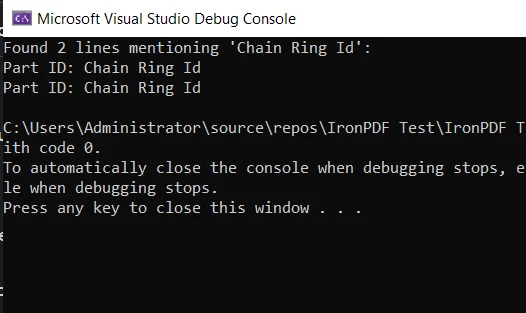
This is a basic example of how the Find method can be used along with IronPDF in a practical scenario. It demonstrates the utility and versatility of C# along with its powerful libraries that help make your programming tasks easier and more efficient.
Conclusion
In this tutorial, we dove deep into the C# Find method and its relatives, FindIndex, FindLastIndex, and FindAll. We explored their uses, explored some code examples, and uncovered the circumstances where they are most effective.
We also ventured into the world of PDF manipulation using the IronPDF library. Likewise, we saw a practical application of our Find method knowledge in extracting and searching content within a PDF document.
IronPDF offers a free trial of IronPDF, providing an excellent opportunity to explore its functionalities and determine how it can benefit your C# projects. If you decide to continue using IronPDF after the trial, licenses start from $999.
Frequently Asked Questions
How does the C# Find function work for developers?
The C# Find function allows developers to locate the first element in a collection, array, or list that satisfies specific conditions defined by a predicate. This feature is useful for streamlining the coding process.
What is a predicate, and how is it used in C#?
A predicate in C# is a delegate that represents a method with a specific condition. It's used in methods like Find to test each element in a collection, returning those that meet the criteria.
Can I use the Find method with a custom class in C#?
Yes, you can use the Find method with a custom class by defining a predicate that matches the search criteria for the elements of the class, such as finding an object with a specific property value.
What happens if no elements match the criteria in the Find method?
If no elements match the criteria specified by the predicate in the Find method, it returns a default value, such as null for reference types or 0 for value types.
What are the differences between Find and FindAll in C#?
The Find method returns the first element that matches the predicate, while FindAll returns a list of all elements that satisfy the predicate conditions.
How do FindIndex and FindLastIndex methods differ?
FindIndex returns the index of the first element that matches the predicate, whereas FindLastIndex returns the index of the last element that matches the criteria.
How can I integrate a PDF library with C# Find for text search?
By using a PDF library, you can extract text from PDFs and utilize the Find method to search for specific content within the text, making it effective for document processing.
Is it possible to search for elements by their properties using Find?
Yes, you can define a predicate based on element properties to search for specific criteria, such as locating an object with a particular ID or attribute.
How efficient is the Find method for large data collections?
The Find method performs a linear search, checking each element in sequence. While straightforward, it may not be the most efficient for very large collections due to its O(n) complexity.
What benefits does a PDF library offer for C# developers?
A PDF library provides robust PDF handling capabilities, allowing developers to easily extract, manipulate, and search PDF content using C#, thereby enhancing the efficiency of document-related tasks.










 Get started for FREE
 Get started for FREE
 Book Free Live Demo