using IronPdf;

// Disable local disk access or cross-origin requests
Installation.EnableWebSecurity = true;

// Instantiate Renderer
var renderer = new ChromePdfRenderer();

// Create a PDF from a HTML string using C#
var pdf = renderer.RenderHtmlAsPdf("<h1>Hello World</h1>");

// Export to a file or Stream
pdf.SaveAs("output.pdf");

// Advanced Example with HTML Assets
// Load external html assets: Images, CSS and JavaScript.
// An optional BasePath 'C:\site\assets\' is set as the file location to load assets from
var myAdvancedPdf = renderer.RenderHtmlAsPdf("<img src='icons/iron.png'>", @"C:\site\assets\");
myAdvancedPdf.SaveAs("html-with-assets.pdf");
using IronPdf;// Disable local disk access or cross-origin requestsInstallation.EnableWebSecurity = true;// Instantiate Renderervar renderer = new ChromePdfRenderer();// Create a PDF from a HTML string using C#var pdf = renderer.RenderHtmlAsPdf("<h1>Hello World</h1>");// Export to a file or Streampdf.SaveAs("output.pdf");// Advanced Example with HTML Assets// Load external html assets: Images, CSS and JavaScript.// An optional BasePath 'C:\site\assets\' is set as the file location to load assets fromvar myAdvancedPdf = renderer.RenderHtmlAsPdf("<img src='icons/iron.png'>", @"C:\site\assets\");myAdvancedPdf.SaveAs("html-with-assets.pdf");
Ein Paar ist eine einfache Datenstruktur, die zwei verwandte Werte hält. Es bietet eine bequeme Möglichkeit, zwei unterschiedliche Datenelemente zusammenzubundeln. Paare werden häufig verwendet, wenn eine Methode zwei Werte zurückgeben muss oder bei der Arbeit mit Schlüssel-Wert-Zuordnungen.
In C# greifen Entwickler oft auf die Verwendung von Tupeln (`Tuple<T1, T2>`) zurück, um Werte zu paaren. Allerdings sind Tupel unveränderlich, und auf ihre Elemente wird über Eigenschaften wie Item1 und Item2 zugegriffen, was bei häufiger Verwendung zu weniger lesbarem Code führen kann. Hier kommt eine benutzerdefinierte Pair-Klasse ins Spiel.
Wenn Sie eine Struktur benötigen, um zwei verwandte Objekte zu halten und die Datenverbergung keine Priorität hat, können Sie die Pair-Klasse in Ihrem Code verwenden. Die Pair-Klasse kapselt ihre Objekt-Referenzen nicht. Stattdessen macht sie sie direkt für alle aufrufenden Codes als öffentliche Klassenfelder zugänglich.
Diese Designentscheidung ermöglicht einen direkten Zugriff auf die enthaltenen Objekte ohne den Aufwand der Kapselung. Außerdem werden wir am Ende des Artikels erkunden, wie [IronPDF for PDF Generation](/) von [Iron Software Overview](https://ironsoftware.com/) zur Erstellung eines PDF-Dokuments verwendet werden kann.
## Tupel
C# 7.0 führte Verbesserungen in der Tupel-Syntax ein, die die Arbeit mit Tupeln noch einfacher machen. So können Sie Tupel deklarieren und initialisieren:
```csharp
// Tuple declaration
var person = (name: "John", age: 30);

// Accessing tuple elements using named properties
Console.WriteLine($"Name: {person.name}, Age: {person.age}");

// Tuple deconstruction
var (name, age) = person;
Console.WriteLine($"Name: {name}, Age: {age}");
```
## Vorteile von Tupeln
#### Korrekte Syntax
Tupel ermöglichen es, komplexe Datenstrukturen mit einer prägnanten Syntax auszudrücken, ohne benutzerdefinierte Klassen oder Strukturen definieren zu müssen.
#### Leichtgewichtig
Tupel sind leichtgewichtige Datenstrukturen und eignen sich daher für Szenarien, in denen Sie temporäre oder Zwischenablagen für Daten benötigen.
#### Implizite Namensgebung
Mit der Tupel-Syntax können Sie Tupel-Elemente implizit benennen, was die Lesbarkeit des Codes verbessert und den Bedarf an Kommentaren verringert.
#### Mehrere Werte von Methoden zurückliefern
```csharp
public (int Quotient, int Remainder) Divide(int dividend, int divisor)
{
int quotient = dividend / divisor;
int remainder = dividend % divisor;
return (quotient, remainder);
}
var result = Divide(10, 3);
Console.WriteLine($"Quotient: {result.Quotient}, Remainder: {result.Remainder}");
```
#### Vereinfachung von Methodensignaturen
```csharp
public (string Name, string Surname) GetNameAndSurname()
{
// Retrieve name and surname from a data source
return ("John", "Doe");
}
var (name, surname) = GetNameAndSurname();
Console.WriteLine($"Name: {name}, Surname: {surname}");
```
#### Gruppierung verwandter Daten
```csharp
var point = (x: 10, y: 20);
var color = (r: 255, g: 0, b: 0);
var person = (name: "Alice", age: 25);
```
### Einschränkungen und Überlegungen
Während C# 7.0 Tupel erhebliche Vorteile bieten, gibt es einige Einschränkungen und Überlegungen zu beachten:
* Tupel sind im Vergleich zu benutzerdefinierten Klassen oder Strukturen in ihrer Ausdruckskraft begrenzt.
* Auf Tupel-Elemente wird mit Item1, Item2 usw. zugegriffen, wenn keine expliziten Namen angegeben sind, was die Lesbarkeit des Codes verringern kann.
## Benutzerdefinierte Klasse paaren
```csharp
public class Pair<T1, T2>
{
public T1 First { get; set; }
public T2 Second { get; set; }
// Constructor to initialize the pair
public Pair(T1 first, T2 second)
{
First = first;
Second = second;
}
}
```
In dieser Klasse werden die Typen zur Nutzungszeit definiert, und die beiden Eigenschaften werden als öffentliche Eigenschaften verfügbar gemacht.
### Verwendung der Pair-Klasse
Nun, lassen Sie uns einige häufige Anwendungsfälle erkunden, in denen die Pair-Klasse von Vorteil sein kann:
#### 1. Speichern von Koordinaten
```csharp
// Creating a new instance of the Pair class to store coordinates
Pair<int, int> coordinates = new Pair<int, int>(10, 20);
Console.WriteLine($"X: {coordinates.First}, Y: {coordinates.Second}");
```
#### 2. Rückgabe mehrerer Werte aus einer Methode
```csharp
// Method returning a Pair, representing both quotient and remainder
public Pair<int, int> Divide(int dividend, int divisor)
{
int quotient = dividend / divisor;
int remainder = dividend % divisor;
return new Pair<int, int>(quotient, remainder);
}
// Usage
Pair<int, int> result = Divide(10, 3);
Console.WriteLine($"Quotient: {result.First}, Remainder: {result.Second}");
```
#### 3. das Speichern von Schlüssel-Werte-Paaren
```csharp
// Storing a key-value pair
Pair<string, int> keyValue = new Pair<string, int>("Age", 30);
Console.WriteLine($"Key: {keyValue.First}, Value: {keyValue.Second}");
```
## Schlüssel-Werte-Paare
Schlüssel-Wert-Paare bieten eine einfache und effiziente Möglichkeit zur Zuordnung von Daten. In C# ist das Hauptwerkzeug zur Arbeit mit Schlüssel-Wert-Paaren die `Dictionary<TKey, TValue>`-Klasse, ein vielseitiger und leistungsstarker Sammlungstyp.
### Schlüssel-Werte-Paare verstehen
Ein Schlüssel-Wert-Paar ist eine Datenstruktur, die einen eindeutigen Schlüssel mit einem Wert verknüpft. Diese Assoziation ermöglicht eine effiziente Abfrage und Manipulation von Daten basierend auf ihrem eindeutigen Bezeichner. In C# werden Schlüssel-Wert-Paare häufig für Aufgaben wie Caching, Konfigurationsmanagement und Datenspeicherung verwendet.
### `Dictionary<TKey, TValue>` in C#
Die `Dictionary<TKey, TValue>`-Klasse in C# ist eine generische Sammlung, die Schlüssel-Wert-Paare speichert. Sie bietet schnelle Suchvorgänge basierend auf den Schlüsseln und wird häufig zur Verwaltung assoziativer Daten verwendet.
#### Erstellen und Auffüllen eines Wörterbuchs
```csharp
Dictionary<string, int> ages = new Dictionary<string, int>
{
{ "Alice", 30 },
{ "Bob", 35 },
{ "Charlie", 25 }
};
```
#### Zugriff auf Werte nach Schlüssel
```csharp
// Directly access a value by its key
Console.WriteLine($"Alice's age: {ages["Alice"]}");
```
#### Iterieren über Schlüssel-Werte-Paare
```csharp
// Iterate over all key-value pairs in the dictionary
foreach (var pair in ages)
{
Console.WriteLine($"Name: {pair.Key}, Age: {pair.Value}");
}
```
### Erweiterte Szenarien
#### Behandlung von fehlenden Schlüsseln
```csharp
if (ages.TryGetValue("David", out int age))
{
Console.WriteLine($"David's age: {age}");
}
else
{
Console.WriteLine("David's age is not available.");
}
```
#### Löschen von Einträgen
```csharp
// Remove an entry given its key
ages.Remove("Charlie");
```
#### Wörterbuch-Initialisierung
```csharp
// Initialize a dictionary with color codes
var colors = new Dictionary<string, string>
{
{ "red", "#FF0000" },
{ "green", "#00FF00" },
{ "blue", "#0000FF" }
};
```
### Über das Wörterbuch hinaus: Alternativen und Überlegungen
Während `Dictionary<TKey, TValue>` ein leistungsstarkes Werkzeug ist, hängen alternative Ansätze und Überlegungen von den spezifischen Anforderungen Ihrer Anwendung ab:
* `ConcurrentDictionary<TKey, TValue>`: Wenn Ihre Anwendung einen thread-sicheren Zugriff auf das Verzeichnis von mehreren Threads erfordert, sollten Sie `ConcurrentDictionary<TKey, TValue>` in Betracht ziehen.
* `ImmutableDictionary<TKey, TValue>`: Für Szenarien, in denen Unveränderlichkeit gewünscht ist, bietet `ImmutableDictionary<TKey, TValue>` aus dem `System.Collections.Immutable`-Namensraum unveränderliche Schlüssel-Wert-Sammlungen.
* Benutzerdefinierte Schlüssel-Wert-Paar-Klassen: In Situationen, in denen Sie zusätzliche Funktionalität oder spezifisches Verhalten benötigen, ziehen Sie die Erstellung benutzerdefinierter Schlüssel-Wert-Paar-Klassen in Betracht, die auf Ihre Anforderungen zugeschnitten sind.
## IronPDF-Bibliothek
[IronPDF von Iron Software Products](/) ist eine hervorragende Bibliothek zur Erstellung von PDF-Dokumenten. Ihre Benutzerfreundlichkeit und Effizienz sind unübertroffen.
IronPDF überzeugt in der [HTML-zu-PDF](/tutorials/html-to-pdf/)-Konvertierung, indem es den originalen Layouts und Stilen präzise erhält. Es ist ideal zur Erstellung von PDFs aus webbasierten Inhalten wie Berichten, Rechnungen und Dokumentationen. Mit Unterstützung für HTML-Dateien, URLs und rohe HTML-Strings erstellt IronPDF problemlos hochwertige PDF-Dokumente.
```csharp
using IronPdf;
class Program
{
static void Main(string[] args)
{
var renderer = new ChromePdfRenderer();
// 1. Convert HTML String to PDF
var htmlContent = "<h1>Hello, IronPDF!</h1><p>This is a PDF from an HTML string.</p>";
var pdfFromHtmlString = renderer.RenderHtmlAsPdf(htmlContent);
pdfFromHtmlString.SaveAs("HTMLStringToPDF.pdf");
// 2. Convert HTML File to PDF
var htmlFilePath = "path_to_your_html_file.html"; // Specify the path to your HTML file
var pdfFromHtmlFile = renderer.RenderHtmlFileAsPdf(htmlFilePath);
pdfFromHtmlFile.SaveAs("HTMLFileToPDF.pdf");
// 3. Convert URL to PDF
var url = "http://ironpdf.com"; // Specify the URL
var pdfFromUrl = renderer.RenderUrlAsPdf(url);
pdfFromUrl.SaveAs("URLToPDF.pdf");
}
}
```
IronPDF kann aus dem NuGet-Paketmanager installiert werden:
```shell
:ProductInstall
```
Oder von Visual Studio in dieser Weise:

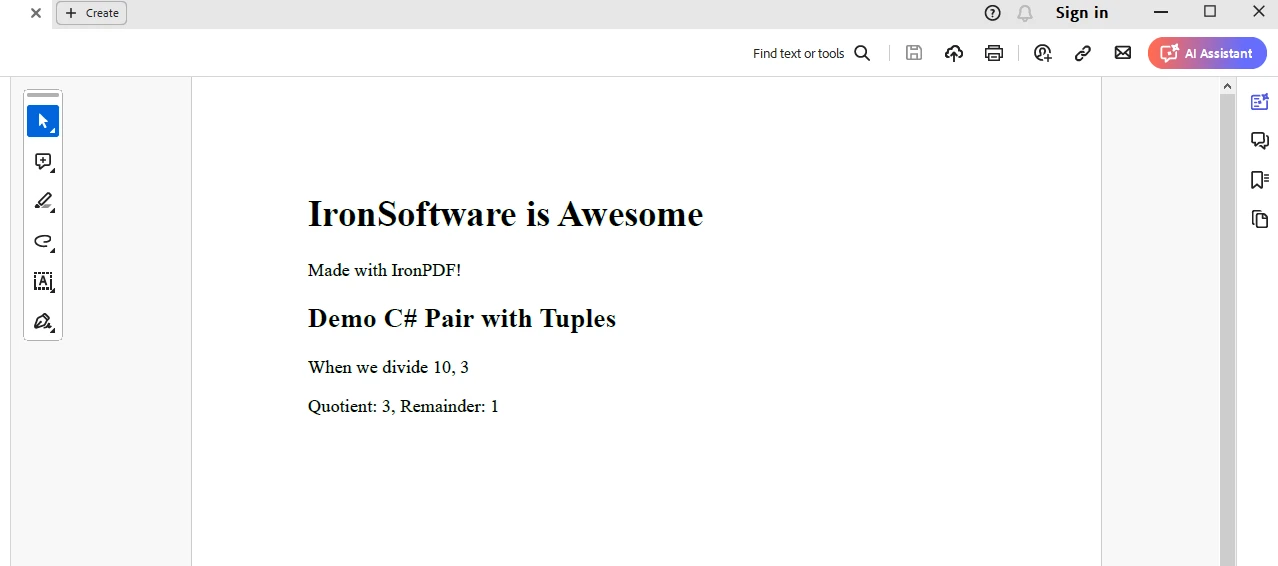
Um ein Dokument mit einem Tupelbeispiel zu erstellen, können wir den folgenden Code verwenden:
```csharp
using IronPdf;
namespace IronPatterns
{
class Program
{
static void Main()
{
Console.WriteLine("-----------Iron Software-------------");
var renderer = new ChromePdfRenderer(); // var pattern
var content = "<h1>Iron Software is Awesome</h1> Made with IronPDF!";
content += "<h2>Demo C# Pair with Tuples</h2>";
var result = Divide(10, 3);
Console.WriteLine($"Quotient: {result.Item1}, Remainder: {result.Item2}");
content += $"<p>When we divide 10 by 3:</p>";
content += $"<p>Quotient: {result.Item1}, Remainder: {result.Item2}</p>";
var pdf = renderer.RenderHtmlAsPdf(content);
pdf.SaveAs("output.pdf"); // Saves PDF
}
// Method to demonstrate division using tuples
public static (int Quotient, int Remainder) Divide(int dividend, int divisor)
{
int quotient = dividend / divisor;
int remainder = dividend % divisor;
return (quotient, remainder);
}
}
}
```
## Ausgabe
## Testlizenz für IronPDF
Holen Sie sich Ihre [IronPDF-Testlizenz](trial-license) und platzieren Sie die Lizenz im `appsettings.json`.
```json
{
"IronPdf.LicenseKey": "<Your Key>"
}
```
### Abschluss
In diesem Artikel haben wir das Konzept von Paaren und die Bedeutung einer `Pair`-Klasse in C# untersucht. Wir haben eine einfache Implementierung der benutzerdefinierten `Pair`-Klasse zusammen mit verschiedenen Anwendungsfällen bereitgestellt, die ihre Vielseitigkeit und Nützlichkeit in alltäglichen Programmieraufgaben demonstrieren.
Ob Sie mit Koordinaten arbeiten, mehrere Werte aus einer Methode zurückgeben oder Schlüssel-Wert-Zuordnungen speichern, die Pair-Klasse kann eine wertvolle Ergänzung Ihres Programmierungs-Sets sein.
Zusätzlich dazu ist die [IronPDF-Bibliotheksfunktionalität](/docs/) eine großartige Kombination von Fähigkeiten, die Entwickler haben sollten, um bei Bedarf PDF-Dokumente in Anwendungen zu erstellen.
Ein Paar ist eine einfache Datenstruktur, die zwei verwandte Werte hält. Es bietet eine bequeme Möglichkeit, zwei unterschiedliche Datenelemente zusammenzubundeln. Paare werden häufig verwendet, wenn eine Methode zwei Werte zurückgeben muss oder bei der Arbeit mit Schlüssel-Wert-Zuordnungen.
In C# greifen Entwickler oft auf die Verwendung von Tupeln (Tuple<T1, T2>) zurück, um Werte zu paaren. Allerdings sind Tupel unveränderlich, und auf ihre Elemente wird über Eigenschaften wie Item1 und Item2 zugegriffen, was bei häufiger Verwendung zu weniger lesbarem Code führen kann. Hier kommt eine benutzerdefinierte Pair-Klasse ins Spiel.
Wenn Sie eine Struktur benötigen, um zwei verwandte Objekte zu halten und die Datenverbergung keine Priorität hat, können Sie die Pair-Klasse in Ihrem Code verwenden. Die Pair-Klasse kapselt ihre Objekt-Referenzen nicht. Stattdessen macht sie sie direkt für alle aufrufenden Codes als öffentliche Klassenfelder zugänglich.
Diese Designentscheidung ermöglicht einen direkten Zugriff auf die enthaltenen Objekte ohne den Aufwand der Kapselung. Außerdem werden wir am Ende des Artikels erkunden, wie IronPDF for PDF Generation von Iron Software Overview zur Erstellung eines PDF-Dokuments verwendet werden kann.
Tupel
C# 7.0 führte Verbesserungen in der Tupel-Syntax ein, die die Arbeit mit Tupeln noch einfacher machen. So können Sie Tupel deklarieren und initialisieren:
// Tuple declarationvar person = (name: "John", age: 30);// Accessing tuple elements using named propertiesConsole.WriteLine($"Name: {person.name}, Age: {person.age}");// Tuple deconstructionvar (name, age) = person;Console.WriteLine($"Name: {name}, Age: {age}");
// Tuple declaration
var person = (name: "John", age: 30);

// Accessing tuple elements using named properties
Console.WriteLine($"Name: {person.name}, Age: {person.age}");

// Tuple deconstruction
var (name, age) = person;
Console.WriteLine($"Name: {name}, Age: {age}");
' Tuple declarationDim person = (name:= "John", age:= 30)' Accessing tuple elements using named propertiesConsole.WriteLine($"Name: {person.name}, Age: {person.age}")' Tuple deconstruction'INSTANT VB TODO TASK: VB has no equivalent to C# deconstruction declarations:var(name, age) = personConsole.WriteLine($"Name: {name}, Age: {age}")
' Tuple declaration
Dim person = (name:= "John", age:= 30)

' Accessing tuple elements using named properties
Console.WriteLine($"Name: {person.name}, Age: {person.age}")

' Tuple deconstruction
'INSTANT VB TODO TASK: VB has no equivalent to C# deconstruction declarations:
var(name, age) = person
Console.WriteLine($"Name: {name}, Age: {age}")
Vorteile von Tupeln
Korrekte Syntax
Tupel ermöglichen es, komplexe Datenstrukturen mit einer prägnanten Syntax auszudrücken, ohne benutzerdefinierte Klassen oder Strukturen definieren zu müssen.
Leichtgewichtig
Tupel sind leichtgewichtige Datenstrukturen und eignen sich daher für Szenarien, in denen Sie temporäre oder Zwischenablagen für Daten benötigen.
Implizite Namensgebung
Mit der Tupel-Syntax können Sie Tupel-Elemente implizit benennen, was die Lesbarkeit des Codes verbessert und den Bedarf an Kommentaren verringert.
Mehrere Werte von Methoden zurückliefern
public (intQuotient, intRemainder) Divide(int dividend, int divisor){ int quotient = dividend / divisor; int remainder = dividend % divisor; return (quotient, remainder);}var result = Divide(10, 3);Console.WriteLine($"Quotient: {result.Quotient}, Remainder: {result.Remainder}");
public (int Quotient, int Remainder) Divide(int dividend, int divisor)
{
    int quotient = dividend / divisor;
    int remainder = dividend % divisor;
    return (quotient, remainder);
}

var result = Divide(10, 3);
Console.WriteLine($"Quotient: {result.Quotient}, Remainder: {result.Remainder}");
Public Function Divide(ByVal dividend AsInteger, ByVal divisor AsInteger) As (QuotientAsInteger, RemainderAsInteger) Dim quotient AsInteger = dividend \ divisor Dim remainder AsInteger = dividend Mod divisor Return (quotient, remainder)End FunctionPrivate result = Divide(10, 3)Console.WriteLine($"Quotient: {result.Quotient}, Remainder: {result.Remainder}")
Public Function Divide(ByVal dividend As Integer, ByVal divisor As Integer) As (Quotient As Integer, Remainder As Integer)
	Dim quotient As Integer = dividend \ divisor
	Dim remainder As Integer = dividend Mod divisor
	Return (quotient, remainder)
End Function

Private result = Divide(10, 3)
Console.WriteLine($"Quotient: {result.Quotient}, Remainder: {result.Remainder}")
Vereinfachung von Methodensignaturen
public (stringName, stringSurname) GetNameAndSurname(){ // Retrieve name and surname from a data source return ("John", "Doe");}var (name, surname) = GetNameAndSurname();Console.WriteLine($"Name: {name}, Surname: {surname}");
public (string Name, string Surname) GetNameAndSurname()
{
    // Retrieve name and surname from a data source
    return ("John", "Doe");
}

var (name, surname) = GetNameAndSurname();
Console.WriteLine($"Name: {name}, Surname: {surname}");
Public Function GetNameAndSurname() As (NameAsString, SurnameAsString) ' Retrieve name and surname from a data source Return ("John", "Doe")End Function'INSTANT VB TODO TASK: VB has no equivalent to C# deconstruction declarations:var(name, surname) = GetNameAndSurname()Console.WriteLine($"Name: {name}, Surname: {surname}")
Public Function GetNameAndSurname() As (Name As String, Surname As String)
	' Retrieve name and surname from a data source
	Return ("John", "Doe")
End Function

'INSTANT VB TODO TASK: VB has no equivalent to C# deconstruction declarations:
var(name, surname) = GetNameAndSurname()
Console.WriteLine($"Name: {name}, Surname: {surname}")
Gruppierung verwandter Daten
var point = (x: 10, y: 20);var color = (r: 255, g: 0, b: 0);var person = (name: "Alice", age: 25);
var point = (x: 10, y: 20);
var color = (r: 255, g: 0, b: 0);
var person = (name: "Alice", age: 25);
Dim point = (x:= 10, y:= 20)Dim color = (r:= 255, g:= 0, b:= 0)Dim person = (name:= "Alice", age:= 25)
Dim point = (x:= 10, y:= 20)
Dim color = (r:= 255, g:= 0, b:= 0)
Dim person = (name:= "Alice", age:= 25)
Einschränkungen und Überlegungen
Während C# 7.0 Tupel erhebliche Vorteile bieten, gibt es einige Einschränkungen und Überlegungen zu beachten:
Tupel sind im Vergleich zu benutzerdefinierten Klassen oder Strukturen in ihrer Ausdruckskraft begrenzt.
Auf Tupel-Elemente wird mit Item1, Item2 usw. zugegriffen, wenn keine expliziten Namen angegeben sind, was die Lesbarkeit des Codes verringern kann.
Benutzerdefinierte Klasse paaren
public class Pair<T1, T2>{ public T1First { get; set; } public T2Second { get; set; } // Constructor to initialize the pair publicPair(T1 first, T2 second) {First = first;Second = second; }}
public class Pair<T1, T2>
{
    public T1 First { get; set; }
    public T2 Second { get; set; }

    // Constructor to initialize the pair
    public Pair(T1 first, T2 second)
    {
        First = first;
        Second = second;
    }
}
Public Class Pair(OfT1, T2) Public Property First() AsT1 Public Property Second() AsT2 ' Constructor to initialize the pair Public Sub New(ByVal first AsT1, ByVal second AsT2)Me.First = firstMe.Second = second End SubEnd Class
Public Class Pair(Of T1, T2)
	Public Property First() As T1
	Public Property Second() As T2

	' Constructor to initialize the pair
	Public Sub New(ByVal first As T1, ByVal second As T2)
		Me.First = first
		Me.Second = second
	End Sub
End Class
In dieser Klasse werden die Typen zur Nutzungszeit definiert, und die beiden Eigenschaften werden als öffentliche Eigenschaften verfügbar gemacht.
Verwendung der Pair-Klasse
Nun, lassen Sie uns einige häufige Anwendungsfälle erkunden, in denen die Pair-Klasse von Vorteil sein kann:
1. Speichern von Koordinaten
// Creating a new instance of the Pair class to store coordinatesPair<int, int> coordinates = new Pair<int, int>(10, 20);Console.WriteLine($"X: {coordinates.First}, Y: {coordinates.Second}");
// Creating a new instance of the Pair class to store coordinates
Pair<int, int> coordinates = new Pair<int, int>(10, 20);
Console.WriteLine($"X: {coordinates.First}, Y: {coordinates.Second}");
' Creating a new instance of the Pair class to store coordinatesDim coordinates As New Pair(OfInteger, Integer)(10, 20)Console.WriteLine($"X: {coordinates.First}, Y: {coordinates.Second}")
' Creating a new instance of the Pair class to store coordinates
Dim coordinates As New Pair(Of Integer, Integer)(10, 20)
Console.WriteLine($"X: {coordinates.First}, Y: {coordinates.Second}")
2. Rückgabe mehrerer Werte aus einer Methode
// Method returning a Pair, representing both quotient and remainderpublic Pair<int, int> Divide(int dividend, int divisor){ int quotient = dividend / divisor; int remainder = dividend % divisor; return new Pair<int, int>(quotient, remainder);}// UsagePair<int, int> result = Divide(10, 3);Console.WriteLine($"Quotient: {result.First}, Remainder: {result.Second}");
// Method returning a Pair, representing both quotient and remainder
public Pair<int, int> Divide(int dividend, int divisor)
{
    int quotient = dividend / divisor;
    int remainder = dividend % divisor;
    return new Pair<int, int>(quotient, remainder);
}

// Usage
Pair<int, int> result = Divide(10, 3);
Console.WriteLine($"Quotient: {result.First}, Remainder: {result.Second}");
' Method returning a Pair, representing both quotient and remainderPublic Function Divide(ByVal dividend AsInteger, ByVal divisor AsInteger) AsPair(OfInteger, Integer) Dim quotient AsInteger = dividend \ divisor Dim remainder AsInteger = dividend Mod divisor Return New Pair(OfInteger, Integer)(quotient, remainder)End Function' UsagePrivate result AsPair(OfInteger, Integer) = Divide(10, 3)Console.WriteLine($"Quotient: {result.First}, Remainder: {result.Second}")
' Method returning a Pair, representing both quotient and remainder
Public Function Divide(ByVal dividend As Integer, ByVal divisor As Integer) As Pair(Of Integer, Integer)
	Dim quotient As Integer = dividend \ divisor
	Dim remainder As Integer = dividend Mod divisor
	Return New Pair(Of Integer, Integer)(quotient, remainder)
End Function

' Usage
Private result As Pair(Of Integer, Integer) = Divide(10, 3)
Console.WriteLine($"Quotient: {result.First}, Remainder: {result.Second}")
3. das Speichern von Schlüssel-Werte-Paaren
// Storing a key-value pairPair<string, int> keyValue = new Pair<string, int>("Age", 30);Console.WriteLine($"Key: {keyValue.First}, Value: {keyValue.Second}");
// Storing a key-value pair
Pair<string, int> keyValue = new Pair<string, int>("Age", 30);
Console.WriteLine($"Key: {keyValue.First}, Value: {keyValue.Second}");
' Storing a key-value pairDim keyValue As New Pair(OfString, Integer)("Age", 30)Console.WriteLine($"Key: {keyValue.First}, Value: {keyValue.Second}")
' Storing a key-value pair
Dim keyValue As New Pair(Of String, Integer)("Age", 30)
Console.WriteLine($"Key: {keyValue.First}, Value: {keyValue.Second}")
Schlüssel-Werte-Paare
Schlüssel-Wert-Paare bieten eine einfache und effiziente Möglichkeit zur Zuordnung von Daten. In C# ist das Hauptwerkzeug zur Arbeit mit Schlüssel-Wert-Paaren die Dictionary<TKey, TValue>-Klasse, ein vielseitiger und leistungsstarker Sammlungstyp.
Schlüssel-Werte-Paare verstehen
Ein Schlüssel-Wert-Paar ist eine Datenstruktur, die einen eindeutigen Schlüssel mit einem Wert verknüpft. Diese Assoziation ermöglicht eine effiziente Abfrage und Manipulation von Daten basierend auf ihrem eindeutigen Bezeichner. In C# werden Schlüssel-Wert-Paare häufig für Aufgaben wie Caching, Konfigurationsmanagement und Datenspeicherung verwendet.
Dictionary<TKey, TValue> in C#
Die Dictionary<TKey, TValue>-Klasse in C# ist eine generische Sammlung, die Schlüssel-Wert-Paare speichert. Sie bietet schnelle Suchvorgänge basierend auf den Schlüsseln und wird häufig zur Verwaltung assoziativer Daten verwendet.
Dim ages As New Dictionary(OfString, Integer) From { {"Alice", 30}, {"Bob", 35}, {"Charlie", 25}}
Dim ages As New Dictionary(Of String, Integer) From {
	{"Alice", 30},
	{"Bob", 35},
	{"Charlie", 25}
}
Zugriff auf Werte nach Schlüssel
// Directly access a value by its keyConsole.WriteLine($"Alice's age: {ages["Alice"]}");
// Directly access a value by its key
Console.WriteLine($"Alice's age: {ages["Alice"]}");
' Directly access a value by its keyConsole.WriteLine($"Alice's age: {ages("Alice")}")
' Directly access a value by its key
Console.WriteLine($"Alice's age: {ages("Alice")}")
Iterieren über Schlüssel-Werte-Paare
// Iterate over all key-value pairs in the dictionaryforeach (var pair in ages){Console.WriteLine($"Name: {pair.Key}, Age: {pair.Value}");}
// Iterate over all key-value pairs in the dictionary
foreach (var pair in ages)
{
    Console.WriteLine($"Name: {pair.Key}, Age: {pair.Value}");
}
' Iterate over all key-value pairs in the dictionaryFor Each pair In agesConsole.WriteLine($"Name: {pair.Key}, Age: {pair.Value}")Next pair
' Iterate over all key-value pairs in the dictionary
For Each pair In ages
	Console.WriteLine($"Name: {pair.Key}, Age: {pair.Value}")
Next pair
Erweiterte Szenarien
Behandlung von fehlenden Schlüsseln
if (ages.TryGetValue("David", out int age)){Console.WriteLine($"David's age: {age}");}else{Console.WriteLine("David's age is not available.");}
if (ages.TryGetValue("David", out int age))
{
    Console.WriteLine($"David's age: {age}");
}
else
{
    Console.WriteLine("David's age is not available.");
}
Dim age AsIntegerIf ages.TryGetValue("David", age) ThenConsole.WriteLine($"David's age: {age}")ElseConsole.WriteLine("David's age is not available.")End If
Dim age As Integer
If ages.TryGetValue("David", age) Then
	Console.WriteLine($"David's age: {age}")
Else
	Console.WriteLine("David's age is not available.")
End If
Löschen von Einträgen
// Remove an entry given its keyages.Remove("Charlie");
// Remove an entry given its key
ages.Remove("Charlie");
' Remove an entry given its keyages.Remove("Charlie")
' Remove an entry given its key
ages.Remove("Charlie")
Wörterbuch-Initialisierung
// Initialize a dictionary with color codesvar colors = new Dictionary<string, string>{ { "red", "#FF0000" }, { "green", "#00FF00" }, { "blue", "#0000FF" }};
// Initialize a dictionary with color codes
var colors = new Dictionary<string, string>
{
    { "red", "#FF0000" },
    { "green", "#00FF00" },
    { "blue", "#0000FF" }
};
' Initialize a dictionary with color codesDim colors = New Dictionary(OfString, String) From { {"red", "#FF0000"}, {"green", "#00FF00"}, {"blue", "#0000FF"}}
' Initialize a dictionary with color codes
Dim colors = New Dictionary(Of String, String) From {
	{"red", "#FF0000"},
	{"green", "#00FF00"},
	{"blue", "#0000FF"}
}
Über das Wörterbuch hinaus: Alternativen und Überlegungen
Während Dictionary<TKey, TValue> ein leistungsstarkes Werkzeug ist, hängen alternative Ansätze und Überlegungen von den spezifischen Anforderungen Ihrer Anwendung ab:
ConcurrentDictionary<TKey, TValue>: Wenn Ihre Anwendung einen thread-sicheren Zugriff auf das Verzeichnis von mehreren Threads erfordert, sollten Sie ConcurrentDictionary<TKey, TValue> in Betracht ziehen.
ImmutableDictionary<TKey, TValue>: Für Szenarien, in denen Unveränderlichkeit gewünscht ist, bietet ImmutableDictionary<TKey, TValue> aus dem System.Collections.Immutable-Namensraum unveränderliche Schlüssel-Wert-Sammlungen.
Benutzerdefinierte Schlüssel-Wert-Paar-Klassen: In Situationen, in denen Sie zusätzliche Funktionalität oder spezifisches Verhalten benötigen, ziehen Sie die Erstellung benutzerdefinierter Schlüssel-Wert-Paar-Klassen in Betracht, die auf Ihre Anforderungen zugeschnitten sind.
IronPDF-Bibliothek
IronPDF von Iron Software Products ist eine hervorragende Bibliothek zur Erstellung von PDF-Dokumenten. Ihre Benutzerfreundlichkeit und Effizienz sind unübertroffen.
IronPDF überzeugt in der HTML-zu-PDF-Konvertierung, indem es den originalen Layouts und Stilen präzise erhält. Es ist ideal zur Erstellung von PDFs aus webbasierten Inhalten wie Berichten, Rechnungen und Dokumentationen. Mit Unterstützung für HTML-Dateien, URLs und rohe HTML-Strings erstellt IronPDF problemlos hochwertige PDF-Dokumente.
using IronPdf;class Program{ static voidMain(string[] args) { var renderer = new ChromePdfRenderer(); // 1. Convert HTML String to PDF var htmlContent = "<h1>Hello, IronPDF!</h1><p>This is a PDF from an HTML string.</p>"; var pdfFromHtmlString = renderer.RenderHtmlAsPdf(htmlContent); pdfFromHtmlString.SaveAs("HTMLStringToPDF.pdf"); // 2. Convert HTML File to PDF var htmlFilePath = "path_to_your_html_file.html"; // Specify the path to your HTML file var pdfFromHtmlFile = renderer.RenderHtmlFileAsPdf(htmlFilePath); pdfFromHtmlFile.SaveAs("HTMLFileToPDF.pdf"); // 3. Convert URL to PDF var url = "http://ironpdf.com"; // Specify the URL var pdfFromUrl = renderer.RenderUrlAsPdf(url); pdfFromUrl.SaveAs("URLToPDF.pdf"); }}
using IronPdf;

class Program
{
    static void Main(string[] args)
    {
        var renderer = new ChromePdfRenderer();

        // 1. Convert HTML String to PDF
        var htmlContent = "<h1>Hello, IronPDF!</h1><p>This is a PDF from an HTML string.</p>";
        var pdfFromHtmlString = renderer.RenderHtmlAsPdf(htmlContent);
        pdfFromHtmlString.SaveAs("HTMLStringToPDF.pdf");

        // 2. Convert HTML File to PDF
        var htmlFilePath = "path_to_your_html_file.html"; // Specify the path to your HTML file
        var pdfFromHtmlFile = renderer.RenderHtmlFileAsPdf(htmlFilePath);
        pdfFromHtmlFile.SaveAs("HTMLFileToPDF.pdf");

        // 3. Convert URL to PDF
        var url = "http://ironpdf.com"; // Specify the URL
        var pdfFromUrl = renderer.RenderUrlAsPdf(url);
        pdfFromUrl.SaveAs("URLToPDF.pdf");
    }
}
ImportsIronPdfFriend Class ProgramShared Sub Main(ByVal args() AsString) Dim renderer = New ChromePdfRenderer() ' 1. Convert HTML String to PDF Dim htmlContent = "<h1>Hello, IronPDF!</h1><p>This is a PDF from an HTML string.</p>" Dim pdfFromHtmlString = renderer.RenderHtmlAsPdf(htmlContent) pdfFromHtmlString.SaveAs("HTMLStringToPDF.pdf") ' 2. Convert HTML File to PDF Dim htmlFilePath = "path_to_your_html_file.html" ' Specify the path to your HTML file Dim pdfFromHtmlFile = renderer.RenderHtmlFileAsPdf(htmlFilePath) pdfFromHtmlFile.SaveAs("HTMLFileToPDF.pdf") ' 3. Convert URL to PDF Dim url = "http://ironpdf.com" ' Specify the URL Dim pdfFromUrl = renderer.RenderUrlAsPdf(url) pdfFromUrl.SaveAs("URLToPDF.pdf") End SubEnd Class
Imports IronPdf

Friend Class Program
	Shared Sub Main(ByVal args() As String)
		Dim renderer = New ChromePdfRenderer()

		' 1. Convert HTML String to PDF
		Dim htmlContent = "<h1>Hello, IronPDF!</h1><p>This is a PDF from an HTML string.</p>"
		Dim pdfFromHtmlString = renderer.RenderHtmlAsPdf(htmlContent)
		pdfFromHtmlString.SaveAs("HTMLStringToPDF.pdf")

		' 2. Convert HTML File to PDF
		Dim htmlFilePath = "path_to_your_html_file.html" ' Specify the path to your HTML file
		Dim pdfFromHtmlFile = renderer.RenderHtmlFileAsPdf(htmlFilePath)
		pdfFromHtmlFile.SaveAs("HTMLFileToPDF.pdf")

		' 3. Convert URL to PDF
		Dim url = "http://ironpdf.com" ' Specify the URL
		Dim pdfFromUrl = renderer.RenderUrlAsPdf(url)
		pdfFromUrl.SaveAs("URLToPDF.pdf")
	End Sub
End Class
IronPDF kann aus dem NuGet-Paketmanager installiert werden:
PM > Install-Package IronPdf
Install-Package IronPdf
Oder von Visual Studio in dieser Weise:
Um ein Dokument mit einem Tupelbeispiel zu erstellen, können wir den folgenden Code verwenden:
using IronPdf;namespace IronPatterns{ class Program { static voidMain() {Console.WriteLine("-----------Iron Software-------------"); var renderer = new ChromePdfRenderer(); // var pattern var content = "<h1>Iron Software is Awesome</h1> Made with IronPDF!"; content += "<h2>Demo C# Pair with Tuples</h2>"; var result = Divide(10, 3);Console.WriteLine($"Quotient: {result.Item1}, Remainder: {result.Item2}"); content += $"<p>When we divide 10 by 3:</p>"; content += $"<p>Quotient: {result.Item1}, Remainder: {result.Item2}</p>"; var pdf = renderer.RenderHtmlAsPdf(content); pdf.SaveAs("output.pdf"); // Saves PDF } // Method to demonstrate division using tuples public static (intQuotient, intRemainder) Divide(int dividend, int divisor) { int quotient = dividend / divisor; int remainder = dividend % divisor; return (quotient, remainder); } }}
using IronPdf;

namespace IronPatterns
{
    class Program
    {
        static void Main()
        {
            Console.WriteLine("-----------Iron Software-------------");
            var renderer = new ChromePdfRenderer(); // var pattern
            var content = "<h1>Iron Software is Awesome</h1> Made with IronPDF!";
            content += "<h2>Demo C# Pair with Tuples</h2>";

            var result = Divide(10, 3);
            Console.WriteLine($"Quotient: {result.Item1}, Remainder: {result.Item2}");
            content += $"<p>When we divide 10 by 3:</p>";
            content += $"<p>Quotient: {result.Item1}, Remainder: {result.Item2}</p>";

            var pdf = renderer.RenderHtmlAsPdf(content);
            pdf.SaveAs("output.pdf"); // Saves PDF
        }

        // Method to demonstrate division using tuples
        public static (int Quotient, int Remainder) Divide(int dividend, int divisor)
        {
            int quotient = dividend / divisor;
            int remainder = dividend % divisor;
            return (quotient, remainder);
        }
    }
}
ImportsIronPdfNamespaceIronPatternsFriend Class ProgramShared Sub Main()Console.WriteLine("-----------Iron Software-------------") Dim renderer = New ChromePdfRenderer() ' var pattern Dim content = "<h1>Iron Software is Awesome</h1> Made with IronPDF!" content &= "<h2>Demo C# Pair with Tuples</h2>" Dim result = Divide(10, 3)Console.WriteLine($"Quotient: {result.Item1}, Remainder: {result.Item2}") content &= $"<p>When we divide 10 by 3:</p>" content &= $"<p>Quotient: {result.Item1}, Remainder: {result.Item2}</p>" Dim pdf = renderer.RenderHtmlAsPdf(content) pdf.SaveAs("output.pdf") ' Saves PDF End Sub ' Method to demonstrate division using tuples PublicShared Function Divide(ByVal dividend AsInteger, ByVal divisor AsInteger) As (QuotientAsInteger, RemainderAsInteger) Dim quotient AsInteger = dividend \ divisor Dim remainder AsInteger = dividend Mod divisor Return (quotient, remainder) End Function End ClassEndNamespace
Imports IronPdf

Namespace IronPatterns
	Friend Class Program
		Shared Sub Main()
			Console.WriteLine("-----------Iron Software-------------")
			Dim renderer = New ChromePdfRenderer() ' var pattern
			Dim content = "<h1>Iron Software is Awesome</h1> Made with IronPDF!"
			content &= "<h2>Demo C# Pair with Tuples</h2>"

			Dim result = Divide(10, 3)
			Console.WriteLine($"Quotient: {result.Item1}, Remainder: {result.Item2}")
			content &= $"<p>When we divide 10 by 3:</p>"
			content &= $"<p>Quotient: {result.Item1}, Remainder: {result.Item2}</p>"

			Dim pdf = renderer.RenderHtmlAsPdf(content)
			pdf.SaveAs("output.pdf") ' Saves PDF
		End Sub

		' Method to demonstrate division using tuples
		Public Shared Function Divide(ByVal dividend As Integer, ByVal divisor As Integer) As (Quotient As Integer, Remainder As Integer)
			Dim quotient As Integer = dividend \ divisor
			Dim remainder As Integer = dividend Mod divisor
			Return (quotient, remainder)
		End Function
	End Class
End Namespace
Ausgabe
Testlizenz für IronPDF
Holen Sie sich Ihre IronPDF-Testlizenz und platzieren Sie die Lizenz im appsettings.json.
{ "IronPdf.LicenseKey": "<Your Key>"}
{
    "IronPdf.LicenseKey": "<Your Key>"
}
JSON
Abschluss
In diesem Artikel haben wir das Konzept von Paaren und die Bedeutung einer Pair-Klasse in C# untersucht. Wir haben eine einfache Implementierung der benutzerdefinierten Pair-Klasse zusammen mit verschiedenen Anwendungsfällen bereitgestellt, die ihre Vielseitigkeit und Nützlichkeit in alltäglichen Programmieraufgaben demonstrieren.
Ob Sie mit Koordinaten arbeiten, mehrere Werte aus einer Methode zurückgeben oder Schlüssel-Wert-Zuordnungen speichern, die Pair-Klasse kann eine wertvolle Ergänzung Ihres Programmierungs-Sets sein.
Zusätzlich dazu ist die IronPDF-Bibliotheksfunktionalität eine großartige Kombination von Fähigkeiten, die Entwickler haben sollten, um bei Bedarf PDF-Dokumente in Anwendungen zu erstellen.
Jacob Mellor ist Chief Technology Officer bei Iron Software und ein visionärer Ingenieur, der Pionierarbeit in der C# PDF-Technologie leistet. Als der ursprüngliche Entwickler hinter der Kern-Codebasis von Iron Software hat er die Produktarchitektur des Unternehmens seit seiner Gründung geprägt und es zusammen mit CEO Cameron Rimington in ein Unternehmen mit mehr als 50 Mitarbeitern verwandelt, das die NASA, Tesla und globale Regierungsbehörden beliefert.