using IronPdf;

// Disable local disk access or cross-origin requests
Installation.EnableWebSecurity = true;

// Instantiate Renderer
var renderer = new ChromePdfRenderer();

// Create a PDF from a HTML string using C#
var pdf = renderer.RenderHtmlAsPdf("<h1>Hello World</h1>");

// Export to a file or Stream
pdf.SaveAs("output.pdf");

// Advanced Example with HTML Assets
// Load external html assets: Images, CSS and JavaScript.
// An optional BasePath 'C:\site\assets\' is set as the file location to load assets from
var myAdvancedPdf = renderer.RenderHtmlAsPdf("<img src='icons/iron.png'>", @"C:\site\assets\");
myAdvancedPdf.SaveAs("html-with-assets.pdf");
using IronPdf;// Disable local disk access or cross-origin requestsInstallation.EnableWebSecurity = true;// Instantiate Renderervar renderer = new ChromePdfRenderer();// Create a PDF from a HTML string using C#var pdf = renderer.RenderHtmlAsPdf("<h1>Hello World</h1>");// Export to a file or Streampdf.SaveAs("output.pdf");// Advanced Example with HTML Assets// Load external html assets: Images, CSS and JavaScript.// An optional BasePath 'C:\site\assets\' is set as the file location to load assets fromvar myAdvancedPdf = renderer.RenderHtmlAsPdf("<img src='icons/iron.png'>", @"C:\site\assets\");myAdvancedPdf.SaveAs("html-with-assets.pdf");
Um eine zufällige Ganzzahl in C# zu erstellen, können Entwickler die `Random`-Klasse nutzen, ein grundlegendes Werkzeug in der Softwareprogrammierung zur Erzeugung von Zufälligkeit. Die Erzeugung zufälliger Ganzzahlen ist ein Schlüsselkonzept in der Programmierung, das Aufgaben wie statistische Simulationen, Spieleentwicklung, Modellierung unvorhersehbarer Ereignisse, Erzeugung dynamischer Inhalte und Implementierung von Algorithmen mit zufälligen Eingaben ermöglicht. Es ist in vielen Szenarien nützlich, von der Erstellung zufälliger Spielebenen bis hin zum Neuanordnen von Elementen in einer Liste oder der Durchführung statistischer Analysen.
## Wie man eine zufällige ganze Zahl in C# verwendet
1. Erstellen Sie ein neues C# Projekt.
2. Erstellen Sie eine Instanz der `Random`-Klasse.
3. Verwenden Sie die `Next()`-Methode, um eine zufällige Ganzzahl zu erzeugen.
4. Definieren Sie einen Bereich für zufällige Ganzzahlen.
5. Nutzen Sie die zufällige Ganzzahl in Ihrem Programm und wiederholen Sie den Prozess bei Bedarf.
## Was ist C# Zufallszahl
Die [**Random-Klasse**](https://learn.microsoft.com/en-us/dotnet/api/system.random?view=net-8.0) bietet eine einfache und anpassungsfähige Möglichkeit, Zufallszahlen in C# zu erzeugen. Die `Next()`- und `Next(minValue, maxValue)`-Methoden bieten einen Pseudo-Zufallszahlengenerator in praktischen Bereichen. Zusätzlich ermöglicht die `Random`-Klasse die Anpassung des Seed-Werts, was wiederholbare Zufallsfolgen für Tests und Debugging erleichtert.
In diesem Artikel untersuchen wir die Funktionen der `Random`-Klasse in C#, einschließlich deren Verwendung, Sicherheitsvorkehrungen und bewährte Methoden zur Erzeugung von Zufallszahlen. Wir werden auch verschiedene Szenarien und Beispiele vorstellen, in denen sie eingesetzt wird, und zeigen, wie Entwickler Zufälligkeit nutzen können, um ihre C#-Programme zu verbessern. Das Verständnis der Erzeugung zufälliger Ganzzahlen in C# ermöglicht es Entwicklern, Unvorhersehbarkeit in ihre Anwendungen zu integrieren, was letztendlich die Benutzererfahrung verbessert und die Innovation in der Softwareentwicklung fördert.
### Grundlegende Zufallszahlengenerierung
Die `Next()`-Methode kann ohne Parameter verwendet werden, um auf einfachste Weise eine nichtnegative Zufallszahl zu generieren.
```csharp
// Create an instance of Random
Random random = new Random();
// Generate a random integer
int randomNumber = random.Next();
```
Die `NextDouble()`-Methode kann eine zufällige Fließkommazahl zwischen 0,0 und 1,0 erzeugen.
### Zufallszahl innerhalb eines Bereichs
Verwenden Sie die `Next(minValue, maxValue)`-Methode, um eine Zufallszahl innerhalb eines angegebenen Bereichs zu generieren. Diese Methode gibt eine Zufallszahl zurück, die größer oder gleich `minValue` und kleiner als `maxValue` ist.
```csharp
// Create an instance of Random
Random rnd = new Random();
// Generate a random integer value between 1 and 100
int randomNumberInRange = rnd.Next(1, 101);
```
### Zufällige Ganzzahl kleiner als ein Maximalwert
Wenn Sie nur eine Zufallszahl benötigen, die kleiner als ein bestimmtes Maximum ist, verwenden Sie die `Next(maxValue)`-Methode. Sie gibt eine zufällige Ganzzahl zurück, die kleiner als die angegebene `maxValue` ist.
```csharp
// Create an instance of Random
Random random = new Random();
// Generate a random number between 0 and 99
int randomNumberLessThanMax = random.Next(100);
```
### Erzeugung von Zufallsbytes
Die `NextBytes(byte[] buffer)`-Methode erlaubt es, ein Byte-Array mit zufälligen Werten zu füllen, was nützlich ist, um zufällige Binärdaten zu erzeugen.
```csharp
// Create an instance of Random
Random random = new Random();
// Create a byte array
byte[] randomBytes = new byte[10];
// Fill the array with random byte values
random.NextBytes(randomBytes);
```
### Benutzerdefinierter Seed-Wert
Initialisieren Sie die `Random`-Instanz mit einem spezifischen Seed-Wert für konsistente Ausführungen. Die Verwendung desselben Startwerts ist hilfreich für wiederholbare Ergebnisse, wie Testszenarien.
```csharp
// Initialize Random with a seed value
Random random = new Random(12345);
// Generate a random integer
int randomNumberWithSeed = random.Next();
```
### Thread-sichere Zufallsgenerierung
Thread-sichere Zufallszahlengenerierung ist in Mehrfach-Thread-Umgebungen von entscheidender Bedeutung. Eine verbreitete Technik ist die Verwendung der `ThreadLocal`-Klasse, um einzigartige `Random`-Instanzen für jeden Thread zu erstellen.
```csharp
// Create a thread-local Random instance
ThreadLocal<Random> threadLocalRandom = new ThreadLocal<Random>(() => new Random());
// Generate a random number safely in a multi-threaded environment
int randomNumberThreadSafe = threadLocalRandom.Value.Next();
```
### Fortgeschrittene Zufallstechniken
Um Zufallszahlen mit bestimmten Verteilungen (z.B. Gaußsche Verteilung) zu erzeugen, könnten Sie Drittanbieter-Bibliotheken oder benutzerdefinierte Methoden benötigen.
```csharp
// Example of generating random numbers with a Gaussian distribution using MathNet.Numerics
using MathNet.Numerics.Distributions;
// Parameters for the Gaussian distribution: mean and standard deviation
double mean = 0;
double standardDeviation = 1;
// Generate a random number with a Gaussian distribution
double randomNumberWithGaussianDistribution = Normal.Sample(new Random(), mean, standardDeviation);
```
Diese Beispiele demonstrieren verschiedene Anwendungen der C# `Random`-Klasse zur Erzeugung von Zufallszahlen. Wählen Sie den Ansatz aus, der Ihren Bedürfnissen am besten entspricht, basierend auf Ihren spezifischen Anforderungen und Ihrer Situation.
## Was ist [IronPDF](https://ironpdf.com/)?
[**IronPDF**](https://ironpdf.com/) ist eine beliebte C#-Bibliothek, die verschiedene Funktionen zum Erstellen, Bearbeiten und Ändern von PDF-Dokumenten bietet. Während ihre Hauptanwendung in PDF-bezogenen Operationen besteht, kann sie auch mit C# für verschiedene Aufgaben verwendet werden, z. B. um zufällige Ganzzahlen in PDF-Dokumente einzufügen.
Ein Hauptmerkmal von IronPDF ist die [**HTML-zu-PDF-Konvertierung**](https://ironpdf.com/tutorials/html-to-pdf/) Fähigkeit, die Layouts und Stile beibehalten, was es ausgezeichnet für Berichte, Rechnungen und Dokumentationen macht. Sie können HTML-Dateien, URLs und HTML-Strings mühelos in PDFs konvertieren.
```csharp
using IronPdf;
class Program
{
static void Main(string[] args)
{
// Create a ChromePdfRenderer instance
var renderer = new ChromePdfRenderer();
// 1. Convert HTML String to PDF
var htmlContent = "<h1>Hello, IronPDF!</h1><p>This is a PDF from an HTML string.</p>";
var pdfFromHtmlString = renderer.RenderHtmlAsPdf(htmlContent);
pdfFromHtmlString.SaveAs("HTMLStringToPDF.pdf");
// 2. Convert HTML File to PDF
var htmlFilePath = "path_to_your_html_file.html"; // Specify the path to your HTML file
var pdfFromHtmlFile = renderer.RenderHtmlFileAsPdf(htmlFilePath);
pdfFromHtmlFile.SaveAs("HTMLFileToPDF.pdf");
// 3. Convert URL to PDF
var url = "http://ironpdf.com"; // Specify the URL
var pdfFromUrl = renderer.RenderUrlAsPdf(url);
pdfFromUrl.SaveAs("URLToPDF.pdf");
}
}
```
**Funktionen von IronPDF:**
- IronPDF ermöglicht es Entwicklern, hochwertige PDF-Dokumente aus HTML-Inhalten zu erstellen, was es perfekt zum Archivieren von Dokumenten, Erstellen von Berichten und Scraping von Webseiten macht.
- Konvertieren Sie Bilddateien wie JPEG, PNG, BMP und GIF einfach in PDF-Dokumente. Sie können durchsuchbare und editierbare PDF-Dateien aus bildbasierten Inhalten wie gescannten Dokumenten oder Fotos erstellen.
- Es bietet umfassende PDF-Manipulations- und Änderungsmöglichkeiten, die es Ihnen ermöglichen, PDF-Seiten programmatisch zu teilen, zu drehen und neu anzuordnen. Sie können Text, Bilder, Kommentare und Wasserzeichen zu bestehenden PDFs hinzufügen.
- IronPDF unterstützt die Arbeit mit PDF-Formularen, sodass Entwickler Formularfelder ausfüllen, Formulardaten abrufen und PDF-Formulare dynamisch erstellen können.
- Sicherheitsfunktionen umfassen die Möglichkeit, PDF-Dokumente zu verschlüsseln, mit einem Passwort zu schützen und digital zu signieren, um die Datenprivatsphäre zu gewährleisten und unbefugten Zugriff zu verhindern.
Für weitere Informationen, schauen Sie in die [**IronPDF-Dokumentation**](https://ironpdf.com/docs/).
**Installation von IronPDF:**
Um die IronPDF-Bibliothek zu installieren, verwenden Sie die Package Manager Console oder den NuGet Package Manager:
```shell
:ProductInstall
```
Verwenden Sie den NuGet-Paket-Manager, um nach "IronPDF" zu suchen und das notwendige Paket auszuwählen.
### Zufällige Ganzzahl in IronPDF
Sobald IronPDF installiert ist, können Sie es in Ihrem Code initialisieren. Nachdem Sie die erforderlichen Namensräume importiert haben, erstellen Sie eine Instanz der `IronPdf.HtmlToPdf`-Klasse.
```csharp
using IronPdf;
using System;
class Program
{
static void Main(string[] args)
{
// Create a new instance of Random
Random random = new Random();
// Generate a random integer between 1 and 100
int randomNumber = random.Next(1, 101);
// Create HTML content with the random integer
string htmlContent = $@"
<html>
<head><title>Random Integer PDF</title></head>
<body>
<h1>Random Integer: {randomNumber}</h1>
</body>
</html>";
// Create a new HtmlToPdf renderer
var renderer = new HtmlToPdf();
// Render the HTML to a PDF
var pdf = renderer.RenderHtmlAsPdf(htmlContent);
// Save the PDF document
pdf.SaveAs("output.pdf");
}
}
```
Obwohl IronPDF keine Zufallswerte direkt erzeugt, kann es sie in ein PDF-Dokument einbetten. Nachdem Sie Zufallszahlen mit C#'s eingebauter `Random`-Klasse generiert haben, können Sie diese mithilfe der Fähigkeiten von IronPDF zu Ihren PDFs hinzufügen. Speichern Sie das geänderte PDF-Dokument in einer Datei oder einem Stream, sobald der Inhalt hinzugefügt wurde.
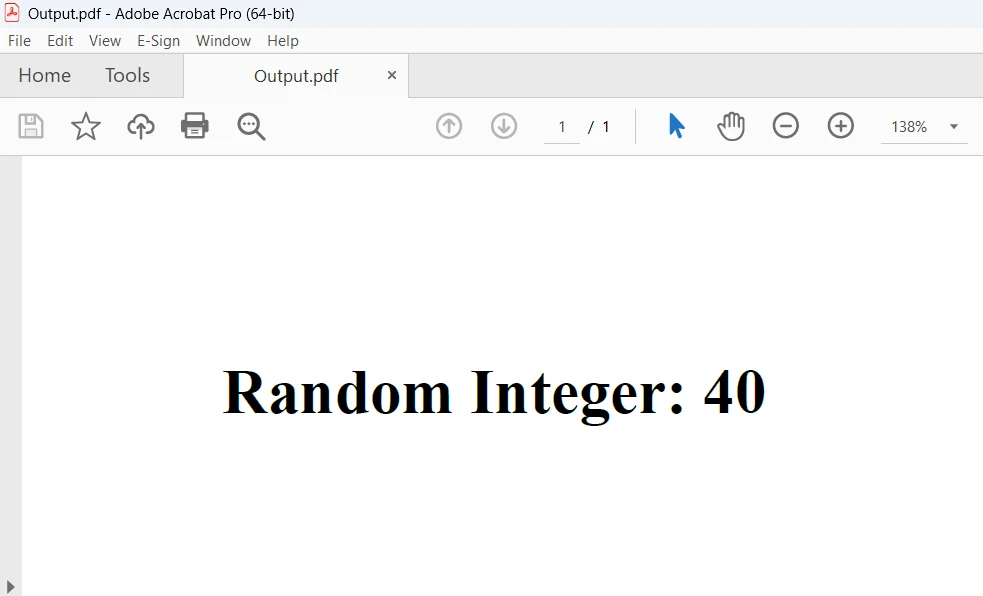
Der obige Bildschirm zeigt das Ergebnis des Codes. Für mehr Details siehe [**Beispiel zur Erstellung eines PDFs aus HTML**](https://ironpdf.com/examples/using-html-to-create-a-pdf/).
## Abschluss
Abschließend ist die Verwendung von C# zur Erzeugung zufälliger Ganzzahlen zusammen mit der HtmlToPdf-Funktionalität von IronPDF ein leistungsstarker Ansatz, um PDF-Dokumente dynamisch mit eingebetteten Zufallsdaten zu erstellen. Entwickler können leicht dynamische Inhalte in PDF-Dokumente integrieren, indem sie die HTML-zu-PDF-Konvertierung von IronPDF mit den Zufallsganzzahl-Funktionen von C# kombinieren, was enorme Möglichkeiten für die Berichterstellung, Datenvisualisierung und Dokumentenautomatisierung eröffnet.
Die Lite-Edition von IronPDF enthält ein Jahr Softwarewartung, Upgrade-Optionen und eine permanente Lizenz. Eine mit Wasserzeichen versehene Testphase ermöglicht es den Benutzern, das Produkt zu bewerten. Für weitere Details zu den Kosten, Lizenzen und dem kostenlosen Test von IronPDF besuchen Sie [**IronPDF-Lizenzinformationen**](https://ironpdf.com/licensing/). Für mehr über Iron Software besuchen Sie [**Über Iron Software**](https://ironsoftware.com/).
Um eine zufällige Ganzzahl in C# zu erstellen, können Entwickler die Random-Klasse nutzen, ein grundlegendes Werkzeug in der Softwareprogrammierung zur Erzeugung von Zufälligkeit. Die Erzeugung zufälliger Ganzzahlen ist ein Schlüsselkonzept in der Programmierung, das Aufgaben wie statistische Simulationen, Spieleentwicklung, Modellierung unvorhersehbarer Ereignisse, Erzeugung dynamischer Inhalte und Implementierung von Algorithmen mit zufälligen Eingaben ermöglicht. Es ist in vielen Szenarien nützlich, von der Erstellung zufälliger Spielebenen bis hin zum Neuanordnen von Elementen in einer Liste oder der Durchführung statistischer Analysen.
Wie man eine zufällige ganze Zahl in C# verwendet
Erstellen Sie ein neues C# Projekt.
Erstellen Sie eine Instanz der Random-Klasse.
Verwenden Sie die Next()-Methode, um eine zufällige Ganzzahl zu erzeugen.
Definieren Sie einen Bereich für zufällige Ganzzahlen.
Nutzen Sie die zufällige Ganzzahl in Ihrem Programm und wiederholen Sie den Prozess bei Bedarf.
Was ist C# Zufallszahl
Die Random-Klasse bietet eine einfache und anpassungsfähige Möglichkeit, Zufallszahlen in C# zu erzeugen. Die Next()- und Next(minValue, maxValue)-Methoden bieten einen Pseudo-Zufallszahlengenerator in praktischen Bereichen. Zusätzlich ermöglicht die Random-Klasse die Anpassung des Seed-Werts, was wiederholbare Zufallsfolgen für Tests und Debugging erleichtert.
In diesem Artikel untersuchen wir die Funktionen der Random-Klasse in C#, einschließlich deren Verwendung, Sicherheitsvorkehrungen und bewährte Methoden zur Erzeugung von Zufallszahlen. Wir werden auch verschiedene Szenarien und Beispiele vorstellen, in denen sie eingesetzt wird, und zeigen, wie Entwickler Zufälligkeit nutzen können, um ihre C#-Programme zu verbessern. Das Verständnis der Erzeugung zufälliger Ganzzahlen in C# ermöglicht es Entwicklern, Unvorhersehbarkeit in ihre Anwendungen zu integrieren, was letztendlich die Benutzererfahrung verbessert und die Innovation in der Softwareentwicklung fördert.
Grundlegende Zufallszahlengenerierung
Die Next()-Methode kann ohne Parameter verwendet werden, um auf einfachste Weise eine nichtnegative Zufallszahl zu generieren.
// Create an instance of RandomRandom random = new Random();// Generate a random integerint randomNumber = random.Next();
// Create an instance of Random
Random random = new Random();
// Generate a random integer
int randomNumber = random.Next();
' Create an instance of RandomDim random As New Random()' Generate a random integerDim randomNumber AsInteger = random.Next()
' Create an instance of Random
Dim random As New Random()
' Generate a random integer
Dim randomNumber As Integer = random.Next()
Die NextDouble()-Methode kann eine zufällige Fließkommazahl zwischen 0,0 und 1,0 erzeugen.
Zufallszahl innerhalb eines Bereichs
Verwenden Sie die Next(minValue, maxValue)-Methode, um eine Zufallszahl innerhalb eines angegebenen Bereichs zu generieren. Diese Methode gibt eine Zufallszahl zurück, die größer oder gleich minValue und kleiner als maxValue ist.
// Create an instance of RandomRandom rnd = new Random();// Generate a random integer value between 1 and 100int randomNumberInRange = rnd.Next(1, 101);
// Create an instance of Random
Random rnd = new Random();
// Generate a random integer value between 1 and 100
int randomNumberInRange = rnd.Next(1, 101);
' Create an instance of RandomDim rnd As New Random()' Generate a random integer value between 1 and 100Dim randomNumberInRange AsInteger = rnd.Next(1, 101)
' Create an instance of Random
Dim rnd As New Random()
' Generate a random integer value between 1 and 100
Dim randomNumberInRange As Integer = rnd.Next(1, 101)
Zufällige Ganzzahl kleiner als ein Maximalwert
Wenn Sie nur eine Zufallszahl benötigen, die kleiner als ein bestimmtes Maximum ist, verwenden Sie die Next(maxValue)-Methode. Sie gibt eine zufällige Ganzzahl zurück, die kleiner als die angegebene maxValue ist.
// Create an instance of RandomRandom random = new Random();// Generate a random number between 0 and 99int randomNumberLessThanMax = random.Next(100);
// Create an instance of Random
Random random = new Random();
// Generate a random number between 0 and 99
int randomNumberLessThanMax = random.Next(100);
' Create an instance of RandomDim random As New Random()' Generate a random number between 0 and 99Dim randomNumberLessThanMax AsInteger = random.Next(100)
' Create an instance of Random
Dim random As New Random()
' Generate a random number between 0 and 99
Dim randomNumberLessThanMax As Integer = random.Next(100)
Erzeugung von Zufallsbytes
Die NextBytes(byte[] buffer)-Methode erlaubt es, ein Byte-Array mit zufälligen Werten zu füllen, was nützlich ist, um zufällige Binärdaten zu erzeugen.
// Create an instance of RandomRandom random = new Random();// Create a byte arraybyte[] randomBytes = new byte[10];// Fill the array with random byte valuesrandom.NextBytes(randomBytes);
// Create an instance of Random
Random random = new Random();
// Create a byte array
byte[] randomBytes = new byte[10];
// Fill the array with random byte values
random.NextBytes(randomBytes);
' Create an instance of RandomDim random As New Random()' Create a byte arrayDim randomBytes(9) AsByte' Fill the array with random byte valuesrandom.NextBytes(randomBytes)
' Create an instance of Random
Dim random As New Random()
' Create a byte array
Dim randomBytes(9) As Byte
' Fill the array with random byte values
random.NextBytes(randomBytes)
Benutzerdefinierter Seed-Wert
Initialisieren Sie die Random-Instanz mit einem spezifischen Seed-Wert für konsistente Ausführungen. Die Verwendung desselben Startwerts ist hilfreich für wiederholbare Ergebnisse, wie Testszenarien.
// Initialize Random with a seed valueRandom random = new Random(12345);// Generate a random integerint randomNumberWithSeed = random.Next();
// Initialize Random with a seed value
Random random = new Random(12345);
// Generate a random integer
int randomNumberWithSeed = random.Next();
' Initialize Random with a seed valueDim random As New Random(12345)' Generate a random integerDim randomNumberWithSeed AsInteger = random.Next()
' Initialize Random with a seed value
Dim random As New Random(12345)
' Generate a random integer
Dim randomNumberWithSeed As Integer = random.Next()
Thread-sichere Zufallsgenerierung
Thread-sichere Zufallszahlengenerierung ist in Mehrfach-Thread-Umgebungen von entscheidender Bedeutung. Eine verbreitete Technik ist die Verwendung der ThreadLocal-Klasse, um einzigartige Random-Instanzen für jeden Thread zu erstellen.
// Create a thread-local Random instanceThreadLocal<Random> threadLocalRandom = new ThreadLocal<Random>(() => new Random());// Generate a random number safely in a multi-threaded environmentint randomNumberThreadSafe = threadLocalRandom.Value.Next();
// Create a thread-local Random instance
ThreadLocal<Random> threadLocalRandom = new ThreadLocal<Random>(() => new Random());
// Generate a random number safely in a multi-threaded environment
int randomNumberThreadSafe = threadLocalRandom.Value.Next();
' Create a thread-local Random instanceDim threadLocalRandom As New ThreadLocal(OfRandom)(Function() New Random())' Generate a random number safely in a multi-threaded environmentDim randomNumberThreadSafe AsInteger = threadLocalRandom.Value.Next()
' Create a thread-local Random instance
Dim threadLocalRandom As New ThreadLocal(Of Random)(Function() New Random())
' Generate a random number safely in a multi-threaded environment
Dim randomNumberThreadSafe As Integer = threadLocalRandom.Value.Next()
Fortgeschrittene Zufallstechniken
Um Zufallszahlen mit bestimmten Verteilungen (z.B. Gaußsche Verteilung) zu erzeugen, könnten Sie Drittanbieter-Bibliotheken oder benutzerdefinierte Methoden benötigen.
// Example of generating random numbers with a Gaussian distribution using MathNet.Numericsusing MathNet.Numerics.Distributions;// Parameters for the Gaussian distribution: mean and standard deviationdouble mean = 0;double standardDeviation = 1;// Generate a random number with a Gaussian distributiondouble randomNumberWithGaussianDistribution = Normal.Sample(new Random(), mean, standardDeviation);
// Example of generating random numbers with a Gaussian distribution using MathNet.Numerics
using MathNet.Numerics.Distributions;

// Parameters for the Gaussian distribution: mean and standard deviation
double mean = 0;
double standardDeviation = 1;

// Generate a random number with a Gaussian distribution
double randomNumberWithGaussianDistribution = Normal.Sample(new Random(), mean, standardDeviation);
' Example of generating random numbers with a Gaussian distribution using MathNet.NumericsImportsMathNet.Numerics.Distributions' Parameters for the Gaussian distribution: mean and standard deviationPrivate mean AsDouble = 0Private standardDeviation AsDouble = 1' Generate a random number with a Gaussian distributionPrivate randomNumberWithGaussianDistribution AsDouble = Normal.Sample(New Random(), mean, standardDeviation)
' Example of generating random numbers with a Gaussian distribution using MathNet.Numerics
Imports MathNet.Numerics.Distributions

' Parameters for the Gaussian distribution: mean and standard deviation
Private mean As Double = 0
Private standardDeviation As Double = 1

' Generate a random number with a Gaussian distribution
Private randomNumberWithGaussianDistribution As Double = Normal.Sample(New Random(), mean, standardDeviation)
Diese Beispiele demonstrieren verschiedene Anwendungen der C# Random-Klasse zur Erzeugung von Zufallszahlen. Wählen Sie den Ansatz aus, der Ihren Bedürfnissen am besten entspricht, basierend auf Ihren spezifischen Anforderungen und Ihrer Situation.
IronPDF ist eine beliebte C#-Bibliothek, die verschiedene Funktionen zum Erstellen, Bearbeiten und Ändern von PDF-Dokumenten bietet. Während ihre Hauptanwendung in PDF-bezogenen Operationen besteht, kann sie auch mit C# für verschiedene Aufgaben verwendet werden, z. B. um zufällige Ganzzahlen in PDF-Dokumente einzufügen.
Ein Hauptmerkmal von IronPDF ist die HTML-zu-PDF-Konvertierung Fähigkeit, die Layouts und Stile beibehalten, was es ausgezeichnet für Berichte, Rechnungen und Dokumentationen macht. Sie können HTML-Dateien, URLs und HTML-Strings mühelos in PDFs konvertieren.
using IronPdf;class Program{ static voidMain(string[] args) { // Create a ChromePdfRenderer instance var renderer = new ChromePdfRenderer(); // 1. Convert HTML String to PDF var htmlContent = "<h1>Hello, IronPDF!</h1><p>This is a PDF from an HTML string.</p>"; var pdfFromHtmlString = renderer.RenderHtmlAsPdf(htmlContent); pdfFromHtmlString.SaveAs("HTMLStringToPDF.pdf"); // 2. Convert HTML File to PDF var htmlFilePath = "path_to_your_html_file.html"; // Specify the path to your HTML file var pdfFromHtmlFile = renderer.RenderHtmlFileAsPdf(htmlFilePath); pdfFromHtmlFile.SaveAs("HTMLFileToPDF.pdf"); // 3. Convert URL to PDF var url = "http://ironpdf.com"; // Specify the URL var pdfFromUrl = renderer.RenderUrlAsPdf(url); pdfFromUrl.SaveAs("URLToPDF.pdf"); }}
using IronPdf;

class Program
{
    static void Main(string[] args)
    {
        // Create a ChromePdfRenderer instance
        var renderer = new ChromePdfRenderer();

        // 1. Convert HTML String to PDF
        var htmlContent = "<h1>Hello, IronPDF!</h1><p>This is a PDF from an HTML string.</p>";
        var pdfFromHtmlString = renderer.RenderHtmlAsPdf(htmlContent);
        pdfFromHtmlString.SaveAs("HTMLStringToPDF.pdf");

        // 2. Convert HTML File to PDF
        var htmlFilePath = "path_to_your_html_file.html"; // Specify the path to your HTML file
        var pdfFromHtmlFile = renderer.RenderHtmlFileAsPdf(htmlFilePath);
        pdfFromHtmlFile.SaveAs("HTMLFileToPDF.pdf");

        // 3. Convert URL to PDF
        var url = "http://ironpdf.com"; // Specify the URL
        var pdfFromUrl = renderer.RenderUrlAsPdf(url);
        pdfFromUrl.SaveAs("URLToPDF.pdf");
    }
}
ImportsIronPdfFriend Class ProgramShared Sub Main(ByVal args() AsString) ' Create a ChromePdfRenderer instance Dim renderer = New ChromePdfRenderer() ' 1. Convert HTML String to PDF Dim htmlContent = "<h1>Hello, IronPDF!</h1><p>This is a PDF from an HTML string.</p>" Dim pdfFromHtmlString = renderer.RenderHtmlAsPdf(htmlContent) pdfFromHtmlString.SaveAs("HTMLStringToPDF.pdf") ' 2. Convert HTML File to PDF Dim htmlFilePath = "path_to_your_html_file.html" ' Specify the path to your HTML file Dim pdfFromHtmlFile = renderer.RenderHtmlFileAsPdf(htmlFilePath) pdfFromHtmlFile.SaveAs("HTMLFileToPDF.pdf") ' 3. Convert URL to PDF Dim url = "http://ironpdf.com" ' Specify the URL Dim pdfFromUrl = renderer.RenderUrlAsPdf(url) pdfFromUrl.SaveAs("URLToPDF.pdf") End SubEnd Class
Imports IronPdf

Friend Class Program
	Shared Sub Main(ByVal args() As String)
		' Create a ChromePdfRenderer instance
		Dim renderer = New ChromePdfRenderer()

		' 1. Convert HTML String to PDF
		Dim htmlContent = "<h1>Hello, IronPDF!</h1><p>This is a PDF from an HTML string.</p>"
		Dim pdfFromHtmlString = renderer.RenderHtmlAsPdf(htmlContent)
		pdfFromHtmlString.SaveAs("HTMLStringToPDF.pdf")

		' 2. Convert HTML File to PDF
		Dim htmlFilePath = "path_to_your_html_file.html" ' Specify the path to your HTML file
		Dim pdfFromHtmlFile = renderer.RenderHtmlFileAsPdf(htmlFilePath)
		pdfFromHtmlFile.SaveAs("HTMLFileToPDF.pdf")

		' 3. Convert URL to PDF
		Dim url = "http://ironpdf.com" ' Specify the URL
		Dim pdfFromUrl = renderer.RenderUrlAsPdf(url)
		pdfFromUrl.SaveAs("URLToPDF.pdf")
	End Sub
End Class
Funktionen von IronPDF:
IronPDF ermöglicht es Entwicklern, hochwertige PDF-Dokumente aus HTML-Inhalten zu erstellen, was es perfekt zum Archivieren von Dokumenten, Erstellen von Berichten und Scraping von Webseiten macht.
Konvertieren Sie Bilddateien wie JPEG, PNG, BMP und GIF einfach in PDF-Dokumente. Sie können durchsuchbare und editierbare PDF-Dateien aus bildbasierten Inhalten wie gescannten Dokumenten oder Fotos erstellen.
Es bietet umfassende PDF-Manipulations- und Änderungsmöglichkeiten, die es Ihnen ermöglichen, PDF-Seiten programmatisch zu teilen, zu drehen und neu anzuordnen. Sie können Text, Bilder, Kommentare und Wasserzeichen zu bestehenden PDFs hinzufügen.
IronPDF unterstützt die Arbeit mit PDF-Formularen, sodass Entwickler Formularfelder ausfüllen, Formulardaten abrufen und PDF-Formulare dynamisch erstellen können.
Sicherheitsfunktionen umfassen die Möglichkeit, PDF-Dokumente zu verschlüsseln, mit einem Passwort zu schützen und digital zu signieren, um die Datenprivatsphäre zu gewährleisten und unbefugten Zugriff zu verhindern.
Um die IronPDF-Bibliothek zu installieren, verwenden Sie die Package Manager Console oder den NuGet Package Manager:
PM > Install-Package IronPdf
Install-Package IronPdf
Verwenden Sie den NuGet-Paket-Manager, um nach "IronPDF" zu suchen und das notwendige Paket auszuwählen.
Zufällige Ganzzahl in IronPDF
Sobald IronPDF installiert ist, können Sie es in Ihrem Code initialisieren. Nachdem Sie die erforderlichen Namensräume importiert haben, erstellen Sie eine Instanz der IronPdf.HtmlToPdf-Klasse.
using IronPdf;using System;class Program{ static voidMain(string[] args) { // Create a new instance of Random Random random = new Random(); // Generate a random integer between 1 and 100 int randomNumber = random.Next(1, 101); // Create HTML content with the random integer string htmlContent = $@" <html> <head><title>Random Integer PDF</title></head> <body> <h1>Random Integer: {randomNumber}</h1> </body> </html>"; // Create a new HtmlToPdf renderer var renderer = new HtmlToPdf(); // Render the HTML to a PDF var pdf = renderer.RenderHtmlAsPdf(htmlContent); // Save the PDF document pdf.SaveAs("output.pdf"); }}
using IronPdf;
using System;

class Program
{
    static void Main(string[] args)
    {
        // Create a new instance of Random
        Random random = new Random();
        // Generate a random integer between 1 and 100
        int randomNumber = random.Next(1, 101);

        // Create HTML content with the random integer
        string htmlContent = $@"
            <html>
            <head><title>Random Integer PDF</title></head>
            <body>
            <h1>Random Integer: {randomNumber}</h1>
            </body>
            </html>";

        // Create a new HtmlToPdf renderer
        var renderer = new HtmlToPdf();
        // Render the HTML to a PDF
        var pdf = renderer.RenderHtmlAsPdf(htmlContent);
        // Save the PDF document
        pdf.SaveAs("output.pdf");
    }
}
ImportsIronPdfImportsSystemFriend Class ProgramShared Sub Main(ByVal args() AsString) ' Create a new instance of Random Dim random As New Random() ' Generate a random integer between 1 and 100 Dim randomNumber AsInteger = random.Next(1, 101) ' Create HTML content with the random integer Dim htmlContent AsString = $" <html> <head><title>Random Integer PDF</title></head> <body> <h1>Random Integer: {randomNumber}</h1> </body> </html>" ' Create a new HtmlToPdf renderer Dim renderer = New HtmlToPdf() ' Render the HTML to a PDF Dim pdf = renderer.RenderHtmlAsPdf(htmlContent) ' Save the PDF document pdf.SaveAs("output.pdf") End SubEnd Class
Imports IronPdf
Imports System

Friend Class Program
	Shared Sub Main(ByVal args() As String)
		' Create a new instance of Random
		Dim random As New Random()
		' Generate a random integer between 1 and 100
		Dim randomNumber As Integer = random.Next(1, 101)

		' Create HTML content with the random integer
		Dim htmlContent As String = $"
            <html>
            <head><title>Random Integer PDF</title></head>
            <body>
            <h1>Random Integer: {randomNumber}</h1>
            </body>
            </html>"

		' Create a new HtmlToPdf renderer
		Dim renderer = New HtmlToPdf()
		' Render the HTML to a PDF
		Dim pdf = renderer.RenderHtmlAsPdf(htmlContent)
		' Save the PDF document
		pdf.SaveAs("output.pdf")
	End Sub
End Class
Obwohl IronPDF keine Zufallswerte direkt erzeugt, kann es sie in ein PDF-Dokument einbetten. Nachdem Sie Zufallszahlen mit C#'s eingebauter Random-Klasse generiert haben, können Sie diese mithilfe der Fähigkeiten von IronPDF zu Ihren PDFs hinzufügen. Speichern Sie das geänderte PDF-Dokument in einer Datei oder einem Stream, sobald der Inhalt hinzugefügt wurde.
Abschließend ist die Verwendung von C# zur Erzeugung zufälliger Ganzzahlen zusammen mit der HtmlToPdf-Funktionalität von IronPDF ein leistungsstarker Ansatz, um PDF-Dokumente dynamisch mit eingebetteten Zufallsdaten zu erstellen. Entwickler können leicht dynamische Inhalte in PDF-Dokumente integrieren, indem sie die HTML-zu-PDF-Konvertierung von IronPDF mit den Zufallsganzzahl-Funktionen von C# kombinieren, was enorme Möglichkeiten für die Berichterstellung, Datenvisualisierung und Dokumentenautomatisierung eröffnet.
Die Lite-Edition von IronPDF enthält ein Jahr Softwarewartung, Upgrade-Optionen und eine permanente Lizenz. Eine mit Wasserzeichen versehene Testphase ermöglicht es den Benutzern, das Produkt zu bewerten. Für weitere Details zu den Kosten, Lizenzen und dem kostenlosen Test von IronPDF besuchen Sie IronPDF-Lizenzinformationen. Für mehr über Iron Software besuchen Sie Über Iron Software.
Jacob Mellor ist Chief Technology Officer bei Iron Software und ein visionärer Ingenieur, der Pionierarbeit in der C# PDF-Technologie leistet. Als der ursprüngliche Entwickler hinter der Kern-Codebasis von Iron Software hat er die Produktarchitektur des Unternehmens seit seiner Gründung geprägt und es zusammen mit CEO Cameron Rimington in ein Unternehmen mit mehr als 50 Mitarbeitern verwandelt, das die NASA, Tesla und globale Regierungsbehörden beliefert.